
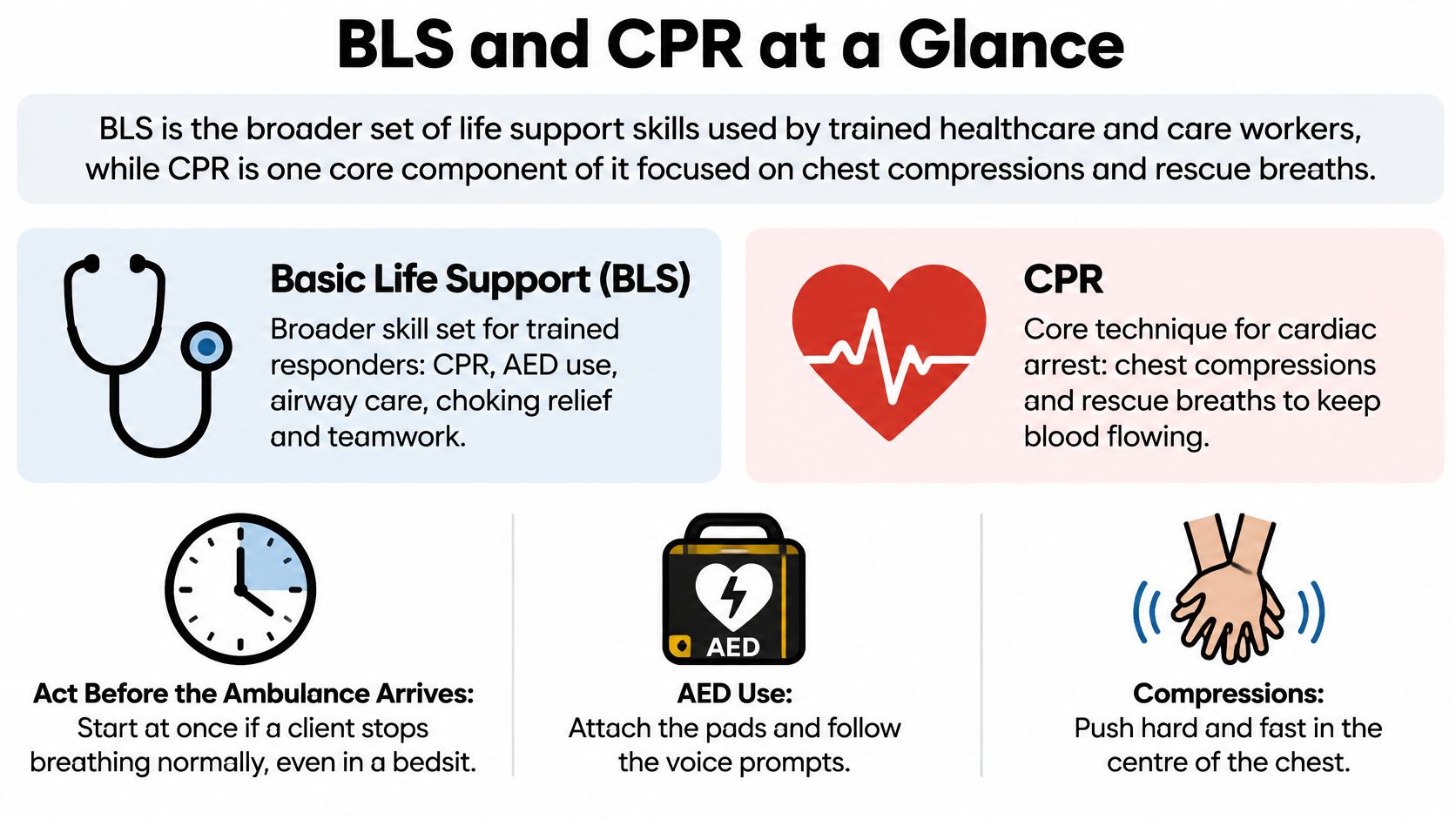
Basic life support (BLS) is the full emergency response to an unresponsive adult, including the 999 call, CPR and AED use; cardiopulmonary resuscitation (CPR) is the chest compression and breathing treatment inside it.
You're on a domiciliary visit in a bedsit when your client becomes unresponsive and stops breathing normally. There's no colleague beside you, the hallway is cramped, and you don't know whether there's a defibrillator nearby. Knowing how to push on the chest matters, but so does knowing what to do before you start, how to summon help and how to keep the response organised.
Table of Contents
- BLS and CPR at a Glance
- Component Demands and the Adult BLS Sequence
- Which Term Applies in Real Care Situations
- Training, Certificates and Refresher Differences
- UK Compliance Duties for Care Workers
- Choose the Course Your Role Needs and Book It
BLS and CPR at a Glance
CPR is a treatment skill. BLS is the response that gets that treatment started and keeps it connected to emergency help. That distinction matters when you're choosing training for a care role rather than learning a useful public first-aid skill.
The Care Certificate Standard 12 on basic life support places resuscitation within a wider response involving recognition, emergency activation and defibrillation. In practice, a worker needs to recognise that something is seriously wrong, act promptly and use the equipment and support available.
BLS and CPR compared on scope and role
| Aspect | Basic life support (BLS) | CPR |
|---|---|---|
| Scope | Full emergency response from recognition to handover | Physical treatment manoeuvre for suspected cardiac arrest |
| Core focus | Sequence of safety, responsiveness, emergency calling, CPR and defibrillation | Chest compressions with rescue breaths where appropriate |
| Place in the emergency | Whole process, including decisions before and after CPR | The treatment step once arrest is recognised |
| Typical learner | Care workers, healthcare assistants and support workers with responsibilities for service users | Members of the public and lay rescuers, also staff within BLS |
| AED role | Built into the sequence whenever an AED is available | May be taught alongside CPR; check the provider's outline |
| Decision it supports | Who acts, in what order, and when to hand over | How to keep blood flowing until help arrives |
The comparison below shows how the treatment sits within the wider response.
Why the course title isn't enough
The phrase basic life support vs CPR can make these sound like competing techniques. They aren't. A learner can perform good compressions on a manikin yet hesitate when asked to recognise abnormal breathing, direct a colleague or introduce an AED without unnecessary delay.
Equally, some courses labelled CPR and AED teach a substantial response sequence. Judge the syllabus and assessment, not just the certificate's heading.
A pass in chest compressions doesn't automatically demonstrate that someone can manage a collapse at work.
For a care worker, the useful question is whether the training covers the decisions their employer expects them to make. The role-matching verdict at the end gives a practical starting point for that choice.
Component Demands and the Adult BLS Sequence
Component demands in CPR-only and BLS training
| Component | What the rescuer does | CPR-only course | Full BLS course |
|---|---|---|---|
| Scene and responsiveness | Check for danger, tap the shoulders and speak loudly | May be brief or assumed | Formal check and clear decision to start the sequence |
| Airway | Open with head tilt and chin lift; remove only clearly visible, readily accessible obstructions | Usually taught as part of breathing assessment or ventilation | Assessed alongside the decision about CPR or recovery position |
| Breathing | Check for normal breathing and recognise gasping as abnormal | Used to decide whether to start compressions | Recognition linked to emergency activation and dispatcher support |
| Circulation | Compress the centre of the chest with correct rate, depth and full recoil | Core practical focus | Same technique, maintained through the response |
| Ventilation | Give rescue breaths if trained and willing; otherwise continue compressions | May be omitted in compression-only instruction | Taught and assessed where included in the rescuer's training |
| AED use | Switch on, attach pads, follow prompts and minimise pauses | Check whether included and assessed | Integrated into the practical response |
These are the standards to look for in a course, not a guarantee that every provider uses the same assessment. Ask what the learner must demonstrate in practice.
The Resuscitation Council UK adult BLS guidelines direct rescuers to call 999 immediately for an unresponsive person, assess breathing with dispatcher support and, when indicated, give compressions at 100–120 per minute, 5–6 cm deep, using 30:2 compressions to breaths if trained and willing. Full chest recoil and minimal interruptions are part of the same standard.
Put the actions in the right order
The following sequence is for an adult with a suspected cardiac arrest. Follow ambulance call-handler instructions, and use the practical training appropriate to your role.
- Check that you can approach safely. Look for immediate hazards such as electricity, smoke, traffic or an aggressive animal. Don't become another casualty, but don't spend time tidying an otherwise safe room.
- Check responsiveness. Speak loudly and gently tap the shoulders. If there's no response, shout for help so anyone nearby knows you need assistance.
- Call the emergency ambulance service immediately. Use speakerphone so you can stay beside the person and follow instructions. If a colleague is present, give them a direct task rather than assuming someone will make the call.
- Assess breathing while connected to the call handler. Open the airway and look, listen and feel for normal breathing without prolonging the check. Occasional gasps, noisy irregular breaths or uncertain breathing in an unresponsive person must not reassure you that they're breathing normally.
- Start CPR if breathing is absent or abnormal. Put the heel of your hand in the centre of the chest, place your other hand on top and keep your shoulders over your hands. Use the compression standard above, allowing the chest to rise fully between pushes; add rescue breaths only if trained and willing.
- Have an AED brought to the person. Send a colleague or bystander if someone is available. If you're alone, tell the call handler and follow their advice rather than abandoning the person to search an unfamiliar building.
- Use the AED as soon as it arrives. Switch it on, expose the chest and attach the pads as shown on their diagrams. Keep everyone clear during analysis and any shock, then resume compressions immediately when prompted, whether or not a shock was advised.
- Continue until there's a valid reason to stop. Professional responders may take over, the person may show clear signs of life and normal breathing, or you may become physically unable to continue. If the scene becomes unsafe, protect yourself and tell the call handler.
If the person is unresponsive but breathing normally, they need emergency assessment, airway protection and continued observation rather than chest compressions. Use the recovery position where appropriate and follow dispatcher instructions. If breathing becomes abnormal, reassess immediately.
Practise the transitions, not just the compressions
Most avoidable hesitation happens between actions. A learner finishes checking responsiveness, looks at the trainer and waits for the next instruction. In a useful assessment, the trainer lets the learner make the decision.
Practise with a phone on speaker, an AED trainer and a manikin in a realistic layout. A cramped bedroom creates different problems from an empty training room: access to the chest, room for the rescuer's knees and a route for arriving ambulance staff all need consideration.
Assessment check: Ask the learner to start from finding an unresponsive person, not from kneeling beside a manikin with their hands already positioned.
Rescue breaths also need practical attention. Use the barrier device taught for your workplace, make a seal and watch for chest rise; don't allow repeated unsuccessful attempts to create a prolonged break in compressions. A care worker shouldn't improvise with equipment they've never been trained to use.
When colleagues are available, assign tasks aloud. Someone can retrieve the AED, another can guide ambulance staff to the room, and another trained rescuer can prepare to relieve the person doing compressions. Avoid leaving everyone watching the same task while another essential action goes undone.
A CPR-only assessment may establish good hand position and compression technique. A BLS assessment should also establish that the learner recognises the emergency, activates help, uses the AED safely and sustains the response through handover.
Which Term Applies in Real Care Situations
A domiciliary visit with no colleague nearby
You arrive at a client's home and find them unresponsive on the kitchen floor. BLS governs the response, because you must make the decisions as well as provide treatment.
Give the call handler the address and access details, assess breathing and act on their instructions. A family member may know about a nearby AED or be able to guide responders, but gathering that information mustn't delay CPR.
A phone is an emergency tool when it keeps you connected to dispatcher support.

A residential home during the night shift
A night worker finds a resident who isn't breathing normally. The worker starts the response while colleagues follow the home's escalation arrangements, bring the AED if available and prepare for ambulance access.
This is BLS in a team setting. Calling a senior colleague is useful, but it mustn't become a permission step that delays emergency help or indicated treatment.
The stakes are substantial: Resuscitation Council UK's executive summary reports approximately 115,000 out-of-hospital cardiac arrests reported to UK ambulance services annually, with resuscitation attempted in about 43,000 cases. Those figures describe the wider emergency system, not just care settings.
Use a demonstration to rehearse how the actions connect, alongside hands-on practice.
An off-duty collapse or a supported-living emergency
An off-duty healthcare assistant sees someone collapse in a supermarket. They should ask staff to summon emergency help and bring the AED while they assess the person and start indicated CPR. Compression-only CPR is appropriate if they aren't trained or willing to give rescue breaths; the shop setting doesn't make the response less urgent.
A supported-living worker may have a non-clinical job description, but shouldn't interpret that as a reason to ignore a collapse. They should use their training, contact emergency services and follow the service's escalation arrangements without attempting procedures outside their competence.
The treatment skills overlap, but workplace responsibilities and available support differ. Review your service's emergency response procedures before a crisis, particularly who calls, who attends and how responders gain entry.
Training, Certificates and Refresher Differences
Training and certificate differences by route
| Factor | CPR-only course | BLS course |
|---|---|---|
| Typical length | Focused session; confirm the provider's timetable | Broader session; allow time for sequence practice and assessment |
| Assessment | Compression technique, breaths where taught and a knowledge check | Should test the full response, including AED integration |
| AED use | Confirm whether practical instruction is included | Should be included and assessed |
| Certificate validity | Check the provider's stated expiry and employer acceptance | Check both provider validity and the employer's refresher requirement |
| Suits | Public preparedness and roles accepting focused CPR training | Care workers and staff with broader response duties |
Course duration isn't a reliable substitute for course content. A shorter session may suit someone refreshing an established skill, while a new worker may need coached practice before they can perform confidently.
Nor should a longer course automatically be treated as adequate. Time spent watching slides doesn't demonstrate that someone can recognise gasping, organise help and use an AED trainer.
Choose the route and assessment separately
Your first decision is what you need to learn. Your next is how you'll demonstrate it.
Online learning can explain recognition, terminology and the response sequence. It can't, by itself, establish your compression depth, physical stamina or ability to achieve chest rise with rescue breaths. If your employer requires observed practical competence, arrange that assessment rather than assuming an online completion certificate replaces it.
Cura Academy's Basic Life Support course is one option for learning the wider response, including CPR, AED use, choking response and recovery-position procedures. Compare its current delivery and assessment arrangements with your employer's requirements, just as you would for an employer-led session or another training provider.
A certificate records what was completed. Your employer still needs to know whether that completion meets the role's practical requirements.
A broader workplace first-aid qualification may also be required for a designated first-aider. Check the distinction using the first aid at work course guide, rather than treating BLS as a replacement for every first-aid responsibility.
Set the refresher date before booking
Certificate expiry and workplace refresher deadlines aren't necessarily the same. An employer can require an update before a provider's certificate expires.
Ask your manager or agency which deadline they use, whether they accept the delivery format and whether an observed skills check is required. Keep their answer with your training record so a later compliance check doesn't turn into a dispute over course titles.
Before paying, check the syllabus for AED practice, adult resuscitation, the assessment method and certificate conditions. If your service supports children or infants, confirm that the course and assessment also cover those groups rather than assuming adult BLS is enough.
UK Compliance Duties for Care Workers
A care worker's compliance involves more than holding a document with an expiry date. The employer needs appropriate emergency arrangements, the worker needs training suited to their duties, and both need a workable plan for the actual setting.
Start induction by asking what your service requires, who signs off competence and where the emergency policy is kept. New workers completing the Care Certificate should also check how basic life support learning connects to workplace assessment and local procedures.
Turn the requirement into a workplace check
Employers must arrange appropriate workplace first-aid provision, but don't assume that every service must buy an AED or accept the same certificate. Ask the manager to explain the provision made for staff and service users, and what you're expected to do within it.
Inspection readiness means staff can describe and demonstrate the arrangements, not just produce training records. In England, CQC is the relevant care regulator; Wales, Scotland and Northern Ireland have their own care regulators, and first-aid rules also need checking for the nation concerned. Confirm which regulator and rules apply to your service before deciding what counts as compliant training.
The Resuscitation Council UK epidemiology guidelines report that AED use remains below 10% in the UK evidence summary. That finding doesn't establish what equipment your workplace must hold, but it reinforces why compression training alone cannot resolve every weakness in emergency readiness.
Check what will happen on your shift
Use induction to make the response practical:
- Equipment access: Locate the AED if one is provided, check how to reach it and report inaccessible or missing equipment.
- Help and entry: Identify how to summon colleagues and how ambulance staff will enter a locked building.
- Care-plan information: Know where relevant emergency treatment plans are held and how to communicate them without delaying urgent help.
- Training records: Store your completion evidence, assessment record and agreed refresher date where the manager can retrieve them.
For domiciliary care, check lone-worker arrangements, phone reception and the escalation contact before accepting unfamiliar visits. Don't treat the absence of an on-site AED as a reason to delay calling or starting CPR.
Use the service's mandatory training in health and social care requirements to organise the paperwork, then confirm the practical arrangements with your manager. Compliance needs both evidence of training and a response staff can carry out.
Choose the Course Your Role Needs and Book It
If responding to a collapse is part of your duties, choose BLS training that meets your employer's practical assessment requirements. For public preparedness, a CPR and AED course is usually a suitable starting point; a non-clinical job title alone doesn't determine what workplace training you need.
Course needed by role and setting
| Role or setting | Likely course | AED expectation | Refresher check |
|---|---|---|---|
| Residential care worker | BLS | Know the device location and follow local policy | Confirm the employer's deadline |
| Domiciliary carer working alone | BLS | Establish available access and the escalation route | Confirm with the employer or agency |
| Healthcare assistant on a ward | BLS matched to trust requirements | Use local emergency equipment within training and protocol | Follow trust policy |
| Support worker in supported living | BLS or CPR and AED, as specified by the employer | Confirm local response responsibilities | Follow employer policy |
| Member of the public or lay rescuer | CPR and AED | Use an available AED and follow its prompts | Arrange an update when skills or confidence need refreshing |
For agency and bank workers, check acceptance before purchasing another course. The agency may hold your certificate, but the placement provider can still require local induction, equipment familiarisation or a practical assessment.
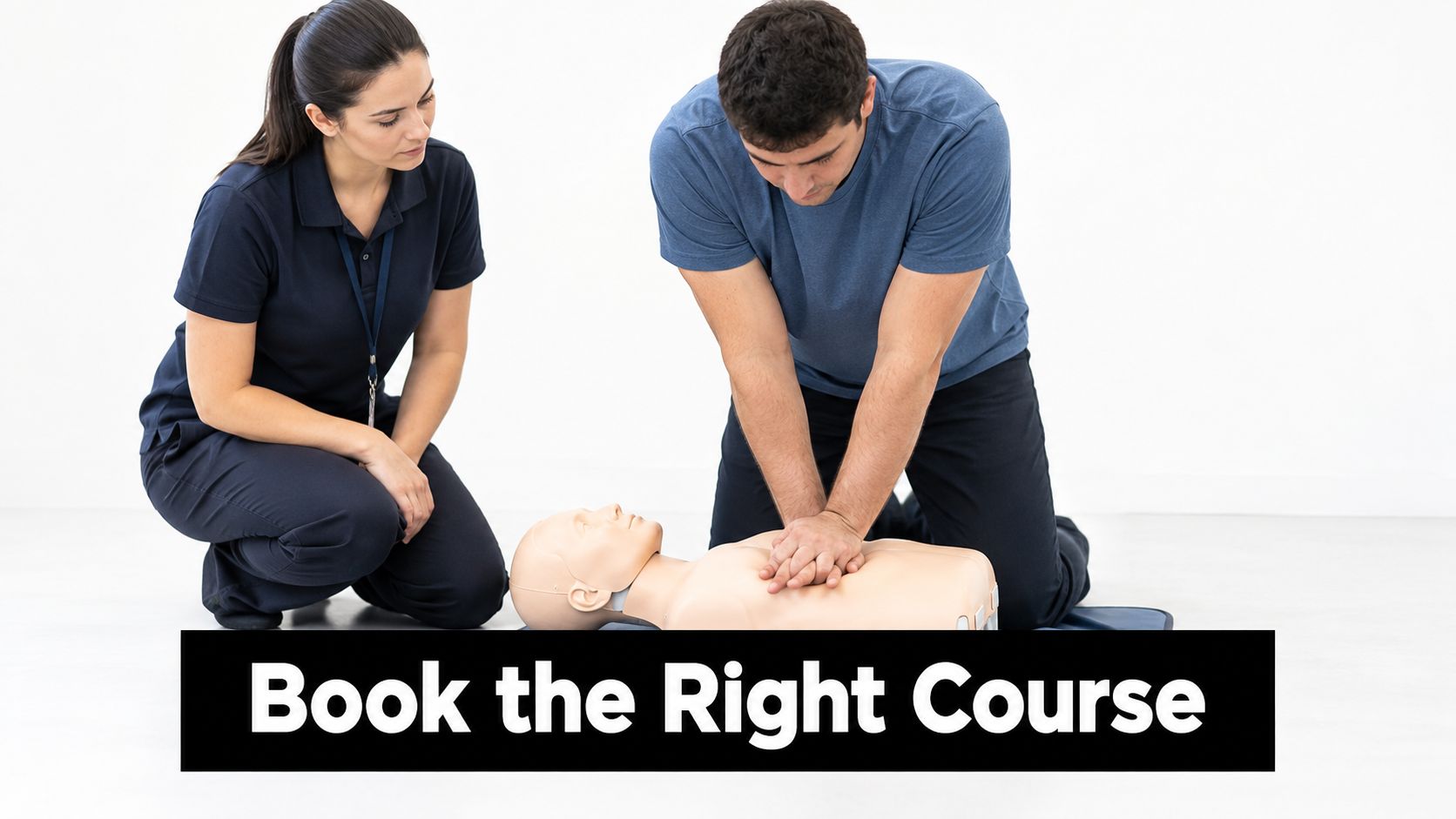
Look for training that includes feedback on your technique, not just an opportunity to copy a demonstration.
Make the booking useful
- Confirm your role's requirement. Ask your employer or agency for the accepted course scope, delivery format and assessment method.
- Check the course outline. Look for AED coverage, realistic scenario practice, certificate conditions and any additional workplace assessment.
- Book the appropriate route. Choose full BLS for broader response duties, or CPR and AED where your role's requirements allow it.
- Record the follow-up. Store your certificate and assessment evidence, diarise the agreed refresher date and complete local induction.
Don't choose solely on price or the fastest completion time. A convenient course is useful only if the employer accepts it and you can perform the required actions afterwards.
The right course establishes a foundation; rehearsal makes that foundation usable. Keep practising the sequence, know how to summon help and make sure you can find the emergency equipment on the shift you're working.
Cura Academy offers Basic Life Support training covering CPR, AED use and the wider response care workers need to understand. Visit Cura Academy to review the course content and compare it with your employer's training and assessment requirements before booking.