
A resident is on the floor before the morning handover. One colleague is looking for the senior. Another is reaching for the hoist. Nobody has confirmed who's calling for help, and the resident can't explain what happened.
That's where emergency response procedures need to work: with incomplete information, limited staff and someone who may not understand instructions. A useful procedure tells you what to do immediately, who owns each task and how to keep providing care when the ambulance hasn't arrived.
Table of Contents
- First Actions for Common Incidents at a Glance
- How to Run the First Two Minutes Step by Step
- Who Does What and When to Escalate
- CPR, Choking and Seizure Procedures for Life-Threatening Moments
- Holding the Scene When the Ambulance Is Delayed
- Fire, Aggression, Falls and Missing Person Procedures
- Record, Report and Review Before the Shift Ends
First Actions for Common Incidents at a Glance
Choking at the dining table. A fall in the bathroom. A resident missing at dusk. Each needs a different first action, and the right one has to be obvious before anyone reaches for the care plan.
Keep a quick reference at the nurses' station and in the staff handbook. For domiciliary workers, make it available offline rather than behind an office login.
First actions and 999 triggers by incident
| Incident | First action in the opening minute | Call 999 when | Tell next | Record |
|---|---|---|---|---|
| Fall | Check responsiveness and injury. Don't lift if head, neck or hip injury is possible. Keep warm. | Unresponsive, head injury with drowsiness or vomiting, suspected hip fracture, or uncontrolled bleeding | Senior on shift | Time found, last known well, observations |
| Choking | Encourage effective coughing. For ineffective coughing, give back blows followed by abdominal thrusts, within training. | Coughing is ineffective or the airway remains obstructed. Have someone call while treatment starts. | Senior immediately | Onset, actions, outcome |
| Seizure | Protect the head, time the seizure and clear hard objects. Don't restrain. | First seizure, prolonged seizure, repeated seizures without recovery, serious injury or breathing difficulty; follow any individual emergency plan | Senior, then relevant clinician and family | Start and finish, movements, recovery |
| Fire | Raise the alarm, close doors if safe and follow the evacuation plan. | Any fire or smoke, even if it appears extinguished | Senior, who confirms the call | People accounted for and anyone still inside |
| Physical aggression | Keep distance, clear others away and summon support. | A weapon, serious injury or immediate danger makes the situation unsafe | Senior; police as appropriate | Behaviour, preceding events, actions, injuries |
| Missing person | Establish last-seen details and organise a safe search without leaving others unsupported. | Immediate danger arises from vulnerability, medical needs, weather or location | Senior, police and family | Description, clothing, photograph, last-seen details |
| Unresponsive or suspected cardiac arrest | Call on speakerphone, assess breathing as directed, begin CPR if breathing is abnormal or absent, and send for the AED. | Immediately | Senior, then family under the care plan | Collapse, CPR, AED use and instructions |
Don't wait for certainty
The trigger column is where hesitation causes trouble. Staff shouldn't need a manager's permission to recognise an emergency.
In England, ambulance incidents are classified by clinical urgency. NHS England's April 2024 Ambulance Quality Indicators recorded a mean Category 1 response of 8 minutes 10 seconds, against an average target of 7 minutes, for immediately life-threatening incidents. A quick answer on the phone still leaves a gap before a responder reaches the bedside, and less urgent calls wait far longer. The first actions in the table are the care the resident gets during that whole wait, including when they cannot explain what happened or follow instructions.
Check first aid supplies against the same standard. Whatever the supplier, from a local stockist to a catalogue like Material Handling USA first aid kits, contents should match your UK service's risk assessment and the competence of the staff who will use them.
Print the table, test it against your policy and agree local additions with the manager before it goes on the wall.
How to Run the First Two Minutes Step by Step
Use a rehearsed opening routine, not a search through a policy folder. The sequence must still work when a resident cannot answer questions or follow instructions.
This visual is a rehearsal aid. During an incident, follow the emergency call handler's directions.
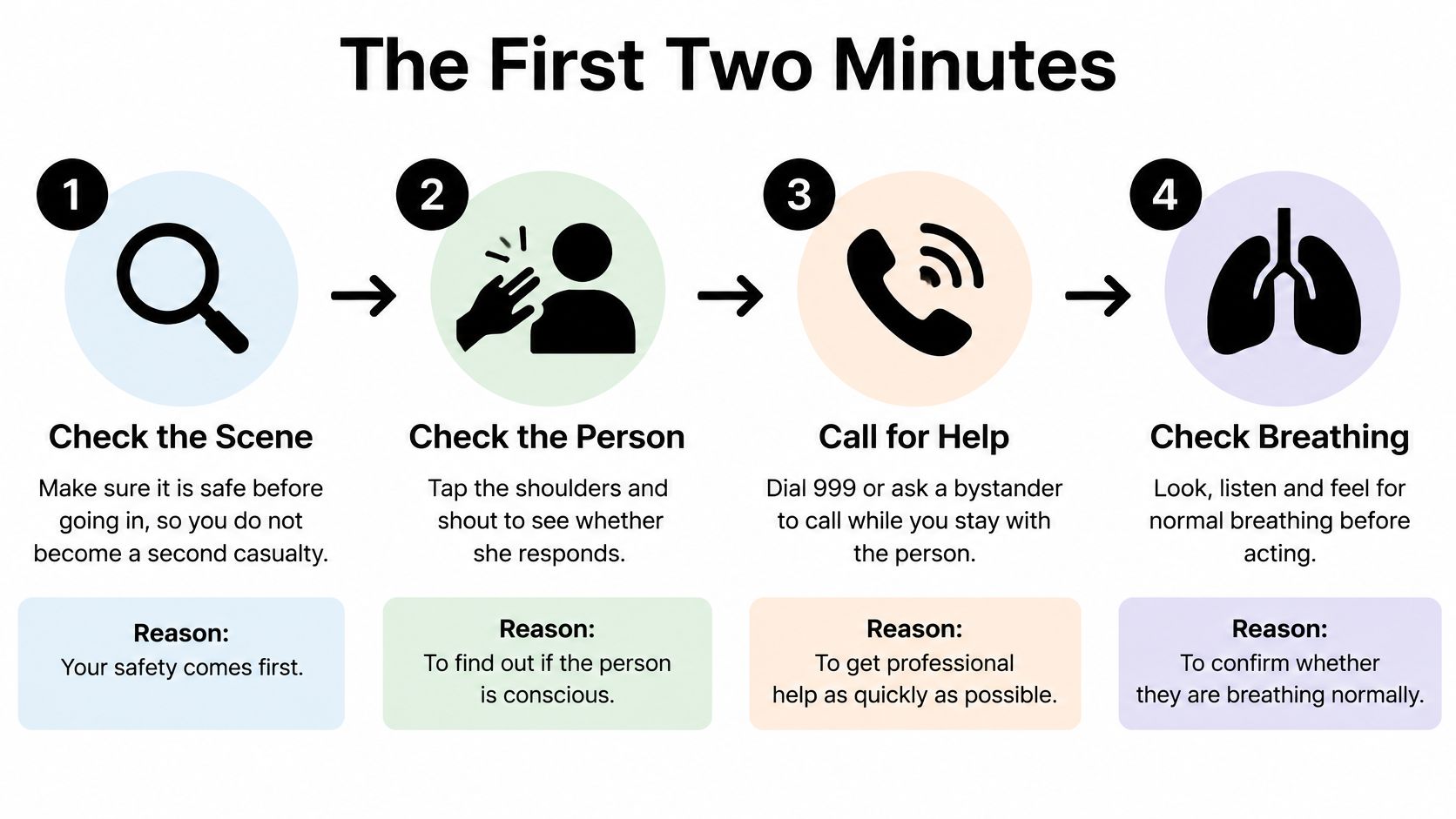
Use a routine you can say aloud
- Check the scene. Look for smoke, electricity, broken glass, traffic or an aggressive person before approaching. Don't become another casualty by rushing into an unsafe space.
- Check responsiveness. Speak clearly and gently tap the shoulders. If the person doesn't respond, call for emergency help immediately and assess breathing as the dispatcher directs; gasping isn't normal breathing.
- Give someone a named task. Say, “Amira, bring the emergency phone,” rather than shouting for somebody to help. Ask for confirmation so you know the instruction was heard.
- Make the emergency call. Give the address and access details first, then describe consciousness, breathing, bleeding and what happened. Use speakerphone where possible, and don't delay while searching for a charger or a different handset.
- Name the response leader. The leader coordinates actions and makes sure information reaches the caller. This isn't necessarily the most senior person employed by the service; it's the appropriate person available at the scene.
- Start the relevant first aid. Don't let gathering equipment interrupt an action you can already provide. Don't move a fallen person just to make assessment easier.
- Capture action times. Use paper or an approved secure device when someone is free to record. Life-saving treatment comes before typing, and estimated times must be marked as estimates.
- State the reassessment arrangement. Name who's watching the person and agree review prompts under the local protocol and dispatcher's advice. Continuous observation is necessary when someone is unstable; a scheduled prompt must never become permission to look away.
Practical rule: Give an instruction, name its owner and get an acknowledgement.
Check whether the routine worked
By the end of the opening response, someone should be caring for the person, emergency communication should be established where required, and important times should be captured when staffing allows.
For a lone worker, those tasks overlap. Stay with the person, use speakerphone and explain the staffing limitation to the dispatcher. A neat record isn't worth interrupting essential care.
Who Does What and When to Escalate
Role allocation by staffing situation
| Staffing situation | Leads the response | Calls 999 | Keeps the record | Tells next |
|---|---|---|---|---|
| Lone worker on a home visit | Worker on scene | Worker, using speakerphone where possible | Worker when safe; complete promptly afterwards | Office or on-call manager |
| Two staff on a residential shift | Most senior competent person present | Colleague while leader provides care | Colleague when the call and care allow | Shift manager and family under the plan |
| Full team with on-call manager | Shift lead or senior nurse | Designated caller near the patient | Assigned record keeper | On-call manager and relevant contacts |
| Night shift with senior off site | Most experienced competent worker present | Available worker, without waiting for the senior | Colleague if available | On-call manager and relevant clinician |
Escalation isn't a permission chain
The worker on scene starts care and alerts the senior. The senior brings in the on-call manager for staffing, operational decisions and support.
Use the GP or NHS 111 for clinical advice when the situation isn't immediately life-threatening. Call 999 directly for an emergency. Don't work through the management ladder before making that call.
Describe what you can observe. “She's making occasional gasps and isn't responding” is more useful than “She's Category 1.” The call handler determines priority, and staff must report changes rather than assign their own category.
The need for sustained responsibility is clear: NHS England's October 2025 ambulance indicators recorded an England Category 2 average response of 32 minutes 37 seconds, while Category 3 averaged 2 hours 4 minutes 1 second. Completing the emergency call doesn't end the care worker's responsibility.
Allocate functions, not imaginary extra staff
Once help is requested, cover these functions:
- Patient support: Someone remains responsible for observation and care.
- Crew access: Someone arranges entry, clears the route and directs responders.
- Timed recording: Someone preserves the sequence of events and instructions.
A lone worker cannot stand at the front door and remain beside an unstable patient. Tell dispatch about access barriers and ask the office to arrange support.
For providers reviewing digital alerts, 3rd-i's resource on understanding safety app dispatch workflows can help frame questions about acknowledgement and escalation. An app notification must never be assumed to mean an emergency service has been contacted.
Write role holders' names on the shift sheet. Make reassignment explicit when someone leaves, goes on a break or hands over.
CPR, Choking and Seizure Procedures for Life-Threatening Moments
The emergency call is underway. The adult is unresponsive and isn't breathing normally. Begin CPR rather than waiting for equipment or a colleague with more experience.
Use practical training to rehearse hand position and body posture.
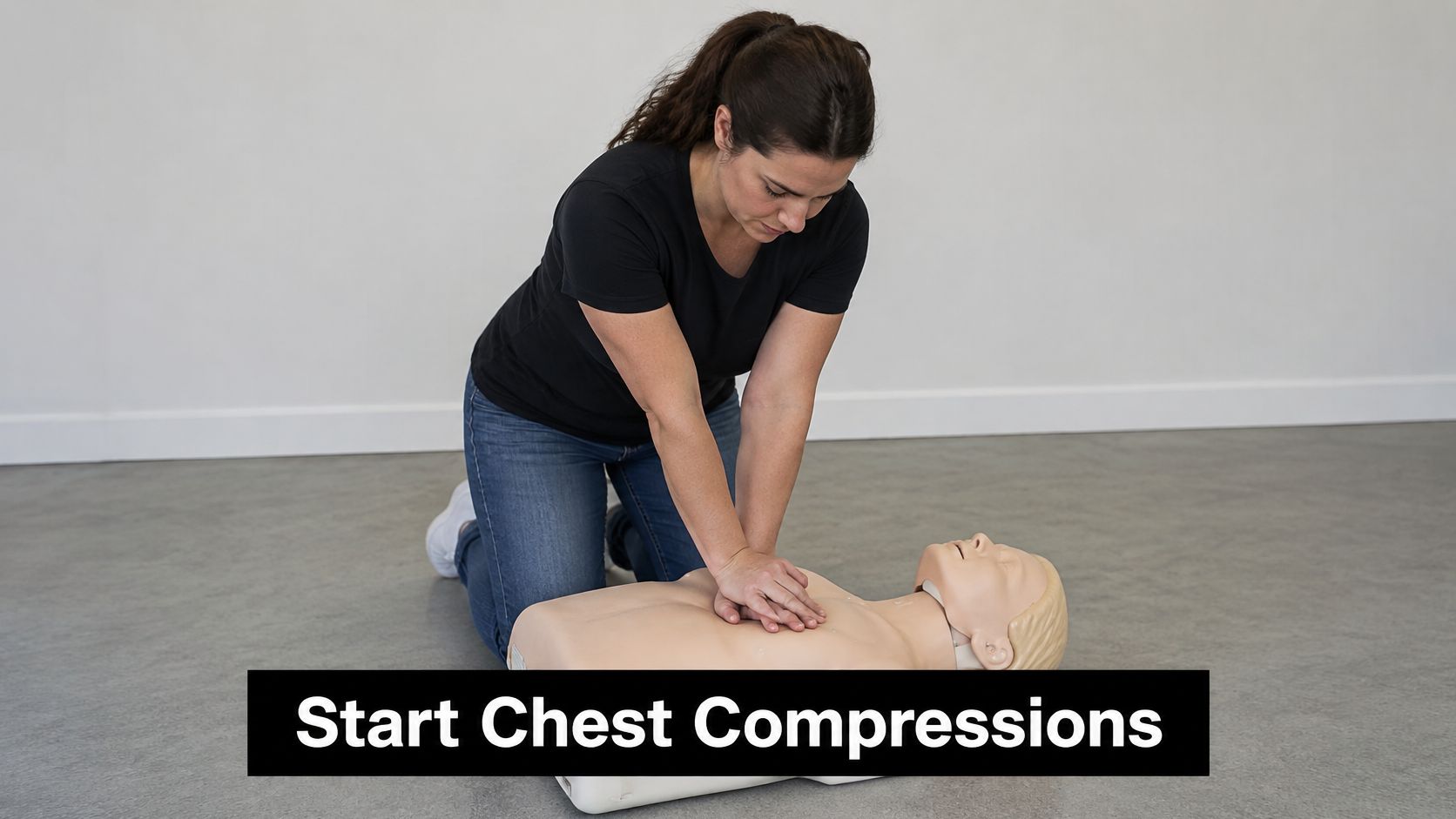
CPR and AED use
The Resuscitation Council UK executive summary specifies adult compressions at 100–120 per minute, to a depth of 5–6 cm, with full recoil and minimal interruption, and a 30:2 compression-to-breath ratio when rescue breaths can be given.
Place your hands in the centre of the chest, on the lower half of the breastbone. Keep your arms straight and allow the chest to rise fully between compressions. If you aren't trained or can't give rescue breaths, provide compression-only CPR and follow the dispatcher.
Send another person for the AED. Switch it on, expose the chest and follow the prompts. If a colleague is available, they can attach pads while compressions continue.
Nobody should touch the person during rhythm analysis or a shock. Resume compressions promptly when instructed. Don't pause repeatedly to check whether CPR has worked; follow the dispatcher and AED, and report clear signs of recovery.
If another capable rescuer is available, arrange a change before fatigue ruins compression quality. Make the change quickly and keep someone responsible for listening to the device.
A valid, applicable advance decision or emergency care plan may affect treatment. Know where those records are kept, communicate their contents to the dispatcher and don't assume that a decision about CPR rules out other emergency care.
For preparation between shifts, use the basic life support guidelines alongside practical assessment. Reading alone won't establish whether your compressions are effective.
Use the video as a training aid, not something to watch during an emergency.
Choking when the person can't cooperate
An effective cough is useful. Encourage it and watch closely. Don't give food or drink, and don't put your fingers blindly into the mouth.
If coughing becomes ineffective, act using your choking training. Give back blows, then abdominal thrusts if the obstruction remains, checking for clearance after each action. Use the appropriate alternative technique where abdominal thrusts aren't suitable.
A frightened person with dementia may push you away. Use a brief explanation and a familiar voice if available, but don't mistake distress for effective breathing.
If the person becomes unresponsive, lower them safely and begin CPR as directed. Arrange clinical assessment after thrusts because injury or retained material may need attention.
Seizures need protection, not force
Clear nearby hazards, cushion the head and time the movements. Don't hold the person down or put anything in their mouth.
After the movements stop, check breathing. If they're breathing normally, use the recovery position where appropriate and continue watching them. If breathing isn't normal, follow the cardiac-arrest response.
Follow any prescribed seizure plan. Rescue medication should only be given by someone trained and authorised, using that person's prescription and protocol.
Record recovery as carefully as the seizure itself. New weakness, persistent confusion or breathing difficulty needs urgent escalation.
Holding the Scene When the Ambulance Is Delayed
Recent ambulance performance in England
| Ambulance category | Recent England performance | What it means for your plan |
|---|---|---|
| Category 1, immediately life-threatening | The reported average exceeded the national average target | Treatment must continue while responders travel |
| Category 2, emergency | The reported average requires sustained interim care, not just an initial response | Arrange observation, staff relief and accessible records |
| Category 3, urgent | The reported average extends beyond a short incident response | Plan comfort, staffing and clinician-directed interim care |
Across England in the 2024/25 financial year, the mean ambulance response time was 35 minutes 22 seconds, compared with a 30-minute target, according to NHS England's performance report. That aggregate figure isn't a prediction for an individual patient, but it supports planning for a sustained wait.
An average is not an arrival promise. A percentile measure describes a point in the distribution, not the longest possible wait.
Keep observation active
Set reassessment prompts in the local protocol, adjusted to the person's condition and ambulance instructions. Record consciousness, breathing, pain, bleeding and any observations staff are trained to take.
Call 999 again if the person deteriorates, develops new symptoms or the situation becomes unsafe. Give the incident reference if available and describe the change. Don't repeatedly call only to chase an arrival estimate while leaving the person unobserved.
Gather the medication administration record, care plan, communication passport and relevant advance decisions. Tell the named contact what has happened, what staff have done and what remains uncertain.
Waiting is still a phase of care. It needs an owner, observations and a plan for deterioration.
Make the procedure usable for this person
The UK government's emergency vulnerability guidance update calls for a common, multi-agency approach to identifying and supporting vulnerable individuals and groups. Turn that into adjustments staff can deliver in practice.
- Dementia: Keep a familiar worker nearby and reduce competing voices. Put the person's preferred reassurance phrases in the emergency information.
- Hearing or sight loss: Find their hearing aids or glasses and explain before touching them. Keep communication aids accessible.
- Language barriers: Request interpreting support and use short, concrete statements. Don't assume a nod means understanding.
- Wandering or distress: Use calm accompaniment and a safer supervised space. Don't improvise restraint or lock someone in; seek support and document decisions.
Give a structured handover
Tell the crew the person's name and age, onset or collapse time, latest observations, actions with times, medicines and last doses, allergies, and relevant advance decisions.
Put the documents together in a clearly labelled envelope or approved transfer pack. Confirm which crew member receives them and record that handover.
Fire, Aggression, Falls and Missing Person Procedures
These incidents need different responses. Treating every emergency as a first-aid problem can send staff towards danger or delay the right service.
Fire
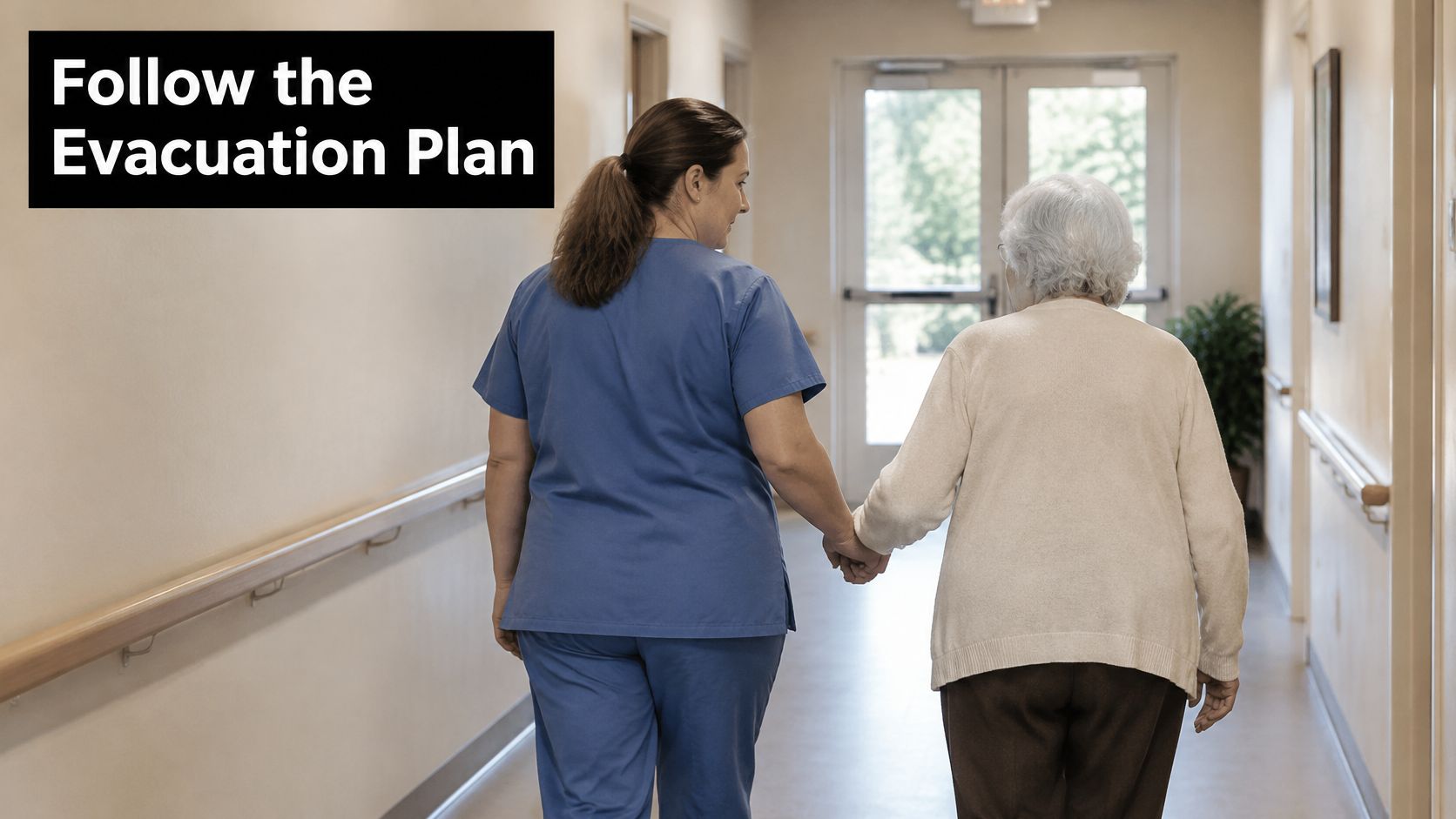
Raise the alarm and follow the building's evacuation strategy. Close doors behind you where safe, and don't enter smoke to retrieve belongings or paperwork.
Each person who needs assistance should have a usable personal emergency evacuation plan. It must identify the route, equipment and trained assistance required, not just say that staff will help.
Use evacuation chairs, sheets or other equipment only as assessed and trained. Don't improvise a carry or use an ordinary lift during a fire. Follow the specific plan for any designated evacuation lift.
At the assembly point or designated safe area, reconcile the resident, visitor and staff lists. Tell firefighters exactly who may remain inside and their last known location. Nobody re-enters to check.
Physical aggression
Stand where you have an exit. Keep your hands visible, lower your voice and use short sentences. Offer a manageable choice rather than several demands.
Move other residents away and reduce noise. Check whether pain, fear, personal care, hunger or misunderstanding may be contributing, without allowing that assessment to delay help when danger is immediate.
Use de-escalation techniques as a rehearsed team skill. Any restrictive intervention needs an appropriate legal basis, trained staff and the least restrictive safe approach.
Record observable behaviour rather than labels. Write that the person struck a door and threatened a colleague, not that they were difficult.
Calm accompaniment can help someone move away from a distressing environment.
Falls
Don't begin with the hoist. Establish responsiveness, breathing, pain, bleeding and possible injury before deciding whether movement is safe.
Ask about head impact, and check whether the person takes anticoagulant medication. A head injury needs prompt clinical advice even when external injury looks minor. Escalate immediately if consciousness or breathing changes.
Keep the person warm and preserve dignity. Use assessed lifting equipment only when injury has been considered and staff can follow the moving-and-handling plan. Record the position found and the person's own account.
Missing person
Allocate search areas and keep someone responsible for residents who remain. Check exits, grounds and usual destinations without sending lone staff into unsafe locations.
Contact police promptly when vulnerability or circumstances create risk. Don't wait for a routine search to finish if immediate danger is plausible.
Prepare the person's description, current clothing, recent photograph, medical needs and last-seen information. Log search areas, callers and instructions so arriving colleagues don't repeat checks while leaving another area unsearched.
Record, Report and Review Before the Shift Ends
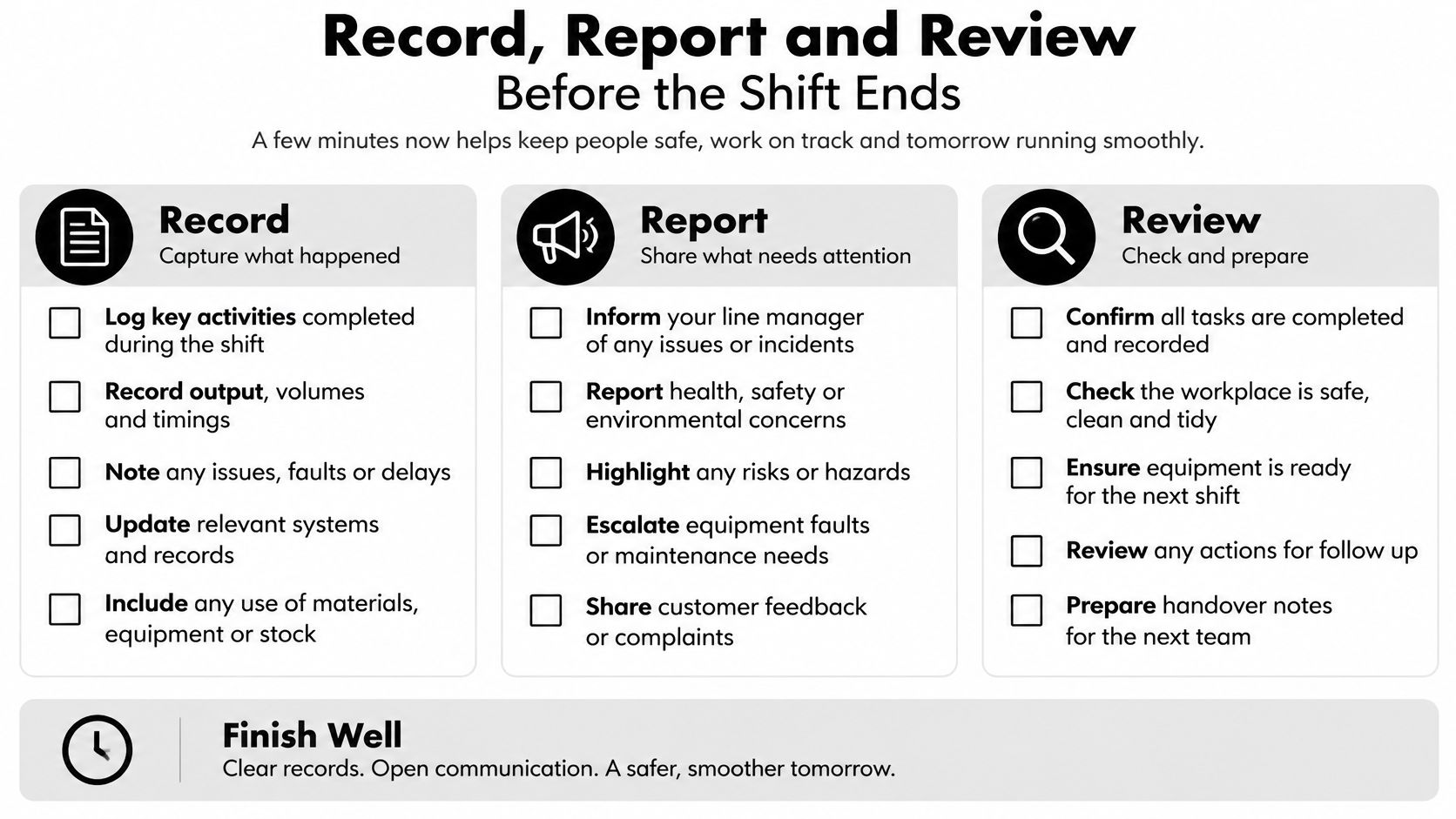
Before leaving, ask: Could the next worker understand what happened without asking me? If the answer is no, the record needs attention.
Write factual, timed entries while events are fresh. Record who was present, what staff observed, what the person said, advice received and who accepted responsibility at handover. When an ambulance is delayed, log each update separately: the time you called, the category given, any recategorisation, and every change in the person's condition during the wait. A Category 3 call can run past two hours, and the notes made across that wait matter as much as the first entry.
Distinguish observations from assumptions. Record that someone was found beside the bed, not that they fell out of bed unless that was witnessed. Note what the person could do in the moment, whether they understood instructions, moved on command, or stayed where staff left them. Preserve original entries and make corrections through the approved audit process.
Separate the reporting decisions
An internal incident form doesn't automatically complete every reporting duty. The manager must decide which external routes apply and document that decision.
- Internal reporting: Complete the incident record during the shift where practicable, inform the manager and hand over unfinished actions explicitly.
- Regulator notifications: Check current CQC requirements for the service and incident. Don't assume the ambulance crew or hospital will notify on the provider's behalf.
- Work-related injury reporting: Assess whether the event falls within RIDDOR reporting requirements. Not every injury or hospital attendance is reportable.
- Safeguarding: Escalate suspected abuse or neglect through the local safeguarding procedure. Keep immediate protection separate from later investigation.
- Candour: Be open with the person and relevant representative. The manager should assess whether the statutory duty applies rather than relying on an informal description of harm.
- Retention and confidentiality: Store records under the organisation's retention policy and restrict access appropriately. Don't keep resident information on personal messaging apps.
Use the incident reporting procedures resource to prepare staff for the information they'll need to capture.
Keep the closing checks visible at handover.
Review the failure point
Hold a prompt review once immediate care is secure. Ask what happened, what helped, what the procedure missed and who will make each change.
Test the incident against the actual timeline. If the ambulance ran long, does the record show who monitored the person and how often? If the person couldn't follow instructions, does the procedure account for that, or does it assume a resident who can answer questions and move on request?
Include maintenance staff and visiting contractors where they were involved. General safety guidance for contractors and operators can prompt questions about site hazards, access and responsibility, while the care-specific decisions sit with your own procedures.
A review is unfinished until someone owns the change and staff know what they must do differently.
Check the training matrix for Basic Life Support and dementia awareness. Confirm practical competence, not just course completion, and rehearse a scenario where the usual senior is absent and the person cannot follow instructions.
Cura Academy offers Basic Life Support and Dementia Awareness training to support preparation for these situations. Visit Cura Academy to choose relevant learning for your role, then agree with your manager how you'll practise it alongside local emergency procedures.