
You're on a late shift, the rota's already messy, and a new starter is sitting at a laptop staring at a long list of e-learning tiles. Safeguarding. Fire safety. Infection control. Moving and handling. Information governance. Then the inbox pings with another reminder, and nobody has told them what matters first.
That's the problem with mandatory training in health and social care. It looks like an endless admin chore when it should be treated as a compliance map. The list becomes manageable once you separate what is statutory, what is employer mandatory, and what is role-specific competence tied to safe practice and inspection evidence, as Skills for Care sets out in its guidance on statutory and mandatory training (Skills for Care).
The Care Certificate gives new starters a structured baseline, and Skills for Health now describes the revised version as 16 standards that must all be completed before a certificate is awarded (Skills for Health). That matters because good providers don't throw random modules at people. They build a defined pathway around competencies, evidence, and supervision, then they keep it tight enough that a manager can check it.
Practical rule: if a module protects people from immediate harm, supports a legal duty, or gates a shift, it isn't optional noise. It goes near the top of the list.
Table of Contents
- Why Mandatory Training Feels Overwhelming and What It Really Is
- The Core Modules Every UK Care Worker Should Expect
- The Oliver McGowan Duty and What Appropriate to Role Means
- How Training Maps to the Care Certificate's 16 Standards
- The 2025 NHS England Portability Reform and Why It Matters
- Which Modules You Actually Need by Role
- Completing and Prioritising Training Without Burning Out
- Turning Training Into Shifts and a Compliance File That Sticks
Why Mandatory Training Feels Overwhelming and What It Really Is
A new carer's first week often feels like punishment by spreadsheet. They've barely learned the layout of the building, yet they're expected to complete a stack of modules before they've even found the medication room or the mop cupboard. That panic is understandable, but it's also a sign the training has been presented badly.
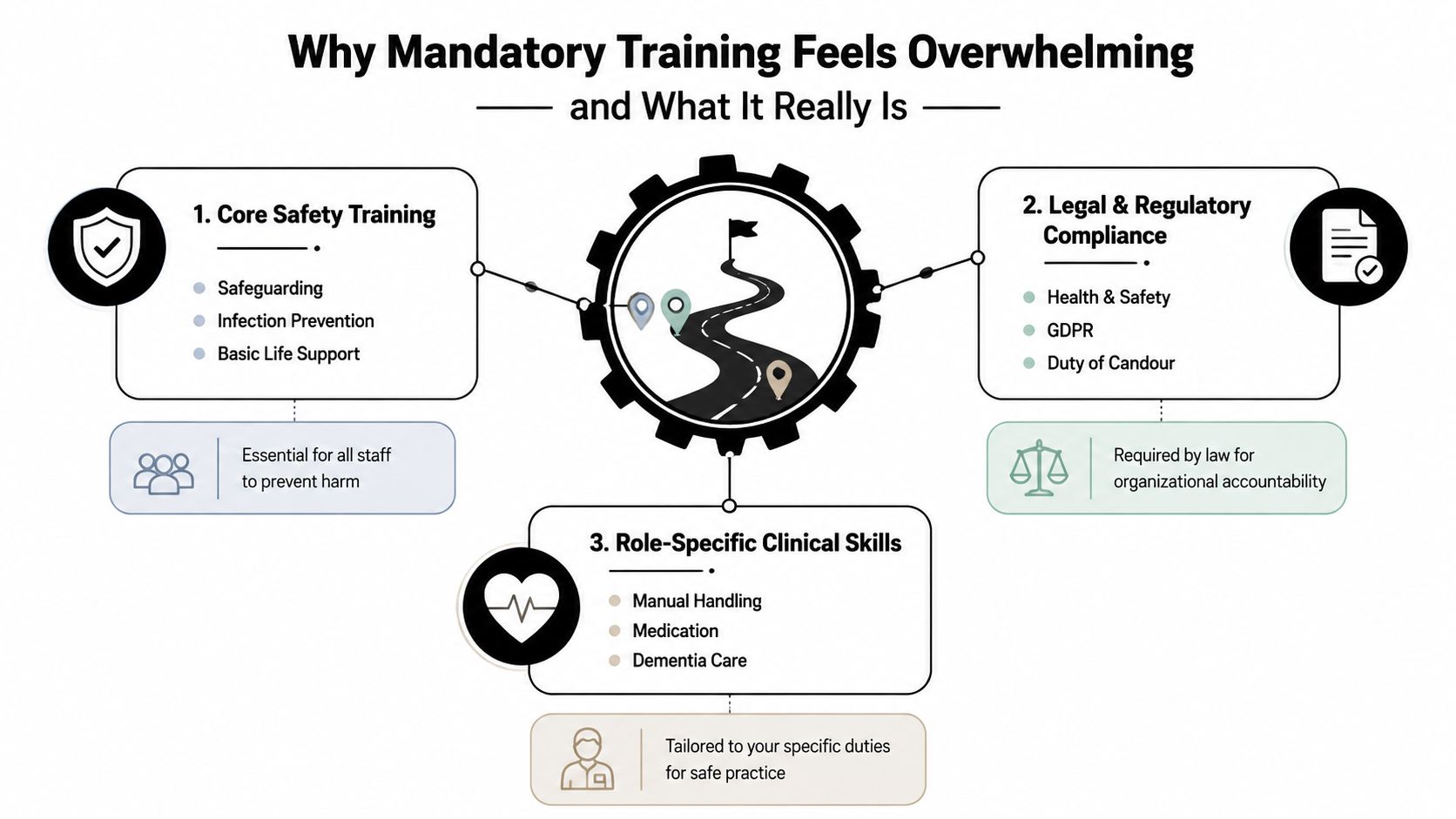
The fix is to stop treating the list as a random library and start reading it as a compliance structure. Skills for Care draws a useful line between statutory training, which is required by law, and mandatory training, which is required by the organisation or commissioners to reduce risk and meet policy requirements (Skills for Care). In practice, most providers mix both inside one training matrix, so the worker sees one long checklist even though the drivers behind it are different.
Three layers sit underneath the checklist
The first layer is law. That includes duties linked to safety, equality, mental capacity, safeguarding, and data handling. The second layer is regulation, where CQC expectations and the Fundamental Standards push providers to show staff are trained, supervised, and competent, not just signed in on a course sheet. The third layer is employer policy, where a care home, GP surgery, domiciliary service, or hospital adds topics based on its own risks and the people it supports.
The purpose of each module is usually plain once you strip away the jargon. Fire safety reduces burn risk and evacuation failure. Manual handling reduces avoidable injury. Safeguarding protects the person receiving care and protects the worker who has to recognise abuse early. Infection prevention stops bad habits turning into outbreaks.
The big mistake is to treat induction, mandatory training, and refresher training as the same thing. They're not. Induction gets a new starter safe enough to begin. Mandatory training covers the organisation's required baseline. Refresher training keeps the knowledge current when risks change or certificates expire.
If you're new, don't ask, “How do I get through all of this?” Ask, “Which modules make me safe to work, which ones are legally required, and which ones does my employer need for this specific role?” That question cuts through the noise fast.
The Core Modules Every UK Care Worker Should Expect
A new starter walks in on day one and gets handed a training list that looks copied from three different services. That is the usual problem. The right way to read core training is simple, statutory items come from law or regulation, while mandatory items come from the provider's duty to run a safe service. Skills for Care's definition keeps that distinction clear and stops people pretending every course carries the same legal weight.
The essential modules for every care worker
Every care worker should expect health and safety, fire safety, manual handling, infection prevention and control, and safeguarding adults. In some services, safeguarding children and young people also matters. Equality, diversity and human rights, information governance and data protection, and Mental Capacity Act awareness are standard in most settings, because staff handle risk, decisions, and personal information from the start.
Other common modules are medication awareness, first aid awareness, food hygiene, lone working and personal safety, and conflict resolution or breakaway. Some of these come directly from law or regulation, others from the provider's risk assessment and the actual work. A copied training matrix is weak practice. A good one matches the role, the setting, and the people supported.
| Module | Legal or Regulatory Driver | Statutory or Employer Mandatory |
|---|---|---|
| Health and safety | Health and safety duties, CQC expectations | Statutory and employer mandatory |
| Fire safety | Fire safety law and local procedures | Statutory and employer mandatory |
| Manual handling and back care | Safe working duties and injury prevention | Statutory and employer mandatory |
| Infection prevention and control | IPC code expectations and service risk | Statutory and employer mandatory |
| Safeguarding adults at risk | Care Act duties and safeguarding policy | Statutory and employer mandatory |
| Safeguarding children and young people | Local safeguarding duties where relevant | Employer mandatory, role dependent |
| Mental Capacity Act and DoLS awareness | Legal framework for decision-making and liberty | Statutory and employer mandatory |
| Equality, diversity and human rights | Equality law and inclusive practice | Statutory and employer mandatory |
| Information governance and data protection | UK GDPR and organisational policy | Statutory and employer mandatory |
| Medication awareness | Safe medicines support and provider policy | Employer mandatory, often role based |
| First aid awareness | Emergency response and workplace readiness | Employer mandatory, role dependent |
| Food hygiene | Safe food handling duties | Employer mandatory, role dependent |
| Lone working and personal safety | Risk control for community and unsupported work | Employer mandatory, role dependent |
| Conflict resolution and breakaway | Workplace violence and personal safety controls | Employer mandatory, role dependent |
Some modules are useful without being part of every baseline list. Dementia awareness and end-of-life care belong in many services, especially where staff support people with complex needs or changing capacity. They matter. They should not push out the training that keeps people safe on shift one.
For employers trying to shape a role-based curriculum, the core skills training framework gives a clearer structure than a bloated one-size-fits-all list. Use it to separate universal training from modules that only make sense for a specific setting or job family.
The Oliver McGowan Duty and What Appropriate to Role Means
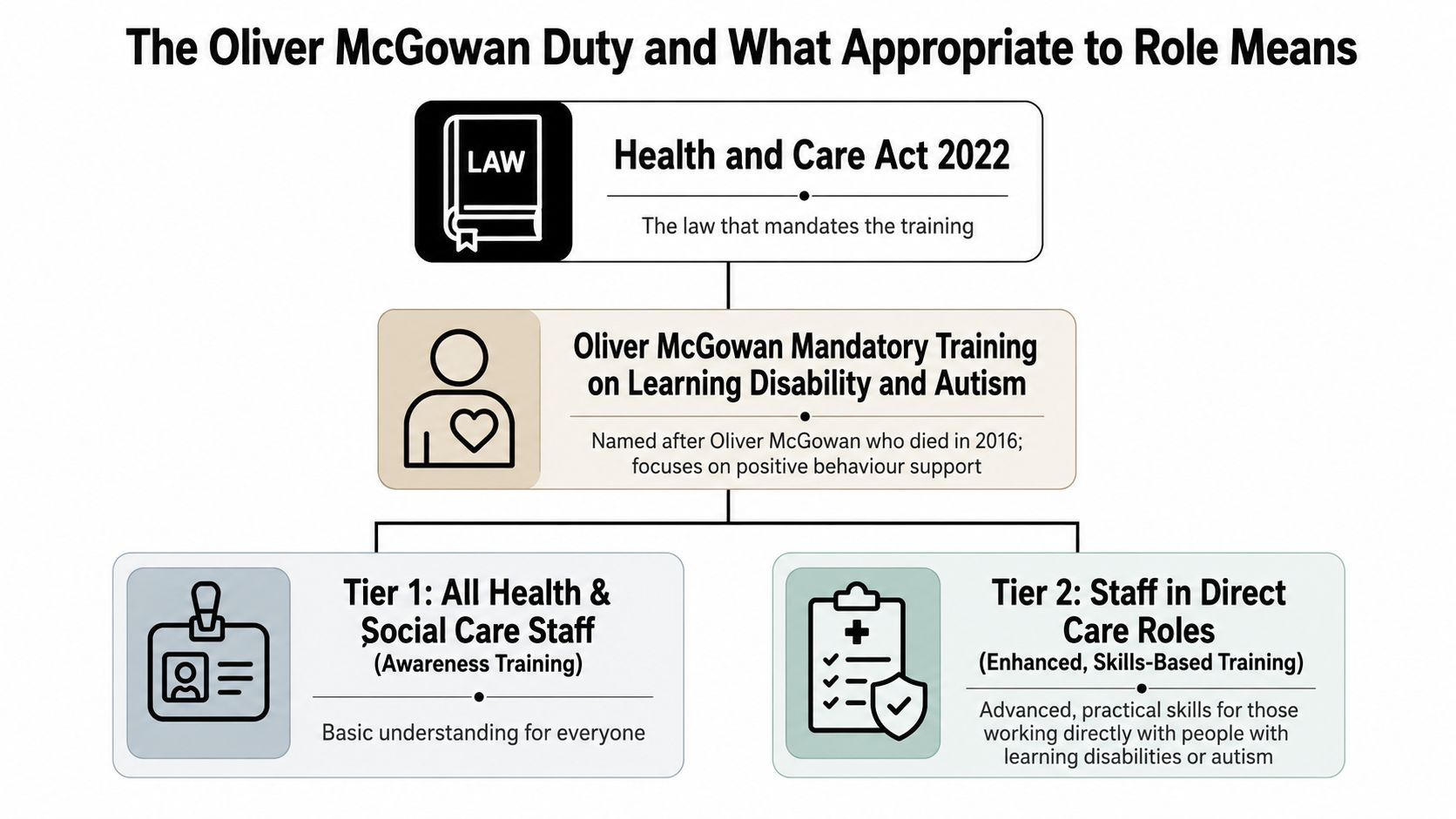
A new starter sits through generic autism awareness, files the certificate, and still freezes when a person's distress is triggered by poor communication. That is exactly why the Oliver McGowan duty exists. Under the Health and Care Act 2022, CQC-registered providers in England must make sure staff receive learning disability and autism training appropriate to their role. It is a legal control, not optional CPD.
The reason is plain. Services too often treated learning disability and autism as a goodwill topic, then missed reasonable adjustments, misunderstood communication, or let distress escalate. Skills for Care says Oliver's Training was co-produced and trialled with over 8,300 health and care staff, which shows the national framework was tested before wider use (Skills for Care).
“Appropriate to role” is the part people keep getting wrong
A hospital porter does not need the same depth as a support worker in a learning disability service. A porter needs Tier 1, the awareness layer. A support worker or nurse delivering direct care needs Tier 2, the skills-based version. That split matters because the law is about competence in context, not forcing every worker through the same content.
The government's code of practice sets out the Oliver McGowan package as the preferred route for meeting the requirement. Inspectors want to see practical understanding, communication differences, reasonable adjustments, co-occurring conditions, and how behaviour can be misread when services rely on shortcuts.
Do not count attendance and call it competence. If the worker cannot show how they would adapt communication or escalate concerns in real practice, the training has not landed.
CQC expectations on safe care and staffing mean providers must evidence capability, not just course completion. That is what “appropriate to role” means in practice. A tick-box certificate will not protect a provider if staff cannot show the right response on the floor.
How Training Maps to the Care Certificate's 16 Standards
A new starter can sit through every mandatory module and still fail the Care Certificate if no one checks workplace competence. The certificate is built around 16 standards, and completion only counts when the worker can show safe practice in real care settings. Skip that link and you end up with tidy records and weak staff.
The link between modules and standards matters
Managers should map each training module to the standard it supports, then watch the person apply it on the floor. A screen-based certificate proves attendance, not skill. The sign-off belongs in the workplace, where the assessor sees communication, judgement, and safe technique.
The pairings are direct. Safeguarding supports Standard 11. Health and safety sits with Standard 13. Infection prevention and control sits with Standard 15. Privacy and dignity links to person-centred care and confidentiality, while Mental Capacity Act awareness supports respectful decision-making. Personal development and reflective practice also sit naturally across the foundation of the certificate.
| Care Certificate Standard | Relevant Mandatory Training Module(s) |
|---|---|
| Standard 1, Understand your role | Induction, employer policies, local procedures |
| Standard 2, Your personal development | Safeguarding, MCA awareness, supervision expectations |
| Standard 3, Duty of care | Safeguarding adults, incident reporting, escalation |
| Standard 7, Privacy and dignity | Person-centred care, equality, confidentiality |
| Standard 11, Safeguarding adults | Safeguarding adults module |
| Standard 13, Health and safety | Health and safety, fire safety, moving and handling |
| Standard 15, Infection prevention and control | IPC, hand hygiene, PPE |
| Standard 16, Awareness of learning disability and autism | Oliver McGowan training |
The Care Certificate online course is a foundation, not a shortcut past role checks. Use it to cover baseline induction and supervised practice, then test whether the worker can do the job. Refresher training usually runs on annual cycles for higher-risk topics, but the certificate itself does not replace ongoing competence checks.
A good manager keeps the evidence joined up. Put each module against a reference code in the training record, then keep the course, date, assessor sign-off, and linked standard together. If an audit lands, no one should have to hunt through folders to prove what happened.
The 2025 NHS England Portability Reform and Why It Matters
The portability change is the bit most guides still miss. From 1 May 2025, NHS England began redesigning statutory and mandatory training so staff moving between NHS organisations would not have to repeat the same learning, and the parliamentary record says the change could save up to 200,000 staff days (UK Parliament written question response). That is a real shift in how workers move, not a tidy admin update.
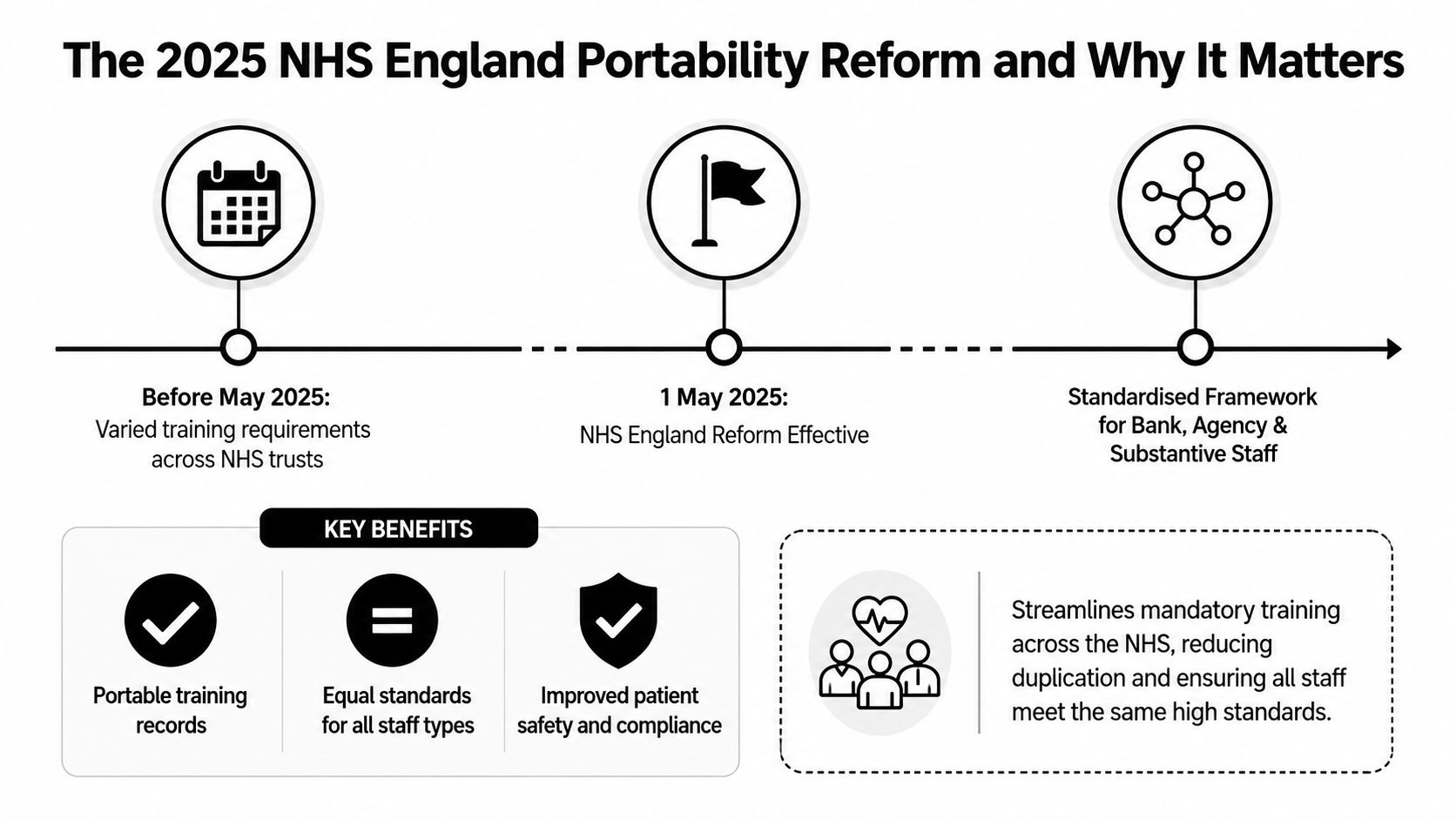
The framework covers safeguarding, infection prevention, fire safety, equality, information governance, resuscitation, and moving and handling. The point is simple. Training should be more portable and take less time when staff change trusts, pick up bank work, or move across providers. If you have seen a capable worker sit through the same module twice because two organisations would not accept the same evidence, you already know why this matters.
What changes on the ground
A social care worker taking bank shifts in an acute trust should move through onboarding faster when core evidence is current and clearly recorded. That means fewer duplicate inductions, fewer delays, and one compliance record that can travel with them more easily. It also stops the lazy habit of treating every move as if the worker is starting from zero.
The limits still matter. Provider-specific clinical skills still need local sign-off. Local induction still matters. Professional registration requirements still apply. Portability cuts duplication. It does not remove responsibility.
The direction of travel is clear. NHS training is being pushed towards standardisation, and social care providers need records that can stand up to scrutiny. Staff who move often, especially bank and agency workers, will be judged more on the quality and consistency of evidence than on promises in a folder.
Which Modules You Actually Need by Role
A serious training matrix is role-led, not wishful thinking. A care worker, a healthcare assistant, a senior carer, and a registered manager do not need the same depth in every topic, and anyone who says they do is selling convenience over competence.
Typical role split
A support worker or carer usually needs the common core. That means health and safety, fire safety, safeguarding adults, IPC, moving and handling, equality, information governance, and the Oliver McGowan awareness layer where relevant. A healthcare assistant often adds clinical observation skills, blood glucose monitoring where in scope, and more detailed escalation training.
A senior carer or shift leader needs everything above, plus medication competency assessment, supervision basics, incident review, and handover quality. A registered manager or nominated individual needs governance, audit, CQC KLOE awareness, workforce assurance, and a stronger grip on how training evidence supports inspection readiness.
| Role | Core Modules Required | Role-Specific Modules | Refresher Frequency |
|---|---|---|---|
| Support worker or carer | Health and safety, fire safety, safeguarding adults, IPC, moving and handling, equality, information governance | Oliver McGowan Tier 1 where relevant, lone working, basic food hygiene | Annual for high-risk topics, then as policy requires |
| Healthcare assistant | Core modules plus observation, escalation, basic clinical support | Blood glucose monitoring, clinical observations, delegated tasks | Annual or competency-based, depending on task |
| Senior carer or shift leader | Core modules plus leadership of safe practice | Medication competency, supervision, handover, incident response | Annual for core items, role-based reassessment for medication and practice tasks |
| Registered manager or nominated individual | Governance and core compliance modules | Audit, quality assurance, KLOE awareness, staff compliance oversight | Ongoing review, with scheduled refreshers and policy updates |
Don't overcomplicate the timetable. Annual refreshers are common for high-risk skills, while some items are one-off induction followed by workplace observation. The exact scope still depends on employer policy, but the role split gives you a realistic starting point.
Completing and Prioritising Training Without Burning Out
If someone dumps 20 modules on your desk, don't start with the easiest-looking one. Start with the ones that block safe practice and inspection readiness. Safeguarding, infection prevention and control, and basic life support go first because they're the quickest route to being useful on shift.
After that, move through health and safety, fire awareness, moving and handling, and information governance. Keep equality, diversity and human rights and the Oliver McGowan modules high in the queue because they're not optional extras. They're part of lawful, respectful care.
A practical rhythm that people actually finish
Use the rule of three. Finish any module under 30 minutes the same day. Batch theory-only e-learning into 90-minute blocks. Book practical assessments in person, because those tasks are about observed performance, not passive clicking.
Build your evidence folder before you start. Save the certificate PDF, the completion date, and any assessment or observation notes. Add the provider's registration details if your employer asks for them, because people often get delayed because they can't locate proof quickly enough.
Keep one clean file. If you need to search five platforms and three email inboxes to prove training, your compliance system isn't working.
The other thing people ignore is expiry. Check what's already out of date first, then deal with annual refreshers such as manual handling and basic life support before you waste time on lower-risk content. If you use a managed platform, put every due date in one place and let reminders do the nagging for you. A proper training matrix template helps with that, and this training matrix template is the sort of structure worth copying.
Turning Training Into Shifts and a Compliance File That Sticks
A worker with the right training should move into shifts quickly. A clean compliance file does that job because managers can verify competence without chasing the same evidence again. That matters even more as NHS England pushes portability across settings and the wider care workforce.
Keep the file dull and practical. Include dated certificates, course outlines, assessor sign-off where relevant, and a one-page matrix summary by role. If a bank coordinator, agency worker, or manager can open it and see current evidence straight away, you have removed delay from booking.
Cura Academy is one option for storing care training records, expiry reminders, course completion evidence, and role-linked pathways in one place. Other platforms do similar work. The point is simple, the system must produce proof fast, not just hold learning in the background.
Treat the file as a live compliance asset. Update it after each module, keep refresh dates visible, and maintain the core stack so you are not scrambling when a shift appears or a spot check lands. The workers who get booked most easily are usually the ones who are easiest to verify.
Use a training matrix template to keep due dates and role requirements in one place. That gives you a clear view of what is current, what is due, and what blocks a shift.