

A first aid at work course in the UK is a 3-day, 18-contact-hour qualification for higher-risk workplaces. In care settings, you choose it from a written first-aid needs assessment, not by guessing or copying what another home did.
You're probably here because someone has told you, “Just book first aid,” and nobody's explained whether that means the full course, the one-day version, or something more specific for your site. That confusion is common in care, especially when rotas are tight, agency staff come and go, and managers are trying to keep training current without wasting money on the wrong course.
The right answer depends on the job, the building, the residents or service users, and how long staff may have to manage an incident before help arrives. If you work in residential care, domiciliary care, or agency shifts, the decision should be made with the employer's legal cover in mind, not on sales copy or hearsay.
Table of Contents
- Why Care Workers Are Searching for the Right First Aid Course
- What a First Aid at Work Course Is
- First Aid at Work vs Emergency First Aid at Work
- Syllabus and Skills You Will Actually Learn
- What Happens on a Typical 3-Day Course
- Assessment, Certification and Renewal Rules
- Classroom, Blended and Online Delivery Compared
- Choosing an Approved Provider and Booking With Confidence
Why Care Workers Are Searching for the Right First Aid Course
A care assistant gets told on a Friday afternoon that they need “first aid” before next week's shift. Another colleague swears the one-day course is enough. A senior carer is looking at the rota and trying to work out who can realistically be released for training without leaving a gap on the floor.
That is the reality for care teams. The issue is not whether training sounds useful, it is getting the right level of cover in place so the booking matches the workplace and does not create a compliance problem later.
The question underneath the question
People asking about a first aid at work course are usually trying to answer one thing with three different labels. Can I do this course and stay compliant at work? Will it be accepted by my employer, agency, or provider? Is it the right fit for the role I do?
Those are sensible questions, because in care the wrong course is a poor fit from the start. If the workplace needs a fuller level of first-aid provision, a shorter course leaves the gap in place. If the workplace only needs limited cover, booking a bigger qualification wastes time and money.
Practical rule: in care, start with the setting, the risks, and who is on shift. The course name comes second.
Managers, senior carers, and agency coordinators all need the same thing, a clear route from workplace risk to training choice. UK guidance places that responsibility on the employer through the first-aid needs assessment, so the course has to fit the site, not the other way round, as set out in the HSE first aid training guidance.
That is why this guide goes beyond “what's taught”. It maps the course to the legal decision that comes first, then shows what care workers in residential, domiciliary, and agency roles should look for before they book, alongside broader mandatory training for care workers requirements that sit around it.
What a First Aid at Work Course Is
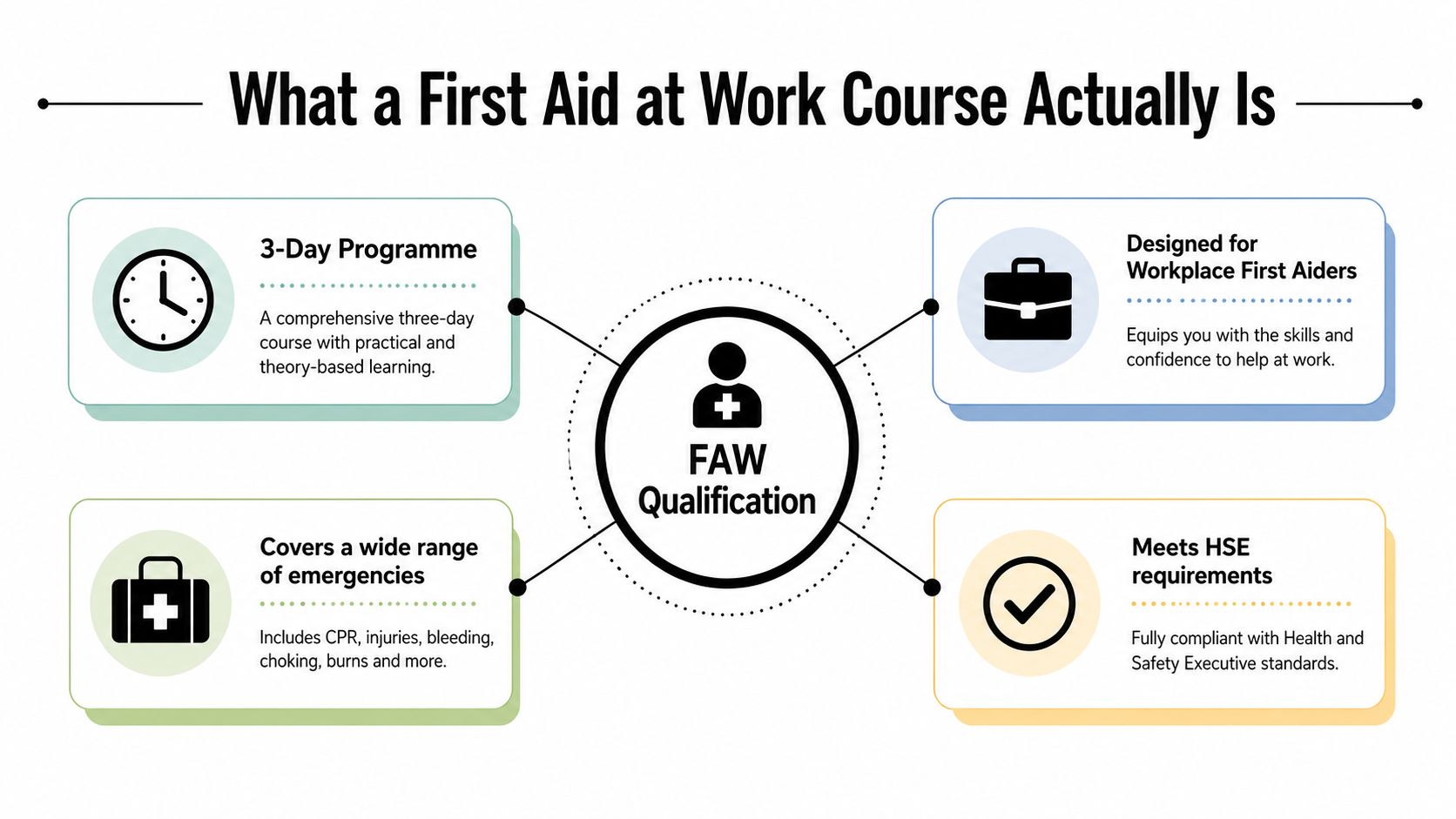
A First Aid at Work qualification is the full workplace first-aid course. It is usually delivered over 3 days, with around 18 contact hours in standard UK training guidance. Employers choose it for workplaces where first aiders may need to do more than the basics while waiting for emergency services.
What the qualification is for
The course is built to support a real workplace first-aid arrangement. It covers the level of care needed to match risk, shift patterns, staffing levels, and response time on site. That is why employers must complete a first-aid needs assessment before they book training, then decide whether first aiders are needed, what level of training fits the work, and how many staff should be trained. Refresher training also has to stay current HSE guidance.
In plain English, this course suits settings where a first aider may need to hold the line until help arrives. Care homes, supported living environments, and some domiciliary operations often need that fuller cover because residents or service users may have complex needs, mobility issues, or medical vulnerability.
What it changes for care settings
The legal point matters because it stops people treating training like a tick-box purchase. A home with night shifts, lone workers, or residents who are more likely to collapse, choke, bleed, or deteriorate quickly needs more than a generic certificate.
A credible provider should talk about workplace risk before it talks about course dates.
Managers need the same discipline. If your training plan starts with “How many people can we get through a course?”, you are asking the wrong question. Start with the assessment, then decide whether the full First Aid at Work course is the right level for your site.
First Aid at Work vs Emergency First Aid at Work
The choice between First Aid at Work (FAW) and Emergency First Aid at Work (EFAW) can be a difficult one to make. The difference is simple, but the consequences aren't. FAW is the fuller 3-day route, while EFAW is the shorter one-day option aimed at life-threatening emergencies.
Side by side comparison
| Feature | First Aid at Work (FAW) | Emergency First Aid at Work (EFAW) |
|---|---|---|
| Duration | 3 days, around 18 contact hours | 1 day |
| Depth | Broader workplace first aid coverage | Focused on immediate life-saving action |
| Best fit | Higher-risk or more complex care settings | Lower-risk settings with simpler cover needs |
| Practical use | Better when a casualty may need longer support | Better when rapid emergency response is the main goal |
| Decision basis | Employer's first-aid needs assessment | Employer's first-aid needs assessment |
The important bit is not the table, it's the rule behind it. HSE doesn't hand you a fixed headcount or a one-size-fits-all answer. It expects the employer to assess the workplace and choose adequate, appropriate cover.
Which care setting usually points where
A small domiciliary agency may be able to justify EFAW for certain teams if the needs assessment supports that choice. A larger residential home, especially one with multiple floors, shift changes, and residents with complex needs, often needs the fuller FAW route because staff may need broader first-aid capability before paramedics arrive.
That is why the blanket advice “everyone just does the one-day course” is weak. It ignores risk, staffing, and how quickly a casualty can deteriorate. The safer default, especially where there are hazards, lone working, or higher-risk service users, is the fuller First Aid at Work course.
Syllabus and Skills You Will Actually Learn
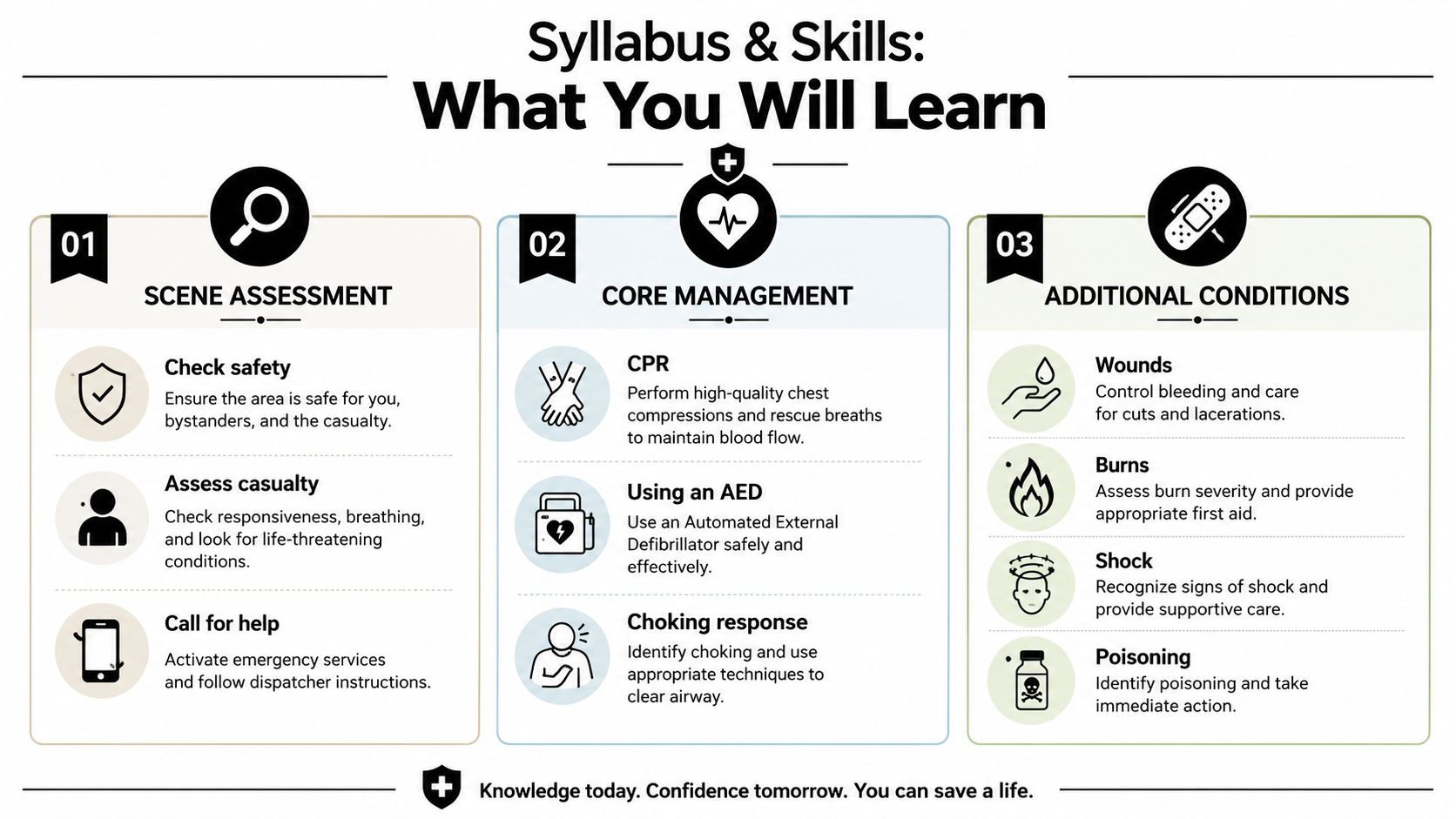
A good First Aid at Work course is practical, not lecture-heavy. The syllabus should give you the skills to size up a scene, manage a casualty, and keep acting while waiting for help.
The parts you'll use on shift
You should expect training on scene safety, casualty assessment, and what to do when someone is unresponsive. In care work, that matters because the first person on scene is often not a clinician, it's the person already doing the rounds, serving meals, or checking a room.
You'll also cover CPR and defibrillation, choking, bleeding, shock, burns, fractures, spinal injuries, poisoning, eye injuries, anaphylaxis, and major illness including heart attack, stroke, asthma, diabetes, and seizures. That list is not just theory. In a care setting, it maps directly to the kinds of incidents staff are called on to handle before escalation.
A useful benchmark for judging course quality is the adult CPR standard used in advanced first-aid specifications. It calls for 30 chest compressions at a depth of 5 to 6 cm, at a rate of 100 to 120 per minute, followed by 2 rescue breaths delivered in no more than 10 seconds course specification.
What that means in practice
If a trainer can't show you how those compressions feel, how the pause for breaths is managed, and how the AED fits into the sequence, the course is too shallow. Hands-on practice matters because first aid is muscle memory under stress, not a memory test.
Quality check: a proper course makes you do the skill, not just hear about it.
That is especially true for care workers. If you're likely to be first on scene for a choking resident, a collapse, or a bleed, the syllabus has to feel relevant the moment you leave the room.
What Happens on a Typical 3-Day Course
A proper 3-day course usually starts with registration, ID checks, and a short introduction to the trainer's expectations. After that, the day moves quickly into demonstrations, paired practice, and scenario work, because first aid is learned by doing.
Day by day reality
Day one is usually the basics of casualty assessment and the core life-saving steps. People often assume that means sitting through endless slides, but the better providers keep theory tight and move learners onto manikins, AED trainers, and role-play early.
Day two tends to dig into injury and illness management, so you're not just repeating CPR. That's when learners usually realise why the longer qualification exists, because care work rarely involves a single neat emergency. It's more often a mix of confusion, mobility problems, medication issues, and a deteriorating casualty who needs calm, organised action.
Day three is usually where confidence either lands or doesn't. Trainers will often run scenario-based assessments, short written tasks, and practical checks, then go back over the weak spots before sign-off. Wear comfortable clothes, expect to kneel on the floor for CPR practice, and don't turn up assuming you can just watch from the side.
A useful thing to know is that trainers usually need to confirm who you are before certification is issued. That sounds minor, but it catches people out when they turn up without the right ID or rush in late expecting it won't matter.
The best courses feel busy in a good way. They don't waste your time, and they don't pretend that first aid can be learned from a slide deck alone.
Assessment, Certification and Renewal Rules
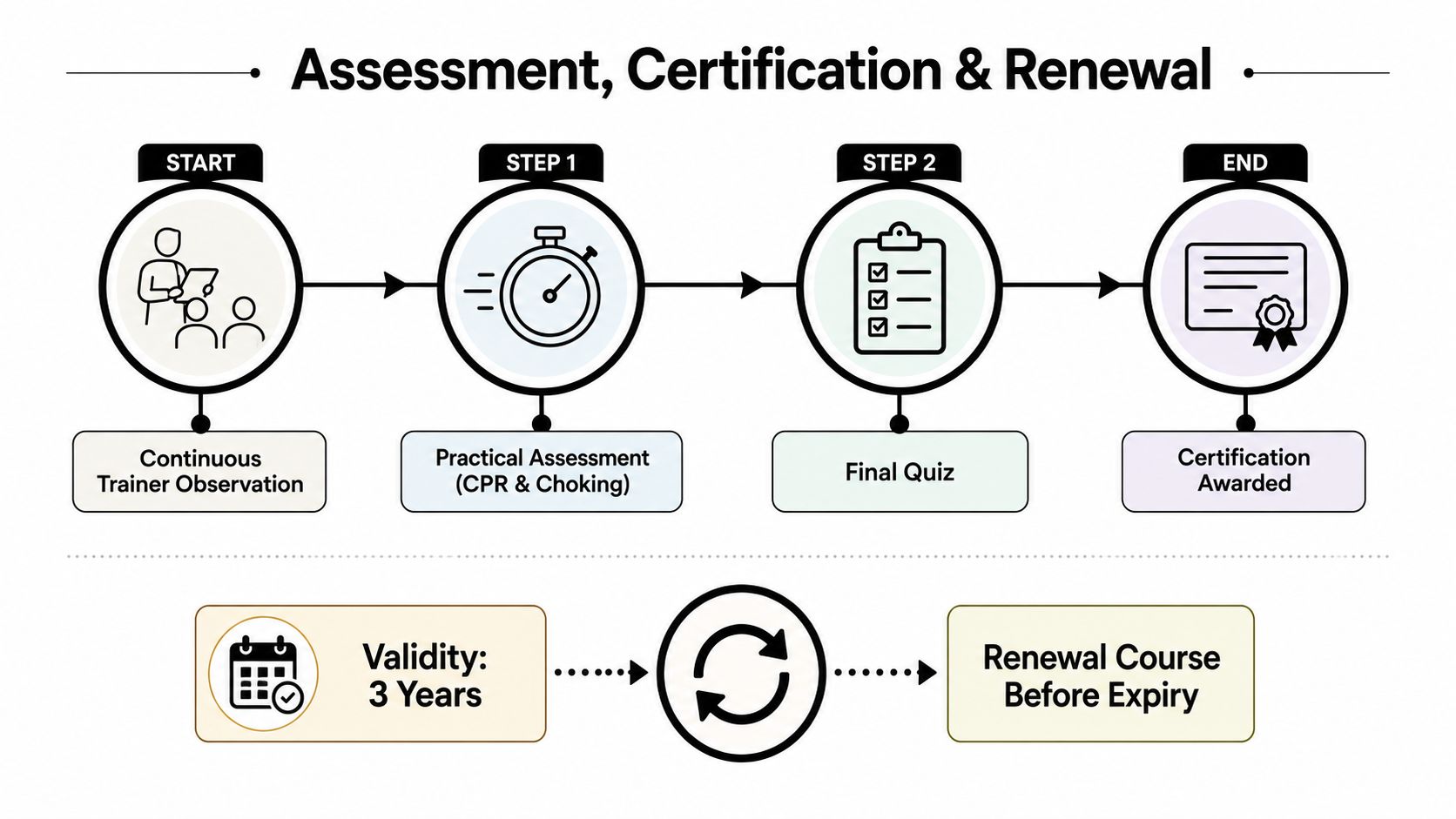
Assessment on a First Aid at Work course is normally ongoing. The trainer observes your practical work throughout the course, checks how you apply each skill, and then decides whether you can perform it reliably under pressure.
How people are normally signed off
The practical checks usually cover CPR and another core emergency skill, such as managing an unresponsive casualty. Many providers also use a short written or multiple-choice paper to check the knowledge side. That mix matters because a first aider needs hands-on competence and enough understanding to make sound decisions in real situations.
Assessment also links directly to the employer's needs assessment. A care home, domiciliary provider, or agency should not send someone on the wrong level of training and hope it fits later. The certificate has to match the risks in the role, otherwise the training looks tidy on paper and weak in practice.
Certification is normally valid for 3 years, then the full course has to be repeated. Training should also stay current through refreshers and employer-led updates. In practice, many managers and agencies expect people to stay refreshed before they keep them active on the rota.
What care workers should do with that
Do not wait until the certificate is almost out of date. Put the renewal date in your calendar, tell your manager early, and book the next course before the gap turns into a rota problem.
| Renewal point | What to do |
|---|---|
| Certificate active | Keep your skills current through refreshers |
| Certificate nearing expiry | Book renewal planning early |
| Certificate expired | Treat it as a gap that needs fixing fast |
That small bit of planning saves a lot of awkwardness later. A care worker with expired training is harder to roster, and a manager with several expired certificates has a compliance problem on their hands.
If you want the wider context on how online learning fits into basic life support options, see the basic life support courses online guide for context.
Classroom, Blended and Online Delivery Compared
The delivery format matters just as much as the course title. A classroom-only First Aid at Work course is fully face-to-face. Blended learning combines online theory with in-person practical assessment. Fully online certification is where you need to be careful.
What HSE will and won't accept
HSE guidance accepts blended learning in first aid training, but the practical parts still need in-person assessment. CPR, defibrillation, and casualty handling are not credible if they never leave the screen. That's why the full qualification can't be reduced to a remote-only course and still claim the same status.
A clean way to think about it is this, online can support learning, but it can't replace the physical practice that makes the qualification useful. That includes the ability to kneel, compress, turn, support, and respond in real time.
For care workers comparing options, the safer route is usually to match the delivery format to your setting's tolerance for risk and the employer's compliance expectations. If you want a broader overview of online basic life support options, see the basic life support courses online guide for context.
The formats side by side
| Delivery format | What it looks like | Credibility for full FAW |
|---|---|---|
| Classroom only | Entirely in person | Strong, straightforward |
| Blended learning | Online theory plus face-to-face practical work | Strong, if practical assessment is real |
| Online or remote only | No in-person practical assessment | Not suitable for full FAW certification |
The blunt advice is this. If a provider is promising a full First Aid at Work course with no real practical element, walk away. The cheap shortcut usually costs more when a manager or agency rejects the certificate later.
Choosing an Approved Provider and Booking With Confidence
A bad provider muddies the decision. A good one makes the legal check simple. Start with your workplace needs assessment, then match the course to the actual care setting. Residential care, domiciliary care, and agency shifts do not all carry the same first aid risk, so the level you book should reflect that reality.
What to look for before you pay
- Approval and recognition: Ask who awards the certificate and whether employers in your sector accept it.
- Practical time: Make sure the course includes enough hands-on practice, not just theory with a quick sign-off at the end.
- Setting fit: Residential care, domiciliary care, and agency work don't all need the same emphasis, so the provider should be able to explain how the course fits your role.
- Assessment quality: A proper provider should be able to explain how learners are assessed, not hide behind vague claims.
Cheap courses are rarely cheap in the end if they cut practical time. If the fee looks unusually low, ask what has been removed. Usually it is practice, trainer contact, or meaningful assessment, and that is where compliance problems start.
Pick providers that can show clear sector knowledge, not just polished sales copy. If you are comparing options across care services, the health and social care training providers guide helps you judge quality without getting distracted by marketing language.
Booking rule: buy the course that fits the workplace risk, not the cheapest certificate on the page.
For care workers, managers, and agency leads, the next step is plain. Check the needs assessment, confirm whether FAW or EFAW is the right level, and book with a provider that can prove real practical teaching. If you are standardising training across a team, use a structured system so refreshers, renewals, and mandatory training stay under control instead of turning into last-minute panic bookings.
A CTA for Cura Academy.