
Basic life support is the immediate response to an unresponsive person who may be in cardiac arrest, built on calling 999, starting CPR and using an AED as soon as one is available. For a care worker, it means taking organised action while emergency help is on its way, rather than waiting for a clinician to arrive.
You might be supporting someone alone at home, helping residents in a care home or supervising activities at a day centre. In any of those settings, knowing what to do next helps you turn concern into a clear response.
Table of Contents
- What Basic Life Support Means for Care Workers
- Adult Compression Rates, Breaths and AED Use
- How to Run the Basic Life Support Sequence
- How Child and Infant BLS Differs From Adult Care
- What UK Cardiac Arrest Data Means for Care Workers
- Check Your BLS Training and Book the Right Course
What Basic Life Support Means for Care Workers
Around 115,000 out-of-hospital cardiac arrests are reported to UK ambulance services each year, according to Resuscitation Council UK's cardiac arrest epidemiology guidance. For care workers, BLS is a practical skill for responding while emergency help is on its way.
During a home-care visit, you may find someone slumped in a chair and unresponsive to your voice or a gentle tap on the shoulder. Your first task is to recognise the emergency and get help, not to identify the medical cause. In a care home or day centre, the same principle applies: the first trained person present may need to act before a clinician arrives.
Basic life support, or BLS, buys time. Chest compressions help maintain blood flow to the brain and other organs while emergency clinicians and treatment are on the way. Like a temporary bridge, BLS supports the person until more help can reach them.
Keep your phone within reach so the emergency call handler can guide your actions.
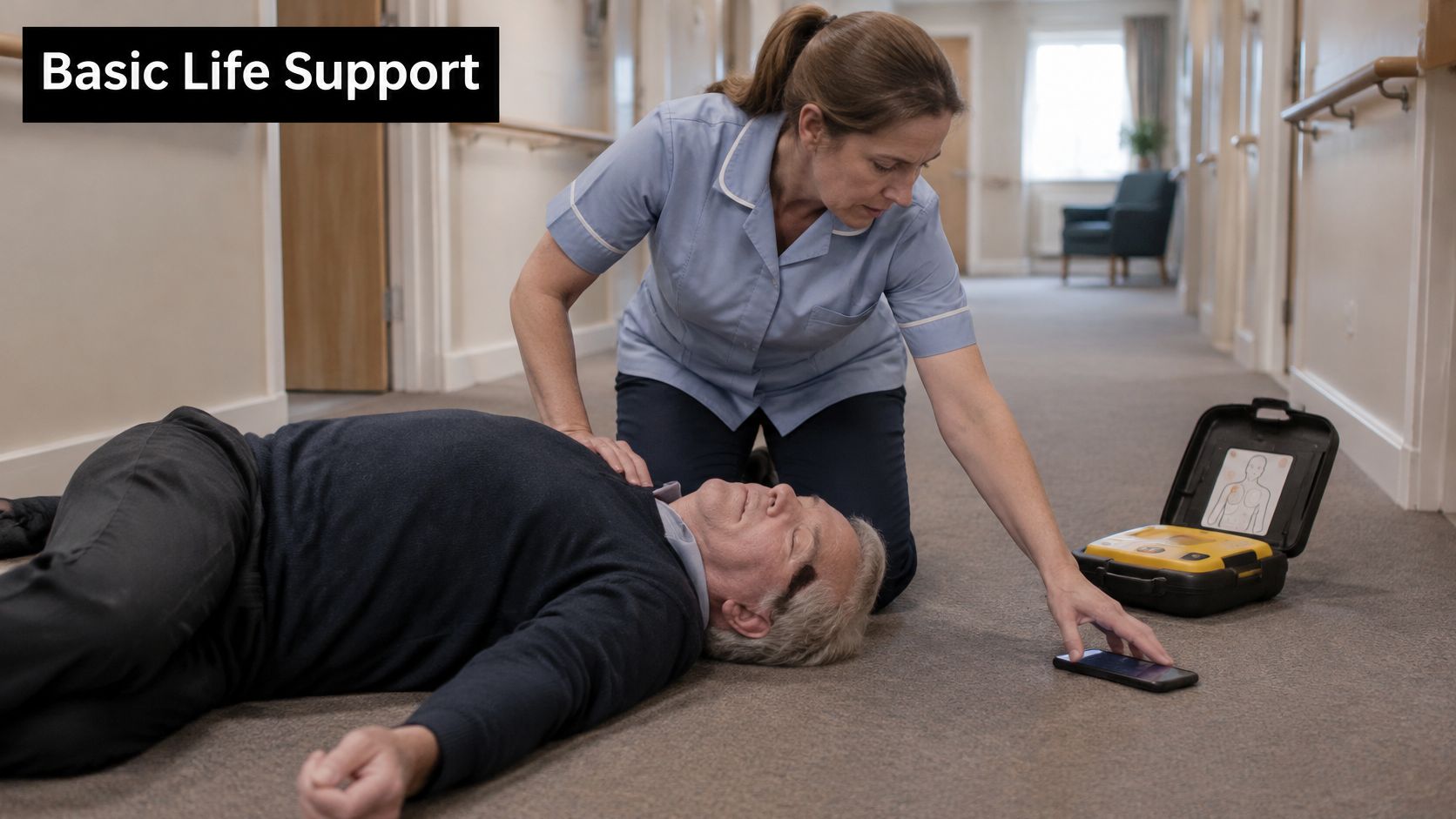
BLS is more specific than general first aid
First aid covers a wide range of injuries and illnesses. BLS focuses on the immediate response when someone is unresponsive and may not be breathing normally.
Its core principles give you a simple way to organise your assessment:
- Recognition: Check whether the person responds and summon emergency help.
- Airway: Open the route air takes to reach the lungs.
- Breathing: Check whether the person is breathing normally.
- Circulation: Start chest compressions if cardiac arrest is suspected.
These checks should guide action, not delay it. The ambulance call handler can support your decisions while you follow your training.
On-shift priority: Call for emergency help promptly. Don't wait for the most senior person in the building.
Care workers may be first to respond, whether supporting someone at home, in a care home or at a day centre. Know the sequence well enough to act under pressure, and check that your training matches the people you support.
Adult Compression Rates, Breaths and AED Use
For adults, the practical targets are 100–120 compressions per minute, reaching 5–6 cm deep, with interruptions kept short. The adult CPR approach below separates someone without training from a rescuer trained to provide breaths.
Adult CPR by rescuer type
| Rescuer | Compressions | Rescue breaths | Stop when |
|---|---|---|---|
| Untrained bystander | 100–120 per minute, 5–6 cm | None, compression-only CPR | Ambulance crew takes over, AED prompts a brief pause, or clear signs of life appear |
| Trained rescuer | 100–120 per minute, 5–6 cm | 30 compressions to 2 breaths | Ambulance crew takes over, AED prompts a brief pause, or clear signs of life appear |
An AED prompt to pause is not an instruction to abandon resuscitation. Stop touching the person when the device needs to analyse or deliver a shock, then follow its instruction to resume CPR.
Make every compression effective
Kneel close to the person on a firm surface. Put the heel of your hand in the centre of the chest, place your other hand on top and keep your shoulders above your hands.
Use a controlled rhythm with enough pressure to achieve the required depth. Both rate and depth matter. Going quickly with shallow compressions isn't a substitute for effective technique.
Let the chest return fully after each compression without losing your hand position. Leaning continuously on the chest prevents full recoil and reduces the effectiveness of your efforts.
Count aloud if it helps you maintain the pattern. If another capable rescuer is present, arrange a quick changeover when you become tired, keeping the pause as short as possible.
Let the AED guide you
Switch the AED on, expose the chest and apply the pads to bare skin using the pictures on the pads. If colleagues are helping, one person can prepare the device while another continues compressions.
Nobody should touch the person during rhythm analysis or shock delivery. The AED decides whether a shock is indicated. You don't need to interpret the heart rhythm yourself.
Resume CPR immediately when instructed after a shock. If the device says no shock is advised, that doesn't mean the person has recovered, so follow its prompts and continue unless there are clear signs of life.
Keep going until professionals actually take over, not simply until you hear the ambulance arrive.
If you're trained and able to give breaths, use the trained-rescuer approach. If you're untrained or unable to ventilate safely, provide continuous compressions and follow the call handler. Practising on a manikin with feedback is how you learn to combine hand position, depth, recoil and breathing without unnecessary delays.
How to Run the Basic Life Support Sequence
The Resuscitation Council UK adult BLS guidelines specify 100–120 compressions per minute at a depth of at least 5 cm but no more than 6 cm, and prioritise calling 999 immediately for any unresponsive person. Make the call before trying to establish whether their breathing is normal.
The visual gives a short reminder of the response, while the steps below explain the assessment involved.
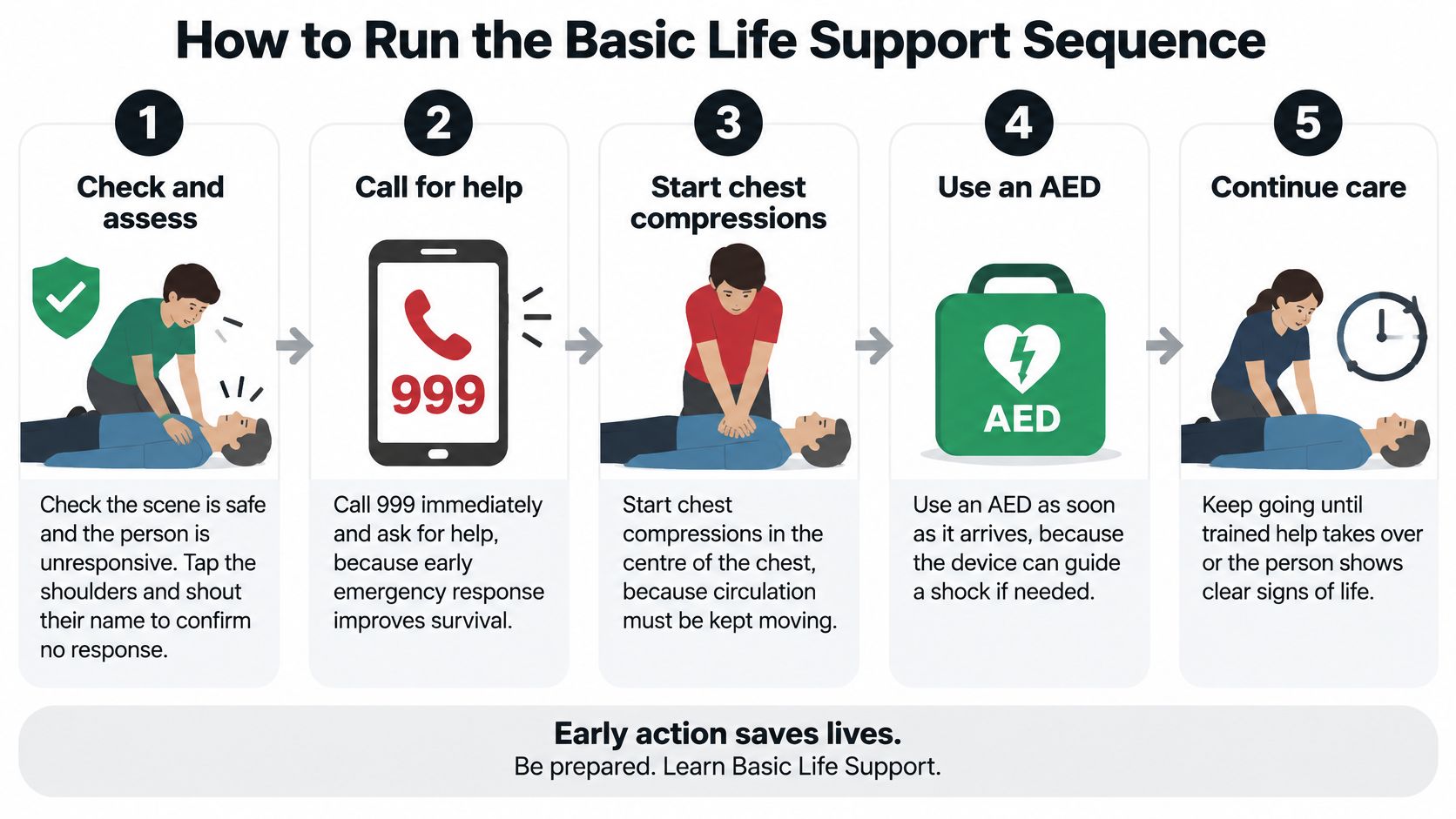
Follow a clear adult response
- Check safety and responsiveness. Look for immediate hazards, approach safely, gently tap the shoulders and speak loudly to the person. A safe rescuer can provide useful help, so don't rush into an electrical hazard, traffic or another active danger.
- Call for emergency help immediately. Put your phone on speaker, or direct a named colleague to make the call while you stay with the person. Early contact allows the call handler to dispatch help and coach you; don't delay the call while finding the manager or completing an internal escalation chain.
- Open the airway. Gently tilt the head back and lift the chin so you can assess breathing through an open airway. Remove only an obvious, readily accessible obstruction, and don't sweep your fingers blindly inside the mouth.
- Look for normal breathing. Look for regular chest movement and listen for breathing, using the call handler's advice if you're uncertain. Occasional gasps, snorting or irregular laboured breaths aren't normal breathing, so don't mistake them for reassurance.
- Begin chest compressions if breathing is absent or abnormal. Position your hands in the centre of the chest and start without delay, adding breaths if trained and able. Compressions provide limited but vital blood flow, so don't repeatedly stop to search for a pulse.
- Attach an AED as soon as it arrives. Ask another person to fetch it where possible, turn it on and follow the pad diagrams and voice prompts. The device can identify a rhythm requiring a shock; keep compressing during preparation where possible, but stand clear whenever it instructs you.
- Continue until handover or clear recovery. Follow the CPR and AED prompts until the ambulance team takes over, the person shows clear signs of life, or you're physically unable to continue. Don't stop just because the person hasn't responded to your first efforts.
Recognise recovery without assuming it
Normal breathing is regular and sustained, with repeated chest rise and fall. A single gasp or brief movement isn't enough to assume recovery.
If the person starts moving purposefully and breathing normally, stop compressions and follow the call handler's instructions. Keep observing their breathing, because deterioration can occur again.
Your workplace's emergency response procedures should also make access arrangements clear. A colleague can open the entrance, meet the ambulance and bring relevant care information without distracting the rescuer from immediate treatment.
How Child and Infant BLS Differs From Adult Care
Adult CPR rules don't transfer unchanged to children and infants. Breathing support has a prominent role in paediatric resuscitation, so a course intended only for adult care may not prepare you for a child's emergency.
Practise ventilation using an age-appropriate training manikin rather than assuming adult technique will work.
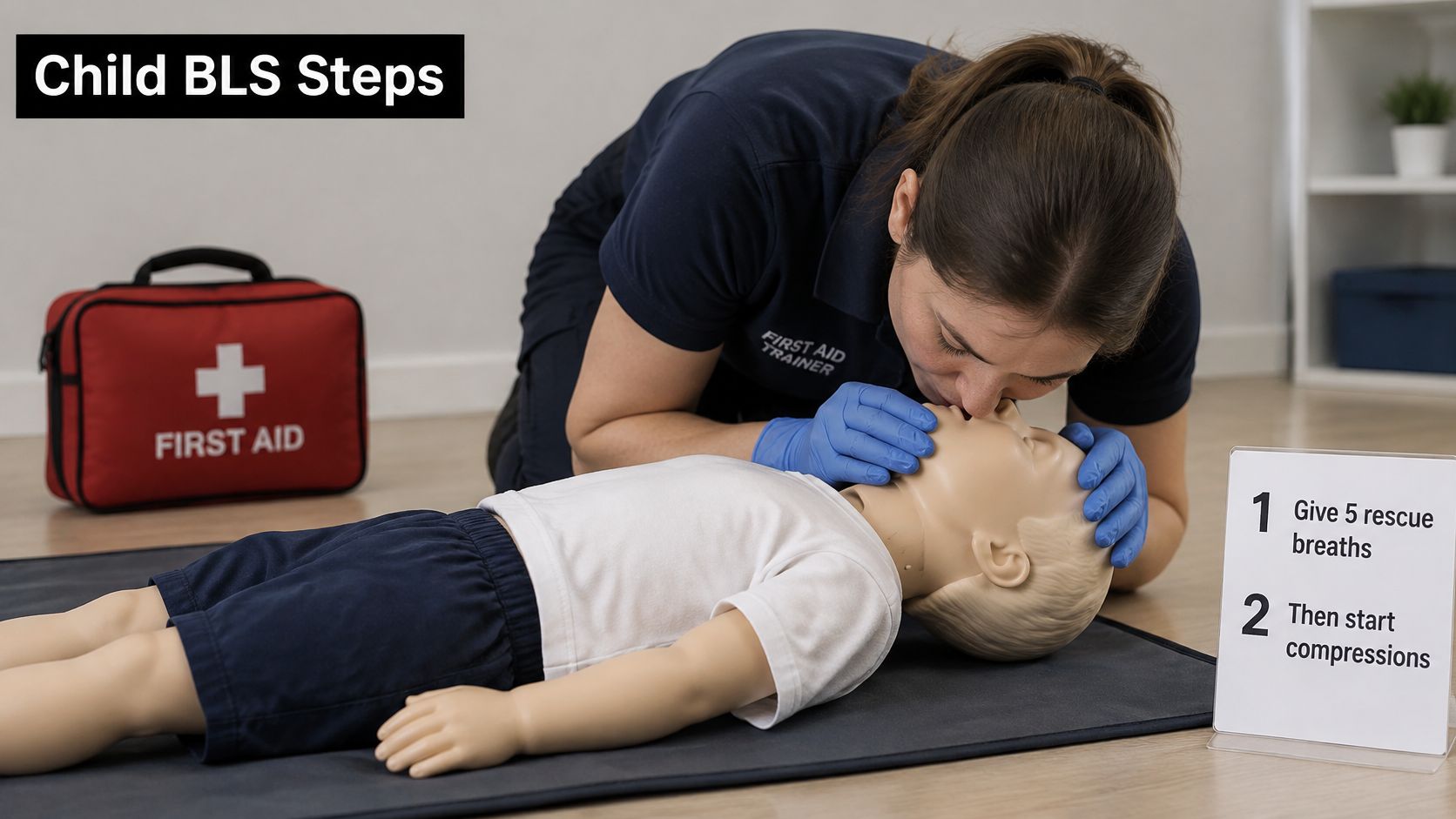
The Resuscitation Council UK paediatric BLS guidelines describe five initial rescue breaths, followed by compressions, with a 15:2 ratio for trained rescuers and 30:2 for untrained rescuers following call-handler advice, as summarised below.
Paediatric CPR ratios by rescuer type
| Rescuer | Ratio | Initial breaths | If ventilation is not possible |
|---|---|---|---|
| Trained rescuer | 15:2 | Five rescue breaths before compressions | Compress continuously until ventilation can begin |
| Untrained rescuer | 30:2 | Follow the call handler's advice | Compression-only CPR as directed by the emergency call handler |
When breaths are difficult or unsafe
A rescuer may struggle to obtain a seal, lack suitable equipment or face a situation where ventilation isn't safe. Continue compressions rather than doing nothing, and explain the difficulty to the call handler.
That fallback doesn't make hands-only CPR the complete answer for every child. Paediatric training should teach you how to provide ventilation effectively, not how to omit it.
A barrier device or other ventilation equipment is useful only if you know how to use it. Don't spend a prolonged period searching for equipment while the child receives no resuscitation.
Use the following video alongside practical instruction, not as a substitute for supervised skills practice.
Match training to the person you support
Attach an AED as soon as it's available, using its paediatric mode or appropriate pads where available and following the device instructions. Don't delay CPR while someone else prepares it, and make sure the pads don't touch each other on a small chest.
Infant and child positioning, compression technique and ventilation need age-appropriate practice. An adult compression-depth target should never be applied automatically to a baby.
If your shifts include children, compare your learning with paediatric first aid requirements. Check whether your practical training covers infants, children, safe ventilation and AED use, rather than relying on the broad label of first aid.
What UK Cardiac Arrest Data Means for Care Workers
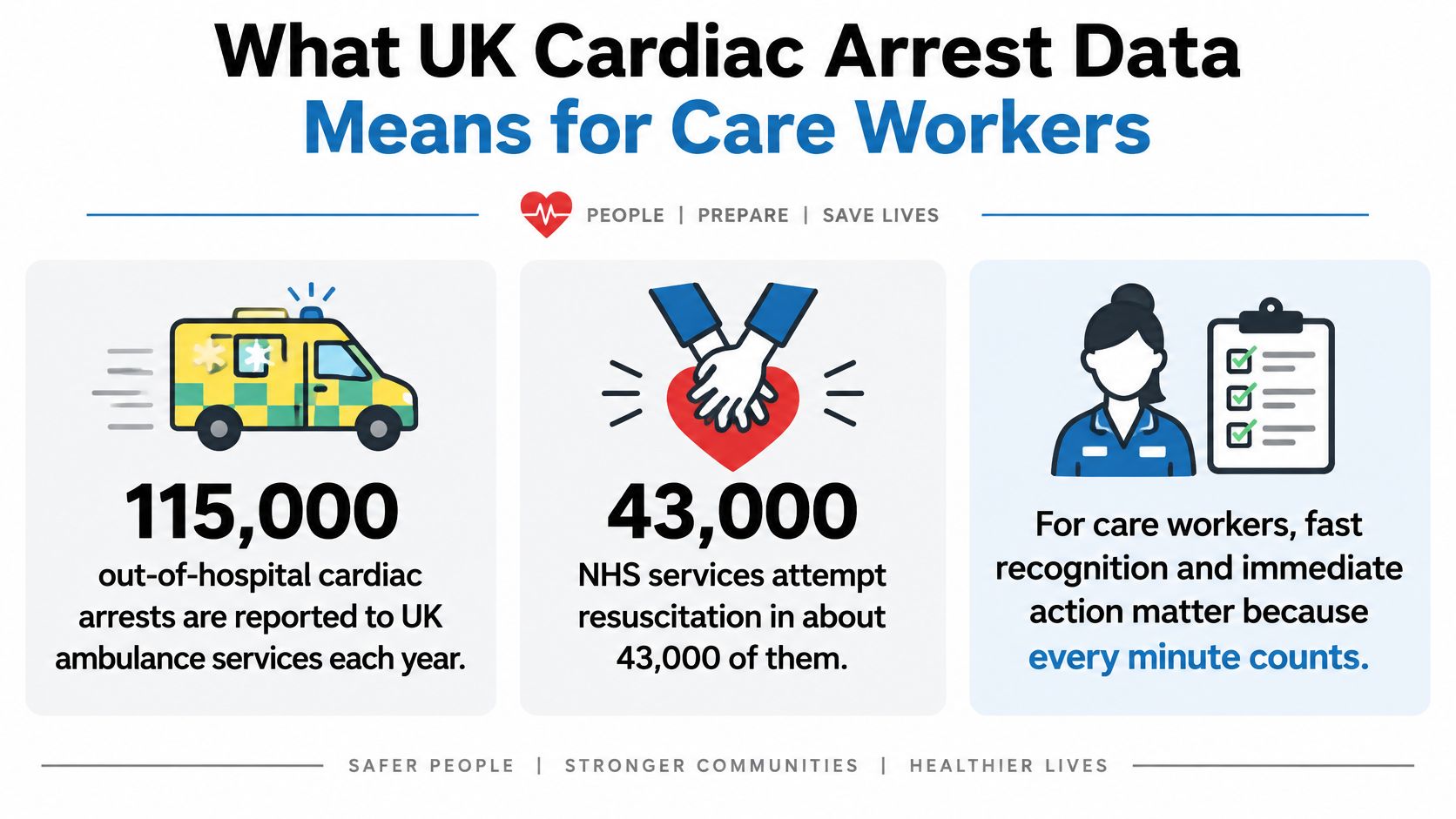
Approximately 115,000 out-of-hospital cardiac arrests are reported to UK ambulance services annually, with resuscitation attempted in about 43,000 cases, according to Resuscitation Council UK's cardiac arrest epidemiology guidance.
Cardiac arrest outcomes by nation
| Nation | Bystander CPR | AED use | 30-day survival |
|---|---|---|---|
| England | 72.6% | 9.0% | 9.5% |
| Scotland | 62.6% | 9.6% | |
| Wales | 64.3% | ||
| Northern Ireland | 41.5% | 8.0% | 6.5% |
The figures show differences between nations, but they do not explain why those differences exist or predict what will happen to an individual.
Read the pattern without overinterpreting it
Bystander CPR is recorded more often in England, Scotland and Wales than in Northern Ireland in this comparison. The national figures do not show whether a particular care worker's training changed an outcome. They describe populations, not a controlled comparison between trained and untrained staff.
The AED figures also highlight two separate tasks: starting CPR and getting a defibrillator to the person. On shift, one colleague may begin resuscitation while another locates the AED. If no one knows where it is kept, retrieval can be delayed.
Shift preparation: Know where the AED is, how to access it and who will bring it while you stay with the person.
Turn the figures into a workplace check
In a care home or day centre, agree roles before an emergency: one person leads resuscitation, another retrieves equipment, and another guides ambulance crews to the room. The first trained person present may need to act while colleagues take on those supporting tasks.
For a domiciliary worker, preparation means keeping a phone accessible, knowing the address to give the call handler and understanding how responders can enter the property.
Discuss emergency treatment plans and documented resuscitation decisions during routine care planning. If a collapse occurs, follow organisational policy and explain any available documentation to the call handler.
Use the figures as context, then focus on what you can prepare for on your shift: recognising deterioration, calling for help, providing CPR and using the AED safely. Check that your training assesses these practical skills, rather than relying on attendance alone.
Check Your BLS Training and Book the Right Course
Each minute without CPR and defibrillation can reduce the chance of survival by up to 10%, while defibrillation within 3–5 minutes can produce survival rates as high as 50–70% in appropriate cases, according to Resuscitation Council UK's out-of-hospital cardiac arrest consensus paper. These aren't guarantees for an individual person, but they explain why practical readiness matters.
A focused BLS course should address emergency recognition, compressions, ventilation and AED use. A first aid at work course covers a broader range of workplace emergencies and may include resuscitation, so compare the actual syllabus rather than assuming either title meets your employer's requirements.
Check before you book
- Employer requirements: Confirm the accepted course, certification and practical assessment arrangements.
- Certificate date: Find your completion record and check the renewal requirement your employer applies.
- Hands-on practice: Confirm arrangements for manikin practice and an AED trainer, particularly if online learning forms part of the course.
- Relevant scenarios: Match adult, child and infant content to the people you support.
- Training records: Save your certificate and put the required renewal date in your diary.
Managers organising this across a team can use HR Management 365's training guidance for UK HR teams when considering how to organise learning records and reminders.
Our Basic Life Support course has a current sale price of £8.00. Compare its content and certification with your employer's requirements, including any separate practical assessment you need.
This week, find your certificate and check its date. If it's missing or out of date, agree the appropriate training with your manager and book it.
We offer the Basic Life Support course, Care Certificate Bundle and Dementia Awareness course to support your care learning. Visit Cura Academy to review the BLS course and choose training that matches your role and your employer's requirements.