
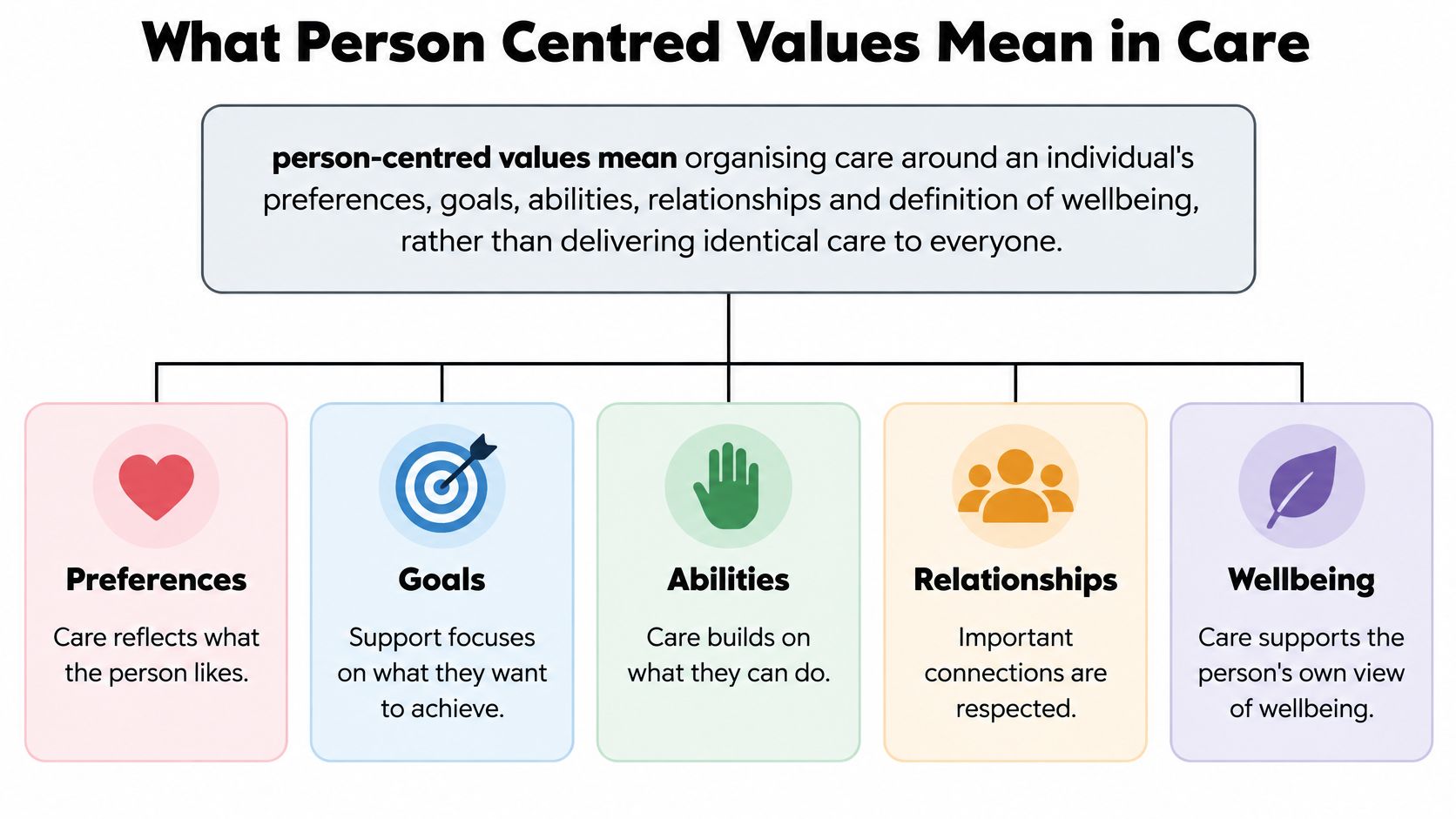
Person-centred values mean organising care around the individual's preferences, goals, abilities and own idea of wellbeing, not an identical routine for everyone.
You're starting a morning care round, breakfast is arriving, and someone doesn't want their usual wash. A relative says they must have it now. The practical question isn't whether you can name the values in your workbook, but whether your next action leaves that person heard, involved and treated with dignity.
Table of Contents
- What Person Centred Values Mean in Care
- Workforce Values an Assessor Can Observe
- When Routines Clash with Personal Choice
- Choice That Stays Fair for Every Person
- How to Record Values for the Care Certificate
- Show the Values on Your Next Shift
What Person Centred Values Mean in Care
Say you're supporting people with morning personal care. One wants a shower before breakfast because that's how they've always started the day. Another wants tea first, then a wash at the basin, with help only for the parts they can't manage.
The task might look similar on a rota. The right method isn't identical, because their preferences, abilities and desired outcomes aren't identical. Person-centred care means finding out those differences and letting them influence what you do.
The government's Adult Social Care Quality Matters framework places the person at the centre of planning and delivery, using the principle “no decision about me without me.” The person is an equal partner, not just the recipient of a service that staff have already organised.
Start with the person, not the task
A useful opening question is what matters to the person about the activity. Getting dressed might be about comfort, choosing clothes for a visitor, maintaining a faith practice or managing without unnecessary help. You won't discover that by asking only whether they've been dressed.
NHS England's personalised-care model supports this wider approach through shared decision-making, personalised care and support planning, personal health budgets, social prescribing, patient activation and choice. On a care shift, the practical translation is straightforward: find out the outcome the person wants, agree suitable support and check whether it worked for them.
The relationship between preferences, abilities and wellbeing is shown below.
Eight person-centred values and what they look like
When learners ask, what are person centred values, they're usually looking for the familiar Care Certificate values below. Don't treat them as separate boxes. Closing a bathroom door can protect privacy, preserve dignity and demonstrate respect at the same time.
| Value | Meaning | Observable behaviour |
|---|---|---|
| Individuality | The person is not a diagnosis or a room number | Use their name, history and preferences, not a standard script |
| Rights | They keep human and legal rights while receiving care | Explain options and don't restrict liberty for staff convenience |
| Choice | They decide how support is given where they are able | Offer real options, including refusing that part of care |
| Privacy | Their body, space and information stay protected | Close doors, cover them during care and share information only on a need-to-know basis |
| Independence | They do what they still can | Set up the task and step back rather than taking over |
| Dignity | They are treated as worthy of respect in every task | Avoid rushing, exposure or talk that embarrasses them |
| Respect | Their identity, culture and wishes are taken seriously | Follow preferred name, pronouns, food and faith practices |
| Partnership | Decisions are made with them, not only for them | Plan, review and change support together |
A task-led round can finish washes, medication prompts and meals on time while still failing the person. Staff might choose clothes without asking, discuss continence within other people's hearing or take over an activity someone wanted to attempt.
Practical rule: Completing care isn't enough. Check whether the way you delivered it preserved the person's control, comfort and self-respect.
The care plan should make the preferred method clear, not merely identify the task. It should explain what matters, what the person can do, who they want involved and what would prompt a review. That gives the next worker something usable when a busy routine, unfamiliar communication or a disagreement makes the decision less straightforward.
Workforce Values an Assessor Can Observe
Values are the behaviour underneath your role, not a pleasant communication style added after the work is finished. A worker can sound friendly while making every decision for someone. An assessor needs to see whether the person influences the support.
The English Care Workforce Pathway for care or support workers identifies seven universal values. These differ from the Care Certificate list: they describe the attitudes and conduct expected of the workforce, while the familiar person-centred values help explain what people should experience when receiving support.
Turn workforce values into things someone can see
- Kind, compassionate and empathetic: Listen before acting. If someone looks distressed when you bring their clothes, explore what's wrong instead of continuing because they're already laid out.
- Honest, trustworthy and reliable: Do what you agreed. If you can't return when promised, explain the delay and arrange appropriate support rather than leaving the person wondering.
- Respectful: Use the person's preferred name and speak directly to them, including when relatives or professionals are present.
- Courageous and principled: Speak up when an established routine causes embarrassment or removes choice. Familiar practice isn't automatically good practice.
- Seeing the whole person: Ask about strengths, relationships and aspirations, not just symptoms and tasks. Wanting to visit a friend can be as relevant to planning as needing help with footwear.
- Flexible, open and willing to learn: Adapt when the person changes their mind or shows you a better way to assist. Ask for guidance when you don't understand their communication.
- Proud and positive: Speak about people without stereotypes or dismissive labels. Describe the support someone needs without reducing them to a difficulty.
These behaviours connect. Listening with curiosity helps you understand what matters. Co-production, meaning developing support together, turns that understanding into a goal the person recognises as their own. You can then tailor your assistance rather than merely offer a warmer version of the standard routine.
What convincing assessment evidence looks like
Suppose a person wants to fasten their own cardigan but finds small buttons difficult. An observer could see you ask permission to help, position the cardigan within reach and allow time before offering assistance. Your explanation should identify why you held back, not just report that dressing was completed.
A useful evidence standard is preference-led planning, respectful communication, adaptability and reliable follow-through. Show these behaviours with people whose abilities, identities, relationships and risks differ. Being confident with someone you know well doesn't demonstrate that you'll adapt appropriately with someone unfamiliar.
A supervisor can also compare what you said you would do with what happened. Did the promised adjustment reach the handover? Did you check that the person was comfortable with the revised approach?
What did you change today because of something the person said or showed?
When Routines Clash with Personal Choice
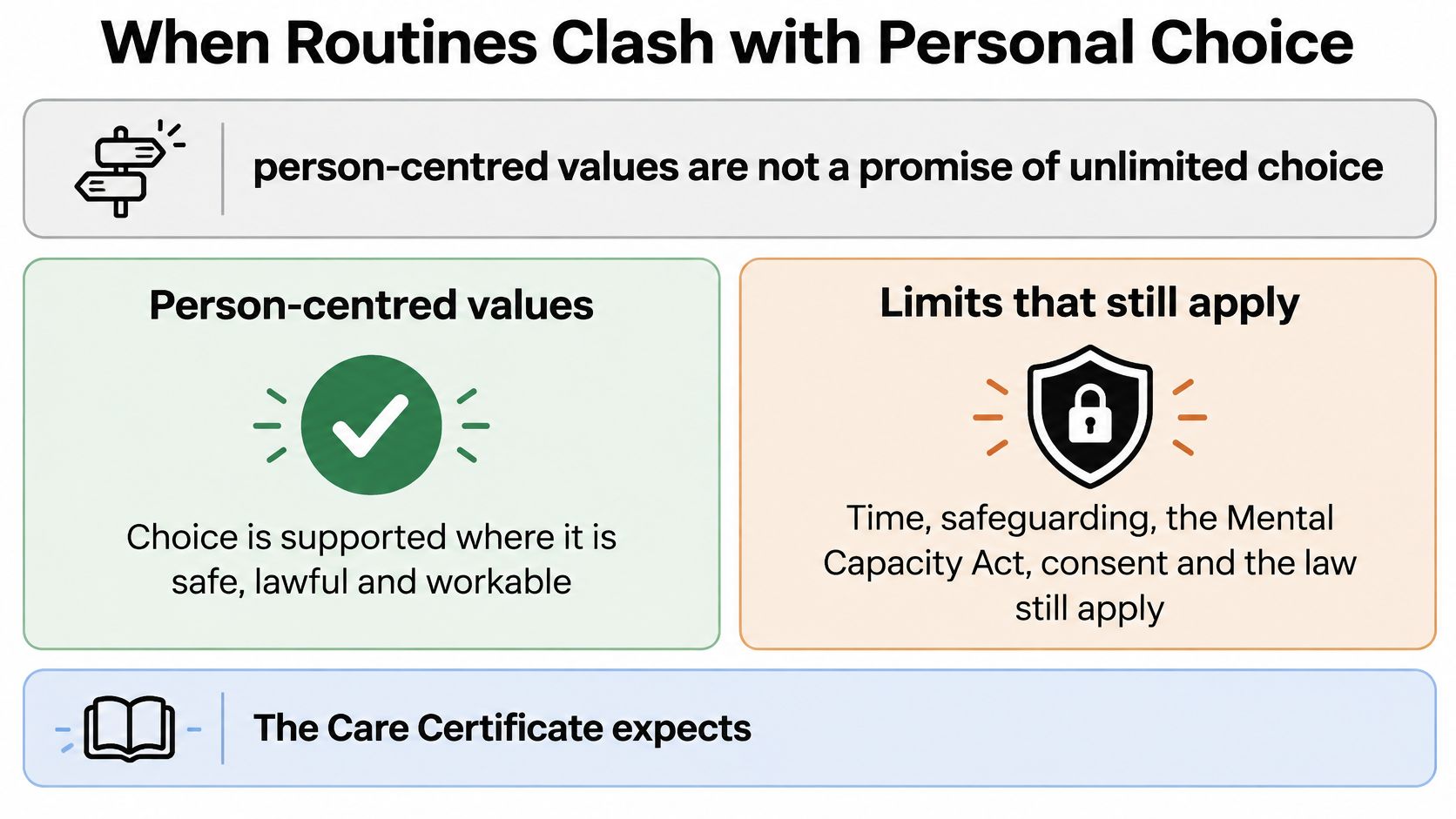
Person-centred values are not a promise of unlimited choice. Safeguarding, consent, the Mental Capacity Act and other legal duties still apply. Time and resources can constrain what you can offer, but they aren't permission to impose a routine without discussion.
Care Certificate Standard 5 expects learners to identify person-centred values, explain their day-to-day application and demonstrate actions that promote them. That means showing what you do when respecting a preference becomes inconvenient, uncertain or contested.
The distinction between supporting choice and recognising limits is important.
When choice and the usual routine conflict
| Situation | Task-led habit | Person-centred response |
|---|---|---|
| Running late on personal care | Rush the usual wash | Ask how they want support and offer realistic options. Tell the shift lead if essential care can't be delivered safely |
| Family wants a different meal or routine | Follow the relative to keep the peace | Check the person's consent and record their choice. Escalate pressure or unresolved disagreement |
| Unwise decision but the person has capacity | Override them for safety | Explain the risk, support the informed choice and agree a proportionate safeguard. Seek advice about serious or unfamiliar risks |
| Lacks capacity for this specific decision | Decide alone and move on | Follow the best-interests process and involve them as far as possible. Involve the appropriate decision-maker |
| Communicates non-verbally | Assume the preference | Use known cues, communication aids and previously stated wishes. Seek communication support if the meaning remains unclear |
| Changes their mind mid-task | Insist the plan is already agreed | Stop, reconfirm consent and update the record. Escalate any resulting unmet need or immediate safety concern |
A decision you disagree with doesn't, by itself, show that someone lacks capacity. Capacity concerns relate to the specific decision, and your role is to recognise concerns and follow the appropriate assessment and escalation process, not make a blanket judgement.
If someone refuses a wash, for example, establish whether they're cold, in pain, embarrassed or asking for a different time. Offer a workable alternative, such as washing at the basin now or discussing a later visit with the coordinator. Don't promise a return visit you can't arrange.
Explain the limit without turning it into a threat
CQC expectations include shared decisions, plans covering physical, mental, emotional and social needs, reasonable adjustments, and people's involvement in controlling access to their information. Our guidance on how to promote choice can help you practise making offers that are meaningful rather than token.
The following video provides another prompt for discussing person-centred practice during training.
Your explanation should distinguish a genuine safety or legal boundary from staff preference. Don't describe something as unsafe merely because the usual method is quicker.
A useful script is: I can offer these options; I can't offer that because of this risk; this is what I'll record and who I'll tell.
Choice That Stays Fair for Every Person
Equality isn't sameness. Giving everyone the same menu, wash time and leaflet can still exclude someone who can't read the information, tolerate the environment or make their preference understood.
Say a worker asks everyone in a dining room what they'd like for lunch. Someone with hearing loss misses the question, another person can't understand the written menu, and someone else needs information about ingredients before choosing. They've received the same offer, but they haven't had an equal opportunity to decide.
Care Certificate Standard 4 on equality and diversity supports practice that recognises individual needs and identity. The Equality Act's protected characteristics matter here, alongside CQC expectations for accessible information and reasonable adjustments.
Adjust the way you offer support
Treat the person as the expert in their own care. Their physical, emotional, social and cultural needs include likes, dislikes, beliefs and personal history, not just the information that fits neatly into a task checklist.
Practical adjustments can include:
- Communication support: Use a communication board, pictures, a British Sign Language interpreter or a spoken-language interpreter, as appropriate.
- Processing time: Ask a clear question, allow time for a response and avoid repeatedly rephrasing before the person has finished thinking.
- Sensory changes: Reduce background television noise, adjust harsh lighting or move to a quieter space.
- Personal-care preferences: Ask about modesty, hair care, clothing, faith practices and who the person feels comfortable receiving intimate support from.
- Chosen involvement: Check who the person wants present instead of automatically inviting the nearest relative.
An adjustment is useful only if it helps this person participate. Don't assume that everyone with the same diagnosis needs the same aid.
Familiar situations that need different approaches
Dementia: A broad question about lunch may be overwhelming. Showing familiar options or a photograph may help the person express a preference, but don't reduce every decision to a narrow choice without checking what they can manage.
Trauma: Someone may become distressed when a worker approaches closely or touches without warning. Explain the next action, ask permission and offer a pause; don't label their reaction as being difficult.
Faith or sexuality: A person's wishes may not be known to their family. Ask privately what they want recorded and shared, and don't treat a relative's account as automatic permission to disclose sensitive information.
Family members can contribute valuable knowledge, particularly about communication and history. Share information they are entitled to receive, record the person's own consent and escalate conflicting views rather than letting the loudest voice settle the matter.
Before a sensitive conversation, establish who should be in the room and how this person shows yes and no.
How to Record Values for the Care Certificate
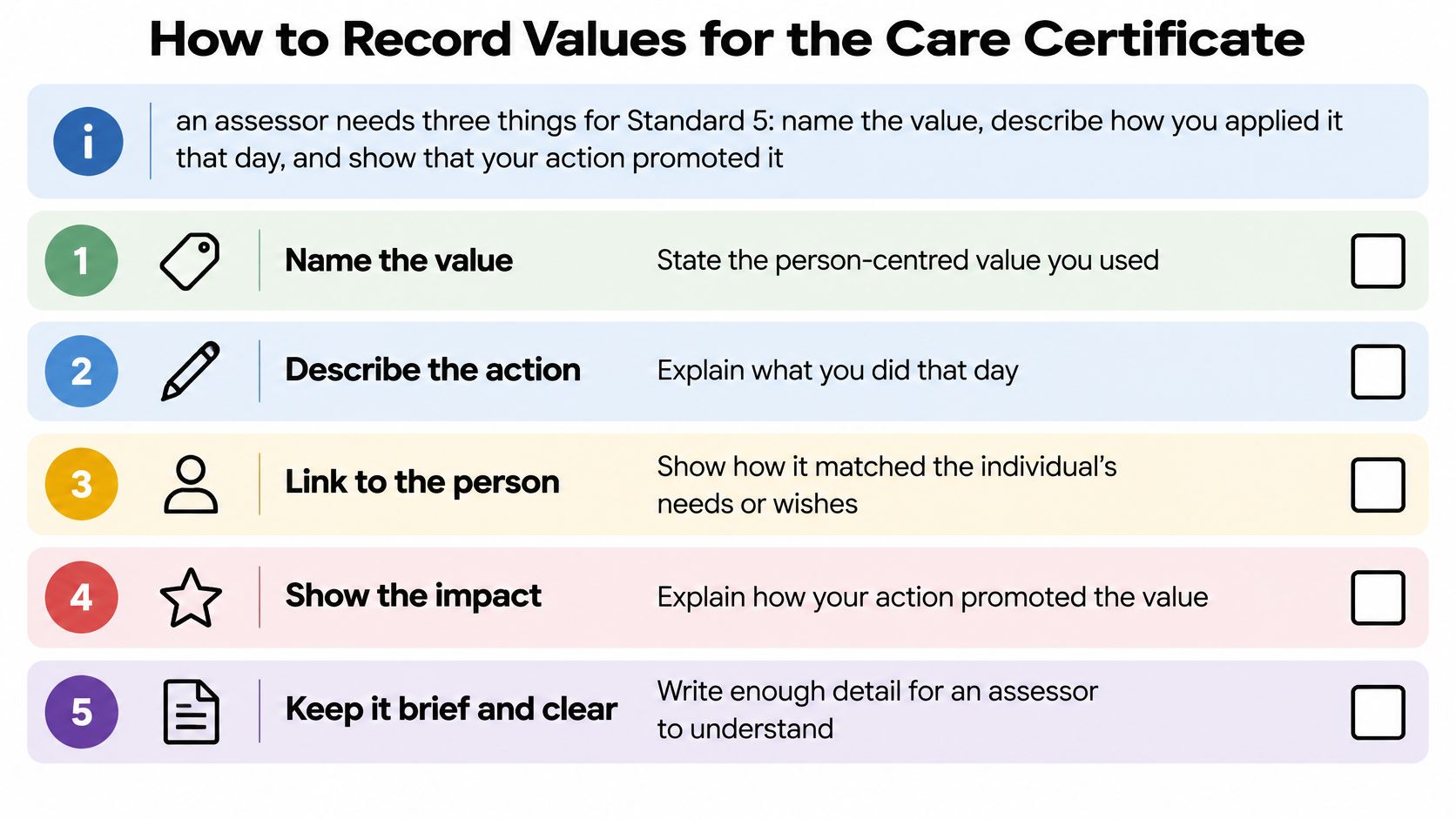
An assessor needs to connect the value, your action and its effect on the person. Naming dignity without explaining what you did is too vague; describing a completed wash without identifying the person's involvement leaves the important part missing.
Use our Care Certificate guidance to understand the wider learning context, then make each example specific to your own work. A reflective account supports assessment, but it doesn't replace required workplace observation.
Build a record someone else can follow
- Name the value you used. Identify privacy, choice, independence or another relevant value rather than claiming every value automatically.
- State the person's preference. Use their words where accurately recorded, or describe the known cue and how you checked its meaning.
- Describe your action. Explain what you did, what you offered and what you deliberately left for the person to do.
- Record the decision context. Include relevant consent, capacity concerns, safeguards and the involvement of others without copying unnecessary sensitive detail.
- Note the outcome and review point. State what happened, whether the approach worked and what should trigger another discussion.
Weak: I promoted dignity by providing personal care.
Stronger hypothetical example: Mrs Khan prefers a wash at the basin after breakfast with the door closed. With her agreement, I set out the flannel and she washed her face herself. I waited outside as requested, following her agreed support arrangements, and she called when ready for help.
The stronger account shows a person, an action and an outcome. It also avoids implying that leaving someone alone is automatically appropriate: the method must fit their assessed needs and agreement.
This checklist gives you another way to review your evidence.
Make each value checkable
These hypothetical care-plan lines show how a preference can remain visible when someone else takes over. They aren't wording to copy without checking with the person.
| Value | Pressure to resist | Checkable care-plan evidence |
|---|---|---|
| Individuality | The standard early-morning routine | Prefers breakfast before washing; discuss any proposed change with them |
| Rights | A blanket restriction for convenience | Wishes to access the garden; use the individually agreed support arrangements |
| Choice | A relative selecting every meal | Ask the person directly about meals; involve their relative as requested |
| Privacy | Keeping the door open for easier observation | Requests a closed bathroom door; agree how staff will remain available |
| Independence | Staff taking over because dressing is slow | Sets out and fastens clothing independently; offer help only when requested |
| Dignity | Discussing intimate needs during a busy round | Discuss continence privately and keep the person covered during assistance |
| Respect | Assuming a cultural or faith preference | Follow the dietary preferences the person has confirmed and review changes with them |
| Partnership | Agreeing revisions without the person | Include the person in reviews and invite their chosen supporter with consent |
Put the standing preference in the care plan, today's events in the daily note, and information the next worker must act on in the handover. Use a reflective account to examine your judgement and what you'd change.
Avoid copied policy language with no person, action or outcome. Supervision and incident learning should also examine whether staff followed the agreed approach, not just whether the workbook was completed.
Before submitting evidence, ask: could an unfamiliar assessor tell what mattered to this person and what you changed because of it?
Show the Values on Your Next Shift
Before your next shift, read what matters to the person, how they want support and who they want involved. Then ask something the plan doesn't answer. A preference recorded previously may still be accurate, but it shouldn't prevent a fresh conversation.
Choose a familiar activity for closer attention, such as helping with breakfast or getting ready to go out. Notice whether you offer a genuine decision, protect personal space and leave the person the part they can manage. Record any new preference before you leave, using the appropriate workplace system.
Ask for observation, not just reassurance
Invite your supervisor to watch a routine and identify where the person's preference was visible in your method, not only the result. Someone being dressed neatly doesn't prove they chose the clothes or received the assistance they wanted.
Bring a difficult scenario to supervision too. Explain what pulled against the person's preference, what you did and which decision needed further advice. If your account ends with staff choosing the usual routine, examine whether that was necessary or just familiar.
- Check your own contribution: Distinguish your actions from decisions made by a senior worker or another professional.
- Keep evidence honest: Record an unresolved disagreement as unresolved, including who you informed and what needs follow-up.
- Look for a change: Identify what you would repeat or adjust when a similar situation arises.
Our guide to person-centred practice offers another starting point for reviewing everyday support. Learners who want structured preparation can use our Person Centred Care course to rehearse these situations before discussing workplace examples with an assessor.
The aim isn't an impressive paragraph in a portfolio. It's a recognisable pattern: the person influences the support, you respond within your role, and the next worker can understand what was agreed. That makes your evidence useful to both the assessor and the person receiving care.
Our Person Centred Care course covers choice, dignity, independence and involvement in decisions, while our Care Certificate Bundle supports people new to care with mandatory training and the full suite of courses required to complete the Care Certificate. Visit Cura Academy to choose training that matches your learning needs, then bring a specific shift example to your supervisor or assessor.