
You're starting a shift, reading a completed care plan, when the person you're supporting asks to have breakfast before getting washed. The handover says personal care comes first. There's no obvious safety reason for that order, but everyone's used to it, and you're already watching the clock.
Table of Contents
- Why Person Centred Practice Matters
- Understanding the Core Concept
- Key Aspects of Everyday Practice
- How to Put Person Centred Practice Into Action
- Person Centred Practice in Action
- Common Misconceptions and Practical Challenges
- Build Competence Through Training
- Your Person Centred Practice Checklist
Why Person Centred Practice Matters
In that situation, a worker might speak warmly, explain the morning routine and gently persuade the person to follow it. Nothing sounds unkind. Yet the person's preference still hasn't changed what happens.
That's the difference between being polite and working in a person centred way. Kindness matters, but it doesn't replace influence over everyday decisions. A person should be able to recognise their own priorities in the support they receive, not just find their name on a standard plan.
A completed plan isn't the same as involvement
The Care Quality Commission's community mental health findings illustrate the distinction: 38% of respondents to its 2024 survey said they didn't have a care plan; among those who did, 70% reported substantial involvement in agreeing it, while 36% of respondents reported no choice about how care and treatment would be delivered and 28% didn't feel in control.
These findings concern community mental health services, rather than every care setting. Nevertheless, they offer a useful warning for any worker: documentation and lived experience aren't interchangeable.
Practical rule: Judge a plan partly by what staff do differently because of it.
In the breakfast example, the important question isn't whether staff recorded a preference somewhere. It's whether they checked the reason for the existing routine, considered any relevant risks and changed the order where appropriate.
Person centred practice matters because ordinary decisions affect how much control someone retains. When to get dressed, who helps with intimate care and whether there's time to contact a friend aren't minor details because they happen every day.
For workers, the responsibility is practical: connect what matters to the person with what happens. For managers, it includes checking whether schedules, staffing arrangements and handovers allow workers to honour those priorities. Neither a caring attitude nor a detailed document can do that work alone.
Understanding the Core Concept
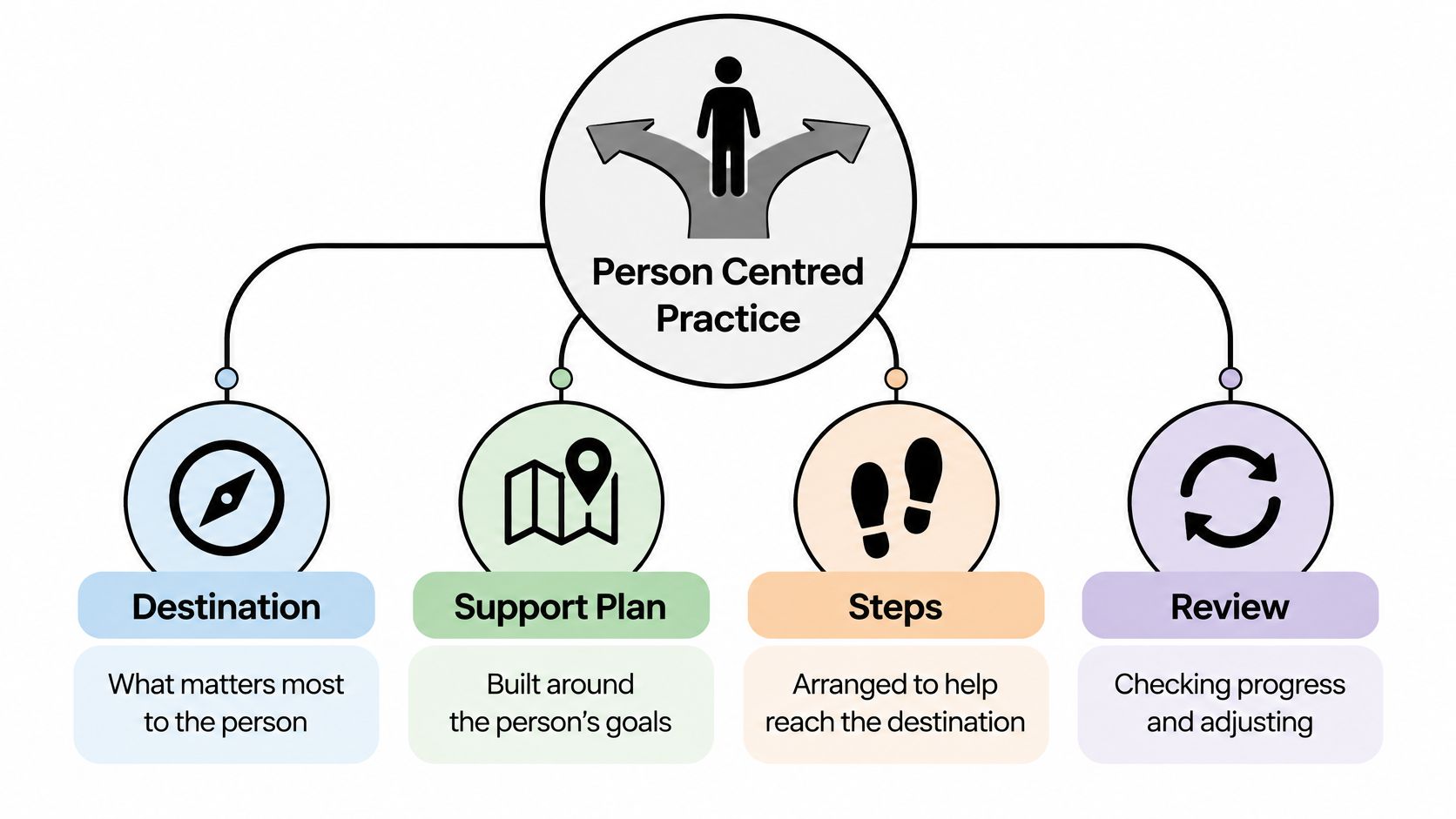
Think of support as planning a journey. The destination is what the person wants their life to include, such as preparing their own meals, returning to a community activity or feeling confident at home. The support plan is the map, not the destination itself.
Starting with the organisation's timetable reverses that relationship. Staff arrange the available tasks, then expect the person to fit around them. Starting with the person means asking what those tasks should help them achieve.
The diagram connects the destination with planning, action and review.
Personal knowledge and professional knowledge belong together
Person centred practice means making decisions with someone, using their goals, values, preferences, strengths and circumstances alongside relevant professional knowledge. It doesn't mean asking what they want and abandoning them to work out the rest.
NHS England's evidence on personalised care describes shared decision-making in these terms and identifies more realistic expectations, a closer match between choices and personal values, and fewer unnecessary interventions as benefits.
The essential elements serve different purposes:
- Choice means having meaningful options, rather than being asked to approve a decision already made.
- Control means having influence over how support happens.
- Participation means contributing in a way that works for the person, including through supported communication.
- Dignity means treating identity, privacy and personal boundaries as important throughout.
- Outcomes describe what the person wants support to make possible.
A person might want to cook again. A professional might identify difficulties with standing, fatigue or handling equipment. Neither perspective should cancel out the other. Together, they provide the starting point for a workable approach.
When several services contribute, resources discussing care coordination for older adults can help readers think beyond an individual appointment to the wider support arrangement.
The map must also remain open to revision. Someone who previously enjoyed group activities may now prefer quieter company. Don't treat an old preference as a permanent instruction, or assume that changing direction means the original plan failed.
Key Aspects of Everyday Practice
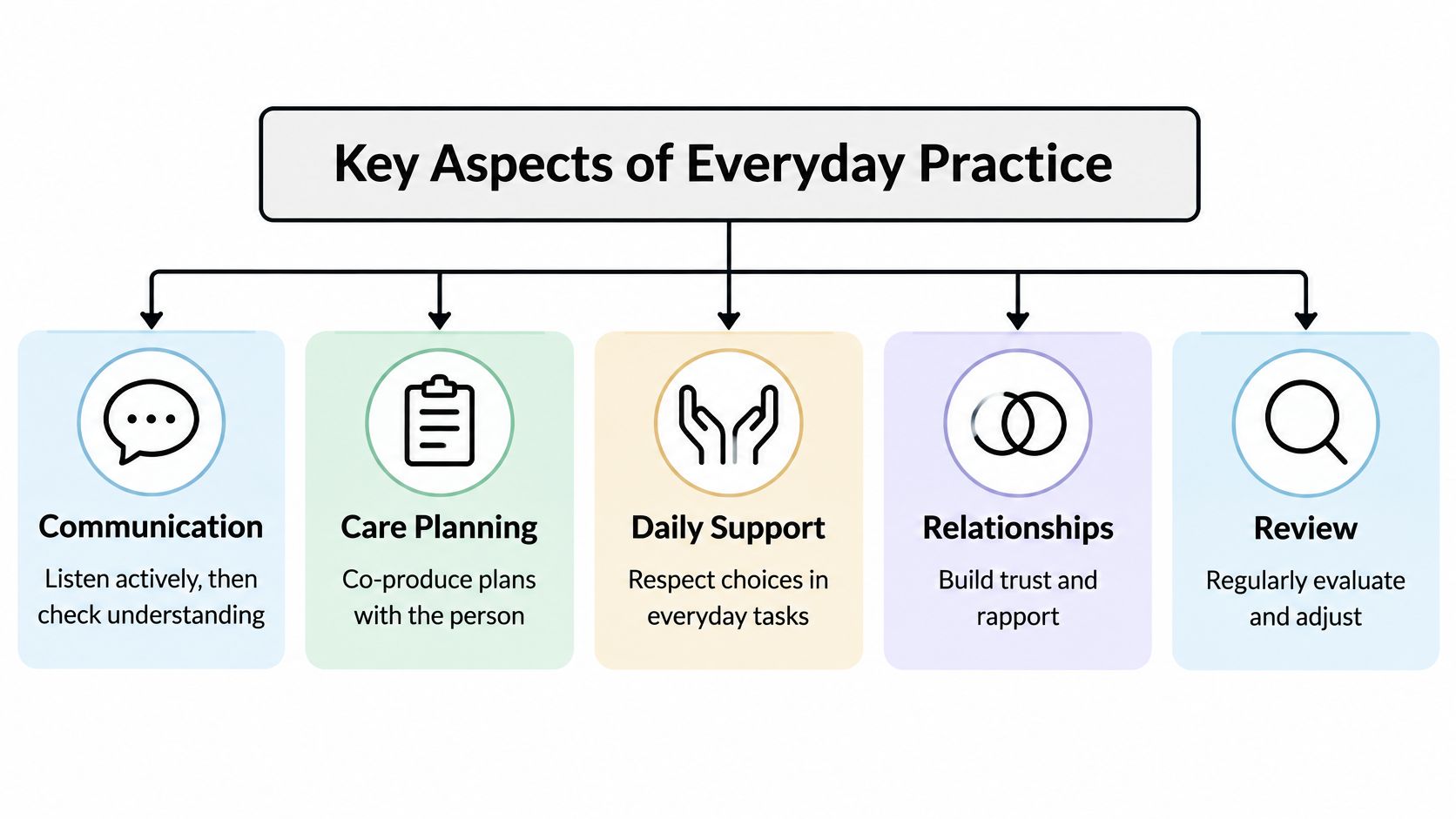
A worker can finish every assigned task without finding out whether the person spent the day as they wished. That's why daily practice needs attention to communication, planning, practical support, relationships and review, rather than task completion alone.
England's Adult Social Care Outcomes Framework commentary for 2024–25 reported partially met or unmet needs among people receiving long-term support concerning how they spend their time at 84.0%, control over daily life at 78.4%, and social contact at 69.9%.
These findings give workers concrete areas to explore. Don't stop at asking whether someone is comfortable. Ask whether they're able to do things they value and maintain relationships that matter.
Listen for meaning, not just an answer
Communication involves noticing how someone expresses agreement, uncertainty or distress. Use their preferred communication method, allow processing time and check understanding without making the conversation feel like a test.
For reflection on your own habits, VoiceType's tips to improve communication skills offer a general resource. Pair broader communication learning with the care-specific context of communication in health and social care, particularly when considering sensitive conversations and supported involvement.
Make the plan useful at the point of care
A co-produced plan should help another worker understand more than what needs doing.
- Communication should identify how the person prefers to receive information and express decisions.
- Care planning should connect assessed needs with desired outcomes, agreed actions and the person's involvement.
- Daily support should preserve what the person can do, rather than automatically taking over.
- Relationships should include the people, cultural connections and ordinary interests the person values.
- Review should establish how staff and the person will recognise whether support is working.
Risk enabling belongs within this work. As a practical approach, consider the person's wishes, their understanding of the decision, the assessed hazards and the support that might make the activity possible. Follow your organisation's assessment and escalation procedures rather than making unsupported decisions outside your role.
For example, don't reduce a gardening request to whether the person can walk outside unaided. Explore whether seating, suitable equipment or assistance would help them participate. The useful question is what support is needed, not only whether risk exists.
How to Put Person Centred Practice Into Action
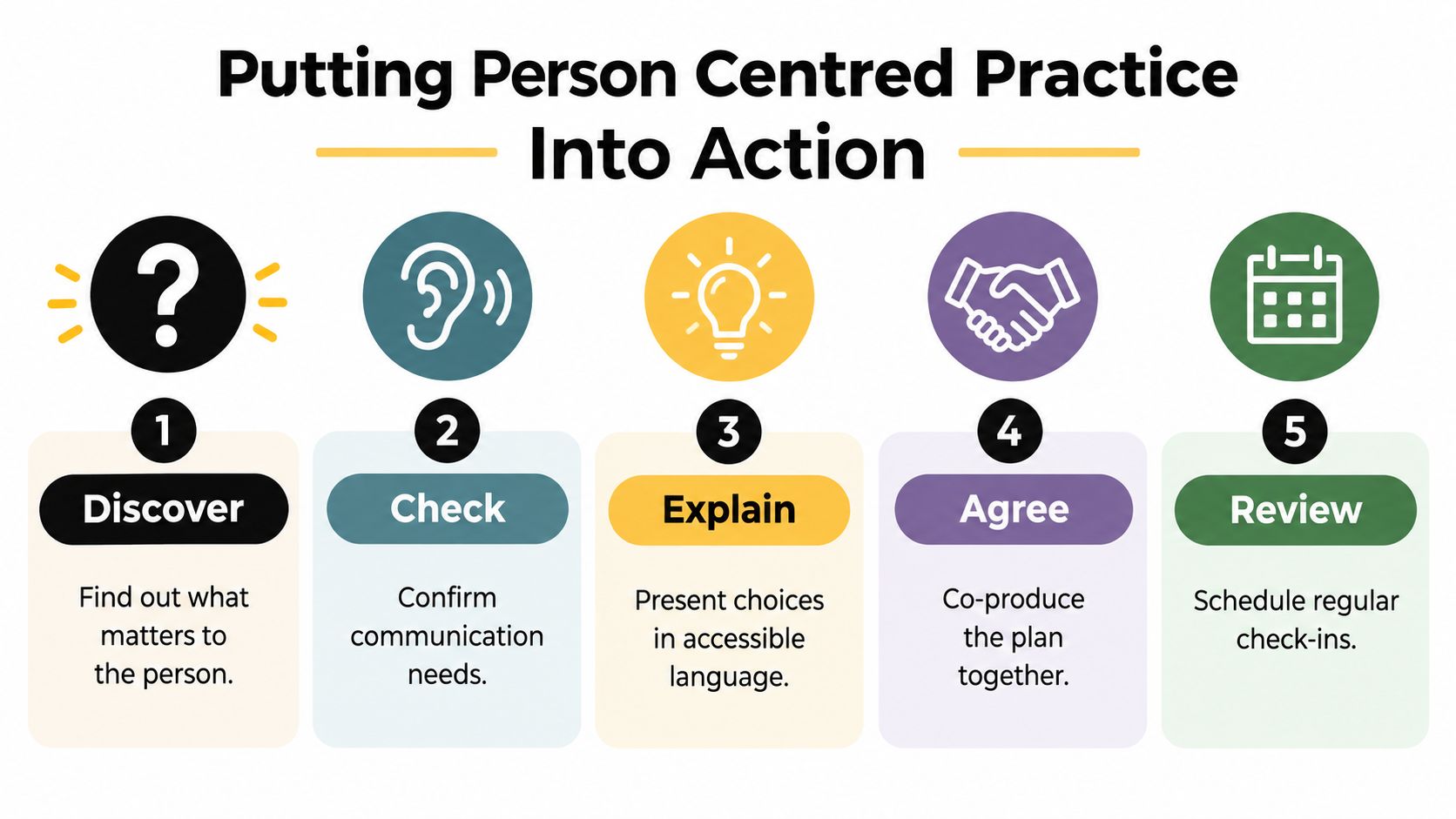
Use a repeatable sequence, but keep the conversation human. The aim isn't to collect identical answers from everyone. It's to reach an agreement that the person understands and the team can deliver.
This visual provides a prompt for moving from discovery to review.
Discover before proposing a solution
Begin with what matters now. Ask what the person would like help to achieve, what's difficult and what they want to continue doing themselves. Check whether pain, tiredness, language, hearing or the surroundings are affecting the conversation.
Then explain available options in accessible language. Include relevant benefits, concerns and practical limits, without making your preferred option sound like the only acceptable answer. The guidance on how to promote choice offers a useful companion for reflecting on how you present alternatives.
Put Person Centred Practice Into Action
| Practice Stage | Worker Action | Outcome to Check |
|---|---|---|
| Discover | Ask what the person wants support to make possible. | The goal reflects their priorities. |
| Check | Confirm communication needs and the support wanted for participation. | The person can contribute meaningfully. |
| Explain | Discuss realistic options and relevant risks. | The person understands the available choices. |
| Agree | Record the chosen approach, responsibilities and necessary support. | Everyone knows what they've agreed to do. |
| Review | Check experience and progress, including after changes. | The approach remains suitable. |
An agreement needs an owner. If the person wants help attending a community activity, identify who will check transport, who will confirm assistance and who will tell them what's been arranged. Don't leave these actions under a vague instruction to encourage independence.
Use the video as a discussion prompt, then consider how you'd apply the sequence in your own setting.
Useful prompts include:
- At assessment ask what a better day would look like for the person.
- At handover check what has changed and which agreed actions remain outstanding.
- At review ask whether the support achieved what the person hoped, rather than only whether staff delivered it.
Record the person's preference, relevant reasoning, agreed action and review trigger. Distinguish what they said from your own observation or interpretation.
For example, record that someone declined a particular activity and explain any reason they chose to give. Don't convert that into a broad statement that they dislike social contact. Accurate wording helps the next worker offer support without inheriting an assumption.
Person Centred Practice in Action
The following scenarios are illustrative, not reports of actual cases. Each shows a point where a worker's response can either preserve the person's influence or remove it.
A domiciliary visit with competing priorities
A person wants to dress before breakfast because eating in nightclothes feels undignified. The visiting worker's task list puts breakfast first. Rather than insisting on the usual order, the worker checks whether there's a care-related reason for it and, where appropriate, supports dressing first.
The person-led response isn't agreeing to a request. It's recognising the reason behind it and making an appropriate adjustment. Record the preference so another worker doesn't restart the same disagreement at the next visit.
A planning meeting dominated by others
During a meeting, a relative repeatedly answers questions directed to the person receiving support. The worker acknowledges the relative's contribution, then gives the person space to respond using their preferred communication method.
If accounts differ, record whose view is whose. Don't write that the family agreed when the person's own preference remains unclear.
A relative's reassurance that everything is fine isn't a substitute for finding out how the person experiences their support.
A valued activity with an identified risk
A person wants to visit a familiar garden but has recently become less steady. A weak response is an automatic refusal. An equally weak response is proceeding without checking the current assessment or available assistance.
The worker should seek the appropriate assessment and agreement, exploring supported access rather than treating the activity as either completely safe or impossible. If the planned support isn't available, record the unmet preference, explain what happens next and escalate it to the responsible colleague.
The CQC's assessment of health and adult social care in England reported concerns that activities described as person centred weren't always reflected in the experiences of people with dementia, including people confined to rooms with little social contact. That makes it important to check actual opportunities, not just activity schedules.
A rushed handover that loses the purpose
A handover says to assist with dressing but omits that the person is preparing for a valued family visit. The next worker sees a task, not a time-sensitive goal.
Include the purpose, current agreement and outstanding action. If a delay threatens the visit, name who needs to resolve it rather than passing on an unexplained warning.
Common Misconceptions and Practical Challenges
Person centred practice doesn't mean unlimited choice. Workers still need to explain professional concerns, respect other people's rights and act within their role. The mistake is using these responsibilities as a blanket reason to avoid exploring alternatives.
Nor does a person-led approach guarantee less risk. Someone may value an activity despite understanding its disadvantages. The worker's job is to seek an appropriate, supported decision, not promise a life without uncertainty.
Don't confuse disagreement with inability
A person who rejects professional advice isn't automatically unable to decide. Equally, apparent agreement doesn't prove they understood what was proposed.
When there are concerns about decision-making ability, seek guidance through the appropriate process. The explanation of mental capacity assessment is relevant preparation, but reading guidance doesn't replace a required assessment or advice from the responsible professional.
When you're unsure: Describe the concern precisely and escalate it. Avoid using labels such as difficult or non-compliant in place of an explanation.
Be honest about constraints without treating them as final
A worker may understand someone's preference yet lack the time, authority or staffing to meet it. Pretending the option is available creates a promise the service may not keep. Saying nothing can leave the person believing their wishes don't matter.
Use a practical response:
- Identify the priority by asking which part of the request matters most.
- Explain the constraint without blaming the person or hiding behind a vague reference to policy.
- Explore an adjustment that preserves as much of the intended outcome as possible.
- Record the unresolved need rather than presenting a temporary compromise as the person's ideal choice.
- Escalate clearly to a named role, explaining the effect on the person and the decision needed.
Fragmented services create another difficulty: everyone may assume someone else is following up. If a referral delay changes what's achievable, seek an interim agreement and clarify responsibility for updates.
Share relevant information through approved channels and follow your organisation's confidentiality procedures. A useful handover gives the next team enough context to act, without circulating unrelated personal details.
Build Competence Through Training
Knowing the definition of person centred practice won't necessarily help a worker respond when a relative interrupts, a person declines support or a preferred activity conflicts with the rota. Those situations call for rehearsal, feedback and judgement.
Use supervised practice alongside formal learning. A supervisor can observe how you offer options, review the language in your records and help you recognise assumptions you didn't notice during the interaction.
Practise decisions, not just definitions
A productive learning activity uses a realistic disagreement. Ask a colleague to play someone who wants a different routine, then practise explaining the available options without steering them towards the easiest answer for staff.
Afterwards, review specific behaviours:
- Involvement means checking whether you gave the person space to express an unexpected preference.
- Reasoning means being able to explain why you proposed an adjustment or sought advice.
- Continuity means checking whether another worker could understand and carry out the agreement from your record.
For structured learning, Cura Academy is a UK-based training and membership option offering essential care training, Care Certificate standards, mandatory refreshers and role-specific courses including Basic Life Support and Dementia Awareness. Its structured pathways, one-off bundles and organisational support can complement workplace induction and supervision.
The platform screenshot provides a reference for exploring its training offer.
Check learning in the workplace
Choose a relevant learning activity, apply it within your role and bring an anonymised example to supervision. Compare what you intended with what the person experienced.
For aspiring workers, this builds a way to explain professional judgement rather than listing completed courses. Existing staff and providers can use the same approach to identify where local routines need attention. Course completion records learning activity; observed practice helps demonstrate application.
Your Person Centred Practice Checklist
Use these questions during supervision, reflective practice or a team discussion about a specific care episode. Ask for examples rather than accepting a general assurance that staff know the person well.
- Personal priorities Can I identify what the person wants this support to achieve?
- Accessible involvement Did I use their preferred communication approach and check understanding?
- Meaningful options Could they influence the decision, including expressing disagreement?
- Useful planning Does the record connect their outcome with agreed actions and responsibilities?
- Supported autonomy Have relevant risks and enabling support been considered through the appropriate process?
- Continuity Will the next worker know what changed and what remains unresolved?
- Lived experience Has the person said whether the arrangement works for them?
Use the answers to change something
Don't turn the checklist into another document completed without discussion. Choose an answer that needs attention and agree a concrete response, such as correcting an outdated preference, confirming responsibility for a referral or reviewing an inflexible visit routine.
Person centred practice consists of small decisions made consistently, but the responsibility doesn't sit with the individual worker alone. Workers need teams and services that pass on information, resolve obstacles and check whether agreed actions happened.
The most useful final question is simple: what changed because we listened?
Cura Academy offers health and social care training that can support learning about person centred care and related workplace responsibilities. Visit Cura Academy to explore a relevant course or learning pathway, then bring a real practice question to your next supervision session.