
“Always say yes” is attractive advice, but it isn't a safe or honest care policy. A person may want a particular carer, visit time, provider, meal, activity or level of independence, while funding rules, staffing, geography, safeguarding duties or available services limit what can happen. Promoting choice means helping someone make a genuine decision within those conditions, not offering a menu of impossible promises.
The strongest practice sits between control and abandonment. Staff must explain the options, make risks understandable, check that the person has understood, record the decision and revisit it when circumstances change. That's how a legal entitlement becomes experienced control in everyday care.
Table of Contents
- The Reality of Choice in UK Social Care
- Building a Structured Decision Making Pathway
- Navigating Risk and the Mental Capacity Act
- Managing Expectations When Resources Are Limited
- Measuring and Auditing Choice Quality
- Embedding Autonomy into Training and Onboarding
The Reality of Choice in UK Social Care
More choice doesn't automatically produce better care. An unfiltered list of providers, support arrangements or daily activities can leave someone confused, particularly when they're living with dementia, communication difficulties, distress or several overlapping needs. A skilled worker narrows the conversation without taking the decision away, presenting realistic options in a form the person can use.
UK evidence shows that around one-third of the public wrongly believe social care is provided by the NHS and/or is free, while independence, choice and control rank below more tangible priorities such as increasing care capacity, according to The King's Fund analysis of public attitudes to social care. That misunderstanding matters. Someone who doesn't know who pays, what they may be eligible for or which organisation is responsible can't properly judge the choices in front of them.
For a new team leader, the first task is to separate three types of choice.
Three meanings of choice
Legal choice is what the person has a right to be involved in under the relevant legal and care framework. In England, personal budgets became mandatory for eligible people from April 2015 under the Care Act 2014. A personal budget states the amount allocated to meet assessed care and support needs, helping the person understand the resources available and participate in arranging support, as described by the National Audit Office review of personalised commissioning.
Available choice is what can be delivered in that person's area, budget and care setting. A preferred provider may have no capacity. A requested visit time may conflict with essential calls. A direct payment may offer flexibility, but the person may need support to manage it.
Informed choice exists when the person understands the options, consequences, costs, limitations and alternatives well enough to decide. Just asking, “Are you happy with that?” and receiving a nod isn't proof of understanding.
Practical rule: Don't measure choice by the number of options you mention. Measure it by whether the person can explain the decision in their own words and whether the service can deliver what was agreed.
Funding, location and navigation skills shape practical access to care. A person with strong family support and reliable transport may be able to consider alternatives that aren't realistic for someone living alone in a rural area. Digital forms can also exclude people who need paper information, an interpreter, advocacy or a slower conversation. Our guidance on barriers to health and social care explores how these obstacles affect access and decision-making.
The team's role isn't to hide constraints or use them as an excuse to stop asking. It's to explain them plainly, identify what remains possible and escalate the gap when the available service can't meet an important need.
Building a Structured Decision Making Pathway
Promoting choice works better as a guided pathway than as a conversation with no clear outcome. The Adult Social Care Outcomes Framework treats self-directed support and direct payments as indicators of choice and control, while the Care Act requires local authorities to explain personal budgets to eligible people and, in most circumstances, offer the option of a direct payment. The Adult Social Care Outcomes Framework definitions support a practical sequence that staff can apply in assessments, reviews and daily planning.
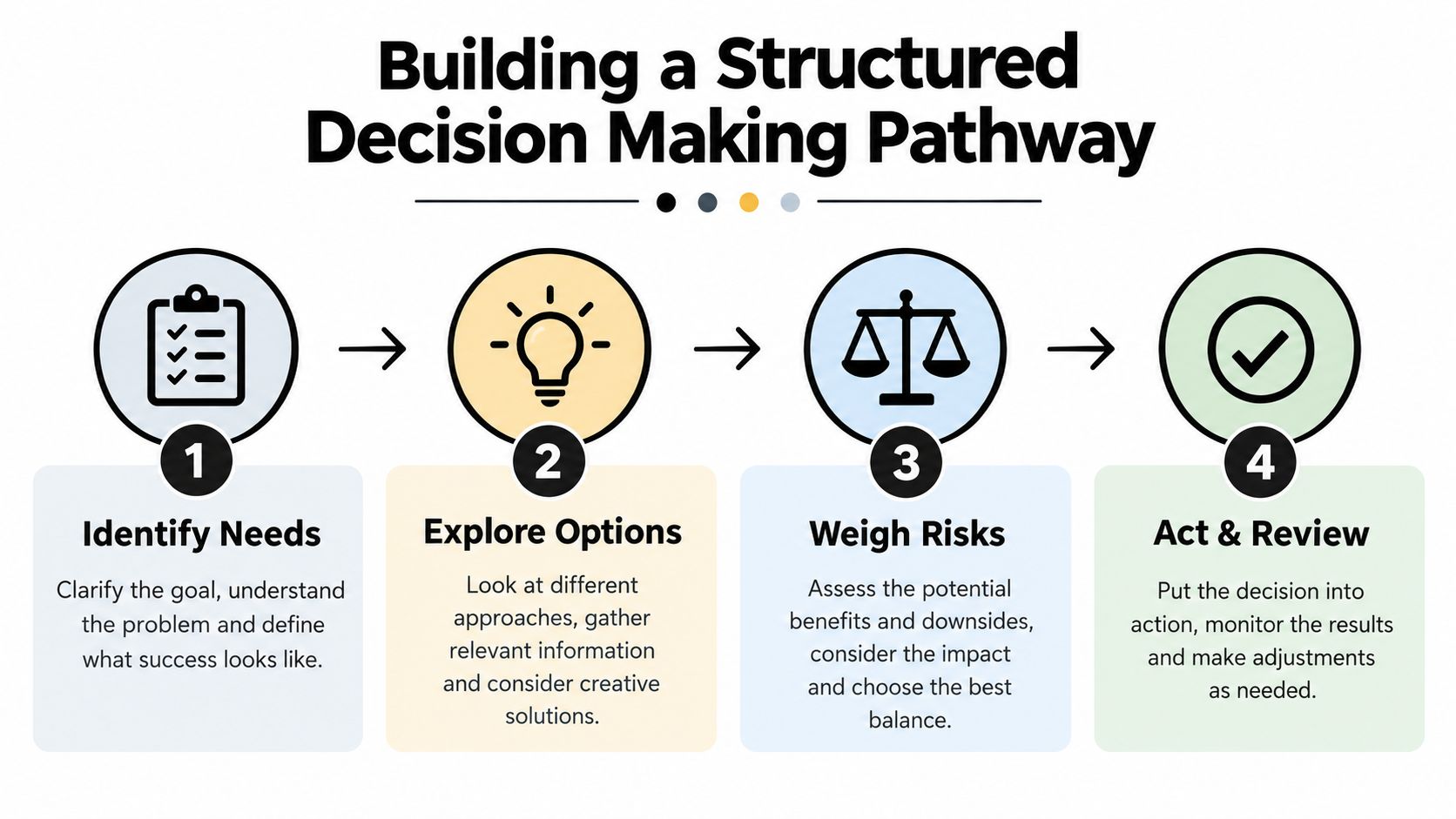
Start with outcomes, not services
Ask what the person wants to achieve before naming a service. “I want to keep attending my allotment” gives the team more useful information than “I need two visits a week”. The outcome might involve personal care, social contact, nutrition, faith, employment, family relationships or staying safe at home.
Record the person's words where possible, then identify the support need behind them. Note communication preferences, timing, cultural requirements and who the person wants involved. Don't assume that a family member's preferred arrangement is the person's own preference.
Make the resource boundary visible
A personal budget or agreed cost envelope gives the conversation a clear boundary. Explain what it covers, what it doesn't cover and which routes are available, including commissioned support, direct payments and other appropriate services. Avoid presenting a figure without explaining its practical meaning. A person needs to know whether choosing one arrangement leaves less flexibility elsewhere.
Use plain language and a written summary. If the person has difficulty processing information, offer an accessible format, extra time, advocacy or involvement from someone they trust.
Compare realistic routes and trade-offs
Present a small number of workable options rather than every theoretical possibility. For each option, explain the likely benefits, limitations, cost implications, staffing arrangements and risks. If the preferred provider has no capacity, say so and provide the nearest meaningful alternative rather than implying that the person chose freely from an empty list.
Teach-back is useful here. Ask, “Can you tell me what you understand about the options and what would happen next?” This checks the explanation, not the person. If their answer is incomplete, change your explanation rather than repeating the same words.
Record, act and review
The record should show the outcome sought, options discussed, the person's preferred option, any declined alternatives, identified risks, agreed safeguards and a contingency plan. Include who took part, what communication support was used and when the decision will be reviewed.
The review must test delivery, not just paperwork. Ask whether the chosen arrangement happened, whether it still meets the person's outcome and whether a change in health, staffing or finances has altered the available options.
For a concise visual explanation of the conversation, use the following video as a discussion prompt with staff:
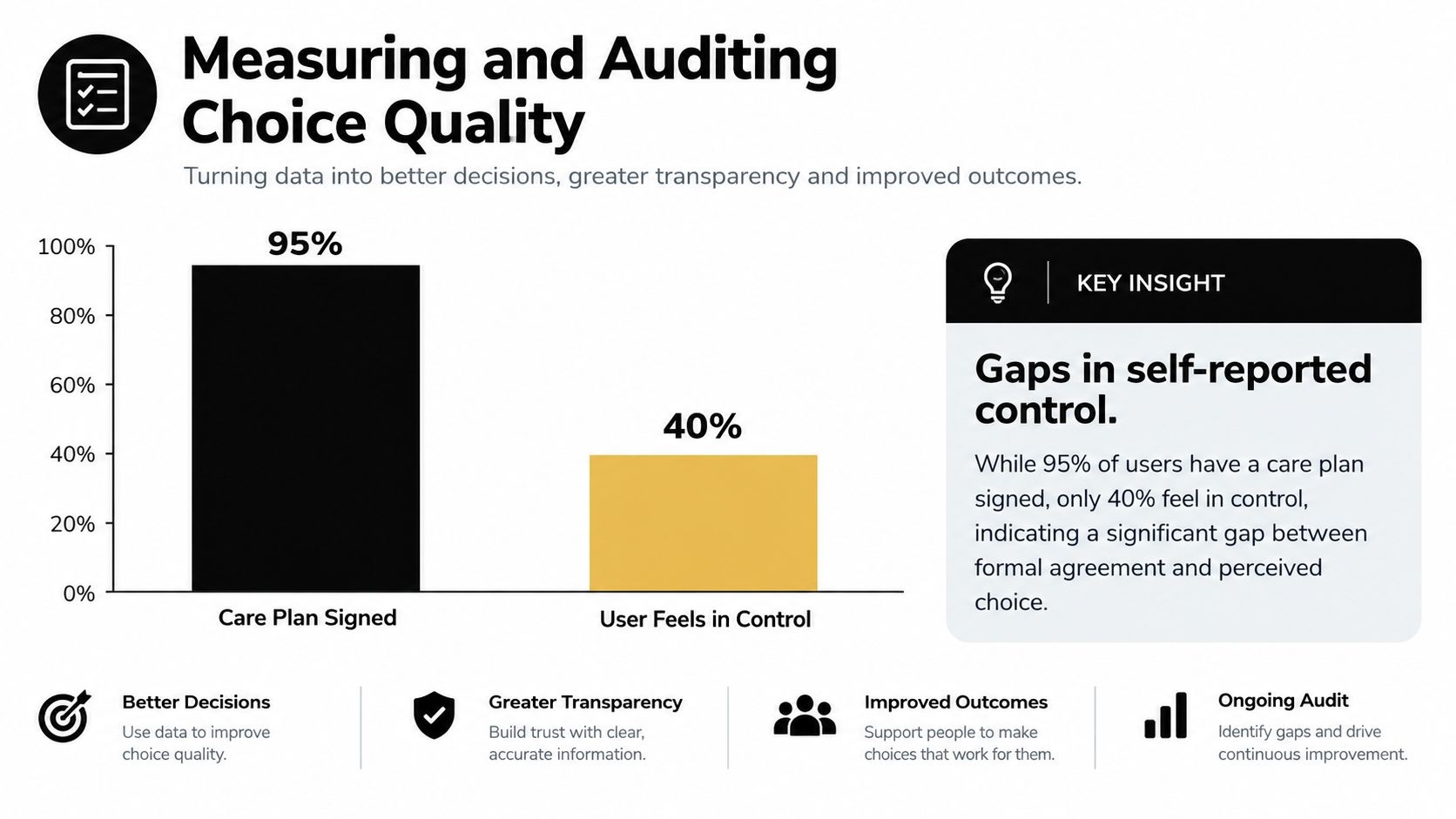
A signed care plan can show that information was provided. It can't, by itself, show that the person had adequate control over daily life.
Navigating Risk and the Mental Capacity Act
Risk is where many teams withdraw choice. A worker sees a possible fall, missed medication, choking incident or financial concern and selects the option that feels safest for the organisation. That may reduce immediate uncertainty, but it can also remove ordinary freedoms without properly considering the person's wishes, abilities and rights.
The Mental Capacity Act requires a decision-specific approach. Don't label someone as lacking capacity because they have dementia, a learning disability, a mental health diagnosis or because they've made a decision others consider unwise. Assess whether the person can understand, retain, use or weigh the relevant information, and communicate the decision by any appropriate means.

Separate unwise decisions from incapacity
An unwise choice isn't automatically an incapacity decision. An adult may choose to eat food that carries a manageable risk, refuse a suggested activity, spend money differently from how staff would spend it or decline a preferred care arrangement. The question is whether they understand the relevant consequences and can weigh them, not whether staff agree.
Before concluding that capacity is absent, remove avoidable barriers. Choose a time when the person is alert, reduce noise, use pictures or objects, arrange an interpreter, involve an advocate and break a complex decision into smaller parts. Record the steps taken to support the decision.
A useful risk assessment describes the person's goal alongside the hazard. “The person wants to walk to the local shop” is more informative than “community access risk”. It lets the team consider practical controls such as a walking aid, a route review, a phone, staff support, weather planning or a check-in arrangement.
Document a proportionate response
A defensible record should answer several questions:
- What matters to the person? State the desired activity or outcome and why it matters.
- What could go wrong? Describe the specific harm, not a vague reference to risk.
- How likely and serious is the harm? Use the organisation's approved approach, but don't let a score replace professional reasoning.
- What controls preserve the choice? Consider training, equipment, timing, supervision, environmental changes and contingency plans.
- What did the person understand and decide? Record their words where possible.
- Who reviewed the decision? Identify the responsible professional, family member, advocate or best-interests decision-maker where relevant.
If the person lacks capacity for that specific decision, follow the best-interests process. Involve the person as far as possible, consider their past and present wishes, consult relevant people and choose the least restrictive option that can meet the need. A best-interests decision isn't permission to impose the most convenient routine.
For practical support with the legal framework, Mental Capacity Act training can help staff practise capacity assessments, communication adjustments and best-interests documentation.
A good risk assessment doesn't ask, “How do we stop this person doing the activity?” It asks, “What support would make the person's preferred activity safer and still recognisable as their choice?”
Review the plan after an incident, near miss, health change or repeated refusal. Don't use one event as a reason to remove the option permanently unless the evidence and legal process support that decision.
Managing Expectations When Resources Are Limited
Unlimited choice is impossible when services depend on people being available to deliver them. In March 2025, adult social care homecare vacancy rates were just over 10%, more than double those in care homes, and adult social care vacancies remained around three times higher than in the wider job market, according to the Care Quality Commission's access findings. Staffing shortages therefore create a direct tension between a person's preference and what an agency can safely provide.
The answer isn't to stop asking what matters. It's to distinguish a preference from an essential need, explain the constraint early and offer a contingency that the person can clearly evaluate.
Speak plainly about the limit
Avoid vague language such as “we'll see what we can do” when the rota already makes the request unlikely. That creates an expectation the team may later break. A better explanation might be:
“You've said you prefer a female worker for personal care. We'll record that as your preference and try to meet it. At present, our available rota can't guarantee it for every visit. Let's discuss what you would want us to do if no suitable female worker is available.”
This wording acknowledges the preference, states the limitation and gives the person a role in contingency planning. It doesn't turn a staffing problem into the person's responsibility.
When a requested visit time is unavailable, explain the practical reason and compare alternatives. A morning call might support medication and personal care but require a different worker. A later call might provide continuity but affect breakfast, work or community activities. The person should know the trade-off before accepting the arrangement.
Offer alternatives that preserve the outcome
A substitute is meaningful only if it still addresses what matters. If the person wants continuity, offer a smaller consistent team rather than promising one worker. If the person wants privacy, explore gender matching, a support plan for unfamiliar workers and an escalation route. If the person wants to attend an activity, consider a different day, transport support or another provider, while being honest about what each option involves.
Use a simple record:
| Decision point | Person's preference | Current limitation | Alternatives discussed | Agreed contingency |
|---|---|---|---|---|
| Worker | Familiar staff member | Rota changes | Small named team | Review after staffing change |
| Visit time | Morning | Limited availability | Later call or revised task order | Escalate if essential need is missed |
| Activity | Local group | Transport unavailable | Different session or support route | Revisit at review |
CQC reporting has identified cases where staffing shortages or poor communication limited people's ability to request preferences such as the gender of a care worker. That makes documentation important, but documentation isn't the remedy on its own. Escalate recurring unmet preferences to the registered manager, commissioner or social worker when they affect dignity, safety, cultural needs or the viability of the care plan.
If the person declines every available alternative, record the refusal and the information provided. Don't describe it as non-compliance without explaining what choice was unavailable and what support was offered.
Measuring and Auditing Choice Quality
A completed care plan tells a manager that a process happened. It doesn't prove that the person felt informed, understood the options or experienced control. Choice needs its own audit trail, with measures that distinguish an offer from an outcome.
The national benchmark gives services a useful point of comparison. In England's 2023–24 data, 70.28% of people using adult social care reported having choice over services, while one reported local-authority result was substantially lower at 64.72%, as shown in the CQC data on choice over services. The gap demonstrates why a provider shouldn't rely only on a positive anecdote or an unweighted local questionnaire.
Track the four stages of real choice
Use four separate measures in file audits, supervision and service-user feedback:
- Choice offered: Did staff identify more than one realistic option where constraints allowed?
- Choice understood: Could the person explain the options, consequences and next step in their own way?
- Choice exercised: Did the person select an option, decline it or request a different arrangement?
- Choice sustained: Was the selected arrangement delivered and reviewed over time?
These measures expose different failures. A person may receive several options but understand none of them. Another may make a clear selection, yet the rota repeatedly delivers something else. A third may have genuine control initially, but lose it after a change in staffing or health.
Build a repeatable audit cycle
Start with a baseline using the same question and method each time. Ask whether the person has enough choice over the services they receive, then explore the decision points behind the answer. Map assessment, care-plan design, worker preference, visit scheduling, meals, activities, medication support and review arrangements.
Next, identify the operational barrier. It may be poor communication, inaccessible information, limited provider capacity, late rota changes, an unclear budget or staff anxiety about risk. Choose a targeted response, such as teach-back practice, an accessible information pack, a preferred-worker matching process or a clearer escalation route.
Remeasure using the same question and weighted methodology where national comparability is intended. Don't compare a small convenience sample with a national indicator and call the result a trend. Record who was excluded, why they were excluded and how communication needs were accommodated.
Segment what the headline hides
Review findings by communication need, capacity, language, care setting and type of support. A service can appear strong overall while people who need an interpreter, advocacy or non-digital information experience far less control.
The National Audit Office found user-level evidence of benefits for most personal-budget users, but local-authority-level analysis found no association between higher personal-budget uptake and overall satisfaction or other outcomes. Personal-budget uptake is therefore a process measure, not proof that people experienced better choice. Audit the quality of the decision and the person's experienced control separately.
Agreement is not autonomy. A person can agree because they understand, because they feel pressured, or because the explanation never gave them a workable alternative.
Embedding Autonomy into Training and Onboarding
Staff won't promote choice consistently if onboarding treats it as a definition to memorise. New workers need to practise the conversations that become difficult on a busy shift, including refusals, risk, changing preferences, unavailable staff and family disagreement.
Start with a clear internal policy. Define what staff can decide during a visit, what requires a senior review and how they must record a preference that can't be met. Include expectations for accessible communication, consent, capacity, safeguarding, direct payments and escalation. Then connect each requirement to a realistic scenario.
Turn mandatory learning into daily behaviour
A useful onboarding pathway includes:
- Define the standard: Show how person-centred care, dignity, consent and self-directed support appear in care plans and handovers.
- Practise the conversation: Role-play a person requesting a preferred worker, refusing support or choosing an activity with a manageable risk.
- Test understanding: Require staff to use teach-back rather than relying on yes-or-no confirmation.
- Review the record: Ask new workers to write a preference, limitation, risk control and contingency in plain language.
- Supervise the first decisions: A senior worker should review early examples and correct vague entries such as “client happy” or “family agrees”.
Training on the Mental Capacity Act should sit beside safeguarding, dementia awareness and the Care Certificate rather than being treated as a separate legal module. Staff need to understand that protecting someone from every risk can be as restrictive as ignoring a foreseeable harm.
Managers can also borrow a useful distinction from The OKR Hub's guidance on autonomy at work, which links autonomy with clear outcomes and boundaries. In care, that means staff can use professional judgement within defined limits, while managers remain accountable for oversight, escalation and safe systems.
Make autonomy visible on every shift
Add a short choice prompt to handovers: What matters to the person today? What preference changed? What option wasn't available, and what alternative was agreed? Review a sample of records in supervision and look for evidence of the person's voice, not only staff actions.
Use spot checks to observe whether workers offer options, explain changes before acting and respect a refusal. Recognise good judgement, especially when a worker raises an unmet need instead of accepting a poor arrangement without comment. For staff building their confidence and compliance profile, person-centred care training can reinforce the link between formal learning and frontline decisions.
The team culture should make room for honest limits. Staff must be able to say, “We can't provide that exact option today, but here are the alternatives and I'll escalate the gap,” without being criticised for failing to deliver an impossible promise.
Cura Academy helps aspiring and existing care workers build job-ready competence through Care Certificate learning, mandatory refreshers and practical role-specific training in one place. Visit Cura Academy to strengthen your understanding of person-centred care, the Mental Capacity Act and the everyday skills that help people make informed choices.