
You've just changed a pad, you're running behind, and the next call bell is already ringing. Your gloves are off, the bin is across the room, and you need the door handle, the notes folder, and then another resident's drink. That's exactly where the chain of infection either breaks or keeps going. It isn't a poster to memorise for training. It's a quick check you can run during every task: where are the germs, how could they reach someone else, and what's the earliest point where you can stop them?
Table of Contents
- The Six Links of the Chain at a Glance
- Why the Chain Matters in UK Care Settings
- Following One Infection Through a Care Home
- Prevention Measures That Break Each Link
- Handling Links You Cannot Remove at Home or in Agencies
- How Breaking the Chain Limits Antibiotic Resistance
- Confirm Your Infection Control Training Before Your Next Shift
The Six Links of the Chain at a Glance
| Link | What it means | Care-setting example |
|---|---|---|
| Infectious agent | Bacteria, viruses, fungi or parasites that cause disease | Norovirus in soiled bed linen |
| Reservoir | Where the agent lives and multiplies: people, animals, food, water or the environment | A colonised resident, or a contaminated commode or sink |
| Portal of exit | The route the agent takes out of the reservoir | Coughed droplets, faeces, urine or wound discharge |
| Mode of transmission | How the agent moves to a new person | Contact via hands, droplets, airborne particles or shared equipment |
| Portal of entry | The route into a new body | Nose, mouth, eyes, wounds, catheter or cannula sites |
| Susceptible host | A person who can catch the infection | A frail older resident, someone with an open wound, or an unvaccinated person |
How the Sequence Runs
The links work as cause and effect. An infectious agent needs a reservoir where it can survive and multiply, then it needs a way out. Faeces leaving the bowel, droplets leaving the mouth, and discharge leaving a wound are all portals of exit, even though they look very different on shift.
Next, something has to carry the agent. Hands, gloves you've kept on too long, a shared hoist sling, a commode, or droplets in the air can all become the mode of transmission. If that agent then reaches eyes, broken skin, a catheter site, or another person's mouth, it has found a portal of entry.
The final link is the person. A susceptible host isn't just someone who's already ill. It might be a resident who's frail, dehydrated, recovering from surgery, living with a wound, or missing a vaccination. Age alone doesn't decide it, and a colleague with cracked skin on their hands can be susceptible too.
Remove any one link and the sequence stops. You don't have to fix all six at once.
That last point is where learners often get stuck. You can't always remove the agent or cure the reservoir, but you can block exit, interrupt transmission, protect entry, or reduce susceptibility. If you're also supporting people in their own homes, practical infection prevention at home gives a useful plain-language companion for applying the same six links outside a care home.
On your next task, name the links in order without fanfare. It takes seconds, and it turns a vague instruction to be careful into a specific decision about gloves, cleaning, hand hygiene, or escalation.
Why the Chain Matters in UK Care Settings
Infection isn't a rare complication at the edge of care. The UKHSA advisory board paper on preparedness for infectious disease threats estimates that an infection diagnosis is the primary reason for hospital admission in approximately 7 to 10% of all admissions, equivalent to about 1.2 million admissions annually, and that infections account for 25 to 30% of emergency admissions. In 2019 to 2020, England recorded approximately 280,000 admissions for pneumonia.
Those hospital figures start much earlier, often in the places where you work. A resident who can't clear secretions, a client whose catheter care is rushed, or a wound that isn't protected can move from manageable risk to emergency care. The chain matters because it shows you where that journey could've been interrupted.
A Working Tool on Every Task
Think of dominoes standing in a row. The row falls only while every piece stays upright and close enough to knock the next one. Remove one piece and the fall stops. A pad change without gloves, hand hygiene missed after a commode clean, or laundry carried against your uniform puts the missing piece back.
Every routine task touches at least one link. Washing hands targets transmission, changing a dressing protects a portal of entry, bagging linen at the bedside controls exit, and cleaning a commode reduces a reservoir. You don't need a confirmed diagnosis before you act, because standard precautions assume any blood or body fluid could carry an agent.
Before your next task, ask one question: which link am I about to touch? Then check the matching control is ready before you start, not halfway through with contaminated gloves on.
Following One Infection Through a Care Home
At 2 a.m., a resident develops sudden diarrhoea. Her gut is the reservoir, but the cause is not yet known. It could be infection, medication, or something she ate. The first missed break is treating the episode as only a cleaning job instead of recognising that it may be a source of infection.
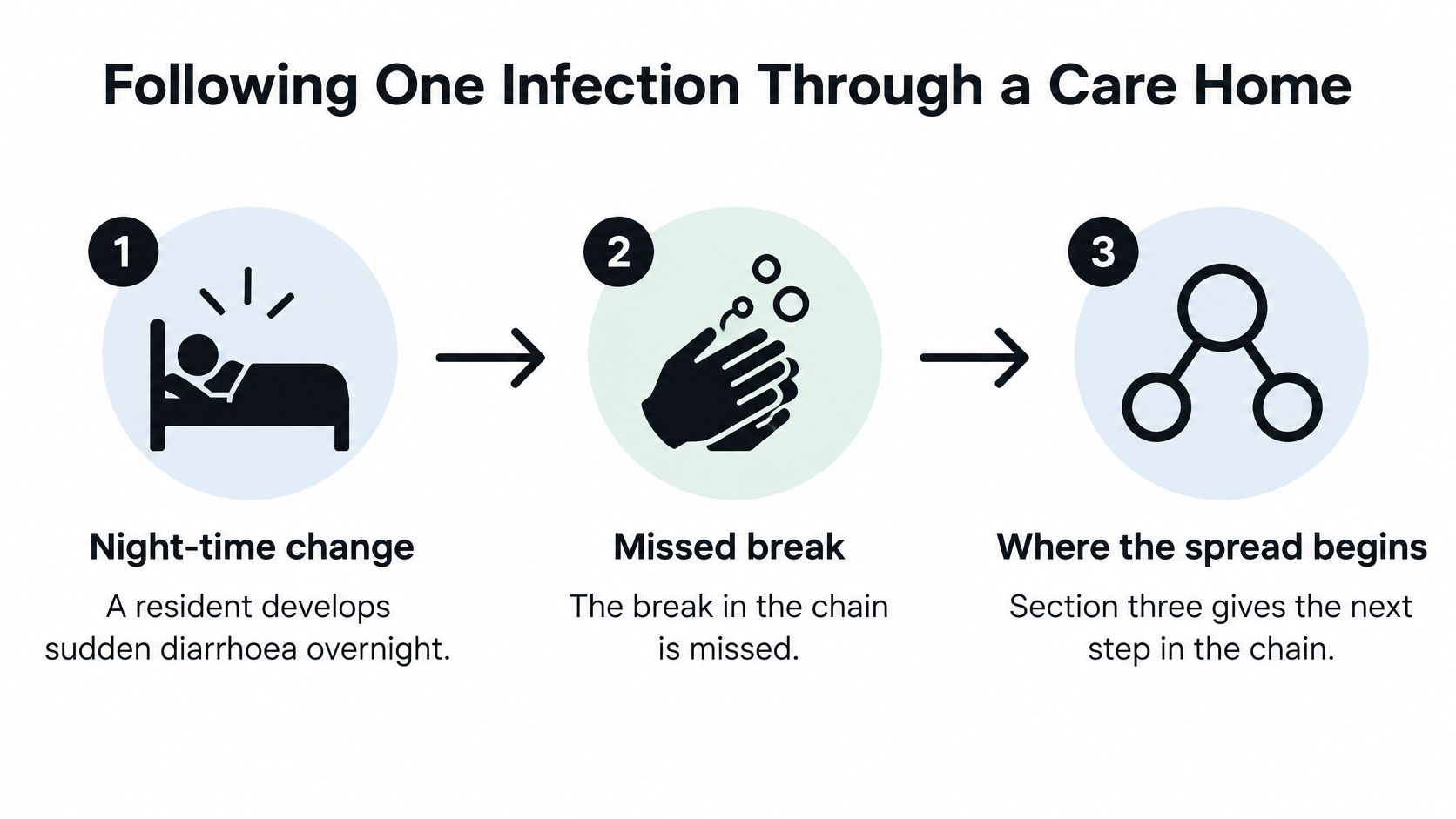
Faeces reach her pad, nightdress, and bed linen, creating a visible portal of exit. If the linen is left in a bag on the floor rather than contained at the bedside, contaminated material can spread around the room. Bag it where it is removed.
A carer changes the pad without gloves because the dispenser is empty. She then opens the door, steadies the drinks trolley, and picks up a pen. Her hands become the mode of transmission. The missed break is the lack of suitable protective equipment and hand hygiene before touching other items; the shift action is to pause, obtain what is needed, and clean hands at the right points.
Where Entry and Susceptibility Meet
Later, a colleague eats lunch at the staff room table without washing their hands after helping with the trolley. Hand to mouth provides a portal of entry. In the next bedroom, a frail resident with a urinary catheter has a direct entry route and may be more vulnerable to infection. Keep the care task and the possible route of spread in view, rather than assuming the two residents have the same risk.
The video below can help you trace each link in this scenario. Pause at each one and identify the missed break and the action that could stop the chain.
A person can carry an organism without appearing unwell, and may still pass it on. The UKHSA blog on breaking the chain of infection explains how interrupting transmission helps prevent infection. Keep that possibility in mind when symptoms are unclear: follow infection-control procedures and report changes through the care home's usual process.
Respiratory infections follow the same chain, but organisms may leave in droplets or sputum, travel through air or on hands, and enter through the nose or mouth. If a resident becomes hot, flushed, or unusually drowsy, use this guide to recognising and managing fever in care to help decide what to record and escalate.
After an incident, write down the six links, match each one to what happened, and mark the first missed break. That pinpoints where a practical shift action could have interrupted the chain.
Prevention Measures That Break Each Link
| Measure | Links it breaks | Where care workers use it |
|---|---|---|
| Hand hygiene (WHO five moments) | Mode of transmission, portal of entry | Before and after every resident contact, and after touching their surroundings |
| Personal protective equipment | Portal of entry, portal of exit | Gloves and apron for personal care, masks and eye protection for splashes or respiratory spread |
| Environmental cleaning and decontamination | Reservoir, mode of transmission | High-touch surfaces, commodes, equipment and bathrooms, cleaned before disinfecting |
| Vaccination | Susceptible host | Staff and resident influenza and COVID-19 programmes |
| Isolation and cohorting | Mode of transmission, portal of exit | Single rooms for infectious residents, or a dedicated group of residents and staff |
| Safe handling of linen, waste and sharps | Reservoir, portal of exit | Bagging soiled linen at source, clinical waste disposal and sharps containers |
Hand Hygiene Without the Guesswork
Use the WHO five moments: before patient contact, before an aseptic task, after body fluid exposure risk, after patient contact, and after touching patient surroundings. The fifth moment catches people out. Bed rails, call bells, locker handles, and curtains count as surroundings.
Use alcohol hand rub when your hands aren't visibly soiled. Use soap and water when they are visibly dirty, and after caring for someone with diarrhoea or vomiting. Gloves don't change the rule, because hands can be contaminated during removal and through tiny defects you can't see.
PPE and Cleaning Do Different Jobs
Put PPE on before the task and choose it for the risk in front of you. Gloves and an apron suit likely contact with body fluids, while a mask and eye protection are for splash risk or respiratory spread. Remove PPE in the order your local policy sets, dispose of it immediately, and clean your hands straight afterwards.
Cleaning is not wiping until a surface looks better. Clean first to remove dirt and organic matter, then disinfect with the correct product for the stated contact time. Start with high-touch points such as door handles, taps, commode arms, bed controls, and shared equipment. If you're comparing approaches across facilities, Castus insights on healthcare infection prevention is a helpful extra read on reducing environmental risk.
Practical rule: Hand hygiene and PPE don't replace cleaning or source control. They work alongside them.
For wounds, aseptic technique protects the portal of entry while dressings contain discharge at the portal of exit. Our overview of wound care basics for care workers covers the preparation and non-touch principles that support that break. Keep clean and used items apart, and don't put a clean dressing pack on a bed that's just held soiled linen.
Vaccination, isolation, and cohorting reduce risk at the ends of the chain. Vaccination makes the host less susceptible, while a single room or a dedicated staff group limits contact between a source and other people. Use them with, not instead of, the task-level controls in the table.
Handling Links You Cannot Remove at Home or in Agencies
Domiciliary and agency work breaks the classroom version of the chain. You may arrive to find no hot water, no soap, uncollected rubbish, a commode shared by the household, or a client who won't stay in one room while unwell. That doesn't mean you've failed. It means the link you can't remove needs recording, compensating controls, and escalation.
Proportionate Precautions in Someone Else's Home
Standard precautions apply to every client, whether or not infection is known. Add extra PPE for a specific risk, such as likely contact with faeces, vomit, blood, wound discharge, or a known respiratory infection. Wearing gloves for making tea or holding a hand usually adds no protection, can damage skin, and may spread contamination if you keep them on between tasks.
Use what you can control. Carry your hand hygiene supplies according to local policy, create a clean field on a wiped tray or towel, bag waste at the point of use, and keep your uniform and bag away from soiled bedding. Ask politely for soap, a clean towel, or access to hot water, and explain which task needs it.
Escalate in Four Steps
- Record it today: Write the concern in the care log on the same shift, using facts rather than blame.
- Tell the office: Contact the care manager or agency coordinator before the next visit if the risk will repeat.
- Ask for a response: Request a risk assessment, equipment, extra time, or a second worker where the task needs it.
- Follow policy on unsafe tasks: Use your agency's process if a task can't be done safely, and don't improvise sharps or waste disposal.
Agency staff need an arrival habit too. Ask whether there's an outbreak, find handwashing and waste facilities before personal care starts, and read what the care plan says about infection risks, allergies, wounds, and devices. Five minutes of questions can prevent you walking an organism from one setting to the next.
How Breaking the Chain Limits Antibiotic Resistance
Breaking the chain is also an antimicrobial resistance intervention, even when nobody has an infection yet. Every infection you prevent is an infection that doesn't need assessment for antibiotics. Fewer antibiotic courses mean less selection pressure, which is the process that helps resistant organisms survive and spread.
The picture isn't settled. The UK government announcement of the five-year plan to combat antimicrobial resistance reports that NHS England found human antibiotic use was 5% below the 2019 baseline by December 2025, but 67.3% of use came from the preferred Access category, below the 70% target. It also reports that the specified set of drug-resistant infections was 22.7% above the 2019 to 2020 baseline in the 2024 English outcome reported by UKHSA.
You don't prescribe antibiotics, but you influence what happens before prescribing is considered. Report new diarrhoea, cough, confusion, pain, breathlessness, or reduced urine promptly and accurately. Record when symptoms started, what you've observed, recent contacts, temperature if it's in your role, and any possible outbreak pattern.
Don't let loose language create pressure. Saying someone needs antibiotics because they're confused or has smelly urine doesn't identify a pathogen, and diarrhoea, cough, or confusion don't guarantee antibiotics will help. Clear observations give prescribers something safer to work with.
This week, you can support vaccination conversations, tighten one hand hygiene moment you often rush, and report one possible environmental reservoir you've been walking past. None of those actions requires prescribing. All three break the chain earlier.
Confirm Your Infection Control Training Before Your Next Shift
Infection prevention and control is part of the Care Certificate, and most employers treat it as mandatory training with regular refreshers. A certificate shows you've covered the knowledge. Competence is different, because a manager or assessor still needs to observe your hand hygiene, PPE use, and aseptic technique in practice.
Your Five-Step Check
- Open your training matrix: Check the infection control entry, expiry date, and whether your current employer can see it.
- Close any gap: If it's missing or out of date, choose training covering the six links, hand hygiene, PPE, cleaning and decontamination, waste and sharps, and cross-contamination.
- Save the evidence: Keep your certificate and send a copy to your manager or agency straight away.
- Find the local procedure: Ask where your service keeps its outbreak procedure and what number you call out of hours.
- Book observation: Arrange the practical check your employer requires, rather than waiting for an audit to find the gap.
Our Infection Control course covers infection prevention and control principles, how infections spread, hand hygiene, PPE use, cleaning and decontamination, waste disposal and sharps safety, and managing cross contamination risks. It gives learners an instant digital certificate upon completion. It's suitable for healthcare assistants, support workers, care workers, nurses, residential care staff, domiciliary care staff, agency workers, new to care workers, and all health and social care professionals.
If you're checking several subjects at once, our guide to mandatory training requirements for care workers will help you sort what's due now from what can wait. Don't rely on memory, and don't assume an old certificate from another employer has transferred. Ask for written confirmation that it's been accepted.
Do step one before your next shift. If the date is wrong, you'll know today while there's still time to fix it.
You can turn the chain from theory into shift-ready practice with focused infection control training that covers hand hygiene, PPE, cleaning, waste, sharps, and cross-contamination. Visit Cura Academy to check the course against your training matrix and complete your learning before your next shift.