
A service user feels hot and clammy during a morning visit. They're quieter than usual, their drink is untouched, and the thermometer gives you a number that makes you pause. The safe response isn't to reach immediately for medicine or cold water. It's to assess the person, identify risk, support comfort and fluids, and record what changes.
That is the central principle in how to manage fever in care settings. Fever is a signal, not a diagnosis. A lower temperature can be reassuring, but it doesn't prove that the underlying illness is improving. A person who's confused, struggling to breathe or unable to drink needs prompt attention even if the reading falls after an antipyretic.
Table of Contents
- What Fever Really Means in a Care Setting
- The First 10 Minutes of Assessment
- Comfort, Hydration and Observation
- Safe Medicine Administration Within Policy
- When to Call the GP, NHS 111 or 999
- Fever in Older Adults, People With Dementia and Children
- Infection Control, Documentation and Handover
What Fever Really Means in a Care Setting
In a care setting, fever functions as one data point within a broader risk assessment, not as a diagnosis in itself. A raised temperature may accompany infection, but the person's appearance, behaviour, breathing, fluid intake and response to you guide the next decision. Your role is to gather reliable observations, recognise deterioration and escalate concerns according to the care plan and local policy.
A person's usual temperature varies with the individual, time of day and measurement method. Feeling hot or shivery does not confirm fever, so use the approved thermometer and record how and when the reading was taken. One result has limited value without context. Check whether alertness has changed, drinks are being left untouched, urine output has reduced or breathing looks different from normal.
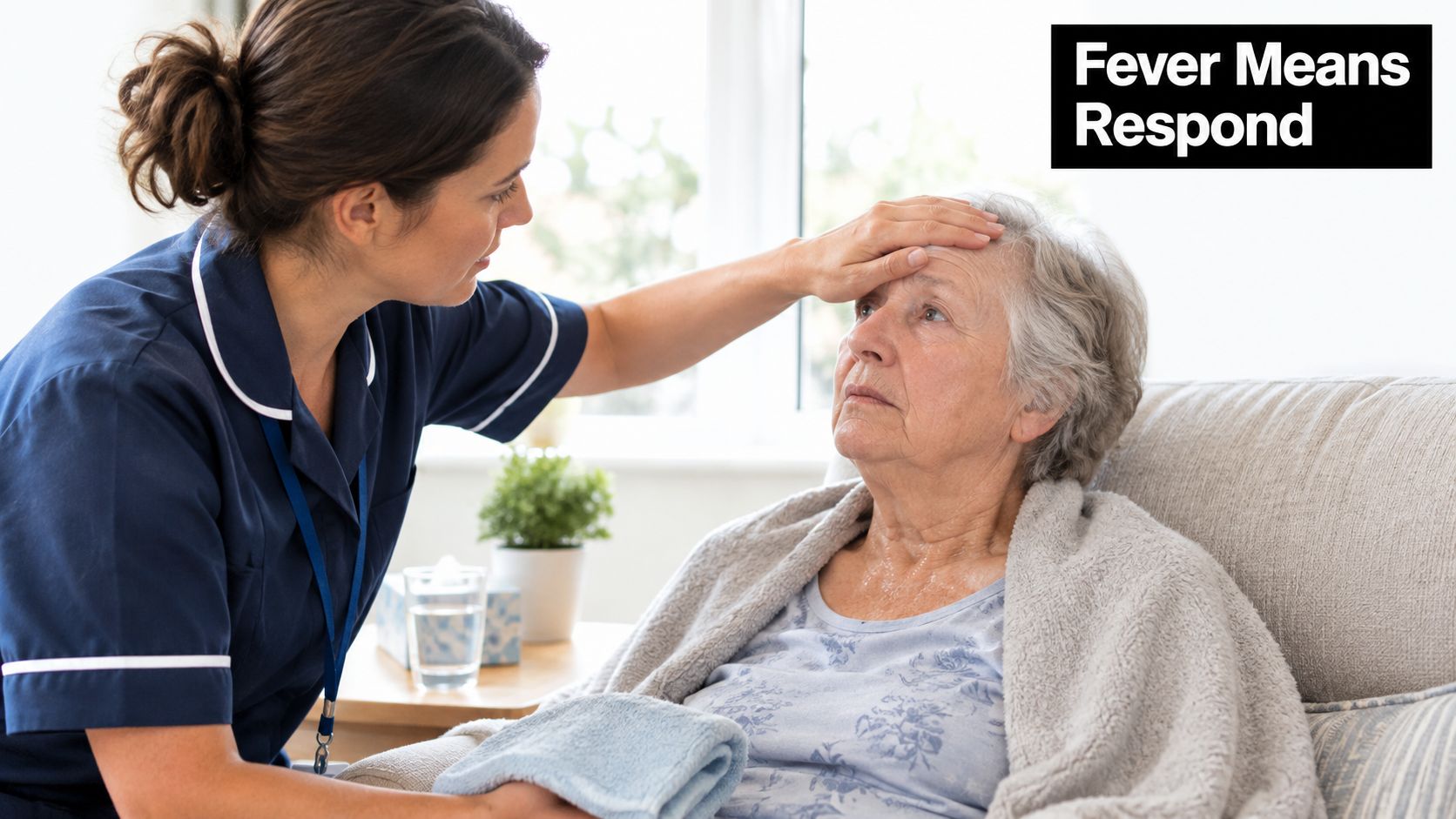
Practical rule: Treat the person, not the number.
This rule matters when a service user has dementia, communication difficulties or a fluctuating baseline. A new refusal to eat, a fall, unusual agitation or increased sleepiness may signal a meaningful change even when the temperature rise is modest. Compare the person with their normal presentation, ask colleagues or family what they have noticed, and keep your own observations specific rather than interpretive.
Why fever deserves careful assessment
Fever is common in young children, yet it can be an early sign of serious bacterial disease. NICE reports that between 20% and 40% of parents report a feverish illness in their child each year, making it probably the most common reason for a child to be taken to a doctor in the UK under-five age group. Feverish illness is also the second most common reason for a child to be admitted to hospital, as described in the NICE context for feverish illness in under-fives.
Many cases result from self-limiting viral infections, but that does not remove the need to watch for deterioration. NICE's traffic-light approach classifies green as lower risk, amber as intermediate risk requiring closer assessment, and red as high risk. Use the categories to support escalation decisions, not just to chase a normal thermometer reading.
Sick-day decisions also require care. Ibuprofen may be unsuitable when someone is dehydrated, so check the person's fluid intake, medicine instructions and local policy before giving it. For general background reading, Prime Journal health guides may help families, but they do not replace the care plan, NHS advice or urgent clinical assessment.
The First 10 Minutes of Assessment
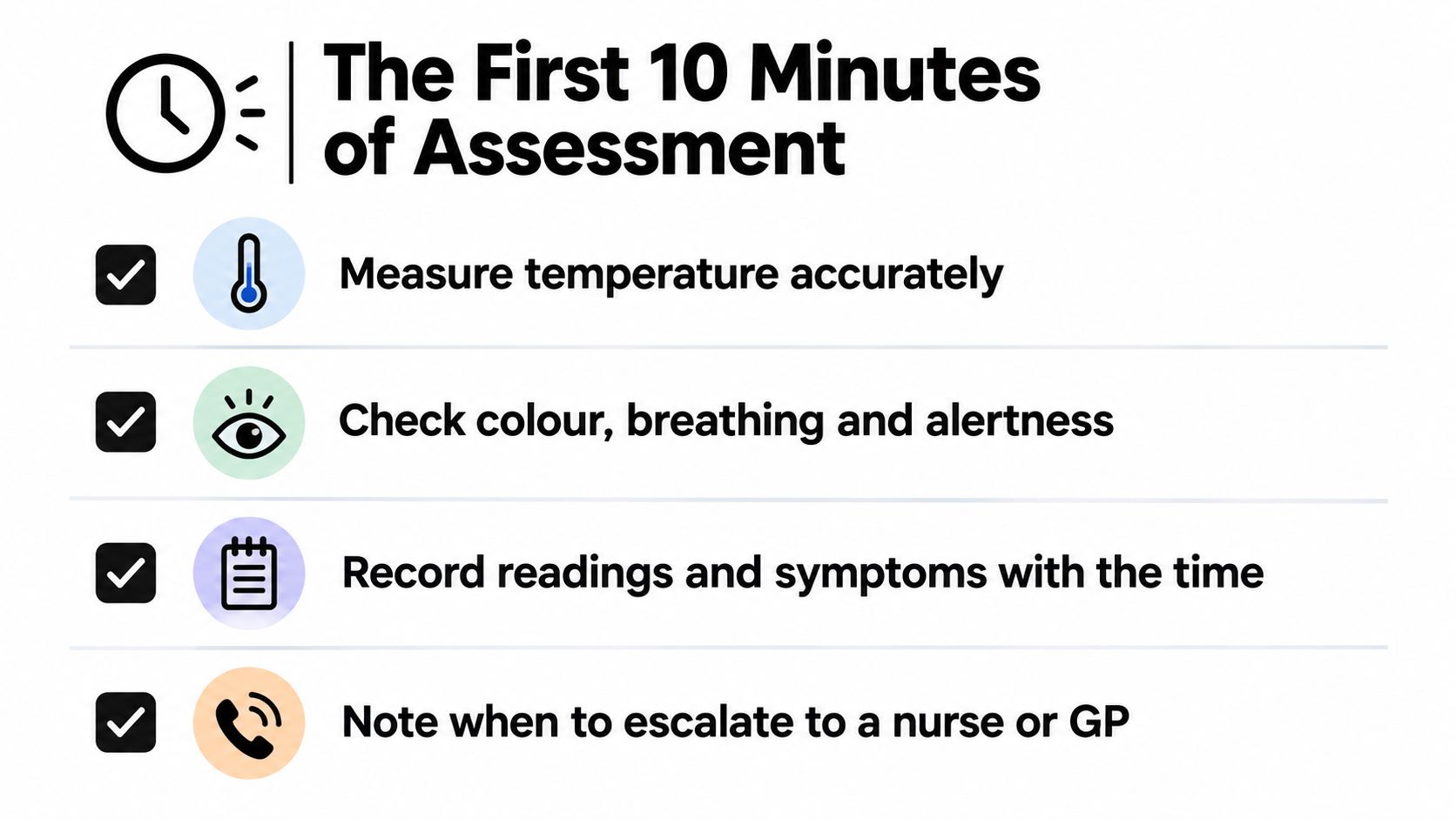
Start with a calm, structured check. You're not trying to diagnose the cause; you're gathering reliable information and identifying whether the person needs immediate escalation.
Look and listen before measuring
First, observe without rushing into treatment. Note whether the person is alert, responding normally and able to speak or interact in their usual way. Look at skin colour, including signs of blue, pale or mottled skin, and watch the chest for fast, laboured or noisy breathing. Listen for wheezing, grunting or difficulty completing a sentence.
Then check hydration. Ask when the person last drank and passed urine, and look for a dry mouth, unusual weakness, reduced urine or worsening drowsiness. For a child, note wet nappies, tears, mouth moisture and whether they're willing to breastfeed or take fluids. A new rash also matters. A non-blanching rash, which doesn't fade when pressed, requires urgent attention.
Measure the temperature using the equipment and method set out in the care plan. Record the result, time, method and any relevant circumstances, such as recent fluids, bathing or medication. Don't keep repeating a reading without recording it, because an undocumented number can't help the next carer or clinician.
Use traffic-light thinking
Use the NICE logic in plain terms:
- Green features: The person is alert, breathing comfortably, drinking reasonably and behaving close to their baseline. Continue observation and follow the care plan.
- Amber features: There's reduced drinking, less urine, unusual irritability, increased sleepiness, a change in behaviour or another concerning symptom. Seek advice through the appropriate route and increase observation.
- Red features: There's severe breathing difficulty, blue or mottled skin, a seizure, inability to rouse, confusion, shock-like signs or a non-blanching rash. Escalate urgently.
The thermometer reading should sit inside this assessment rather than replace it. Recheck the person after a suitable interval set by local policy, sooner if their condition changes. Record what you see, what the person tells you and what action you take.
Use this short training video as a prompt for the rhythm of an initial check, but follow your employer's procedures and clinical instructions for real situations:
Comfort, Hydration and Observation
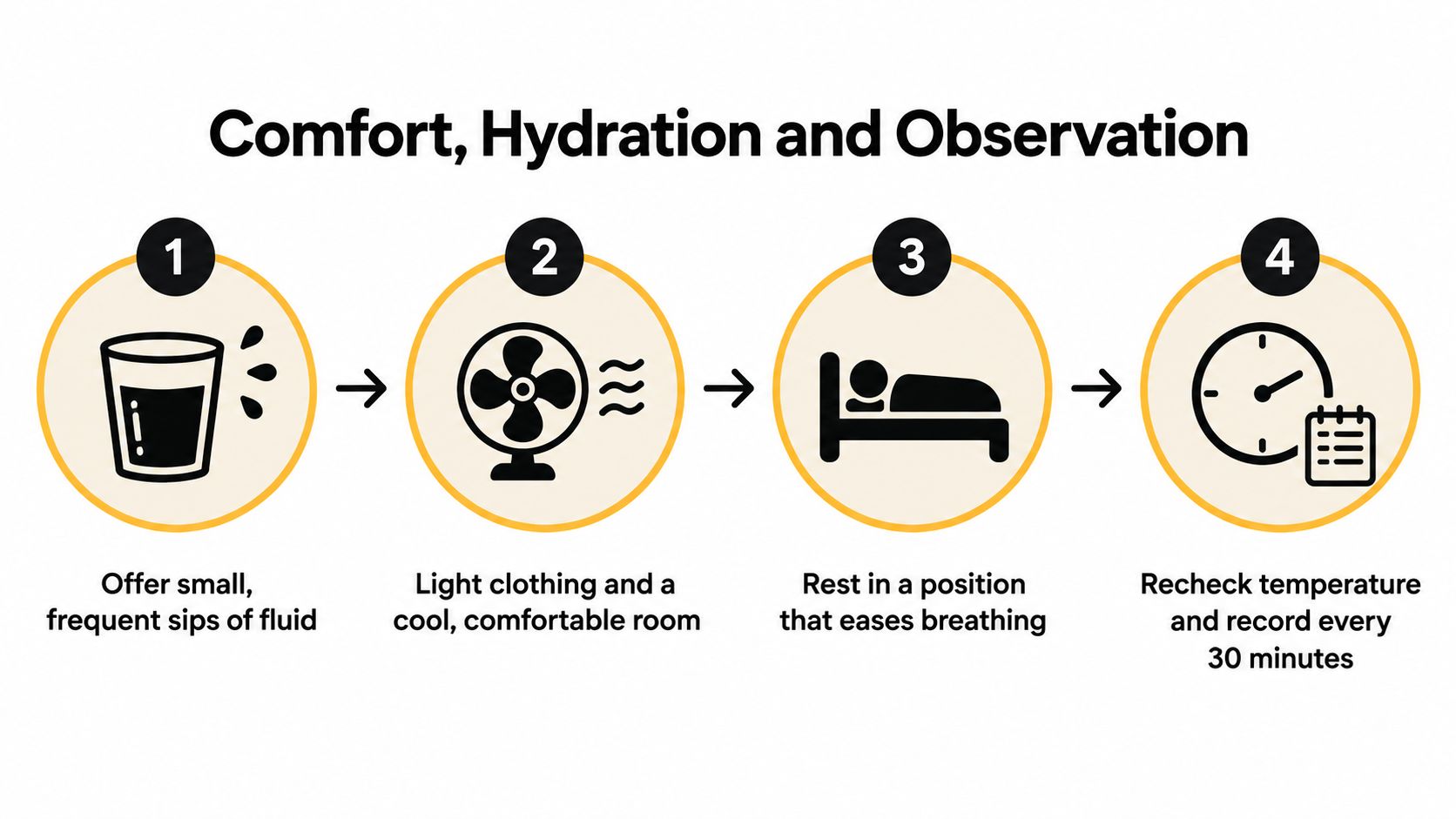
For a stable person, comfort and hydration are active care, not something you do while waiting for medicine to work. Fever can increase fluid loss, while sweating, vomiting, diarrhoea or poor intake can push someone towards dehydration. Offer fluids in a way the person can manage, such as small, frequent sips, unless a clinician has set a fluid restriction.
Adults may be able to choose water or another suitable drink. Continue breastfeeding for a feverish baby and offer age-appropriate fluids to children in line with the family's advice and care plan. Watch intake and urine output rather than assuming that a drink left at the bedside has been consumed.
Make the environment comfortable
Use light clothing and bedding, and keep the room comfortably cool rather than cold. Avoid over-wrapping, which can trap heat and make the person uncomfortable. Cold baths, ice packs and forceful cooling aren't routine fever care. They can cause distress and shivering, so focus on comfort and the cause of the illness instead.
Rest should be practical. Position the person so breathing is comfortable, keep essential items within reach and reduce unnecessary exertion. For someone with dementia, explain each action before you do it and maintain a familiar routine where possible.
NICE advises carers of feverish children at home to encourage fluids and watch for dehydration signs such as sunken eyes, a sunken fontanelle or a poor overall appearance. The guidance also recommends escalation if the child has a fit, develops a non-blanching rash, appears less well, or if the carer becomes more worried or unable to provide care, as set out in its safety-net advice quality statement.
Record the temperature, behaviour, fluids offered and taken, urine output and new symptoms each time you reassess. For structured learning on supporting safe drinking and nutrition, see nutrition and hydration training.
Safe Medicine Administration Within Policy
Medicine can improve comfort, but it doesn't turn a risk assessment into a safe one. Paracetamol or ibuprofen should be considered for distress or discomfort, not just to force the thermometer to a preferred reading. If the number falls but the person remains confused, breathless, difficult to wake or unable to drink, the risk remains.
Before giving anything, check the service user's Medication Administration Record, the label, the prescribed or authorised instructions, the dose and the time since the previous dose. Confirm that the product is suitable for that person and that another carer hasn't already administered it. Never combine cold-and-flu products containing paracetamol with separate paracetamol unless the instructions and care plan clearly allow it.
The ibuprofen and dehydration decision
Ibuprofen needs particular caution. Dehydration from fever, vomiting, diarrhoea or poor intake can increase kidney risk. An NHS-area sick-day guideline advises avoiding anti-inflammatory medicines such as ibuprofen while someone is dehydrated and restarting them only once normal drinking resumes, generally within about 48 hours, as explained in the sick-day rules guidance.
Don't give ibuprofen when the person is dehydrated, has relevant ulcer or kidney disease, has a relevant heart condition, is subject to pregnancy-related restrictions, has an allergy, or has been told by a clinician to avoid it. If you're unsure, pause and seek advice. A carer shouldn't make up a dose, substitute a product or alter a prescribed plan.
Medicine safety means checking the chart before reaching for the packet.
For children, dose selection must follow the product instructions, the child's age and weight information held by the parent or care plan, and professional advice where needed. Don't alternate paracetamol and ibuprofen routinely or give both together unless a healthcare professional instructs you to do so. Don't give ibuprofen to a dehydrated child.
A lower temperature after medicine is only one observation. Reassess comfort, alertness, breathing, fluid intake and urine output. For practical guidance on role boundaries and safe administration, see rights of medication administration.
When to Call the GP, NHS 111 or 999
Choose the escalation route by the person's condition, not by the temperature alone. Follow the care plan and local policy, and tell the clinician exactly what you observed.
| Trigger or symptom | Action to take | Timeframe |
|---|---|---|
| Fever isn't improving, symptoms are worsening, or the person has dehydration, behaviour change or new symptoms | Contact the GP or NHS 111 for clinical advice | Same day |
| Fever has lasted more than five days | Contact the GP or NHS 111, even if the person seems relatively comfortable | Same day |
| A child under three months has a temperature of 38°C or above | Seek urgent medical assessment | Urgently |
| A child aged three to six months has a temperature of 39°C or above | Seek urgent advice | Urgently |
| Severe breathing difficulty, blue, pale or mottled skin, confusion, reduced consciousness, a seizure, inability to rouse, a non-blanching rash or signs of shock | Call 999 or attend A&E according to the emergency response | Immediately |
| The carer becomes more worried or unable to provide safe care | Contact NHS 111, the GP or the emergency service according to severity | Promptly |
A child's fever lasting five days or longer is specifically a reason to seek further advice, and the same-day route is appropriate where dehydration or deterioration is present. Don't wait for the temperature to rise further if the person's condition is worsening.
NICE treats safety-net advice as a formal quality measure. Before ending a call, make sure you know what to watch for, what action to take and when to call back.
Use a clear handover script:
“I'm calling about [person and age]. The fever began [time]. The latest temperature is [reading], taken by [method]. They're [alertness and behaviour], breathing [description], drinking [amount or change], passing urine [change], and have [rash or other symptoms]. We gave [medicine, dose and time], and the condition is [improving, unchanged or worsening].”
Fever in Older Adults, People With Dementia and Children
An older adult may not mount a dramatic temperature response even with a serious infection. A change from baseline in behaviour, hydration or mobility often arrives before a confirmed fever.
Older adults
Look for new confusion, a fall, unusual weakness, loss of appetite, reduced movement or a sudden need for more support. Check whether the person is drinking less and review risks linked to kidney, heart or stomach conditions, as well as their regular medicines.
A modest thermometer reading does not explain away a worrying change. Compare the person's behaviour, breathing, fluid intake and function with their usual presentation, then act on the overall pattern.
People with dementia
A person with dementia may not describe pain, thirst or breathlessness reliably. Agitation, withdrawal, resistance to care, altered sleep, repetitive speech or loss of familiar skills may be the first visible signs of illness.
Approach slowly, explain each step and use short questions. Keep your tone calm, involve someone familiar where appropriate, and record the difference from the person's baseline. Refusing fluids is a clinical concern that needs assessment, not merely a behaviour-management response.
Children
Children need decisions based on age, symptoms and general condition. Very young babies with fever need urgent medical assessment, while older babies and young children have different thresholds for urgent advice. Follow the relevant NHS guidance, including the Royal Berkshire NHS fever guidance.
Do not alternate paracetamol and ibuprofen unless a health professional tells you to. If a child is dehydrated, seek clinical advice about ibuprofen rather than treating the next dose as routine. Reduced drinking, fewer wet nappies, worsening alertness or a change in breathing require prompt review.
For a child taking long-term medication, confirm whether the sick-day rule applies before pausing any regular prescription. Record that decision in the MAR and inform the family.
A lower temperature does not resolve poor drinking, abnormal behaviour or breathing difficulty. Continue observing the child's condition and escalate if it deteriorates.
Infection Control, Documentation and Handover
Accurate records connect observations across shifts. They show whether a fever is rising or settling, whether fluids are being accepted, and which medicines have already been given. Record the onset, every temperature with its measurement method, appearance, behaviour, breathing, fluid intake, urine output, medicine name, dose and time. Add calls to the GP, NHS 111 or 999, the advice received and the agreed review point.
During care, wash your hands before and after contact. Use gloves and aprons for the task and according to local policy, dispose of tissues safely, and clean shared equipment. Keep the person's space clean, limit unnecessary contact when infection is suspected, and follow workplace guidance on ventilation. See practical advice on infection control in care.
Clear documentation gives a district nurse, GP or ambulance crew a concise account of changes and actions already taken. Tools for transcribing infectious disease consultations may support accurate information handling, while confidentiality and recording requirements still apply.
Use this pocket checklist:
- Observe: Compare behaviour, breathing, colour and alertness with baseline.
- Measure: Record the temperature and method.
- Hydrate: Offer suitable fluids and monitor urine output.
- Review medicine: Check the MAR, label, dose, timing and dehydration risks.
- Handover: State what changed, what was given, advice received and who reviews next.
Cura Academy provides Care Certificate training, mandatory refreshers and role-specific courses for frontline settings. Visit Cura Academy to strengthen fever assessment, medicine safety and infection-control practice.