
You've just arrived for a shift, and the first thing you notice is small but uncomfortable to ignore. The dressing on a service user's leg has lifted at one edge, it feels slightly damp, and the skin around it looks pinker than it did yesterday. Nothing about that moment needs panic, but it does need a calm, organised response.
That's what wound care basics are for. In care work, you're often the first person to spot a change, the first to record it, and sometimes the first to decide whether the problem stays within routine support or needs a registered professional straight away. Wounds are also common and costly across the NHS, with a peer-reviewed cohort study estimating that the NHS managed approximately 3.8 million adult patients with a wound during 2017 to 2018, about 7% of the UK adult population, at a total annual cost of £8.3 billion. The same study estimated £5.6 billion was spent on wounds that had not yet healed, which is one reason basic wound knowledge matters in every setting where personal care happens. [^1]
The good news is that you don't need to be a nurse to do your part well. You do need to know what a wound is, what normal healing tends to look like, which changes matter, what you can safely do, what you must document, and when your role ends and clinical assessment begins.
Table of Contents
- A Typical Shift and Why Wound Care Matters
- Wound Types and the Four Stages of Healing
- Recognising Infection and Other Warning Signs
- Common Dressings and When Each Is Used
- Stepwise Safe Care Actions a Support Worker Can Perform
- Consent, Documentation and Handovers
- Escalation Triggers and Pressure Ulcer Prevention
- Building Confidence With the Right Training
A Typical Shift and Why Wound Care Matters
The dressing is sitting slightly loose when you help someone settle into a chair after breakfast. They say it doesn't hurt much, but the area looks a little more irritated than it did on handover, and the pad feels damp where it shouldn't. That's the kind of situation where a good support worker doesn't guess, doesn't improvise, and doesn't shrug it off.
A wound can be part of everyday care, not just a specialist issue. People in hospitals, care homes, supported living and domiciliary care all live with cuts, surgical wounds, ulcers, skin tears and pressure damage, so the first person to notice a change is often a carer rather than a clinician. The job at that point is simple in principle, even if it takes practice in real life, notice, protect, record and escalate if needed.
What makes this worth learning early is that wound care is not just about the surface. It involves recognising different wound types, understanding the stages of healing, spotting infection, noticing quieter signs that a wound is going off track, choosing safe actions within your care plan, and knowing how to hand over clearly. If you can do those things well, you're already reducing risk for the person in front of you.
Practical rule: if the wound changes, your response should change with it.
A confident first shift isn't about having every answer. It's about knowing which questions belong to you, and which ones belong to the nurse, GP, tissue-viability service or podiatry team.
Wound Types and the Four Stages of Healing
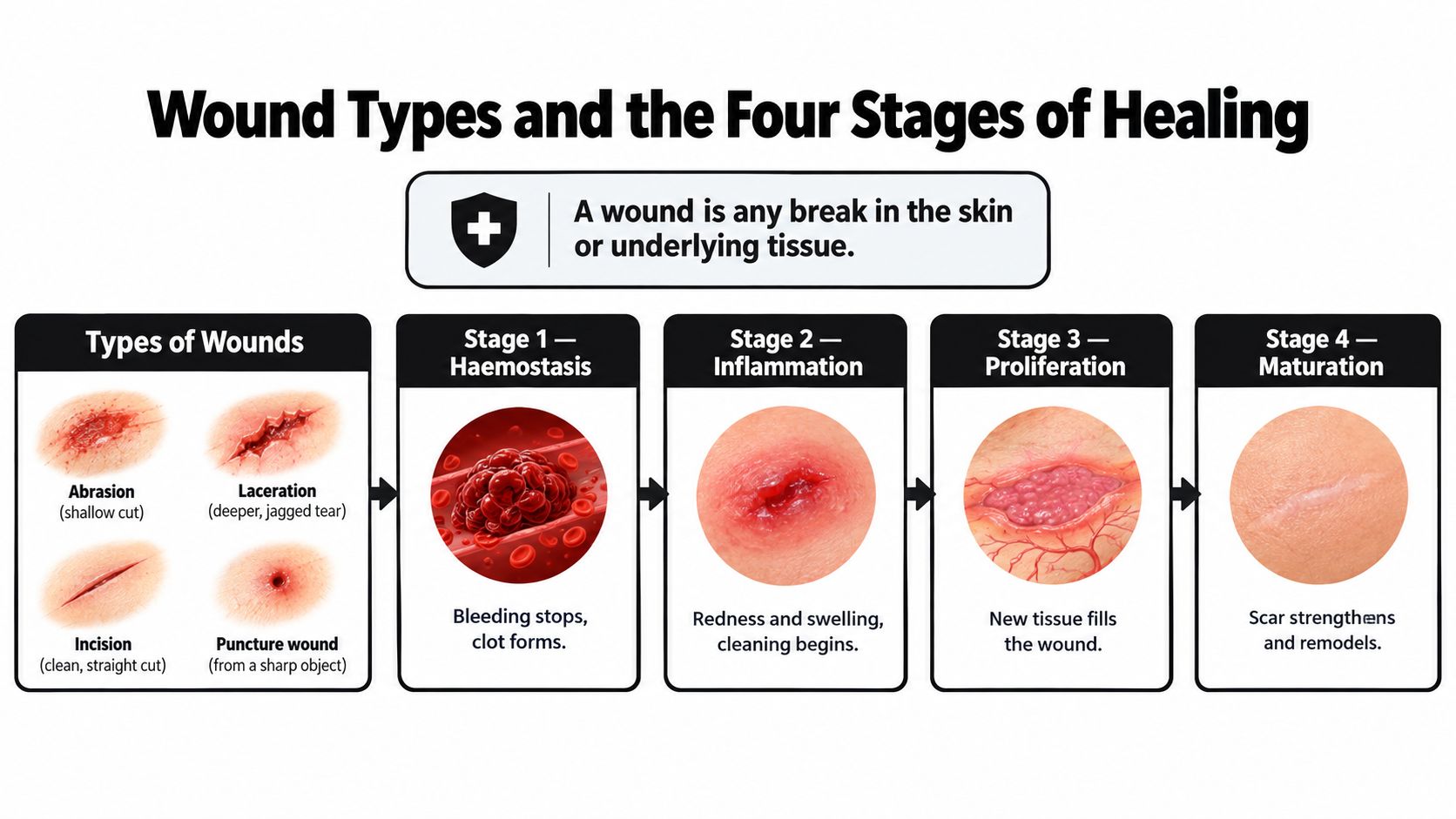
A wound is any break in the skin or the tissue underneath it. That can be as small as a graze from a fall, or as complex as a pressure ulcer, foot ulcer or post-operative wound that needs close monitoring. The label matters because not every wound behaves the same way, and different wound types carry different risks.
What you're likely to see
In care settings, you'll commonly come across abrasions, lacerations, pressure ulcers, leg and foot ulcers, surgical wounds and burns. A scratch from a transfer belt and a pressure injury on a heel are both wounds, but their risks, dressing needs and escalation points are very different. That's why the wound name is more than a label, it shapes how you observe and what you report.
For a clear, clinical overview of wound progression, the wound healing guide for clinicians is a useful companion reference. Keep in mind that your role is not to diagnose the wound type, but to recognise enough to support safe care and report change accurately.
The four stages in plain language
Think of a kitchen cut on your finger. First, bleeding slows and a clot forms. That's haemostasis, the body's quick effort to stop blood loss and seal the area. After that, the finger often looks red, warm and slightly swollen while the body clears away debris and starts defence work. That's inflammation.
Next comes proliferation, when the body starts building new tissue, so the wound may look pink, moist and gradually smaller. Finally, maturation happens over time, when the new tissue strengthens and remodels into scar tissue. The wound may look closed before it is fully strong, which is one reason carers still need to protect the area from friction, pressure and knock-on damage.
A useful rule for documentation is to describe what stage the wound appears to be in, without overreaching. If it still looks fresh, draining or inflamed, say so. If it's closed but fragile, say that too. Clear description helps the next person judge whether the wound is moving forward or stalling.
Recognising Infection and Other Warning Signs
Some wound changes are expected, especially early on. Others need prompt clinical assessment, even when the wound doesn't look dramatic at first glance. The difficulty for new carers is that not every problem shouts for attention, and not every bit of redness means infection.
The obvious warning signs
The clearest infection signs are the ones most people are taught first. Increasing redness, heat, swelling, pain, offensive odour, thick yellow or green discharge, wound separation, fever or feeling generally unwell all warrant clinical assessment. Early wound fluid can be misleading, though, because a clear, straw-coloured fluid can be normal during the first 36 hours after some wounds [^2].
That's why a dressing that looks damp isn't automatically a problem. What matters is the trend, whether the fluid is changing, the smell is changing, the pain is rising, or the skin around the wound is becoming more inflamed rather than less. If the area is getting worse instead of settling, don't normalise it.
The quieter signs people miss
Some wounds don't look infected, but they still aren't healing well. Delayed or static healing, increasing exudate over time, friable or easily bleeding granulation tissue, hypergranulation, pocketing and wound breakdown are all signs that need attention. These are especially important in older adults, people with diabetes, reduced mobility or poor circulation, because a wound can deteriorate without dramatic redness or pus.
A good support worker compares each dressing change with the last one. Is it bigger or smaller, wetter or drier, more painful or less painful, less stable or more fragile? That trend-based observation is often what tells the clinical team that a plan needs review.
If you're unsure, don't change the plan on your own. Observe carefully, document exactly what you saw, and escalate through the right local pathway. The guidance on infection control in care is a useful reminder that good hand hygiene and clean technique protect both the person and the staff member. For a quick plain-English consumer perspective on red flags, see when to see a doctor for wounds, but keep your own action within your role and care plan.
Common Dressings and When Each Is Used
Dressing choice is a clinical decision, but carers still need to understand what the common dressing families are trying to do. You're not choosing brand names in the moment, you're using the dressing already agreed in the care plan and checking whether it's doing its job.
| Dressing type | What it does | Typical use |
|---|---|---|
| Gauze | Absorbs fluid and gives basic protection | Small wounds, cleaning support, or secondary cover |
| Film | Thin protective layer that lets the skin breathe | Low-exudate wounds or to protect fragile skin |
| Hydrocolloid | Helps maintain moisture and supports a sealed environment | Superficial wounds with light drainage |
| Foam | Cushions the area and absorbs more fluid | Wounds that need extra absorption or protection |
| Absorbent pads | Takes up larger amounts of exudate | Heavier drainage or when dressings need more soak-up capacity |
The principle behind all of them is similar, keep the wound clean and moist, but not so wet that the surrounding skin becomes soggy. If a dressing becomes wet, loose or saturated, it should be replaced promptly. NHS guidance also advises against covering wounds with waterproof materials unless a clinician recommends it, because trapped moisture can worsen maceration and raise the risk of problems.
Practical rule: a dressing that's leaking, slipping or trapping moisture is no longer doing its job.
What you should notice is performance, not prescribe the product. Is the dressing staying in place? Is the surrounding skin getting pale, white or soggy? Is exudate increasing rather than easing? Those are the questions that help the clinical team decide whether the current dressing still fits the wound.
Stepwise Safe Care Actions a Support Worker Can Perform
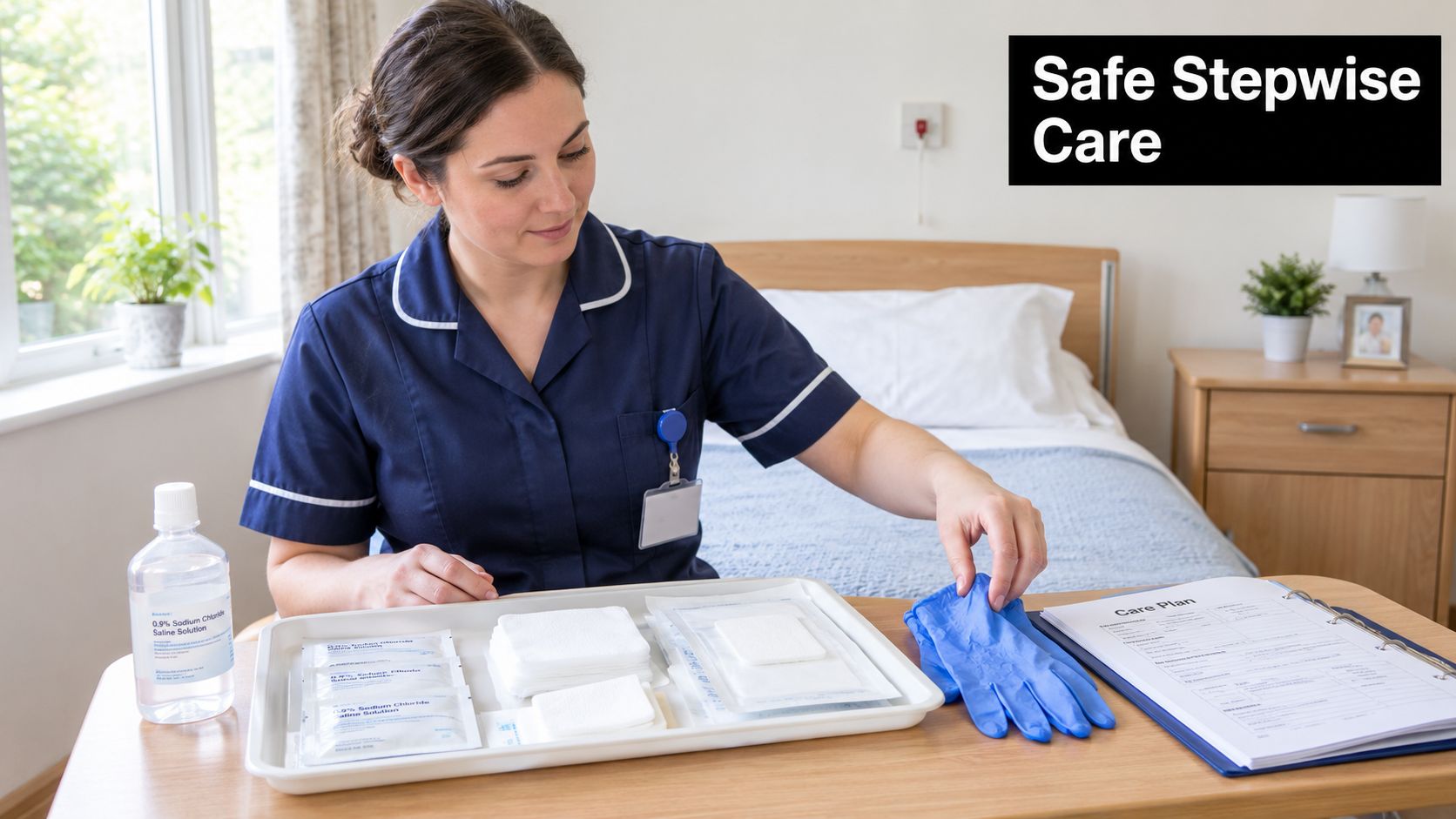
Before touching the dressing, check the care plan and make sure the person understands what you're doing. Gather the supplies you've been told to use, wash or sanitise your hands, and explain the process in simple terms so the person knows what to expect. Consent matters here, even for routine care, because respectful explanation reduces anxiety and helps the person stay involved.
The routine to follow
Start with clean hands and a clean workspace. Remove the old dressing carefully so you don't contaminate the wound bed, then look at the surrounding skin, the amount of exudate, the smell if any, and whether the skin is getting irritated or broken down. If gentle cleansing is part of the plan, do only that, and only in the way you've been instructed.
Apply the prescribed dressing exactly as directed, then secure it so it's comfortable and stays in place without putting extra pressure on the area. Check that the person can move, rest and dress comfortably afterwards. If the dressing feels too tight, too loose or awkward under clothing or bedding, that's worth reporting.
A support worker should not assess wound depth, decide on a different dressing, or start treatment for suspected infection independently. If the wound looks worse, the dressing choice seems unsuitable, or the person reports new pain or swelling, stop and escalate rather than improvising. A short first-aid refresher such as the HLTAID011 first aid course can help reinforce calm responses in care settings, but it doesn't replace local wound protocols.
Boundaries that keep care safe
- Check before you touch: Follow the person's plan rather than memory or habit.
- Keep it clean: Use hand hygiene before and after the procedure.
- Handle dressings gently: Avoid dragging or pressing on fragile tissue.
- Report what you see: Change in odour, colour, swelling or comfort matters.
- Escalate concerns: Don't make independent dressing changes beyond your authorisation.
For general workplace technique, the manual handling guidance for carers sits alongside wound care because safe positioning and safe moving often protect the wound as much as the dressing does.
Consent, Documentation and Handovers
Consent is part of wound care, not an extra task added at the end. If the person agrees, proceed in the way set out in the care plan. If they refuse, stay calm, explain the concern, and follow the local process rather than forcing the issue. Where capacity is in question, follow your service's legal and safeguarding procedures and involve the appropriate registered professional.
Good notes protect everyone. After each dressing change, record the date, time, wound appearance, approximate size if you're expected to note it, surrounding skin, exudate type and amount, pain, dressing used, and any concerns or escalation made. Vague notes like “wound looked fine” or “dressing changed” don't help the next carer or clinician decide what's happening.
Good note example: “Left heel wound, pink wound bed, small amount of clear exudate, surrounding skin intact, dressing applied as per care plan, person comfortable, RN informed of increasing tenderness.”
Weak note example: “Dressing done, all okay.”
Handovers should be short, structured and practical. Say what changed, what stayed the same, what you did, and who you told. That record trail supports continuity of care and also protects the carer if questions come up later, because the person's status and your actions are clear.
Escalation Triggers and Pressure Ulcer Prevention
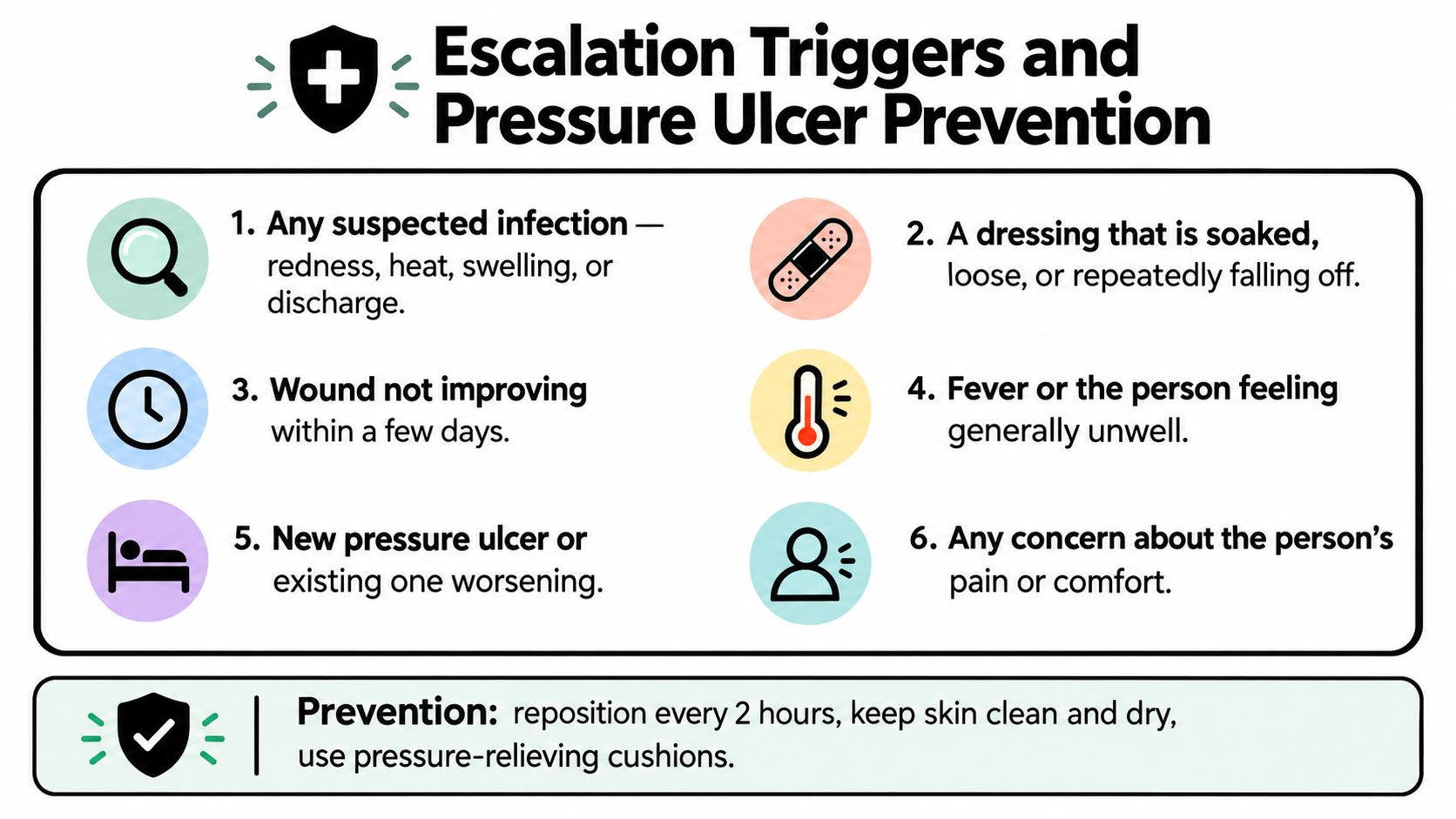
Escalation doesn't need to feel dramatic. If you suspect infection, if a dressing keeps failing, if the wound isn't improving, if there's new skin damage, if pain or swelling suddenly increases, if a dressing is wet or loose and can't be safely replaced, or if you think a pressure ulcer may be starting, contact the right professional promptly. That might be the duty nurse, GP, tissue-viability service, podiatry, 111, or 999 depending on severity and local pathways.
Pressure ulcers deserve particular attention because they can develop during illness, immobility or dependence on carers. Available hospital-based studies estimate that new pressure ulcers occur in approximately 4% to 10% of patients admitted to UK hospitals, while NICE cites an estimated UK annual cost of £1.4 billion to £2.1 billion for pressure-ulcer care and around £10,551 per year to treat a single grade IV pressure ulcer [^3]. The number that matters most at bedside level is not the headline cost, though, it's whether someone's skin is being checked and protected every day.
Daily prevention is built from ordinary habits. Reposition people as required, keep skin clean and dry, pay attention to moisture, and support nutrition where that sits within the care plan. The skin breakdown prevention guidance for carers fits neatly with this work, because pressure care and wound care are often the same conversation in practice.
Building Confidence With the Right Training
Wound care basics sit naturally alongside the Care Certificate and the mandatory training most employers expect across domiciliary, residential and agency settings. They also connect tightly with Basic Life Support, infection control, safeguarding and dementia awareness, because the same person may need all of those skills in one shift. When those topics fit together, care feels less like guesswork and more like a set of reliable routines.
Confidence grows when learning stays current. A support worker who understands dressing support, observation, documentation and escalation is far better placed to work calmly under pressure, especially when the wound looks different from the one on the last shift. That confidence matters to the person receiving care, and it matters to the team relying on accurate handover.
Cura Academy gives UK care workers a practical route to stay up to date, with unlimited access to role-specific training for £10 a month, a compliance-ready profile, and a straightforward way to refresh essential courses as part of everyday professional development. For someone building a care career or trying to stay shift-ready, that kind of structure removes a lot of the noise.
Keep learning, keep observing, and don't be afraid to escalate when a wound stops following the expected pattern. That's safe care, and it's good care.
If you want a simple way to keep your training current and strengthen your confidence with topics like wound care, consent, infection control and other core care skills, visit Cura Academy and see how the membership fits your role. It's a practical way to stay compliant, build knowledge steadily, and walk into shifts feeling prepared.