
You're outside the last home on your evening round. The street is dark, someone you don't recognise answers the door, and the office line goes to voicemail. Your phone is charged, but that doesn't tell you whether to go inside, wait for advice or leave.
Lone working training should help you make that decision. For UK care staff, useful training connects the care plan, the employer's safety arrangements and the judgement needed when a visit doesn't match what you expected.
Table of Contents
- Why Care Staff Train for Working Alone
- What Good Lone Working Training Teaches
- How the Risk Assessment Sets the Training
- Check In, Escalate and Recover After an Incident
- Care Visit Scenarios That Show the Training
- Choose a Course That Fits the Job
- Get Ready for Lone Working Shifts
Why Care Staff Train for Working Alone
A care worker can be surrounded by people and still be a lone worker. What matters is whether a colleague is immediately available to help, not whether the building is empty.
That includes domiciliary visits, community support, outreach, waking-night work and travel between service users. On that late visit, the person answering the door isn't a substitute for a colleague who understands your role and can support you safely.
The employer's duty comes before the visit
According to the Health and Safety Executive's lone-working guidance, employers must assess risks before people work alone, including employees, contractors and self-employed people working for their organisation. The Management of Health and Safety at Work Regulations require suitable risk-management arrangements, including training, supervision and monitoring.
In everyday terms, a manager needs to decide whether the work is safe to do alone, explain the controls and arrange a response if something goes wrong. Giving you a course login doesn't settle those questions.
Practical rule: Before entering an unfamiliar household, know who will respond if you need help, not just which number you've been told to ring.
Why threats belong in the training
The HSE's workplace-violence statistics estimate 689,000 incidents of violence at work in England and Wales in 2024/25, comprising approximately 370,000 assaults and 319,000 threats. These figures cover workplaces generally, rather than care alone, but they show why training must address intimidation as well as physical attacks.
A worker shouldn't have to wait until someone hits them before taking a threat seriously. Recognising escalating behaviour, setting a boundary and reporting what happened are practical safety skills.
The following visual brings together the everyday reasons care staff need preparation for working alone.
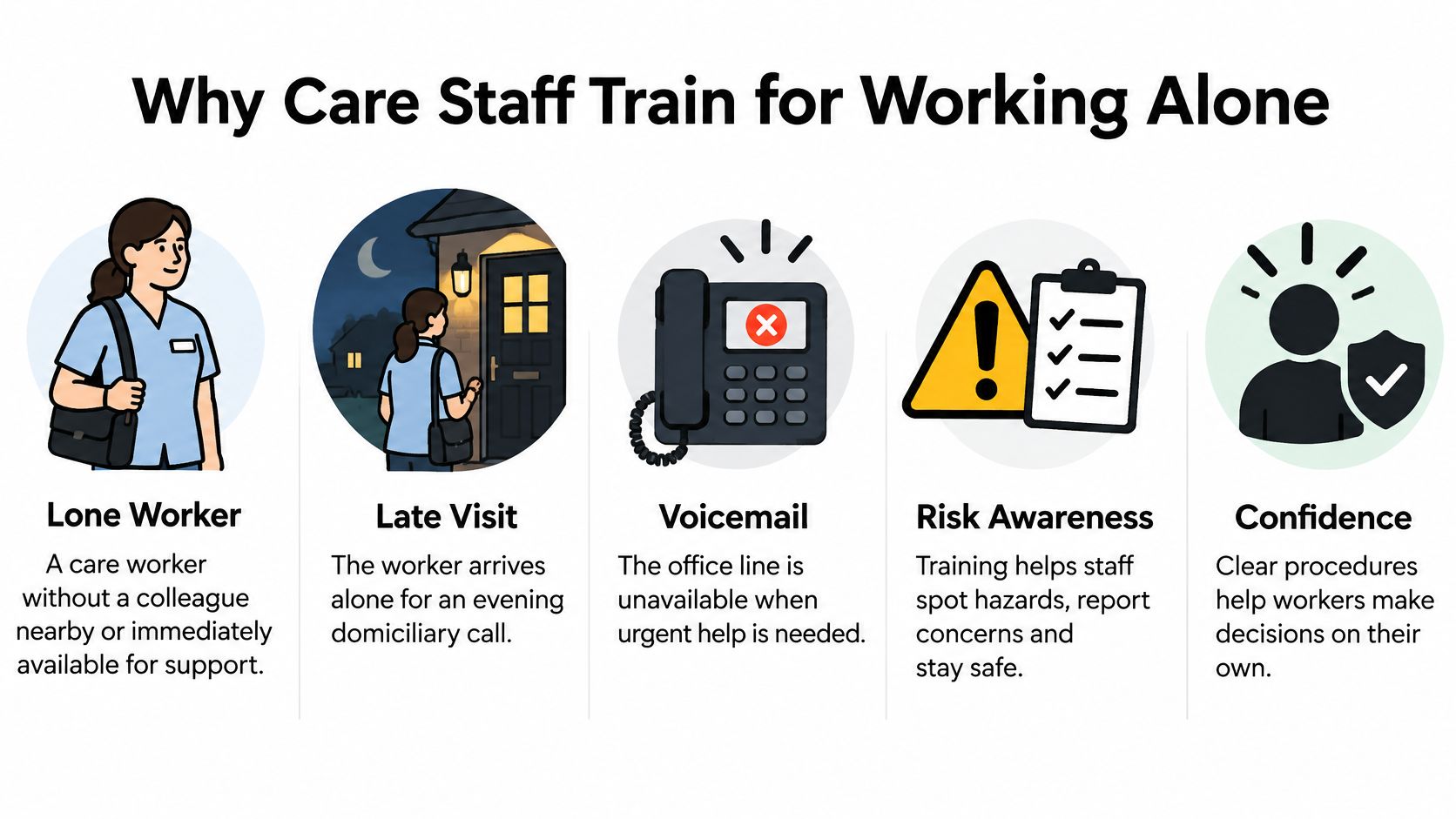
The hazards may look familiar: a slippery floor, an unexpected visitor, a fall or an angry relative. The consequences can be more serious when nobody is immediately available to help. Training needs to prepare the worker for that gap.
What Good Lone Working Training Teaches
Useful training produces a skill the worker can demonstrate, not just an answer they can recognise in a quiz. Use this checklist to distinguish learning about a procedure from being ready to carry it out.
Lone working modules, outcomes and pass tests
| Module | What the worker can do | Pass test | Typical care situation |
|---|---|---|---|
| Dynamic risk assessment | Spot hazards before and during the task and stop if it is unsafe alone | Stops a task the assessment says needs a colleague | First visit or a changed care plan |
| Check-in and check-out | Follow agreed contact times and report a change of plan | Reports an overrun or address change before it becomes a missed check-in | Domiciliary round and travel between visits |
| Communication failure | Act if the phone, app or signal fails | Switches to the named backup without waiting for the device to recover | Rural visit or a flat with no signal |
| Violence and de-escalation | Notice warning signs, set boundaries and leave | Ends the visit when the agreed limit is reached, even if the task is unfinished | Agitated person or a threatening household member |
| Emergency escalation | Summon help, call emergency services and notify the employer | Gives the location, explains the danger and activates the agreed response without delay | Collapse, assault or a missed check-in |
| First aid and self-rescue | Give immediate help within competence and get yourself safe | Recognises the limit of training, seeks help and withdraws if the scene becomes unsafe | Fall, choking or injury on a solo shift |
| Reporting and support | Report without blame and join a debrief | Records key details and attends a debrief before any return to the same address | Threat, near miss or actual harm |
The HSE's guidance on training, supervision and monitoring explains that lone workers may need additional training because immediate help is less accessible. Workers need competence for the job, familiarity with technical solutions, an understanding of when to seek advice and clear limits on what they may undertake alone.
What a practical assessment should reveal
Start with dynamic risk assessment. Ask the learner to identify what has changed during a visit and explain whether the planned task can continue. Noticing the hazard isn't enough if they then carry on regardless.
For check-in and check-out, give them an overrun or a changed destination. They should update the responsible contact before the expected check-in is missed, rather than assume the office will work it out.
Test communication failure by making the usual app unavailable. The learner should use the actual backup procedure, not keep refreshing the screen while the risk remains unresolved.
For de-escalation, practise calm language and a clear exit decision. A safe response might be: I can't continue while you're threatening me. I'm leaving and will contact my manager.
Emergency practice should include giving an accurate address and explaining what help is needed. First-aid scenarios should test the worker's limits, including recognising when approaching an injured person would expose them to danger.
Finally, ask for a factual incident record and an explanation of the support they would seek afterwards. Supervision and contact should match the risk, with closer oversight where needed. These outcomes should reflect the employer's local assessment, not the contents of a generic slide deck.
How the Risk Assessment Sets the Training
The risk assessment is the map; training is the route written on it. If the household, equipment or task changes, the worker may need different instructions and practice.
The HSE's lone-working leaflet explains that employers must address lone-worker hazards within their workplace risk assessment; a separate lone-worker assessment isn't legally required. The important question is whether the controls are suitable for the risks identified.
Turn identified risks into working arrangements
- Consult the workers doing the visits. Ask where access is difficult, which addresses have unreliable reception and what happens when the on-call contact doesn't answer. Include agency staff who may not know local arrangements.
- Remove hazards or choose safer ways of working. Rearrange a task, improve access or select suitable equipment before relying on the worker to manage the danger personally.
- Instruct and train for the remaining controls. Explain the procedure, then practise it. A written instruction to use an alert device is incomplete if the worker hasn't learnt how to activate it.
- Supervise and monitor according to risk. Name the person receiving updates and explain what they must do when contact is lost. Monitoring needs a response, not just a record.
- Review after significant change. New staff, processes or equipment can require revised instructions and further training. Workers also need a clear way to raise concerns when the assessment no longer matches the job.
Proportionate doesn't mean identical
A familiar daytime welfare call might be suitable for a timed check-in if the assessment supports that arrangement. The same approach may be unsuitable for an unfamiliar address with a history of aggression.
A paired visit, a different appointment time or closer contact may be appropriate for the higher-risk situation. These are decisions for the employer's assessment, not assumptions the worker should make at the doorstep.
A worker can recognise a new hazard, but they shouldn't be expected to invent the organisation's emergency arrangements during the visit.
Write the resulting instructions into the service's agreed ways of working in care. Workers need to know which version applies and where to find it before leaving base.
Then compare the local arrangements with the module pass tests. If a worker can describe a generic check-in system but can't use the employer's system, the training hasn't yet prepared them for that round.
Check In, Escalate and Recover After an Incident
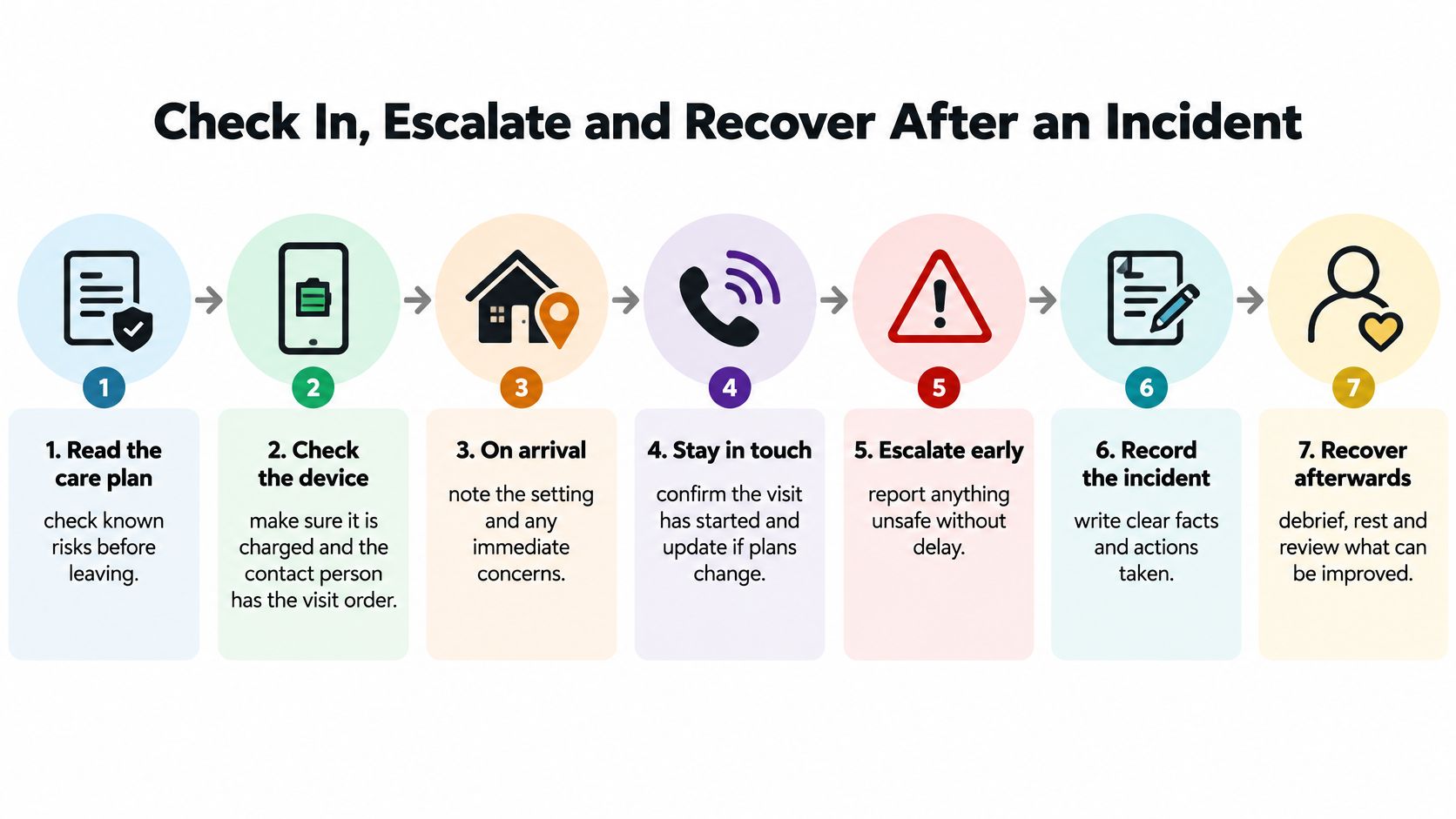
Use a visit procedure that explains both what to do and why. Adapt it to the employer's assessment rather than treating it as permission to undertake every visit alone.
- Read the care plan and known risks before leaving. This helps you spot a mismatch between the planned visit and the situation you find.
- Check the device and the contact arrangements. Confirm it's charged and the responsible person has the visit order, so they can act if contact is lost.
- Assess the setting on arrival. Look at access, other people, pets, the layout and the person's presentation because conditions may have changed.
- Check in and check out as agreed. Report overruns and address changes so the contact person isn't relying on an outdated schedule.
- Pause and leave when the agreed limit is reached. A calm boundary and timely withdrawal can prevent an unsafe encounter continuing.
- Escalate immediate danger. Use the agreed alert, call emergency services when needed and notify the employer without delaying urgent help.
- Use the named backup if communication fails. Follow the planned withdrawal route, including returning to the car if safe, rather than waiting indefinitely for reception.
Keep the broader sequence visible alongside the employer's detailed procedure.
Contact methods and where they fail
A missed check-in is a potential emergency signal, not proof that someone is running late. The responsible person should start the agreed escalation process, with contact intervals chosen for the assessed risk.
| Method | What it does well | Failure mode |
|---|---|---|
| Scheduled welfare call | Simple and familiar to most staff | No answer if the worker cannot speak |
| Check-in app | Alerts the office if a visit overruns | Dead battery or no signal |
| SOS fob or lone-worker device | One-press alert when speech is unsafe | False alarms or the button cannot be reached |
| Location sharing | Helps find a worker who missed check-out | Does not stop the incident or replace training |
A waking-night assignment or known violence risk may need closer contact than a short, familiar daytime call. Location monitoring also needs clear boundaries: explain who can see it, when it operates and what response follows an alert.
A device is a control, not a complete safety system. Test what happens after activation, including out-of-hours cover and an unanswered first call.
Use this video as a discussion prompt alongside practice with the actual workplace procedure.
What happens after the immediate danger
The HSE's lone-worker guidance recognises effects on stress, mental health and wellbeing and calls for clear emergency contact arrangements. A worker who completes the remaining calls after a threat may still need support.
Use a defined aftercare pathway:
- Get safe. Move away from the danger without creating another risk.
- Summon help. Obtain emergency assistance and tell the responsible manager where you are.
- Report without blame. Record facts, actions and relevant messages or other evidence.
- Receive support. Arrange a supportive debrief, practical help and access to wellbeing support.
- Review the assessment. Check what changed and whether the controls worked.
- Decide whether work resumes. Authorise a revised plan rather than sending someone straight back.
The employer's incident-reporting procedures should identify who receives the report and who follows it up. For managers connecting learning with reporting arrangements, Pebb's guide to strengthen compliance through employee training offers a useful organisational perspective.
Aftercare matters: A debrief should establish what support and changes are needed, not pressure the worker to prove they can cope.
Care Visit Scenarios That Show the Training
An unfamiliar person answers the door
Say you arrive for a new domiciliary call. The path is poorly lit, someone who isn't mentioned in the care plan answers, and the service user seems more confused than the notes suggest.
You pause at the threshold rather than starting personal care. From a safe position, you contact the office, describe the differences and ask for the visit arrangements to be checked.
A doorstep assessment gives you a chance to stop before you're committed to a task inside the home.
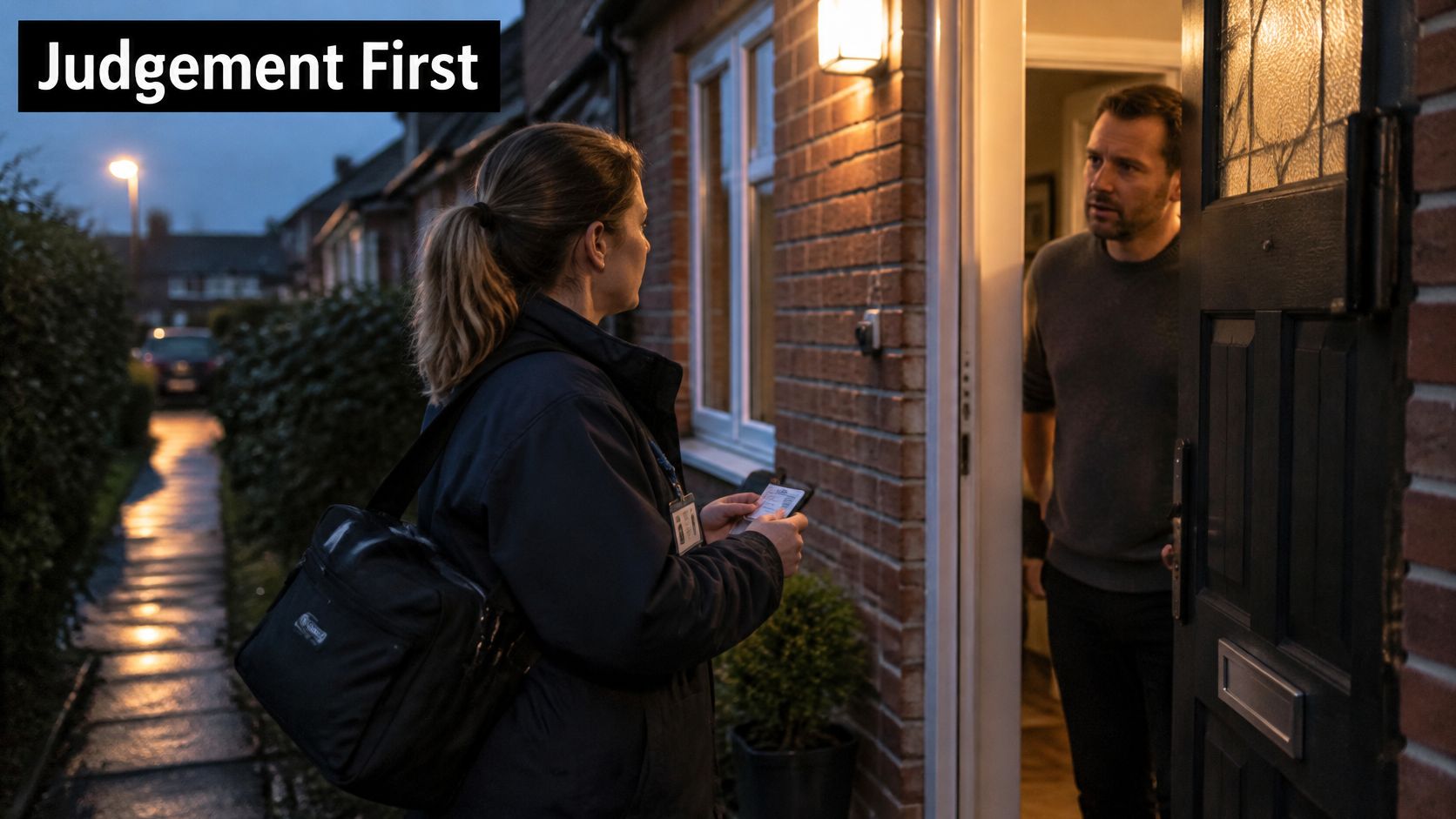
The unfamiliar person isn't automatically dangerous, and confusion doesn't automatically mean the visit must be cancelled. But the combined changes need assessment, including whether the service user needs urgent clinical help.
The deciding action is to pause before personal care begins, rather than investigate while already carrying out the task. Wider domiciliary care training should connect this judgement with consent, care planning and escalation.
A community walk becomes threatening
During a community support walk, the person starts shouting threats near a busy road. You keep your language brief and calm, avoid arguing and create distance from traffic where you can do so safely.
You explain that the activity is stopping and move towards a safer public area. If separation would create an immediate safeguarding risk, summon assistance and follow the emergency plan rather than improvising a physical intervention.
Once safe, record the threat and the circumstances, even though nobody was struck. Include what happened before the escalation and what helped reduce the danger.
The deciding action is to end the unsafe activity, not continue towards the destination to keep the timetable.
A fall during a waking-night shift
A support worker hears a fall in a shared house and finds someone on the floor. No colleague is on site, so the worker first checks whether approaching is safe and assesses the person within their training.
They call emergency services if the situation requires it, follow the call handler's instructions and avoid an unsupported lift. The on-call manager is told what happened and whether help is already coming.
The deciding action is to summon appropriate help, rather than attempt a manoeuvre beyond the worker's competence.
For a rural assignment, resolve the reception problem before departure. The plan must name a usable backup, such as an available landline or an agreed safe contact point; discovering that neither exists after the phone loses signal is too late.
Choose a Course That Fits the Job
Compare courses by what the learner must demonstrate, not by how quickly they can download a certificate. A convenient format is useful only if the learning can be applied to the actual role.
Criteria to use before booking
- Local relevance. The course can be linked to the employer's lone-worker risk assessment rather than used as a replacement for it.
- Scenario coverage. Teaching covers dynamic assessment, check-ins, communication failure, de-escalation, emergency escalation, first aid, self-rescue and reporting.
- Practical judgement. Assessment tests hazard recognition, control selection and the decision to stop unsafe work.
- Recorded outcomes. There is a clear record of the skills assessed and any further practice needed.
- Aftercare. Learning includes supportive reporting, debriefing and mental health effects, not only alarm activation.
- Workplace technology. The employer arranges practice with the devices and systems workers will use in their day-to-day work.
- Change-led refreshers. Refresher decisions respond to changed work arrangements, equipment and competence needs.
Questions that reveal the gaps
Ask how the learning connects to your assessment, how competence is tested, who signs off workplace readiness and how refreshers are arranged. Confirm the course's length, delivery format and cost directly rather than assuming all providers offer the same thing.
At Cura Academy, our certificates confirm course completion; employers retain responsibility for workplace competency sign-off. That distinction helps you compare a knowledge course with practical induction, supervised work and assessment on the job.
A course may meet part of the learning need while leaving local procedures to the employer. Make that boundary explicit before assigning a solo shift.
Get Ready for Lone Working Shifts
Before your next solo shift, match what you've learnt to the arrangements for your actual round. Being confident about the care task isn't the same as knowing how help will reach you.
Your personal readiness check
- Check-in rule. Can you explain when you must make contact and who responds?
- Communication backup. What will you use if the phone or app fails?
- Leaving point. Which changes mean you must stop or withdraw?
- Help route. Who do you contact for urgent assistance and routine advice?
- Reporting route. How will you record a threat, near miss or injury afterwards?
If an answer is unclear, raise it with your manager before setting off. Ask to practise the uncertain part, whether that's activating an alert or reporting an unexpected change at an address.
Readiness means being able to carry out the plan when conditions change, not simply remembering that a plan exists.
For carers, support workers, senior carers, nurses, new entrants and agency staff, we offer training options supporting mandatory learning and professional development. Our courses don't guarantee employment or replace employer-led training, supervision or competency assessments where required.
Don't treat a device or a certificate alone as proof you're safe to work alone tonight.
Cura Academy offers essential care training through individual courses, bundles and membership, helping you organise learning for your care role. Visit Cura Academy to explore the options, then confirm with your employer which local lone-working procedures and practical assessments you need before your next solo shift.