

You've probably landed here in one of three situations. You're trying to get your first care role and every vacancy says “training required”. You already work in care but keep losing time chasing certificates, refreshers, and compliance documents. Or you've had an interview for home care and realised nobody has properly explained what “job-ready” looks like.
That confusion is common in domiciliary care. New carers are often told to get the Care Certificate, do mandatory training, sort a DBS, and be ready for shadow shifts. What they're not usually given is the practical sequence. Which training comes first, what must be evidenced, what can be learned online, and what employers still need to observe before they'll let you work alone.
This guide strips that back to the essentials. The aim isn't to list every possible course. It's to show you how to build a clean, credible onboarding profile that helps an employer say yes faster.
Table of Contents
- What Domiciliary Care Training Is and Why It Matters
- Understanding UK Legal and Employer Requirements
- The Essential Training Modules for Domiciliary Carers
- Your Step-by-Step Pathway to Becoming Job-Ready
- How to Choose the Right Training Provider
- Streamline Your Compliance with Cura Academy
- Your Career in Care Starts Here
What Domiciliary Care Training Is and Why It Matters
Domiciliary care training is the preparation that helps a carer support people safely in their own homes. In practice, that means much more than helping with washing, dressing, meals, or medication prompts. It covers how to work safely on your own, how to notice changes in a person's condition, how to respect choice and dignity, and how to respond properly when something isn't right.
A home care worker doesn't have a team standing beside them on every visit. That's why domiciliary care training matters. You're often making small decisions in real time, inside someone else's home, with limited equipment and no room for guesswork.

The scale of the sector explains why this training can't be treated as an afterthought. Skills for Care's latest data shows 595,000 people working in domiciliary care in England, with around 700,000 across the UK, and the UK home care market was worth around £11.5 billion in 2024, which is why standardised training routes matter across the workforce, as summarised in PolicyBee's domiciliary care statistics.
Training is what makes you safe to send out
A good provider isn't looking for someone who has “done a few online courses”. They're looking for someone who can be trusted in a lone-working role.
That usually means you can show that you understand:
- Safe care delivery through topics such as infection control, safeguarding, and moving and handling
- Professional conduct including confidentiality, boundaries, and accurate record-keeping
- Person-centred support so the person's routine, preferences, communication style, and dignity stay central
- Escalation so you know when to report a concern, stop a task, or call for help
Practical rule: In domiciliary care, training isn't separate from the job. Training is the part that makes the job safe.
What works and what doesn't
What works is layered training. Learn the core rules first, then practise them in context, then get observed before working alone. That's how confidence becomes competence.
What doesn't work is collecting unrelated certificates and assuming that will impress employers. Most managers can spot that immediately. If your training record doesn't match the actual risks of home care, it won't help much.
The strongest candidates usually present a simple picture. They understand the baseline standards, they've completed the right mandatory topics, and they're ready to move into supervised practice without delay.
Understanding UK Legal and Employer Requirements
Many applicants get stuck at this stage. They hear terms like CQC, mandatory training, Care Certificate, induction, safer recruitment, and DBS, and it all starts to sound more formal than it really is.
The simple version is this. In domiciliary care, some requirements come from law and regulation, and some come from employer policy. You need to be ready for both.
What is legal and what is employer-driven
The Care Quality Commission (CQC) regulates providers in England. It expects services to deploy competent staff, supervise them properly, keep records, and make sure people receive safe care. That affects recruitment, induction, observations, and refreshers.
Skills for Care isn't the regulator, but its guidance shapes how providers organise induction and workforce development. That's why the Care Certificate is so widely used. It gives employers a common baseline for new care staff, even though it is not a legal licence to practise.
So if you're asking, “Do I legally need the Care Certificate before I can work?”, the practical answer is no. If you're asking, “Will employers expect me to be working towards it or ready to complete it properly?”, the answer is usually yes.
Most providers don't hire against theory alone. They hire against risk. If a task carries safeguarding, medication, or moving-and-handling risk, they want evidence that you understand the basics before you touch the rota.
Why employers push for fast compliance
Recruitment pressure explains a lot of employer behaviour. The domiciliary care vacancy rate in England was 11.9% in 2023/24, higher than the social care average, and there were around 131,000 vacant posts across adult social care, as reported in the Brunel University paper drawing on workforce data.
That doesn't mean employers will drop standards. It means they value candidates who can move through onboarding cleanly.
A manager will usually be asking questions like these:
- Can this person pass pre-employment checks quickly
- Have they already completed any relevant mandatory training
- Will they need full induction from scratch
- Can they evidence identity, right to work, and background checks properly
If you haven't dealt with criminal record checks before, it helps to understand the process early. A practical explainer on how to get a DBS check can make the onboarding side much clearer.
What employers actually look for
They rarely expect perfection from a new starter. They do expect order.
A strong applicant usually has:
- A basic understanding of the role and what home-based care involves
- Relevant training certificates for core topics
- Awareness of limits so they don't pretend to be competent in tasks they haven't been assessed on
- Good compliance habits including document organisation and date tracking
What causes problems is the opposite. Out-of-date certificates. No clear record of what was completed. No understanding of supervised practice. And no distinction between finishing an e-learning module and being safe to work alone.
The Essential Training Modules for Domiciliary Carers
The easiest way to think about domiciliary care training is as a training matrix. Every worker needs core subjects. Then extra modules are added depending on the role, the people supported, and the tasks involved.
That role-based approach matters because home care staff work independently. According to guidance on building a training matrix in adult social care, a robust matrix covers core compliance topics for all staff and then adds specialist modules where the role demands them. That reduces competence gaps in higher-risk work.
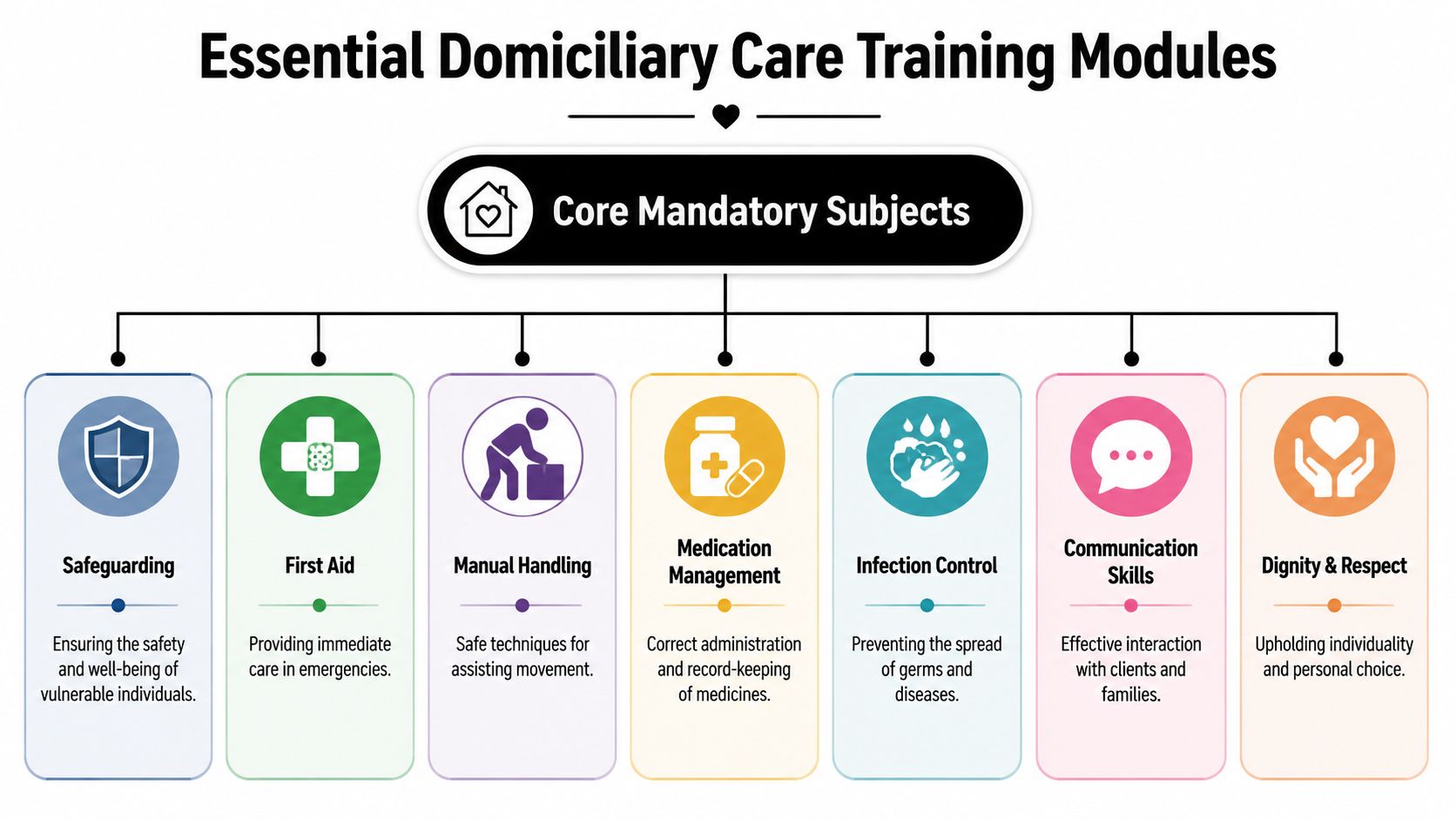
What every new domiciliary carer should cover
Most new starters should expect training in these areas before independent working begins:
-
Safeguarding adults and children
You need to recognise abuse, neglect, self-neglect, coercion, and poor practice. You also need to know what to record and who to tell. -
Infection prevention and control
This is not just handwashing. It includes PPE use, waste handling, cross-contamination risks, and safe working in different home environments. -
Moving and handling
This is one of the clearest examples of where theory alone isn't enough. A certificate helps, but practical assessment matters. -
Medication support or administration awareness
The exact level depends on the role. Some workers prompt. Some assist. Some administer under employer policy and assessment. -
Health and safety
Domiciliary work includes slips, trips, lone working, environmental hazards, pets, smoking in the home, and unsafe equipment. -
Basic life support or first aid awareness
You need a clear response framework for collapse, choking, and emergency escalation. -
Communication, dignity, and person-centred care
These are often treated as softer topics. In reality, they shape whether care feels respectful and safe.
If you're completing foundational learning, it helps to understand how the Care Certificate online course fits into that wider baseline.
A practical training matrix
Below is the sort of checklist many carers need to track. Refresher periods vary by employer, so treat this as a planning tool, not a legal schedule.
| Training Module | Purpose | Typical Refresher Period |
|---|---|---|
| Safeguarding | Recognise concerns, respond appropriately, escalate and record | Employer-set refresher cycle |
| Infection Control | Prevent spread of infection and work safely in home settings | Employer-set refresher cycle |
| Moving and Handling | Use safer techniques for assisting movement and reducing injury risk | Employer-set refresher cycle |
| Medication | Support safe prompting, assistance, recording, and escalation | Employer-set refresher cycle |
| Health and Safety | Manage workplace risks, lone working issues, and incident reporting | Employer-set refresher cycle |
| Basic Life Support or First Aid | Respond appropriately in emergencies until help arrives | Employer-set refresher cycle |
| Communication and Dignity | Deliver person-centred care that respects choice and individuality | Employer-set refresher cycle |
A useful test is simple. If a course can't be linked to a real task you'll carry out in a person's home, it probably shouldn't be at the top of your list.
The Care Certificate then sits over that foundation. It helps join the subjects together into workplace behaviour, values, and safe practice standards. On its own, though, it isn't the whole answer. Job readiness comes from the combination of learning, evidence, and supervised competence.
Your Step-by-Step Pathway to Becoming Job-Ready
If you want shifts quickly, stop thinking in terms of “doing some training” and start thinking in terms of building an onboarding file. Employers don't just hire on goodwill. They hire on evidence.
The Care Certificate is a common baseline, but aspiring workers need a clearer roadmap. With around 131,000 social care vacancies in England in 2023/24, employers need candidates who've already completed mandatory topics like safeguarding, infection control, and moving and handling to accelerate onboarding, as noted by Hands of Angels Healthcare.

Start with the documents and baseline learning
Before you apply widely, get your basics in order.
-
Confirm your route into care
Decide whether you're aiming for domiciliary care with a provider, agency work, bank work, or a support worker route. Each has slightly different onboarding expectations. -
Gather identity and right-to-work documents
Don't wait until after interview. Missing paperwork slows everything down. -
Complete core introductory training
Start with the modules most employers ask about first. Safeguarding, infection control, moving and handling, health and safety, and medication awareness are usually the backbone. -
Understand the actual role
If you're not clear on visit patterns, lone working, travel time, note writing, and shift expectations, read a plain-English guide to the domiciliary care assistant role.
This stage is about removing preventable friction. You want an employer to see someone who's prepared, not someone who still needs the whole job explained from the beginning.
Build evidence, not just certificates
Many candidates undersell themselves at this stage. They finish courses and leave everything scattered across emails, screenshots, and downloads.
Create one simple system:
- A digital folder with all certificates in PDF format
- A compliance list showing course title, completion date, and expiry or refresher date
- A document set for ID, right to work, CV, references, and DBS progress
- A short skills note listing what you've learned versus what still requires observed practice
That last point matters. Be honest. If you've studied moving and handling but haven't yet been assessed in the workplace, say so. Good managers respect that more than overconfidence.
Manager's view: A candidate who knows their limits is safer than one who claims they can do everything on day one.
For visual learners, this walkthrough gives a useful overview of how new carers can think about readiness before applying for work.
Get ready for the first shifts
The final step is understanding the handover from training into practice.
Expect these parts of onboarding:
-
Induction
Employer policies, reporting lines, incident procedure, lone working arrangements, and documentation systems. -
Shadowing
You'll often accompany an experienced carer before taking visits yourself. -
Competency checks
This may include medication processes, moving and handling, note writing, or practical care tasks. -
Sign-off for solo working
The provider decides when you're safe to go out alone.
What works well is arriving with your paperwork complete, your certificates organised, and realistic expectations about assessment. What doesn't work is assuming an online certificate means you can skip observation.
If you keep your profile current and tidy, agencies and providers can often move much faster with you. That's what “job-ready” really means in domiciliary care.
How to Choose the Right Training Provider
Once you know what you need, the next decision is where to get it. Many people waste money at this stage. They buy a cheap course bundle, finish it quickly, then find out it doesn't line up properly with employer expectations or doesn't help them keep records organised.
The right provider depends on your situation. A new starter may need structured pathways and plain-English guidance. An experienced carer may only need refreshers and a cleaner way to track compliance.
What to compare before you pay
Use these criteria before choosing any domiciliary care training provider:
| What to check | Why it matters |
|---|---|
| Course mapping to UK care roles | It should be clear how training fits domiciliary care work, not just generic workplace learning |
| Coverage of core modules | You shouldn't need to shop around for every basic subject |
| Care Certificate support | Helpful if you're new and need a recognised baseline |
| Certificate access and downloads | Employers often ask for documents at short notice |
| Progress tracking | Useful for refreshers and compliance history |
| Practical relevance | Content should reflect home-based care realities, not abstract theory |
| Specialist options | Dementia, medication, and role-specific topics become important quickly |
What usually slows people down
The common problems are predictable:
-
Too much fragmentation
One course from one site, another from somewhere else, no central record, and no clear sequence. -
Content without context
If training never explains how the lesson applies in a client's home, learners struggle to use it. -
No support for refreshers
Certificates expire or need updating, and people only realise when a recruiter asks for them. -
Online-only assumptions
Digital learning is useful, but some skills still need employer observation and sign-off.
A decent provider doesn't need to promise miracles. It just needs to help you stay organised, complete relevant learning efficiently, and present your training clearly when a provider asks for it.
Streamline Your Compliance with Cura Academy
A common hiring delay looks like this. A candidate has finished a few online courses, but when the recruiter asks for proof of training, refresher dates, and what still needs workplace sign-off, everything is scattered across emails and downloads. That is where onboarding slows down.
Where a structured platform helps
Cura Academy is a UK-based training and membership platform built for that practical gap between finishing courses and presenting a profile an employer can review quickly. Its subscription includes Care Certificate learning, mandatory refresher subjects, and role-specific courses such as Basic Life Support and Dementia Awareness. For new starters, the useful part is not only the content. It is the clearer training record, certificate access, and a more organised route towards DBS readiness and onboarding.
That matters in domiciliary care because employers do not hire from course titles alone. They check whether your training matches the role, whether your evidence is easy to verify, and whether you understand which parts can only be signed off in the workplace. A structured platform helps you show that sequence properly.
I tell new carers to treat this as a compliance file, not a shopping basket. If training sits in one place, you spend less time hunting for documents and more time getting cleared for shadow shifts.
Why specialist learning matters
General induction content gets you to interview and onboarding. Specialist learning affects how safe and confident you are once you start working alone in people's homes.
According to the systematic review on homecare workforce education, homecare training works better when it includes dementia-specific content, communication, observation, and scenario-based learning. That reflects real domiciliary care work. Carers often support people with memory problems, multiple health conditions, or changes that are subtle rather than dramatic.
There is a trade-off here. Online learning is useful for theory, language, and awareness. It does not prove practical competence in lone working, distressed behaviour, moving and handling, or medication support. Employers still need supervised practice, observation, and sign-off.
Choose training that helps you present three things clearly. What you have completed, what you understand, and what still needs workplace assessment.
Used properly, a structured platform shortens the admin-heavy part of getting job-ready. It helps you build a cleaner, more compliant profile so employers can move you through onboarding with fewer delays.
Your Career in Care Starts Here
Domiciliary care training feels complicated when it's presented as a long list of standards, courses, and checks. It becomes manageable when you treat it as a sequence.
Start with the role itself. Know what home care work involves. Complete the core mandatory subjects that employers expect to see. Keep every certificate and compliance document in one organised record. Then be ready for the part that no online course can fully replace, which is supervised practice, competency checks, and sign-off for working alone.
That's the difference between being interested in care and being employable in care.
If you're new, don't worry about knowing everything on day one. Good providers don't expect that. They expect honesty, preparation, and a willingness to learn properly. If you already work in the sector, the aim is different. Keep your profile current so refreshers, audits, and shift opportunities don't catch you off guard.
Domiciliary care is practical work. Your training should be practical too. Build it in the right order, keep your evidence tidy, and you'll put yourself in a much stronger position when the next vacancy appears.
If you want one place to organise your domiciliary care training, refreshers, Care Certificate learning, and compliance documents, take a look at Cura Academy. It's designed to help care workers build a job-ready profile faster, with structured pathways that make onboarding easier to manage.