

You arrive for a 7am shift, read the handover sheet and notice that Mrs Patel is on a soft diet. You know how to help with breakfast, but you're not sure why her food has changed, whether the instruction applies to every meal, or where to check what you should record. Asking before you act is the right response.
That moment is exactly where agreed ways of working in care become practical. They connect your employer's policies, workplace procedures, risk assessments and each person's care plan, so you know what safe, lawful and person-centred support looks like during the shift.
Table of Contents
- What Agreed Ways of Working Actually Means on Shift
- Policies, Procedures, and Care Plans Explained Simply
- How Risk Assessments Shape Agreed Ways of Working
- A Real Example of Agreed Ways of Working in a Care Home
- How to Follow Agreed Ways of Working Every Day
- Recording and Evidencing Your Agreed Ways of Working
- Quick Checklist and Common Questions for Care Staff
What Agreed Ways of Working Actually Means on Shift
Agreed ways of working means the rules, procedures, expected practices and care-plan instructions your employer expects you to follow. Some arrangements are written in a policy folder, electronic system or handbook. Others may be explained verbally by the employer or recorded in a person's support plan. The Care Certificate Standard 14 guidance explains that the term includes workplace practices that may be less formally documented.
For Mrs Patel, the soft-diet instruction is part of her agreed way of working because it tells you how to support her safely and according to her assessed needs. It isn't a personal preference you can ignore because another resident eats ordinary food. You should check the care plan, ask the senior worker if anything is unclear, serve the food described in the plan and record relevant information according to local procedure.
The same principle applies to hand hygiene, personal care, moving and handling, medication, safeguarding, confidentiality, reporting accidents and staying within your role. Care Certificate Standard 3 covers duty of care, including your responsibility to follow safe practice and report concerns. Standard 14 covers handling information, including keeping records and personal information confidential.
Practical rule: If you don't know the local process, pause and ask. Never replace an agreed instruction with a guess.
These arrangements aren't optional suggestions. They are the employer's established controls for safe practice, and they may differ between workplaces. A medication process in a residential home might not match the process used by a domiciliary care provider, so you need to check the arrangements whenever you start with a new employer or move between services. NHS and Health Education England learning material also explains that agreed ways of working help staff work within the law and provide care that follows individual care plans, as shown in Care Certificate Standard 1 learning material.
The useful question on every shift is simple: “What has my employer agreed, what does this person's plan require, and how do I show that I followed it?”
Policies, Procedures, and Care Plans Explained Simply
New workers often treat policies, procedures and care plans as if they mean the same thing. They work together, but each answers a different question.
An organisational policy explains the employer's position and responsibilities. A safeguarding policy might state that staff must protect people from abuse, neglect and avoidable harm, and must report concerns through the appropriate route.
A procedure explains how staff carry out that duty. It may tell you who to contact, what form to complete, what immediate action to take and how to record the concern. Your employer's procedure might be stored in a policy folder, intranet or care management system. You can also review a plain-language explanation of policies and procedures in care.
An individual care or support plan explains how the general requirement applies to one person. It may describe a person's communication needs, preferred approach, known risks, mobility support, dietary requirements or signs that should be reported.
| Document | What It Tells You | Example |
|---|---|---|
| Policy | Why the organisation has a duty or rule | Safeguarding concerns must be taken seriously |
| Procedure | How staff must carry out the rule | Report the concern to the manager and complete the required record |
| Care plan | How support is tailored to the individual | Use the person's preferred communication method and follow their recorded triggers |
Applying the three layers
Suppose you notice a bruise on a person's arm. You shouldn't assume how it happened, ask the family to investigate it yourself or discuss it with other people who don't need to know. Start with the person's care plan, including any communication or behaviour support instructions. Follow the safeguarding procedure, inform the appropriate manager and record what you observed using factual language.
The policy sets the duty, the procedure sets the route, and the care plan sets the personal context. If the plan says the person finds direct questioning distressing, that information affects how you communicate while the concern is escalated.
One missing layer can create an unsafe gap. A policy without a procedure leaves you unsure what to do, while a procedure without the care plan can lead to impersonal or unsuitable support.
Medication provides another example. The policy may require safe administration and accurate records. The procedure may explain checking, storage, refusal, omissions and escalation. The care plan may contain individual instructions about swallowing, timing or support. You need all three to work within the agreed way of working.
How Risk Assessments Shape Agreed Ways of Working
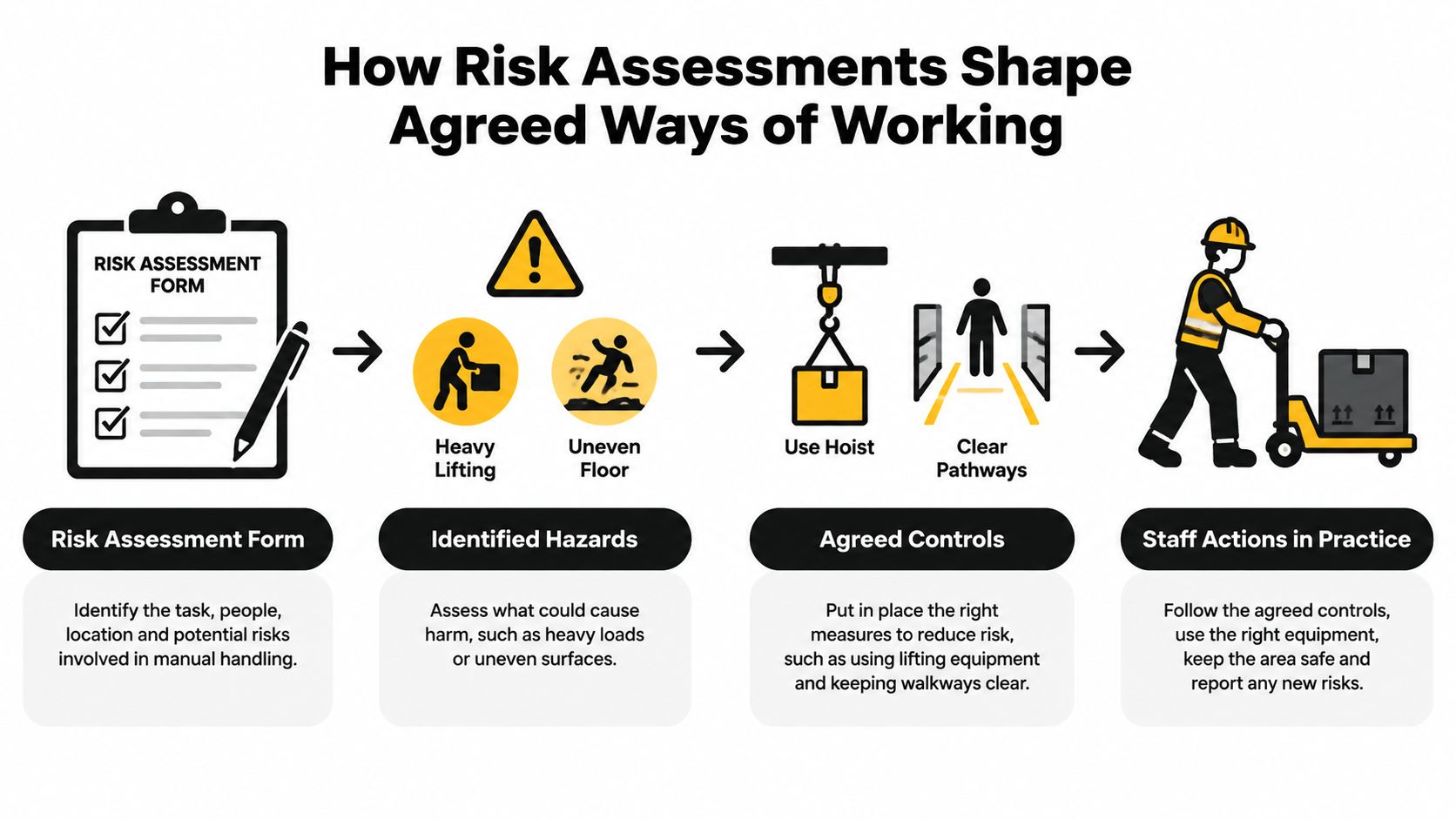
A risk assessment turns a possible danger into practical controls. It identifies a hazard, considers how likely harm may be and how serious the outcome could be, then records measures to reduce the risk. Those measures become instructions that staff must apply, not paperwork to leave unread.
Take a moving and handling assessment. The assessment might identify risks linked to heavy lifting, an uneven floor or changes in a person's ability to stand. Its controls could include using a particular hoist, selecting the correct sling size, keeping walkways clear, wearing suitable non-slip footwear and ensuring two staff members complete a transfer.
On shift, those controls become a sequence of actions:
- Read first: Check the person's moving and handling plan before attempting the transfer.
- Inspect equipment: Check the hoist and sling, including the recorded safety checks and the sling loops.
- Confirm staffing: Make sure the required number of trained staff are present.
- Prepare the area: Remove obstacles and make sure the route is clear.
- Record and report: Document the transfer and report any change in mobility immediately.
The manual handling assessment guidance can help learners understand how hazards and controls are linked. Your employer's own assessment remains the instruction you must follow in practice.
Treat the assessment as a living instruction
A risk assessment can become unsafe if nobody reviews it after a fall, a hospital visit, a change in mobility or an equipment concern. You may notice a change before a manager does, so report it rather than quietly adapting your technique.
The Care Certificate Standard 3 material links agreed ways of working with responses to harmful situations and gives examples including fire drills and medication procedures. Ignoring a control because you think you're being helpful means you're working outside the agreed method, even if the transfer appears to go well.
A Real Example of Agreed Ways of Working in a Care Home
Aisha starts work at Greenfields Residential Home. On her first day, the manager explains the induction programme, gives her the employee handbook and shows her where the paper policy folder and online care system are kept. Aisha confirms that she understands the medication policy and safeguarding procedure, but she isn't expected to work independently just because she has read them.
On day two, Aisha shadows a senior carer. Before supporting four residents, she reads their care plans and checks the relevant moving and handling and falls risk assessments. One resident uses a hoist, another needs encouragement to drink, and a third becomes anxious when personal care is rushed. The senior carer explains how the written instructions apply during the morning routine and answers Aisha's questions.
By day three, Aisha supports a small group under close supervision. She attends handover, listens for changes since the previous shift and checks the notes before starting. During the evening round, she asks her supervisor to watch her record fluid intake, because she wants to make sure the entry is accurate and follows the home's process.
What Aisha has learned
Aisha's agreed ways of working don't come from one document. They include:
- The handbook: General expectations, conduct and workplace rules.
- Policies and procedures: The employer's approach to medication, safeguarding, confidentiality and reporting.
- Care plans: Individual instructions for communication, nutrition, personal care and daily support.
- Risk assessments: Controls for falls, moving and handling and other identified hazards.
- Handover: Current information about changes that may affect the shift.
- Supervision: Direct observation, feedback and confirmation that Aisha can apply the instructions safely.
This arrangement also protects Aisha. If she doesn't understand a medication instruction, she can ask before acting. If a resident's mobility changes, she can report it rather than inventing a new transfer method.
A short training video can reinforce how workplace expectations become part of daily practice:
Skipping induction, care-plan reading or supervised recording would leave gaps. Aisha may still appear busy and caring, but she wouldn't yet have reliable evidence that she was following Greenfields' agreed approach.
How to Follow Agreed Ways of Working Every Day
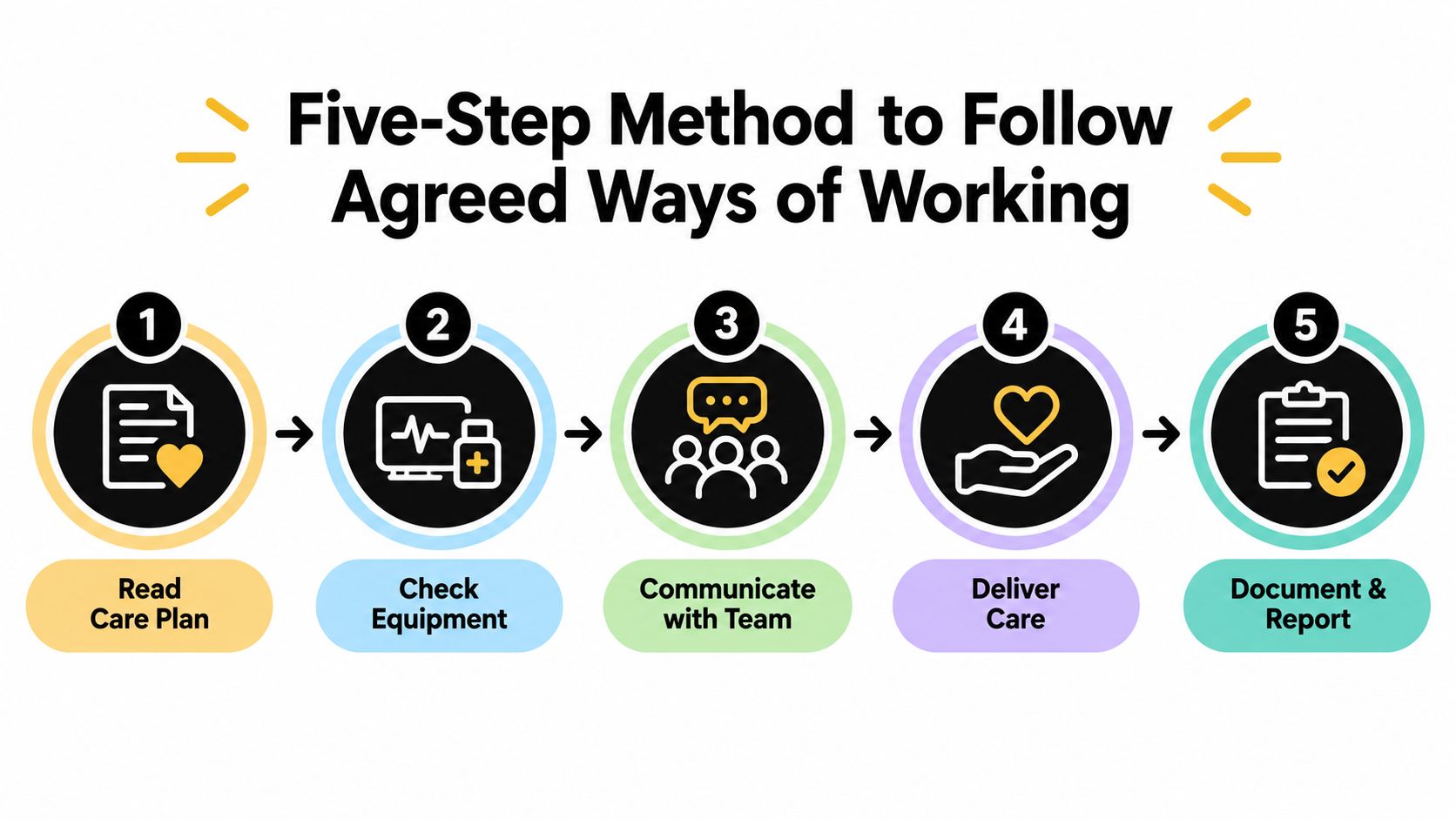
Use the same short routine at the start of every shift. It helps you respond to changes instead of relying on memory or assumptions.
Start with current information
Read the care plan and risk assessment before support begins. Look for updates to mobility, nutrition, communication, medication support, behaviour, skin care or personal preferences. If an update isn't clear, speak to the senior worker before starting the task.
Check handover carefully. Ask what has changed since you last worked. A person may have returned from hospital, become less steady, declined food, reported pain or experienced an incident. Handover doesn't replace the care plan, but it alerts you to information that may require you to check it.
Follow the recorded method
For personal care, nutrition, moving and handling or medication-related duties, follow the written instructions exactly as recorded and stay within your training and role. Don't improvise because a different method seems quicker. If the normal method can't be used, stop, make the person safe and contact the appropriate senior worker.
If the instruction no longer fits the person, report the mismatch. Don't silently create a new procedure.
Your employer may use a paper folder, an electronic care record or both. Learn where updates appear and how the organisation tells staff about changes. Team emails, noticeboards, supervision and online systems may all be part of that communication process.
Speak up and keep learning
Tell a manager or supervisor when equipment is unsuitable, a care-plan instruction conflicts with what you observe, or a risk has changed. Use supervision and team meetings to ask for clarification and request a review where needed.
Read policy updates when you're notified and complete any required learning. Agreed ways of working are a living system, because people's needs, equipment, risks and workplace processes can change. Treating induction as the final step is unsafe. Your responsibility continues through each handover, record, observation and conversation.
Recording and Evidencing Your Agreed Ways of Working
Good records protect the person receiving care, the worker and the employer. They show what happened, what support was provided, what changed and whether the correct escalation took place.
Your writing should be timely, legible, factual and linked to the care plan. Avoid guesses, labels and judgemental language. Record what you saw, heard, did and reported, including the person's response where relevant.
| Record type | What it evidences |
|---|---|
| MAR chart | Medication administration, timings, signatures and reasons for any omitted dose |
| Daily care notes | Support delivered against care-plan goals and the person's response |
| Food and fluid charts | Nutrition and hydration support, intake and concerns reported |
| Positional charts | Repositioning and pressure-risk controls followed |
| Behaviour charts | Observed behaviour, triggers, responses and outcomes |
| Incident or near-miss report | What happened, immediate action and escalation |
| Supervision notes | Questions, feedback, agreed actions and development needs |
| Observation or competency record | Whether a worker demonstrated a safe task correctly |
The record should make sense when read alongside the relevant policy, risk assessment and care plan. For example, an evening entry might show that you checked the person's moving and handling plan, used the specified equipment with the required staff support, documented the transfer and reported a new difficulty standing. A manager can then match the entry to the control and see why the action was taken.
For medication, complete the MAR chart according to local procedure. Don't leave unexplained gaps, copy another person's signature or add information later from memory. If a dose is omitted or refused, follow the employer's process for recording the reason and reporting it.
For incidents and near misses, use the organisation's approved form. The incident reports template guidance can help learners understand the type of information a clear report should contain, but your workplace form and escalation route take priority.
A good record lets another trained worker understand the care without having to guess what you meant.
Quick Checklist and Common Questions for Care Staff
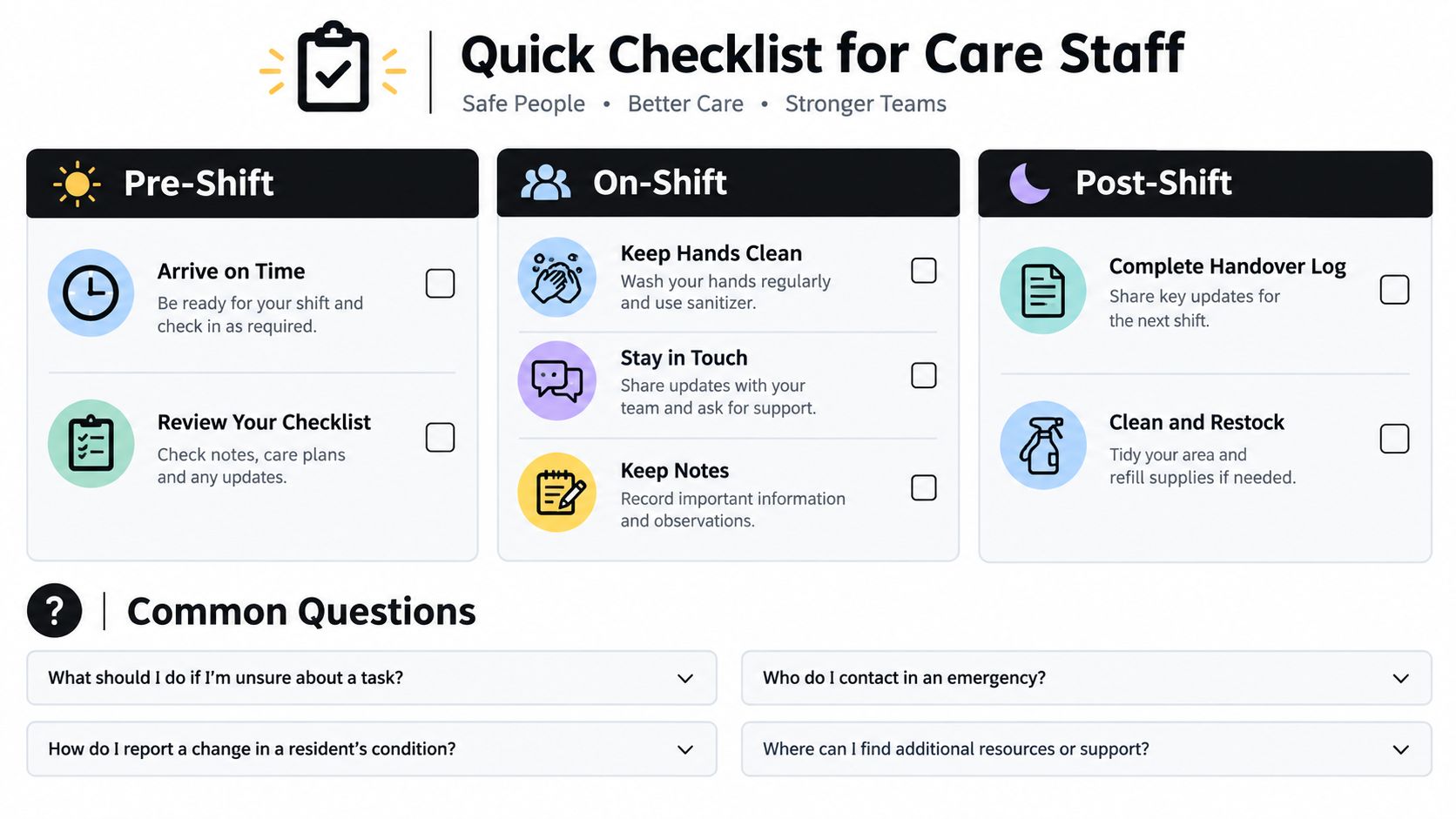
Use this summary before, during and after each shift.
Pre-shift
- Read updates: Check the care plan, risk assessment and handover information.
- Confirm competence: Ask before carrying out a task you haven't been trained or assessed to do.
- Check instructions: Clarify anything that appears missing, unclear or inconsistent.
On-shift
- Follow controls: Use the specified equipment, staffing level and method.
- Protect information: Share personal information only through the approved route and with people who need it.
- Report changes: Escalate changes in health, mobility, behaviour, nutrition or safety.
- Record promptly: Complete the relevant chart or care note while the details are fresh.
Post-shift
- Complete documentation: Check that required records are accurate and signed according to local practice.
- Give handover: Pass on changes, concerns, incidents and actions still needed.
- Raise unresolved issues: Tell the senior worker if an instruction, risk assessment or care plan needs review.
Common questions
What should I do if a care plan seems to contradict a policy?
Don't choose between them yourself. Pause the task if there's a safety risk, speak to the senior worker or manager and record the concern through the local process.
Do verbal instructions count?
They can form part of agreed ways of working, particularly where an employer communicates expected practice verbally. Ask for the instruction to be confirmed or recorded if you're unsure.
Who updates a risk assessment?
The employer or designated assessor manages the review. Your responsibility is to report changes, hazards, incidents and concerns promptly.
What if there's no paperwork available?
Don't guess. Contact the manager or senior worker, use the approved system if available and record the issue according to local procedure.
Cura Academy provides Care Certificate learning, mandatory refresher training and role-specific courses in one membership platform, helping learners build evidence of job-ready knowledge around topics such as duty of care and safe practice. Visit Cura Academy to review the available training and choose the learning route that matches your care role.