
Approximately 111,000 adult social-care vacancies existed in England in March 2025, and that shortage directly restricts timely access to care. The barrier isn't only a lack of applicants. Missing training, delayed checks and incomplete compliance records can keep otherwise capable workers away from shifts.
A common example is a support worker who has the right attitude, relevant experience and a clear DBS check, but still can't accept a booking because a mandatory course has expired. The provider may need someone quickly, yet can't safely place a worker whose competence evidence is incomplete. For the person waiting for home care, the result can be a delayed visit, fewer available hours or a change of worker.
These connected problems explain why barriers to health and social care must be understood as both access issues and workforce issues. Income, housing, transport, language, digital access and employment policy affect whether people can receive care. Training costs, limited time, unclear entry routes and compliance delays affect whether workers can deliver it.
Table of Contents
- The Hidden Connection Between Training Gaps and Care Access Barriers
- Understanding the Main Barriers in UK Health and Social Care
- What Employers Actually Screen for Before Offering Shifts
- Comparing Barriers for Aspiring Workers and Existing Staff
- How Structured Training Platforms Address Workforce Barriers
- Practical Steps to Reduce Your Personal Training Barriers
The Hidden Connection Between Training Gaps and Care Access Barriers
A care worker checks their phone after applying for several shifts. Their DBS status is clear, their availability is good and they can describe safe moving and handling in an interview. Then the agency asks for evidence of current mandatory training. One certificate has expired, another course was completed with a different provider and the Care Certificate record doesn't show which standards have been assessed. The worker isn't necessarily unsuitable, but the agency can't place them quickly.

Why one missing record affects more than one person
Providers have to protect people receiving care, so they need evidence that a worker is ready for the duties assigned. A missing certificate can trigger manual checks, extra supervision or a decision to offer the shift to someone whose records are easier to verify. For an agency worker, that creates an immediate income problem. For a provider, it creates more rota pressure. For the person needing care, it can mean a visit remains unfilled.
This is why training completion and employability aren't identical. A certificate shows that a learning activity took place. It doesn't always show that the worker understands the provider's procedures, has completed practical checks or can perform a particular task safely in that setting.
Communication creates another hidden obstacle. Medical terminology, unclear instructions and rushed handovers can make it harder for workers and service users to understand one another. A practical discussion of medical jargon and healthcare communication barriers can help learners recognise why plain language, confirmation and accessible information matter.
The national capacity problem
England recorded approximately 111,000 adult social-care vacancies in March 2025, with an 8.3% vacancy rate for care-worker roles, compared with 2.2% across the wider UK labour market, according to Skills for Care's workforce report. A workforce gap of that scale doesn't automatically make every applicant selectable. Providers still need people who can be deployed safely and lawfully.
The pressure is sharper when workforce scarcity meets unequal need. Deprived communities may face greater exposure to illness, transport difficulties and financial barriers, while local providers struggle to staff home visits. Digital recruitment and training systems can add another gate if workers lack reliable devices, confidence or accessible alternatives.
Practical rule: A compliance gap is not merely an administrative inconvenience. It can remove a worker from the rota at the exact point when someone else is waiting for care.
A structured Care Certificate online course can help candidates organise foundational learning, but employers still decide which evidence, checks and practical assessments they require. The useful question isn't “Have I taken a course?” It's “Can an employer verify that I'm ready for this role without avoidable delay?”
Understanding the Main Barriers in UK Health and Social Care
The main barriers fall into three connected groups: workforce scarcity, unequal living conditions and access systems that exclude some users. Treating them separately can produce weak solutions. A provider may recruit more staff but fail to reach people who can't afford transport. A service may introduce an online portal but make it difficult for disabled adults or workers with low digital confidence to use.
Workforce scarcity limits the practical supply of care
In England during 2023/24, adult social-care vacancies stood at 8.3%, while homecare vacancies reached 12%, compared with 5% in care homes, as reported by the Care Quality Commission. Homecare depends on staff travelling between people and completing visits across a fragmented rota. When vacancies remain high, providers may have difficulty accepting new packages, expanding visit schedules or maintaining continuity.
A vacancy isn't just an empty line on a spreadsheet. It can mean a manager spends more time rebuilding rotas, an experienced worker accepts additional pressure and a person receiving care sees different staff. Training delays worsen that operational problem because available candidates remain unavailable until their evidence is checked.
Deprivation changes both exposure and access
Socioeconomic deprivation is strongly associated with unequal access and poorer outcomes. Between 1 September 2023 and 31 August 2024, people living in the 20% most deprived areas in England experienced emergency hospital admission rates for infectious diseases nearly twice those of people in the 20% least deprived areas, according to the UK government health inequalities analysis.
The reasons are practical rather than abstract. Housing conditions, income, employment arrangements, transport, health literacy and the ability to attend appointments can all shape whether someone receives timely support. Travel costs, difficulty taking time off work, language barriers, limited translated information, distrust and misinformation can also obstruct prevention.
Digital access can become a new gate
Online booking, digital records and web-based recruitment can reduce administrative work, but they don't remove inequality by themselves. Disabled adults may encounter inaccessible design, poor connectivity or dependence on another person to complete essential tasks. Older workers and applicants with limited digital confidence may struggle to upload evidence, complete modules or monitor renewal dates.
Government evidence on disabled adults identifies digital exclusion, stigma, low health literacy, transport problems, lack of trust and language barriers as factors that can discourage access. The same evidence reports that 29% of people weren't confident they could access timely care from key services, with persistent inequalities affecting people on low incomes, ethnic minorities, disabled people and those with communication needs, as described in the digital inclusion report.
| Barrier type | Key statistic | Primary impact |
|---|---|---|
| Workforce scarcity | Homecare vacancies reached 12% in 2023/24 | Fewer staff available for visits and weaker continuity |
| Socioeconomic deprivation | Infectious-disease admission rates were nearly twice as high in the most deprived areas | Greater need alongside financial and practical access barriers |
| Digital exclusion | 29% lacked confidence in timely access to key services | Online systems can exclude service users and potential workers |
These categories reinforce one another. A strained provider has less time to support a worker through a digital process. A deprived area may need more care while finding recruitment harder. A person who can't use an online portal may be excluded twice, first as a service user and again as a potential care worker. Guidance on why carers are struggling to get shifts in 2026 is most useful when it recognises this wider system rather than blaming individuals.
What Employers Actually Screen for Before Offering Shifts
A worker can have the right attitude and still be paused at the screening stage. Providers and staffing agencies need evidence that a person can be placed safely into a role with the right safeguards, records and supervision. They are checking whether the file is complete, current and easy to audit, because a messy file slows deployment before a shift is even offered.
The order changes by organisation, but the same practical questions usually come up.
The practical compliance checklist
- Identity and eligibility: The provider confirms the applicant's identity and lawful eligibility to work using its required process.
- DBS and relevant checks: A clear or suitable DBS outcome is reviewed with any required employment history and references.
- Mandatory learning: Employers look for current evidence covering the topics relevant to the role and setting.
- Care Certificate progress: For new workers, managers may want to see which standards are complete and where competence still needs assessment.
- Role-specific capability: A domiciliary care role, residential support role and position involving clinical tasks may need different evidence and supervision.
- Renewal status: Expired training can stop a worker from starting, even if the course was completed before.
- Record quality: Dates, course titles, learner identity and assessment evidence should be easy to verify, not scattered across emails and photos.
- Availability and fit: The worker still needs to match the location, shift pattern, travel expectations and needs of the person receiving care.
A certificate and real-world competence are not the same. A learning record helps the employer make a decision, but the provider still carries the duty to run induction, explain local procedures and decide whether the person can carry out duties safely. Someone may understand infection prevention in theory and still need to follow a specific provider's handover, cleaning or escalation process.
Why employers prioritise evidence
The Care Quality Commission's survey of more than 1,900 adult social-care providers found that 54% reported recruitment difficulties and 31% reported retention difficulties, as summarised in Skills for Care's workforce overview. When managers are already short of time, a clear compliance profile cuts avoidable administration. It does not replace proper assessment, but it shows what still needs to be done.
Candidates can use the same logic in their own job search. A CV should show role-relevant training, dates and practical experience instead of making the recruiter hunt for proof. Guidance on how to build an ATS-optimized HHA resume comes from a different market, but the principle is the same for care applicants.
Keep one folder, digital or paper, with certificates, assessment records, renewal dates and notes on outstanding checks. Then use guidance on getting hired by staffing agencies in health and social care to compare your profile with the requirements agencies publish. The aim is not to collect every possible course. It is to remove the gaps most likely to block safe deployment.
Comparing Barriers for Aspiring Workers and Existing Staff
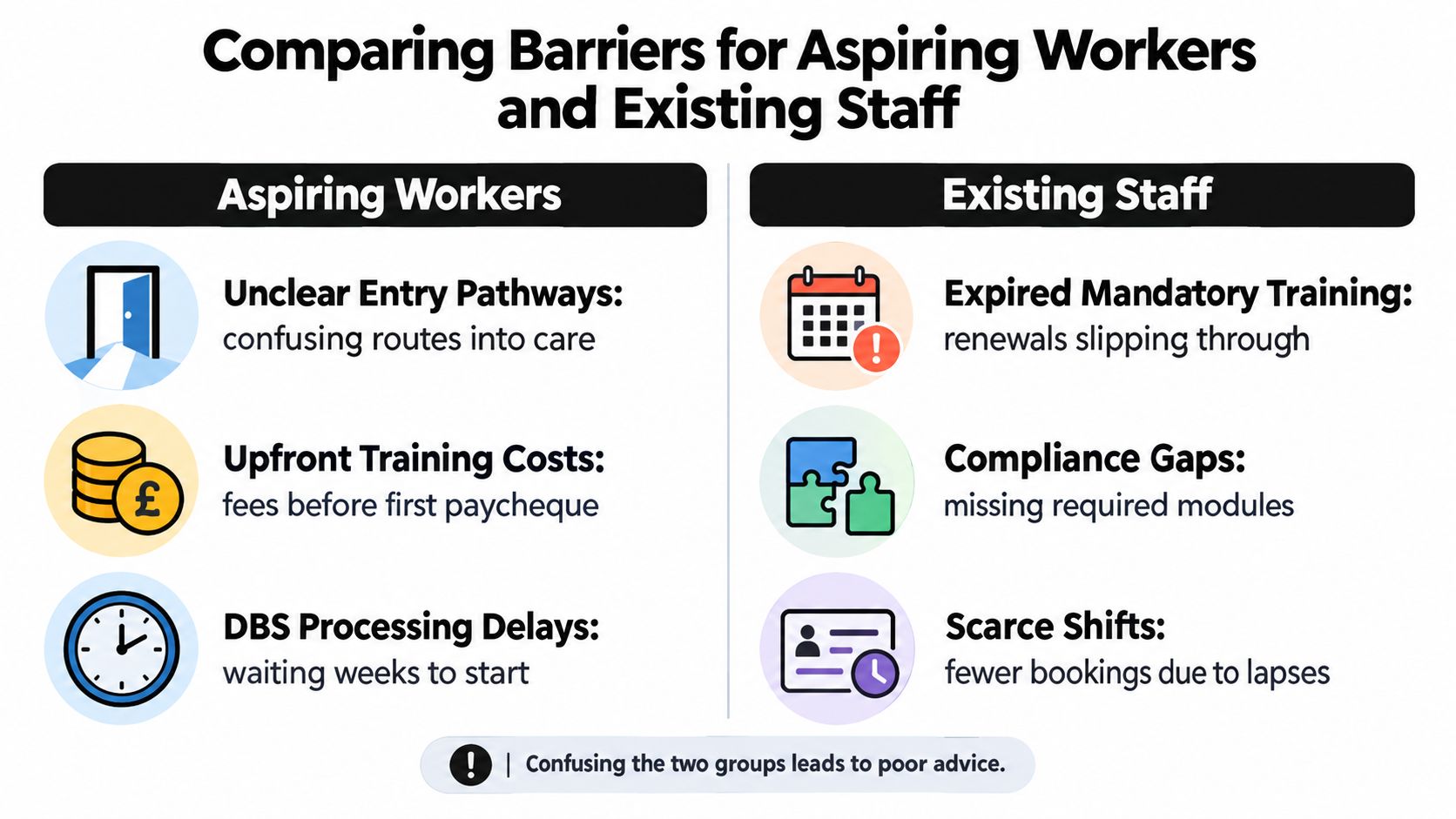
An applicant entering care and an experienced care assistant may use the same job board, but they don't face the same obstacle. The new applicant needs a credible route into the sector and evidence that makes an employer willing to invest time. The existing worker needs to prevent past experience from being undermined by expired records or missed refreshers.
Aspiring workers
New applicants often encounter uncertainty before they even apply. They may not know which Care Certificate standards matter first, whether a provider accepts online learning, how DBS processing will affect a start date or which training costs they must pay themselves.
Their challenge is usually entry clarity. A long list of courses can make the process feel expensive and complicated, especially when the applicant doesn't yet know which setting they want. The sensible response is to identify the intended role, check what local employers request and build a basic evidence folder before applying widely.
Upfront cost also affects access. A candidate may have the time and motivation to train but lack money before their first paycheque. Flexible learning can help with scheduling, but it doesn't remove the need to check whether an employer recognises the course or requires an additional assessment.
Existing staff
Established workers usually have a different problem. They may understand care routines well but lose shift opportunities because a refresher date passed, a module isn't visible on the agency system or a new employer asks for evidence in a different format.
Their priority is maintenance. A worker should review records before accepting a new role, note every renewal requirement and ask whether the provider needs practical revalidation as well as online completion. Experience remains valuable, but managers can't treat experience as a substitute for current evidence where policy requires documented learning.
Agency and bank workers sit between these profiles. They may have substantial experience, yet need a portable record that several employers can understand quickly. Fragmented bookings make delays especially costly because one missing item can affect multiple opportunities.
| Worker group | Main barrier | Best first action |
|---|---|---|
| Aspiring workers | Unclear route, training cost and delayed checks | Confirm role requirements and create a prioritised learning plan |
| Existing staff | Expired or scattered compliance records | Audit dates, request missing evidence and schedule refreshers |
| Agency and bank staff | Different employer requirements and rapid rota decisions | Keep one current, auditable compliance profile |
Confusing these groups leads to poor advice. Telling an experienced worker to start from scratch wastes time, while telling a new applicant that experience alone is enough can leave them unable to pass onboarding.
How Structured Training Platforms Address Workforce Barriers
A care provider may have vacant shifts, suitable applicants and experienced staff, yet still lack enough people who can be deployed safely. One missing certificate, unclear renewal date or unverified assessment can hold up onboarding. Training platforms address this bottleneck by making the route from application to safe, deployable readiness clearer, while leaving local induction and competence assessment with the employer.
Workforce evidence links relevant qualifications and regular training with lower turnover. Among the non-regulated adult social-care workforce, 46% held a relevant social-care qualification, while 54% did not have a recorded relevant qualification. Turnover was 26.5% among workers with a relevant qualification, compared with 37% among those without one. It was 31.6% among workers receiving regular training, compared with 40.6% among those who did not, according to the Skills for Care workforce evidence. These figures do not show that training alone causes retention, but they explain why workforce development can affect both staffing stability and service capacity.
What a structured pathway should do
A useful platform or employer programme should answer four practical questions:
- What should I complete first? Group courses by role and onboarding stage instead of presenting an unconnected catalogue.
- What evidence will I receive? Provide records showing completion, dates and the subject covered.
- What remains the employer's responsibility? Make clear that online learning does not replace local induction, supervised practice or competence checks.
- How will I maintain readiness? Use renewal reminders and a visible training history to prevent small omissions from blocking rota access.
For self-funded learners, membership can spread training access over time. Curated bundles can also clarify which subjects belong together and which should come first. The learner must still confirm recognition with the intended employer, because a course may support readiness without meeting every provider's policy.
Digital access forms another part of the solution. Mobile lessons, clear language and self-paced study can suit people working irregular hours. Providers should also offer human support and alternative routes for learners facing problems with devices, connectivity, accessibility or language.
Cost, time and access continue to restrict skills investment. Government survey findings reported that 81.8% regarded training cost as a barrier, 55.9% cited lack of time and 36.7% cited lack of access, according to Skills for Care workforce strategy evidence. A structured system reduces confusion and administrative work. It cannot resolve low pay, excessive workload or burnout by itself.
The following video shows how organised learning and caregiver support can fit into workforce preparation.
Cura Academy provides online Care Certificate standards, mandatory refreshers and role-specific courses through membership and training bundles. Its value depends on whether the learning matches employer requirements, produces usable evidence and gives learners a manageable way to study.
Practical Steps to Reduce Your Personal Training Barriers
Start with an audit, not another purchase. List every course, certificate, assessment and check you already hold. Record the completion date, renewal expectation, provider name and whether the evidence is easy to retrieve. Ask the agency or care provider which items are mandatory for the role you want, because requirements differ between organisations.
Then prioritise the items that affect deployment most directly. Foundational Care Certificate standards and mandatory subjects may be more useful at the start than specialist courses unrelated to your intended setting. If an employer requires practical assessment, don't assume an online certificate completes the whole requirement. Put outstanding DBS, reference and eligibility tasks on the same checklist so training doesn't progress while another onboarding barrier remains unresolved.
Create a maintenance routine that fits your working life. Review your record before applying for new shifts, keep renewal dates in a calendar and save certificates in one clearly named folder. If you're an employer, provide paid release time where possible, explain which training is required and give workers a straightforward way to ask for help with accessibility or digital access.
For providers: Faster training access should support safe deployment, not bypass induction, supervision or competence assessment.
A certificate alone won't guarantee employability, and digital learning alone won't remove every barrier. The strongest approach combines current evidence, role-specific preparation, human support, lawful employment checks and an employer's clear decision about readiness. That combination helps workers become selectable without treating compliance as a substitute for good care.
Cura Academy offers structured online Care Certificate, mandatory and role-specific training to help aspiring, existing and agency care workers organise their compliance evidence. Visit Cura Academy to review the available learning pathways and choose training that fits your intended care role.