

A new care worker can know every definition in a training workbook and still struggle on a busy shift. They may help someone wash, dress, eat, or move safely, yet fail to ask how that person wants the support delivered, record the choice, or tell the next colleague what matters to them. That gap between understanding person-centred care and proving it in practice is where many otherwise capable workers lose confidence.
Person centred care training needs to prepare people for more than a quiz. It should show how to gain consent, support choice, balance risk, write useful notes, communicate during handover, and raise concerns. Those are the behaviours employers can observe and the evidence organisations need to maintain.
Table of Contents
- Why Person-Centred Care Training Matters More Than Ever
- What Is Person-Centred Care and Where Did It Come From
- Legal Requirements and the Care Certificate Link
- How Training Is Delivered and What You Will Learn
- From Theory to Practice with Real-World Examples
- How to Choose a Quality Training Provider
- Next Steps for Building Your Person-Centred Skills
Why Person-Centred Care Training Matters More Than Ever
Two care workers arrive to support the same resident with getting dressed. Both provide the physical assistance safely. The first worker chooses the clothes, moves through the routine quickly, and records that the resident was dressed. The second asks which outfit the resident wants, checks whether they're comfortable with each step, adapts the pace, and records the preference that shaped the support.
The physical task looks similar from a distance. The experience isn't. One approach treats the person as part of a routine. The other recognises their identity, choices, communication, and control.

Kindness must become observable practice
Person-centred care isn't just about being pleasant. UK guidance describes it as involving people in decisions, treating them as whole persons, supporting self-management, and coordinating care around the individual through the NHS person-centred care framework. That means training must address communication, relationship-building, shared decisions, and enabling skills, not just values.
Employers also need staff who can demonstrate those behaviours when time is limited. A worker might understand that a resident has the right to choose, but still write, “Personal care completed,” without recording what was offered, what the person chose, or whether consent was obtained.
Practical rule: If a choice affected the support, the record should make that choice visible.
The operational test
A useful training course asks what happens after the learning module ends. Can the worker explain a preference during handover? Can they distinguish a person making an informed choice from a person being left without support? Can they record a refusal, respond proportionately, and escalate a change in wellbeing?
Those questions matter to service users, colleagues, managers, and inspectors. They also help care workers move beyond the frustration of knowing they should “do more” without knowing what good evidence looks like. The strongest person centred care training connects the principle to the conversation, the action, and the record.
What Is Person-Centred Care and Where Did It Come From
Person-centred care changes how staff interpret an ordinary care task. A morning wash, meal, or medication round should reflect the individual's preferences, relationships, abilities, beliefs, routines, and goals, rather than follow a fixed sequence for everyone.
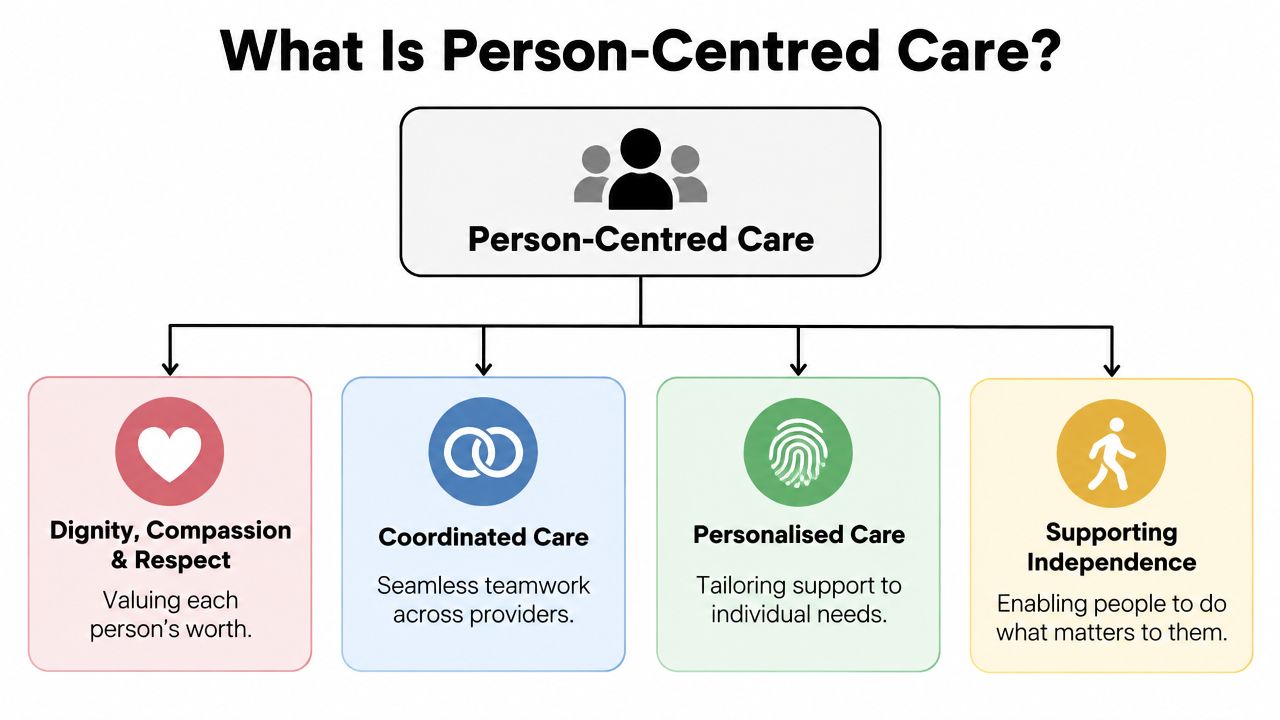
UK NHS learning guidance groups the approach around four connected principles:
- Dignity, compassion and respect are visible in small actions. Staff knock and wait, ask before touching, explain what they are doing, and close the door before personal care.
- Coordinated care means passing on relevant information accurately. A handover should include the person's communication needs, current preferences, and any change that affects support, so they do not have to repeat themselves.
- Personalised care means adjusting the method, not just changing the wording of a standard plan. Staff might offer a preferred time, use familiar terms, or change how instructions are given.
- Support for strengths and independence means allowing the person to complete the parts they can manage, while offering the right level of assistance instead of taking over.
From policy principle to workforce skill
Person-centred care became increasingly established in UK health and care policy over roughly two decades. The NHS Plan in 2000, the first NHS Constitution in England in 2009, and the Health and Social Care Act in 2012 helped make involvement and person-centredness expected features of care. The Act placed a legal duty on NHS England and clinical commissioning groups to involve patients in their care, as explained in NHS educational guidance on person-centred care.
Health Education England published its Person-Centred Approaches Core Skills Education and Training Framework in 2017. The framework sets out the skills required to put the approach into practice. In training, that includes noticing consent, adapting support, explaining choices, and recording what happened, not merely repeating the right values, as set out in the Health Education England framework.
Employers therefore screen for behaviours that may be missing from a certificate: whether a worker notices hesitation, preserves privacy under pressure, and leaves a clear account for colleagues. For related context, see Cura Academy's guide to care values in health and social care.
Legal Requirements and the Care Certificate Link
For social care workers, the clearest training connection is Care Certificate Standard 5, Working in a Person-Centred Way. Skills for Care explains that the standard is supported by learning on legal duties and behaviours that place the person at the heart of care through its person-centred approaches guidance.
The practical implication is important. Completing a course doesn't, by itself, prove competence. A worker needs to show how they apply person-centred principles in conversations, decisions, support plans, records, and reviews. Employers normally combine learning with workplace observation, supervision, and documentary evidence.
What evidence needs to show
Skills for Care identifies several forms of evidence that can support assessment. Each one answers a different question about whether the worker can turn intention into action.
- Care assessments: Do they reflect the person's needs, preferences, abilities, communication, and desired outcomes?
- Care plans: Do they tell staff what support to provide, how to provide it, and what the person has agreed or chosen?
- Reviews: Do records show that support was reconsidered when circumstances, preferences, or risks changed?
- Complaints and compliments: Do they reveal whether people experienced respect, choice, consistency, and responsiveness?
- Training records: Can the organisation show that staff received relevant learning and that managers followed up on competence?
A weak record says, “Supported with lunch.” A stronger record explains the choice offered, the support accepted, the person's participation, and any relevant change or concern. It remains factual and proportionate. It doesn't include unnecessary personal detail or judgemental language.
Legal duty meets daily decision-making
Consent, confidentiality, capacity, safeguarding, and risk enablement all affect person-centred practice. Staff must respect a person's choices while following agreed procedures and escalating concerns when someone may be at risk. Training should therefore use realistic situations, such as a person declining support, changing their routine, or choosing an activity that carries a manageable risk.
The Care Certificate overview from Cura Academy is useful for understanding how person-centred learning fits within the wider induction pathway. The key point is straightforward: compliance evidence should grow out of ordinary care, not be created as a last-minute paperwork exercise.
How Training Is Delivered and What You Will Learn
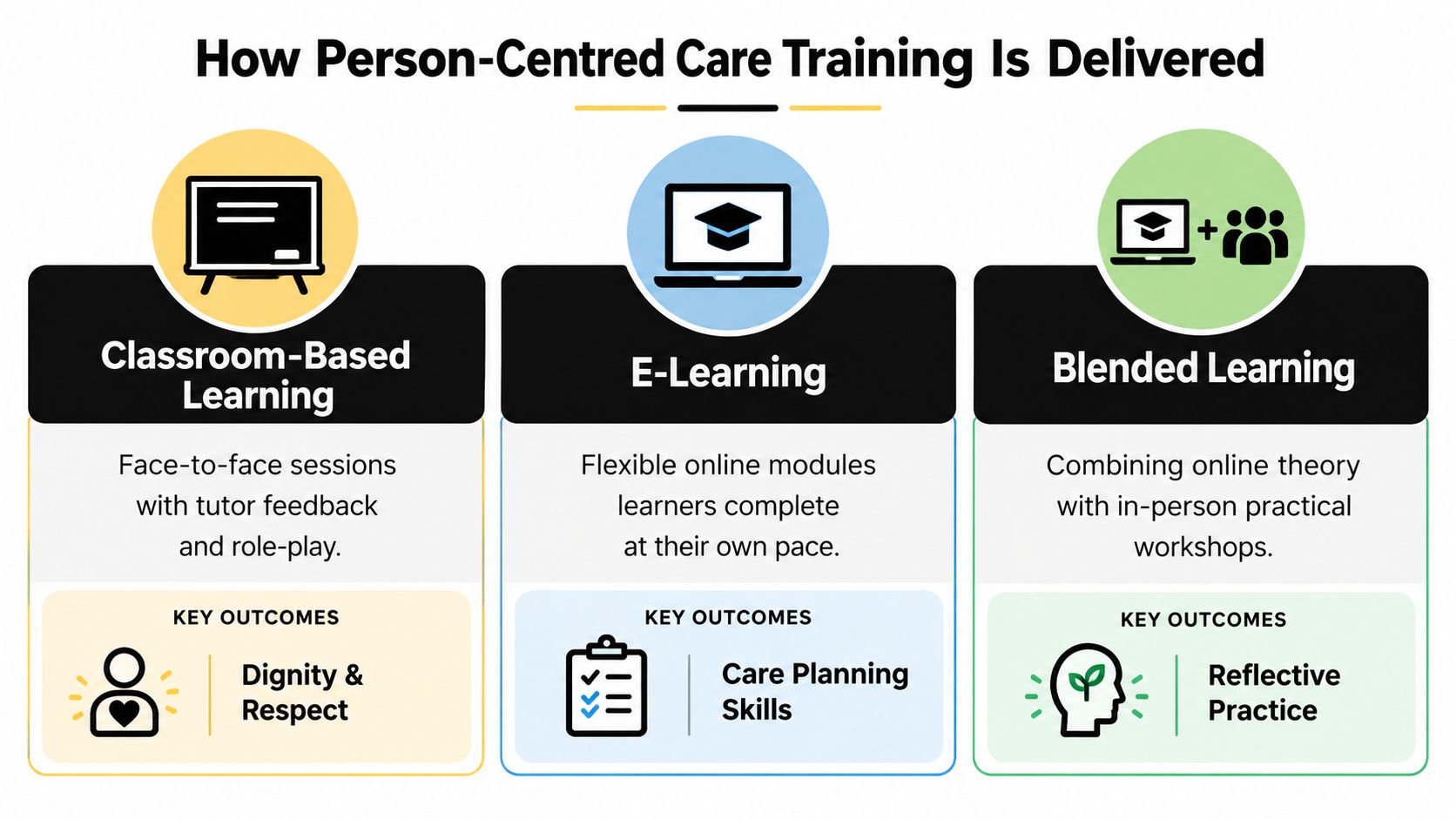
The delivery method affects how well a learner can transfer knowledge into a real shift. No format is automatically sufficient. A flexible course can still be weak if it only tests recall, while a classroom session can fail if learners never practise documentation or decision-making.
Comparing the main options
| Delivery method | Where it helps | What to check |
|---|---|---|
| Classroom learning | Tutor feedback, discussion, role-play, and immediate clarification | Does it use realistic care scenarios rather than presentation-only teaching? |
| E-learning | Flexible access for busy workers, agency staff, and people learning independently | Does it include applied questions, reflection, and practical assessment? |
| Blended learning | Online theory combined with supervised discussion and practical workshops | Are the two parts connected to the same workplace competencies? |
Classroom learning suits people who gain confidence by practising conversations aloud. Role-play can expose habits that written exercises hide, such as asking closed questions, rushing consent, or offering choices that aren't genuine. Its trade-off is reduced flexibility, particularly for workers covering changing shifts.
E-learning works well for foundational knowledge and revision. Learners can revisit communication, dignity, care planning, and reporting principles when they need them. The limitation is that a completed screen doesn't prove someone can handle a distressed person, document a refusal, or contribute to a handover.
Blended learning often offers the strongest bridge when the practical element is meaningful. A learner might study the principle online, then practise a consent conversation, write a care note, and receive tutor or workplace feedback.
Look for role-specific application
Good programmes should address communication, relationship-building, shared decision-making, risk enablement, care planning, reflective practice, and reporting concerns. They should also recognise the difference between domiciliary care, residential care, NHS support work, and agency shifts.
A home-care worker may need to negotiate preferences in someone's own environment. A residential worker may need to maintain consistency across a team. An agency worker may need to read a plan quickly and ask precise questions before beginning support.
The Core Skills Training Framework discussion from Cura Academy offers a useful reference point when comparing structured learning pathways. Focus on whether the course helps you perform the work, not merely whether it gives you a certificate.
From Theory to Practice with Real-World Examples
The true test of person-centred care training comes when the plan meets a busy morning. A resident refuses a shower, a home-care visit is running late, or a person wants to complete part of a task independently even though it would be quicker for staff to take over.

Start with consent. Before providing assistance, explain what you're going to do, check understanding, and ask whether the person agrees. If they decline, don't turn the refusal into a character judgement. Record what was offered, what the person said or communicated, any reason they gave, the alternatives discussed, and the action taken under the care plan or escalation procedure.
Records should show the decision
Consider three common settings:
- Care home: Instead of “Resident settled after personal care,” write that the resident chose a bath rather than a shower, selected their clothing, and accepted support with the parts they couldn't complete independently.
- Domiciliary visit: Rather than recording “Meal prepared,” note the options discussed, the meal chosen, the assistance accepted, and any concern about appetite or swallowing that was reported through the correct route.
- Handover: Don't say only that someone was “more confused”. Describe the change observed, what the person communicated, what support was offered, and who was informed.
Risk enablement requires judgement. Risk avoidance can look safe because it removes the activity, but it can also remove independence and choice. Risk enablement means following the agreed assessment, using proportionate precautions, recording the person's involvement, and escalating when the situation falls outside the plan.
A practical reflection after a shift can be brief:
- What choice did the person make?
- What did I do to support that choice?
- What did I record that another worker can act on?
- What would I raise with a senior colleague?
The SCIE guidance on person-centred care supports the broader principle that values need to become practical behaviour. Your local policy still governs the exact process for consent, capacity, risk, safeguarding, and reporting.
A short video can help learners observe communication style, but it should lead into discussion and written practice rather than replace supervision.
Employers often screen for these undocumented skills during interviews and probation: listening without taking over, noticing what matters to someone, writing neutral notes, explaining a concern clearly, and knowing when to ask for help. Certificates open the conversation. Consistent evidence builds trust.
How to Choose a Quality Training Provider
Start by checking alignment. A course should state which workforce expectation it supports, how learning is assessed, and whether the content applies to health care, social care, or a specific role. If the description only promises awareness and a certificate, ask how it develops practical competence.
Use a simple provider test
First, inspect the curriculum. Look for consent, communication, dignity, independence, personalised support, care planning, risk enablement, documentation, and escalation. A course that spends all its time defining person-centred care may leave you unprepared for the record-keeping employers typically review.
Next, check assessment. Multiple-choice questions can confirm knowledge, but applied scenarios are more revealing. Look for exercises involving a refusal, a changing preference, a handover, a concern, or a care-plan update. You should have a way to test whether your written response is clear, respectful, factual, and actionable.
Then, examine flexibility. Classroom delivery may suit new workers who need guided practice. E-learning can help agency and bank staff fit study around shifts. Blended programmes should explain how online learning connects to tutor feedback or workplace observation.
Finally, verify ongoing usefulness. Care workers need more than one completed module. A provider should make it practical to revisit mandatory learning, refresh knowledge, and follow a pathway that matches the setting in which you work.
Ask before enrolling: “How will this course help me evidence person-centred decisions in a care note or handover?”
Cura Academy is one option for learners who want a structured online route. Its membership platform provides access to Care Certificate standards, mandatory refreshers, and role-specific courses, while its Care Certificate Bundle includes learning aligned with the person-centred care standard for people new to care. Compare that offer with local employer induction, supervised practice, and any assessment your organisation requires.
Accreditation can matter, but don't treat the label as proof of quality. The better question is whether the learning changes what you do, what you record, and how confidently you explain your decisions.
Next Steps for Building Your Person-Centred Skills
Treat person-centred care training as the start of a practice cycle, not a single event. Learning gives you language and structure. Supervision, observation, documentation, and reflection show whether you can use them when a shift becomes pressured.
Begin with a short skills audit. Review a recent care note, if you're permitted to do so, and ask whether it shows the person's choice, consent, participation, and outcome. If it only describes the task completed, practise rewriting it in factual language without adding assumptions.
A practical development plan
- Choose learning that fits your role. Select content relevant to domiciliary care, residential care, NHS support work, or agency shifts, rather than relying on generic awareness alone.
- Practise one conversation. Ask an open question about what matters to the person, then listen without rushing to solve the problem.
- Make one decision visible. Record the preference, option, or adjustment that shaped the support, using your organisation's approved system.
- Check the plan. If the person's needs or preferences have changed, tell the appropriate senior colleague and follow the review process.
- Reflect with evidence. Use supervision to discuss a refusal, a risk-balanced choice, or a difficult handover. Bring the record or scenario, not just a general feeling.
- Keep learning current. Refresh knowledge when your employer requires it, when guidance changes, or when your role and setting change.
The most reliable workers aren't those who perform kindness only when someone is watching. They build respectful choices into ordinary routines and leave records that help the next colleague continue the same standard.
Your next shift gives you a practical starting point. Ask before acting, offer meaningful choices, support the person's abilities, write what happened clearly, and raise anything that doesn't fit the agreed plan.
Cura Academy offers structured access to Care Certificate learning, mandatory refreshers, and role-specific care courses for people building job-ready skills. Visit Cura Academy to choose a learning pathway that helps you develop person-centred practice and evidence it confidently at work.