
You've got a shift starting this week, or an interview tomorrow, and the advert lists washing, observations, medicines and "other duties as required". You're not sure which of those you can do on day one.
Healthcare assistant duties are hands-on and person-centred. They are not independent diagnosis or treatment. You support daily living, take the observations you've been trained for, write what you saw, and pass concerns to a registered professional. The same job title doesn't carry the same tasks on a hospital ward, in a care home and in someone's living room. A line on a poster is not permission. What decides a task is your training, a signed competence check, the care plan, and who you call if something looks wrong.
Use the tables below as a scope check before you say yes.
Table of Contents
- Core Duties by Setting at a Glance
- Personal Care and Daily Living Support
- Where Your Duties End and Delegation Begins
- Observations, Records and When to Escalate
- Infection Prevention and Medication Support
- Care Certificate Standards and Evidence Employers Check
- Confirm Your Duties Match Your Training Before You Apply
Core Duties by Setting at a Glance
| Duty | Hospital | Care home | Domiciliary (home care) |
|---|---|---|---|
| Personal care (washing, dressing, toileting) | Run to ward timings with time pressure | Follows each resident's daily routine | Fitted into a fixed call time |
| Eating and drinking support | Meal rounds and fluid charts | Meal times and fluid records | Prepared or assisted during the visit |
| Moving and handling | Transfers and repositioning with hoists and aids | Transfers and mobility support with equipment | Often one carer, equipment checked in advance |
| Observations | Vital signs as delegated, escalate to the nurse in charge | Routine checks, escalate to the senior carer | Less frequent, reported to the care team |
| Infection prevention | Hand hygiene, PPE, equipment cleaning | Same controls plus shared-space hygiene | Same controls applied in the person's own home |
| Records | Care notes and observation charts | Care plans, daily notes and medication records | Visit notes and handover |
| Medication support | Only where locally authorised | Prompting or assisting per policy | Prompting per care plan, administration only if authorised |
Core tasks overlap across wards, care homes and home visits. What changes is the pace, the room you're in, and the person you report to.
How each row shifts
Personal care on a ward runs to meal times, doctors' rounds and theatre slots. In a care home it follows that resident's usual wash and dress time. In home care it has to fit a booked call, so you plan the order before you knock.
Eating and drinking means protected meal rounds and fluid charts in hospital, set meal times and intake records in a care home, and help with a prepared meal or a drink during a home visit.
Moving and handling on a ward uses hoists, slide sheets and a second pair of hands. A care home uses the same equipment against each person's handling plan. At home you are often the only carer, so you check the hoist, sling and space before you start, and you don't attempt a two-person transfer alone.
Observations follow the nurse's plan in hospital, with abnormal readings going to the nurse in charge. Elsewhere they follow the care plan: routine checks to the senior carer in a home, and less frequent checks phoned or written through to the care team after a visit.
Infection prevention, records and medication support follow the same split. Hand hygiene, task-based PPE and clean equipment apply everywhere, with extra attention to shared lounges in a care home and to the person's own kitchen and bathroom on a visit. Notes are charts on a ward, daily records in a home, and a visit note plus handover in domiciliary care. Medicines stay inside local authorisation. Prompting is not the same as giving a dose.
The UK National Careers Service lists the daily activities that sit under these rows: helping people shower and dress, assisting with meals and toileting, using lifting and moving equipment, providing reassurance, monitoring temperature, pulse and breathing, cleaning work areas, sterilising equipment, and attending meetings with other healthcare professionals.
Practical rule: Find your setting's column, then check every duty against your employer's policy and the individual care plan. The table shows typical patterns, not a national permission slip.
Personal Care and Daily Living Support
It's 07:40 in a care home. Mrs Khan likes her wash before breakfast, hates being rushed, and will refuse a hoist if you walk in talking over her. You knock, wait, and say what you're there to do.
You offer a choice of flannel wash or a shower, and of the blue cardigan or the grey one. You check the water on your inner wrist before it touches her skin. You support washing, including skin folds, then pat dry rather than rubbing. You help with oral hygiene, because a sore mouth makes eating painful and infection more likely. You support continence care with the pad and cream named in her plan, then dressing, keeping her covered while you work one area at a time. After breakfast you help her to the chair with the handling plan, and you reposition her so pressure doesn't sit on the same skin for the whole morning. Repositioning is what protects heels, sacrum and hips from damage.
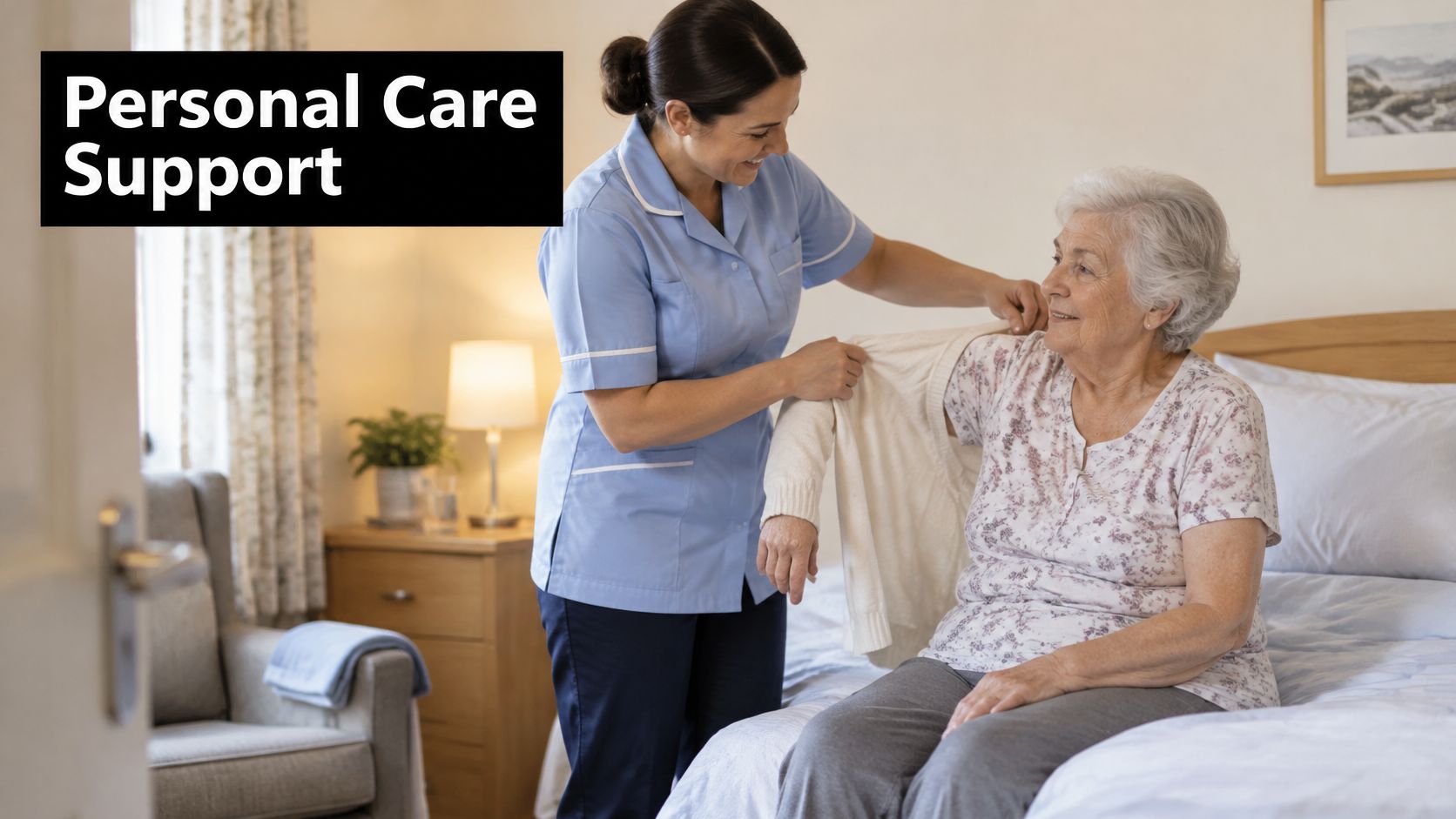
She asks you to slow down. You do. The wash takes longer, so you shorten the chat after dressing rather than skipping drying. You offer a drink between tasks and note what she took.
Three slips show up on almost every early shift:
- Skipping consent: You explain and wait for a yes before you touch, even when you're late.
- Guessing the water: Too hot causes a scald. Too cold makes the person flinch and refuse the rest of the wash.
- Leaving folds damp: Moisture under breasts, groin and between toes causes soreness by the next shift.
At the end she is clean, comfortable and has been asked, not processed. You record the wash, the drink, the new red mark on her heel, and you tell the senior before you leave the room.
A home-care call compresses that same routine into about thirty minutes. You prioritise washing, continence and repositioning, and you write what you couldn't finish so the next carer doesn't assume it was done.
Where Your Duties End and Delegation Begins
A task can sit in the job description and still be outside your duties today. The test is not the title on your badge.

| Scenario | Usually within duties when | Escalate or stop when |
|---|---|---|
| Blood glucose checks | Trained and signed off for the method | Reading falls outside protocol or the person is unwell |
| Dressing changes | Trained, dressing is simple and a plan exists | Wound looks infected, is bleeding, or the dressing is complex |
| Catheter care | Trained in routine cleaning and bag emptying | Catheter is blocked or leaking, or the person has pain or fever |
| Specimen collection | Trained and labelled per procedure | Specimen is unclear or needs a clinical decision |
| Sudden confusion or a fall | Recognise, report immediately, give first aid if trained | Anything beyond training: call for a nurse at once |
| Medicines | Only where authorised and recorded | Dose is unclear, a reaction occurs, or there is no authorisation |
The six checks before you start
Run every new task through task, training, authorisation, supervision, documentation and escalation. Name the task. Confirm you've been taught that exact method. Confirm a registered professional has authorised it for this person. Know whether someone must watch you. Know what you write afterwards. Know the name and number you call if it goes wrong.
Watching a nurse do something is not the same as being delegated and signed off to do it. Recent NHS job descriptions state that healthcare assistants work within their competence, undertake delegated care, report concerns, and escalate abnormal observations to the nurse in charge. Duties aren't fixed nationally by job title. Hospital work centres on personal care and observations. Primary care can include equipment sterilisation, health checks, samples and blood-taking, but only where that employer has trained and authorised you.
If a task falls outside that, stop. Make the person safe, call the nurse or senior carer, and record what you did and what you didn't do.
Say you're asked to change a dressing that looks red, hot and wet. You don't peel it off to "have a look" unless you're trained for that dressing and the plan allows it. You describe what you can see, leave the dressing in place, and get a nurse.
Boundaries also differ between NHS hospitals, GP surgeries and social care employers. Ask for delegation in writing, and keep your agreed ways of working next to the care plan so you're not guessing from memory.
Before any new task, ask three questions. Have I been trained for this exact task? Has someone assessed my competence and signed it? Who do I call if it goes wrong?
This short film walks through how delegation is supposed to feel on a shift, not just on a policy page.
Observations, Records and When to Escalate
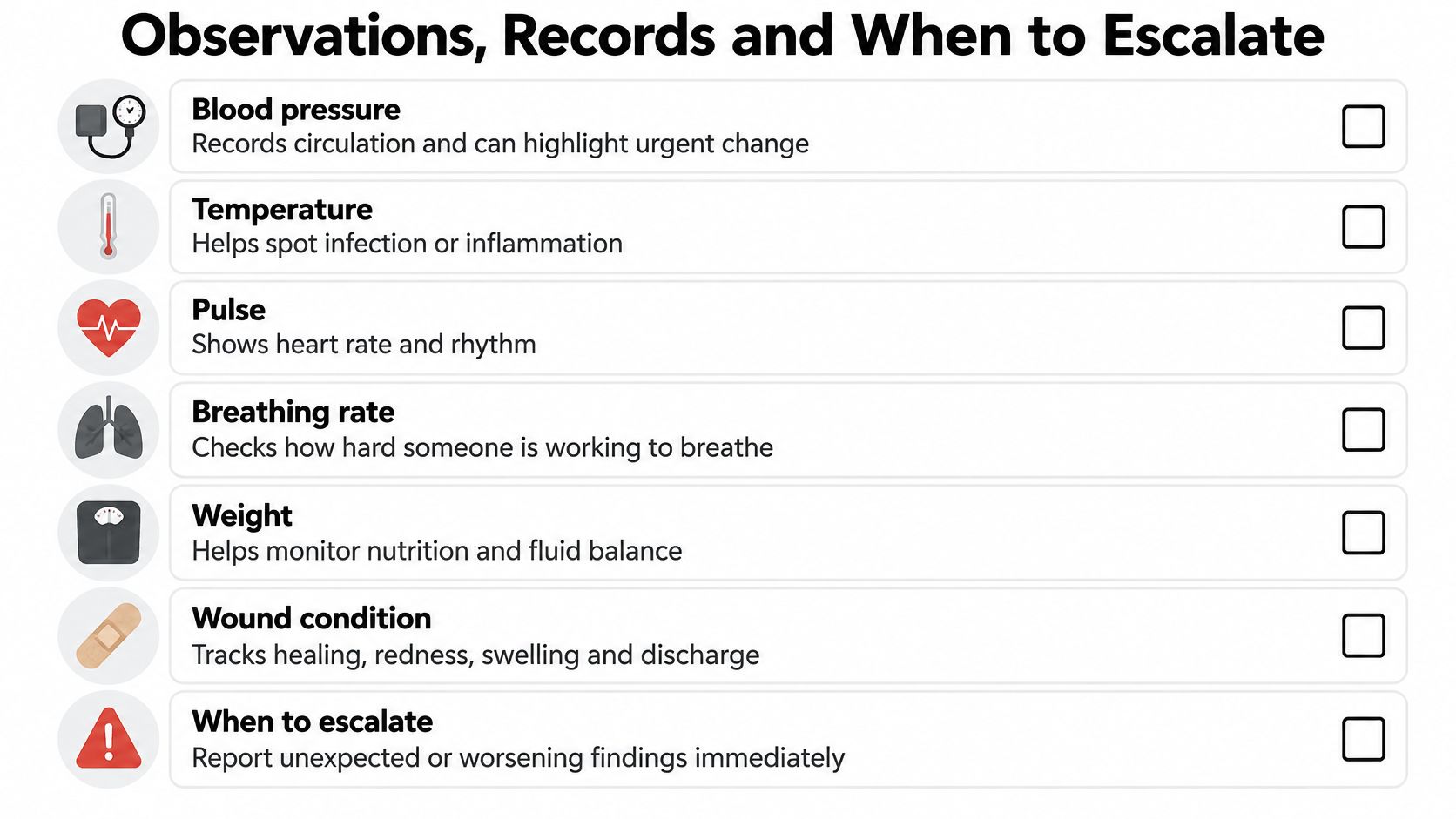
Under delegation you may be asked to measure blood pressure, temperature, pulse, breathing rate and weight, and to look at a wound. Blood pressure and pulse show how circulation is coping. Temperature can flag infection. Breathing rate shows how hard someone is working to get air. Weight, taken the same way each time, helps the team judge food and fluid. A wound check looks for redness, swelling, discharge and whether the edges are closing.
Skills England describes this mix clearly: support with eating, drinking, washing, dressing and toileting, alongside measuring vital signs such as blood pressure, temperature and weight, checking wounds, applying dressings, and preparing people before, during and after work done by registered professionals. You follow the care plan, local protocols and national standards. You don't take on a task past your training or delegated authority. A number without a time and your initials is hard for anyone else to act on, so you write it at the bedside or the chair, not from memory at the end of the shift.
What deterioration looks like
Watch for new confusion, drowsiness, less urine, a drop in food or drink, new pain, a change in breathing, a fall, or a fever. One sign can be enough.
At lunch, Mrs Adeyemi's pulse is faster than her morning reading and she is drowsy over her meal. You write both values with the time, repeat the check at the interval your policy sets, and tell the nurse in charge straight away. You don't wait for the end of the drug round.
Use SBAR so the report is complete in four lines:
- Situation: "Mrs Adeyemi is drowsy at lunch and her pulse is 112."
- Background: "This morning she was alert and her pulse was 78. She has a chest infection."
- Assessment: "She has eaten two spoonfuls and her breathing looks quicker."
- Recommendation: "Can you review her now?"
At handover, pass the latest readings, any repeat checks, what you reported, who you told, and what is still outstanding. Care notes stay factual, dated and signed. "Appears drowsy, pulse 112 at 12:40, nurse informed" is a record. "Seemed off" is not.
Accurate observations only protect someone if the right person hears them in time.
Infection Prevention and Medication Support
Three controls sit on almost every clinical task.
Hand hygiene comes before and after care. Contaminated hands carry germs from one person to the next, including onto door handles and meal trays.
PPE is chosen for the task. Gloves for body fluids, an apron when clothing could be soiled, and the extra items your local policy names for that person. The wrong kit, or kit left on between rooms, spreads what you meant to contain.
Equipment is cleaned or replaced before the next use. An uncleaned blood pressure cuff can move organisms as surely as unwashed hands. Where the task needs it, you use an aseptic technique and you leave kit clean and ready, not "I'll wipe it later".
UK government IPC guidance gives care and support workers the day-to-day job: keep knowledge current, report breaches and risks, and avoid close contact with people you support when you may spread infection. If you have vomiting or diarrhoea, you stay off and follow the local exclusion rules rather than "working through it".
On a wound or device site, look for redness, swelling or fever and report it the same shift. Employers check this with hand-hygiene observation, PPE competency checks and equipment-cleaning logs. If it isn't logged, it didn't happen as far as an audit is concerned.
When a dose is missed
You give medicines only where you are locally authorised and trained. You record every dose, including doses you didn't give, and you report allergic reactions or other concerns to the right professional at once. A morning tablet stays in the pot because the resident is asleep. You record it as omitted, write the reason, and tell the nurse so the pattern can be reviewed before the next dose is due. A blank box looks the same as a dose that was given and forgotten, which delays clinical review and hides errors. Our medication administration training sets out how that record should look when you are authorised to give a dose.
Care Certificate Standards and Evidence Employers Check
The Care Certificate sets fifteen standards that health and social care workers are expected to meet, usually in the first twelve weeks. Listing duties is not the same as being ready. Employers want proof that you can do the task safely in their setting.
| Duty | Care Certificate standard | Evidence to show |
|---|---|---|
| Personal care and dignity | Standard 5 (person-centred care) and Standard 7 (privacy and dignity) | Observed practice record and competency sign-off |
| Eating and drinking support | Standard 8 (fluids and nutrition) | Completed food and fluid charts |
| Moving and handling | Standard 13 (health and safety) | Moving and handling certificate and observed practice |
| Observations and escalation | Standard 6 (communication) | Handover and escalation log entries |
| Recognising emergencies | Standard 12 (basic life support) | Current basic life support certificate |
| Records | Standard 14 (handling information) | Accurate, signed and dated care notes |
| Infection prevention | Standard 15 (infection prevention and control) | Hand-hygiene observation and PPE competency check |
| Safeguarding | Standard 10 (safeguarding adults) | Safeguarding certificate and a reporting example |
A certificate shows you completed learning. A sign-off shows someone watched you do the task safely. Interviewers, induction leads and supervisors look for both, plus safeguarding awareness, emergency response, professional boundaries and a willingness to report concerns. Food and fluid charts, observation entries and specimen labels are part of the job, not extras you add if you have time.
Why proof beats another course
Workforce pressure hasn't gone away. The adult social care workforce survey collected responses from almost 5,000 settings in England in April 2025. Skills for Care reported a 7.0% adult social care vacancy rate in 2024/25, about 70,000 vacant posts, down from the 10.5% peak in 2021/22. Employers still choose the person who can show safe performance and escalation over the person with the longer course list.
All Cura Academy courses are aligned with CQC and Skills for Care standards. If you're mapping your own evidence, our guide on how to complete the Care Certificate shows how each standard is signed off in practice.
Keep one folder. Put certificates, observed-practice forms and sample notes in it, dated and with names removed. Check each page against the standard it supports before you take it to interview or induction. NHS healthcare assistant work and adult social care support-worker work ask for different evidence, so label each item with the setting it came from.
Confirm Your Duties Match Your Training Before You Apply
Don't send the application, or accept the extra task, until the duties and your training sit on the same page. Your employer's written policy overrides any general guide, including this one.
- Mark the advert. Read the job description and tick every duty, including the vague "other duties" line.
- Match the setting. Put each tick against hospital, care home or home care, using the first table, so you aren't assuming ward practice on a domiciliary rota.
- Check sign-off. List which Care Certificate standards you already have evidence for, not just courses you have booked.
- Find the gaps. Note mandatory training that is missing or out of date, including moving and handling, basic life support and infection prevention.
- Stop at the edge. For any duty outside your current competence, ask for written delegation and a competency assessment before you accept it. Apply the three questions: trained, assessed, and who you call.
Close the gaps with the courses your employer names, then book the date rather than leaving it as "soon". When you write applications, a clear note of what you can evidence helps. This guide to patient safety skills for healthcare resumes shows how to put observation, escalation and record-keeping on a CV without overclaiming.
You should finish with three things: a list of duties confirmed for your setting, a training-gap list, and a date for the next course or competency check.
Cura Academy trains people who are new to UK health and social care, and staff who need mandatory refreshers, so healthcare assistant duties match real competence rather than a job title. Pathways cover Care Certificate standards, infection prevention, basic life support and the other courses employers ask for before a shift. Visit Cura Academy to choose a route, complete the training and get ready for compliant work.