
You've started your first care shift, but nobody has clearly explained which tasks belong to your induction, which require observation, and which must be recorded for the Care Certificate. You may have completed several e-learning modules already, yet still have no clear answer to the question that matters: what exactly does your assessor need to see before signing you off?
The practical answer is to treat the Care Certificate as the first version of a job-ready onboarding profile, not as a workbook to finish in isolation. You need a clear framework, a named assessor, evidence from real care work, and an organised portfolio that another employer or agency can understand. The familiar framework began with 15 standards, but the standards were updated in March 2025 and now use 16 standards, alongside the Level 2 Adult Social Care Certificate qualification. Always confirm which version your employer or training provider is using.
Table of Contents
- What the Care Certificate Is and What Completing It Really Means
- Enrolment and Planning Before You Start a Single Standard
- Following a Structured Learning Pathway Standard by Standard
- Collecting Evidence and Passing Workplace Assessments
- Building an Onboarding Profile and Portfolio That Travels
- Real-World Scenarios Agency Starters Career Changers and Refreshers
- Your Action Plan and Common Questions Answered
What the Care Certificate Is and What Completing It Really Means
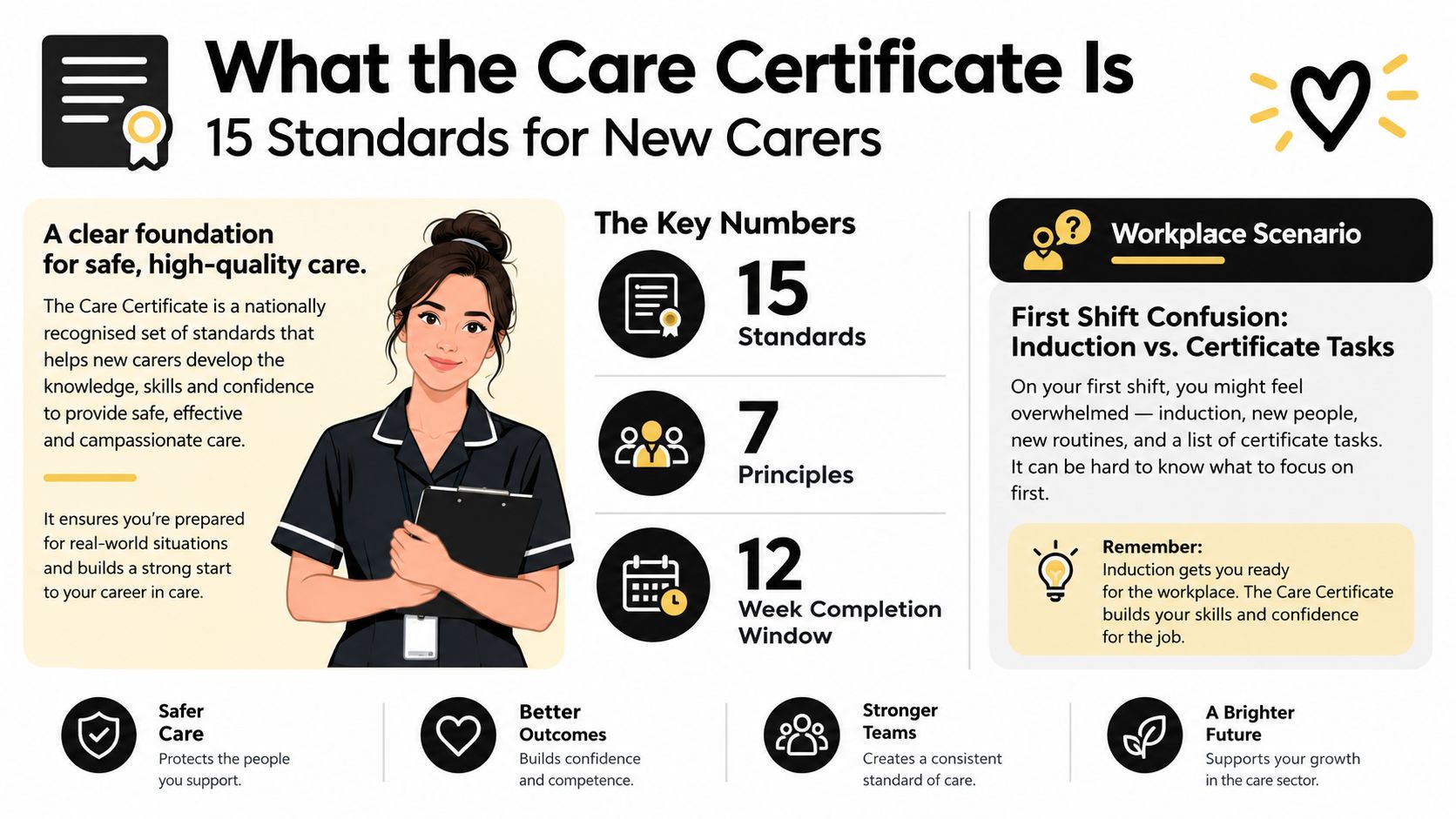
The Care Certificate is an induction framework for new healthcare assistants, adult social care support workers and similar frontline staff. It was launched in England on 1 April 2015 in response to the Cavendish Review, with the original expectation that new workers would complete it within 12 weeks of starting employment. The original framework contained 15 standards covering fundamental skills, knowledge and behaviours, including dignity, safeguarding, communication and infection control. The history and purpose of the framework are set out in the Care Certificate standards published by Skills for Care.
The framework replaced older induction arrangements because employers and reviewers wanted a more consistent way to prepare staff before they worked independently. It applies most directly to new workers entering adult social care and health support roles, including people joining through an agency or moving into a regulated service.
Completion is an assessment process
Completing the Care Certificate means demonstrating competence, not just watching videos or passing a multiple-choice quiz. Your employer normally agrees a plan with you, then uses self-assessment, questions, written evidence and evidence of practice to decide whether each standard has been met. Skills for Care's Care Certificate FAQs explains that evidence may sit in a workbook, portfolio or online record.
That distinction catches people out. E-learning can give you the knowledge to discuss person-centred care or infection prevention, but it can't prove that you communicate respectfully with a resident, follow hand hygiene procedures or report a safeguarding concern appropriately. Your assessor needs to connect the learning to your behaviour at work.
Practical rule: Treat every module as preparation for a workplace conversation or observation, never as the final evidence by itself.
The certificate also isn't a DBS check, a job qualification or an automatic Level 2 award. It doesn't replace employer induction, role-specific training, supervision or mandatory checks. It is evidence that you've met the required induction standards, subject to the assessment process and framework version your employer has adopted.
A completed portfolio can make agency screening and employer onboarding easier because it gives the next organisation something structured to review. It still needs to be accompanied by current employment checks, references, role training and any local competency requirements. CQC inspectors and employers are interested in clear evidence of safe practice, not just a file labelled “Care Certificate complete”.
Enrolment and Planning Before You Start a Single Standard
The fastest way to lose control of your completion plan is to begin with random modules. A new starter watches a communication video, answers some questions, attends a moving and handling session, then discovers weeks later that nobody arranged observations or decided who could sign the evidence. The learning may be useful, but the portfolio stalls.
Start with a short meeting with your manager or training lead. Confirm the framework that applies to your role, especially if you're working between health and adult social care, or if your employer is moving from the original 15-standard framework to the updated 16-standard version. Then agree the target date for each standard and identify a named assessor who has the competence and time to observe you.
Set up the working system
Ask for these items before opening the workbook:
- The approved framework: Get the exact standards, assessment guidance and workbook version your employer expects.
- A named assessor: Confirm who can assess each area and who covers their absence.
- An induction timetable: Include shadow shifts, supervised duties, training sessions and observation dates.
- Access to records: Make sure you can use the learning platform, evidence folder and relevant workplace policies.
- A safe observation plan: Agree which service users and tasks are suitable, with consent and confidentiality protected.
- A review rhythm: Book progress checks early instead of waiting until the end of the induction period.
The original policy expectation was completion within 12 weeks, and NHS Employers' guidance on the Care Certificate uses that period as the practical benchmark. Providers often create avoidable delay by waiting several weeks before starting observations. If you leave all performance evidence until the end, you may not have enough suitable opportunities to demonstrate every requirement.
Use one evidence location from day one. A sensible structure is a folder for each standard, with subfolders for knowledge answers, reflections, observation records, witness statements and assessor feedback. A digital onboarding profile can make this easier. Cura Academy users can map learning modules to the relevant standards, pre-assign assessor pairings and schedule check-ins around week 2, week 6 and week 10, while still following the employer's assessment process. Guidance on choosing a provider is also available in this health and social care training providers resource.
Before you start, write down the evidence still needed for every standard. That single list stops “completed” from becoming a vague status with no observation, signature or date behind it.
Following a Structured Learning Pathway Standard by Standard
The numerical order isn't always the most efficient learning order. I prefer to begin with standards that establish the worker's understanding, then move into behaviours that can be observed during ordinary shifts. This reduces the gap between learning and practice.
Start with Understanding Your Role, Personal Development, Communication, and Privacy and Dignity. These are suitable for guided study, policy reading and reflective answers. Pair them with practical tasks such as reading the job description, identifying the limits of your role, completing a development discussion, handing over information accurately, and explaining how you protect a person's privacy during personal care.
Next, work through Duty of Care, Equality and Diversity, Person-Centred Ways of Working, and Fluids and Nutrition. A supervisor can observe how you seek consent, respect preferences, support a meal or drink, and respond when a person refuses care. The usual mistake is writing an idealised answer that doesn't match the service's care plan or your actual responsibilities.
The final group covers standards that depend heavily on workplace context, including awareness of mental health, dementia and learning disability, safeguarding, basic life support, health and safety, and infection prevention. Pair each learning unit with a same-day task where possible. For example, after studying safeguarding, identify the reporting route in your service with your supervisor. After infection prevention learning, arrange a hand hygiene observation rather than relying on a completed quiz.
Cura Academy's pathway can organise modules, knowledge checks and workbook answers in a practical sequence, while your assessor can still review evidence against the official numerical order. That matters because a well-designed learner pathway and an employer's assessment paperwork don't always use the same navigation.
| Standard and Topic | Main Evidence Source | Pair With This Real Task |
|---|---|---|
| Understanding your role | Job description, policy questions and reflection | Discuss role boundaries with a supervisor |
| Personal development | Learning plan and supervision record | Agree a development objective |
| Duty of care | Knowledge answers and scenario discussion | Explain how to report a concern |
| Equality and diversity | Written response and reflection | Adapt communication to an individual's needs |
| Person-centred working | Observation and care documentation | Follow a person's preferences during support |
| Communication | Questions, reflection and observation | Complete a clear handover |
| Privacy and dignity | Knowledge evidence and observation | Protect privacy during personal care |
| Fluids and nutrition | Workbook answers and workplace observation | Support a drink or meal according to the care plan |
| Mental health, dementia and learning disability awareness | Knowledge questions and discussion | Adjust support to an individual's presentation |
| Safeguarding | Scenario answers and observed reporting | Follow the service's safeguarding pathway |
| Basic life support | Practical training record and assessment | Demonstrate the required response in training |
| Health and safety | Questions and workplace documents | Complete or discuss a risk assessment |
| Infection prevention and control | Knowledge evidence and observation | Demonstrate effective hand hygiene |
The table reflects the familiar 15-standard pathway. If your employer uses the March 2025 update, follow its additional standard and revised assessment instructions rather than forcing evidence into an older workbook.
Collecting Evidence and Passing Workplace Assessments
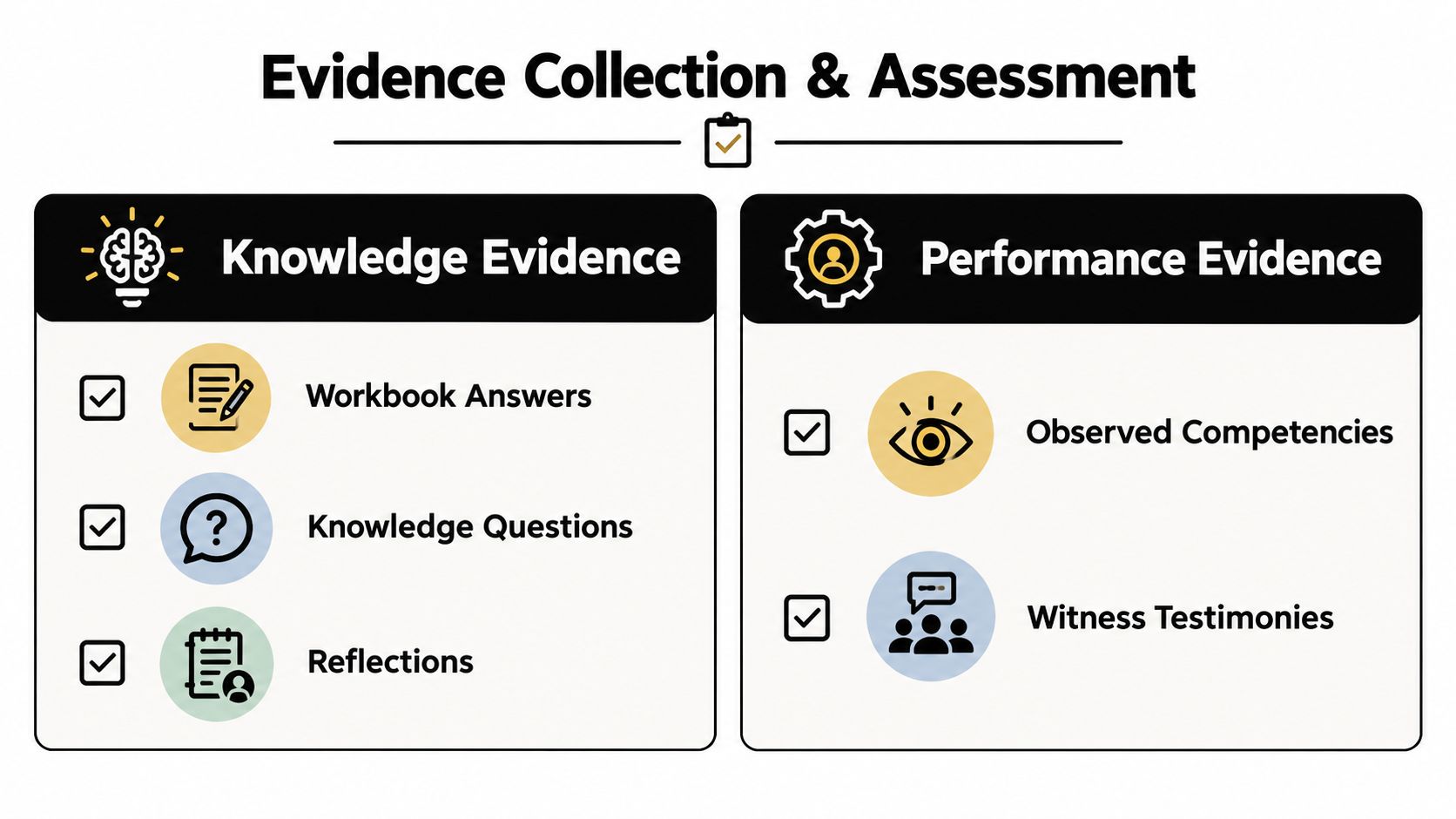
Assessors usually look for two different kinds of evidence. Knowledge evidence shows that you understand the requirement. Performance evidence shows that you can apply it safely and consistently in the workplace.
Knowledge evidence may include workbook answers, questions, policy discussions and reflective accounts. Performance evidence can include direct observation, a competent witness statement, a completed workplace document or a record showing how you carried out a task. Strong portfolios combine the two instead of asking one type of evidence to do every job.
Match evidence to the standard
For Standard 1, Understand Your Role, attach the relevant job description and write a short reflection explaining your responsibilities, boundaries and escalation route. For Standard 5, Work in a Person-Centred Way, arrange an observation during a care plan interaction, with consent and confidentiality managed correctly.
For Standard 13, Health and Safety, a completed risk assessment can be useful product evidence if your assessor confirms it meets the standard. For Standard 15, Infection Prevention and Control, a hand hygiene observation is more persuasive than a generic statement saying you understand infection control.
Before an observation, ask the assessor what they will be looking for. During the observation, work normally. Don't perform a theatrical version of care or recite policy language to the person you're supporting. Afterwards, record the date, activity, context, assessor's name, outcome and any action required.
Use a gap as a task, not a failure. If the assessor says your explanation of confidentiality is incomplete, return to the policy, discuss a relevant example and submit a focused reflection. If your practical technique needs improvement, book another supervised opportunity and record what changed.
A portfolio is ready for sign-off when another competent person can follow the evidence without asking you to reconstruct the whole story.
Keep file names precise. “Standard 5 observation, date, assessor” is more useful than “care evidence final”. Remove unnecessary personal information, follow your employer's confidentiality policy and don't store identifiable care records in a personal folder without permission. A training matrix can help managers see missing items, and this training matrix template provides a practical way to organise progress.
A short weekly review prevents small evidence gaps becoming a final-week crisis. Ask three questions: which standard is next, what evidence is missing, and when will the assessor observe it?
Building an Onboarding Profile and Portfolio That Travels
Your first Care Certificate portfolio shouldn't disappear into an employer's filing cabinet as soon as you move role. Build a controlled personal record of your training and assessment evidence, then share only what the new employer, agency or inspector legitimately needs.
Skills for Health describes the certificate as portable and says workers shouldn't need to repeat it when changing jobs if they've already completed it elsewhere. That doesn't mean every document transfers automatically. A new employer may need to verify the assessor, check the version of the framework, confirm that the evidence belongs to you and assess any local competencies that aren't covered by the certificate.
Use a clean evidence structure
Keep an encrypted cloud folder or approved digital portfolio with:
- A contents page: List each standard, completion status, evidence type, assessor and date.
- Signed assessment records: Export completed PDFs and retain the assessor's name and competence details.
- Witness statements: Scan signed records and make sure they explain what was observed.
- Certificates and course records: Keep PDFs for relevant learning, including practical training.
- A transfer note: Record any standards still outstanding and the next action required.
- DBS information: Keep your DBS documentation and, where applicable, maintain eligibility for the Enhanced DBS Update Service.

A platform such as Cura Academy can attach learning and evidence to individual standards, which gives a new organisation a clearer starting point than a collection of unrelated course certificates. For employers improving the human side of joining and compliance, resources on engaging employee onboarding content can also help turn a document-heavy induction into a more understandable experience.
Don't keep everything indefinitely without checking policy. Employer records may have retention rules, and personal data must be handled lawfully. Keep your own completion evidence where permitted, shred duplicate paper copies containing personal information, and ask the employer how long identifiable workplace documents should remain in your possession.
The most common portability failures are simple: missing signatures, unclear dates, no assessor details, screenshots without the learner's name, and evidence that refers to a different employer's procedure without explanation. A new assessor may accept the evidence, request clarification or require a fresh observation. A tidy portfolio won't remove professional judgement, but it gives that judgement something reliable to work with.
Real-World Scenarios Agency Starters Career Changers and Refreshers
The same framework feels very different depending on how you enter care. A new agency worker may need to prove every foundation skill, while an experienced support worker may already have useful evidence but lack access to the original assessor.
A new agency starter
A worker with no care background can often complete the knowledge-heavy standards quickly because they don't depend on a long employment history. The delays usually appear when the worker books shifts across different services but has no consistent assessor or evidence folder. Agree who owns the portfolio before accepting placements, and ask the agency how observations will be arranged.
The worker should keep a transfer-ready profile and give each new service a short list of completed and outstanding standards. Evidence from one placement must still be checked for relevance by the receiving employer. A care home may accept a general safeguarding discussion but require its own local reporting and emergency procedures.
A career changer
Someone moving from hospitality or retail may bring useful experience in communication, privacy, equality and responding to customer needs. That experience can support reflective evidence for Standards 1, 6 and 7, but it doesn't automatically prove competence in care. The learner still needs to connect the experience to regulated care responsibilities and complete workplace observations.
The biggest mistake is assuming transferable skills remove the need for assessment. They make the conversation richer and may reduce repetition, but the assessor must decide whether the evidence meets the standard.
An experienced worker returning
A worker returning after a career break may have old certificates, previous supervision records and strong practical experience. The first task is to verify which framework was used, whether the evidence is still accessible and what the current employer requires. If the original assessor cannot be contacted, provide the records to the new assessor and ask for a gap review rather than starting blindly.
| Starting point | Likely fast-track standards | Common blockers | Typical completion |
|---|---|---|---|
| New agency starter | Knowledge and role orientation once the employer is confirmed | No named assessor, changing placements and missing observations | Around the employer's planned induction window if shifts and evidence are coordinated |
| Career changer | Communication, privacy, dignity and customer-facing reflection | Treating previous experience as automatic care competence | A staged pathway combining recognition of experience with new observations |
| Returning care worker | Familiarity with care routines and previous portfolio evidence | Outdated framework, missing signatures or inaccessible assessor | A gap-based plan rather than an automatic full repeat |
The important distinction is between reusing evidence and assuming competence. A shared onboarding profile helps the right person review existing evidence quickly, but it doesn't bypass assessment.
Your Action Plan and Common Questions Answered
Start on Monday with these actions:
- Confirm eligibility: Ask your employer which Care Certificate framework and workbook apply to your role.
- Create your profile: Set up one approved folder or digital record for standards, evidence and assessor feedback.
- Agree ownership: Name the assessor and confirm who covers observations during absence.
- Plan the pathway: Allocate target dates to each standard and include the updated framework if required.
- Book evidence time: Reserve regular weekly slots for questions, reflections and portfolio organisation.
- Arrange observations: Match practical standards to real shifts and suitable workplace tasks.
- Review progress: Check outstanding evidence with your manager before the final sign-off meeting.
- Submit the portfolio: Ask the assessor to confirm every standard has evidence, dates and signatures.
How long does it take?
For a full-time worker, the recognised benchmark is around 12 weeks, but the actual pace depends on shifts, assessor availability, role complexity and access to suitable observations. Starting late compresses the time available for practical evidence.
Does the Care Certificate expire?
The certificate itself isn't a substitute for ongoing training. Employers may require refreshers, updated competencies and local induction after a move or career break. Keep your evidence current and ask the receiving organisation what it accepts.
Does it transfer between employers?
It is intended to be portable, so you shouldn't automatically repeat a completed certificate when changing jobs. The new employer still needs to verify your records and may require additional local assessment.
What happens if one standard isn't signed off?
You remain incomplete for that standard. Ask for the exact gap, complete the required learning or observation, and resubmit targeted evidence. Don't label the whole portfolio complete while a standard remains unresolved.
Does it count towards a Level 2 qualification?
The Care Certificate and a Level 2 qualification aren't automatically the same thing. The March 2025 update aligns the framework with the Level 2 Adult Social Care Certificate qualification, but your employer or training provider must explain the qualification route, eligibility and assessment requirements.
Build the portfolio as if an agency compliance officer will review it on a busy morning. Clear evidence, named assessors, accurate dates and a transparent record of outstanding work will serve you better than a full folder of unconnected certificates.
Cura Academy provides structured Care Certificate learning pathways, mandatory refreshers and role-specific care training that can be organised alongside your workplace evidence and onboarding profile. Visit Cura Academy to choose a practical route for building job-ready records before you approach an employer or agency.