

A new care worker completes every online module before their first shift. The training matrix turns green, the certificates sit in the personnel file, and the rota is already under pressure. Then the worker arrives at a client's home and has to support medication, use moving and handling equipment, recognise a safeguarding concern, or respond to a change in condition without a manager beside them.
That situation exposes the central issue in domiciliary care compliance. A certificate proves that someone completed learning. It doesn't, by itself, prove that they can apply it safely, consistently and within the limits of their role. Safe services connect recruitment checks, induction, observed practice, supervision, care records and audits into one evidence trail.
Table of Contents
- Achieving Domiciliary Care Compliance in the UK
- Understanding the Current Regulatory Environment
- Conducting Mandatory Pre-Employment Checks
- Bridging the Gap Between Training and Competence
- Maintaining Compliance Through Active Monitoring
- Leveraging Training Platforms for Ongoing Education
- Your Essential Compliance Checklist for 2026
Achieving Domiciliary Care Compliance in the UK
Health and social care depends on trust, but trust is built through repeatable actions. A person receiving care at home needs visits to happen as planned, support to reflect their preferences, records to match what happened and concerns to reach the right manager quickly. Families and commissioners need the same assurance, supported by evidence rather than verbal reassurance.
The definition of domiciliary care matters because the setting changes how compliance works. Care workers usually operate alone in a person's home, often moving between clients and making decisions without immediate face-to-face supervision. That makes role clarity, practical assessment and reliable records especially important.

Start with the service, not the spreadsheet
A compliant provider should map each regulated activity and client-specific risk to the competence required to deliver it. Personal care, medication support, moving and handling, infection prevention, lone working, safeguarding and basic life support shouldn't sit in a generic list detached from real duties.
A practical starting sequence is:
- Map the work. Identify what each client's care plan requires and which tasks carry the greatest risk.
- Check the worker. Confirm identity, references, employment history, DBS status and suitability for the proposed role.
- Induct properly. Explain policies, client needs, escalation routes, record keeping and local procedures.
- Observe practice. Use a competent assessor to watch the worker perform relevant tasks and record the outcome.
- Keep reviewing. Link refreshers and reassessment to risk, incidents, complaints, changing duties and supervision findings.
This approach takes more coordination than assigning a bundle of e-learning courses. It also gives managers something far more useful during an inspection: evidence showing what a worker is authorised to do, who assessed them, when the assessment took place and what happens if practice falls below the required standard.
Practical rule: If a worker can't explain the task, demonstrate it safely and produce the required record, treat the training as incomplete.
The Care Quality Commission's historical inspection findings reinforce why this matters. Compliance depends on reliable visit delivery, person-centred records, safeguarding, supervision and active quality monitoring, not training completion alone. For a provider, the aim isn't to create a perfect folder. It's to make safe practice the easiest way for staff to work every day.
Understanding the Current Regulatory Environment
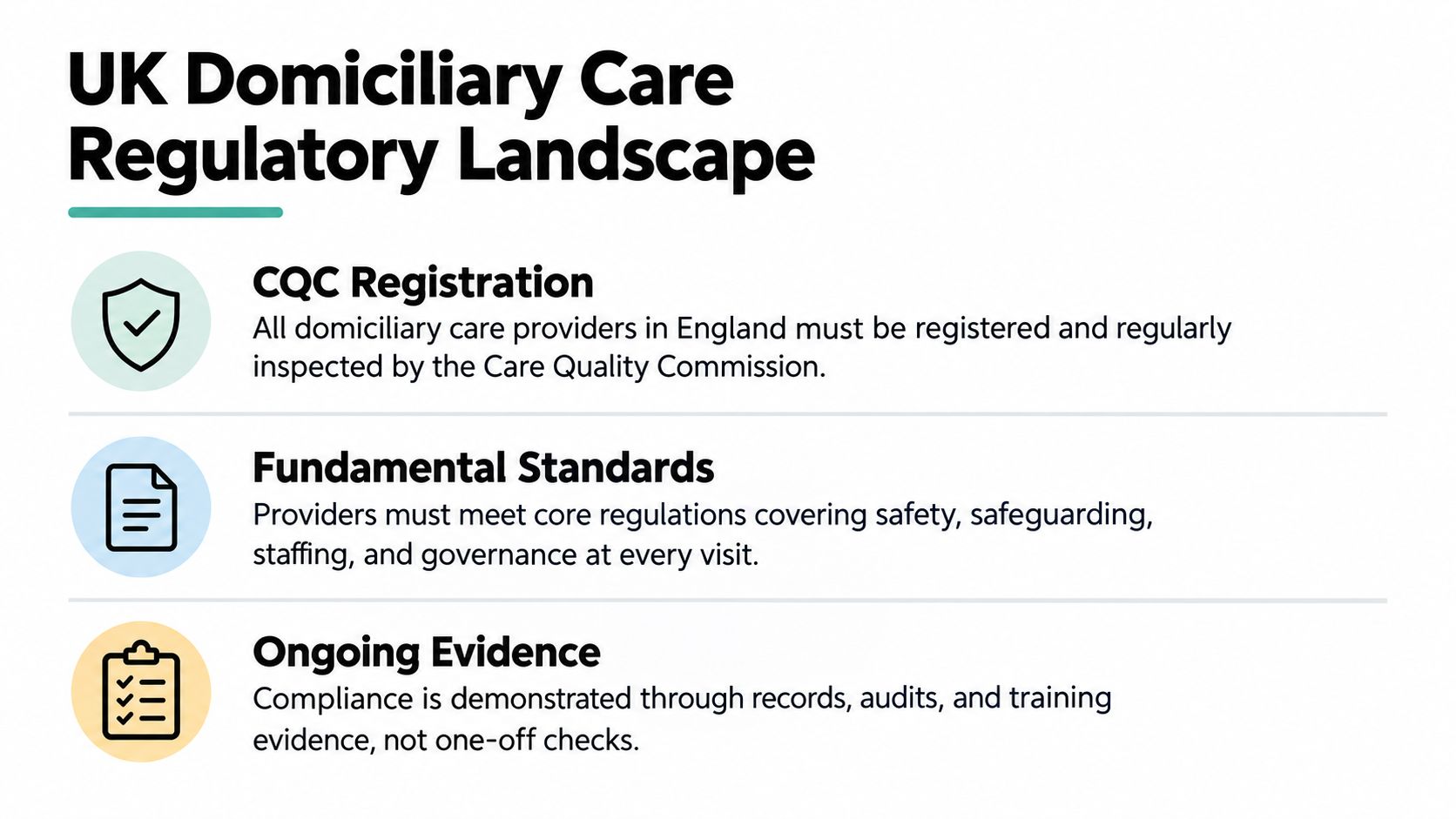
Domiciliary care operates at significant scale, so a small control failure can affect several visits before anyone notices. ADASS data cited by the CQC recorded more than 47.5 million homecare hours in England between January and March 2025, over 5% higher than the same period in 2024, as reported in the CQC ratings data workbook. More visits create more opportunities for good care, but also more chances for late attendance, incomplete notes, medication errors and weak escalation.
The current rating picture gives managers a practical benchmark. Among 916 homecare services rated under the CQC Single Assessment Framework by 1 August 2025, 72.27% were rated good, 2.95% outstanding, 21.29% requires improvement and 3.49% inadequate. With 24.78%, almost one in four rated services below good, compliance cannot be treated as an annual paperwork exercise.
Apply the CQC framework to lone working
Before building your evidence trail, review the CQC key lines of enquiry to see how inspectors assess services under the Single Assessment Framework. For domiciliary care, the five areas must be visible in everyday lone-working practice:
- Safe: staff follow safeguarding, infection control, medicines and incident procedures, and report missed visits or changing risks promptly.
- Effective: workers follow the care plan, use equipment correctly and record whether support achieved the intended outcome.
- Caring: lone workers respect choices, privacy, dignity and communication preferences during visits.
- Responsive: staff recognise changes in need, respond to concerns and escalate when the planned support no longer fits.
- Well-led: supervisors review records, complaints, incidents and spot checks, then act on patterns rather than filing evidence without follow-up.
A completed online course supports the evidence trail, but it does not prove that a worker can apply the learning alone in a client's home. Managers need observed practice, competency decisions, supervision records and clear limits on tasks a worker may perform.
Use inspection findings to test controls
A CQC themed inspection programme covering 250 domiciliary-care agencies in England between April and November 2012 found that 74% met all five standards examined, while 97% met the standard for respecting and involving people. The CQC themed inspection summary also identified late or missed visits, limited continuity, unsupported staff, weak care planning and poor responses to people and families.
Those older findings remain useful as control tests. A provider may have complete policies and training records yet still fail to deliver visits reliably or identify when a care plan no longer reflects a person's needs.
Build assurance around exceptions
Completion percentages can hide one worker's repeated late notes, one client's missed visits or unexplained gaps in a medication record. Track exceptions by worker, client, branch and contract, record the management decision, and check whether corrective action worked. Inspectors need evidence that the service notices problems, responds proportionately and learns from them.
Conducting Mandatory Pre-Employment Checks
Pre-employment compliance starts before a worker is offered a first unsupervised visit. The purpose isn't to create unnecessary delay. It's to establish whether the person is identifiable, suitable, appropriately screened and capable of progressing through induction for the duties they may perform.
Use a documented sequence rather than relying on a recruiter's memory. Record the evidence, the date checked, the person who checked it and any restriction attached to the decision.
Verify identity and history
Begin with identity verification and a clear employment history. Investigate unexplained gaps, inconsistent dates or references that don't match the application. References should be relevant to the role and should support the candidate's suitability for work involving vulnerable adults.
Check DBS status and retain the required evidence in line with your information governance arrangements. The enhanced DBS check requirements should form part of the provider's recruitment procedure, alongside a decision about whether the applicant is suitable for the specific duties proposed. A DBS check is not a substitute for a reference, interview, identity check or supervision plan.
Match suitability to actual duties
A worker may be suitable for general care duties but not yet authorised to support medication or use particular equipment. Map each proposed activity to the evidence required before deployment.
| Decision point | Evidence to confirm | Deployment outcome |
|---|---|---|
| Identity and history | Identity, references and employment information have been checked | Recruitment can progress |
| Screening | DBS status and role suitability are recorded | The provider can make a documented suitability decision |
| Induction | Policies, client information, safety procedures and escalation routes have been covered | The worker may proceed to supervised practice |
| Competence | Practical observation and assessment are complete for relevant tasks | The worker may perform only authorised duties |
| Exceptions | Missing or expired evidence has an owner and deadline | The worker remains restricted until approval is recorded |
A shortage of staff can tempt managers to treat a partially complete file as “good enough”. That's precisely when controls need to become clearer. If supervised induction can safely cover a missing element, record who is supervising, what the worker may and may not do, and the deadline for completion. If the risk can't be controlled, don't deploy the worker to that task.
Keep the first shift conditional
The first shift should be a readiness decision, not an automatic consequence of recruitment. The manager should be able to answer three questions: Is the worker suitable? Are they prepared for this client? What are they authorised to do today?
That decision should reflect client-specific risks. A worker supporting a person with complex medication needs requires different evidence from someone providing companionship and meal support. A generic training matrix can't make that distinction on its own.
Bridging the Gap Between Training and Competence
Online training is useful, but it solves only part of the problem. A safeguarding module can explain categories of abuse and reporting routes. An infection prevention course can describe hand hygiene. Basic life support learning can establish theory. None of those certificates proves that a worker will act correctly in a particular home under pressure.
The practical test is whether the provider can show documented induction, observed competency, supervision and clear authorisation. This is particularly important when staff work alone and managers can't routinely watch practice.

A certificate answers the wrong question
A certificate answers, “Did the learner complete this course?” The manager needs answers to different questions:
- Can the worker explain the relevant risk?
- Can they perform the task safely?
- Can they recognise when the task is outside their competence?
- Can they record what happened accurately?
- Do they know who to contact when circumstances change?
Observed assessment should mirror the job. For moving and handling, assess the technique with the equipment and care context the worker will encounter. For safeguarding, test whether the worker can respond to a disclosure, preserve information appropriately and escalate without making promises they can't keep. For infection prevention, observe hand hygiene and the use of protective equipment rather than accepting a quiz score.
A fast onboarding process becomes unsafe when it removes the evidence that tells you what a worker can actually do.
Medication support provides a clear example. CQC guidance requires medicines support to be agreed in the care plan and recorded accurately for every medicine and occasion, while recent local-authority guidance recommends annual medicines refreshers and documented competency assessments, not attendance alone. The guidance for managing medicines in home care supports a process where the provider confirms the worker's authorised level of support, observes practice and checks records.
Define the evidence trail
For every risk area, keep four connected records:
- Learning evidence, showing the course or briefing completed.
- Assessment evidence, showing what the worker demonstrated and whether they passed.
- Supervision evidence, showing how practice was reviewed in the workplace.
- Review evidence, showing when reassessment is due or why it was brought forward.
A structured employee training guide for 2026 can help managers think about training as an ongoing process rather than a collection of certificates. The provider still has to adapt any framework to its policies, client risks and regulated activities.
The strongest file makes limits visible. It says, for example, that a worker has completed theory and general induction but isn't authorised to administer medication until observed assessment is signed off. That may feel slower at the start. It prevents managers from making unsafe assumptions later.
Maintaining Compliance Through Active Monitoring
Compliance expires in practice long before a policy reaches its review date. A worker changes role, a client's needs develop, a visit pattern becomes unstable or a care record stops matching the plan. Managers need a shift-readiness process that checks whether the evidence is current for the people and visits scheduled.
Homecare vacancy rates were just over 10% in March 2025, more than twice the rate for care homes, according to CQC reporting on access to adult social care. Staffing pressure makes transparent controls more important, not less. A provider must know whether a mobile, agency or bank worker is cleared, trained, competent and appropriate for the assigned client before the visit begins.
Reconcile four views of the visit
Digital systems are valuable only when managers compare their records with reality. Reconcile:
- The planned call, including the scheduled worker, time and required tasks.
- The electronic evidence, such as call-monitoring records or GPS exceptions.
- The contemporaneous note, showing what happened and what changed.
- The human feedback, including client, family and worker reports.
Don't treat a completed dashboard percentage as proof that care occurred correctly. The CQC reported a homecare service where staff appeared to be logged into different locations simultaneously, indicating inadequate oversight of worker allocation and visit duration. The service rating fell from good to requires improvement. The control that matters is investigation of unexplained variance, followed by a recorded decision and corrective action.
Turn audit findings into a control loop
A local-authority medicines-management policy uses 90% as a minimum compliance threshold and requires weekly re-auditing when domiciliary medication-audit compliance falls below that level, as set out in the medicines-management policy. Providers can use that principle as an operational model: define a threshold, specify the response and keep checking until performance is restored.
The threshold shouldn't replace judgement. A high-risk error may require immediate action even if the overall audit result remains above the threshold. Conversely, a lower-risk documentation lapse may need targeted coaching rather than blanket retraining.
A useful compliance review asks:
- Which exception occurred?
- Which client or task was affected?
- Was the worker authorised and competent?
- Did the care plan and record agree?
- Was the manager notified on time?
- What evidence will show that the fix worked?
Teams looking to distinguish procedural conformity from effective control may find the Synopsix compliance assessment useful as a prompt for reviewing whether records demonstrate real performance. The goal is an evidence trail linking training, supervision, deployment and outcomes.
Leveraging Training Platforms for Ongoing Education
A training platform can reduce administrative friction, but it can't remove the provider's responsibility to assess competence. The right choice depends on workforce size, turnover, role mix, reporting needs and how much practical assessment the organisation manages internally.
Traditional one-off purchases work well when a provider needs a specific course for a defined group. They can be simple to approve and easy to assign. The weakness is fragmentation. Certificates may sit across different portals, expiry dates can be missed and managers may struggle to see whether learning relates to a worker's current duties.
Compare the operating models
| Model | Where it helps | What managers still need to control |
|---|---|---|
| One-off courses | A targeted training requirement or occasional specialist topic | Expiry dates, records, course relevance and practical sign-off |
| Subscription access | Ongoing refreshers and repeated access for a changing workforce | User permissions, completion monitoring and role-based assignment |
| Internal delivery | Local procedures, client-specific induction and observed practice | Assessor competence, consistency and protected assessment time |
| Blended approach | Theory online with workplace observation and supervision | Clear ownership of each evidence type and escalation of gaps |
Subscription access can be practical for organisations that repeatedly onboard workers or need staff to revisit core subjects. It reduces the need to purchase each module separately, but unlimited access doesn't prove that a worker has completed the right pathway or demonstrated capability. Managers should still assign learning by role and connect it to an assessment record.
Use platforms as part of a pathway
A sensible pathway starts with role selection, screening and core learning. It then moves into provider induction, client-specific preparation, observed assessment and supervised deployment. The platform supports the learning stages. The registered provider remains accountable for deciding whether the worker is ready for a particular task.
For individual workers, a platform such as Cura Academy offers online Care Certificate standards, mandatory refreshers and role-related courses, with a subscription model and one-off bundles available. That can help organise learning and keep certificates accessible, but employers still need to verify identity, suitability, local induction and workplace competence before authorising duties.
Training records should show more than a green completion icon. Add the course name, completion date, renewal expectation, assessor, assessment result, restrictions and next review. If a worker changes from companionship to personal care or begins supporting medication, update the pathway rather than assuming the old record remains sufficient.
Training platforms are most useful when they make gaps visible. They don't replace supervision, and they shouldn't become a reason to move assessment into the background.
The following video can support an introductory discussion about organising care-related learning:
Your Essential Compliance Checklist for 2026
A defensible compliance system gives every important risk an owner, an evidence source and a review route. Start by baselining the organisation against the CQC's five quality domains, then separate weaknesses in provider systems from gaps in individual-worker competence. A strong policy won't compensate for an unassessed worker, and a competent worker can't repair a scheduling system that repeatedly misses visits.
Build the baseline
Create one live register covering:
- Safety risks, including medication, moving and handling, infection prevention and emergency response.
- Workforce controls, including identity, DBS status, induction, competence, supervision and role restrictions.
- Client safeguards, including care-plan accuracy, consent, dignity, safeguarding and communication preferences.
- Operational evidence, including late or missed visits, call-monitoring exceptions, contemporaneous notes and complaints.
- Governance actions, including the responsible manager, deadline, evidence required and review outcome.
Rank deficits involving safety, staffing, medication, safeguarding and management oversight as high priority. Don't give every action the same deadline. A missing competency assessment for a task due on today's rota needs a different response from a policy review that can be scheduled into the quality calendar.
Make improvement measurable
For each action, record:
- The problem, stated in operational terms.
- The owner, who has authority to complete it.
- The evidence, such as an observation form, sample audit or supervision note.
- The deadline, based on risk rather than convenience.
- The indicator, showing what acceptable improvement looks like.
- The validation, confirming that the change worked in practice.
Sample audits should test the record against the visit, not just check whether a field is populated. Review care notes alongside the care plan, medication administration evidence, call exceptions and client feedback. If the records disagree, investigate the disagreement.
Repeat the cycle after change
Reassess after an incident, complaint, safeguarding referral, significant workforce turnover or service expansion. A new client group can introduce risks that weren't present in the original service model. A new scheduling system can create different evidence gaps from the old one.
The practical standard is simple: before deployment, know what the worker is authorised to do; during delivery, check that the visit and record match; after an exception, act and verify. That cycle protects people more effectively than a training matrix left untouched between inspections.
Cura Academy provides online Care Certificate standards, mandatory refreshers and role-specific learning that can help care workers organise their training evidence before employer-led induction and observed assessment. Visit Cura Academy to review the available learning pathways and use them as one part of a demonstrable domiciliary care compliance process.