

At 7:15am, you arrive at a terraced house, enter using the key safe, and find Mrs P waiting in her dressing gown. She needs help washing, getting dressed, taking her morning medicines and preparing breakfast before you leave for your next call. You're not working in a care home. You're providing care in Mrs P's own home, which is the practical starting point for understanding the definition of domiciliary care.
The word domiciliary means relating to the home. In UK care practice, it describes paid support delivered where a person lives, usually through planned visits and, where assessed and arranged, more intensive or live-in support. The person remains in familiar surroundings rather than moving into a residential setting. The NHS description of domiciliary care includes help with washing, dressing, meals, medication and household duties.
That definition affects how you work. You enter someone else's space, follow their care plan, respect their routines and manage risks that can change from one household to another. A useful introduction to the role is this guide to what a home carer does.
Table of Contents
- What Domiciliary Care Means in Plain English
- The Core Services Included in Domiciliary Care
- How Domiciliary Care Differs from Residential Care
- How Domiciliary Care Packages Are Structured Day to Day
- The Regulatory Framework Behind the Definition
- Common Misconceptions About Domiciliary Care Work
- Bringing the Definition Together for Your Care Role
What Domiciliary Care Means in Plain English
Domiciliary care is person-centred support provided in a person's own home. The support may be arranged by a local authority, funded privately or commissioned through another care pathway, but the central feature stays the same: the individual continues living at home while a care worker helps them manage daily life safely.
That could mean supporting Mrs P with her morning routine, helping Mr K transfer from bed to his wheelchair, or checking that an older person has eaten and is safe before you leave. Each visit should reflect the person's assessed needs and preferences, not a standard routine imposed by the provider.
Why the home matters
The home changes the way care is delivered. In a care home, equipment, staff areas and routines are organised around one service environment. In domiciliary care, you might work in a small flat, a busy family home or a house with stairs, pets and unfamiliar hazards. You must use the agreed procedures while treating the person's home as their private space.
The Health and Safety Executive guidance on domiciliary care describes care delivered in people's homes by personal assistants, agency staff or local authority homecare services. It also distinguishes this arrangement from residential care because the person remains in their own residence.
What the definition includes
The definition covers more than the location of a visit. It also describes a regulated social care service designed to support independence, dignity and safety at home. A care plan should set out what you're expected to do, how the person prefers tasks completed and which concerns must be reported.
Your role is therefore not to “pop in”. You're delivering planned support within someone's home, often while working alone and managing time between calls.
The Core Services Included in Domiciliary Care
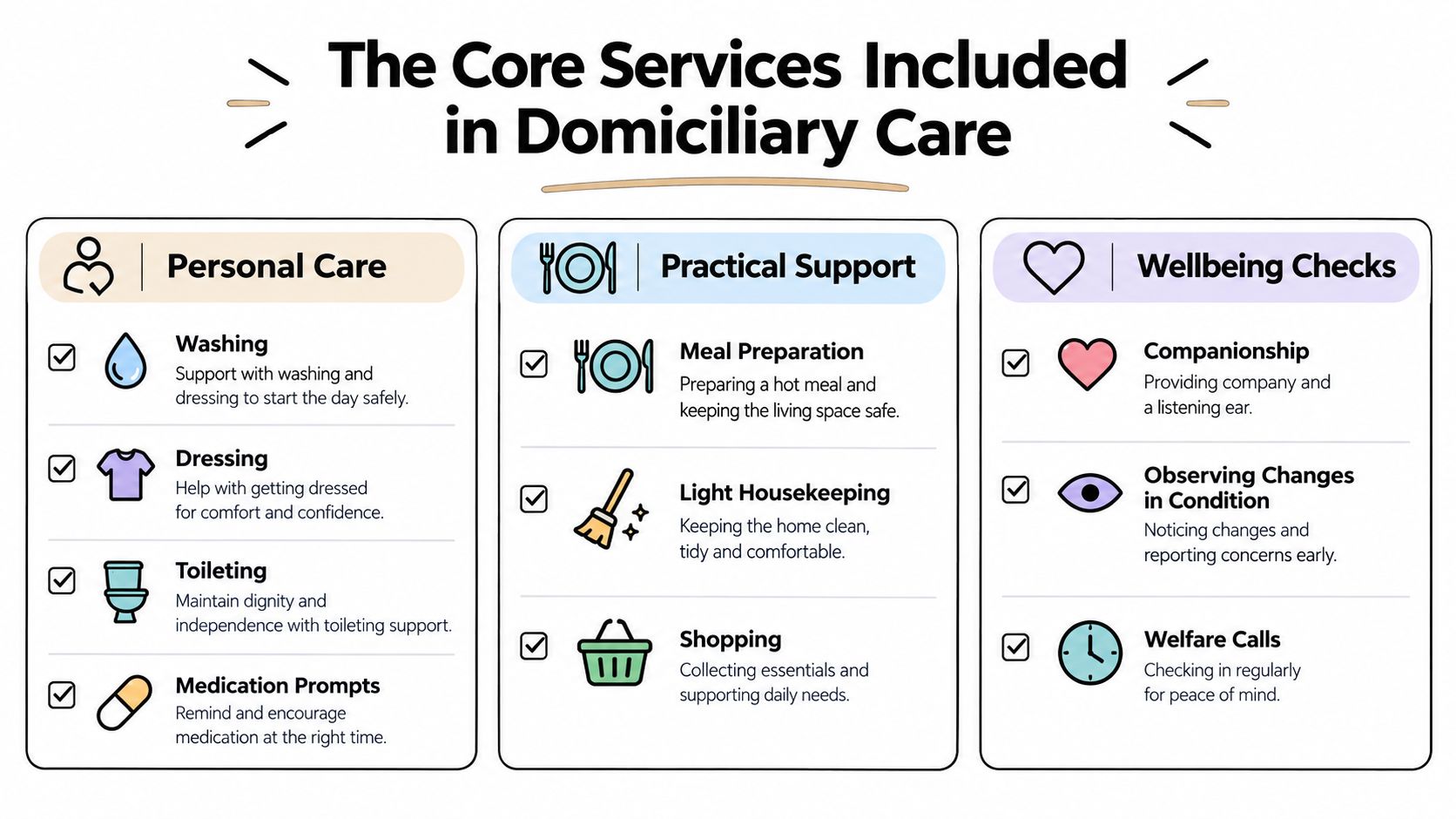
A typical domiciliary care visit combines several kinds of support. The exact tasks depend on the person's assessment, care plan, training and the provider's policies.
Personal care
Personal care is often the most intimate part of the visit. You may support someone with:
- Washing and dressing: Help the person start or finish these tasks while protecting privacy and encouraging independence.
- Toileting and continence: Follow the care plan, use suitable protective equipment and report changes such as soreness or altered continence.
- Mobility and transfers: Use the agreed technique and equipment rather than improvising when a person is unsteady.
- Medication prompts: Remind the person at the agreed time or administer medicines only when this is included in your role, training and written instructions.
The aim isn't to take over unnecessarily. If a person can wash their face, choose their clothes or prepare part of their breakfast, your support should preserve that ability.
Practical help
A visit may also include preparing a meal, making a drink, washing up, putting laundry away, completing essential shopping or carrying out light household tasks. These activities support safety and nutrition, but they should remain connected to the person's assessed needs.
Wellbeing observations
You're also watching for changes. Is the person more confused than usual? Are they struggling to stand? Have they eaten, drunk and taken the support listed in their plan? Record and report concerns through the correct route rather than relying on an informal message to a relative.
Practical rule: Complete the task, observe the person, record what matters and escalate concerns according to policy.
How Domiciliary Care Differs from Residential Care
The clearest distinction is where the person lives and where the service operates. Domiciliary care brings support to the person's home. Residential care provides accommodation, care and staffing within a care home.
| Feature | Domiciliary Care | Residential Care |
|---|---|---|
| Location | The person remains in their own home | The person lives in a care home |
| Staff presence | Workers usually attend at planned times, with arrangements varying by assessed need | Staff are based on site as part of the care home service |
| Daily routine | The person's household, preferences and routines shape the visit | The care home provides the setting, facilities and shared timetable |
| Working environment | The worker enters an individual home and manages household-specific risks | Staff work within a service environment with established systems and shared resources |
| Care planning | Tasks are organised around visits and the person's home-based needs | Care is delivered within the home's wider staffing and activity arrangements |
A home carer may begin a shift alone, travel between several addresses and use a different moving-and-handling plan at each call. Residential staff can usually seek immediate support from colleagues on the same site. That doesn't make one setting easier than the other. It means the risks, communication methods and staffing arrangements are different.
The person's assessed needs should guide the choice. Someone who can remain safe between planned visits may value staying at home. Someone needing continuous supervision, specialist equipment or support throughout the day may be assessed for a different arrangement. Families, social care professionals and providers may all contribute to the decision, but a worker must follow the package that has been authorised.
In domiciliary care, the household itself becomes part of the working environment. You need to respect preferences about food, privacy, clothing and routines while also following risk assessments and safeguarding procedures.
How Domiciliary Care Packages Are Structured Day to Day
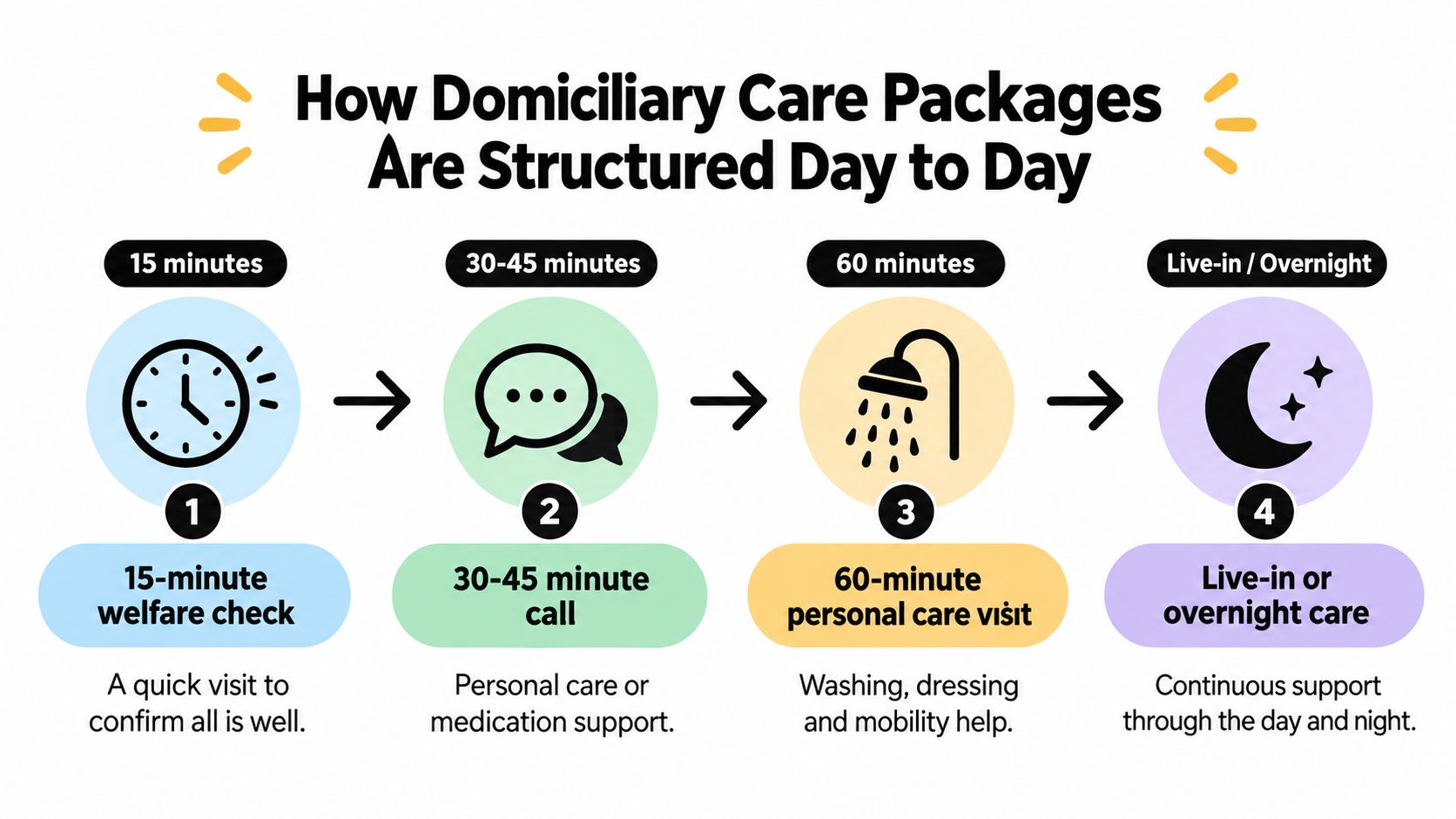
A care package is built around the person's needs, then translated into visits or longer periods of support. One person may need a short welfare check, while another may require several calls covering personal care, meals, medicines and mobility.
A short visit might confirm that someone is safe, settled and able to manage until the next call. A longer call could include washing, dressing, breakfast preparation and mobility support. A double-up visit uses two workers where the care plan and moving-and-handling assessment require it, such as during a hoist transfer.
What shapes the rota
The rota sets planned arrival windows, visit lengths, addresses and tasks. Travel between calls matters because a worker can't leave one person late without affecting the next visit. Traffic, parking, access problems and a longer-than-expected care task can all create pressure, so you should contact the office promptly when timing becomes unsafe or unrealistic.
The care plan provides the working detail. It may specify how the person communicates, which equipment to use, what assistance is needed and which changes must be reported. Read it before acting, especially when you're new to the package.
Short visits and extended support
Local authority and privately arranged packages can use similar visit structures, although flexibility and funding arrangements may differ. Overnight sitting, waking-night support and live-in care are separate arrangements from ordinary hourly calls, even though all can fall within home-based care.
For practical guidance on the role, review the responsibilities of a domiciliary care worker. Your duties must match your training, the care plan and your employer's instructions.
The Regulatory Framework Behind the Definition
The definition becomes operationally important because regulated domiciliary care in England falls within the system overseen by the Care Quality Commission. The CQC describes domiciliary care services as providing personal care for people living in their own homes, with packages shaped to individual circumstances. Visits may be intermittent, or arrangements may provide continuous support in appropriate cases, as outlined in the CQC guidance on service types.
Registration affects the provider's systems, not just its website description. The service must show how it manages safety, staffing, training, care planning, complaints, safeguarding and governance. For a worker, that translates into practical expectations during every call.
The five questions in daily practice
CQC assessment considers whether a service is:
- Safe: Are risks, medicines, safeguarding concerns and incidents managed properly?
- Effective: Do staff have the competence and information needed to meet assessed needs?
- Caring: Does the worker protect dignity, privacy, choice and emotional wellbeing?
- Responsive: Does the service adapt when a person's needs or preferences change?
- Well-led: Does management provide clear policies, supervision, oversight and accountability?
These questions are not abstract labels. A safe visit may involve checking that a hoist is used correctly. Effective practice may mean following an agreed communication approach. Responsive care could involve reporting that a person's mobility has changed instead of repeating yesterday's routine.
| Body or document | Role | Impact on daily practice |
|---|---|---|
| Care Quality Commission | Registers and assesses regulated services in England | Follow the provider's policies, care plans, recording systems and escalation routes |
| Health and Safety Executive | Provides health and safety guidance for domiciliary work | Manage lone working, household hazards, travel and moving-and-handling risks |
| Care plan and risk assessments | Set out individualised support and identified hazards | Complete only authorised tasks and report changes |
| Employer training and supervision | Builds competence and checks practice | Keep mandatory learning current and ask for support when a task exceeds your competence |
Training should prepare you for those expectations, including the specific pressures of community work. Cura Academy provides UK care training covering Care Certificate standards, mandatory refreshers and role-specific learning such as Basic Life Support, with pathways relevant to domiciliary and other care settings. You can explore domiciliary care training alongside your employer's own induction and competency checks.
Common Misconceptions About Domiciliary Care Work
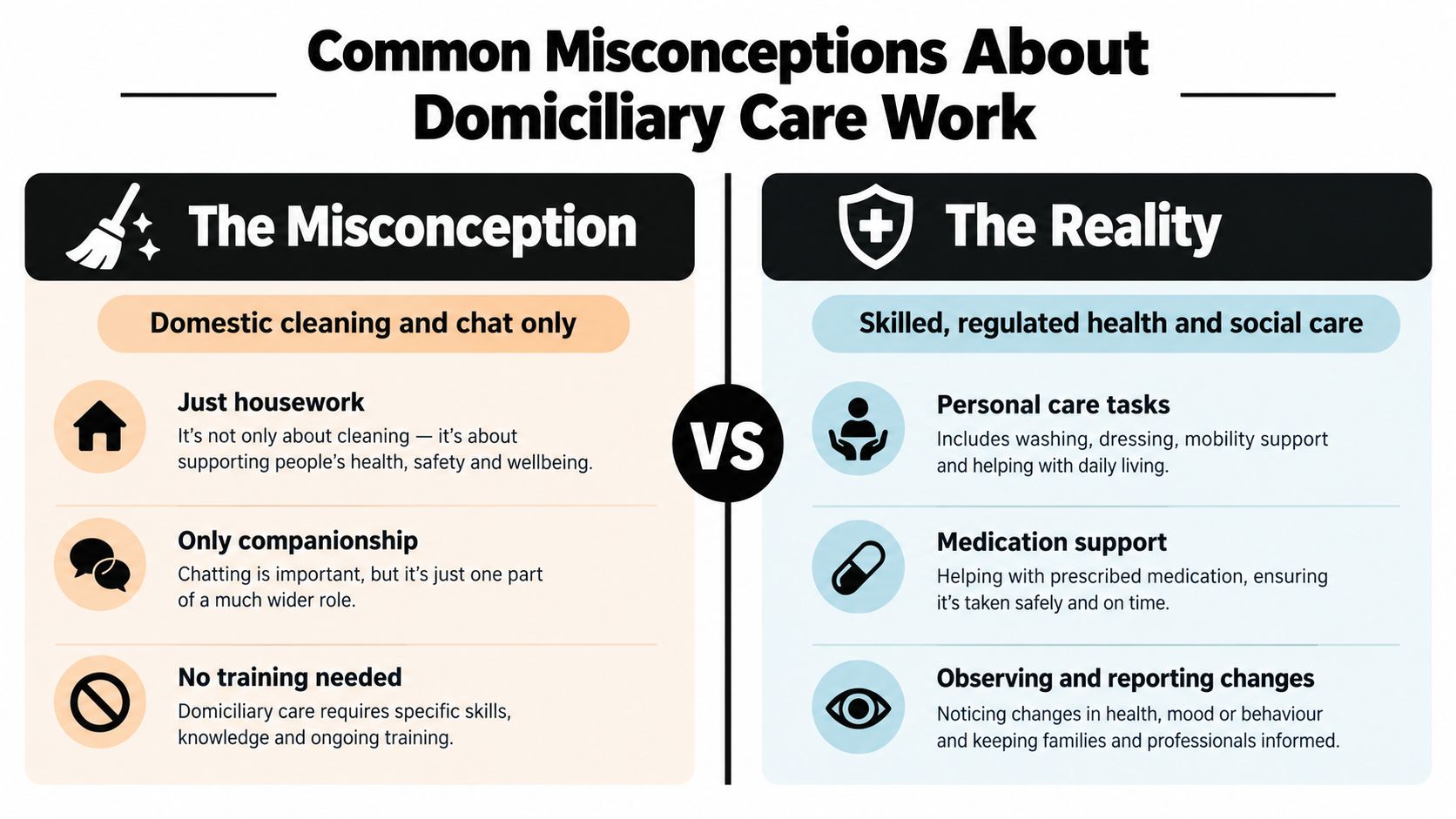
Some families hear “home care” and think of cleaning or friendly conversation. Those activities can form part of a visit, but they don't capture the responsibility involved in professional domiciliary care.
A support worker may provide intimate personal care, continence support, pressure-area care, medication assistance or end-of-life support. Depending on the service, training and authorisation, workers may also support tasks involving stoma care, catheter bags, PEG feeding or rehabilitation after hospital discharge. These duties must never be assumed from a job title alone. They require clear instructions, suitable competence and the right level of supervision.
What belongs in the package
Meal preparation, laundry, shopping and light tidying can help someone remain safe and comfortable at home. They may be essential to the person's wellbeing, but they sit alongside personal care and observation rather than replacing them.
Consider a lunchtime call. You might prepare food, check fluid intake, support a transfer, prompt prescribed medication and notice that the person is unusually breathless. The domestic task is only one part of the visit. Your observation and reporting may be just as important.
Why the distinction protects everyone
If a service treats domiciliary care as general housekeeping, it risks assigning tasks without proper assessment or training. The person may not receive the right support, and the worker may be placed in an unsafe position.
A care worker should never accept a task simply because a family member says it has “always been done that way”. Check the care plan, your competence and the provider's instructions first.
Professional boundaries also protect dignity. Personal care should be explained, consent should be respected and records should be accurate. A clean kitchen matters, but it doesn't replace safe continence care, careful mobility support or timely escalation of a change in condition.
Bringing the Definition Together for Your Care Role
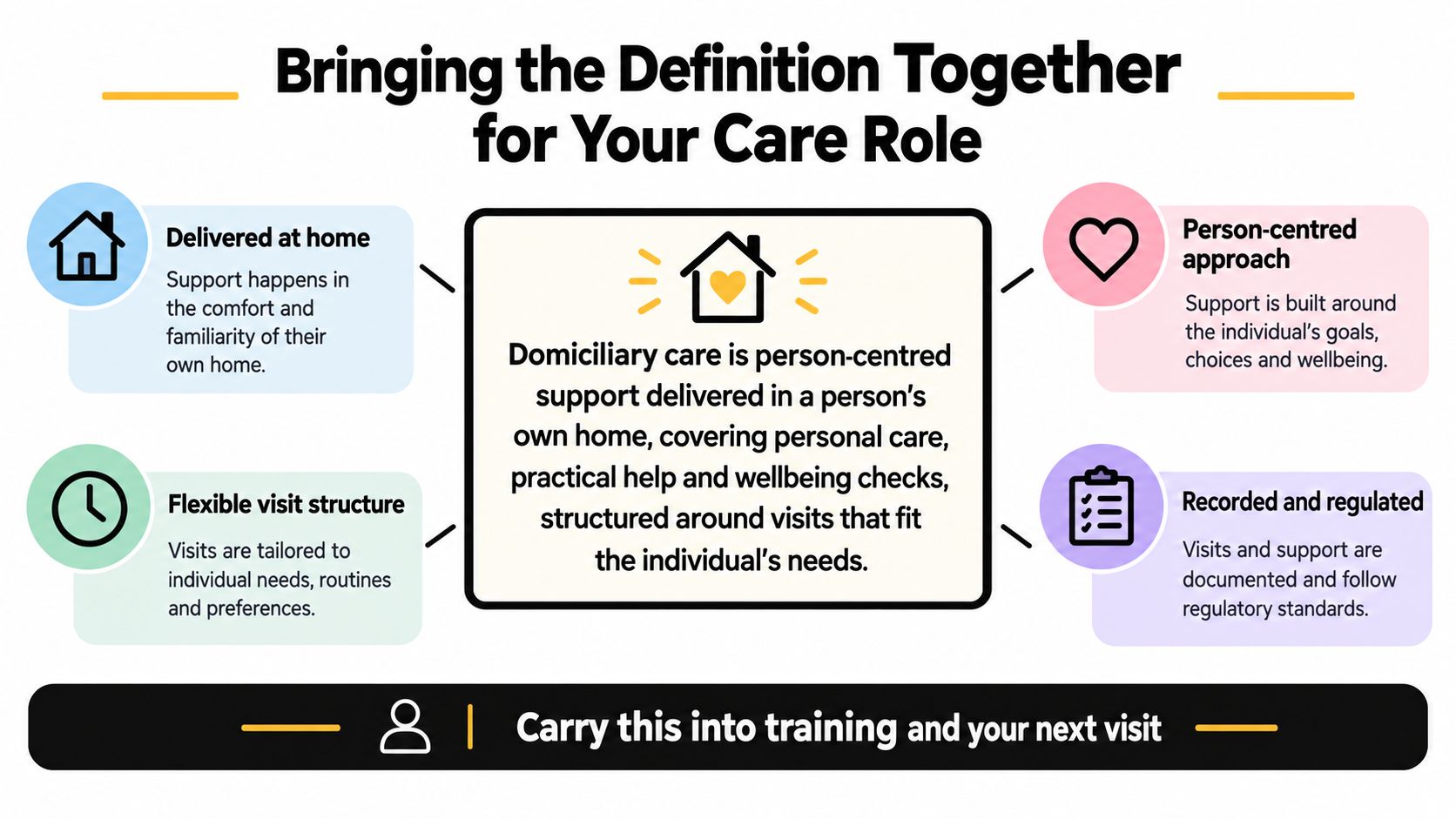
A practical definition of domiciliary care is this: person-centred support delivered in a person's own home, covering personal care, practical help and wellbeing checks through visits or longer arrangements suited to individual need.
Carry four questions into your next shift:
- What am I expected to deliver? Check the care plan for personal care, meals, medication support, mobility tasks, observations and recording requirements.
- How does this setting affect my work? You're entering a private home, so respect the person's routines while managing household hazards, access arrangements and lone-working procedures.
- What type of package am I on? Identify whether the call is a welfare check, a personal care visit, a double-up arrangement or an extended overnight or live-in service.
- Which standards apply? Follow your employer's policies, use only equipment and techniques you've been trained to use, and report concerns through the correct route.
Questions to take to supervision
Ask your supervisor:
- Which tasks am I competent and authorised to complete for each person?
- What should I do if a visit is running late or the person's needs have changed?
- Which lone-working check-in process must I follow?
- Where do I record medication support, food and fluid observations, incidents and concerns?
- When should I refuse a task and request guidance?
Those answers turn a broad definition into safe practice. Domiciliary care is home-based, but it isn't informal. It combines individual routines, planned support, professional boundaries and regulated responsibilities.
Cura Academy helps new and existing UK care workers build job-ready skills through Care Certificate preparation, mandatory refreshers and role-specific courses relevant to domiciliary care. Visit Cura Academy to choose a learning pathway that supports your next induction, supervision or shift.