
A new care worker is ready to start, the rota is waiting, and the manager has promised a first shift. Then the onboarding stops. The application uses the wrong workforce, an identity document does not match the form, or the applicant misses the window to keep the certificate portable. None of these problems necessarily relates to safeguarding risk, but each can delay a lawful start.
The practical enhanced DBS check requirements are less about a person's job title and more about the duties they perform, how often they perform them, the workforce selected on the application, and the quality of the identity evidence provided. This matters across domiciliary care, residential care, supported living, agency work, and personal employment.
Table of Contents
- Why Enhanced DBS Checks Matter for Care Roles
- Determining Eligibility Through Regulated Activity
- Identity Verification and Document Standards
- What Information Appears on the Certificate
- Employer Responsibilities and Application Accuracy
- Maintaining Portability With the Update Service
- Avoiding Common Delays and Preparation Mistakes
Why Enhanced DBS Checks Matter for Care Roles
An enhanced DBS check is part of a safer recruitment process for roles involving close contact with children or adults receiving health or social care services. It isn't a certificate that every care worker can request on demand. Eligibility is controlled by the duties attached to the role and by the regulatory framework governing the workforce.
For example, a care assistant providing personal care to an adult may meet the relevant eligibility test, while someone working in a general administrative role at the same provider may not. The employer must assess the actual work, not rely on a broad label such as “healthcare staff” or “support worker”.
Practical rule: Start with the duties and rota, not the applicant's preferred DBS level.
An enhanced certificate includes the information available at standard level, together with local police information considered relevant to the role. Barred-list information isn't included automatically. It depends on whether the position qualifies for the relevant regulated activity and whether the correct workforce and barred-list option have been selected on the application. The DBS employer guidance on check requests sets out this distinction.
The safeguarding value
Care workers may enter private homes, support people with personal routines, administer or assist with care arrangements, and work with adults whose circumstances can make them particularly vulnerable. The check supports an employer's wider suitability assessment, but it doesn't replace references, right-to-work checks, induction, supervision, training, or ongoing safeguarding procedures.
The certificate also reflects the role for which it was requested. An enhanced check isn't a universal clearance for every future role. A move from adult social care to a children's setting, or from supervised duties to regulated activity, can require a fresh eligibility assessment.
Why delays become operational problems
A delayed check can leave a provider with an uncovered shift, an agency worker unable to accept work, or a candidate waiting without a confirmed start date. Managers often try to solve this by submitting applications quickly, but speed doesn't compensate for incorrect eligibility coding or incomplete identity checks.
Good practice is to review the job description, service setting, duties, frequency, workforce, and identity documents before submission. That small control prevents the common situation where recruitment teams discover a problem only after the applicant has already resigned from another job or arranged childcare around a promised start.
Determining Eligibility Through Regulated Activity
Job titles don't decide enhanced DBS eligibility. Regulated activity does. For adult-workforce roles in England and Wales, an enhanced certificate with an adults' barred-list check is available only where the role qualifies as regulated activity. The assessment must consider the service type, the activity performed, and how frequently the activity takes place, as explained in the adult workforce guidance.
A manager should therefore test the role in three stages.
Start with the service
First identify whether the person receives health or social care services within the categories covered by the guidance. A care provider shouldn't assume that every person receiving support creates the same DBS route. The service context matters before the individual task is considered.
Next, describe the activity precisely. “Supports residents” is too vague for a reliable eligibility decision. “Provides personal care”, “trains staff”, “supervises care delivery”, or “is solely in charge of children” gives the assessor something operational to test.
Then test the activity and frequency
For adult roles, the relevant question is whether the work falls within regulated activity. This requires more than occasional contact in a care environment. The organisation should examine the task, whether it is performed unsupervised where relevant, and the pattern created by the rota.
For children's settings, some activities become eligible when they take place more than three days in a thirty-day period or overnight between 2am and 6am, as set out in the government guidance for employers requesting DBS checks. These frequency thresholds mean that a rota can change the eligibility outcome even when the job title stays the same.
A useful assessment record should capture:
- Service type: Record whether the setting involves adults receiving health or social care services, children, or another group.
- Core activity: Write down the actual care, training, supervision, or responsibility involved.
- Frequency pattern: Review the rota rather than relying on the contract wording.
- Supervision: Note whether the work is supervised and whether that affects the relevant regulated-activity test.
- Workforce selection: Match the application to the people being supported, such as adults or children.
Separate enhanced eligibility from barred-list eligibility
An enhanced check and an enhanced check with barred-list information aren't interchangeable. A role may qualify for enhanced-level disclosure without qualifying for the relevant barred-list check. Employers that select a barred list without establishing regulated activity risk submitting an application that doesn't match the role.
The strongest process is to assess the role before advertising it, then revisit the decision if duties or rota patterns change. A new weekend pattern, overnight responsibility, or move into personal care can alter the screening requirement. Record the reasoning, because a clear eligibility note helps the manager, applicant, umbrella body, and auditor work from the same facts.
Identity Verification and Document Standards
Many applications fail operationally after eligibility has been established. The applicant may have the right role for an enhanced check, yet the application still stalls because the name, date of birth, document details, or identity route doesn't align.
For Standard and Enhanced applications, current DBS guidance requires one document from Group 1 plus two further documents from Group 1, 2a, or 2b. The applicant should prepare the documents before the employer or registered body starts the application, rather than searching for substitutes after an onboarding deadline has been set. The DBS digital identity verification guidance also states that high-confidence digital identity verification is the minimum level for enhanced checks.
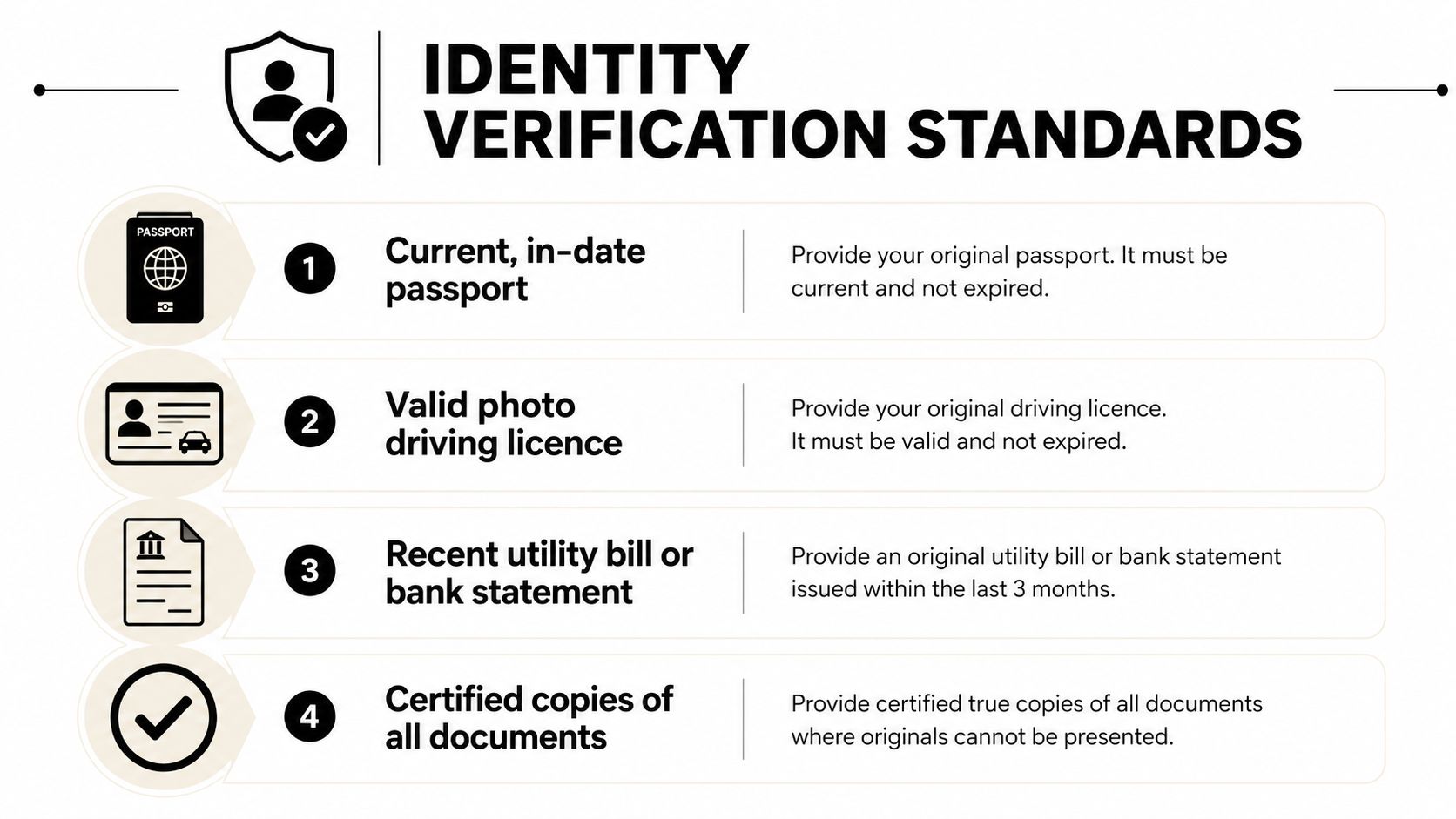
Use a controlled preparation process
A practical check before submission should confirm:
- Names match: Compare the application with the identity documents, including middle names and spelling. Explain any legitimate name change through the process required by the checking organisation.
- Dates match: Check the date of birth across every document and the application form.
- Documents are current where required: Don't assume an old document will satisfy the route because it clearly identifies the applicant.
- Details are legible: Blurred scans, cropped images, glare, and incomplete pages create avoidable review work.
- Digital verification is suitable: Where a digital route is used, confirm that it meets the high-confidence standard required for an enhanced application.
A proof-of-address problem can also interrupt onboarding. Applicants can review practical document guidance in this UK proof of address guide, while the employer should still follow the DBS route and evidence rules that apply to the application.
New access for self-employed care workers
The route is no longer limited to a conventional employer-led application in every case. On 20 January 2026, the UK government announced that self-employed workers and personal employees can apply for enhanced DBS checks through a registered DBS Umbrella Body, with a set fee of £49.50. The government announcement on applications for self-employed workers and personal employees provides the relevant detail.
That change helps personal assistants and independent workers access the appropriate check, but it doesn't remove the need to prove eligibility. The worker still needs an accurate role description, the right workforce assessment, and compliant identity verification.
What Information Appears on the Certificate
The certificate is a record of what the DBS has disclosed for the particular application. It shouldn't be treated as a general statement that a person is suitable for every care role.
An enhanced certificate contains standard-level police record information plus local-police intelligence considered relevant to the role. Barred-list information is included only when the post qualifies for regulated activity, so a certificate without barred-list information isn't automatically evidence that the employer or applicant made an error. The official explanation of what appears on DBS certificates is the appropriate reference for interpreting the disclosure.

The role controls the relevance test
Local police information isn't included because a person works in care. It must be considered relevant to the role. That makes the application description important. A vague description gives the decision-maker less context than a precise account of the duties, setting, and people supported.
Managers should compare the certificate with the position offered. If the applicant has moved into a materially different role, the old certificate may not answer the new eligibility question. This is especially important where the new role involves children, adult regulated activity, overnight work, or a different workforce category.
Workforce selection affects the result
The adults' and children's workforces are separate operational choices. Selecting the wrong one can produce a certificate that doesn't contain the information the role requires, even if the applicant's identity details are correct.
For a children's setting, the guidance provides circumstances in which a paid role in a specified establishment is regulated activity and can qualify for an enhanced check with a Children's Barred List check. Other activities depend on the frequency conditions described in the eligibility guidance. For adult care, the employer must assess service type, activity, and frequency before deciding whether an adults' barred-list check is available.
The certificate can only reflect the question the application was entitled to ask.
When reviewing a certificate, ask three questions. Was the application made for the correct role? Was the correct workforce selected? Was barred-list information requested only where the role qualified? Those checks are more useful than assuming every enhanced certificate should display the same content.
For a plain-language explanation of the disclosure itself, see this guide to what an enhanced DBS check shows.
Employer Responsibilities and Application Accuracy
The employer carries the main responsibility for getting the application route right. A care manager can't ask an applicant to order an enhanced check independently and assume the result will satisfy the organisation's recruitment process. The provider must assess the position, choose the correct workforce, and use an appropriate registered route.
The organisation must also be based in England or Wales to request a standard or enhanced DBS check. Employers must enter the correct workforce on the application form, and the government warns that an application can be rejected if the workforce is entered incorrectly. These requirements are set out in the DBS workforce guidance for employers.
Build the application around the post
Before opening the form, the manager should retain a short eligibility record containing:
- Role duties: What the worker will do, not just the title on the vacancy.
- People supported: Whether the work concerns adults, children, or both in separate duties.
- Frequency and rota: The pattern that supports the eligibility decision.
- Workforce choice: The category selected on the application.
- Barred-list decision: The reason a relevant barred-list check is or isn't requested.
This record makes quality control easier. It also helps when an umbrella body asks why a particular level or workforce has been selected.
Know when to use an Umbrella Body
Direct DBS registration is structured around volume. An organisation seeking registration must submit more than 100 eligible DBS applications per year, according to the DBS employer registration guidance. Smaller care providers may therefore use a registered DBS Umbrella Body rather than applying for direct registration.
That arrangement can work well, but responsibility doesn't disappear. The provider still needs to supply accurate role information and confirm that the selected check is lawful. An umbrella body can process the application, but it shouldn't be expected to invent the eligibility decision from an incomplete job description.
Treat rejection as a process signal
A rejected application is more than an administrative nuisance. It may indicate that the organisation selected an ineligible workforce, described the post poorly, or submitted information that doesn't align with the role. Pause and correct the underlying process instead of sending the same application again.
Maintaining Portability With the Update Service
A DBS certificate isn't a one-time onboarding task for workers who move between providers. Agency, bank, and personal care workers often need to demonstrate current readiness to more than one organisation, and the Update Service can reduce repeated administrative work when its conditions are met.
Applicants must join within 30 calendar days of the certificate issue date, and the service costs £16 per year for non-volunteers, as confirmed in the official DBS identity guidance. The deadline runs from the certificate issue date, not from the day a manager mentions the service.
Make the decision before the certificate arrives
The safest approach is to decide during onboarding whether the Update Service fits the worker's circumstances. The applicant can prepare the payment method and understand the deadline before the certificate is issued. Once the certificate arrives, record the issue date immediately and set a reminder well inside the permitted window.
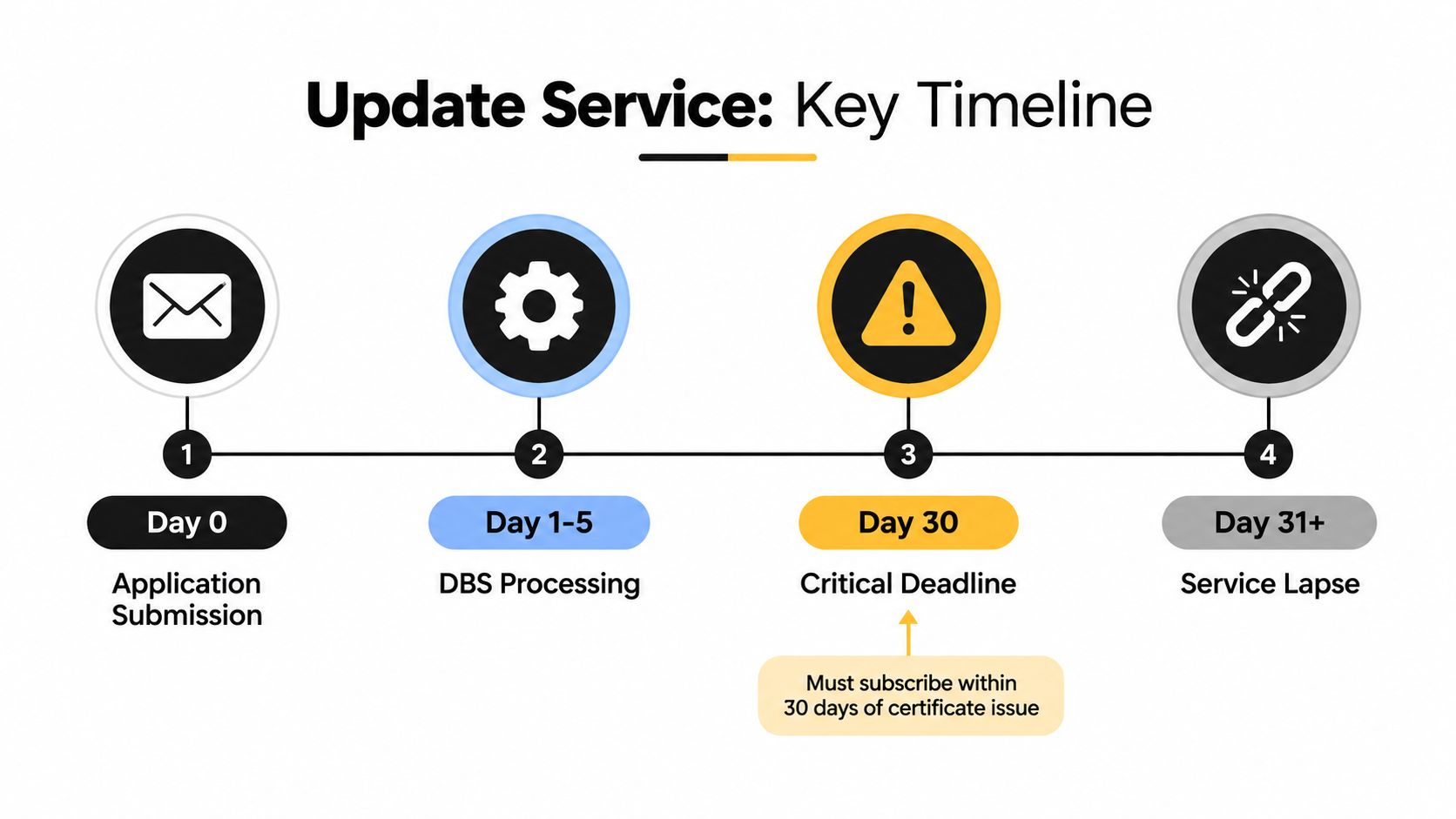
The service is particularly useful for workers who expect to change employers or accept shifts through different staffing arrangements. It can support portability, but it doesn't make every certificate suitable for every role. A new employer still needs to check that the certificate relates to the required workforce and level, and that the role and duties are comparable for the purpose of the check.
Don't confuse portability with universal clearance
The Update Service doesn't turn an adult-workforce certificate into a children's-workforce certificate. It also doesn't remove the employer's responsibility to assess the role or obtain a new check when the work is materially different.
For a practical explanation of registration and employer status checks, use this Enhanced DBS Update Service guide for UK care workers.
The following video can help applicants understand the process visually:
Avoiding Common Delays and Preparation Mistakes
The assumption that “the DBS check has been submitted, so onboarding is underway” causes many avoidable problems. Submission is only one point in a chain. A worker can be eligible and still face delay because the application contains a different name, an incorrect workforce, an unsuitable identity route, or a missed Update Service deadline.
Use a pre-submission control
Before an application is sent, the applicant and manager should independently check the same core details:
- Identity consistency: Compare the full name, date of birth, current address details, and document information across the form and evidence.
- Role accuracy: Match the description to the actual duties, including personal care, supervision, training, overnight work, or contact with children.
- Workforce coding: Confirm that the adults' or children's workforce selection reflects the role.
- Barred-list logic: Ask whether the role qualifies for regulated activity before selecting a barred-list check.
- Certificate planning: Decide whether the worker needs Update Service portability and record the certificate issue date when it arrives.
A manager should also inspect rota changes before the first shift. If the worker was initially recruited for supervised support but will now work alone, the original eligibility assessment may no longer describe the post.
Fix the source, not the symptom
Repeatedly requesting documents from an applicant won't solve a poorly designed application form. Likewise, asking an umbrella body to “upgrade” a check after submission won't replace a proper role assessment. The reliable fix is a documented internal workflow, trained identity checkers, and a final review by someone who understands regulated activity.
Cura Academy offers structured health and social care training, compliance-focused learning pathways, and resources supporting Enhanced DBS and Update Service readiness. If you're preparing for care work or standardising onboarding, visit Cura Academy to review the training and membership options that can help you organise evidence of job readiness before applying.