

You've been offered a care role, or an agency has found shifts that suit you, but your start date is stuck behind DBS paperwork. You may already have a certificate at home and wonder why another employer can't accept it. The answer often depends on whether you're registered with the DBS Update Service, whether your existing check matches the new role, and whether the employer can legally carry out a status check.
That uncertainty is common across domiciliary care, residential care and agency work. A certificate can sometimes move with you between suitable roles, but it isn't a universal pass that removes every safeguarding check. Employers still need your consent, the correct workforce and check level must match, and a status check only shows the current position of the certificate at the time it's performed.
By the end of this guide, you'll understand DBS Update Service how does it work in practical terms. You'll know when your certificate may be reused, when you'll need a fresh application, what an employer sees online and which steps prevent avoidable delays before your first shift.
Table of Contents
- Introduction Why DBS Delays Cost Carers Shifts
- What the DBS Update Service Is and How It Keeps Certificates Current
- Who Can Join and When You Must Register
- How Employers Perform a DBS Update Service Status Check
- Portability Limits and When You Still Need a New DBS
- Real World Examples How the Update Service Speeds Up Care Onboarding
- Pros and Cons for Care Workers and Employers Plus Next Steps
Introduction Why DBS Delays Cost Carers Shifts
A care worker accepts a position with a domiciliary provider. The interview went well, references are moving forward and the rota team has suitable visits available. Then the administrator asks for a new DBS check, even though the worker already has a recent Enhanced certificate from another care employer.
The worker searches through emails, checks the certificate date and asks whether the previous document can be used. If the worker is registered with the Update Service, the answer may be straightforward. The new provider could be able to check the certificate online, with permission, instead of ordering another application. If the certificate isn't registered, or the new role doesn't match the original check, the worker may need to wait for a new application before starting.
That difference matters in care. A delayed clearance can leave an applicant unable to accept planned shifts, while an employer has to keep checking documents, arranging cover and deciding whether the role can begin. The Update Service doesn't remove the employer's safeguarding responsibilities, but it can make the verification part more manageable when the conditions are right.
Practical rule: Treat your DBS certificate as one part of your onboarding file. Keep the document details available, but never assume that another employer can use it without checking the level, workforce and legal entitlement.
This guide follows the process from the basic idea to real care scenarios. You'll first learn what the service does, then check whether you can join, see how an employer performs a status check and compare situations where portability works with those where it doesn't. The final section brings the decision back to your next job application, so you can speak to recruiters clearly and avoid last-minute confusion.
What the DBS Update Service Is and How It Keeps Certificates Current
Think of a DBS certificate as a document issued for a particular check, and the Update Service as a subscription that lets an eligible certificate remain available for online status checking. Instead of treating every job move as a completely new starting point, an employer may be able to check whether the certificate is still up to date.
The service launched on 17 June 2013, according to DBS Update Service guidance from the UK Government. It's designed for Standard and Enhanced certificates that are reused across roles in the same workforce when the check level and workforce details match.
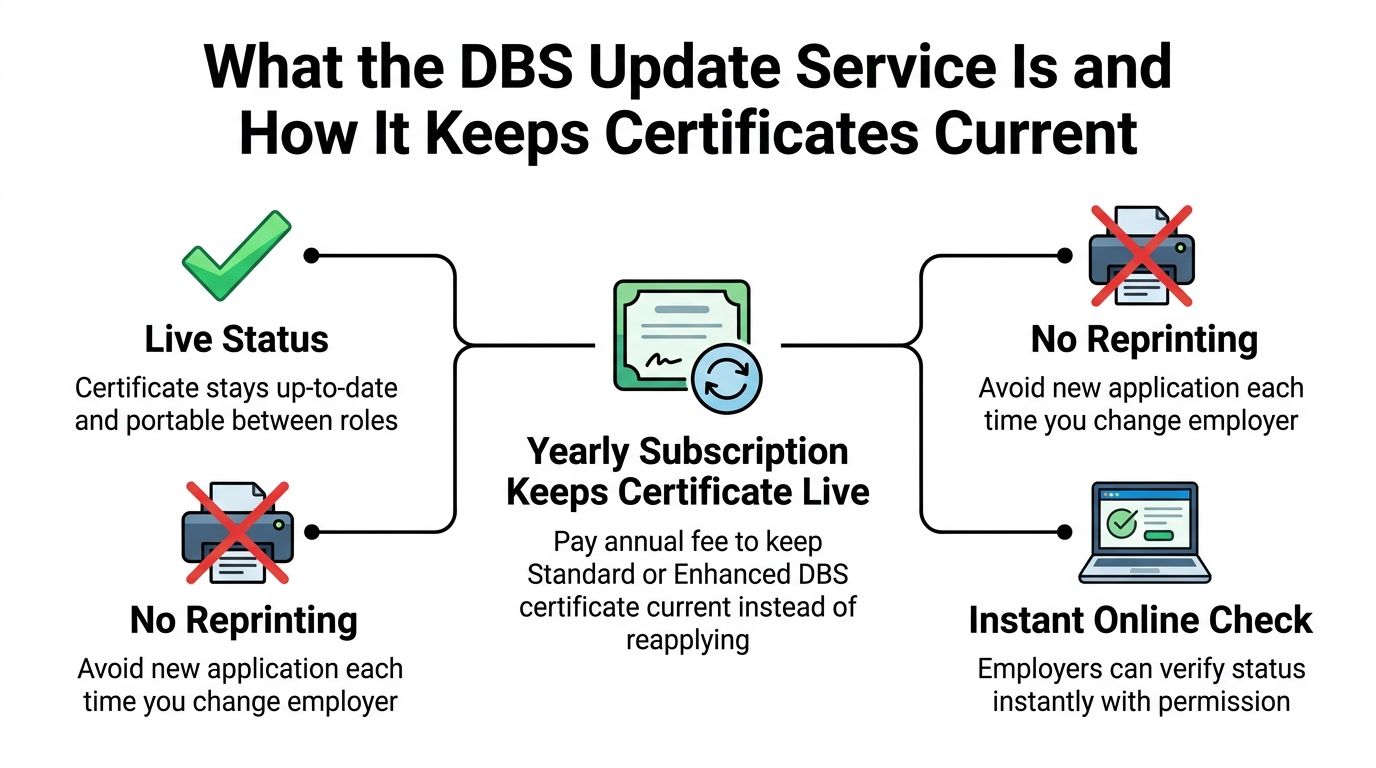
The subscription analogy
A useful comparison is a library membership. The certificate is the book you were issued, while the subscription gives an authorised employer a way to check its current status. You're not receiving a brand-new certificate each time somebody checks. The employer is checking whether the existing certificate remains suitable for the role.
The applicant must give consent before an employer performs the check. If the employer is legally entitled to check and the role matches the relevant requirements, the online result can return immediately. The employer can then decide whether to proceed or request a fresh DBS application.
The arrangement can help carers who move between suitable roles in the same workforce. For example, a Standard or Enhanced certificate connected to adult social care may be reusable for another role involving the same workforce and matching level. The employer still has to assess the role rather than relying on the word “portable”.
What “current” really means
The service doesn't continuously watch a person's record in the background. Government guidance describes a status check as a point-in-time check of the current certificate status, not continuous monitoring. The employer must decide how often checks are appropriate, taking account of risk, safeguarding needs and internal policy.
That distinction prevents a common misunderstanding. Registration doesn't mean an employer can stop following its safer recruitment process, and one online check doesn't replace every other onboarding requirement. The provider may still need to review the original certificate, confirm identity and complete other checks required for the role.
Basic DBS checks aren't eligible for the Update Service. The service is intended for Standard and Enhanced certificates, so someone holding a Basic check can't use the subscription to make that certificate portable in this way.
Who Can Join and When You Must Register
A domiciliary carer may finish a new Standard or Enhanced DBS certificate on Monday and begin arranging shifts with another provider later that week. The Update Service can support that move, but only if the certificate is eligible and the subscription is started on time. Basic DBS checks cannot be added.
Registration must begin within 30 days of the certificate being issued, as stated in the UK Government's DBS Update Service instructions. Treat the issue date like the start of a short onboarding task. Do not wait for a residential home or agency to ask whether you have subscribed.
Your action: Record the certificate issue date and start the subscription within the 30-day window.
The annual subscription costs £16, while volunteers pay nothing. The certificate still needs to be the right type for the work, and a free subscription does not change the registration deadline.
A quick eligibility check
Before registering, check these points:
- Certificate type: Confirm that it is Standard or Enhanced, not Basic.
- Issue date: Locate the issue date and calculate the registration window from it.
- Role connection: Check that the certificate relates to the workforce and level likely to be required in future care roles.
- Reference details: Keep the certificate or application information available while registering.
- Payment status: If you are not volunteering, prepare for the yearly subscription and keep payment details current.
If the paper certificate has not arrived, use the relevant application reference information. The Cura Academy guide to joining the DBS Update Service provides a practical walkthrough, which can help an agency worker complete the setup without delaying a placement.
What happens if you miss the window
Missing the registration window means you cannot add that existing certificate to the Update Service later. If a future employer needs a DBS check, you may have to make a new application, even when the earlier certificate was issued recently.
Add registration to your onboarding checklist when the certificate is issued. Save the certificate securely, write down its issue date and confirm that the subscription is active. A volunteer follows the same timing rule, although the subscription costs nothing. This small record can prevent a care agency from waiting for a fresh check before offering a shift.
How Employers Perform a DBS Update Service Status Check
An employer can't run a status check because a candidate says they have an Update Service certificate. The provider must first confirm that it has a legal right to check the certificate for the role and that the required workforce and check level correspond with the existing certificate.
The candidate's permission is also essential. Consent gives the employer authority to perform the online check and forms part of the process for handling the applicant's information responsibly. You should expect the employer to ask for permission rather than treating registration as open access.
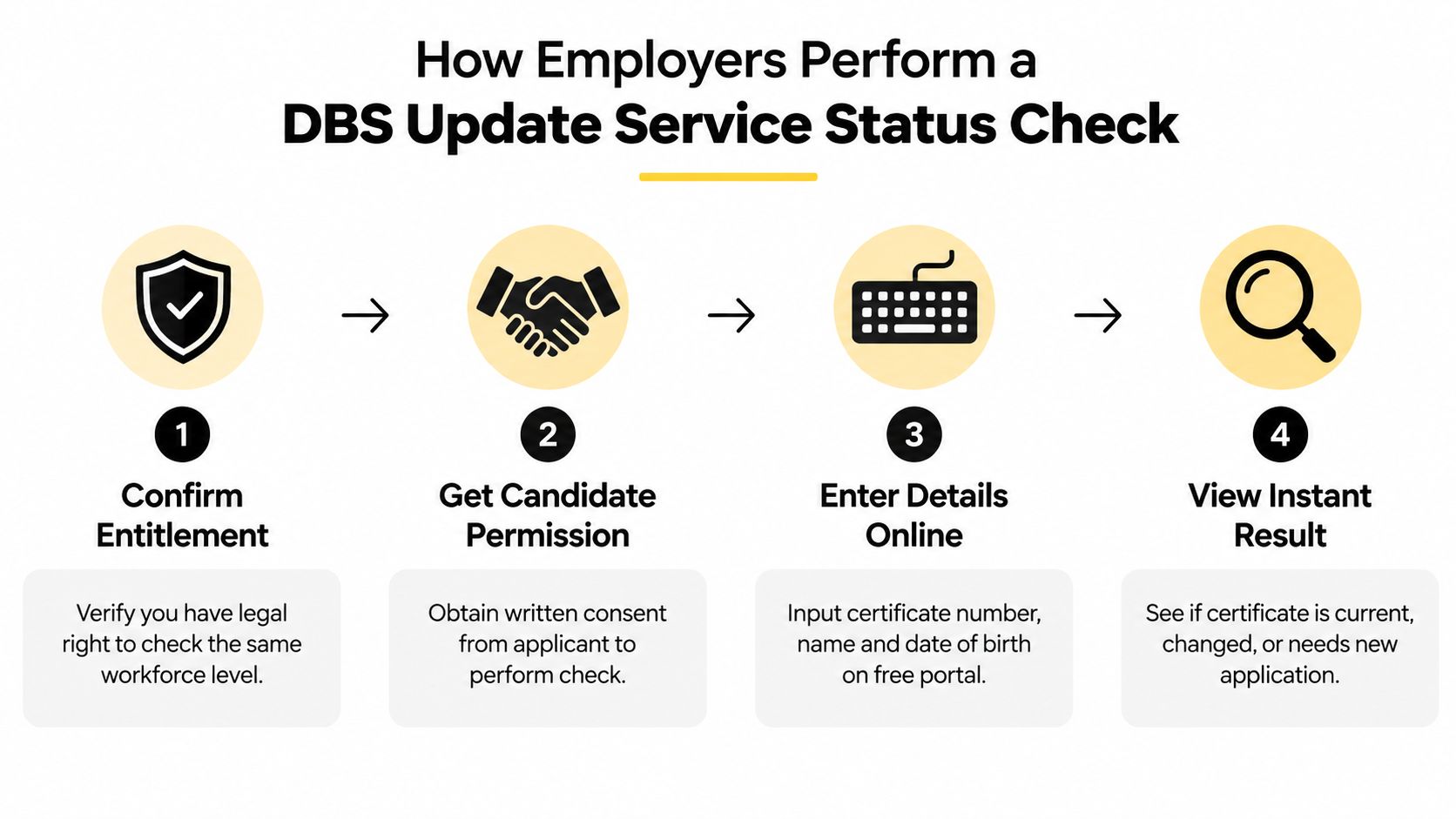
The employer's process
The practical sequence usually looks like this:
- Confirm entitlement. The employer checks that the role legally permits the relevant DBS check and that the workforce and level match.
- Obtain permission. The candidate agrees to the status check. Keep a record of the consent request and response.
- Match the certificate. The employer uses the certificate details and the applicant's identifying information to locate the correct record.
- Review the result. The online response indicates whether the certificate remains up to date or whether new information means a fresh application is needed.
The result isn't a replacement copy of your certificate. It doesn't give the employer a new certificate document or remove the need to compare the original certificate with the role. If the service indicates a change, the employer will need to decide what further action is appropriate and may request a new DBS check.
The UK Government's digital and online services guidance explains that an authorised employer with the person's permission can check whether the certificate is still up to date. A result can be available instantly, but speed doesn't mean the employer can skip its wider recruitment checks.
What you should prepare
Have your original certificate available and make sure your personal details are consistent with the information held by the employer. If the provider can't match the certificate, ask whether the issue is a reference detail, a name variation or a mismatch between the role and the original check.
You can also watch this DBS Update Service checking guide to understand the employer-facing process. A calm response to a recruiter might be: “I'm registered with the Update Service, and I'm happy to give consent. Please confirm whether the certificate level and workforce match your role.”
The service returns a current status, not a promise that the certificate will always remain unchanged. Employers decide how often to check based on their own risk assessment and safeguarding policy.
Portability Limits and When You Still Need a New DBS
The Update Service doesn't make every DBS certificate suitable for every care job. Portability depends on a match between the existing certificate and the new role. The most important comparisons are check level and workforce.
A certificate used for one workforce may not meet the requirements of another. A move from adult care to work involving children can change the workforce category. Likewise, an employer may need an Enhanced check where the certificate you hold is Standard, or may require a barred list check that your existing certificate doesn't include.
Decision matrix
| Scenario | Portable via Update Service | Action Needed |
|---|---|---|
| Same workforce and matching check level | Usually designed for reuse | Give consent for the employer's status check and provide the original certificate details |
| Different workforce | Not automatically portable | Ask the employer whether a new DBS application is required |
| New role requires a higher check level | Not portable at the lower level | Complete the required new application |
| Employer needs a barred list check not included on the certificate | Not covered by the existing certificate | Follow the employer's process for the relevant check |
| Basic certificate | Update Service isn't available | Apply through the route required for the new role |
| Employer can't establish legal entitlement | No status check should proceed | Discuss the correct recruitment and checking process |
The phrase “same workforce” needs careful attention. Two jobs can both be described informally as care work while still requiring different checks. A domiciliary role supporting adults and a role involving children may not sit within the same workforce category, so you shouldn't assume that a successful check in one setting transfers to the other.
The DBS certificate validity guidance can help you understand why an employer may ask for more information even when your certificate is registered. DBS certificates don't have a government-set expiry date, but the employer remains responsible for deciding whether the certificate is appropriate and whether a new application is necessary.
A current Update Service record can support portability, but it doesn't override the requirements of the new role.
Before accepting a shift, ask the agency or provider what level and workforce the role requires. That question can reveal a mismatch early, rather than after you've arranged travel, completed training or declined another opportunity.
Real World Examples How the Update Service Speeds Up Care Onboarding
The practical value becomes clearer when you follow a worker through a job move. The key isn't owning a DBS certificate. It's having the correct registration, giving permission promptly and checking that the new role matches.

Domiciliary care and a second provider
A domiciliary carer already works with one adult social care provider and applies to another. The second provider asks for an Enhanced DBS certificate for a role involving the same workforce. The carer confirms that the certificate is registered, supplies the original details and gives consent.
The provider can perform an online status check rather than automatically starting another application. The carer should still disclose the certificate information accurately and complete the employer's identity, reference and training checks.
Residential care and bank staffing
A residential home brings in bank staff who may already work elsewhere. One applicant has a matching certificate and Update Service registration, while another has a certificate for a different workforce. The administrator shouldn't treat both applicants alike.
For the matching applicant, a status check may support a quicker onboarding decision. For the other applicant, the home may need a new DBS application because the existing check doesn't meet the role's requirements. The difference comes from the certificate and role details, not from whether the worker has previous care experience.
Agency work across several homes
An agency worker wants to accept shifts at multiple residential settings. The agency can use the Update Service process where the certificate, workforce and level are suitable, but each placement may still have its own safeguarding and identity requirements.
The worker can reduce avoidable delays by telling the agency about the registration early, keeping consent requests moving and responding quickly if a new application is required. The agency must keep its own records and make its own decisions rather than assuming that every placement accepts the same certificate.
Onboarding habit: Tell the recruiter about your Update Service registration at the first compliance conversation, not on the morning of your first shift.
These examples show why the service can prevent shift delays without guaranteeing immediate clearance. A matching certificate helps, but the employer's legal entitlement, internal policy and wider recruitment checks still control the final decision.
Pros and Cons for Care Workers and Employers Plus Next Steps
A domiciliary carer may move to a residential home, or an agency worker may accept shifts with several providers. If the certificate matches the new role, an active Update Service record can reduce repeat paperwork and help the employer reach a decision sooner.
That benefit depends on the details. The certificate must cover the right workforce and level, and the employer must be legally entitled to check it. The service cannot make an unsuitable certificate portable, and it does not replace identity checks, references, training evidence or safeguarding decisions.
For care workers, the responsibility is straightforward. Register within the allowed window, keep the annual subscription active where required, protect your certificate information and tell the new provider that you can give consent for a status check. Keep your role and workforce details available, so a recruiter can spot a mismatch before it delays a shift.
Employers gain an online status-check route, but they still need to confirm consent, compare the certificate with the vacancy and record their recruitment decision. Each home or agency may also apply its own onboarding requirements.
Your next actions
- Find your certificate: Note its issue date, level and workforce.
- Check registration: Confirm that you joined within the required window.
- Keep payment active: Remember the yearly subscription if you are not a volunteer.
- Prepare consent: Be ready to authorise a status check.
- Expect limits: Ask whether the role needs a different workforce, level or barred list check.
- Organise evidence: Keep identity documents, references and care training records ready.
Cura Academy provides structured care training, including Care Certificate standards, mandatory refreshers and role-specific learning, alongside preparation for Enhanced DBS and Update Service requirements. If you are preparing for care work or agency onboarding, visit Cura Academy to organise those steps in one place.
Before your next compliance conversation, check your certificate details, confirm your Update Service registration is active and prepare the consent wording your prospective employer may need.