

There is no official expiry date on a DBS certificate. Its practical validity is driven by the employer's risk assessment and DBS Update Service membership, not by a fixed statute-based period.
You may already know the frustration. You accept a care shift, upload your documents, and then an agency tells you your Enhanced DBS is too old for its policy. The certificate is clean, but the booking still disappears. That situation feels like a contradiction because, legally, the certificate hasn't “expired”, yet an employer can still decide it isn't current enough for the role.
For care workers, the issue isn't just the DBS check validity period. It's whether your certificate remains acceptable to the organisation booking you, whether it matches the role, and whether the Update Service gives the recruiter a way to check for new information.
Table of Contents
- Why Care Workers Keep Getting Caught Out by DBS Timing
- How DBS Validity Works Behind the Scenes
- Basic, Standard, and Enhanced Checks Compared
- The DBS Update Service Rules That Decide Your Shifts
- How Often Agencies Should Run an Update Service Status Check
- Why Joining the Update Service Within 30 Days Matters So Much
- Your Step-by-Step Plan to Stay Compliant and Job-Ready
- Putting It All Together and Quick Answers
Why Care Workers Keep Getting Caught Out by DBS Timing
Aisha, a support worker, accepted a Saturday dementia care shift through an agency. Her Enhanced DBS certificate was clean and had been issued 14 months earlier. The agency's internal policy required a newer check, with a 12-month freshness limit, so the booking was removed before she could work it.
Aisha hadn't broken a law. The certificate didn't carry an official expiry date. The agency was applying its own safeguarding and client requirements, which it was entitled to do. That distinction catches out new carers because recruiters often use simple portal rules, while the official position is more nuanced.
DBS guidance for employers states that the information on a certificate is accurate only on its date of issue. Employers must check that date and decide whether a newer check is needed. The guidance doesn't create a universal expiry period.
Why employers still reject older certificates
A care home, agency, NHS framework, or local authority contract may apply a different freshness policy. One organisation may accept an existing certificate after checking it through the Update Service. Another may require a new application because its contract, insurer, safeguarding lead, or client demands a more recent disclosure.
The result looks like a fixed validity period, but it is a patchwork of:
- Employer policy: The organisation decides how recent a certificate must be.
- Role risk: Personal care and unsupervised contact with adults at risk demand closer scrutiny than a non-regulated administrative role.
- Contract terms: A commissioning body or agency framework may set conditions that go beyond the basic legal position.
- Certificate type: The check must be at the correct level and for the relevant workforce.
Practical rule: Never tell a recruiter, “My DBS is valid for three years.” Tell them the issue date, certificate level, workforce, and whether you're registered on the Update Service.
The mismatch matters because care work is shift-based. A compliance gap can mean more than an administrative delay. It can remove you from a weekend booking, postpone an induction, or force you to repeat paperwork you thought was finished.
The carers who stay bookable treat DBS management as an ongoing responsibility. They keep the certificate details accessible, join the Update Service promptly when eligible, and ask each agency what its policy requires before accepting a placement.
How DBS Validity Works Behind the Scenes
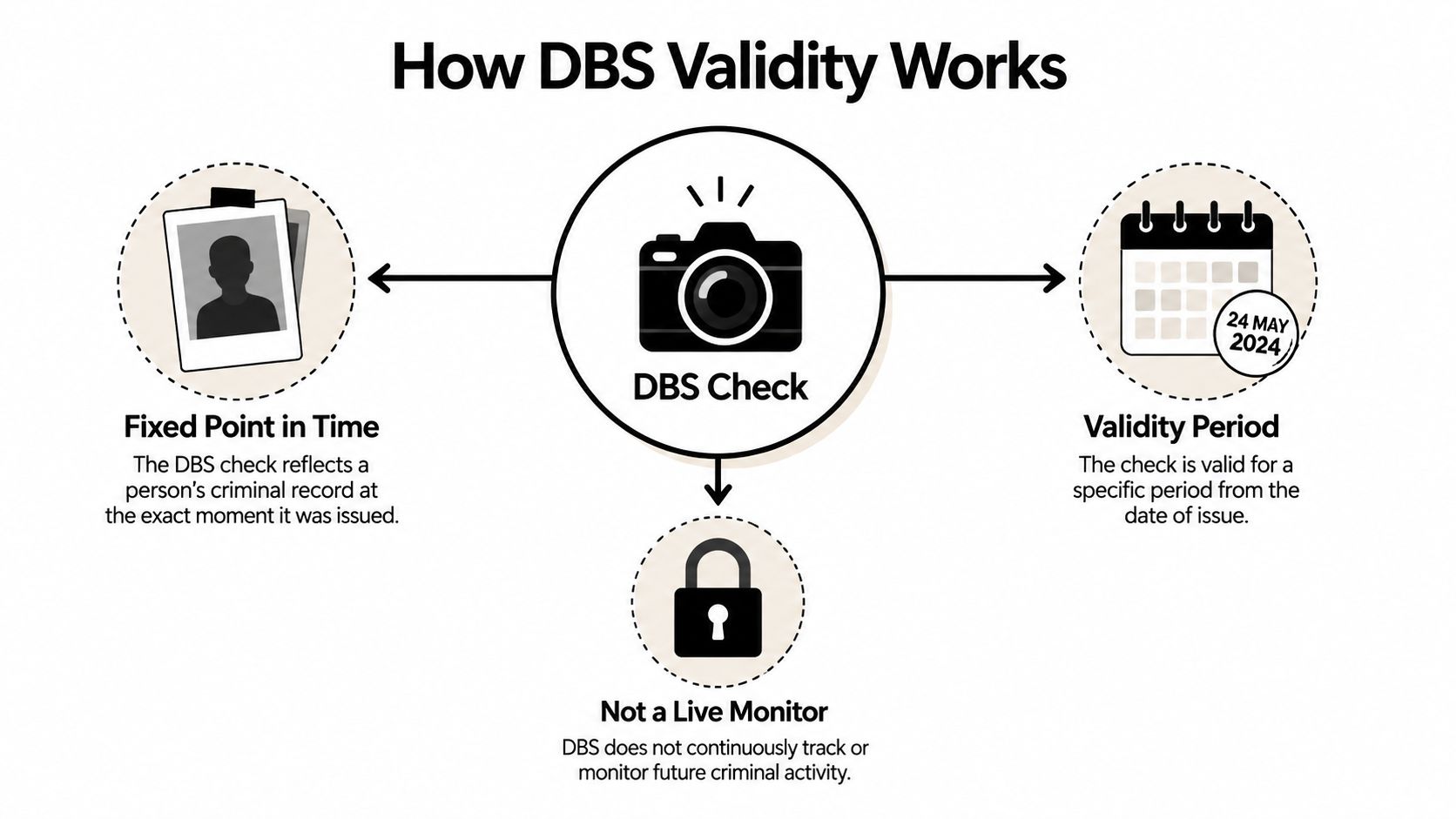
A care worker can present a clean-looking DBS certificate to an agency on Monday, then face a fresh compliance question after information changes later. A DBS certificate works like a photograph, not a live camera feed. It records the information available when the check was issued. A conviction, caution, or relevant police information that appears later will not automatically update that certificate.
That explains why the Disclosure and Barring Service does not place a universal expiry date on every certificate. An expiry date could suggest that the information remains accurate until that point. In practice, the record can change the day after issue while the paper certificate remains unchanged.
What each check level tells an employer
A Basic DBS check shows unspent convictions and conditional cautions. It can suit work outside regulated activity, including domestic cleaning or back-office administration.
A Standard DBS check can show eligible spent and unspent convictions and cautions. It may fit certain positions, but the certificate alone does not establish suitability for frontline regulated care.
An Enhanced DBS check gives the higher level of disclosure used for eligible roles involving vulnerable people. It can include relevant information held by local police. If the role qualifies, the employer may also request an Adults' Barred List check.
The official employer guidance states that care workers providing personal care to adults in regulated activity can be asked to apply for an Enhanced DBS check with an Adults' Barred List check.
Where the Update Service fits
Without Update Service membership, a new employer generally needs to view the certificate and decide whether it meets the role's requirements. Membership gives an organisation a way to carry out an online status check, with the worker's consent, rather than relying only on the original document.
Use this distinction when onboarding with an agency:
Your DBS certificate is a dated snapshot. The Update Service lets an eligible employer check whether that snapshot has changed, but it does not make the certificate a permanent guarantee.
Basic, Standard, and Enhanced Checks Compared
Choosing the wrong check level can delay onboarding even when your paperwork is otherwise organised. A Basic certificate won't satisfy an employer that needs an Enhanced check for regulated adult care, and a certificate for one workforce may not cover a role involving a different workforce.
For many frontline carers, the job description gives the answer. If it mentions regulated activity, personal care, vulnerable adults, medication-related duties, or lone working, ask the employer which Enhanced route it needs before applying.
DBS check levels at a glance
| Check Level | Scope | Typical Care Role | Who Can Request | Approx. Cost |
|---|---|---|---|---|
| Basic | Unspent convictions and conditional cautions | Domestic cleaning or back-office administration | The individual or an employer | Cost varies by application route |
| Standard | Eligible spent and unspent convictions and cautions | Some roles with access to sensitive information or responsibilities that don't qualify for Enhanced | An authorised organisation for an eligible role | Cost varies by application route |
| Enhanced | Standard-level information plus relevant local police information, where disclosed | Frontline support work and eligible regulated care | An authorised organisation for an eligible role | Cost varies by application route |
| Enhanced with Adults' Barred List check | Enhanced disclosure plus the relevant barred-list check | Eligible personal care for adults in regulated activity | An authorised organisation for an eligible role | Cost varies by application route |
The Adults' Barred List relates to eligible work with adults. The Children's Barred List relates to eligible work with children. They're separate checks, so don't assume an adult-care certificate covers a children's role or the other way around.
Match the certificate to the actual duties
A recruiter should identify the lawful level for the post. You shouldn't request a higher level because it sounds safer, since DBS eligibility depends on the role and duties.
Ask three questions before submitting an application:
- Which level does this role require?
- Which workforce does it involve, adults or children?
- Does the employer need a barred-list check?
For a regulated adult-care position, assume the employer may require an Enhanced DBS with an Adults' Barred List check, then confirm the exact route with the agency or registered organisation. That single conversation can prevent a certificate mismatch and a second application.
The DBS Update Service Rules That Decide Your Shifts
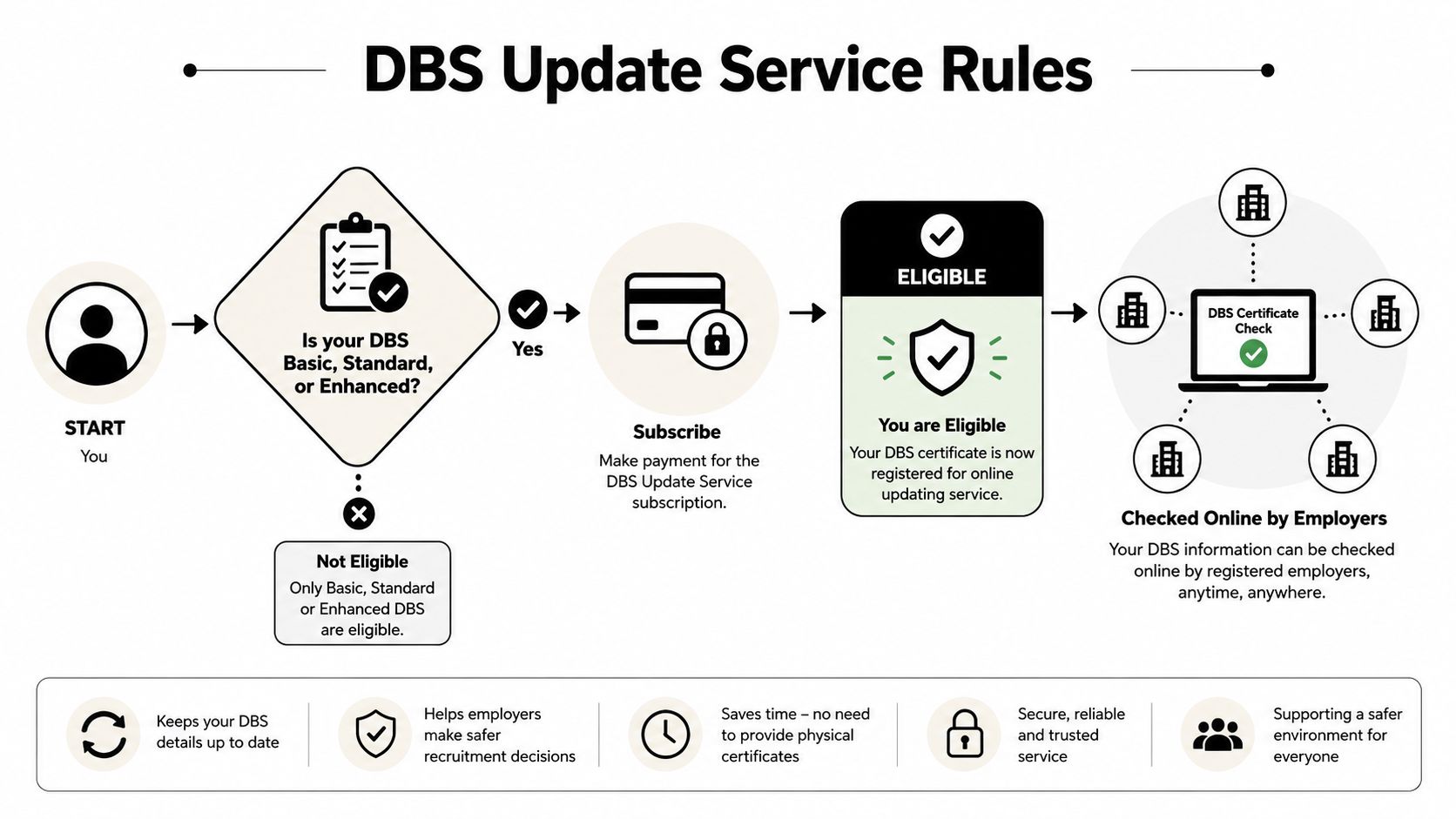
The Update Service lets eligible certificates be checked online, but joining it does not remove the employer's responsibility to confirm that the certificate matches the role.
For care workers, timing affects whether an agency can rely on that check. GOV.UK's Update Service guidance states that the subscription runs on a 1-year cycle. If you register using your certificate number, you must join within 30 calendar days of the certificate's issue date.
Build the habit immediately after issue
A certificate arriving in the post should trigger an action, not a filing routine. Check the issue date, store the certificate number securely, and complete registration within the 30-calendar-day window. Delaying this task can leave you unable to use the service for a future agency check.
The service supports online checks for Standard and Enhanced certificates. The official guidance explains that an employer can complete a free, instant online status check to establish whether the certificate remains up to date, provided the relevant conditions and consent requirements are satisfied.
Understand what membership does and doesn't do
A status check can show whether new information has been added or whether the certificate has been withdrawn. The result does not cover identity checks, lawful role matching, or the employer's safeguarding decision. A different role may also require a new certificate, even where an existing membership remains active.
Treat membership as one part of your onboarding file. The applicant guide says the subscription lasts one year, may be renewed up to 30 days before expiry, and cannot be renewed on the final day. Renewal must be completed by the day before expiry.
Set calendar reminders for registration and renewal. Do not assume payment or renewal happens automatically. If you lose account access, change your name, or have a new matter that could affect your record, contact the DBS and tell the agency. A status check cannot resolve every change in your circumstances.
How Often Agencies Should Run an Update Service Status Check
There's no prescribed frequency for Update Service status checks. Updated DBS Update Service guidance says organisations should choose a schedule based on the role, safeguarding needs, and internal policy.
That gives employers flexibility, but it doesn't justify random checks or a blanket assumption that every worker needs the same treatment. A defensible system checks before reliance, then repeats checks according to the risk of the placement.
A workable cadence for care employers
Run a status check during recruitment or onboarding, before placing a worker into a new role, and during the organisation's regular review process. Increase the frequency where the worker has unsupervised access to vulnerable adults, children, medication, personal finances, or private homes.
The employer should record the decision and its reasoning. If the result says new information or certificate withdrawn, pause the booking, review the risk, speak with the worker, and arrange a fresh disclosure if required. Don't allow an automated result to make a safeguarding decision without human review.
| Role Risk Level | Example Setting | Minimum Check Frequency |
|---|---|---|
| Lower risk, non-regulated duties | Domestic cleaning or administrative support | At recruitment and when the role changes |
| Standard care access | Supported living or supervised care duties | At recruitment, before placement, and at the organisation's scheduled review |
| Higher risk regulated activity | Personal care, lone working, or direct access to vulnerable adults | At recruitment, before placement, at regular risk-based reviews, and after a relevant concern |
| Complex or changing duties | Roles involving adults and children, medication, finances, or multiple placements | At every material placement change and at a tighter risk-based interval set by the employer |
Agencies can perform checks manually through the DBS service or use a recruitment system that records consent and prompts reviewers. The technology doesn't decide the cadence. The agency's safeguarding policy does.
Care workers can make onboarding easier by asking, “What is your Update Service check policy before a new placement?” The guide to checking DBS Update Service status can help you understand the information a recruiter may request and the questions to raise before accepting shifts.
Why Joining the Update Service Within 30 Days Matters So Much
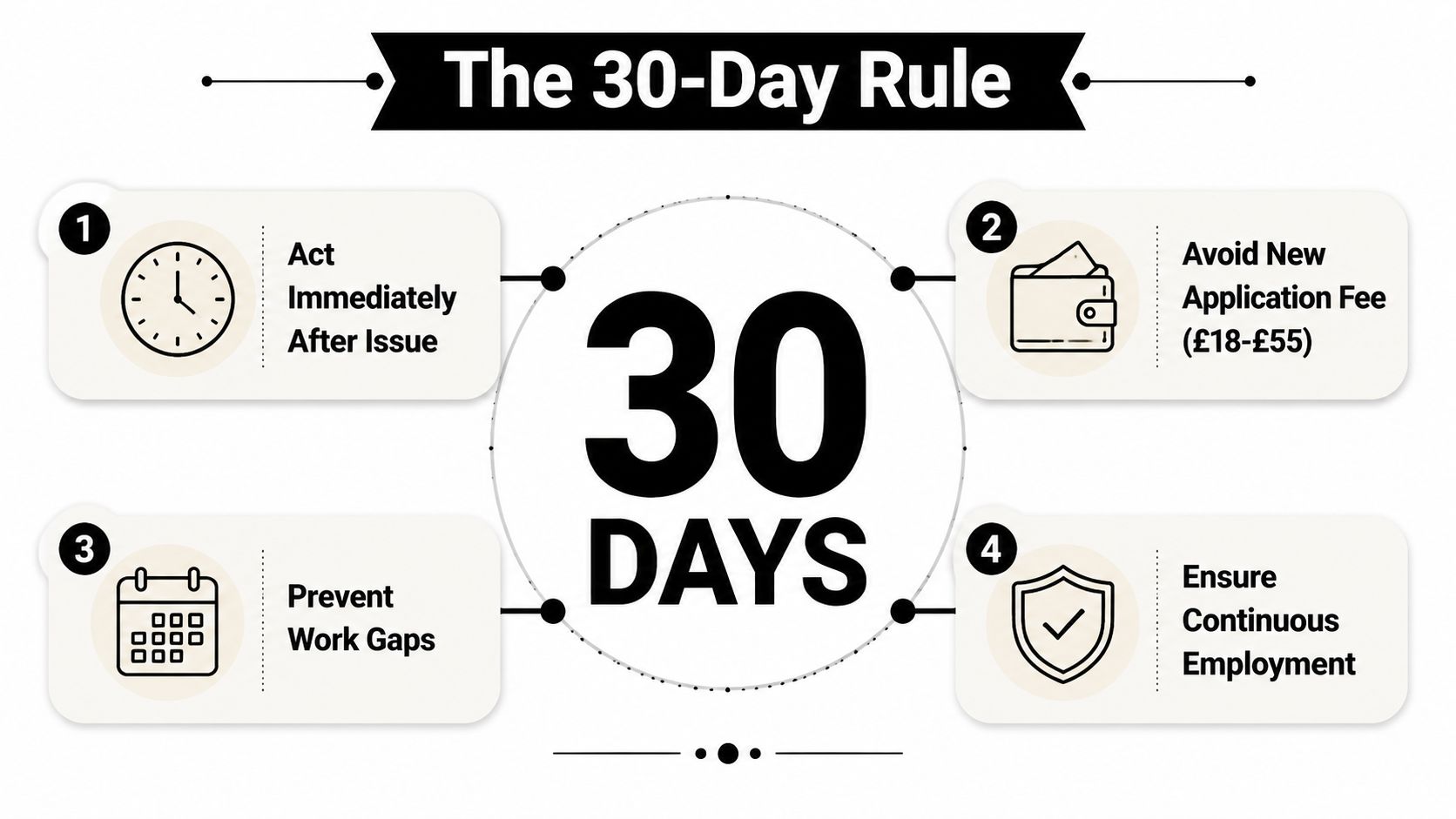
The 30-day subscription window is the most important timing decision after your certificate is issued. Miss it, and the practical benefit of portability may disappear. You may then need a completely new DBS application when another employer wants current evidence.
GOV.UK's Update Service guidance confirms that registration with the certificate number must happen within 30 calendar days of the issue date. That deadline starts from the date printed on the certificate, not the day you opened the envelope or began applying for jobs.
Protect your ability to move between employers
Registering promptly lets an eligible employer request a status check, with your consent, when considering you for a role. That can make your compliance file easier to review across agencies, although the new role still has to match the certificate's level and workforce requirements.
The subscription runs for 1 year, and the applicant guidance explains the renewal rules, including the need to renew by the day before expiry. Treat it like a recurring compliance task, not a form you complete once.
If you miss the registration deadline, don't tell recruiters that your certificate is unusable. Explain the issue date and ask what their policy requires. In many onboarding situations, the employer may request a new check because it can't use the Update Service for that certificate. GOV.UK guidance refers to limited circumstances involving certificate errors or reprints, but those exceptions aren't a workaround for forgetting to register.
Watch the video below for a practical explanation of the Update Service and its role in care recruitment.
For further guidance, read Cura Academy's explanation of the Enhanced DBS and Update Service. Then put the issue date in your calendar and deal with registration before you start chasing shifts.
Your Step-by-Step Plan to Stay Compliant and Job-Ready
A clean certificate helps, but organised evidence is what keeps your onboarding moving. Use this plan during your first working week and update it whenever your role or personal details change.
Start with the correct application
- Confirm the duties. Ask the agency or care provider whether the role requires Basic, Standard, Enhanced, or Enhanced with a barred-list check. For eligible personal care involving adults in regulated activity, confirm whether an Adults' Barred List check is required.
- Use the employer's approved route. Apply through the organisation or its registered umbrella body. Don't submit a certificate that doesn't match the level or workforce the role requires.
- Check every identity detail. Review your name, address history, date of birth, and identity documents before submission. Errors can create avoidable delays or require correction.
Register and organise the evidence
- Join within 30 calendar days. Use the exact certificate number and the issue date shown on the certificate. Save confirmation securely.
- Create a compliance folder. Keep the original certificate safe, then store a clear record of its level, workforce, issue date, Update Service details, training evidence, right-to-work documents, and references. Follow each employer's instructions for handling sensitive information.
- Update agency portals. Upload the documents requested by each agency and answer the same DBS questions consistently. If an agency asks for a fresh check despite your membership, ask whether its policy requires one.
Use a repeatable personal check
The official guidance doesn't impose a universal status-check timetable, so workers should follow each employer's risk-based policy. For personal organisation, set a reminder before your Update Service subscription renewal date and ask the agency to confirm its own review schedule.
A three-yearly full re-check can be an employer policy, but it isn't an official expiry rule. Don't present it as law, and don't assume it applies to every placement.
Before a shift, check:
- DBS details: The certificate level, workforce, issue date, and Update Service status match the agency file.
- Training: Required courses and refreshers are current under the employer's policy.
- Personal information: Your name and contact details match the records the recruiter holds.
- New concerns: You've told the relevant employer if a new matter could affect your disclosure.
For identity paperwork, Cura Academy's guide to proof of address in the UK can help you prepare the documents an onboarding team may request.
Putting It All Together and Quick Answers
Your certificate's issue date sets the baseline. Update Service membership gives eligible employers a way to check its status, the employer's risk assessment determines whether it's acceptable, and your own reminders prevent avoidable onboarding problems. That's the practical DBS check validity period for care work: not a legal countdown, but a rolling compliance routine.
Does an Enhanced DBS expire after three years?
No. There's no official expiry date. An employer may choose a three-year re-checking policy, but that's an internal requirement rather than a fixed statutory validity period.
Can a Basic DBS check cover a care role?
It can cover some non-regulated care-related duties, such as domestic cleaning or administration. It won't automatically meet the requirement for eligible regulated personal care, where an Enhanced check and possibly a barred-list check may be required.
What happens if I miss the Update Service window?
If you don't register within 30 calendar days of the certificate's issue date, the employer may be unable to use the Update Service for that certificate. Ask the agency whether it requires a new application and follow its onboarding policy.
Can an agency reject a clean certificate because it's old?
Yes. Employers decide whether the information is recent enough for the role, and they can apply a risk-based freshness policy. A clean certificate doesn't override an agency's safeguarding, contractual, or client requirements.
Treat DBS compliance like training, references, and right-to-work evidence. You maintain it continuously, rather than completing one form and forgetting about it.
Cura Academy helps UK care workers organise essential training, prepare for Enhanced DBS and Update Service requirements, and build a job-ready compliance profile. Visit Cura Academy to choose a structured route into care work or keep your existing compliance evidence organised for agency onboarding.