
Nearly one in eleven hospital patients had a pressure ulcer, and only 51.3% of at-risk patients had a planned repositioning regimen. Preventing skin breakdown therefore depends on consistent daily action, not just completing a risk assessment or filing a care plan.
That gap matters in every setting. A resident may have a completed Waterlow score, a documented mattress, and a care plan that says “reposition regularly”, yet still spend too long in one position because nobody owns the next skin check or records whether the turn happened. In domiciliary care, the same problem can appear when a rushed visit covers continence care but misses a new area of discolouration beneath a device or around a skin fold.
The practical answer is to build prevention into ordinary care, with clear triggers, assigned actions, suitable equipment, and reliable escalation. This guide focuses on how to prevent skin breakdown by closing the small gaps between knowing what to do and doing it every time.
Table of Contents
- Why Prevention Gaps Still Exist in UK Care
- Completing Risk Assessment Early and Accurately
- Performing Daily Systematic Skin Inspections
- Choosing Repositioning Schedules and Support Equipment
- Managing Moisture, Nutrition and Documentation
- Avoiding Common Misconceptions in Skin Care
- Your Daily Prevention Checklist and Next Steps
Why Prevention Gaps Still Exist in UK Care
The National Audit of Pressure Ulcer Prevalence in England examined 10,144 patients across 36 hospitals representing 18 NHS trusts. It found that 9.04% of patients had at least one pressure ulcer, while 64.0% of recorded ulcers were category 1 or 2. These early categories still represent skin damage and an opportunity to prevent deterioration. (National Audit of Pressure Ulcer Prevalence in England)
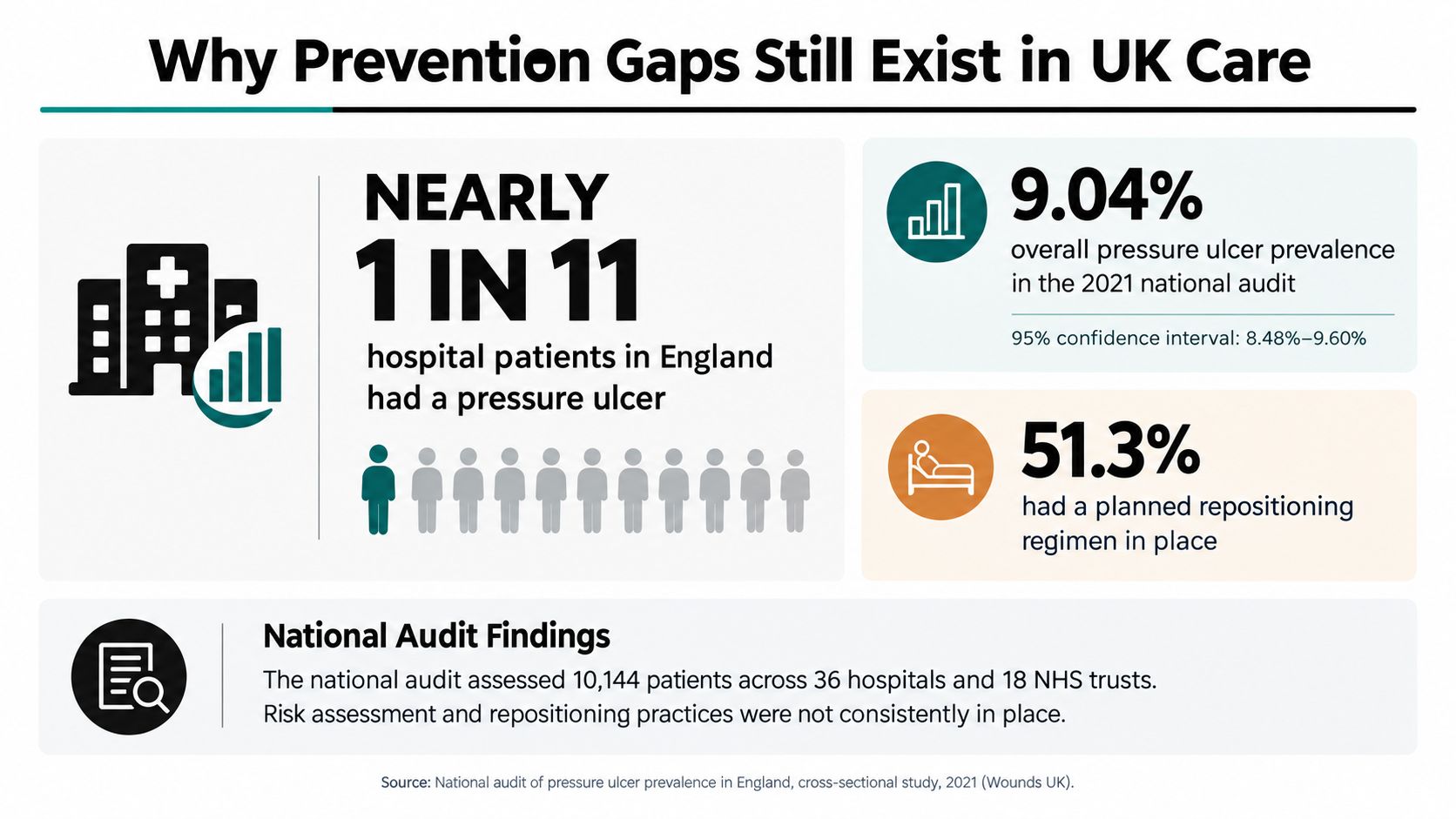
The audit also exposes the difference between policy and delivery. 69.8% of patients had a documented pressure-ulcer risk assessment within six hours, and 81.4% of patients identified as at risk had a care plan. Yet only 51.3% had a planned repositioning regimen. A plan that isn't translated into a completed turn, skin inspection, or pressure-relieving adjustment won't protect tissue.
Where the routine breaks down
Consider a resident who returns from hospital with reduced mobility. The admission paperwork is completed, staff know the resident is at risk, and the care plan includes repositioning. During a busy evening, continence care takes priority, the resident is settled in bed, and the planned turn is recorded later from memory. By morning, a reddened heel is discovered.
No one intended to neglect the resident. The failure occurred between assessment and action. The schedule wasn't visible at the point of care, the equipment wasn't checked, and nobody had a simple handover question such as, “What changed during the last round?”
Practical rule: A prevention plan is only complete when staff can explain what must happen, who will do it, when it will happen, and how they'll confirm it happened.
Small oversights can also delay specialist input. When a wound isn't healing or pressure damage is becoming more complex, a resource on non-healing wound management can help carers understand why early review matters, but it doesn't replace local clinical escalation.
The reliable approach is organised and repetitive. Assess early, inspect deliberately, reposition according to individual risk, manage moisture without damaging the skin barrier, and document the actual care delivered.
Completing Risk Assessment Early and Accurately
Risk assessment must begin at admission, before a skin problem appears. CPFT clinical guidelines support completing and documenting the assessment within six hours of admission to hospital or a nursing home, or at the first community visit, with a trained professional involved where required. (UK pressure-ulcer prevention guidance)
Use a validated tool such as the Waterlow, Braden, or Norton scale, then apply clinical judgement. A score cannot identify a fragile heel, explain why someone refuses to move, or show that a person has become drowsier and less able to report discomfort. The practical gap appears when a completed score stays in the record while staff lack clear actions at the bedside.
What to assess beyond the score
Check:
- Mobility: Can the person change position independently, or do they need prompting, assistance, or equipment?
- Sensation: Reduced sensation may remove the warning signs of sustained pressure.
- Previous or current ulcers: Existing or previous damage calls for closer observation.
- Nutrition and hydration: Poor intake, falling weight, or suspected malnutrition requires clinical review.
- Positioning ability: Record whether weakness, pain, cognitive impairment, or physical restrictions prevent independent repositioning.
Write observations rather than a category alone. “High risk” gives limited direction. “Unable to reposition without two carers, reports sacral discomfort, poor intake today, and has non-blanching colour change on the right heel” tells the next worker what to check and act on immediately.
Reassess when circumstances change
Repeat the assessment after changes in mobility, continence, alertness, health status, equipment, or care needs. A person who walked to the bathroom yesterday may be bedbound after an infection today. Someone who usually reports pain may become confused or drowsy, requiring closer observation.
The assessment should produce visible actions in the care plan: a skin inspection routine, an individual repositioning schedule, equipment requirements, continence measures, nutrition review, and escalation instructions. In care homes and domiciliary care, assign responsibility and record completion at the point of care. If planned actions are missing or only entered later from memory, the assessment has not yet protected the person.
Performing Daily Systematic Skin Inspections
Skin inspection works best when it follows the same sequence every time. Check the sacrum, hips, heels, elbows, shoulders, ankles, and the back of the head, then inspect skin folds, continence-pad areas, and any place where a device touches the skin.

Don't rely on a quick glance. Use appropriate lighting, explain what you're doing, preserve dignity, and compare both sides where possible. Look for colour change, warmth, swelling, dryness, moisture damage, pain, blistering, broken skin, and areas that remain discoloured after pressure is relieved.
Inspect the places people miss
Devices create hidden pressure points. Check beneath oxygen tubing, masks, splints, casts, compression products, continence products, and other supports. Skin folds can remain damp after washing, while wrinkles in bedding can create sustained friction and pressure.
Ask the person what they feel. Pain, burning, tenderness, or a new change in comfort may be an early warning, especially when sensation is reduced or communication is limited. Don't assume intact skin is safe if the person has become less mobile or can't reposition without help.
A high-risk person needs a documented pathway, not an informal glance. Record what you found, where you found it, what action followed, and who was informed. If you identify early non-blanching erythema, guidance recommends repeating skin assessment at least every two hours while increasing preventive measures. (NICE quality standard on pressure ulcers)
For staff who handle personal care, consistent infection-control practice also protects vulnerable skin. Review infection control in care alongside local policies, particularly for cleansing, hand hygiene, equipment cleaning, and the safe disposal of continence materials.
Use a written check that can be understood at handover. A useful entry might state: “Sacrum intact, heels warm with no persistent colour change, moisture-related redness to groin, cleansed and barrier product applied, senior carer informed.” It shows both the observation and the response.
The following demonstration can support discussion during team training, but staff must still follow their employer's moving-and-handling and clinical procedures.
Choosing Repositioning Schedules and Support Equipment
A repositioning schedule works only when staff can deliver it consistently. Set it according to the person's risk, tissue tolerance, comfort, mobility, clinical condition, and care goals. NICE recommends encouraging adults at risk to change position frequently and at least every six hours. Consider more frequent repositioning for people assessed as high risk. (NICE guideline on pressure ulcers)
Write instructions that staff can follow during a busy shift. “Turn regularly” leaves too much room for interpretation. A useful plan states the position, assistance required, equipment, skin-check expectation, and escalation trigger. It should also allow for pain, sleep, respiratory needs, or a new area of redness.
| Risk level | Repositioning frequency | Equipment recommendations |
|---|---|---|
| At risk | Encourage frequent position changes and plan at least every six hours, adjusting for the person's condition and skin findings | Appropriate pressure-redistributing mattress, cushions where indicated, pillows or wedges, and safe moving-and-handling aids |
| High risk | Consider more frequent repositioning, guided by skin inspection, comfort, tissue tolerance, and clinical goals | High-specification foam mattress where indicated, heel offloading, suitable slide sheets or hoists, and a documented turning record |
| Non-blanching erythema or deterioration | Increase preventive action and repeat skin assessment at least every two hours | Remove pressure from the affected area, review equipment fit, escalate promptly, and seek clinical direction |
Match equipment to the person
A pressure-redistributing mattress reduces sustained loading, but it does not replace inspection or repositioning. A cushion may support a chair user, while a heel protector or correctly placed support can prevent continuous pressure on the heel. Choose equipment from the assessment and local clinical advice, not from convenience or availability.
Check every mattress, cushion, sling, slide sheet, and offloading device before use. Look for bottoming out, leaks, bunching, exposed seams, and incorrect positioning. Never place someone directly on an area of redness. Check beneath or around support devices so they do not create a new pressure point.
Record missed turns and the reason, such as pain, refusal, clinical instability, or staffing constraints. That information helps the team adjust the plan rather than treating non-delivery as a completed intervention.
Moving technique matters as much as timing. Dragging stretches skin and deeper tissues, especially when someone is moved across a bed or chair. Use the appropriate aid and number of carers, follow local procedures, and reinforce practical skills with training on moving and handling techniques.
Managing Moisture, Nutrition and Documentation
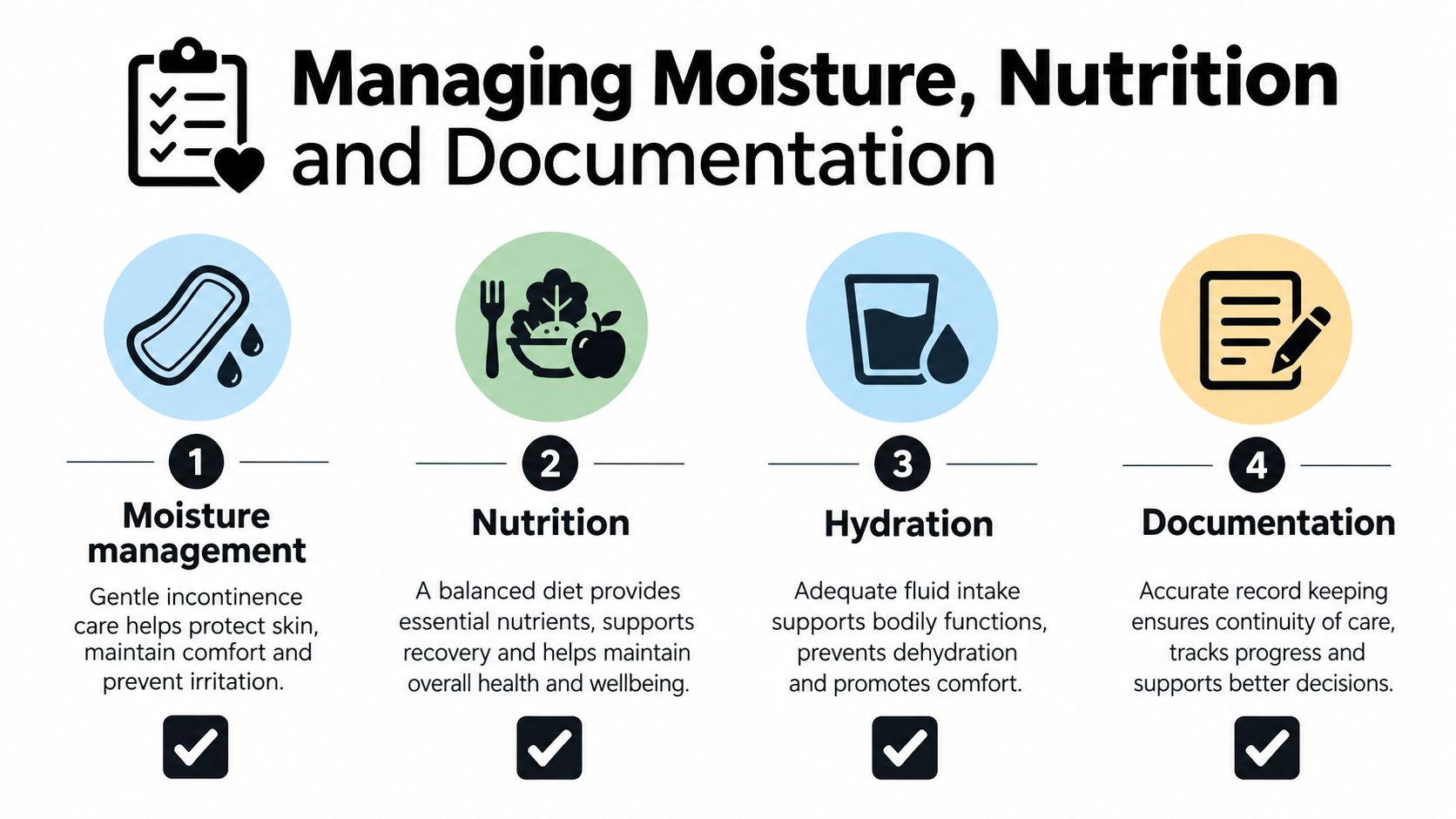
Repositioning alone won't prevent breakdown. Effective prevention combines pressure redistribution, skin inspection, continence care, nutrition and hydration review, and accurate documentation. NHS England's React to Red initiative reported an 87% reduction in avoidable pressure ulcers in targeted care homes and an 85% reduction in community services. These were programme outcomes, not a universal national benchmark, and they underline the value of consistent, multi-component delivery. (NHS England's React to Red case study)
Keep continence care gentle
After incontinence, cleanse with warm rather than hot water and a suitable soap substitute or pH-balanced cleanser. Pat dry instead of rubbing, then apply an appropriate barrier product without vigorous friction. Moisturiser may be suitable for dry skin, while a barrier product protects areas exposed to urine, faeces, or sweat. Follow product guidance and local protocols, and record what was used.
Keep bedding dry, smooth, and free from wrinkles. Protective mattress products can be useful in continence-care routines, and a practical guide for carers and parents can help families think about bedding protection alongside skin care.
Connect intake to escalation
Ask whether the person is eating and drinking as usual. Poor intake, falling weight, swallowing difficulty, or suspected malnutrition should prompt clinical or dietetic review. Don't give supplements solely to prevent ulcers when intake is already adequate. Record meaningful changes rather than just writing “eating well”.
A simple end-of-round record should show:
- Skin: What was inspected and what changed?
- Position: What position was used, and was assistance needed?
- Moisture: What cleansing and barrier care took place?
- Intake: Were food and fluids taken as expected?
- Escalation: Who was informed, and what instruction followed?
Staff needing structured learning on food and fluids can use nutrition and hydration training alongside workplace policy and clinical supervision.
Avoiding Common Misconceptions in Skin Care
Some skin-care habits survive because they sound helpful. Massaging reddened skin is not a safe default. Vulnerable tissue may already be damaged, and rubbing can add friction and shear. Relieve pressure, inspect the area, document the finding, and escalate according to local guidance instead.
Another mistake is treating “clean and dry” as permission to wash repeatedly with hot water, perfumed soap, or vigorous cloths. UK NHS guidance supports gentle cleansing, moisturising dry skin, and protecting moisture-exposed areas with a suitable barrier product. Excessive washing can strip the skin barrier and make fragile tissue more irritable. (NHS guidance on pressure damage prevention and skin care)
Distinguish the pattern, then act
Moisture-associated damage is often diffuse, linked to continence, sweat, or repeated washing. Pressure damage is more commonly localised over a bony area or beneath a device. The patterns can overlap, so don't rely on appearance alone. Consider the person's position, continence, equipment, symptoms, and recent care.
Use warm water, a soap substitute or pH-balanced cleanser, and patting motions. Avoid applying several incompatible creams, and don't massage vulnerable skin. If the cause isn't clear, ask a senior clinician or tissue-viability professional rather than experimenting with products.
Escalate persistent change: Persistent redness, blistering, pain, colour change, skin loss, or non-blanching skin requires prompt review, particularly when the person can't describe symptoms reliably.
Intact skin also doesn't equal low risk. A person can have healthy-looking skin at one visit and still be vulnerable because mobility, sensation, nutrition, moisture exposure, or equipment has changed. Prevention depends on the risk picture and the trend over time, not a single reassuring inspection.
Your Daily Prevention Checklist and Next Steps
A workable prevention routine should fit the shift, not sit separately from it. At the start of care, confirm the current risk assessment and look for changes in mobility, alertness, pain, continence, intake, and equipment. During personal care, inspect pressure areas and hidden contact points, cleanse gently, protect moisture-exposed skin, and report anything that doesn't look or feel usual.
Use the care plan as an operational document:
- Confirm risk: Check the latest assessment, individual risk factors, and required assistance.
- Inspect skin: Review bony areas, heels, folds, pad areas, and beneath devices.
- Complete planned movement: Reposition safely, use the prescribed aids, and confirm the action occurred.
- Review equipment: Check fit, function, wrinkles, pressure points, and heel protection.
- Support intake: Note food and fluid concerns and follow the escalation pathway.
- Record clearly: Document findings, care delivered, products used, response, and communication.
- Escalate early: Act on non-blanching erythema, persistent redness, pain, blistering, colour change, or skin loss.
At handover, don't say only “skin fine”. State what was checked and whether anything changed. A short, specific update helps the next carer continue prevention rather than restarting from assumptions.
Training reinforces the practical details that busy shifts can erode. Cura Academy provides access to Care Certificate standards, mandatory refreshers, and role-specific care courses, giving learners a structured way to keep knowledge current and support job-ready practice. Use training alongside local policies, supervision, competency checks, and clinical advice.
The strongest prevention systems make the right action visible and easy to verify. Every risk assessment should lead to a practical plan, every plan should lead to observed care, and every change should lead to timely communication.
Cura Academy offers structured access to essential care training, Care Certificate standards, mandatory refreshers, and role-specific courses that support compliant, job-ready practice. Visit Cura Academy to build a consistent learning pathway and strengthen the skills behind safer skin care.