
In UK health and social care, formal support is organised assistance delivered through recognised services, employers or public systems, rather than relying only on family, friends or informal networks.
Perhaps your parent has started struggling with washing, taking medication or leaving the house. You're helping where you can, but you need to know who else can help, who takes responsibility and what happens if an arrangement breaks down.
Table of Contents
- Why People Keep Asking What Formal Support Means
- Defining Formal Support Beyond Family Help
- Formal and Informal Support Side by Side
- Real Examples of Formal Support in Practice
- Who Delivers Formal Support and Who Qualifies
- How Formal Support Fits Into a Care Pathway
- Choosing a Route Into Formal Support Training
- Your Next Step Toward Formal Support Readiness
Why People Keep Asking What Formal Support Means
A parent who previously managed independently might now need help getting dressed. Their daughter visits before work, a neighbour collects shopping, and someone suggests contacting social services. The family's immediate question is practical: what help can they arrange beyond what they're already doing?
Then unfamiliar language starts appearing. A council letter mentions support needs, a care job advert promises formal supervision, and a training course describes professional responsibilities. The same word, support, seems to mean different things.
The confusion is understandable
A useful starting point is to ask who the support is for. Help for a person receiving care is different from the induction, supervision and feedback that help a worker deliver that care safely.
Family involvement can make the distinction less obvious. For a separate example involving children and families, Friendly ABA Premier's resource on in-home ABA and parent coaching provides a point of comparison when thinking about professional input alongside parental involvement. It shouldn't be treated as guidance on English adult social-care eligibility.
Start with responsibility: Being helpful and being responsible for an agreed service aren't the same thing.
For the family trying to arrange daily care, some useful questions are:
- Who arranges the help? Identify the organisation or professional responsible.
- What has been agreed? Ask what the person will receive and what remains outside the arrangement.
- Who responds to problems? Find out whom to contact if needs change or help doesn't arrive.
These questions take the discussion beyond whether someone is kind, experienced or available. They focus attention on how the arrangement works.
You don't need to learn every care-sector term before asking for assistance. You need enough understanding to recognise the service being offered, distinguish it from family help and know what evidence to request.
Defining Formal Support Beyond Family Help
Think of the difference between a timetabled bus service and a friend offering a lift. Both can get someone to their destination, but the bus service has an operator, an organised route and an arrangement passengers can check. A friend's lift depends on a private understanding.
The analogy isn't exact, but it highlights what makes support formal: organisation and responsibility, not payment alone or a professional-looking uniform.
What makes an arrangement formal
In adult social care, formal support comes through statutory, commissioned or professional services. It can include personal care, medication management, therapy, home adaptations, clinical support, counselling, advocacy and practical assistance. England's assessment-led approach is explained in the Redcar and Cleveland adult social-care guide.
The layers are easiest to understand separately:
- Organised help: Someone has arranged what assistance will be provided.
- Accountable delivery: An identifiable organisation or professional takes responsibility.
- An agreed purpose: The help responds to the person's needs rather than a general assumption about what they require.
A scheduled visit alone doesn't explain the whole arrangement. The important questions concern what the worker is expected to do, why those tasks matter and who checks whether the assistance remains appropriate.
Formal doesn't mean institutional
Support can be professional and structured while happening in someone's own home. Equally, receiving help at home doesn't automatically make an arrangement formal.
For a broader comparison of settings, Vitals Healthcare Doctor On Call's resource can help readers compare elderly care options. Keep that comparison separate from questions about UK entitlement, funding or local-authority responsibilities.
Another easily missed point is that carers can receive formal support themselves. The adult social-care guide cited above describes provision that may include breaks, counselling, training, employment advice and information.
That changes the question from “Who can help my parent?” to “What assistance does this whole caring situation require?” The person receiving care matters, but so does the relative trying to keep the arrangement manageable.
Formal and Informal Support Side by Side
A neighbour collecting groceries and a care worker delivering an agreed visit might both provide valuable assistance. The distinction isn't that one cares more. It's how their involvement is arranged, recorded and checked.
Informal support is unpaid help from relatives, friends or neighbours. It can be personal and flexible, but the people involved may not have written down their responsibilities or discussed what happens when someone becomes unavailable.
Formal Versus Informal Support at a Glance
| Aspect | Formal support | Informal support |
|---|---|---|
| Who provides it | An organised service or professional | Family, friends or neighbours |
| How it is arranged | Through an agreed service arrangement | Through personal relationships |
| Whether it is recorded | Should have records appropriate to the service | May rely on conversations or private notes |
| How it is reviewed | Through a structured review or oversight arrangement | When those involved discuss changes |
| What happens when it stops | There should be a route for raising the interruption | Others may need to rearrange help privately |
The table is a practical comparison, not a judgement about the quality of either contribution. A relative may keep careful notes, while an organised service may still need improvement. Good documentation supports accountability, but paperwork alone doesn't guarantee good care.
Why professional help doesn't remove family involvement
A UK government response on adult social care and the cost of inaction reports that, on average, seven hours of formal care reduce unpaid care by two hours. That describes partial replacement, not a complete transfer of responsibility, and it isn't a formula for predicting an individual family's experience.
For example, a professional visit might cover personal care while a relative continues offering companionship and helping with shopping. Each person needs to understand where their contribution begins and ends.
Agree the handover, not just the visit.
A sensible handover discussion covers changes in the person's condition, unfinished tasks and concerns that need attention. Families shouldn't assume that a worker can take on every request, and workers shouldn't assume that relatives can fill every gap.
Clear boundaries make collaboration easier. They also help everyone recognise when an arrangement needs reassessment rather than another improvised favour.
Real Examples of Formal Support in Practice
The examples below are illustrative situations, not accounts of named clients. Each shows a different way organised support might respond to daily needs.
A professional discussion can help turn a general concern into a clearer description of what assistance is needed.

Help at home and in residential settings
Domiciliary care means care delivered in the person's own home. For example, a worker might support someone with washing and dressing while respecting what they can still do independently.
In residential care, the setting changes, but the need for individual attention doesn't. An illustrative morning might involve staff helping a resident prepare for the day according to their preferences rather than expecting everyone to follow an identical routine.
A personal assistant might support someone with agreed activities and daily living. For a working-age adult, that could mean assistance that helps them take part in community life rather than support centred only on personal care.
Assistance isn't always a care visit
Other arrangements address the environment or the wider caring situation:
- Equipment and home adaptations: The focus may be a practical barrier at home, rather than adding more hands-on assistance.
- Community support: Organised assistance can help a person participate in activities beyond their front door.
- Carer breaks: An agreed arrangement can give an unpaid carer time away from their caring responsibilities.
In England, the Care Act 2014 established a statutory framework for assessing adults and carers, promoting wellbeing, prevention and personalisation, and arranging eligible support. The scale of the sector is substantial: Skills for Care estimated 1.84 million adult social-care posts in 2023/24, including approximately 1.705 million filled posts and 135,000 vacant posts, in its report on England's adult social-care sector and workforce.
These examples have different settings and purposes. What connects them is a deliberate arrangement to address an identified difficulty.
The useful question isn't “Which service sounds familiar?” It's “Which arrangement would help this person achieve what matters to them?” That keeps the conversation focused on the person rather than the service label.
Who Delivers Formal Support and Who Qualifies
The organisation arranging support and the organisation delivering it may be different. A local authority may assess needs and commission assistance, while a care provider employs the workers who carry out visits. Clinicians, counsellors and advocates may contribute within their professional roles.
For a newcomer, this can feel like being passed between organisations. A practical way to make sense of it is to separate the jobs involved.
Follow the responsibility, not just the job title
- Assessment and planning: Who identifies the person's needs and discusses appropriate outcomes?
- Service delivery: Which provider or professional will deliver the agreed assistance?
- Day-to-day responsibility: Who deals with missed visits, concerns or changing circumstances?
For someone considering frontline work, understanding support-worker duties and responsibilities can help distinguish the worker's role from decisions made by assessors, managers or clinicians.
Evidence requirements also differ between professional systems. PracticeReady's evidence guidance for Australian psychologists is a separate-country resource, not a guide to English eligibility or UK care-worker requirements. Keep the jurisdiction clear when comparing professional guidance online.
Assessment isn't a promise of public funding
Under the English framework described earlier, a local authority must assess someone who appears to need care and support, regardless of whether they're likely to qualify for public funding. Being assessed, qualifying for support and having that support publicly funded are separate questions.
Ask what the assessment has identified, what decision follows and how the proposed arrangement addresses the needs discussed. Don't assume that requesting an assessment commits the authority to a particular service.
Demand also extends beyond older people. The Care Quality Commission's analysis of access to adult social care reports that new requests in England were 4% higher in 2023/24 than in 2022/23 and 8% higher than in 2019/20; older people accounted for 68% of requests, while requests per 100,000 working-age adults were 14% higher than in 2019/20.
Those figures help correct a common assumption: adult social care isn't only about later life. The starting point is the person's needs and circumstances, not a stereotype about who uses care services.
How Formal Support Fits Into a Care Pathway
A care pathway connects asking for help with receiving assistance that can be checked and adjusted. It's useful to think of it as a sequence of decisions, with a record explaining each decision.
The visual below shows the basic progression.
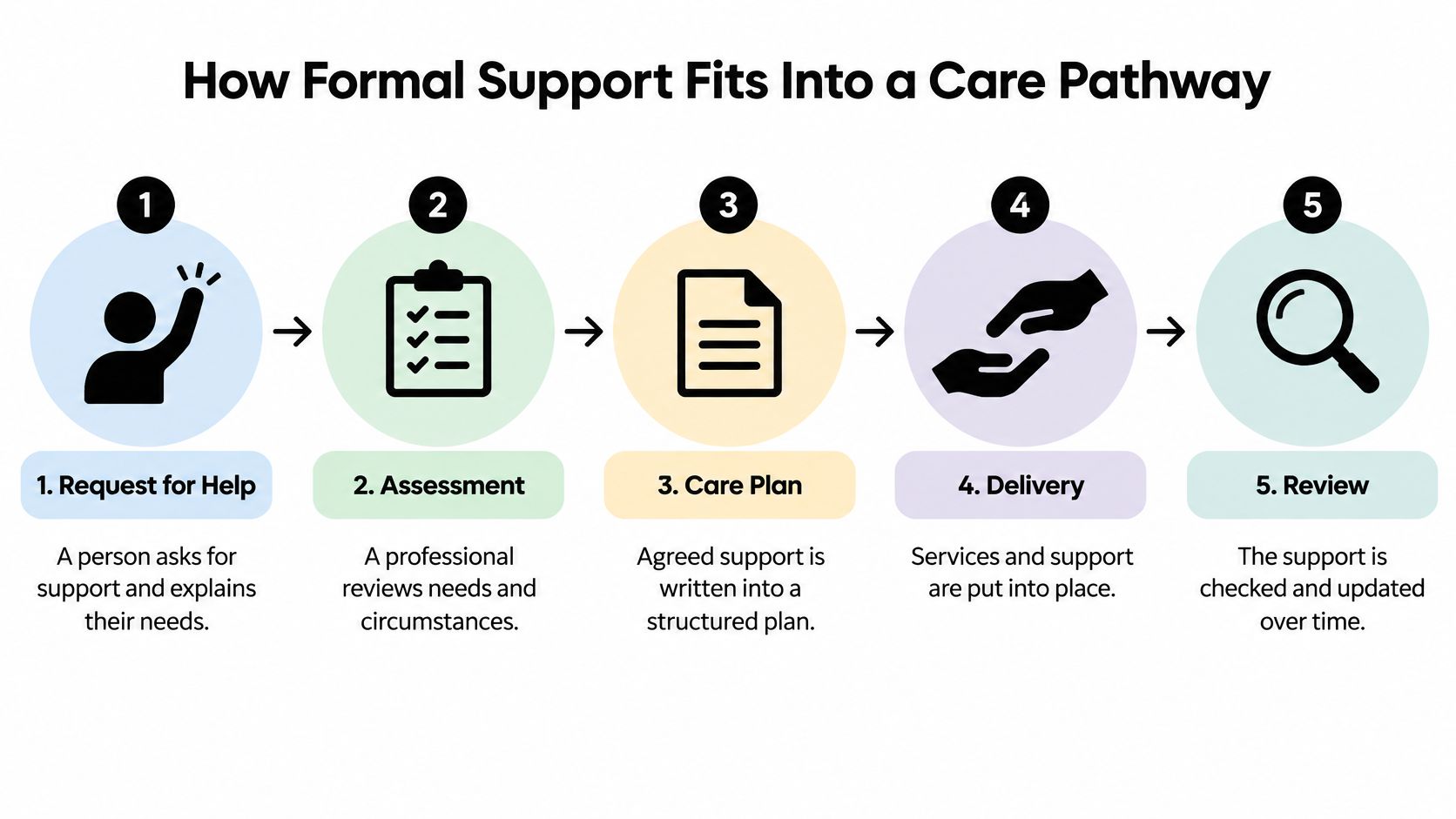
From a request to reviewable delivery
- Request for help: Describe what has become difficult and what assistance is already available.
- Assessment: Explore needs and circumstances rather than jumping straight to a service.
- Care plan: Record the agreed outcomes and how support will contribute to them.
- Delivery: Provide the assistance within the agreed responsibilities and risk arrangements.
- Review: Check whether the arrangement still fits and identify necessary changes.
A plan should explain more than a task. For example, helping someone prepare breakfast may support their wish to continue living independently. Understanding person-centred practice helps workers connect everyday actions with the individual's priorities.
What evidence should you be able to find?
For the person receiving care, look for a connection between assessed needs, agreed outcomes, risk management and delivery records. For the worker, look for a named provider or supervisor, learning objectives, records of support, a competency outcome and a review date.
Skills for Care reported that 56% of social-care staff had partly or fully completed the Care Certificate in 2024/25 in its adult social-care workforce executive summary. That combined measure shouldn't be read as though everyone counted had fully completed it.
Evidence check: A course record shows learning activity. A workplace assessment checks whether the worker can apply learning safely in their role.
Employers remain responsible for that role-specific assessment. A training certificate doesn't, by itself, establish that someone can safely carry out an unfamiliar procedure with a particular person or piece of equipment.
The video below offers an additional format for learning alongside the written pathway.
Keep the evidence purposeful. The aim isn't to collect documents for their own sake, but to make responsibilities, decisions and readiness clear.
Choosing a Route Into Formal Support Training
Choose training by asking what you need to be ready to do, not which certificate you can obtain. A worker starting domiciliary care needs preparation that fits that setting, while an experienced worker changing roles may need to identify gaps rather than repeat everything.
Different routes meet different needs. They're often most useful in combination.
Compare what each route can demonstrate
| Route | What it contributes | What to check |
|---|---|---|
| Employer-led induction and supervision | Local procedures, feedback and supported practice | Whether observation and competency assessment are included |
| Online digital learning | Structured knowledge and a record of completed learning | How the employer will check practical application |
| Formal qualifications | A structured programme for developing occupational knowledge and skills | Whether its content and assessment fit the intended role |
A qualification can support progression, but it doesn't remove the need to learn an employer's procedures. Likewise, experience in another workplace doesn't establish familiarity with a new person's care plan or a different escalation process.
Guidance on support-worker qualifications can help learners separate entry preparation from longer-term development.
Where a digital platform fits
Cura Academy is a UK-based training and membership platform offering access to essential care learning, including Care Certificate standards, mandatory refreshers and role-specific courses such as Basic Life Support and Dementia Awareness. Its structured pathways support course selection and onboarding preparation, with Enhanced DBS and Update Service readiness support and curated bundles for learners preferring one-off purchases.
That makes it an option for people entering care, existing workers updating their learning, and agency or bank staff organising training evidence. It should sit alongside employer induction and practical assessment, not be treated as a substitute for them.
Before choosing any provider, ask concrete questions:
- Role fit: Does the learning match the work you intend to do?
- Employer expectations: What training and evidence will the employer accept?
- Practical follow-through: Who will observe your work and address gaps?
- Access to support: How will you obtain feedback or raise concerns while learning?
Skills for Care's full workforce report provides the wider workforce context for considering induction, learning and supervision together. The practical choice is a connected preparation plan, not a collection of unrelated course completions.
Your Next Step Toward Formal Support Readiness
The most useful answer to “what is formal support?” is something you can test. Can the people involved explain who is responsible, what has been agreed and how they'll check whether it works?
For a family, that means looking beyond the service name. Homecare, residential care or community assistance should make sense in relation to the person's life and the help already available around them.
Check the next missing piece
For a care worker, readiness is equally practical. Knowing the topic, understanding the local procedure and demonstrating safe practice are connected, but they aren't interchangeable.
Choose the action that matches your situation:
- Arranging care: Ask for a clear explanation of the proposed assistance and whom to contact about changes.
- Starting a role: Request the documented induction plan and identify who will supervise you.
- Updating your preparation: Compare your learning records with the employer's requirements and arrange assessment where needed.
You don't have to resolve every question at once. Start with the gap that could leave someone unsure about responsibility or safe practice.
A useful record should help a person act, not merely prove that a form exists. If you can't tell what happens next from the information available, ask for clarification.
Over the next seven days, arrange a conversation with the person responsible for your care plan or workplace induction. Leave with a named contact, an agreed action and a date to check progress.
Cura Academy offers structured care-learning pathways, mandatory refreshers and role-specific courses to support preparation for frontline work. Visit Cura Academy to explore learning that fits your intended role, then agree with your employer how that training will connect to induction, supervision and practical competency assessment.