

A new night-shift carer can know the word dementia and still feel completely unprepared when a resident starts pacing at 3am, asking for her mother. The instinct might be to correct her, guide her back to bed, or describe the episode as “just confusion”. None of those responses begins with understanding what the person may be communicating.
So, what is dementia awareness? In care practice, it's the ability to recognise changes, interpret what they might mean, and respond safely and respectfully. It connects knowledge with action. That distinction matters in the UK, where an estimated 982,000 people were living with dementia in 2024, with a projected 1.4 million by 2040, according to Alzheimer's Society's UK dementia figures. Awareness isn't just knowing a diagnosis. It means knowing what to do next.
Table of Contents
- What Dementia Awareness Actually Means
- Common Types of Dementia and How They Differ
- Signs You Might Notice as a Carer
- Person-Centred Communication and Care
- Capacity, Consent, and Safeguarding
- Why Awareness Alone Is Not Enough
- How Structured Training Builds Real Competency
- Turning Awareness into Everyday Action
What Dementia Awareness Actually Means
Priya has completed her induction and can explain that dementia affects the brain. At 3am, Mrs Okafor is walking repeatedly along the corridor and asking when her mother will arrive. Priya freezes because the definition in her training hasn't yet become a practical response.
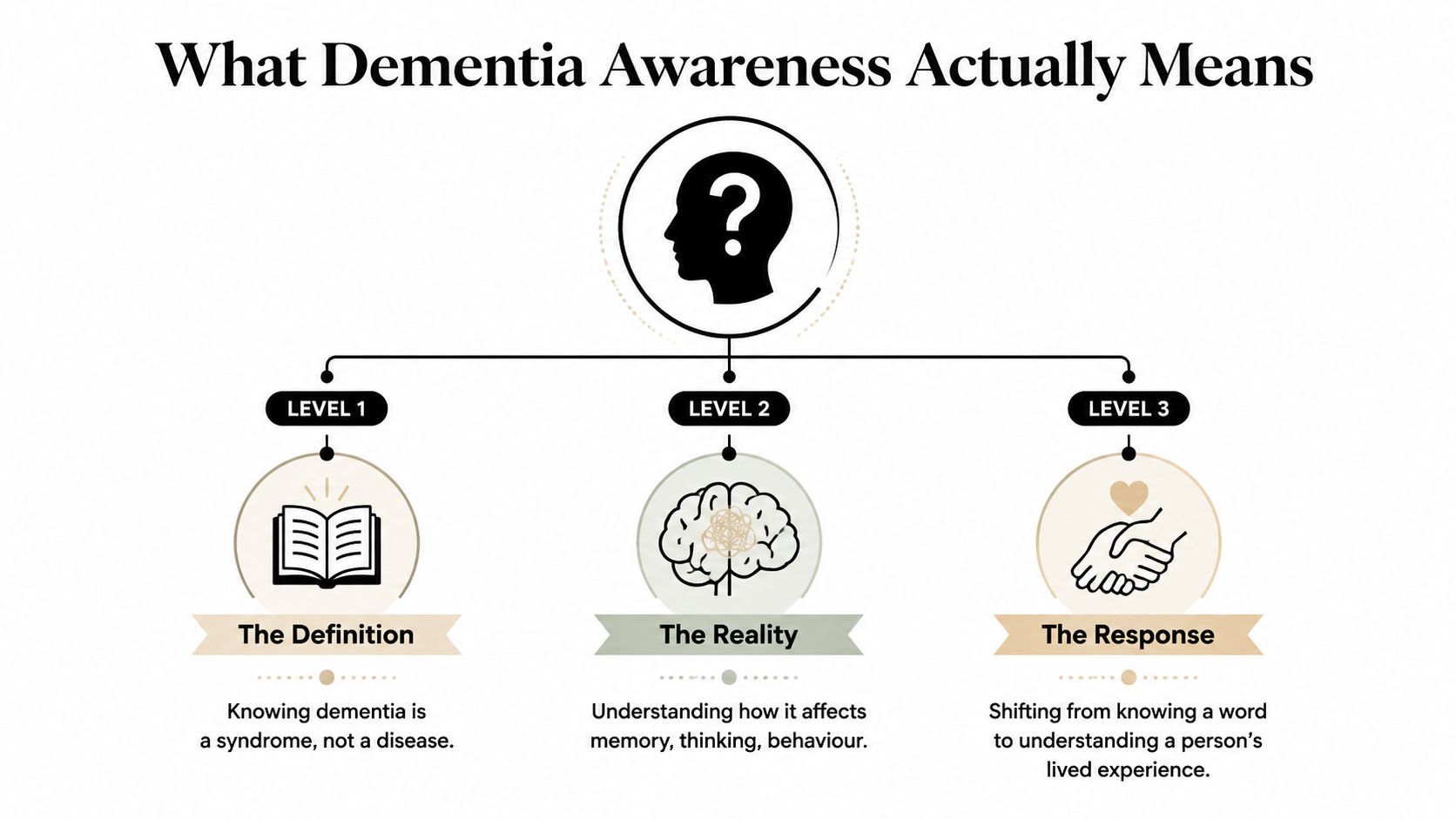
A useful working definition is this: dementia awareness is the practical capacity to recognise, interpret, and respond to the changing needs of someone living with dementia. Recognition might involve noticing a new difficulty with dressing or an unusual change in communication. Interpretation means asking what could be behind the behaviour, such as fear, pain, an unfamiliar environment, or a need for reassurance. Response means adapting your language, environment, pace, and escalation appropriately.
Public awareness is different. A charity campaign, a poster, or a conversation about symptoms may help people recognise the word. A care worker needs more. They need to turn that recognition into safe choices during washing, eating, medication support, handover, and moments of distress.
The UK Dementia Training Standards Framework gives this workforce learning a structure. It describes:
- Tier 1 awareness, for everyone working in health and social care.
- Tier 2 basic skills, for staff who regularly provide direct care.
- Tier 3 intermediate and advanced skills, for people with specialist, leadership, teaching, or advisory responsibilities.
NHS England links the framework with dementia education and e-learning used across the NHS through its dementia training information. Tier 1 familiarity is a starting point, not proof that someone can manage complex communication, recognise changing needs, or lead a reflective response after an incident.
Practical rule: If awareness doesn't change what you notice or what you do, it remains information rather than competence.
Awareness without structure is well-meaning but unreliable. A consistent framework helps a new worker move from knowing the label to understanding the person's lived experience and responding with confidence.
Common Types of Dementia and How They Differ
Dementia is an umbrella term, not a single disease. Different conditions affect memory, language, movement, behaviour, and awareness in different ways, although symptoms can overlap and a person may have mixed dementia.
The patterns carers often encounter
Alzheimer's disease commonly develops gradually. Memory problems may appear early, followed by increasing difficulty with language, orientation, or everyday tasks. Think of the person's familiar abilities becoming harder to access over time, rather than disappearing all at once.
Vascular dementia is associated with problems caused by reduced blood flow or damage to the brain. A person may experience a stepwise pattern, with a noticeable change after a stroke or another vascular event, followed by a period of relative stability. Planning, attention, movement, and communication can be especially affected.
Lewy body dementia can fluctuate from one part of the day to another. A person may be alert and engaged, then unusually drowsy or confused later. Visual hallucinations, changes in movement, and variations in attention can occur, so carers should document observations and report them rather than assuming the person is being difficult.
Frontotemporal dementia often presents differently. Changes in personality, behaviour, social judgement, or language may appear before prominent memory difficulties. A person may seem unlike their previous self, which can be particularly confusing for relatives and staff.
Mixed dementia means that features of more than one type are present. A person might show gradual memory decline alongside vascular changes, for example. The care plan should be based on the person's actual abilities, risks, preferences, and responses, not on a label alone.
| Type | Typical onset | Hallmark symptoms | Progression pattern |
|---|---|---|---|
| Alzheimer's disease | Usually gradual, often later in life | Memory loss, disorientation, language difficulties | Gradual decline |
| Vascular dementia | May follow vascular events or develop gradually | Planning, attention, movement, and communication difficulties | Often stepwise, though patterns vary |
| Lewy body dementia | Variable | Fluctuating alertness, visual hallucinations, movement changes | Fluctuating and progressive |
| Frontotemporal dementia | Can affect people at a younger age than some other forms | Personality, behaviour, or language changes | Progressive, with early non-memory symptoms |
| Mixed dementia | Depends on the conditions involved | Combined features | Often complex and variable |
Rarer forms include posterior cortical atrophy, alcohol-related dementia, and dementia associated with Parkinson's disease. The practical lesson is simple: don't diagnose from a single observation. Notice patterns, record what happened, and share concerns with the appropriate professional.
Signs You Might Notice as a Carer
A diagnosis describes a condition. Your observations describe the person's day.
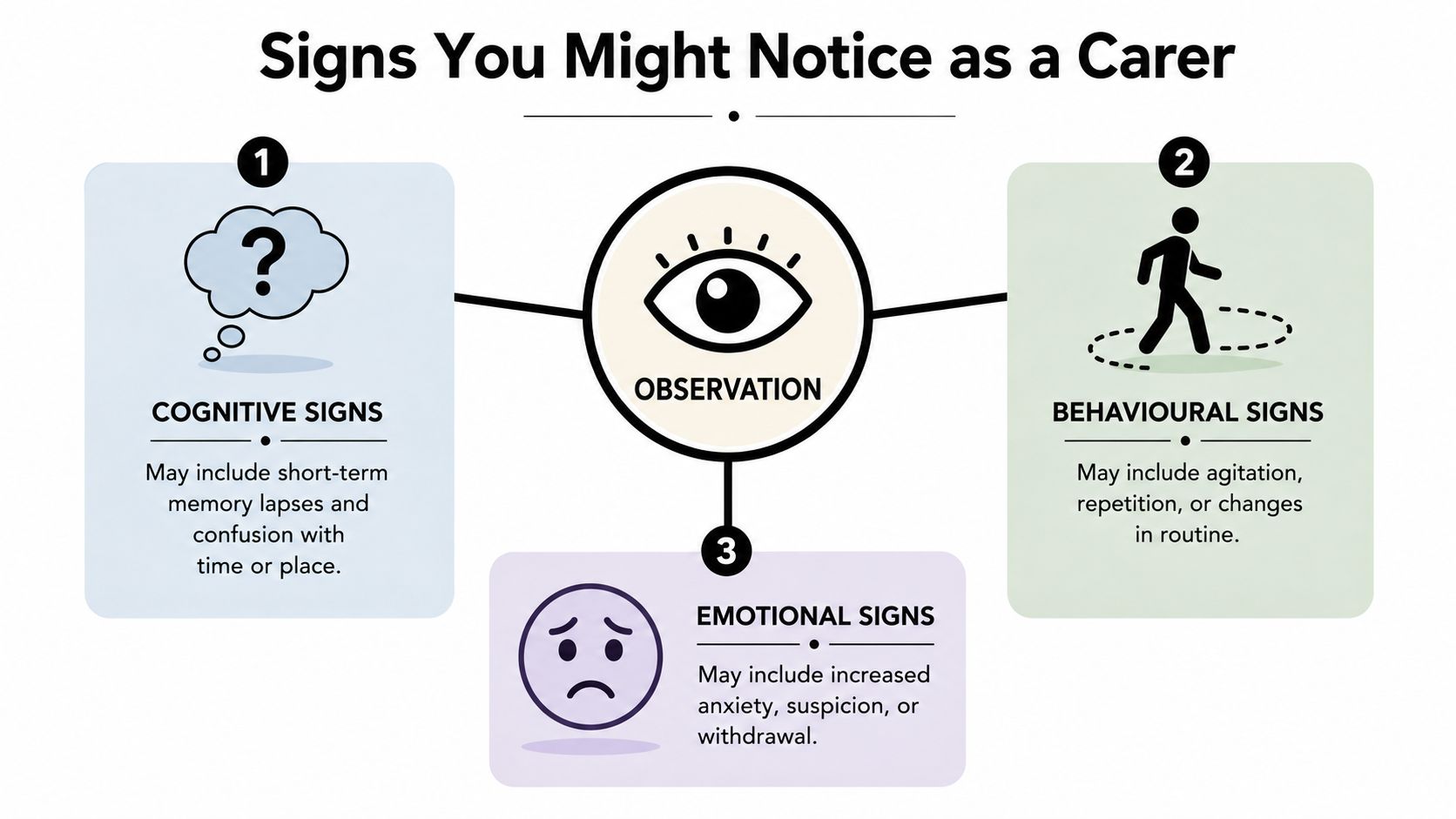
Cognitive changes may include short-term memory loss, disorientation, difficulty finding words, or trouble completing tasks in the right order. A resident might put on a winter coat at lunchtime, forget where the dining room is, or become unable to follow the steps involved in making a cup of tea. These observations are more useful when recorded precisely, including what happened before, during, and after the change.
Behavioural signs often appear as repetition, pacing, hoarding, wandering, refusal of care, or resistance during personal tasks. Someone who repeatedly asks when lunch will be served may be trying to manage uncertainty. Someone who becomes distressed in the bath may be frightened by the temperature, the loss of privacy, unfamiliar equipment, pain, or the sensation of being exposed.
Emotional signs can include anxiety, apathy, sudden tearfulness, suspicion, irritability, or withdrawal. A person who accuses staff of stealing may be experiencing a genuine sense of threat, even when the accusation is not factually accurate. The feeling is real, and your response should take that feeling seriously.
Observe the pattern, not just the incident
Symptoms can fluctuate. Some people find the late afternoon and evening particularly difficult, a pattern often called sundowning. Unfamiliar visitors may see a person who appears capable and settled, while familiar carers notice that dressing, eating, or navigation has become harder.
Write “Mrs Okafor paced for 20 minutes after a noisy visitor left” rather than “Mrs Okafor was unsettled”. The first description gives the team something to investigate and act on. Also report sudden changes, because pain, infection, dehydration, medication effects, constipation, poor sleep, or another health problem can affect behaviour and confusion.
A carer's most important shift in thinking is to treat behaviour as communication. Pacing, shouting, refusing, or withdrawing may express a need that the person can't explain in words. That doesn't remove the need for safety, but it changes the question from “How do I stop this?” to “What might this person be trying to tell me?”
The video below offers another way to think about the signs and responses that arise in dementia care.
Person-Centred Communication and Care
Person-centred care turns awareness into a relationship. It means you don't treat the diagnosis as the whole person, and you don't use a general dementia script when the individual in front of you has a particular history, temperament, routine, and way of communicating.
The VIPS framework offers a practical lens:
- Valuing people, including their dignity, rights, and contribution.
- Individualised care, shaped around personal preferences and abilities.
- Personal perspective, meaning you try to understand the situation from the person's point of view.
- Supportive social psychology, creating an environment that promotes security, belonging, and meaningful engagement.
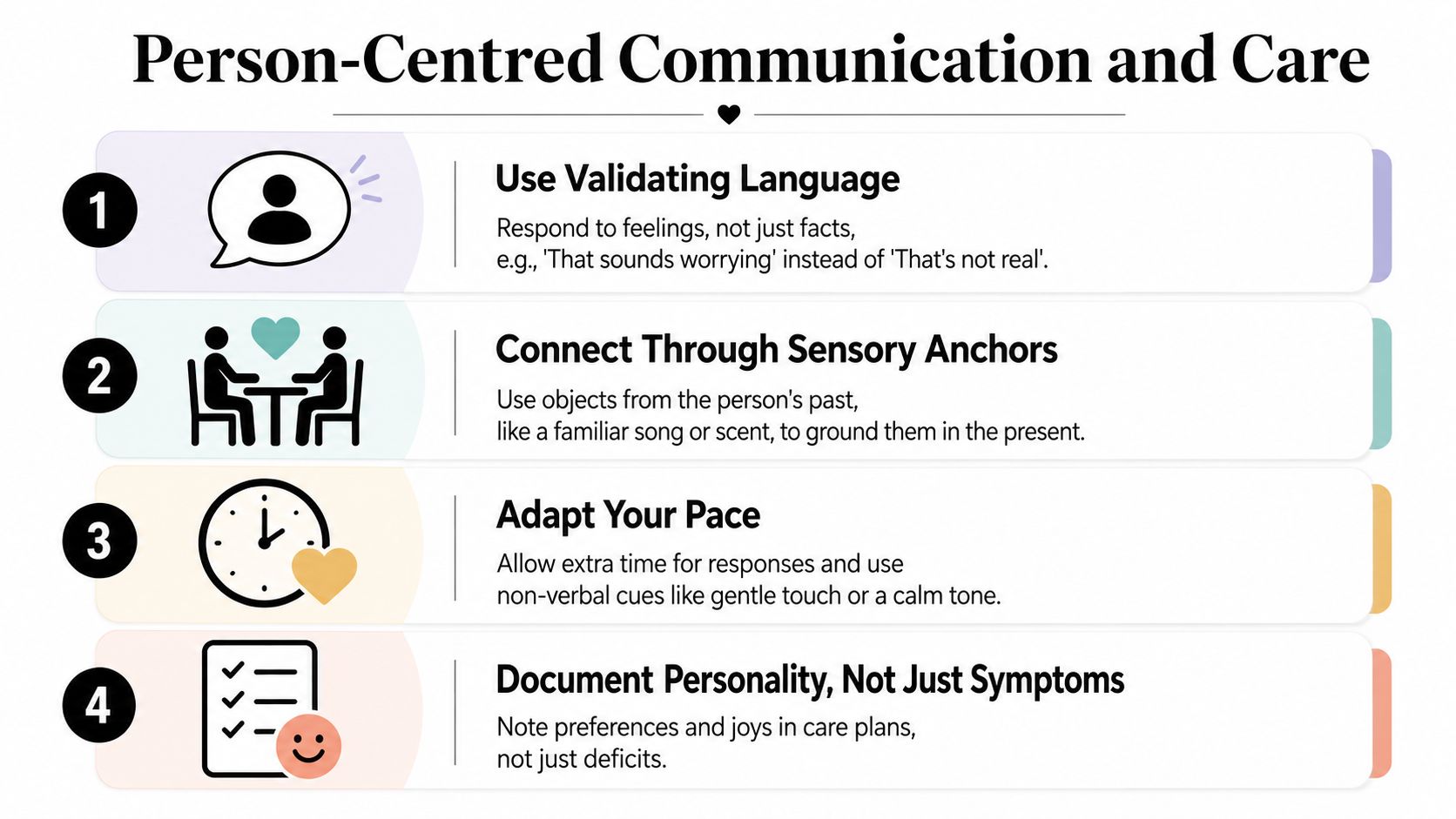
Start with the interaction itself. Approach from the front, use eye contact without forcing it, speak at a measured pace, and ask one question at a time. Reduce background noise where possible. Give the person time to respond, and watch facial expression, posture, gesture, and movement for information that words may not provide.
Respond to feelings before correcting facts
If someone says, “I need to go home to my mother,” correcting the date or explaining that their mother died may increase distress. Try, “You're missing your mother. You sound worried,” then offer reassurance or a familiar activity. Validation doesn't mean agreeing with an inaccurate detail. It means acknowledging the emotion behind it.
Useful changes on a shift include:
- Use a calm tone and short sentences.
- Offer two simple choices rather than an open-ended demand.
- Pause before repeating yourself.
- Move to a quieter space when the environment is overwhelming.
- Record what helped, not only what went wrong.
Life-story templates can capture family relationships, work, music, food, routines, faith, and meaningful places. Consistent staffing can reduce the number of unfamiliar interactions. Activities should match retained abilities, such as folding towels, sorting objects, listening to familiar music, or taking a supported walk.
For more practical examples of language, pacing, and non-verbal communication, use Cura Academy's dementia communication techniques guide. Choose two behaviours you can change tomorrow: slow down your questions, and document the person's preferences alongside their support needs.
Capacity, Consent, and Safeguarding
Dementia awareness also protects a person's rights. A diagnosis does not automatically mean someone lacks capacity, and a carer must not treat confusion as permission to make every decision for them.
The Mental Capacity Act 2005 provides a clear foundation. In everyday terms, presume capacity, support the person to decide, remember that an unwise decision isn't automatically evidence of incapacity, make a best-interests decision only when the person cannot decide, and choose the least restrictive option.
| Principle | What it means in practice |
|---|---|
| Presume capacity | Start by assuming the person can decide unless there is evidence otherwise. |
| Support decision-making | Use accessible language, visual prompts, timing, and a familiar setting. |
| Respect unwise decisions | A choice that seems risky or unusual does not by itself prove incapacity. |
| Act in best interests | If the person cannot make the decision, follow the legal process and involve the right people. |
| Use the least restriction | Don't impose more control than the situation requires. |
Consent for a shower, meal, dressing choice, or conversation should be sought in a way the person can understand. If the person refuses, pause and consider whether the timing, approach, pain, fear, or environment is affecting the response. A formal capacity assessment may be needed for a specific decision, not as a blanket judgement about the person.
Lasting powers of attorney and other representatives have defined roles. They don't erase the person's rights or give staff permission to bypass the Mental Capacity Act. Restrictions that amount to a deprivation of liberty require the correct legal safeguards, including the current arrangements and any applicable transition to the Liberty Protection Safeguards system.
Safeguarding concerns include unexplained injuries, sudden weight loss, withdrawal, neglect, poor care, financial concerns, or restrictions that go beyond a proportionate safety response. Record facts, preserve relevant information, and report through your organisation's safeguarding procedure. For a practical explanation of decision-specific assessment, see Cura Academy's guide to assessing mental capacity.
Why Awareness Alone Is Not Enough
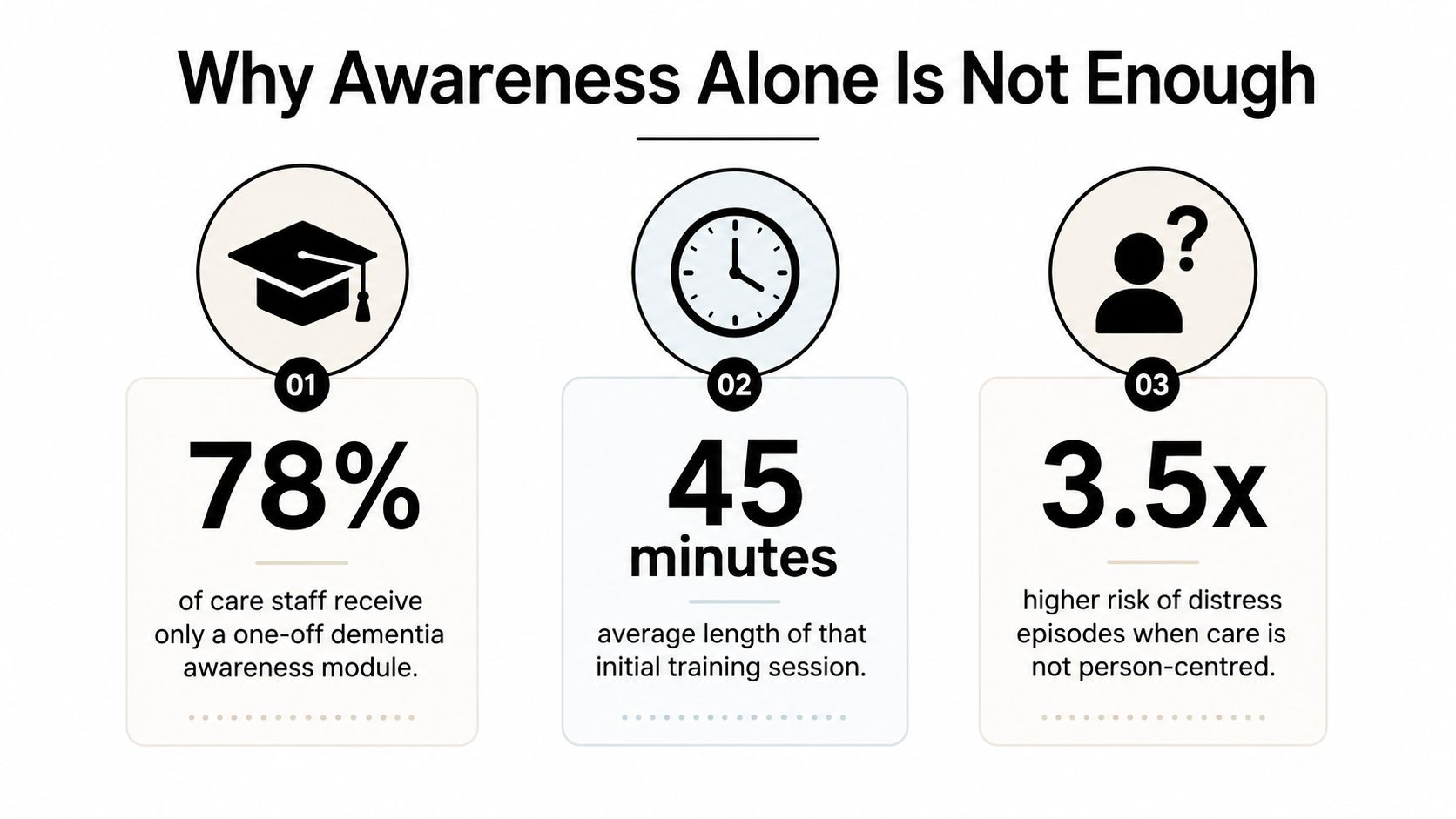
A worker may pass a short awareness module and still struggle to respond when a person refuses personal care, becomes distressed in a noisy dining room, or changes suddenly overnight. Knowing facts is different from performing safely under pressure.
The workforce gap makes that distinction urgent. A 2026 report on England's social care sector found that only 55% of care staff reported receiving dementia-specific training, fewer than half received dementia training at induction, and only 39% of training packages were designed for staff who regularly work with people living with dementia, according to Dementia Researcher's report on the training gap. The same report identified basic provision and inconsistent knowledge as continuing problems.
Measure the three parts of readiness
A useful workforce model is:
- Knowing: Can the worker explain dementia, recognise common changes, and identify possible risks?
- Doing: Can they communicate, support choice, notice triggers, document observations, and escalate concerns?
- Reflecting: Can they review what happened, consider the person's perspective, and change their approach?
A certificate may show that learning was completed. It doesn't necessarily show that the worker can apply it consistently in a real room with competing demands. Managers should connect training with supervision, observed practice, handover quality, care-plan reviews, and reflective accounts.
Awareness is the entry point. Safe care depends on what the worker can recognise, explain, demonstrate, and improve.
This is why the Dementia Training Standards Framework separates broad awareness from the higher-level knowledge and skills required in direct and specialist care. A one-off activity can introduce the subject. Competency needs reinforcement, feedback, and evidence.
How Structured Training Builds Real Competency
A strong learning pathway follows the worker's responsibilities. It doesn't give every employee the same material and assume that a shared certificate means shared capability.
Start with the foundation
The Care Certificate, including Standard 13 on health and safety, helps new care workers understand their responsibilities, risk awareness, communication, and safe practice. At this stage, the learner should be able to recognise a change, support a person respectfully, follow the care plan, and report concerns.
The Dementia Training Standards Framework then adds dementia-specific depth. Tier 1 establishes baseline awareness for all staff. Tier 2 is more appropriate for workers who provide regular direct support, because they need practical skills in communication, person-centred care, recognising distress, promoting autonomy, and responding to risk. Tier 3 supports people who lead, advise, teach, or influence dementia practice across a service.
Cura Academy's dementia learning sits within a broader route for care workers completing essential training and Care Certificate-related learning. Its core skills training framework can help learners organise training around the skills expected in frontline roles.
| Training pathway | Audience | Core topics | Assessment method |
|---|---|---|---|
| Care Certificate | New care workers and support workers | Fundamental care responsibilities, communication, safety, and person-centred practice | Knowledge checks, workplace evidence, and assessor review |
| Dementia Training Standards Framework Tier 1 | All health and social care staff | Dementia awareness, recognition, communication, and respectful support | Learning completion and basic knowledge evidence |
| Dementia Training Standards Framework Tier 2 | Staff providing regular direct care | Practical communication, responsive support, risk reduction, and care planning | Knowledge assessment plus observed workplace practice |
| Dementia Training Standards Framework Tier 3 | Leads, specialists, educators, and advisers | Practice leadership, supervision, improvement, and teaching | Reflective evidence, observation, and leadership outcomes |
Show the skill in action
A learner's progress should be visible. Early practice might involve recognising that a person needs extra time to swallow safely and reporting the concern. More advanced practice might involve adapting the environment, reviewing the care plan with colleagues, and leading a reflective debrief after distress occurs.
Managers can ask the worker to explain why they chose a particular approach, demonstrate it during an observed interaction, and record what they would change next time. Assessment should test judgement, not just recall.
A practical training record combines completed learning with observation, feedback, supervision notes, and reflective accounts. That evidence gives the worker a clearer development path and gives the provider a more reliable view of readiness.
Turning Awareness into Everyday Action
Dementia awareness becomes useful when it appears in ordinary routines, not only in formal training sessions. A new carer can begin with a short pre-shift check.
A checklist for carers
- Read the handover: Note changes in mood, sleep, eating, continence, mobility, communication, and routines.
- Check the environment: Reduce avoidable noise, improve orientation cues, and remove hazards without unnecessarily restricting movement.
- Follow the person's pace: Introduce yourself, explain each step, offer choices, and pause when the person appears uncertain.
- Look for meaning: Treat repetition, pacing, refusal, and withdrawal as observations requiring curiosity.
- Record clearly: Write what you saw, what happened beforehand, what you tried, and how the person responded.
- Escalate changes: Report sudden confusion, possible pain, injury, poor intake, medication concerns, or safeguarding issues through local procedures.
Managers need a parallel process. Review whether induction includes dementia-specific learning, check that staff can demonstrate communication skills, and use supervision to examine difficult incidents without blame. Training should connect to care-plan audits and observed practice, not sit separately in an online completion report.
Families can support the same approach at home by sharing the person's routines, preferred words, meaningful objects, and known triggers. They should also seek professional advice when memory or behaviour changes affect everyday life rather than waiting for a crisis.
The prevention message needs balance. Alzheimer's Research UK explains that up to 45% of dementia cases globally could be prevented or delayed through modifiable factors, but risk reduction isn't a promise that an individual will avoid dementia. UK public understanding remains uneven, with 39% of adults believing dementia risk can be reduced, while only 30% recalled seeing information about how to reduce risk, as reported in the same source. Earlier recognition and diagnosis can help people and families connect with support, plan care, and make informed decisions.
For accessible, structured dementia learning alongside wider care training, visit Cura Academy. Its Dementia Awareness course and broader training pathways help care workers build knowledge that can be connected to induction, compliance, and job-ready practice.