

You arrive at a residential home before the morning rush, training certificates ready on your phone, while the manager checks what you're cleared to do. The shift may involve moving a resident safely, responding to an emergency, protecting confidential information, recognising safeguarding concerns, and following infection-control procedures. Your employer needs more than reassurance that you've completed “some care training”. They need current, usable evidence that your knowledge and skills match the work in front of you.
That's where the Core Skills Training Framework, or CSTF, becomes practical. It gives workers, agencies, care providers, and health-sector employers a shared reference point for core statutory and mandatory training. Used properly, it can help you move between settings with less duplicated learning, keep refreshers visible, and show that you're ready for shifts without treating compliance as a box-ticking exercise.
Table of Contents
- Why the Core Skills Training Framework Matters on Your First Shift
- What the Core Skills Training Framework Actually Is
- Core Subjects and Refresher Intervals You Need to Know
- Core Skills Training Framework vs Care Certificate
- How Cura Academy Courses Map to the Framework
- What UK Care Employers Expect From Your Compliance Evidence
- The Real Compliance Gap in UK Adult Social Care
- Your Practical Next Steps for CSTF Readiness
Why the Core Skills Training Framework Matters on Your First Shift
A first agency shift often exposes the difference between having training and being able to prove it. Reception may ask for your identity documents, DBS information, references, and training record before a registered manager or shift lead confirms where you can work. If your certificates are undated, scattered across emails, or missing the next refresher date, the problem isn't necessarily that you lack experience. The problem is that nobody can verify your readiness quickly.
The CSTF helps create a common language for that conversation. A care home manager can look for evidence linked to familiar areas such as safeguarding, moving and handling, infection prevention and control, fire safety, information governance, and resuscitation. An agency can use the same broad reference point when placing you with a residential provider, domiciliary service, or NHS-linked setting, although the employer still decides what the role and local risks require.
What portability means in practice
Portable evidence doesn't mean every employer must accept every certificate without checking it. Your new provider can still review the course content, delivery method, assessment, practical elements, and expiry arrangements. It does mean that a clearly mapped record gives the employer something meaningful to assess instead of forcing you to repeat familiar introductory modules because your previous provider used different labels.
That matters when shifts are offered at short notice. You want your training record to answer four questions:
- What did you complete? The certificate should identify the subject or course clearly.
- When did you complete it? The issue date lets the employer judge whether the evidence remains current.
- What comes next? A refresher or competence-assessment date prevents avoidable gaps.
- Can the training be matched to the role? The course should show enough detail for the employer to compare it with local requirements.
Practical rule: Treat every certificate as part of your shift-readiness portfolio, not as a file you only open when an agency asks for it.
The framework matters because compliance follows you through your working life. When your evidence is organised and current, you can spend the first shift learning the service, the residents, and the local procedures, rather than trying to explain missing paperwork at the front desk.
What the Core Skills Training Framework Actually Is
In plain English, the Core Skills Training Framework is a shared national reference for common statutory and mandatory training in the UK health sector. Skills for Health first developed it in 2013, and it's now recognised as a national minimum standard for statutory and mandatory training in the health sector. Skills for Health states that the framework can be used by any UK healthcare employer, including NHS, independent, and voluntary providers. The CSTF subject guide sets out the framework's structure and subjects.
The framework exists because organisations used to describe and manage common training in different ways. A worker moving from one employer to another could face repeated learning, inconsistent outcomes, and uncertainty about whether an old certificate covered the same subject. The CSTF provides a mapped baseline, including learning outcomes, the basis in legislation or policy, the intended audience, refresher expectations or competence assessment, and delivery standards. Skills for Health's CSTF overview explains how those elements support a more consistent approach.
Framework, course, and qualification are different things
The CSTF isn't a single course, award, or personal licence. It's the structure that tells employers what core training should address and how they can organise it. A training provider then creates courses, assessments, certificates, and learning pathways that map to those requirements.
That distinction prevents a common misunderstanding. A certificate can show that you completed a particular learning activity, but the certificate alone doesn't remove your employer's responsibility to decide whether you're competent for a specific role. A care home may require additional local induction, supervised practice, or service-specific training before you work independently.
Why the framework is useful to care workers
The CSTF was designed for the health sector, but its shared subjects are highly relevant to many care environments. A domiciliary care worker, residential care assistant, agency support worker, and NHS-linked healthcare assistant may work in different settings, yet all need reliable foundations in safety, safeguarding, infection control, emergency response, and professional conduct.
Skills for Care also states that adult social care statutory and mandatory training should be based on a review of legislation, guidelines, statutory guidance, standards, and recommendations, rather than selected solely because a course appears on a generic list. Its guidance on statutory and mandatory training supports a risk-led approach. The CSTF gives you a recognisable baseline. Your employer then adds the role-specific and service-specific evidence needed for safe practice.
Core Subjects and Refresher Intervals You Need to Know
The CSTF is built around 11 core subjects for England, covering the areas that underpin safe work across health and care settings. The exact requirement for your role depends on the employer, service, and risk profile, so use the list as a planning tool rather than assuming every worker needs identical training in identical formats.
Some subject guides use a three-year refresher period, including examples for all staff and voluntary staff. Other topics may require more frequent learning, practical assessment, or local review. The interval isn't a universal promise that a certificate will be accepted everywhere. It's part of the evidence employers use when deciding whether your training remains current.
| CSTF Subject | Typical Refresher Interval |
|---|---|
| Conflict resolution | Follow the employer's mapped CSTF interval and competence requirements |
| Equality, diversity and human rights | Follow the employer's mapped CSTF interval |
| Fire safety | Follow the employer's local safety and refresher requirements |
| Health, safety and welfare | Follow the employer's mapped CSTF interval |
| Infection prevention and control | Follow the employer's mapped CSTF interval and local risk requirements |
| Information governance and data security | Follow the employer's mapped CSTF interval |
| Moving and handling | Follow the employer's practical assessment and refresher requirements |
| Preventing radicalisation | Follow the employer's mapped CSTF interval |
| Resuscitation | Follow the employer's practical competence and refresher requirements |
| Safeguarding adults | Follow the employer's mapped CSTF interval and role level |
| Safeguarding children | Follow the employer's mapped CSTF interval and role level |
The framework's documentation defines learning outcomes and refresher intervals, with several subjects using a three-year cycle. The Skills for Health framework documentation also shows why employers need to look beyond a course title. They should check whether the content, audience, learning outcomes, delivery standards, and assessment arrangements match the mapped requirement.
How to interpret the subject list
Moving and handling is a useful example of why “completed” and “competent” aren't interchangeable. An online module may introduce principles, risks, and safe decision-making, while the employer may still require practical observation with equipment used in that service.
Resuscitation also needs careful checking. Your evidence should make clear what was taught and assessed, particularly where the role requires practical performance. The same principle applies to infection prevention and control, where general knowledge may need to be reinforced through local procedures, equipment, and supervision.
Safeguarding subjects require a different kind of judgement. The course gives you a foundation for recognising concerns, recording information, and escalating appropriately, but the employer's safeguarding pathway and your role level still matter. Information governance works similarly. A certificate can evidence core learning, while local systems determine how you access, record, share, and protect information.
Build a refresher calendar
Create a training matrix with the subject, certificate date, mapped interval, next review date, practical assessment status, and employer-specific requirements. You can also use a plain-language guide to mandatory training requirements when you're checking how broader statutory and mandatory learning fits around the CSTF.
A useful matrix doesn't just show green or red status. It tells you what action is needed, who must verify it, and whether the evidence demonstrates knowledge, practical skill, or both. That's how a list of modules becomes a working compliance system.
Core Skills Training Framework vs Care Certificate
New care workers often hear CSTF and Care Certificate in the same induction conversation, then assume they're two names for the same programme. They're connected, but they serve different purposes and career stages.
The Care Certificate is an employer-led induction framework for new workers in adult social care. It's built around 15 minimum standards and is commonly used to structure early learning, workplace observation, and evidence during a new worker's first 12 weeks. The CSTF is a wider statutory and mandatory training framework used across health and care contexts, with an emphasis on recurring core subjects and refreshers.
| Dimension | Care Certificate | Core Skills Training Framework |
|---|---|---|
| Main purpose | Structured induction for new adult social care workers | Shared benchmark for core statutory and mandatory training |
| Typical audience | New workers entering adult social care | Health and care staff across NHS, independent, and voluntary settings |
| Evidence | Employer-led learning, assessment, and workplace competence | Course, refresher, and competence evidence mapped to CSTF subjects |
| Timing | Most relevant during early employment and induction | Ongoing throughout employment, with subject-specific review cycles |
| Coverage | 15 minimum standards | 11 core subjects for England |
| Employer role | Must assess how the worker applies the standards | Must confirm role, service, risk, and local competence requirements |
Where the two pathways overlap
Safeguarding, infection prevention, health and safety, communication, equality, and handling-related learning may appear in both a Care Certificate pathway and CSTF-aligned mandatory training. Completion in one pathway can support evidence for the other, but it shouldn't be assumed to provide automatic full equivalence. The employer needs to compare learning outcomes and workplace assessment requirements.
The simplest way to remember the difference is this: the Care Certificate helps demonstrate that a new adult social care worker has completed a structured induction, while the CSTF helps employers organise and refresh core statutory and mandatory subjects over time.
That distinction matters when you change jobs. A Care Certificate record may show how you developed during induction with one employer. CSTF-aligned certificates can help you demonstrate current core learning to another provider, but the new employer can still require local induction, supervised practice, or additional subjects.
For a clearer explanation of the induction pathway, see the Care Certificate guide. Keep both records where they apply. One supports your entry into care, and the other helps maintain evidence that your core knowledge and skills remain current.
How Cura Academy Courses Map to the Framework
A practical training plan starts with the subject your employer needs, not with a random catalogue of courses. Cura Academy provides a Core Skills Training category and course pathways that correspond with common CSTF areas, allowing a learner to organise training around recognisable subjects rather than collecting unrelated certificates.
Start by matching the requirement to the course title and content. For example, a worker preparing for residential or agency shifts might review pathways covering:
- Resuscitation and Basic Life Support: Check whether the learning and assessment format meets the employer's practical requirements. Where hands-on assessment is required, an online certificate may need to be supplemented by face-to-face verification.
- Moving and Handling: Use the course to develop safe principles and decision-making, then confirm whether the employer requires practical observation with the equipment used in its service.
- Infection Prevention and Control: Match the learning to the provider's procedures, including hand hygiene, personal protective equipment, waste handling, and escalation expectations.
- Safeguarding Adults: Look for learning outcomes covering recognition, recording, reporting, boundaries, and escalation. Your employer may also assign a safeguarding level based on your role.
- Health and Safety: Connect the course to workplace hazards, incident reporting, risk assessment, and personal welfare.
- Information Governance: Confirm that the course covers confidentiality, secure information handling, appropriate sharing, and data security.
- Equality, Diversity and Human Rights: Use the learning to support respectful, person-centred practice and identify how rights and reasonable adjustments affect daily care.
Turn the list into one enrolment plan
A combined bundle can reduce the administrative friction of booking separate subjects, especially when you're preparing for an agency compliance check. It still needs careful review. A bundle is useful only when each course maps to the required learning outcomes and the employer accepts the delivery and assessment method.
Renewal planning should sit beside course selection. The CSTF uses subject-specific expectations, and several subjects use a three-year refresher period, as shown in the Skills for Health framework materials. The subject guide should be your reference when you're checking the mapped requirement, rather than relying on a provider's course name alone.
When Care Certificate evidence is also needed
If you're new to adult social care, choose a pathway that supports both mandatory subjects and Care Certificate learning outcomes. Some learning can contribute useful evidence across the two frameworks, but workplace competence still needs to be assessed by the employer.
Cura Academy is one option that offers access to health and social care courses, including core skills and mandatory training pathways. Use it as part of a wider compliance plan, and ask the employer to confirm exactly which evidence it accepts before you book a course.
What UK Care Employers Expect From Your Compliance Evidence
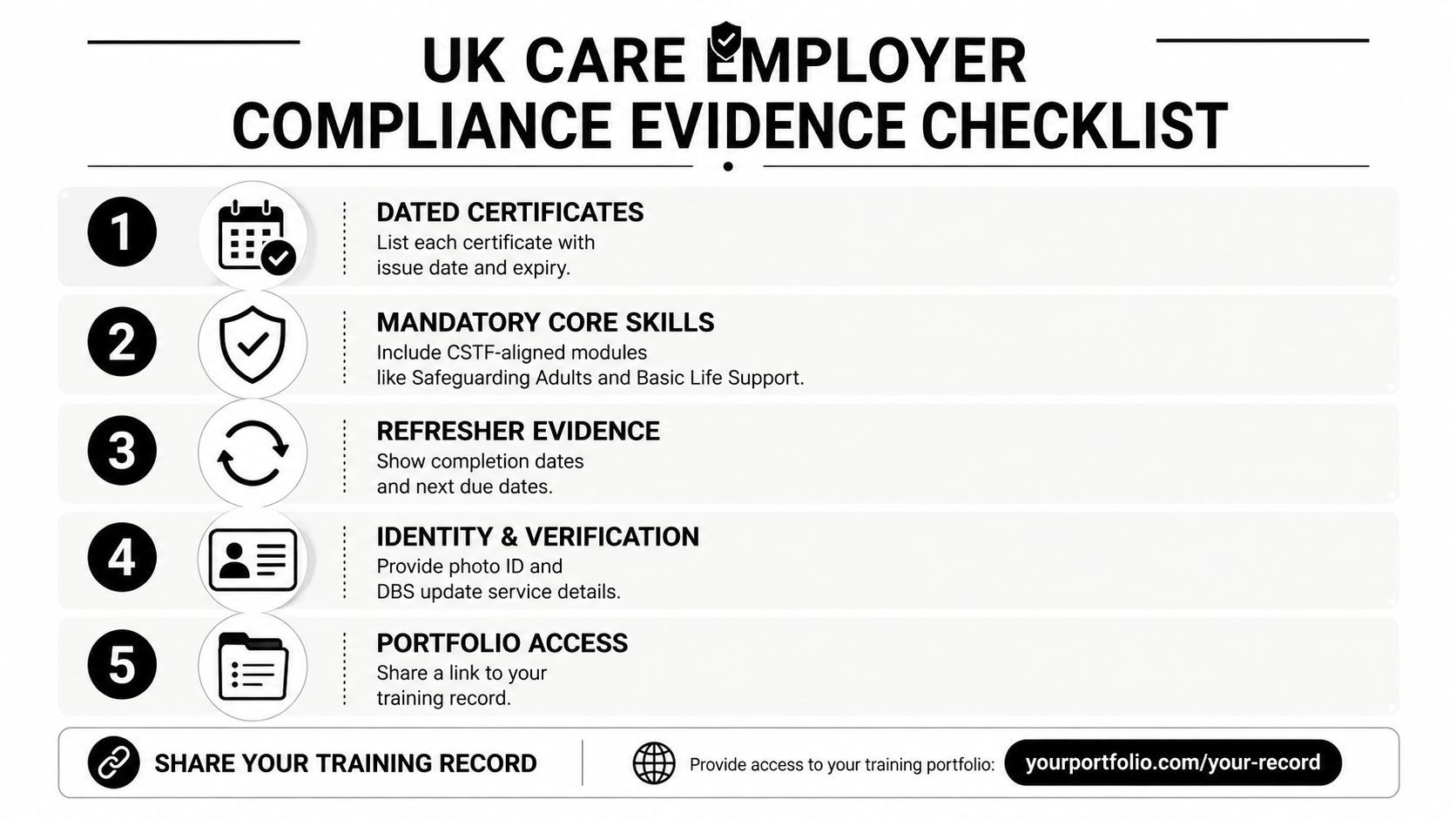
A manager deciding whether you can start a shift needs a record that is quick to check and clear enough to defend during an audit. The exact pack varies by employer, but agencies and care providers commonly ask for dated training certificates alongside identity and background checks, references, and evidence that role-relevant refreshers remain current.
Your training record should be portable, but portable doesn't mean informal. A screenshot with no course title, issue date, provider information, or assessment detail may not give a manager enough confidence. Store certificates in a named folder, keep the original files, and maintain a simple matrix showing the next review or refresher date.
Build an evidence pack a manager can use
A strong pack normally makes these details easy to find:
- Dated certificates: Show the course name, completion date, learner identity, and provider details.
- Subject mapping: Identify the CSTF subject covered, rather than relying on a vague label such as “care compliance”.
- Refresher information: Record the next due date or the interval used by the employer.
- Identity and background evidence: Keep your photo identification, DBS information, references, and other onboarding documents organised separately from training certificates.
- Practical competence records: Include observed assessments or employer sign-off where the subject involves hands-on performance.
The Health and Social Care Act 2008 regulated activities regulations require providers to organise suitable support, training, and development for staff. A CSTF-aligned record can support that governance process, but it doesn't replace the provider's own assessment of role competence, supervision, and local risks.
Why agencies care about clean records
Agency workers move between services with different residents, equipment, procedures, and reporting routes. A clear portfolio helps the agency identify what can transfer and what needs repeating or adding. It also lets a registered manager distinguish a current refresher from a one-off induction completed years earlier.
Use a training matrix template to track certificates and renewal dates. The aim isn't to create paperwork for its own sake. It's to give the person approving your shift a reliable audit trail and to give you an honest view of where your competence evidence needs strengthening.
The Real Compliance Gap in UK Adult Social Care
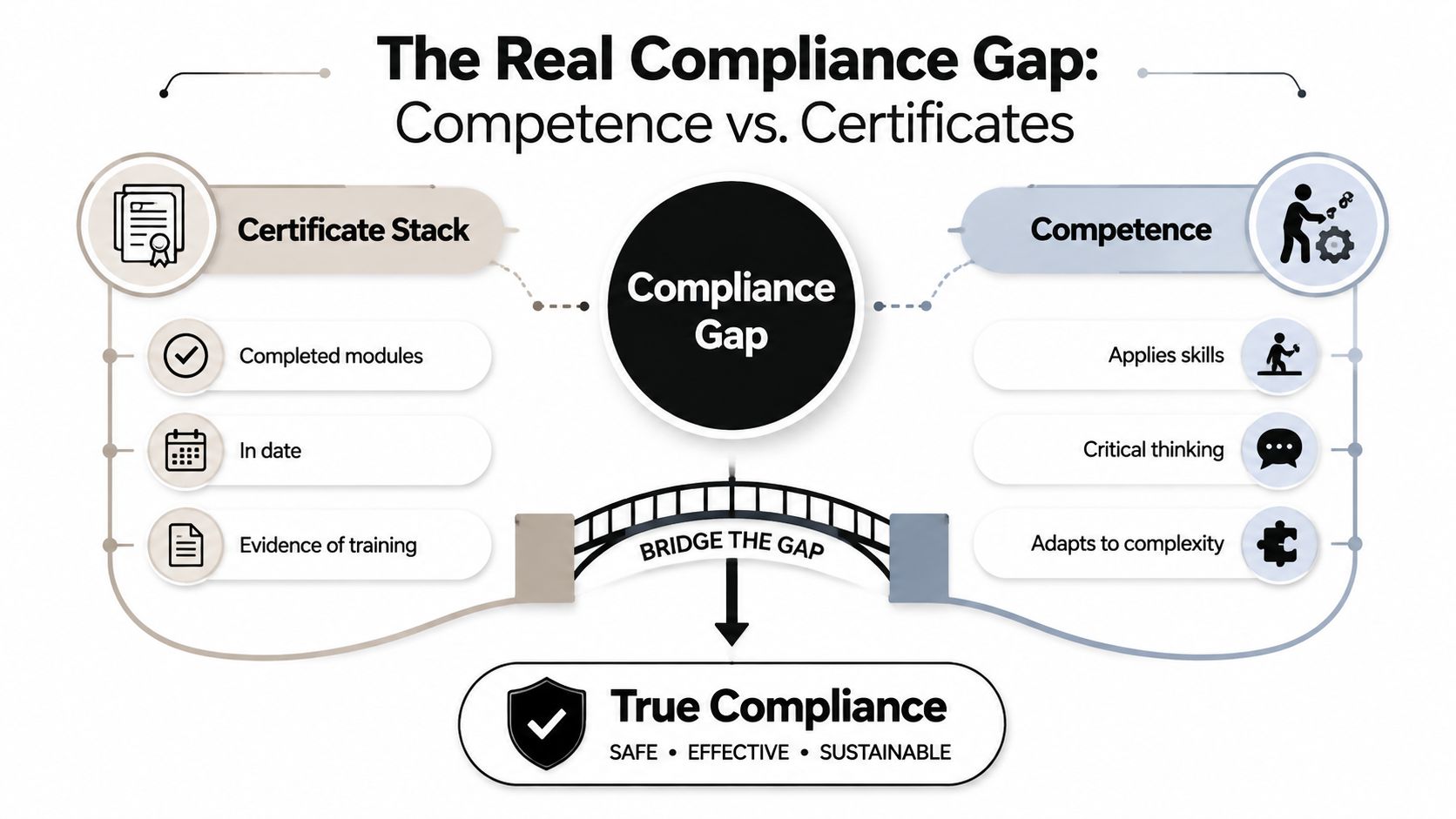
A full training matrix can still conceal a competence gap. A worker may have a folder of completed modules, yet struggle to explain how they'd escalate a safeguarding concern, protect confidential information during a busy handover, or adapt moving and handling practice to a resident's changing condition.
Skills for Care's evidence points to pressure beyond course content. Its 2025 state-of-the-sector report highlights continuing workforce strain and digital-skill needs across adult social care. Its workforce skills report projects that from 2025 to 2030, just over 40,000 registered workers across adult day care, care homes, care at home, and housing support services will need to meet a qualification condition, while recent average provision means around 20,000 people will be able to start the required award over that period. The 2025 Skills for Care report presents this as a progression and compliance bottleneck, not merely a shortage of online modules.
The lesson is uncomfortable but useful. More certificates don't automatically equal stronger compliance.
Three markers of credible competence
- Current evidence: Certificates show completion dates and remain aligned with the relevant CSTF interval or employer requirement.
- Observable application: A supervisor can see you apply the skill safely, communicate your reasoning, and follow the service's procedure.
- Progression evidence: Your record shows movement beyond entry-level induction into role-relevant learning, supervision, and qualifications.
A practical audit should test all three. Ask a worker to explain what they would do, demonstrate where appropriate, and identify the local policy or escalation route. Then check whether the record supports that discussion.
The Department of Health and Social Care's 2026 procurement plan for a national workforce development framework and curriculum also points towards a system-design response. The focus includes consistency in skills, supervision models, career progression, and continuing professional development. For care leaders, that means auditing the depth of evidence, not counting completed modules. For workers, it means treating each refresher as an opportunity to confirm usable competence and plan the next stage of development.
Your Practical Next Steps for CSTF Readiness
You can make your training record shift-ready within one working week if you work in a fixed order. Don't start by booking every course you can find. First establish what you already have, what has expired, and what the employer requires for the role.
A five-day readiness plan
Day one, audit your certificates. Create a list of every core subject, certificate date, provider, delivery format, assessment method, and next review date. Compare the entries with the relevant CSTF subject guide and your agency or employer matrix.
Day two, identify gaps. Mark expired certificates, missing subjects, unclear course titles, and evidence that doesn't demonstrate practical assessment where one is expected. Ask the agency or registered manager to confirm any uncertainty before you pay for replacement training.
Day three, schedule priority refreshers. Book the topics that affect immediate shift access and resident safety, such as moving and handling, resuscitation, safeguarding, infection prevention, and information governance. Follow the employer's required interval rather than assuming every topic renews on the same schedule.
Day four, upload and organise evidence. Save certificates using a consistent file name, place them in a portable training folder, and update your matrix. Keep a backup and make sure the agency can access the version it uses for compliance checks.
Day five, verify readiness. Ask the employer to confirm which documents are accepted, whether local induction remains outstanding, and whether any practical assessment must be completed before independent work.
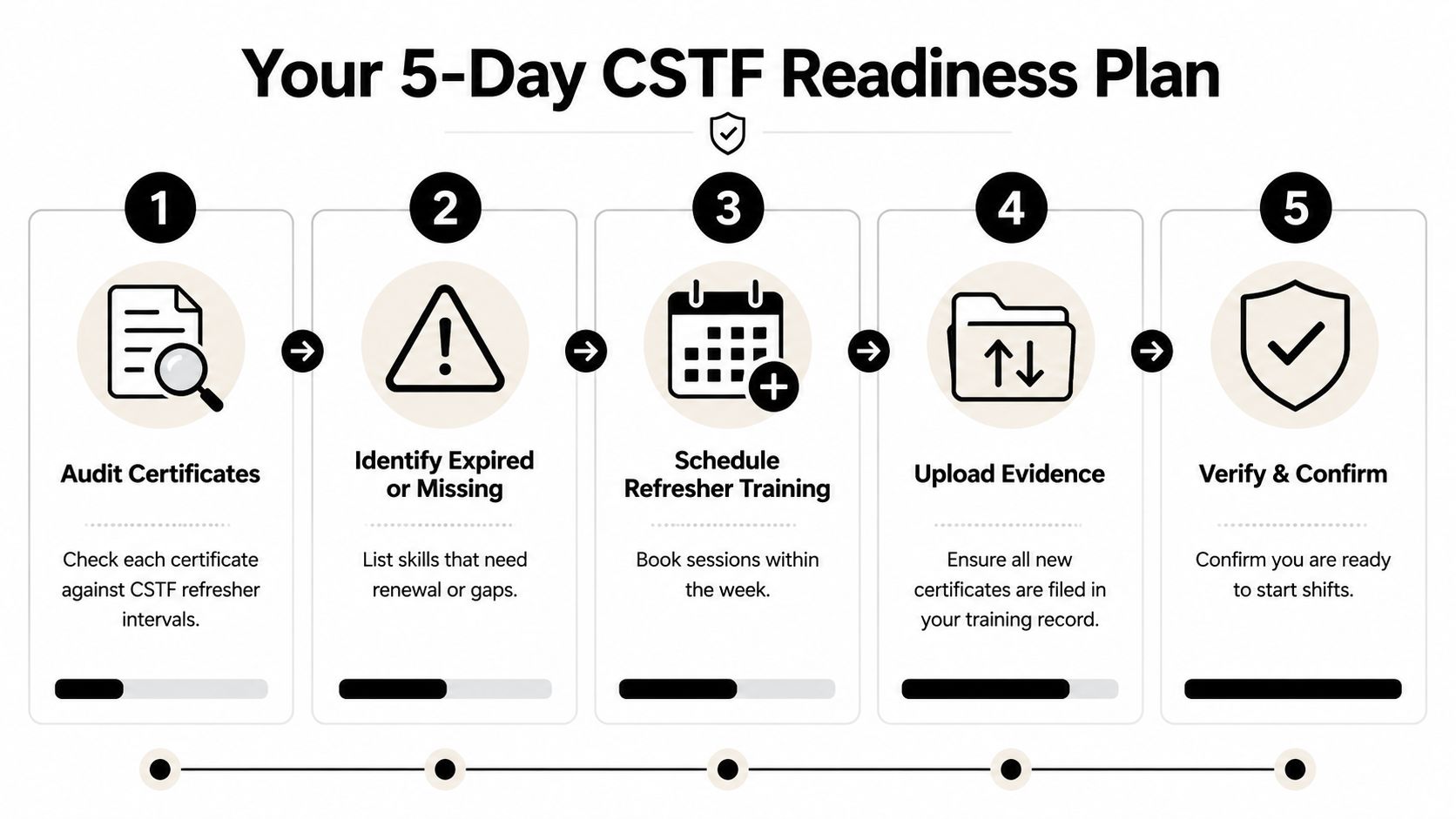
Finish by adding calendar reminders for each refresher and reviewing your record before accepting new settings. A current certificate may open the compliance conversation, but credible competence is what helps you start safely, work confidently, and keep agency opportunities available.
Cura Academy offers health and social care learning pathways, including Core Skills Training and mandatory refresher courses, so you can organise evidence around the subjects UK employers commonly check. Visit Cura Academy to review the available courses and build a clearer route from CSTF training records to shift-ready compliance.