
A registered manager opens the safeguarding folder before a staff meeting and finds a policy with a recent review date, a list of abuse types and a sentence telling workers to report concerns to the manager. Then someone asks what happens on a night shift, who contacts the local authority, and how the team checks what happened after a referral. Nobody can point to a clear answer. That's the difference between a policy that exists and safeguarding policies and procedures that work.
Inspectors need to see how staff recognise, report and respond to concerns, and how managers learn from the outcome. A reliable system gives every step an owner, a route and a record. The test is not whether the policy is filed or signed. It's whether staff can follow it when a concern is uncertain, urgent or raised outside office hours.
Table of Contents
- Core Elements Every Safeguarding Policy Must Include
- Legal and CQC Requirements Behind Each Policy Clause
- Who Does What in Safeguarding Procedures
- How to Report a Safeguarding Concern Step by Step
- Threshold Decisions and Borderline Cases in Care
- Involving Adults Who Cannot Fully Take Part
- Recording, Feedback and Confirming the Concern Was Handled
- Audit Your Policy Against the Inspection Checklist
Core Elements Every Safeguarding Policy Must Include
| Element | What it must state | Evidence an inspector looks for |
|---|---|---|
| Scope and purpose | Who the policy covers, including service users, staff, volunteers, agency and bank workers, and the settings it applies to | Signed copies in each service and read-and-understood records |
| Definitions of abuse | Types of abuse and neglect, including self-neglect, financial, discriminatory, institutional and modern slavery | Staff can give local examples when asked in supervision |
| Zero-tolerance statement | Board-level commitment to zero tolerance of abuse, unlawful discrimination and unlawful restraint | Board or governance minutes that record the commitment |
| Named safeguarding lead and deputy | Who holds the role, deputy cover arrangements and hours of availability | Rota showing deputy cover and a current contact sheet |
| Recognising and recording | Indicators of harm and how to record facts, dates and the person's own words without interpretation | Sample incident records that separate fact from opinion |
| Reporting and escalation | Internal reporting timescale, the escalation route, and when to refer externally | Audit of referral timeliness against the policy |
| Local referral contacts | Local authority adult and children safeguarding contacts, the out-of-hours route, and the named Safeguarding Adults Board or Children Partnership pathway | Contact details with a dated review |
| Whistleblowing route | How staff raise concerns that involve a manager or the organisation | Whistleblowing policy linked from the safeguarding policy |
| Training and induction | Role-based safeguarding training at induction and at set refresh intervals | Training completion matrix with expiry dates |
| Review and learning | Review date, audit cycle and how learning from incidents changes practice | Dated audit actions with named owners |
A policy is a set of decisions staff can act on, not a template to fill in and file. The table should read like a working map: who is responsible, what they do, where they find help and how the service proves the process happened. A statement such as “report concerns to the manager” is incomplete if it doesn't say what to do when that person is unavailable.
That gap becomes clear on a night shift. If the policy names a manager but no deputy or out-of-hours contact, a worker may have no obvious person to call. Name the deputy, set out when they provide cover, and include a current contact route. A rota and contact sheet help show that the arrangements exist beyond the written policy.
Definitions also need to help staff recognise what they see. A worker may not use the term “financial abuse” when a relative controls an adult's money, or may not recognise that repeated deprivation of food could be neglect. Use plain descriptions and local examples, then check understanding in supervision rather than relying on a signature alone.
For background on the person-centred principles behind adult safeguarding, see the adult safeguarding principles guide. Then compare each row with your own document. Mark any element that lacks a named owner, a timescale, a date or a contact, and assign someone to close each gap.
Legal and CQC Requirements Behind Each Policy Clause
A worker reports a concern about an adult, but the facts do not yet show whether a formal enquiry is required. The policy must make clear who assesses the concern, what threshold they apply and how they record the decision. Legal titles alone do not answer those questions. The applicable duties depend on the person's age, the decision involved and the nation where the service operates.
In England, adult safeguarding duties sit within the Care Act 2014. During 2023–24, local authorities recorded 615,530 concerns about abuse or neglect. About 176,560 led to formal Section 42 enquiries involving 141,080 individuals, according to the official adult safeguarding statistics for England. A concern and an enquiry are different stages: staff report what they have observed, and the responsible authority considers whether the legal tests for an enquiry are met. The policy should show who makes that initial referral and how the person's desired outcomes are considered.
| Legal source | Applies to | What the policy must reflect |
|---|---|---|
| Care Act 2014, section 42 enquiries | Adults with care and support needs in England | How concerns are assessed against the threshold, referred to the local authority and considered in light of the person's outcomes |
| Children Act 1989 and Working Together to Safeguard Children | Children and young people in England | Referral to children's social care, multi-agency working and appropriate information sharing |
| Mental Capacity Act 2005 | Adults who may lack capacity for a specific decision | The presumption of capacity, how best-interest decisions are made and when advocacy is available |
| Public Interest Disclosure Act 1998 | Workers raising concerns in good faith | A protected route for raising concerns and a clear statement that retaliation is not tolerated |
| CQC Regulation 13 | All registered providers in England | Systems to prevent abuse, clear accountability at board or equivalent level and prompt escalation |
| CQC Regulation 17 | All registered providers in England | How risks are identified, assessed and reduced, with proportionate action and appropriate escalation |
| Social Services and Well-being (Wales) Act 2014 and Care Inspectorate Wales | Registered services in Wales | The Welsh safeguarding board pathway and relevant regulatory expectations |
| Adult Support and Protection (Scotland) Act 2007 and Care Inspectorate | Registered services in Scotland | The Scottish council referral pathway and relevant regulatory expectations |
For children's services in England, referrals and assessments sit within a multi-agency system. The children in need statistics for England provide the official context for this work. A policy should direct staff to the appropriate local children's social care pathway and explain what relevant information to share. Adult safeguarding procedures do not automatically apply to children, so the policy must make the distinction easy to follow.
CQC Regulation 13 concerns preventing and responding to abuse. Regulation 17 tests whether governance arrangements identify risks, prompt action to reduce them and appropriate escalation. A clause that tells staff to report abuse but leaves unclear who checks the response, or whether corrective action has worked, leaves a gap between reporting and outcome. Use the CQC guidance on Regulation 13 safeguarding requirements alongside its governance expectations under Regulation 17. This helps managers check that policy wording connects responsibility to decisions and follow-up.
CQC regulates services in England; Wales and Scotland have separate legislation and regulatory pathways. Use the relevant national framework rather than copying an English policy unchanged. Map each clause to its legal or regulatory duty, then check that the wording identifies the decision-maker, the action required and how completion is confirmed.
Who Does What in Safeguarding Procedures
The board or equivalent holds safeguarding responsibility under Regulation 13. In practice, that responsibility should show up in approved policy, regular review of safeguarding reports and consideration of audit results. If the board only sees a policy at approval and never examines how referrals or incidents are handled, it has little evidence that the system works.
| Role | Core safeguarding duties | Cover and notes |
|---|---|---|
| Board or equivalent | Holds safeguarding responsibility under Regulation 13 and approves the policy | Reviews safeguarding reports and audit results at set intervals |
| Registered manager | Ensures the policy, training, referrals and audits operate in practice | Accountable to CQC; often also acts as safeguarding lead in smaller services |
| Safeguarding lead | Triages concerns, makes referrals, liaises with the local authority, records decisions | Must be named on every shift rota with a deputy |
| Deputy safeguarding lead | Acts in the lead's absence and shares caseload | Trained to the same level; cover hours written into the policy |
| Care staff, including bank and agency workers | Recognise, record and report the same shift; do not investigate | Shown the policy, the lead and the local route at the start of every placement |
| Volunteers and visiting professionals | Report concerns to the lead and follow the code of conduct | Signed acknowledgement before first contact with service users |
| Nominated whistleblowing contact | Receives concerns that involve managers or the organisation | Named outside the normal line management chain |
The safeguarding lead coordinates the response. They assess the information, make or arrange referrals, keep a decision record and follow up with the local authority. Care staff don't investigate suspected abuse themselves. Their job is to protect the person, record what they know and report it promptly.
Cover makes the division of responsibility real. The lead and deputy should appear on every shift rota, and the policy should state when each is available. The deputy needs the training and authority to act, not just a name listed as a backup.
Consider an agency carer working alone at night who sees a colleague handle a resident roughly. The policy should identify the out-of-hours person to call, explain how to record what was observed and state how to escalate the concern if the lead doesn't respond or is involved. It should also point to the whistleblowing route when the concern involves a manager or the organisation.
Every agency and bank worker should be shown where the policy is and who holds the lead role at the start of each placement or shift. A signed acknowledgement is useful, but it doesn't replace a clear handover. The checklist near the end of this guide includes practical checks for these controls.
How to Report a Safeguarding Concern Step by Step
A clear reporting process protects the person first, preserves reliable information and gives the right people a chance to act. The policy should name the person responsible at each step and set the reporting timescale. If someone is in immediate danger, follow emergency procedures first.
- Make the person safe. If anyone is in immediate danger, call 999 first, then contact the safeguarding lead. In a bruising concern, check whether the resident needs urgent medical attention and move away from any immediate source of risk if it's safe to do so. The usual slip is finishing paperwork before calling for help.
- Respond calmly to a disclosure. Listen without leading questions, don't promise secrecy, and explain that you need to share the information with people who can help. If the resident with dementia tells you someone hurt them, note their words rather than trying to get a fuller account through repeated questioning. The usual slip is investigating or asking questions that suggest an answer.
- Record what happened on the same shift. Write down the date, time, what you saw or heard, who was present and the person's own words. For the bruising example, note where the marks are and what the resident said; label any opinion as opinion. A verbal handover on its own is not a reliable record.
- Report to the safeguarding lead promptly. Use the policy's route and timescale, and don't wait for proof. If the lead isn't available, contact the deputy or follow the stated escalation route. The usual slip is sending an email to a colleague and assuming that counts as a report.
- The lead triages and decides whether to refer. They consider the relevant adult safeguarding threshold or children's referral criteria, take account of immediate risk and record the reasoning. For the resident with bruising, the lead should make sure the facts are documented and assess whether referral to the local authority is required. Staff shouldn't decide alone that a concern isn't serious enough to report.
- Consider who should be told. The person, an advocate or a family representative may need to be informed, unless doing so could increase risk. Record what was shared, with whom and why. Don't assume a relative should be told if that person may be involved in the concern.
- Check whether a CQC notification is required. The registered provider should assess applicable notification requirements and record the decision and reason. Don't assume that every safeguarding concern requires a notification, or that none do.
- Record the outcome and review protection. Update the risk plan, note the local authority's response and set a date to review whether actions have helped. For the bruising concern, record any protective measures and what follow-up is needed. The common slip is closing the incident record when the referral is sent, without documenting what happened next.
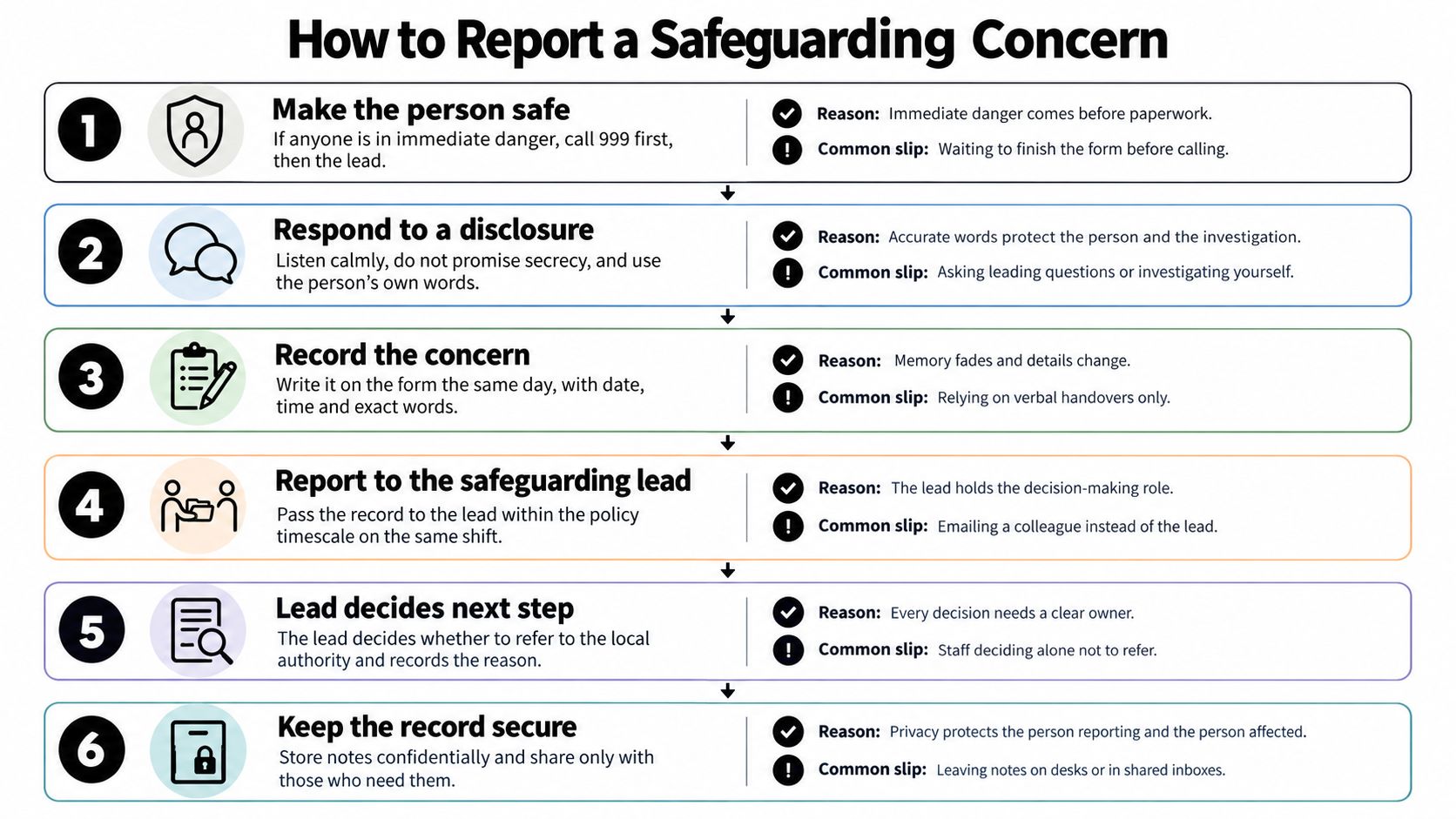
Across the sequence, the recurring risks are delay, unclear ownership, unsupported interpretation and missing follow-up. A policy that names the next person to contact at every point helps prevent a concern from stopping at a handover.
Threshold Decisions and Borderline Cases in Care
A frontline worker doesn't decide whether a concern meets the Care Act threshold for a formal Section 42 enquiry. The worker reports what they know and records the reasoning. The local authority decides whether the statutory tests are met, so uncertainty is a reason to seek guidance, not a reason to delay.
For an adult safeguarding duty in England, the local authority considers whether the adult has care and support needs, is experiencing or at risk of abuse or neglect, and cannot adequately protect themselves because of those needs. When the threshold is met, the authority must make, or arrange, enquiries to determine whether action is required and by whom (Care and support statutory guidance).
A good triage record captures more than the incident. It should include immediate safety steps, the adult's desired outcomes, consent, capacity and communication needs, any conflict of interest, what information was shared and with whom. If the person has substantial difficulty taking part in an enquiry, an independent advocate may be needed.
| Case | Likely route | Document first |
|---|---|---|
| Unexplained bruising on a resident with dementia | Immediate report to the lead; referral likely if the adult is at risk | Body map, time seen, what was said, who was present |
| Resident refusing food and fluids over several days | Assess with the lead; refer if neglect or self-neglect is suspected | Food and fluid charts, GP contact record, the person's stated wishes |
| Repeated low-level missed medication | Internal incident and medication review; refer if the pattern suggests harm or neglect | Medication record, dates and times, a pattern log over the period |
| Family member controlling the adult's finances | Report to the lead; the local authority decides under the Care Act tests | Statements in the person's own words, any evidence of coercion |
| Self-neglect with refusal of care and an unsafe home | Capacity assessment with the lead; referral if the threshold is met | Capacity observations, risk discussions, the person's decisions |
| Agency worker sees poor practice by a colleague | Report to the lead; use the whistleblowing route if the lead is involved | Factual account, dates, the witnesses and any immediate risk |
These examples show why a single incident can need more context. Refusing food may reflect a person's informed choice, a health issue or possible neglect; a pattern of missed medication may point to a system problem or a risk of harm. Record the facts and tell the lead rather than trying to settle the explanation yourself.
Practical rule: If you can't tell whether the threshold is met, report the concern anyway. Screening is for the appropriate decision-makers, not a reason to postpone sharing information.
Involving Adults Who Cannot Fully Take Part
A safeguarding meeting can be completed on paper while the adult's views remain unheard. A person with dementia, a learning disability, communication difficulties or fluctuating capacity may need information in a different format, more time, or help from someone they trust. The policy should show how staff made participation possible and what changed as a result, rather than rely on a standard sentence copied between records.
Support should be confirmed, not assumed. Ask who is helping the adult take part, whether that person is suitable, and whether independent advocacy should be considered. A form that names a relative does not show that the adult understood the discussion or could express a view.
Use these prompts to guide the record:
- What does the person want? Capture their words or signals, how they communicate and what outcome matters to them.
- Can they understand the options as presented? Use familiar words and communication aids, such as pictures, or seek help from someone who understands their communication.
- Is an advocate needed? Consider whether a suitable family member or friend can support the adult, and seek advice about advocacy when needed.
- Could someone be influencing the decision? An unwise choice alone does not mean the person lacks capacity. Record signs of pressure or coercion and tell the lead.
- Could their capacity or wishes change? Revisit consent when circumstances change. Record disagreement and consider what support would help the person take part.
A person's ability to make a decision is specific to that decision and time. If capacity is in question, follow the relevant decision-making process and get appropriate support. This plain-language overview of mental capacity assessments explains why capacity should not be treated as a blanket label.

The plan should connect the adult's wishes to the response: how staff explained the proposed actions, which views shaped the decision and whether the actions achieved the outcome the person wanted. If the adult could not take part fully, record what staff tried, what support was arranged and what remains unresolved. A completed form cannot show person-centred practice unless the adult's views influenced the plan or the reasons they could not do so are clear.
Recording, Feedback and Confirming the Concern Was Handled
Record safeguarding concerns as factual, dated, timed and signed entries. Use the person's own words where possible, marking opinion as opinion and avoiding speculation about the person alleged to have caused harm. The lead should keep a separate decision log showing the reason for the threshold decision, any referral and the action agreed.
A manager should be able to follow the chronology without filling in gaps from memory: when the concern arose, when the worker reported it, when a referral was made, what the local authority decided and what protective action followed. If the records show a referral but not the outcome, the service can't demonstrate that the case was followed through.
Build a follow-up loop into the policy
The policy should tell the lead how to request an update from the local authority, where to record the request and when to chase if no response arrives. A provider may set a chase date, such as five working days, but the policy should also tell staff to act sooner if risk requires it. If there's still no reply after the chase, the lead should escalate to their manager and record what happened.
When an outcome appears inconsistent with the facts, don't alter the original record or dismiss the decision. The lead should ask the local authority to clarify how it considered the information, share any relevant missing facts and record the response. Escalate through the agreed local pathway if the concern remains unresolved.
Information sharing should be necessary and directed to the right people. Record what was shared, with whom and why, while protecting confidentiality. For example, if a concern is closed without feedback, a dated request for an update and a scheduled chase make the missing response visible. An escalation step then prevents the case from slipping unnoticed out of the service's records.
CQC has identified variation in how local authorities understand safeguarding concerns and apply the Section 42 threshold, as well as inconsistent sharing of referral outcomes with partner agencies (CQC's State of Care assessment of adult social care systems). That makes the provider's own decision log and follow-up process important: they show what the service reported, what it heard back and what it did next. At review, connect outcomes to named learning actions, with an owner and evidence that the action changed practice.
Audit Your Policy Against the Inspection Checklist
Use these questions as pass-or-fail checks. A “yes” needs evidence, not reassurance. If the answer is no, put a named owner and a due date in the audit log, then review whether the action was completed.
| Check | Evidence to look for |
|---|---|
| Can every worker on each shift name the safeguarding lead and deputy? | Staff sign-off sheets or spot-check records |
| Is the local referral contact list dated within the last twelve months? | Dated contact list with a review signature |
| Do referral timeliness audits run at a set interval and show actions? | Audit records with findings, owners and completed actions |
| Does the training matrix show current safeguarding training for every role, including bank and agency workers? | Training completion matrix with expiry dates |
| Do incident logs show the decision and outcome, not only the report? | Incident chronology, decision log and recorded outcome |
| Is the whistleblowing route tested in supervision? | Supervision notes showing staff know how to raise concerns |
| Does the policy name the Care Act threshold tests or children's referral criteria? | Current policy wording and referral guidance |
| Were actions from the last safeguarding review closed? | Dated review actions with owners and completion evidence |
If training records show missing or expired safeguarding training, identify the workers affected and book them onto the next available course. A training matrix that only covers permanent staff leaves an obvious assurance gap if bank or agency workers are also providing care.
Set a review date and schedule the first audit. You can use CQC inspection preparation guidance to support broader readiness, but the safeguarding audit still needs to reflect your service's own policy and local pathways.
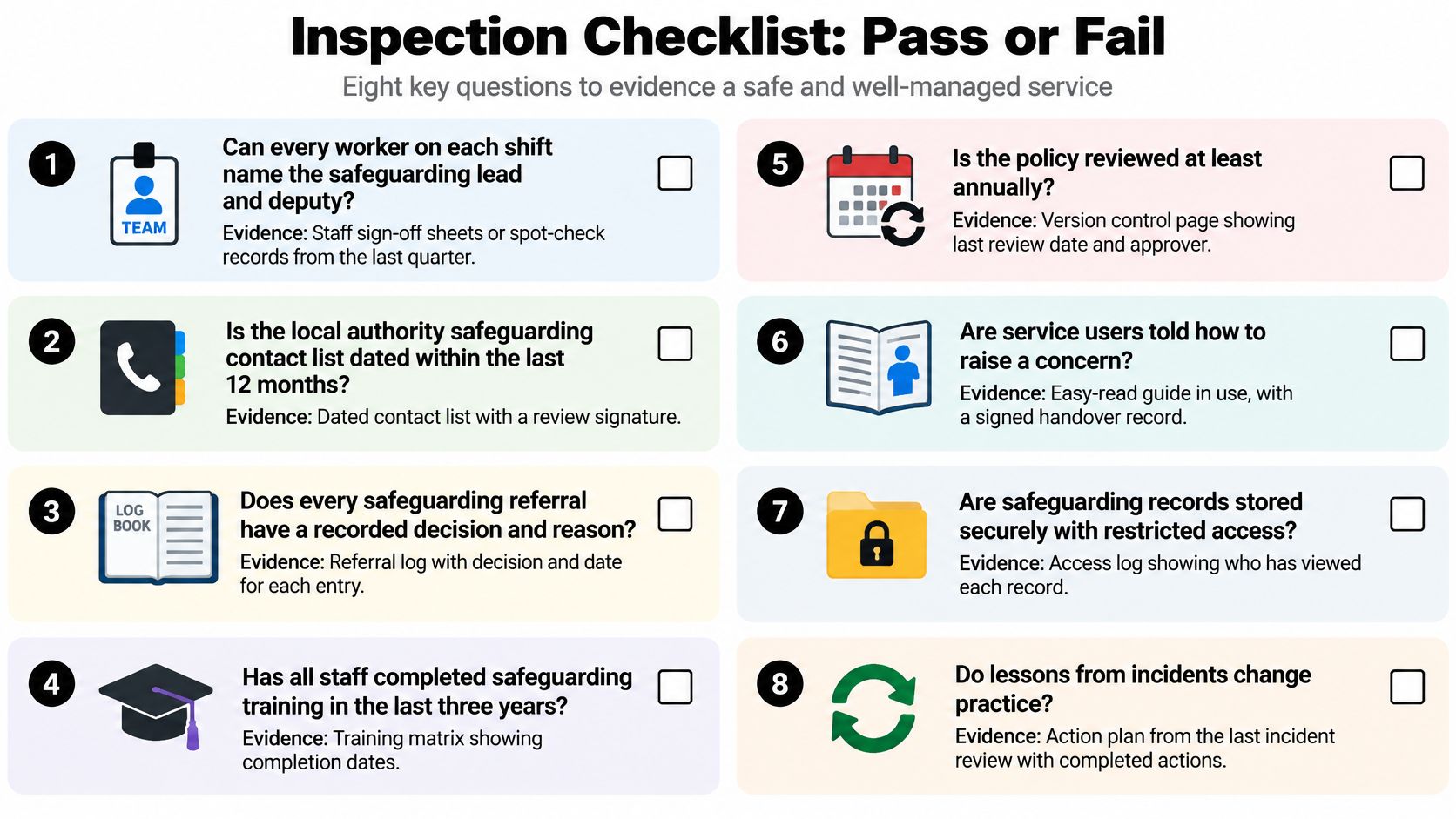
This week, choose the first failing row, name the person responsible and set a date for completion. Then record the evidence that will show the fix is in place.
Cura Academy offers safeguarding adults and children training alongside other health and social care courses, including support with recognising concerns, reporting and record keeping. Review its training options at Cura Academy and choose learning that fits your role and the procedures your service expects staff to follow.