
During personal care, you notice a bruise on someone's upper arm. They seem uneasy when you ask about it and say they don't want to discuss it. You're not sure whether to ask more, tell your manager, or respect their request and move on. On a busy shift, that uncertainty can feel uncomfortable, but a calm, proportionate response is part of good care.
The safeguarding adults principles help you decide what to do next. They're not just policy language: they guide everyday judgements in care homes, home visits, supported living and hospitals. In England, the Care Act 2014 sets the statutory safeguarding framework for councils with adult social services responsibilities. Your role is to notice concerns, listen, record what you've observed and report through the right route, while keeping the adult's wishes in view.
Table of Contents
- Why Adult Safeguarding Matters on Every UK Care Shift
- The Six Safeguarding Adults Principles Explained
- Legal Duties Under the Care Act and Beyond
- Recognising the Ten Types of Abuse
- How to Report a Safeguarding Concern Step by Step
- When Autonomy and Risk Pull in Different Directions
- Putting the Principles Into Practice Every Day
- Frequently Asked Questions for Care Workers and Employers
Why Adult Safeguarding Matters on Every UK Care Shift
The bruise might have an ordinary explanation, or it might point to harm. You don't need to investigate or decide which is true before raising a concern. Your responsibility is to take what you've seen seriously, respond without making assumptions and follow your workplace procedure.
Safeguarding is a daily part of care because risk can show up in small changes: someone becomes withdrawn, appears frightened around a particular visitor, or has unmet needs that are getting worse. It can happen in a person's own home as well as in a service. A quiet concern deserves attention even when there's no dramatic incident.
What the law means for your shift
The Care Act requires a council to make, or arrange, an enquiry when it reasonably suspects that an adult with care and support needs is experiencing, or at risk of, abuse or neglect and can't protect themselves because of those needs. That duty doesn't mean every concern leads to a formal enquiry. It does mean staff should pass information on so the right people can assess the situation.
Start with what you know. Ask the adult how they'd like to be supported, if it's safe and appropriate to do so. Don't press for a detailed account, promise secrecy or confront a person you suspect may be causing harm.
On shift, your job is to notice, listen, record and report. You don't have to prove abuse before raising a concern.
The principles below offer a practical way to think through the next step. They help you protect the adult without taking over decisions that belong to them.
The Six Safeguarding Adults Principles Explained
Mrs Patel has stopped letting anyone into her kitchen. Her fridge is nearly empty, she insists she manages fine, and she asks you to keep it to yourself. Do you respect her wishes, or raise the concern? The six principles exist for moments exactly like this, where two right answers seem to collide.
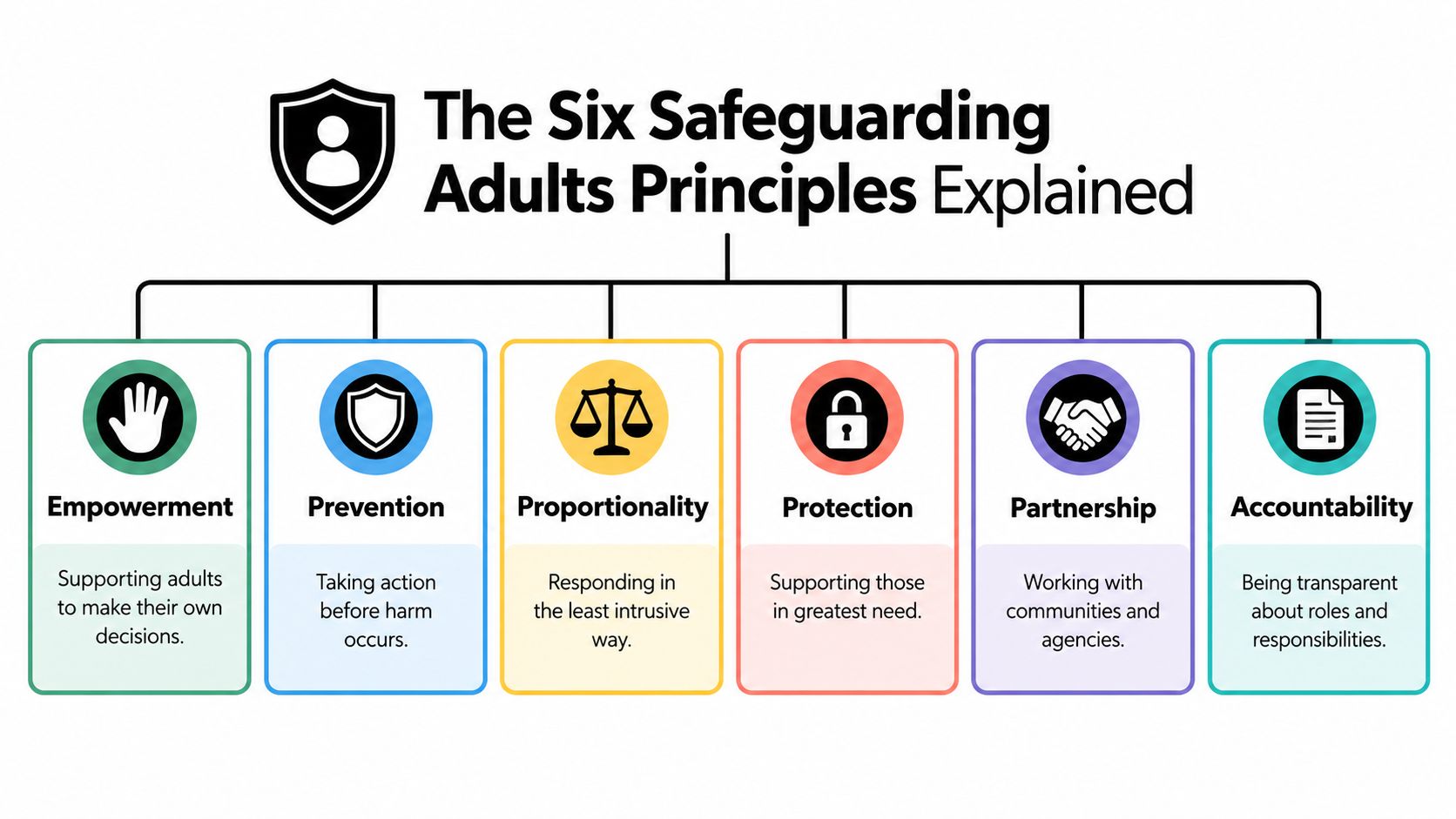
The Care Act 2014 sets out six principles that shape how adult safeguarding works in England: empowerment, prevention, proportionality, protection, partnership and accountability. Learn the words, then connect each one to something you can do on shift.
Six principles, six everyday actions
- Support and choice means backing decisions. Ask the adult what matters to them and explain the options in a way they can understand. If someone tells you a relative takes their money, ask what outcome they want and explain who you will need to inform. Respecting choice still applies when the choice carries risk: an adult with capacity may decline help, and your job is to make sure they decide with clear information and without pressure.
- Prevention means acting early. Notice changes before they become emergencies. Food running low, post left unopened, a family carer who looks exhausted: report what you see so support can reach the person while the problem is still small.
- Proportionality means choosing a response that fits the risk. A concern you are unsure about may call for advice from your safeguarding lead. Immediate danger calls for urgent action. The question stays the same: what is the least intrusive step that still deals with the risk in front of you?
Proportionality is about fit: the least intrusive response that still answers the risk.
- Protection means supporting people who need help to stay safe. A care worker might arrange for an adult who fears retaliation to speak with a safeguarding lead somewhere private, or stay with someone who feels unsafe until help arrives.
- Partnership means working with the right people. Share relevant concerns through your organisation's procedure so managers and other services can coordinate. You hold one piece of the picture; sharing it is how the rest gets assembled.
- Accountability means being clear and answerable. Write down what you saw, what you were told, whom you informed and what happened next. If a decision is questioned later, your record is the evidence of why you acted as you did.
Making Safeguarding Personal ties the six together. It asks a simple question: what does the adult want to happen? Safeguarding Adult Reviews into serious self-neglect often find the same gap, where each agency respected the person's refusals yet nobody asked whether the refusal itself had become part of the risk. Keeping the adult's outcome at the centre still means acting when risk grows. Every decision, including the difficult ones, starts and ends with what matters to them.
Legal Duties Under the Care Act and Beyond
The Care Act places the statutory safeguarding duty on the local authority, not on an individual care worker. When the council reasonably suspects that the legal threshold is met, it must make, or arrange, enquiries to establish what action is needed and who should take it. A section 42 enquiry is not automatically a single type of investigation. The response depends on the circumstances and may involve different agencies.
The council also works with its Safeguarding Adults Board (SAB). The board brings local organisations together to coordinate safeguarding arrangements and support joined-up practice. The local authority leads where the Care Act duty applies, while partner organisations contribute information and action within their own responsibilities.
Where your employer and partner agencies fit
Your employer should have procedures for receiving and escalating concerns. Police deal with suspected crime and immediate threats. NHS bodies, housing providers and other relevant organisations may hold information or provide support that helps clarify and reduce risk. Multi-agency work only functions when staff share relevant information through appropriate channels and record their actions clearly.
For care workers, the practical point is simple: you're not expected to determine the legal threshold or manage an enquiry alone. You are expected to follow your employer's policy, act on immediate safety concerns and give accurate information to the safeguarding lead or local authority route. Good records help others understand what happened and why a decision was made.
Providers must also meet the regulatory requirements that apply to their service. A safeguarding concern is therefore more than an internal HR matter: it may involve statutory duties, regulated care and external agencies. For a wider overview of the laws shaping care practice, see health and social care legislation in the UK.
Recognising the Ten Types of Abuse
Abuse and neglect aren't always obvious. A person may not disclose what's happening, and a single sign may have more than one explanation. Look for changes, patterns and context, then report concerns rather than trying to decide the full story yourself.

What you might notice
- Physical abuse: Hitting, rough handling or inappropriate restraint. Watch for unexplained injuries, flinching or a changing explanation about how an injury happened.
- Domestic abuse: Abuse or controlling behaviour between people in a family or intimate relationship. Someone else may answer every question for the adult or prevent private conversation.
- Sexual abuse: Sexual contact or behaviour without free agreement. The adult may seem distressed during personal care or make a disclosure that needs sensitive handling.
- Psychological abuse: Threats, humiliation, intimidation or isolation. Notice sudden withdrawal, anxiety around a particular person or repeated criticism that undermines the adult.
- Financial abuse: Theft, fraud or pressure over money and possessions. Unpaid bills, missing belongings or an unexplained change in who controls money may be warning signs. If someone needs practical information about prevention, how to stop elder financial abuse offers a starting point for understanding this risk.
- Modern slavery: Trafficking, forced labour or exploitation. A person may appear unable to leave, speak freely or keep their own documents.
- Discriminatory abuse: Harm or unequal treatment linked to a person's identity or characteristics. Listen for insults, exclusion or care that ignores cultural, religious or communication needs.
- Organisational abuse: Poor or harmful practice within a service. Rigid routines, repeated disrespect or restrictions that aren't properly justified may point to a wider problem.
- Self-neglect: Serious difficulty maintaining personal care, health or a safe environment. Poor hygiene, unsafe clutter or a lack of food may need a careful, person-centred response.
- Neglect by others: Failure to meet someone's care needs, whether through action or omission. Missed support, poor nutrition or unmet personal care needs can be indicators.
The principles of prevention and protection ask you to take these signs seriously and share concerns promptly. One clue may not prove abuse, but a pattern can help the safeguarding lead decide what support or enquiry is needed.
How to Report a Safeguarding Concern Step by Step
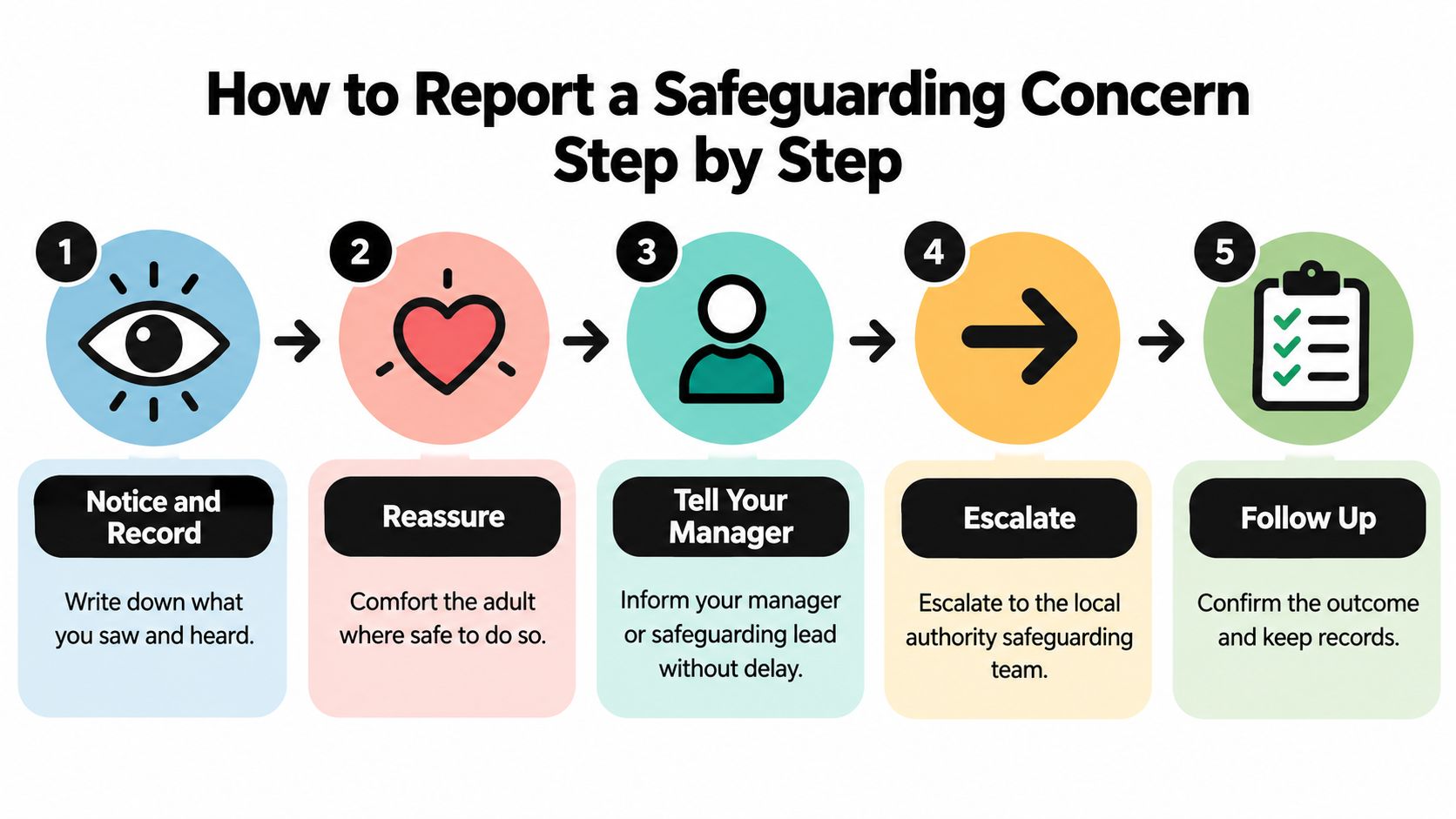
A clear report helps the next person act. Use your workplace safeguarding procedure, and don't delay urgent action while trying to complete a form. The practical route is to record what you know, alert the right people and make sure the concern reaches the appropriate safeguarding team.
The reporting route
- Notice and record. Write what you saw and heard, using the adult's own words where possible. Separate facts from your interpretation, and include when the concern arose and who was present.
- Reassure the adult. Listen calmly and acknowledge what they've told you. Don't promise to keep it secret, ask leading questions or investigate beyond your role.
- Tell your manager or safeguarding lead. Report without delay and follow your organisation's procedure. If the concern involves your manager, use the alternative reporting route in your policy.
- Escalate when needed. The local authority adult safeguarding team can assess the information. If there's immediate danger or a suspected serious crime, contact the police through the appropriate urgent route rather than waiting for an internal response.
- Follow up. Keep a record of whom you contacted and what happened next. Ask your safeguarding lead how to document further information.
After a referral, the local authority may triage the information and decide what response is appropriate. If the Care Act criteria are met, it may make or arrange a section 42 enquiry. The SAB supports local coordination of safeguarding arrangements, but it doesn't replace the council's role in an individual concern.
Confidentiality doesn't mean keeping quiet when someone may be at risk. Share information that's relevant and necessary with the appropriate people, following your workplace procedure and applicable rules. For a practical overview of the reporting route, read safeguarding adults procedures.
When Autonomy and Risk Pull in Different Directions
A person can refuse help and still be at serious risk. Equally, a choice that worries staff doesn't automatically mean the adult lacks capacity or that professionals can override them. Good safeguarding requires more than choosing between “respect the refusal” and “force support”.
National learning from Safeguarding Adult Reviews highlights how difficult these cases can be. Self-neglect appeared in 60% of reviews analysed for April 2019 to March 2023, compared with 45% in the previous analysis. Neglect or omission featured in 46%, and domestic abuse in 16% of the same reviews, as reported in the national analysis of Safeguarding Adult Reviews. These themes show why a refusal or lack of engagement shouldn't be treated as proof that there's no need.
Ask what may be behind the refusal
Consider a composite example: an adult declines help to clear a cluttered home, but the clutter is blocking access to essential areas. They understand that staff are concerned, yet say keeping things as they are matters to them. Your next step isn't to label the choice as incapable or ignore the risk. Ask what outcome they want, explore what support they would accept and record both the concern and their response.
Capacity must be assessed in relation to the particular decision, not inferred from an outcome professionals dislike. It can also change with the decision and circumstances. If you're unsure about the process, review how to assess mental capacity and raise the case with your manager or relevant professional.
Professional curiosity means noticing contradictions and asking respectful, open questions. It doesn't mean pressuring the adult or making accusations. Where risks remain serious, share information and seek multi-agency input rather than leaving one worker to manage the situation alone. Family disagreement can add useful information, but it doesn't replace listening to the adult or checking whose interests are being served.
Support options may include practical help at home or companionship, if the adult wants to explore them. A guide to finding companion care options can help families consider what companionship support might involve.
Putting the Principles Into Practice Every Day
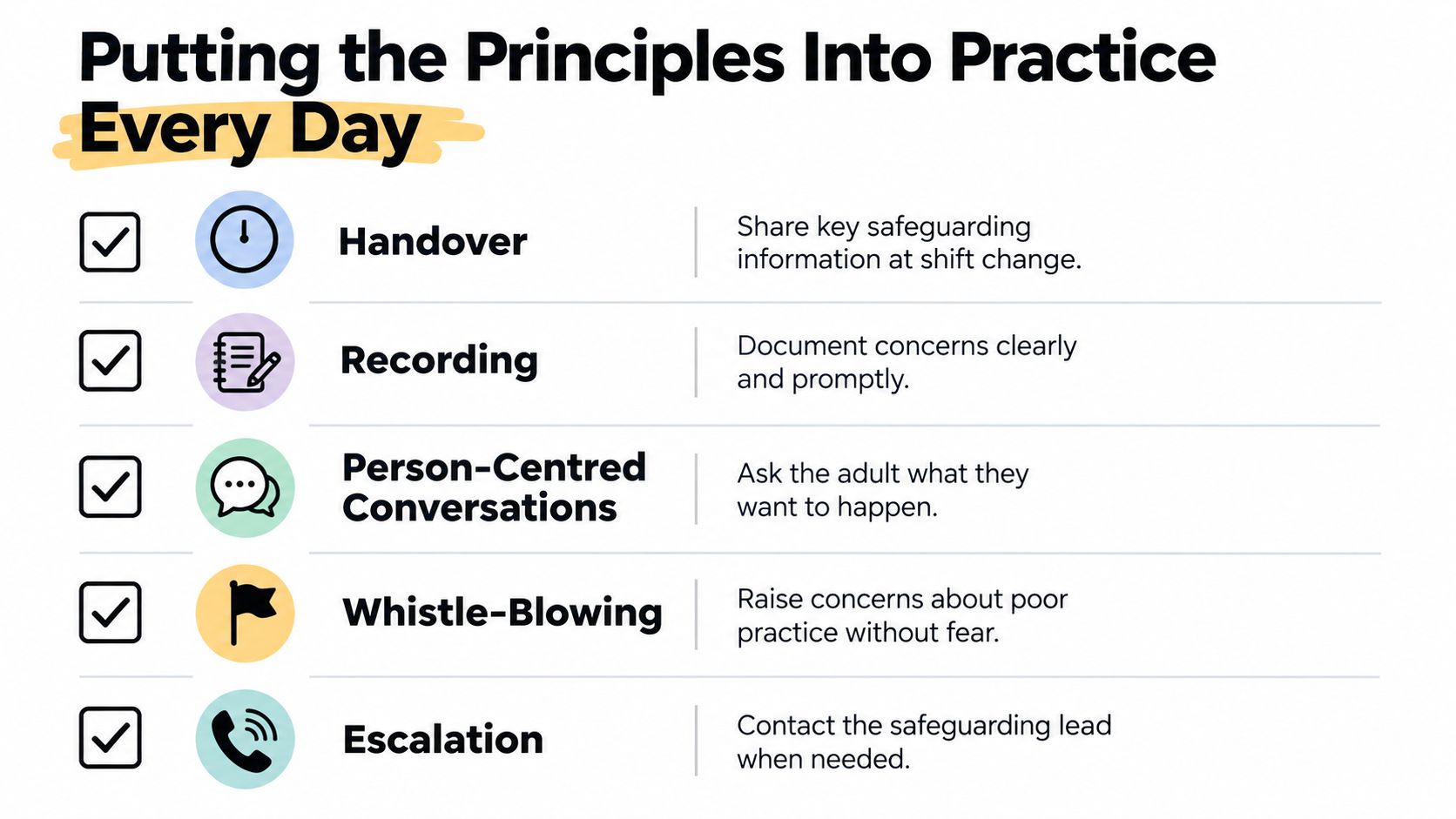
Safeguarding is part of ordinary shift work, not a separate task for rare emergencies. At handover, you might hear that a resident has become quieter around a visitor. During care, you notice the same pattern and record what you observed. You ask the resident what would help them feel safe, then pass the concern to the safeguarding lead. If you witness poor practice and don't feel able to raise it with your manager, follow your organisation's whistle-blowing route.
A quick check for care workers
- At handover: Share relevant safeguarding information with the appropriate colleague.
- When recording: Note observations promptly and distinguish fact from opinion.
- In conversation: Ask the adult what they want to happen and listen without judgement.
- If practice worries you: Use the whistle-blowing procedure and keep a clear record.
- When risk persists: Contact the safeguarding lead or follow the escalation route.
A check for managers and employers
- Training and supervision: Make sure staff understand their reporting responsibilities and have a route to discuss difficult cases.
- Safer recruitment: Apply the organisation's DBS and recruitment processes to relevant roles.
- Policies and practice: Review safeguarding procedures, including escalation and whistle-blowing arrangements, and make sure staff can find them.
- Regulatory readiness: Keep clear records of training, concerns and follow-up actions that demonstrate how the service responds to risk.
English local authorities received an estimated 640,240 concerns of abuse during 2024 to 2025. In that period, 185,270 section 42 enquiries commenced and involved 148,830 individuals, according to the official safeguarding adults statistics for England. A concern doesn't have to fit a dramatic scenario to deserve attention. Staff who want further practical guidance on reducing financial risk can also explore how to stop senior scams.
Frequently Asked Questions for Care Workers and Employers
Does an adult's refusal mean they lack capacity?
No. A person may make a decision others consider risky and still have capacity to make that decision. Capacity must be considered in relation to the specific decision, and staff should seek guidance if they're unsure. Don't assume that a diagnosis, an unpopular choice or a refusal settles the question.
Can I share information if the adult asks me not to?
You should take the adult's wishes seriously and explain what you need to do. If you believe someone may be at risk, follow your safeguarding procedure and share relevant information with the appropriate person or team. Don't promise secrecy before you understand what's being disclosed.
Should I call the police or wait for the local authority?
If someone is in immediate danger or you suspect a serious crime, contact the police through the appropriate urgent route. Don't wait for a local authority response before addressing an emergency. Then follow your workplace reporting process and record what you did.
How often should safeguarding training be refreshed?
There isn't one universal refresh schedule for every role and setting. Employers should follow applicable requirements, assess staff competence and set refreshers that reflect the work and risks involved. Check your organisation's policy and ask your manager what training applies to your role.
| Role | Initial Training | Recommended Refresh |
|---|---|---|
| Care worker or support worker | Before or as part of starting relevant duties, in line with employer policy | Follow the employer's policy and refresh when required or when practice needs updating |
| Manager or safeguarding lead | Training suited to the responsibilities of the role | Follow organisational policy and review learning needs through supervision |
| Employer or provider | Establish role-appropriate training and procedures | Review training arrangements and safeguarding practice regularly |
Cura Academy offers safeguarding adults training alongside care-focused courses and refreshers, with learning pathways for people preparing for care roles and staff who need to maintain their skills. If you want structured training on recognising concerns, responding to disclosures and reporting safely, visit Cura Academy to explore its options.