
A care assistant arrives at a new placement and discovers that the team uses different recording forms from the last service. The worker knows they completed safeguarding training, but isn't sure whether the certificate is still accepted, whether their DBS information is current, or what the manager expects if they notice unexplained bruising. During the shift, a person refuses support with personal care, another resident asks about their fees, and a colleague suggests sharing a care note in a group chat.
None of these decisions sits outside the law. Health and social care legislation affects how staff obtain consent, record care, protect information, report risks, use their training and ask for help. It also determines what employers must be able to demonstrate when they recruit, deploy, supervise and develop their teams.
Table of Contents
- Why Health and Social Care Legislation Matters for Your Day-to-Day Work
- Core Legislation Every Care Worker Must Understand
- Compliance Actions and Checklists for Frontline Staff and Employers
- Training and Record-Keeping Turning Legislation Into Demonstrable Competence
- Navigating Devolved Nations and Local Implementation Differences
- How Cura Academy Supports Legislative Compliance and Career Readiness
- Your Action Plan for Legislative Compliance and Career Progression
Why Health and Social Care Legislation Matters for Your Day-to-Day Work
The law appears in ordinary care decisions
The worker in the opening situation doesn't need to recite every Act from memory. They do need to know the practical response to each event.
If a person refuses personal care, the worker should pause, communicate respectfully, consider whether the person can make that decision and record what happened. If the worker suspects abuse or neglect, they shouldn't investigate alone or promise confidentiality. They should follow the service's safeguarding route, report the concern promptly and make a factual record. If a medication signature is missing, the correct response isn't to guess or amend the chart. The worker should follow the medicines policy and escalate the discrepancy.
These actions protect the person receiving care, but they also protect the employee. A clear record shows what the worker observed, what they did, who they informed and what advice they received. It gives a manager something reliable to review instead of forcing everyone to reconstruct events from memory.
Practical rule: If a situation could affect a person's safety, rights, dignity, consent or confidential information, stop and check the relevant policy before acting beyond your competence.
The law doesn't place every responsibility on the individual care assistant. Some duties belong primarily to the registered provider, such as maintaining safe staffing, arranging supervision and ensuring suitable systems are in place. Other expectations are personal, including working within competence, reporting concerns and handling records securely.
National rules become local routines
A national Act sets the legal framework, while an employer, council, NHS organisation or care provider turns that framework into procedures. One domiciliary-care service may require a particular electronic care-record entry after a missed visit. A residential service may use a paper form and require an immediate verbal report to the nurse in charge. The underlying safety expectation may be similar, but the route for demonstrating compliance can differ.
That distinction matters for bank and agency workers. Holding a certificate doesn't automatically mean a worker understands the local moving-and-handling equipment, escalation contacts, medication process or emergency arrangements. A local induction may therefore be necessary even when the worker has completed comparable training elsewhere.
Digital tools can help clinics and care organisations organise information, but they don't replace professional judgement or the provider's approved process. Teams exploring intelligent support for clinics should still check how any tool handles confidentiality, access permissions, records and escalation.

Understanding the boundary between what the law requires and what the employer adds makes compliance easier. The sections below focus on the rules most likely to shape frontline decisions, then translate them into training evidence, local working practices and career preparation.
Core Legislation Every Care Worker Must Understand
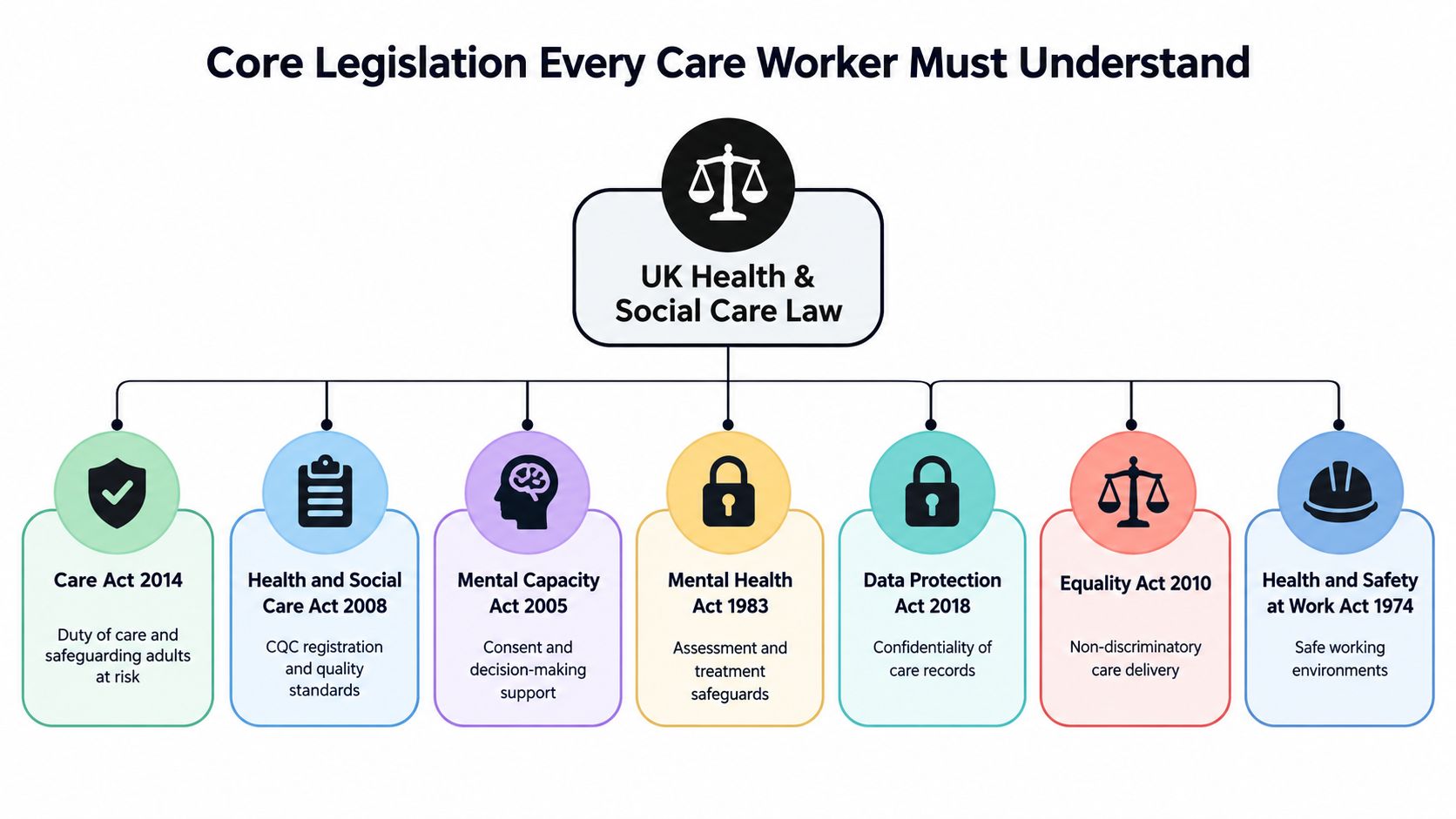
The following laws overlap in practice. A safeguarding concern may involve the Care Act, capacity and consent, equality, confidentiality and the provider's regulatory duties at the same time. Treat the list as a working map, not as seven isolated boxes.
Care Act 2014
The Care Act provides a central framework for adult social care in England. For frontline staff, its practical meaning is person-centred support, attention to wellbeing and a clear response to safeguarding concerns.
A care worker might notice that a person is becoming isolated, struggling to manage at home or experiencing possible financial abuse. The worker isn't responsible for deciding the person's eligibility for services, but they are responsible for recording observations and passing concerns through the agreed route. They must also avoid assuming that a person wants the same outcome as their family or provider.
Mental Capacity Act 2005
The Mental Capacity Act guides decisions when someone may not be able to make a particular decision at a particular time. Staff should support the person to decide, avoid treating an unwise decision as proof of incapacity and involve the person as far as possible.
If the person lacks capacity for the specific decision, any action must be in their best interests and should be as least restrictive as possible. A care worker should never use a blanket assumption such as “they can't decide about anything”. Capacity is decision-specific and can change.
Health and Social Care Act 2008 and CQC regulations
The Health and Social Care Act 2008 supports the regulatory framework for registered health and social care activities. The related regulations shape how providers manage safety, staffing, care quality and governance.
For a worker, this can appear as an instruction to report incidents, complete training, follow infection-control procedures or raise concerns about unsafe practice. For an employer, it means being able to show that systems operate in practice, not merely that policies exist.
Mental Health Act 1983
The Mental Health Act concerns assessment, detention and treatment in defined circumstances. Most care workers won't make detention decisions, but they may support someone subject to the Act or work alongside professionals involved in their care.
Daily responsibilities include respecting rights, following the care plan, recognising distress and escalating changes. Staff shouldn't interpret a person's legal status as permission to ignore their preferences or dignity.
Equality Act 2010
The Equality Act protects people from unlawful discrimination and supports fair access to services and employment. Frontline practice includes adapting communication, respecting cultural and religious needs and challenging discriminatory treatment.
An adjustment might involve changing how information is explained, arranging communication support or considering how a disability affects participation. The worker should record the person's needs and follow the provider's process for requesting support, rather than deciding that an adjustment is inconvenient.
Data Protection Act 2018 and UK GDPR
Care records contain sensitive personal information. Staff should access information only for a legitimate work purpose, use approved systems and share details with the right people through the right channel.
A worker shouldn't photograph a care plan on a personal phone or discuss a person's condition in a public place. Good confidentiality also means checking identity before sharing information and recording relevant, necessary facts rather than personal opinions.
Health and Safety at Work Act 1974
Health and safety law supports safe working environments for staff and the people they support. It affects moving and handling, infection prevention, hazardous substances, accidents, lone working and the reporting of unsafe equipment.
A worker must use equipment and protective measures as trained, report defects and ask for assistance when a task exceeds their competence. A service's local risk assessment may impose requirements that go beyond a worker's general training.
The Health and Care Act 2022 adds a more recent integration and workforce dimension. It received Royal Assent on 28 April 2022, contains 7 parts and 19 schedules, and amended major statutes including the National Health Service Act 2006 and the Health and Social Care Act 2012. It established integrated care systems across England and renamed the National Health Service Commissioning Board as NHS England. From 1 July 2022, CQC-registered providers also had to ensure that staff received role-appropriate learning disability and autism training under the Act's workforce-related requirements.
The practical lesson is simple: the law is most useful when it changes a decision. Ask whether the person has been heard, whether the action is safe, whether information is being handled properly and whether you have the competence and authority to proceed.
Compliance Actions and Checklists for Frontline Staff and Employers
Compliance starts before a worker is left alone with a person receiving care. Regulation 18 of the Health and Social Care Act 2008 (Regulated Activities) Regulations 2014 requires a regulated provider to deploy enough staff who are suitably qualified, competent, skilled and experienced. The Regulation 18 requirements also cover support, training, professional development, supervision, appraisal and further relevant qualifications.
An induction certificate alone doesn't prove continuing competence. A worker may have completed moving-and-handling learning but still need observed practice on the equipment used at a particular service. A registered professional may also need evidence that they continue to meet their regulator's standards.
A worker's pre-shift check
Before accepting a new placement or shift, confirm:
- Role scope: Know which tasks you're authorised and trained to perform, including medication support, personal care, lone working and restrictive interventions.
- Training status: Check completion dates, refresher expectations and whether the employer requires local modules in addition to general certificates.
- Identity and vetting: Ask how the provider checks DBS information and what evidence it needs from agency or bank workers. Don't assume another employer's process automatically transfers.
- Local induction: Learn emergency contacts, safeguarding leads, incident reporting, equipment procedures, record systems and the location of risk assessments.
- Escalation route: Know who to contact if a person is missing, injured, refusing essential support, at risk of abuse or affected by a medication discrepancy.
- Evidence of practice: Take part in observations and supervision. Tell the manager when you don't feel competent to complete a task safely.
Employers should maintain a role-by-role competence matrix. It can connect each worker's duties with mandatory learning, observed practice, supervision notes, refreshers, appraisal and professional-registration evidence. The matrix should show a manager whether a worker is ready for a particular task, not merely whether they have uploaded a certificate.
Compliance checklist by role type
| Role Type | Mandatory Training | DBS Status | Key Records to Maintain |
|---|---|---|---|
| Care assistant | Care Certificate-related learning, safeguarding, infection prevention, health and safety, and role-specific training | Confirm the provider's required checks and update process before deployment | Induction, training completion, competency observations, supervision and care records |
| Support worker | Core care learning plus training linked to the person's needs and the setting | Confirm current employer evidence and any local onboarding requirement | Care plans read, incident reports, best-interests or capacity-related records, supervision and appraisal |
| Agency or bank staff | Core learning, local induction and practical orientation for each placement | Share appropriate evidence with the engaging provider and clarify its validation process | Assignment-specific induction, competency sign-off, shift records, incident escalation and professional evidence where relevant |
Employers should also make it easy for temporary staff to raise concerns. A worker who doesn't know whether to call the shift lead, safeguarding manager or agency contact may delay an important report. A short written escalation pathway is a safety control, not administrative decoration.
For teams that need to combine certificates, forms and competency evidence, PDFWix medical document tools may help with document workflows, provided the organisation applies its own confidentiality, retention and access controls. Further practical guidance on linking policy to staff evidence is available through this health and social care compliance resource.
Training and Record-Keeping Turning Legislation Into Demonstrable Competence
A training record should answer more than “Did this person attend a course?” It should help a manager answer, “Can this person safely perform this task in this setting, and what evidence supports that decision?”
The Health and Social Care Act 2008 gives the regulatory framework a patient-safety purpose. Regulations can address who is fit to work, how activities are delivered and how the workforce is managed and trained. The framework also covers supplying staff who provide health or social care, so domiciliary agencies, staffing businesses and providers using bank workers need to assess both the organisation and the individual worker. The statutory context is set out in the Health and Social Care Act 2008 regulatory framework.
What useful evidence looks like
A robust record normally brings together:
- Learning evidence: Course title, completion date, learner identity and any assessment result or certificate.
- Practical evidence: Observed practice for tasks such as moving and handling, medication support or use of specialist equipment.
- Management evidence: Supervision, appraisal, feedback, action plans and confirmation that concerns were addressed.
- Role evidence: The duties assigned to the worker and the additional learning required for the people they support.
- Professional evidence: Registration and continuing standards evidence where the worker belongs to a regulated profession.
- Incident evidence: Relevant retraining, reflective action and competency review after an error, near miss or safeguarding concern.
A certificate of attendance may show exposure to information. It doesn't necessarily show that the worker can apply it under pressure. For example, a care assistant may know the theory of infection prevention but need observed confirmation that they select, use and dispose of protective equipment correctly in the service's environment.

Keep the trail usable
Records should be accurate, dated, attributable and easy for authorised people to retrieve. Store them in the organisation's approved system, restrict access to those who need it and follow the provider's retention schedule. Don't create a separate personal archive containing confidential care information unless the employer has specifically approved that arrangement.
Training needs also change. A new starter may require broad induction and supervised practice. An experienced worker may need a refresher after a policy change, an incident, a long absence or a move to a different service. A worker who notices an expired certificate or an unfamiliar task should raise it before accepting the assignment.
Online delivery can support consistency when the organisation still checks understanding and practical competence. Teams evaluating effective online employee training should ask how completion is recorded, how learners are assessed and how digital learning connects to observation and supervision. A structured training matrix template can help managers see gaps before deployment rather than during an inspection or incident review.
Navigating Devolved Nations and Local Implementation Differences
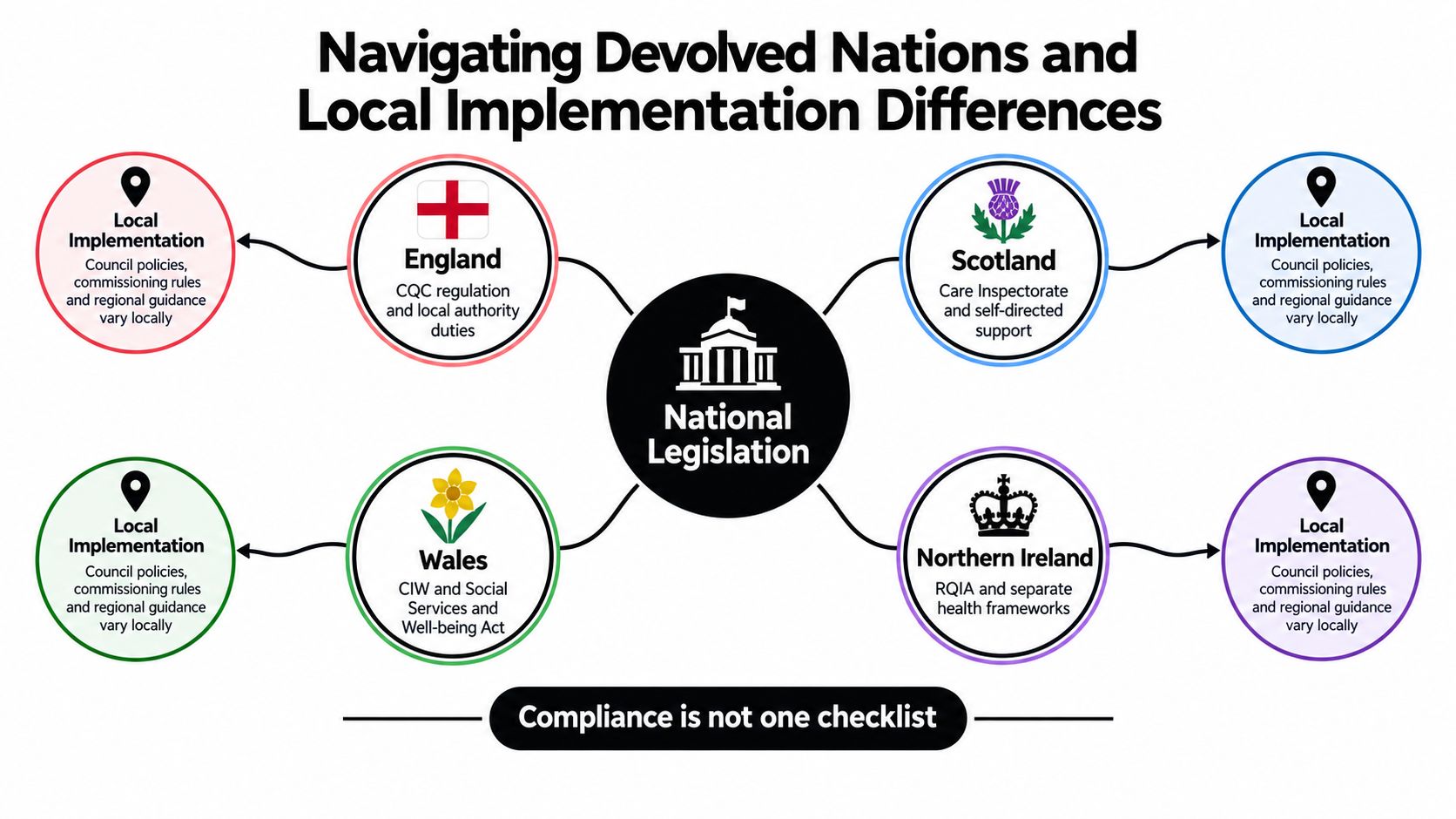
A worker can hold the same certificate and still face different onboarding requirements in different parts of the UK. That's because national legislation, regulators, councils, commissioners and employers each influence what the worker must demonstrate in practice.
England is not the whole UK framework
The Health and Care Act 2022 is principally an England-focused milestone. It established integrated care systems across England and brought NHS organisations, local government and wider partners into a more coordinated planning structure. A worker in England may therefore encounter CQC requirements, local-authority arrangements and integrated-care processes that don't map directly onto a role in Scotland, Wales or Northern Ireland.
Wales has its own Health and Social Care (Wales) Act 2025, while the devolved nations have distinct institutions and legal arrangements. A mobile worker should check the regulator, local safeguarding procedure, commissioning expectations and employer policies for the nation and service where they work. A certificate can support readiness, but it doesn't remove the need to understand the local system.
The local layer changes the conversation
Charging rules show why frontline workers need clear boundaries. For 2025–26 in England, the capital limits remain £14,250 for the lower threshold and £23,250 for the upper threshold, while the personal expenses allowance rises from £30.15 to £30.65 per week, as set out in the adult social-care charging circular for 2025 to 2026. These figures don't determine an individual's final contribution by themselves. The assessment, income, care setting and personal circumstances still matter.
A care worker should explain the process, not calculate a person's liability. They can say that the local authority carries out a financial assessment, identify the correct contact and record that the person has asked for help. They shouldn't promise that care will be free, interpret a complex financial decision or tell a family to ignore an invoice.
Safe communication: Give factual signposting, record consent where appropriate and escalate a dispute to the responsible social-care or financial-assessment team.
The policy environment is also changing. Adult social-care reform discussions include more integrated NHS and local-authority delivery, national career structures and a proposed Fair Pay Agreement for care professionals. Government information also refers to about £9 billion for the Better Care Fund in 2025–26 and projects over £4 billion more funding available for adult social care in 2028–29 compared with 2025–26, but those announcements don't automatically change an individual's current entitlement. The relevant government update on social-care reform illustrates why workers must distinguish enforceable rules from proposals, funding announcements and local decisions.
For a practical view of how national duties meet provider procedures, consult this guide to care home regulations in the UK. The most reliable habit is to ask, “Which rule applies here, which organisation owns the decision and what does my local policy require me to record?”
How Cura Academy Supports Legislative Compliance and Career Readiness
Legislation creates expectations, but workers need a practical route from an expectation to evidence. A course can introduce safeguarding, duty of care, infection prevention or dignity. The employer then needs to connect that learning with induction, observation, supervision and the tasks assigned to the worker.
Cura Academy provides a training and membership platform for UK health and social care workers. Its £10-per-month subscription offers unlimited access to essential care training, including Care Certificate standards, mandatory refreshers and role-specific courses such as Basic Life Support and Dementia Awareness. One-off bundles are also available for people who prefer to purchase a defined set of courses.
Building a job-ready evidence trail
A structured pathway can help an aspiring worker move through several practical stages:
- Select a care career route and identify the learning likely to be relevant.
- Complete core courses and role-specific modules.
- Build a profile containing training evidence.
- Prepare for employer onboarding and compliance checks.
- Keep learning current as duties and local requirements change.
This approach addresses a common gap between “I have completed a course” and “I can show an employer that I'm ready for this role”. It can also help workers organise Enhanced DBS and Update Service readiness information, although the engaging employer remains responsible for its own checks and deployment decision.
The platform's course areas include Care Certificate topics such as duty of care, safeguarding adults, health and safety, infection prevention and control, privacy and dignity. Those subjects fit naturally into an employer's competence framework, but completion still isn't a substitute for local induction or observed practice where the role requires it.
Supporting organisations and mobile workers
A domiciliary provider, residential service or agency may use a shared learning pathway to give staff a consistent foundation. Managers still need to add service-specific procedures, confirm competence on equipment and document supervision. Agency and bank workers particularly benefit from keeping their evidence organised, because they may move between services with different local requirements.
The Health and Care Act 2022 connects regulation with role-appropriate learning on learning disabilities and autism for CQC-registered providers from 1 July 2022, as described in the combined impact assessments for the Act. A training platform can make the learning easier to find and document, while the provider must decide whether the worker's knowledge and observed practice meet the needs of the assignment.
Testimonials supplied for the platform describe time savings and improved shift opportunities after workers brought training into one organised pathway. Those accounts are individual experiences, not a guarantee of employment or shifts. The useful principle is broader: clear, accessible evidence helps workers and employers identify what has been completed, what remains outstanding and what must be checked locally.
Your Action Plan for Legislative Compliance and Career Progression
For an aspiring care worker, start with recognised foundational learning, understand the legislation relevant to the intended role and create a clear profile of completed training, practical competence and vetting readiness.
For an existing care assistant or support worker, audit every certificate and compare it with current duties. Ask your manager to identify missing observations, supervision, refreshers or role-specific learning under Regulation 18. Record concerns early, especially before accepting medication, lone-working or specialist-support duties.
For an employer, maintain a competence matrix, standardise the essential part of induction and add local procedures for safeguarding, records, emergencies and equipment. Review temporary workers against the same deployment standard as permanent staff, then use supervision and appraisal to keep competence current.
Legislation can feel complicated because national rules and local implementation overlap. Consistent training, factual records and a willingness to escalate uncertainty turn that complexity into a manageable working system. Cura Academy can provide the training infrastructure through monthly access or curated bundles, while each employer remains responsible for local checks and safe deployment.
Cura Academy offers Care Certificate-aligned learning, mandatory refreshers and role-specific courses to help care workers organise demonstrable training evidence. Visit Cura Academy to choose a monthly membership or training bundle and start turning legislative knowledge into practical career readiness.