
The new starter is standing at the nurses' station, ready for an induction shift. The manager opens a paper folder and finds certificates with unclear dates, no role-based training plan and no reliable record of who checked practical skills. The immediate question isn't how many courses the starter has completed. It's whether they can safely do the work they're about to be assigned.
That's the practical test behind mandatory training for care homes. A training record should help managers decide who's ready for which duties, where support is needed and what evidence can be shown during regulatory scrutiny. A folder full of certificates might look busy, but it can't answer those questions on its own.
Table of Contents
- Why Mandatory Training Matters More Than Ever in 2026
- The Legal Framework Behind Care Home Training
- Core and Role-Specific Training Topics Explained
- Refresher Intervals Without the Guesswork
- Building a Training Matrix That Actually Works
- Delivering Training That Sticks
- Recordkeeping, Evidence and How Cura Academy Helps
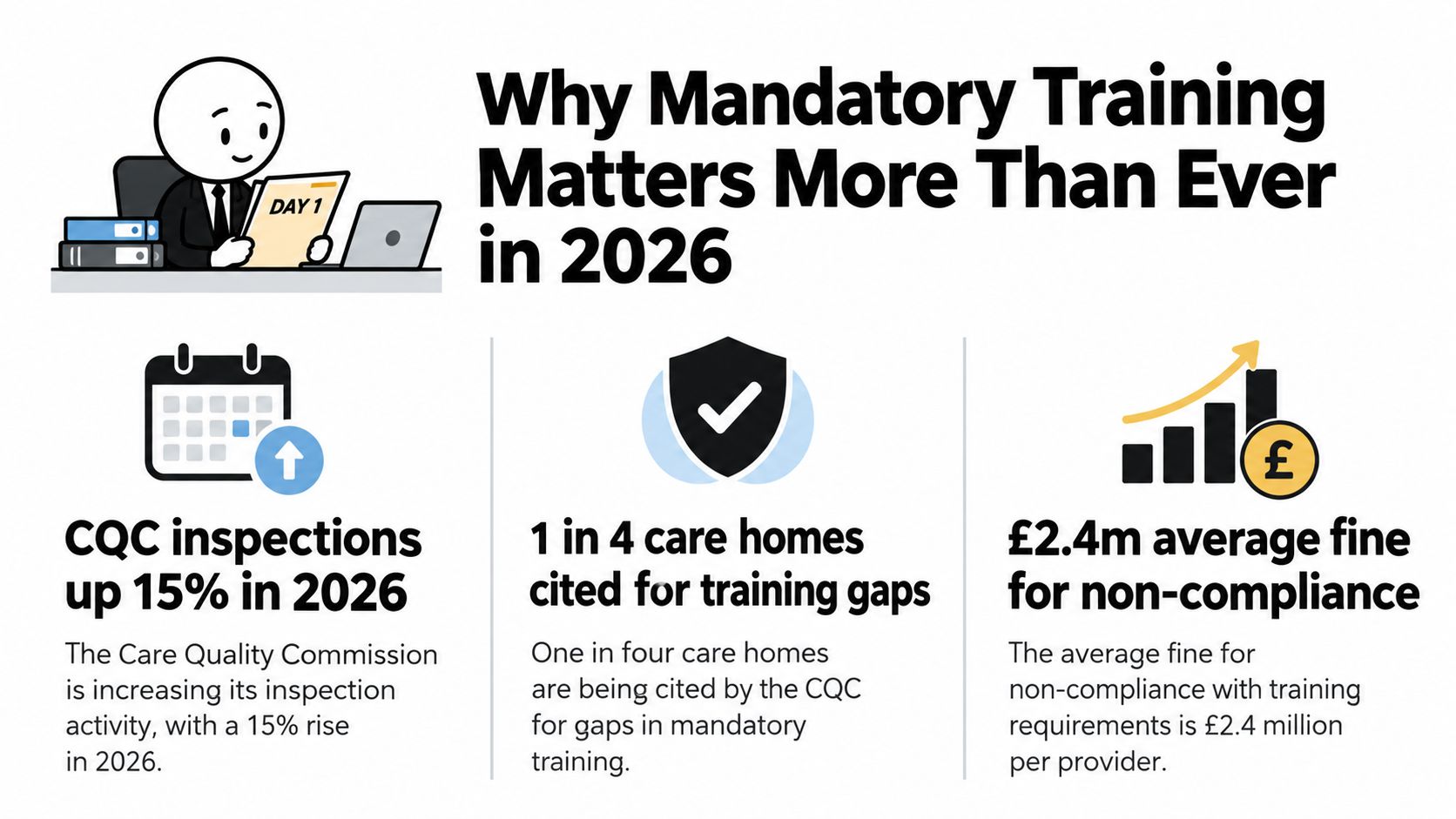
Why Mandatory Training Matters More Than Ever in 2026
A manager who can't verify a new starter's training has a problem before the first care task begins. They need to establish what the person has already learned, what the home requires for the role and whether the worker can demonstrate any practical skills the job involves. If the file is unreliable, the manager has to check rather than assume.
That's why training needs to operate as a live system, not a one-off induction event. In England, Regulation 18 requires providers to ensure staff receive the training, support, supervision, professional development and appraisal needed to perform their roles safely and effectively. The Care Quality Commission's Regulation 18 guidance is the regulatory starting point for understanding that duty.
What the training file needs to prove
A well-organised file lets a manager explain why a topic applies to a particular role, when the worker completed it and what further checks were needed. It should also make gaps visible before a shift is allocated, not after someone asks for evidence.
This matters to more than the care-home manager. CQC may review whether staff are trained and supported for their responsibilities, while commissioners, local authorities and staffing agencies may ask providers to demonstrate workforce readiness. The home also has an immediate responsibility to residents and staff: people shouldn't be assigned tasks they aren't prepared to carry out safely.
Skills for Care's workforce reporting illustrates why a single “qualified or not” label doesn't tell the whole story. In its report on England's adult social care sector, approximately 54% of direct-care workers in 2024/25 didn't hold a relevant social-care qualification, while 69% of that group had engaged with the Care Certificate standards and 81% had completed non-statutory training (Skills for Care, 2025 executive summary). Experience, workplace training and a formal qualification are different things, and a useful training system records them separately.
A practical test: Could someone unfamiliar with the home open the training record and understand what the worker can do, what they still need to learn and who has verified their competence?
The Legal Framework Behind Care Home Training
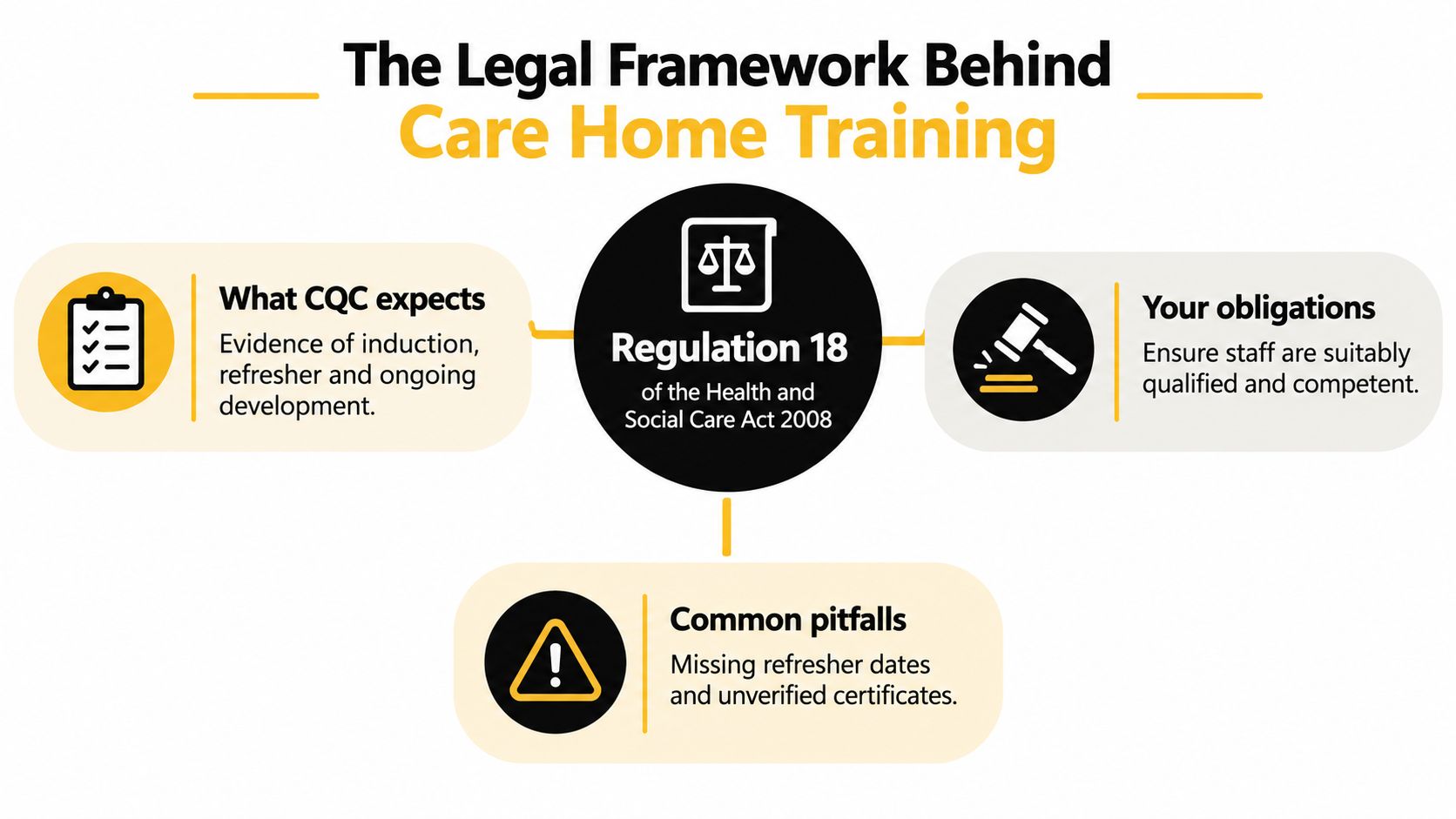
Regulation 18 is the foundation. In plain English, it requires a provider to make sure staff receive the support and learning they need to perform their jobs safely and effectively. It doesn't give every care home an identical course list or prescribe one renewal calendar for every topic. Instead, providers need to identify and meet training needs in the context of their service and each person's role.
The CQC expects training plans to set out induction content, mandatory subjects, role-specific learning and refresher intervals. Providers should also show how their training meets the Care Certificate standards where relevant. That means a training plan needs to be more than a list of course titles: it should help explain who needs each subject and how the home knows the learning is suitable.
Legal floor and employer choices
Think of statutory training as the shared foundation of a building, and employer-defined mandatory training as the parts shaped by the people and work inside it. Skills for Care identifies subjects such as health and safety, fire safety, moving and handling, infection prevention and control, adult safeguarding, and learning-disability and autism awareness as statutory training. Other mandatory requirements can vary according to the service, establishment and job.
One legal requirement has a clear date: from 1 July 2022, people working for CQC-registered providers must receive learning-disability and autism training appropriate to their role. This requirement applies across CQC-registered settings, including care homes, and is regulated under Regulation 18. The key phrase is “appropriate to their role”. A worker's duties and the needs of residents should shape the learning.
The Care Certificate is an induction framework, not a substitute for all role-specific training, practical assessment or ongoing support. Managers should distinguish completion of its standards from other training and from a recognised qualification.
For a plain-language overview of the wider UK regulatory context, see Cura Academy's guide to care home regulations. When managers are planning a programme, it can also help to understand the resource implications: Loresson breaks down training spend as one perspective on budgeting for compliance learning.
Core and Role-Specific Training Topics Explained
There isn't one course list that fits every care home and every job. Start with shared safety topics, then add training that matches the work a person performs and the needs of residents. Think of it as a layered training cake: the base is common learning, the next layer is role-specific, and the top is specialist practice for particular residents or tasks.
The usual foundation includes health and safety, fire safety, moving and handling, infection prevention and control, adult safeguarding, and learning-disability and autism awareness. The provider should decide how each subject applies to different staff. An ancillary worker may need to understand fire procedures and infection control, while a carer who supports residents with mobility needs may also need practical moving-and-handling instruction.
For advice on shaping assignments around job duties rather than giving everyone an identical package, this role-based training guide offers a useful way to think about matching learning to responsibility.
Match the topic to the task
Medication training should follow actual duties. A carer who doesn't handle medicines may need awareness of reporting procedures, while a senior carer or nurse responsible for administration will need training and competence checks appropriate to that responsibility. Likewise, dementia awareness may suit a broad group, but supporting a person with complex needs may require more focused learning and supervision.
Other role-specific subjects might include end-of-life care, falls prevention, positive behaviour support, dysphagia, food hygiene and basic life support. Don't assign a subject just because it appears on a generic checklist. Record why the topic applies, who needs it and whether staff must demonstrate a practical skill.
| Topic | Carer | Senior carer | Team leader | Nurse | Ancillary |
|---|---|---|---|---|---|
| Health and safety | Core awareness | Core awareness | Core awareness and oversight | Core awareness | Relevant to duties |
| Fire safety | Home procedures | Home procedures and support | Procedures and coordination | Procedures and clinical context | Procedures for work area |
| Moving and handling | Training for assigned tasks | Training plus support for practice | Training and oversight as required | Relevant to resident care | Role-dependent |
| Infection prevention and control | Core practice | Core practice and reinforcement | Practice oversight | Practice relevant to clinical duties | Relevant to cleaning or other duties |
| Safeguarding adults | Recognise and report concerns | Respond and report | Follow reporting and escalation processes | Role-appropriate response | Recognise and report concerns |
| Medication competence | If duties require it | If duties require it | If duties require it | Appropriate to nursing duties | Usually not required unless duties include it |
| Dementia and resident-specific needs | As relevant to residents supported | Deeper role-based learning where needed | Coordinate learning and support | Relevant to the people cared for | Awareness where it supports safe interaction |
The table is a starting point, not a legal checklist. A home should adapt it after reviewing its resident group, job descriptions and local procedures. For practical support with infection control in care homes, managers can use the topic as a prompt to review both staff learning and day-to-day practice.
Refresher Intervals Without the Guesswork
Managers often want a fixed answer to “How often should this be refreshed?” Regulation 18 doesn't set one national renewal cycle for every subject. The provider should set intervals that make sense for the role, the level of risk, previous competence, changes in practice and what's happening in the home.
That doesn't mean choosing dates by guesswork. Write down the reason for the interval and the events that would bring learning forward. A provider can consider the training topic, whether the worker uses the skill regularly, whether guidance or local procedures have changed, and whether incidents or assessments point to a gap.

Use evidence to set the next review
Take moving and handling. If a resident's needs change, a worker's assessed practice raises concern or a near-miss shows that a transfer wasn't carried out safely, the manager shouldn't wait for a routine renewal date. Review the risk, arrange further instruction or supervised practice, and document what changed.
Medication competence needs a similar distinction between general learning and the ability to perform an assigned task safely. A course record may show that a worker completed learning, but it won't by itself prove that they can follow the home's medication procedures. The provider can use observed practice, supervision and follow-up checks to decide whether further learning is needed.
For safeguarding, review the interval against the home's policy and the worker's responsibilities. If staff aren't escalating concerns correctly, a refresher and discussion in supervision may be more appropriate than waiting for the next planned course.
Keep the rationale beside the date. A defensible schedule says not only when training is due, but why that timing suits the role and what would trigger an earlier review.
Building a Training Matrix That Actually Works
A matrix earns its place when it helps a manager make decisions. A spreadsheet that only says “complete” or “incomplete” won't show whether a course applies to the role, whether an assessment is needed or what action to take when a worker's duties change.
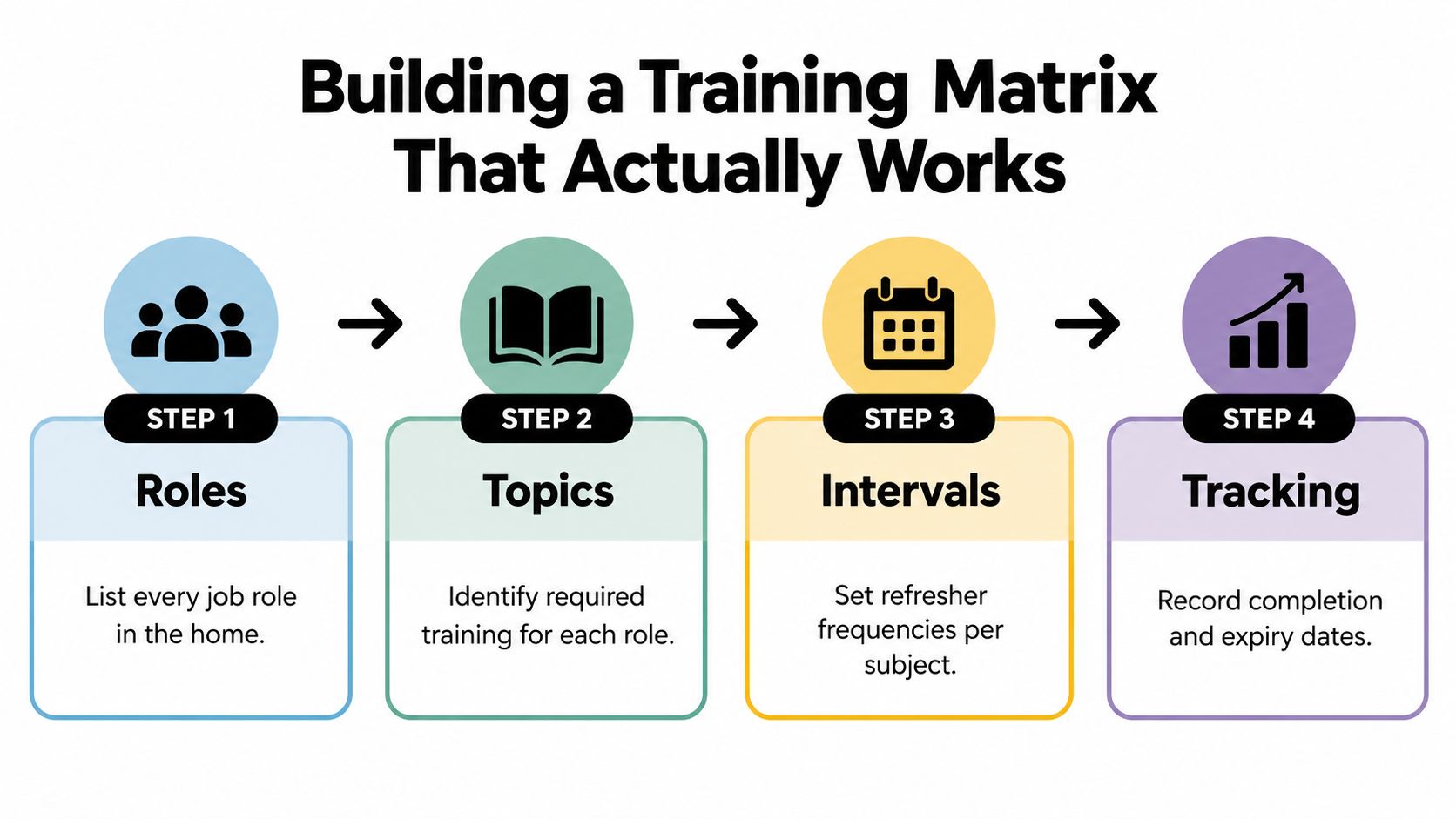
Start by listing every role, including temporary and ancillary roles. Map each one to required topics, then record completion dates and the next review or expiry date. Add a field for the competency outcome where the subject requires practical assessment. A worker's learning record should show more than course attendance when the job requires them to demonstrate a skill.
Build fields that answer inspection questions
A compact matrix might include:
| Role | Topic | Why it applies | Completed | Review due | Competence outcome | Action |
|---|---|---|---|---|---|---|
| Carer | Moving and handling | Supports residents with mobility needs | Date recorded | Review date recorded | Observed and signed off, or pending | Book assessment if needed |
| Senior carer | Medication | Duties include medication support | Date recorded | Review date recorded | Competence check recorded | Supervision or reassessment |
| Ancillary | Fire safety | Needs to follow home evacuation procedures | Date recorded | Review date recorded | Local procedure understood | Repeat induction if procedures change |
This is a working example, not a prescribed template. Use the matrix to produce a clear view of overdue learning, gaps by role and workers whose competence still needs verification. When a person changes duties, update the role mapping instead of assuming their existing record covers new responsibilities.
The same method can help managers evidence role-appropriate learning-disability and autism training. Record who needs the learning, what was completed and how its level relates to the person's work. For additional ideas on linking job tasks to demonstrated ability, Turn On Work on frontline skills assessment is a relevant resource.
A care-home training matrix template can help managers organise the initial structure. Keep ownership clear: someone should review the matrix, follow up gaps and update it when roles, residents or service risks change.
Delivering Training That Sticks
The right delivery method depends on what staff need to learn. E-learning can work well for knowledge and awareness, and it can make completion records easier to organise. But a completed online module isn't proof that someone can perform a practical task safely.
Face-to-face workshops give staff space to ask questions, work through scenarios and practise skills with a trainer. They can be useful for subjects where staff need discussion or demonstration, although managers must still record who attended and whether any assessment was completed. Blended learning combines online preparation with classroom or workplace practice, which can help staff arrive ready to use their training time well.
Choose the method around the skill
Short learning sessions can help staff revisit a focused point during normal work, especially when a manager can connect the material to a current procedure. They shouldn't replace a full course or practical assessment when the task requires deeper instruction. On-the-job assessment lets a supervisor observe how a worker applies learning in the care setting, with feedback recorded against the relevant competence.
A home can use different methods for the same topic. Staff might complete an online introduction, discuss a scenario in a team meeting and then demonstrate the relevant procedure under supervision. That gives the manager evidence of understanding and application, rather than relying on a certificate alone.
Keep supervision and reflective discussion in the mix. After an incident or a change in a resident's needs, a manager can use supervision to explore what the worker understood, what happened in practice and what support would help. If the gap involves a practical skill, arrange appropriate assessment rather than trying to solve it with a knowledge module.
When comparing providers, ask what evidence each format produces. Can the home see completion, assessment outcomes and dates? Does the method allow practical observation where needed? Does it fit the shift pattern without leaving a worker unsupported? The answers matter more than choosing one delivery mode for every subject.
Recordkeeping, Evidence and How Cura Academy Helps
A training record should let an inspector or compliance reviewer follow the evidence from role to requirement to learning to competence. A certificate may confirm course completion, but it should sit alongside the date, the subject, the staff member's role and any assessment required for the work. If a certificate is difficult to verify or doesn't identify what was covered, the manager may need supporting records.
For practical scrutiny, organise the file so a manager can answer straightforward questions: What training does this role require? Has the worker completed it? Is a refresher or competency check due? What did the manager do when a gap appeared? Induction checklists, supervision notes and observed-practice records can help fill out the picture.
Keep evidence connected
A tidy record system separates completion from competence. For example, a course certificate can document learning, while a signed observation records whether a worker demonstrated a particular task safely in the home. If the worker needs more support, note the action and follow-up rather than recording a pass that hasn't been achieved.
Cura Academy is one option for learners and employers organising Care Certificate-aligned learning, mandatory refreshers and role-specific courses. Its offer includes a £10-per-month subscription, curated bundles for one-off purchases and a Training Tracker for organising certificates and validity dates. The platform also supports Enhanced DBS and Update Service readiness, with training pathways intended for care workers and organisations operating across residential, domiciliary and agency settings.
A platform can help organise learning, but the provider remains responsible for deciding which subjects apply to each role and checking whether staff can carry out their duties. Keep local induction, supervised practice and service-specific requirements in view, especially for new starters, bank staff and agency workers.
Inspection-readiness check
Use this short review with your team:
- Role mapping: Can you show which training applies to each job and why?
- Records: Are completion dates, certificates and review dates easy to locate?
- Competence: Do practical topics have an assessment or observation record where needed?
- Gaps: Can you identify overdue learning and show who is following it up?
- Changes: Have you reviewed training after changes in residents' needs, staff duties or incidents?
- Induction: Can a new starter's record show what they've completed and what support they still need?
A clear file doesn't need to be complicated. It needs to show that the home made considered decisions, acted on gaps and kept evidence connected to the work staff do.
Cura Academy brings Care Certificate-aligned learning, mandatory refreshers and role-specific care courses together, with a Training Tracker to help organise certificates and validity dates. If you're reviewing how your home records training and prepares staff for compliance checks, visit Cura Academy to explore its learning pathways and membership options.