
You're halfway through a busy shift. One resident has started vomiting, another is coughing more than usual, the commode from an isolation room has been left near a shared corridor, and a bank worker has arrived from another service because the rota is short. Nobody has made a dramatic mistake. But this is exactly how infection risk builds in a care home. Small gaps join up fast.
That's why infection control in care homes can't sit in a folder, only to be opened before an inspection. It has to live in the rota, the handover, the cleaning schedule, the way staff move through the building, and the way managers make decisions when the home is under pressure. Good homes don't rely on one heroic carer doing everything right. They build a system that makes the right action easier than the wrong one.
For new care staff, this can feel like a lot to hold in your head at once. For experienced staff, the challenge is different. You know the basics, but the hardest part is keeping standards consistent when staffing is tight, admissions change, and agency cover is needed. That's where outbreaks often begin.
Table of Contents
- Why Robust Infection Control Is Non-Negotiable
- Building Your Infection Control Foundation
- From Policy to Practice Through Staff Competency
- Daily Defences Hand Hygiene PPE and Cleaning
- Managing Movement Staff Cohorting and Resident Screening
- Responding to an Outbreak and Reporting Duties
- Auditing Your System and Continuous Improvement
Why Robust Infection Control Is Non-Negotiable
A care home outbreak rarely starts with a dramatic event. More often, it starts with ordinary pressure. A rushed handover. A staff member covering two areas in one shift. A trolley wiped down later instead of now. A resident admitted with vague symptoms that don't look urgent until they do.
Residents in care homes are more vulnerable to infection, but vulnerability is only part of the story. The environment matters just as much. Shared spaces, close personal care, moving staff, visitors, equipment, laundry, meals, and medication rounds all create opportunities for pathogens to travel. When the system is tight, those risks are controlled. When the system slips, the whole home feels it.
The consequences can be severe. During the first wave of the COVID-19 pandemic in the UK, the case fatality rate for care home residents with confirmed infection was 36%, and residents in homes experiencing outbreaks who had no direct evidence of infection still faced twice the mortality rate of those in homes without outbreaks, as reported in this UK care home cohort study on COVID-19 infections and mortality. That matters because it shows something frontline staff already know. An outbreak harms more than the people who test positive. It disrupts routines, staffing, hydration, nutrition, mobility, reassurance, and timely observation.
What this means in practice
Infection control isn't just about passing an inspection or wearing gloves. It's about protecting the whole care environment so residents can stay safe, calm, and stable.
When standards are weak, the effects spread well beyond symptoms:
- Residents decline faster: Isolation, cancelled communal routines, and delayed care all take a toll.
- Staff confidence drops: People become unsure which rule applies, who should report what, and whether the home is acting quickly enough.
- Managers lose control of the day: Beds may close, admissions may pause, relatives become anxious, and agencies ask questions about risk.
Practical rule: Treat infection control as part of care quality, not as a separate compliance task.
The homes that cope best
The homes that handle infection risk best usually aren't the ones with the thickest policy file. They're the ones where staff know exactly what to do when pressure rises. They keep equipment separate. They restrict movement sensibly. They act early when symptoms appear. They document what happened and why.
That's the standard worth aiming for. Not perfect paperwork. A reliable system that still works on a difficult shift.
Building Your Infection Control Foundation
A strong infection control system starts long before the first symptomatic resident. It starts with a policy that people can use. If the guidance in your home is vague, out of date, or buried in a folder nobody reads, staff will fill the gaps with habit. Habit is unreliable when the home is busy.
Your infection prevention and control policy needs to be a working document. Staff should be able to find it quickly, understand it easily, and apply it under pressure. It should match your actual layout, staffing model, equipment, laundry flow, waste arrangements, and reporting lines. A generic template won't do that job on its own.
What your policy must achieve
A useful policy answers practical questions before the outbreak happens. It should set out:
- Who leads IPC: Name the Infection Prevention and Control lead and the deputies who cover absence.
- How symptoms are escalated: Make reporting routes clear for days, nights, and weekends.
- What happens on admission: Include screening steps, information gathering, and placement decisions.
- How isolation is managed: Cover room allocation, signage, dedicated equipment, and staff allocation.
- How cleaning is organised: State frequencies, products, responsibilities, and documentation expectations.
- When external bodies are notified: Spell out who contacts whom and where the records are kept.
This matters for regulation as well as safety. A key benchmark for UK care homes is that serious outbreaks are mandatory for notification to the CQC, and failure to report notifiable diseases or maintain documented policies is identified as a common regulatory failure in this government care home resource on infection prevention responsibilities.
The IPC lead needs authority, not just a title
Too many homes appoint an IPC lead but don't give them enough control over practice. The role only works when that person can challenge poor habits, monitor compliance, and request changes to how the home is running.
A capable IPC lead should be doing more than updating paperwork. They should be:
| Area | What good practice looks like |
|---|---|
| Oversight | Checks trends, incidents, and repeated weak points |
| Coaching | Corrects unsafe habits on shift, not days later |
| Coordination | Works with care, domestic, kitchen, and management teams |
| Escalation | Raises concerns early when staffing or admissions increase risk |
| Documentation | Makes sure records are complete and inspection-ready |
If a serious concern depends on one confident senior being on duty, the system is too fragile.
Keep it usable
Policies fail when staff can't translate them into action. Keep the master document detailed, but support it with short ward-level tools: admission checklists, outbreak flow sheets, cleaning records, isolation signage guidance, and escalation prompts for handovers. New staff and bank staff need fast clarity.
The other common mistake is writing the policy once and assuming it's done. It isn't. Guidance changes, resident needs change, and staffing models change. Infection control in care homes only stays effective when the written system is reviewed against what's really happening on the floor.
From Policy to Practice Through Staff Competency
A policy can tell staff what should happen. Competency is what makes it happen when the bell is ringing, someone needs the toilet, and a colleague is asking for help in another room. That gap between written rules and real behaviour is where many care homes struggle.
New staff often think infection control is mostly about handwashing and gloves. Experienced staff sometimes fall into the opposite trap. They know the basics so well that they stop noticing shortcuts. Both problems are risky. Infection prevention only works when every member of staff applies the same standard, every time, across ordinary care tasks.
What universal precautions look like on shift
Standard Infection Control Precautions apply to everyone, not only to residents with known infections. The Care Home Infection Prevention and Control Manual states that all 10 elements of SICPs, including hand hygiene and PPE use, must be applied universally by all staff, with guidance to restrict staff movement between symptomatic and non-symptomatic areas to reduce cross-contamination in this Care Home Infection Prevention and Control Manual guidance.
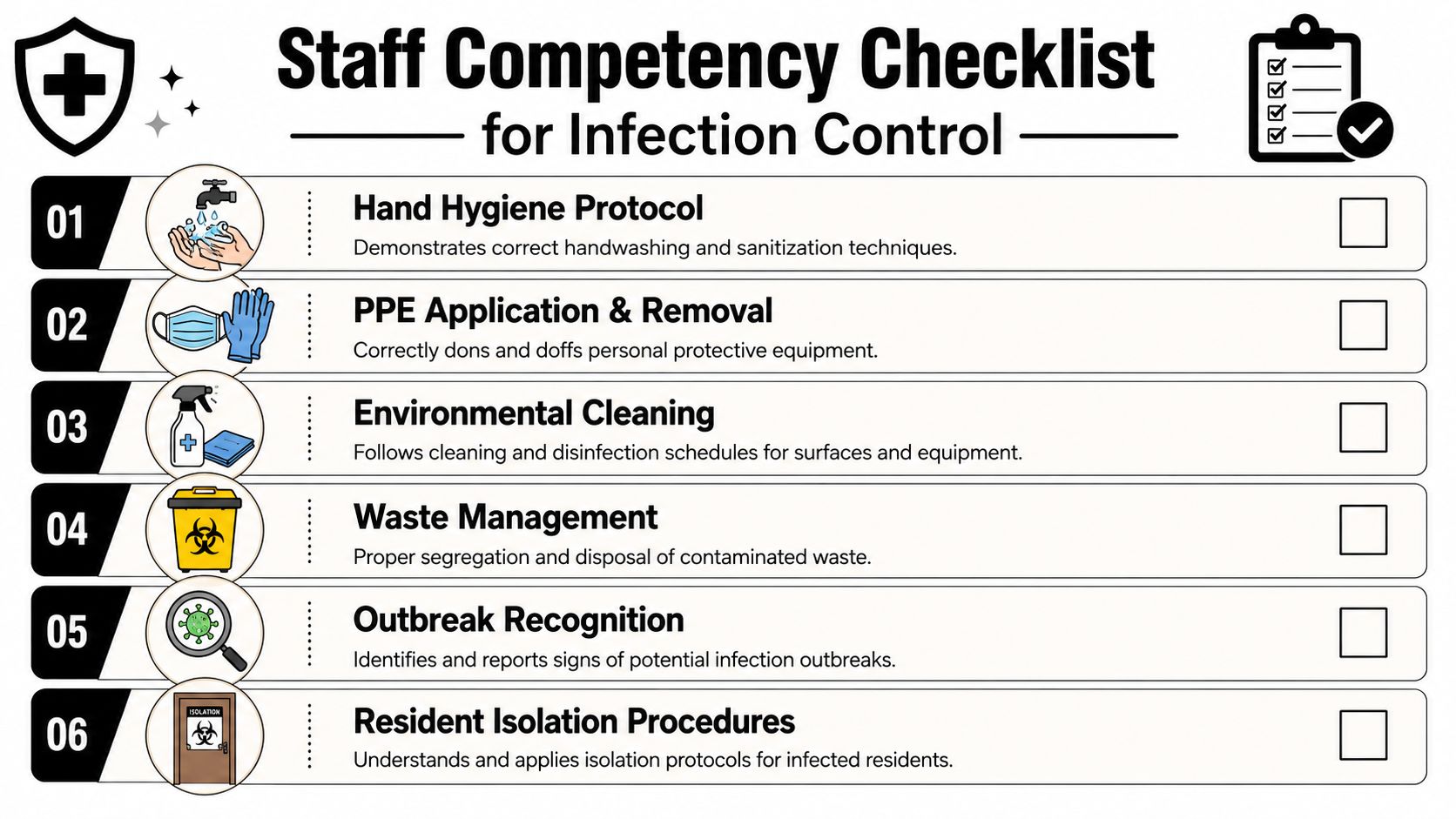
In practice, that means staff must be able to do more than recite rules. They need to show they can:
- Assess risk before contact: Not every task needs the same PPE or the same sequence.
- Use equipment safely: Clean, dedicate, or dispose of items correctly after care.
- Work by zone: Know when they must not move between symptomatic and non-symptomatic residents.
- Handle fluids and waste properly: Avoid contaminating hands, uniforms, handles, and trolleys.
- Recognise deterioration and patterns: Spot when one isolated illness may be turning into something wider.
A short training clip can help reinforce basics during refreshers or supervision:
Training that changes behaviour
One-off induction training isn't enough. Staff need refreshers, but they also need observation. People often know the right answer in a classroom and still make the wrong move during care because the environment is crowded, rushed, or unclear.
That's why competency checks matter. Use real tasks, not only quizzes. Watch staff put on and remove PPE. Watch them clean shared equipment. Watch how they move from one resident to another. Ask what they would do if they were sent from a symptomatic bay to a non-symptomatic resident halfway through a shift.
Useful competency checks include:
- Direct observation: A senior watches routine care and corrects practice immediately.
- Scenario testing: Staff talk through what they'd do on admission, isolation, or suspected outbreak.
- Record review: Check whether cleaning logs, escalation notes, and isolation records are completed properly.
- Spot checks for agency workers: Confirm understanding of site-specific arrangements at the start of the shift.
For staff who need a structured refresher, this guide to infection control training for care workers is the kind of support that helps turn general knowledge into workplace-ready compliance.
Staff don't become competent because they attended training. They become competent when they can apply the standard reliably in your building, with your residents, on your busiest day.
The strongest teams treat infection control as a visible skill. If a carer can demonstrate safe hand hygiene, correct PPE sequence, safe waste handling, and proper escalation, they are far more valuable than someone who only says they've done the course.
Daily Defences Hand Hygiene PPE and Cleaning
A late medication round is running over, a call bell is going, and a member of staff reaches for gloves before they reach for hand gel. That is how small lapses turn into resident harm. Daily infection control is built in those rushed moments, not in the policy folder.
Hand hygiene, PPE, and cleaning are the controls staff use every hour. If they are inconsistent, pathogens move through hands, uniforms, equipment, and surfaces long before anyone suspects an outbreak. That matters even more in homes using bank or agency staff, where people may be competent in principle but unfamiliar with your layout, products, and expectations.
Hand hygiene done properly
Hand hygiene has to happen at the point of care, not when it is convenient. Staff need working sinks, stocked soap and paper towels, alcohol gel in the right places, and enough time to clean their hands between tasks. If any of those are missing, compliance drops.
In practice, the highest-risk moments are predictable:
- Before personal care
- After contact with body fluids
- After removing gloves
- After cleaning tasks
- Before handling food, medicines, or clean equipment
Gloves do not replace hand hygiene. They add a barrier for specific tasks, but contaminated gloves still spread infection to door handles, notes, hoists, and touch screens. I would rather hear a carer say, "I need to stop and clean my hands first," than watch them rush because the shift feels busy.
Watch for the common causes of poor practice:
- Gloves used as a shortcut
- Missed hand hygiene between two tasks for the same resident
- Empty dispensers or sinks that are awkward to access
- Jewellery, watches, or nails that prevent effective cleaning
Staff health matters here too. A worker with broken skin, dermatitis, or an untreated infection is less likely to clean hands properly and may pose a risk to residents. Homes should link IPC practice with occupational health checks for care staff, especially for frequent agency and bank workers who need to show they are safe and fit to work across settings.
PPE that protects instead of contaminates
PPE only helps when it matches the task and is removed safely. The main failure point is usually removal. A member of staff can provide good care, then contaminate their hands or uniform in the final few seconds.
Keep the standard clear.
| Task | What staff need to get right |
|---|---|
| Before entry | Choose PPE for the task and likely exposure |
| During care | Keep hands away from face and avoid touching clean surfaces with contaminated gloves |
| After care | Remove PPE in the correct order and clean hands straight away |
| Between residents | Change PPE when required and never take contamination into the next room |
The trade-off is real. Overuse of PPE wastes supplies and can reduce resident comfort and communication. Underuse exposes staff and residents. Good practice sits in the middle. Staff should be able to explain why they are wearing apron, gloves, mask, or eye protection for that task in that room, in your home.
That matters for mobile staff in particular. A bank carer moving between units can carry risk even if they wear PPE for resident contact, if they then touch keypads, handles, notes, or shared equipment without changing PPE and cleaning hands at the right point.
Cleaning systems that staff can actually follow
Cleaning fails when everyone assumes someone else did it. In care homes, that usually happens with shared equipment and high-touch surfaces. A bedroom may look tidy and still carry contamination on the parts people touch all day.
The safest approach is specific, documented, and easy to check. Staff need to know what is cleaned, with which product, how often, and who is responsible. That includes routine cleaning and cleaning between uses of shared equipment.
Focus on the items that spread infection most easily:
- High-touch surfaces with named responsibility: door handles, rails, call bells, taps, flushes, light switches
- Shared equipment with clear ownership: hoists, commodes, blood pressure machines, thermometers, trolleys
- Colour-coded equipment used properly: cloths and mops kept separate for bathrooms, bedrooms, kitchens, and clinical areas
- Records completed at the time of the task: not written up from memory at the end of the shift
For new, agency, or floating staff, cleaning systems must be visible and local. Labels on cupboards, cleaning charts in the right rooms, and clear product instructions prevent the familiar problem of a competent worker guessing their way through an unfamiliar building.
A room is not clean because it looks presentable. It is clean when the right surface has been cleaned with the right product at the right time, and the home can show that happened.
Managing Movement Staff Cohorting and Resident Screening
Many infection control failures aren't caused by poor handwashing alone. They happen because pathogens are carried through the home by movement. Staff movement. Equipment movement. Admission movement. Once you start looking at the home this way, weak points become obvious.
Research from Norfolk found that once infection was introduced to a care home, spread was largely associated with the number of resident-contact workers employed, highlighting how staff mobility and cohorting consistency affect outbreaks, as discussed in this study of COVID-19 spread in Norfolk care homes. That finding should matter to every manager and every agency worker. The question isn't only whether staff wash their hands. It's whether the system keeps the same people with the same residents as far as possible.
Why movement matters more than people realise
A well-meaning bank worker can become part of the risk pathway if they move between sites, between units, or between symptomatic and non-symptomatic residents in the same shift. The worker may do every individual task correctly and still be part of a weak system.
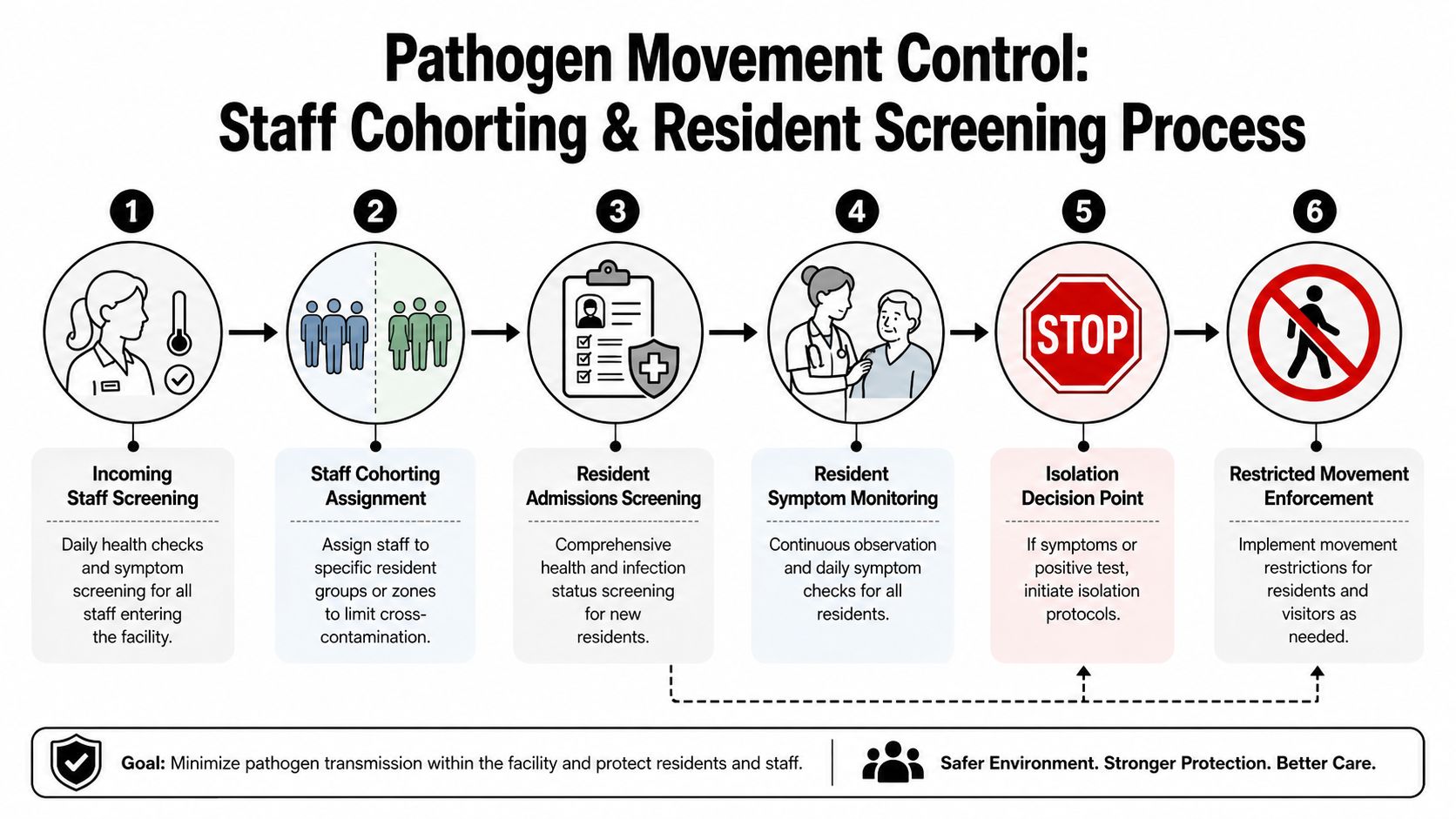
That's why cohorting matters. In practical terms, it means assigning consistent staff to defined resident groups or zones and avoiding unnecessary crossover. The principle is simple. If one zone is affected, you stop it spreading through routine staffing decisions.
Useful questions for managers and shift leads:
- Who has worked elsewhere recently: Especially if staff are covering multiple services.
- Who is allocated where: Avoid moving people casually because one corridor is busier.
- Which equipment stays in zone: Commode means commode, not “just for a minute”.
- What happens when staffing drops: Homes need a fallback plan that doesn't abandon cohorting immediately.
For workers wanting to show they understand compliance beyond the basics, occupational health checks for care staff are part of the wider picture of fitness, screening, and safer deployment.
Screening and cohorting as one system
Resident screening only works when it connects to staffing decisions. A new admission, especially from hospital, changes the home's risk picture straight away. So does a resident returning after treatment, a new cough on one unit, or a sudden cluster of gastric symptoms.
Build a joined-up routine:
- Screen new admissions carefully: Gather all relevant infection and symptom information before placement.
- Start daily health checks: Temperature and vital sign monitoring help staff notice changes early.
- Allocate staff by zone: Keep teams stable wherever possible.
- Restrict crossover when symptoms appear: Don't wait for a perfect answer before reducing movement.
- Review bank and agency deployment: The safest roster is usually the least mobile one.
Infection control in care homes functions as a management discipline, not merely a bedside task. The homes that do this well understand that staffing flow can either interrupt transmission or carry it further.
Responding to an Outbreak and Reporting Duties
Even good systems get tested. When an outbreak starts, hesitation causes damage. Staff need a calm, consistent response that prioritises containment, communication, and reporting. If the first few hours are disorganised, the home spends the next few days catching up.
In the UK, around 40 in every 100 care homes experience a gastroenteritis outbreak each year, and during the COVID-19 pandemic nearly half of all UK care homes were closed to new admissions due to the Omicron outbreak, according to this overview of infection burden and operational disruption in UK care homes. Outbreaks aren't rare interruptions. They're operational events that every home should expect to manage at some stage.
The first decisions matter most
When symptoms suggest an outbreak, act as though early containment will save you work later. Waiting for perfect certainty usually means more exposure, more confusion, and more avoidable movement.
A practical first response often includes:
- Separate symptomatic residents quickly: Use single rooms or designated areas if available.
- Begin enhanced cleaning immediately: Increase attention to high-touch points and shared equipment.
- Stop non-essential movement: Limit staff crossover, resident mixing, and unnecessary traffic.
- Protect admissions decisions: Review whether new admissions can be accepted safely.
- Brief staff clearly: A short, direct handover beats a long message that nobody can remember.
The messaging matters. Families need honest updates. Staff need to know what has changed today, not a generic reminder of policy. Residents need reassurance as much as restriction.
Reporting is part of control
Some teams still think reporting sits alongside outbreak management. It doesn't. Reporting is outbreak management. If the right people aren't informed, support arrives late, records become patchy, and the home may miss regulatory duties.
Keep one clear outbreak record that captures symptoms, onset dates, resident locations, staff impact, actions taken, and who has been notified. If several people are making calls and notes separately, information gets lost.
Use a basic reporting checklist on shift:
| Duty | Why it matters |
|---|---|
| Notify internal leaders | Keeps decisions consistent across shifts |
| Contact the relevant public health route | Supports risk advice and wider control |
| Notify the CQC when required | Meets mandatory regulatory obligations |
| Log all actions taken | Creates evidence and avoids contradictory accounts |
| Update relatives and staff | Reduces confusion and complaint risk |
For teams that need a stronger reporting culture, incident reporting procedures in care settings are worth revisiting so staff know what to record, when to escalate, and how to do it consistently.
A home doesn't prove its strength by avoiding every incident. It proves its strength by recognising trouble early, tightening control quickly, and documenting every significant action properly.
Auditing Your System and Continuous Improvement
Monday morning looks calm. No residents with new symptoms, no obvious stock gaps, no one reporting a problem. That is exactly when auditing matters most. Quiet shifts can hide the habits that start outbreaks later, especially when staff have moved between units, bank staff have filled gaps at short notice, or cohorting has slipped because the rota was stretched.
Audit work checks whether the standard described on paper is the standard seen on shift. Without it, managers are left with reassurance, and reassurance does not protect residents or satisfy CQC if practice is poor.
Waiting until something goes wrong makes the review less useful. Staff are already under pressure, memories differ, and the focus shifts to blame instead of control. The better approach is to check routine practice while the home appears stable, then correct small failures before they spread across shifts.
What to audit every week
Audit a few high-value points properly. Trying to inspect everything usually produces tidy forms and weak oversight.
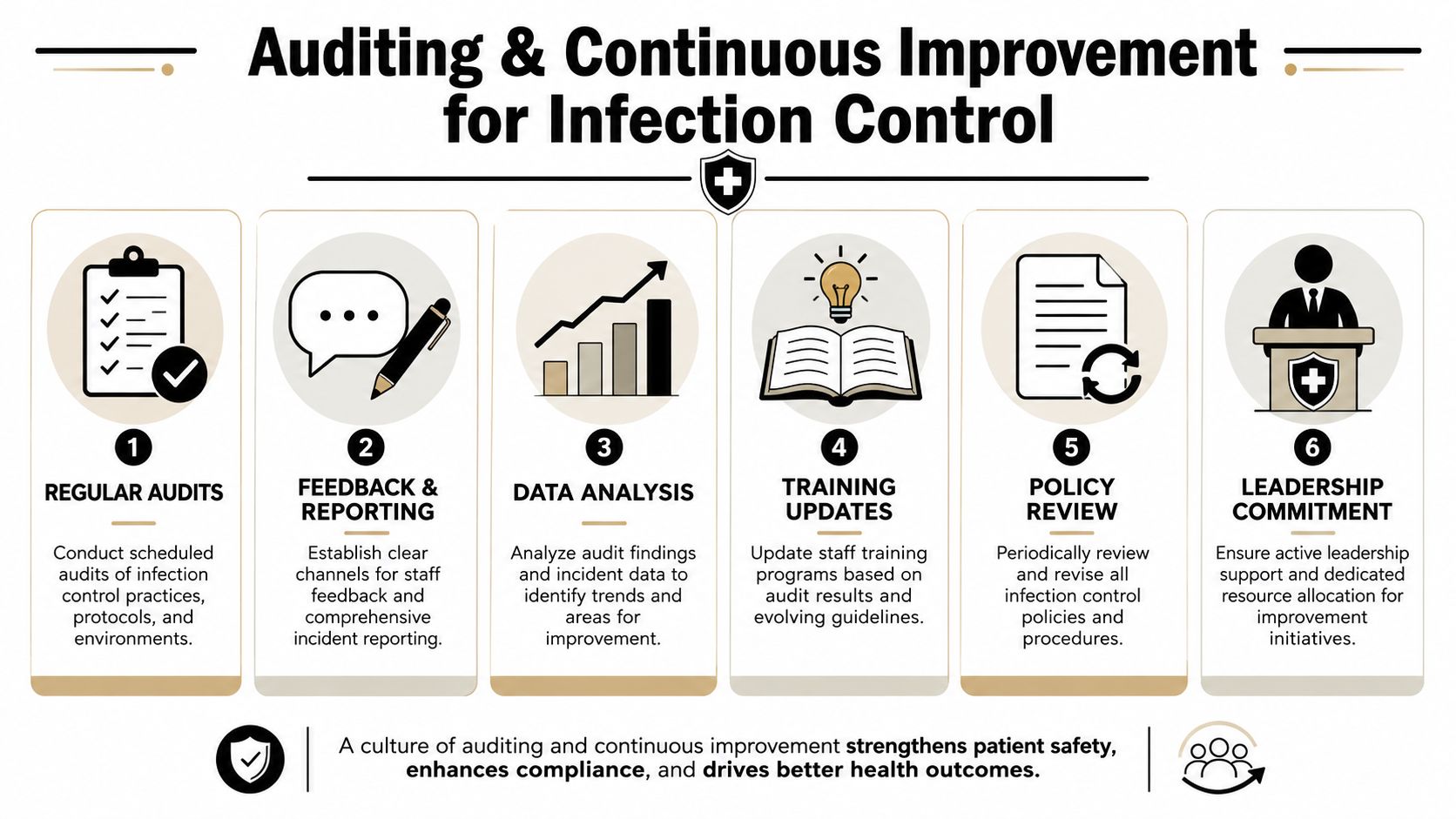
A practical weekly audit might include:
- Hand hygiene observation: Watch care tasks live, including points of contact before and after resident care.
- PPE practice: Check the choice of PPE, where it is stored, and whether staff remove it safely in the care environment.
- Cleaning evidence: Compare cleaning records with what has been cleaned, by whom, and at what time.
- Dedicated equipment use: Confirm items assigned to an isolation area or cohort have stayed there.
- Staff allocation patterns: Review whether staff were kept to one group of residents or moved around to cover gaps.
- Escalation records: Check that new symptoms, concerns, and advice given were recorded promptly and handed over clearly.
Staff allocation needs special attention. Homes often audit soap, gloves, and cleaning schedules, then miss the system weakness that matters just as much. A single worker covering two areas, or an agency carer booked across different homes in the same week, can undo a lot of good daily practice if that movement is not assessed and controlled.
Use findings to improve practice
An audit should lead to a visible change on the floor. If it only creates a folder for inspection, staff quickly learn that the exercise is administrative rather than protective.
The key question is straightforward. What needs fixing before the next shift starts?
Sometimes the answer is simple. Move hand gel to the point of care. Replace a confusing cleaning checklist. Re-label equipment so it stays with the right residents. Sometimes the answer is harder and more expensive, such as changing the rota to reduce crossover, refusing unsafe last-minute redeployment, or giving bank and agency staff a tighter induction before they work independently. Those decisions can feel difficult on a short-staffed day, but they are often cheaper than managing an outbreak.
Good auditing is specific. It names the behaviour, the location, the shift pattern, and the fix.
Record the finding, the action, the person responsible, and the review date. Clear records matter for CQC, but they also help managers see patterns over time. One missed cleaning signature may be a one-off. Repeated breaches in the same unit, on the same shift, or among temporary staff usually point to a system problem.
Leadership keeps the standard alive
Frontline staff carry infection control minute by minute. Leaders decide whether the system supports them or sets them up to fail.
If managers break cohorting to plug rota holes, accept incomplete agency inductions, or ignore missing documentation, staff notice. Standards drop quickly when convenience keeps winning over control. The reverse is true as well. Teams are more likely to follow the rules when they can see that leaders protect staffing boundaries, challenge poor practice early, and act on audit findings instead of filing them away.
Continuous improvement starts with a few hard questions asked regularly:
- Which breaches keep recurring, and on which shifts or units do they happen?
- Is the problem a knowledge gap, or are staffing patterns making safe practice difficult?
- How are bank and agency staff checked, briefed, and monitored before they move between residents or areas?
- Can the home show a clear record of what was found, what was changed, and whether it worked?
If those answers are unclear, the priority is tighter oversight, safer staff allocation, and consistent follow-through.
Cura Academy helps care workers and care providers stay job-ready and compliant with practical training that fits real frontline work. If you need a straightforward way to keep mandatory learning current, build confidence for shifts, and strengthen everyday standards around infection control, explore the training and membership options available through Cura Academy.