
You're halfway through a shift when a person you support refuses their medication, turns away from you and becomes visibly distressed. A rushed response might label the behaviour as difficult. A trained response pauses, checks whether the person understands what's being asked, looks for pain or anxiety, changes the communication approach and involves the right colleague before the situation escalates.
That difference is the practical purpose of learning disability awareness training. It helps care workers, support workers, agency staff, bank workers and managers turn policy into safer actions during ordinary visits, handovers, appointments and personal-care routines. It isn't about memorising definitions or treating every person in the same way. It's about recognising how communication, consent, health needs and reasonable adjustments affect the support someone receives.
The need is broad. In England, there are approximately 1.3 million people with a learning disability, including over 950,000 adults aged 18 or over, while nearly 68,000 children were identified with a primary special educational need associated with a learning disability. About 26% of those children were educated in mainstream schools, so awareness matters across hospitals, schools, residential services and community settings, as explained in the government guidance on learning disabilities.
This guide starts with what awareness training means, then explains the UK legal framework, common learning objectives and delivery formats. It finishes with practical shift scenarios and an action plan for making training visible in supervision, onboarding and care practice.
Table of Contents
- Introduction to Learning Disability Awareness Training
- What Learning Disability Awareness Training Really Means
- Legal and Regulatory Context in the UK
- Core Learning Objectives and Common Modules Explained
- Delivery Methods and Assessment Approaches Compared
- Practical Scenarios and Tips for Confident Support
- Next Steps for Compliance and Continuing Development
Introduction to Learning Disability Awareness Training
A new support worker might meet someone who uses few words, needs extra processing time or reacts strongly to a noisy environment. None of those details, by themselves, tells you what the person wants, understands or can decide. Good training helps you replace assumptions with careful observation and respectful questions.
Consider a domiciliary visit where the person appears not to co-operate with washing and dressing. A worker without suitable preparation may repeat instructions more loudly, hurry the task or ask a family member to take over. A worker who has developed awareness might reduce the number of words used, offer two clear choices, allow processing time and check for discomfort. The outcome isn't guaranteed, but the approach gives the person a fairer opportunity to communicate and participate.
Practical rule: Treat a change in behaviour as information before treating it as a problem.
Learning disability awareness training supports person-centred care because it focuses on the individual rather than a label. It encourages staff to learn how someone communicates, what helps them feel safe, how they show pain and which adjustments make everyday tasks easier. Those details belong in care plans, handovers and supervision, not only in a training workbook.
It also supports organisational readiness. For CQC-registered providers, role-appropriate training is now part of a statutory framework, so managers need more than informal advice passed between experienced workers. Agency and bank staff need clear evidence of what they've completed, which tier applies to their role and where they can find local procedures.
By the end of this guide, you'll be able to distinguish awareness from competence, understand why training is tiered, identify the modules that matter on shift and use scenarios to test whether learning has reached practice. You'll also have a simple route for recording training and discussing gaps with a supervisor.
What Learning Disability Awareness Training Really Means
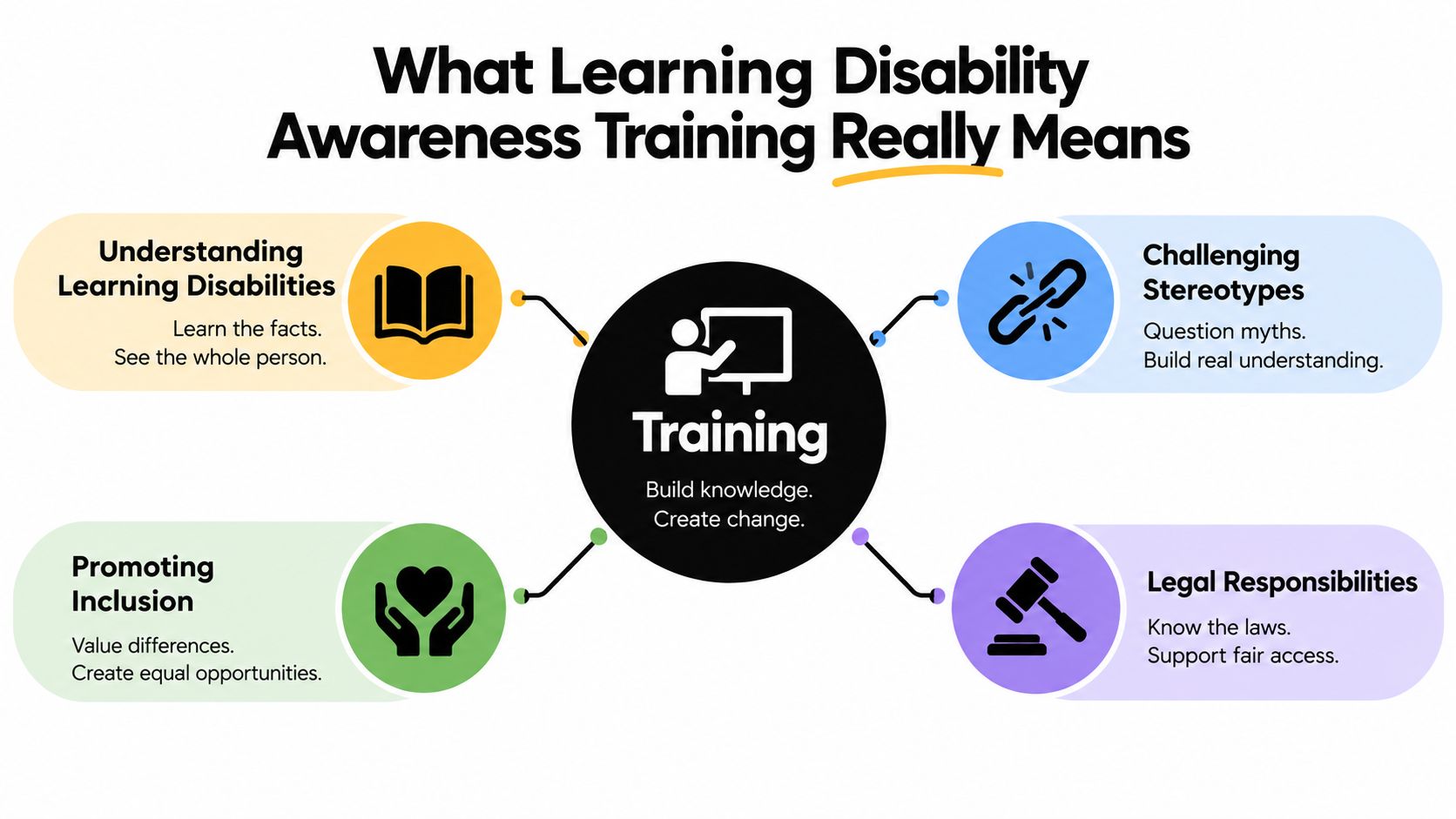
Learning disability awareness training builds the understanding, attitudes and practical skills needed to support people respectfully and safely, while keeping individual preferences at the centre. On a busy shift, that may mean preparing information in an accessible format, explaining each step before providing support and checking how the person wants to respond.
Support works like a well-planned journey. Preparation means learning what helps the individual feel safe. Communication means offering information in a form they can use and allowing time to process it. Review means checking afterwards what worked, recording it and sharing it through the care plan or handover.
Learning disability may affect how someone understands information, learns new skills or manages everyday tasks. A learning difficulty, such as dyslexia, usually refers to a specific difficulty with a particular type of learning. Autism is different again, although a person can be autistic and have a learning disability. These terms provide context, but they do not describe the whole person or decide what support they need.
Awareness must lead to action
A strong course connects three areas:
- Understanding: Learn what learning disability can mean in daily life, without assuming that people with the same diagnosis have identical needs.
- Attitudes: Challenge stereotypes, infantilising language and speaking about a person rather than addressing them directly.
- Practice: Use accessible communication, make reasonable adjustments and recognise when a concern needs escalation.
A certificate records completion, but practice shows whether learning has transferred to the shift. A worker may pass a knowledge check and still rush a conversation, overlook a communication aid or mistake distress for refusal. The useful test is practical: can the worker explain what they would change during a real interaction?
Training should include people with lived experience. Co-production lets learners examine whether examples, language and proposed solutions reflect real lives instead of professional assumptions. The Oliver McGowan code of practice places lived-experience involvement at the centre of its delivery model.
Why this matters for equality
A person who needs more time to answer still deserves to be asked directly. Someone who uses pictures, gestures or a communication device still needs staff to listen through that preferred method. Awareness training helps workers identify barriers created by standard processes, including unclear appointment letters, rushed consent conversations or unfamiliar staff entering a person's home without explaining what will happen.
The aim is to remove avoidable barriers while keeping expectations respectful and appropriate. That gives people a fairer opportunity to participate, make choices and receive suitable care, whether support is provided by a permanent, agency or bank worker.
Legal and Regulatory Context in the UK
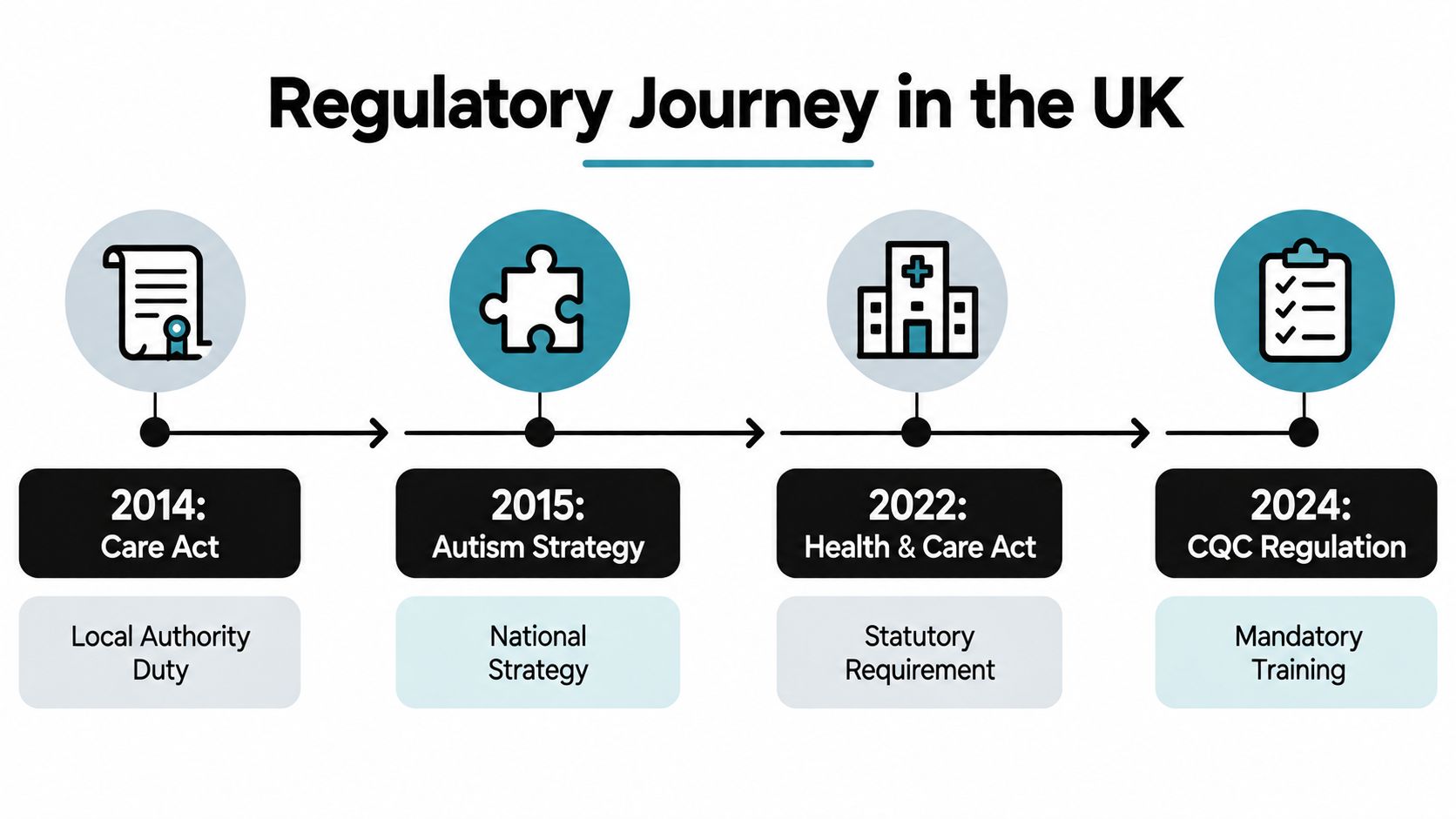
The legal position in England has changed significantly. Learning disability and autism training moved from a best-practice recommendation to a statutory requirement through the Health and Care Act 2022. The Act requires CQC-registered health and social care providers to ensure staff receive training appropriate to their role, with implementation supported through the Oliver McGowan Mandatory Training framework, as recorded in the Parliamentary report on the programme.
For an individual worker, this means training shouldn't be treated as an optional extra that can wait until a manager has spare time. For a provider, it means the organisation needs a defensible system showing who requires training, which level applies, when it was completed and how learning connects with practice.
Understanding the two training levels
The framework distinguishes between general awareness and more specialist responsibility:
- Tier 1 is intended for general staff who need a foundation in learning disability and autism awareness. The code sets a minimum of one hour of live, interactive awareness training.
- Tier 2 is intended for staff with greater autonomy, more complex-care responsibilities or a stronger influence on decisions and support. The minimum is one day of in-person specialist training.
The tier should follow the role, not the worker's job title. A new agency worker may need general awareness before accepting shifts, while a senior support worker, clinical professional or care coordinator may require deeper learning because their decisions affect assessment, escalation and care planning.
Both levels include lived-experience co-delivery. The code requires involvement from a person with a learning disability and an autistic person. That design matters because learners hear how communication, reasonable adjustments and service failures feel from the person receiving care, not only how those issues appear in a policy.
Why the scale affects onboarding
Government estimates cited by Parliament projected that over the first three years of rollout, 1,036,000 staff would complete Tier 1 and 1,186,000 staff would complete Tier 2. Those estimates show why providers need organised onboarding rather than relying on individual workers to discover training independently.
Providers should also distinguish the statutory duty from wider encouragement. CQC-registered employers must meet the legal requirement, while non-CQC employers are encouraged to train staff but aren't covered by the same statutory duty. If you're unsure which expectation applies to your setting, ask your manager or compliance lead and record the answer.
Workers who also need a clear understanding of decision-making duties can review their organisation's Mental Capacity Act training requirements, then connect that knowledge to local consent and escalation procedures.
Core Learning Objectives and Common Modules Explained
Good training should answer a practical question: what will the worker do differently after learning this? Definitions matter, but a course earns its place in care practice when it changes the way staff communicate, assess risk and support choices.
The implementation gap makes this especially important. The government's impact assessment estimated that only about 9.7% of the adult social care workforce had received relevant learning disability and autism training. The same assessment recorded that 53% of staff in a 2018 benchmark said they had the necessary training to meet learning disability improvement standards, while 64% of GPs reported less than a day of training on meeting the needs of people with a learning disability. These figures appear in the Oliver McGowan training impact assessment.
Understanding and attitudes
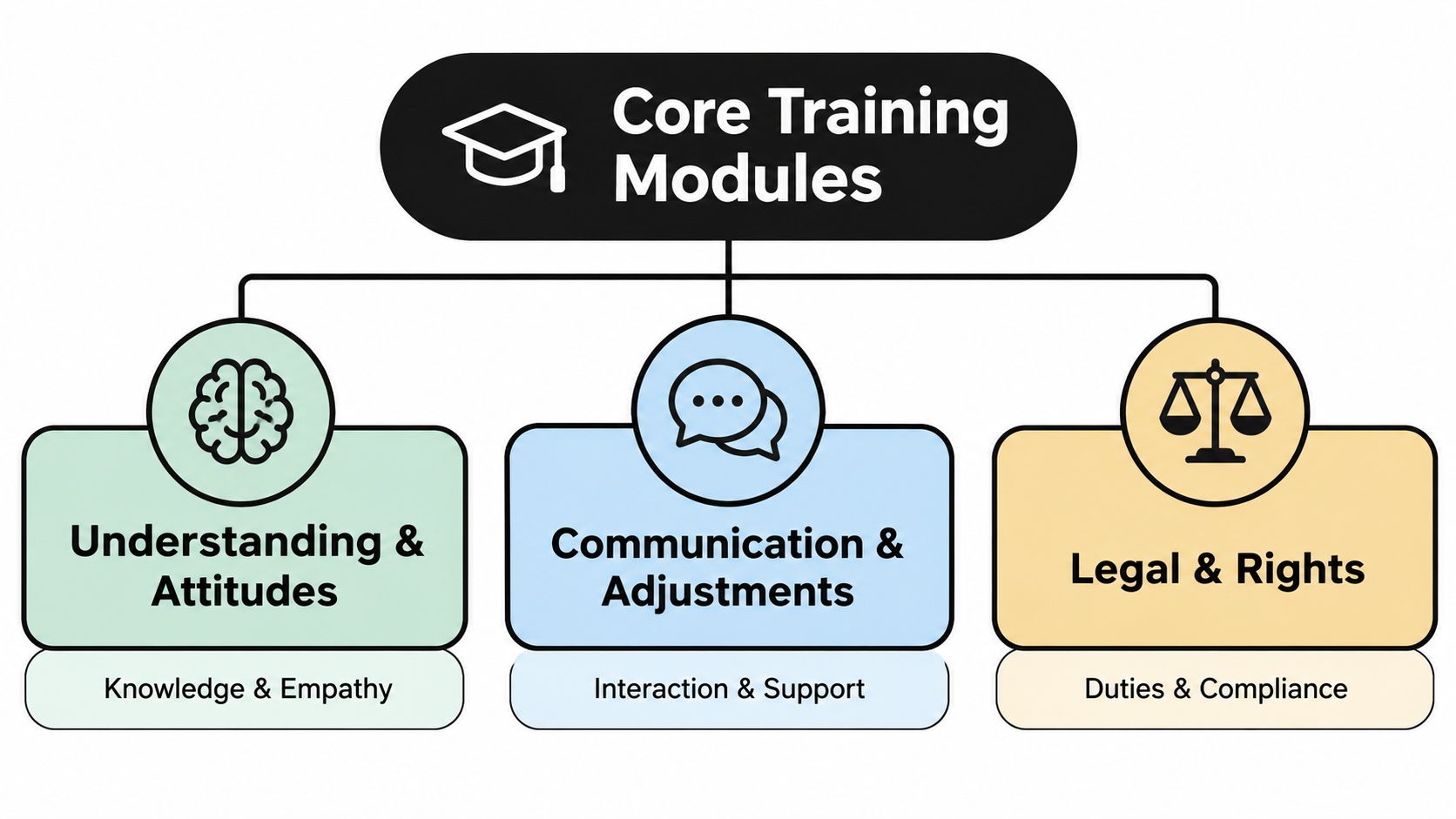
Learners need to recognise that a learning disability can affect people in different ways. The module should challenge assumptions about ability, behaviour, independence and quality of life. It should also explain why staff must speak directly to the person, respect adult identity and avoid making decisions based only on diagnosis.
A useful learning check asks: “What information would I need to learn about this person rather than assume?” The answer may include preferred communication, sensory needs, routines, signs of pain, support with choices and the person's own goals.
Communication and adjustments
Awareness becomes visible on shift. Workers should practise using plain language, short explanations, visual prompts, extra processing time and confirmation of understanding. They should know that repeating the same sentence louder isn't the same as making information accessible.
Reasonable adjustments may include changing the timing of an appointment, reducing background noise, explaining each step of personal care or allowing a familiar supporter to help with communication. The correct adjustment depends on the person and the situation, so staff should ask, observe and record what works.
You can connect these skills with a broader core skills training framework when planning induction or continuing professional development.
Health, capacity and rights
Training should help workers recognise deterioration, pain, fear and distress when a person may not describe symptoms in typical ways. It should cover the Mental Capacity Act, consent, best-interest decision-making, safeguarding and escalation routes without suggesting that a diagnosis automatically determines capacity.
A person may lack capacity for one decision and have capacity for another. Staff should support the person to understand, communicate and decide before assuming someone else must decide for them. Scenario practice is valuable because it lets learners rehearse what to say, what to document and when to seek advice.
Delivery Methods and Assessment Approaches Compared
A new agency worker may complete an e-learning module before a shift, while an experienced support worker may need live discussion to examine a difficult situation. The right format depends on the role, risk and evidence the employer must keep. E-learning can build shared knowledge and provide a completion record. Live sessions let workers question assumptions, practise responses and hear lived experience. Face-to-face workshops give staff with greater responsibility time to rehearse complex decisions.
The Oliver McGowan programme uses co-delivery by a person with a learning disability and an autistic person. NHS England reported high use of its e-learning, with more than 2.5 million launches and more than 740,650 completions by October 2023, as recorded in the official code of practice. The delivery lesson is practical: lived experience should shape discussion, examples and feedback, rather than appear as a separate topic.
Choosing a suitable format
| Format | Best For | Time Commitment | Assessment Style |
|---|---|---|---|
| E-learning | Initial knowledge, preparation and revision | Flexible, self-paced | Knowledge checks and completion record |
| Live interactive webinar | Staff needing discussion and participation | Scheduled live session | Questions, scenarios and participation |
| Face-to-face workshop | Specialist roles and complex-care responsibilities | Dedicated in-person session | Facilitator observation, scenarios and reflection |
| Blended pathway | Foundation learning followed by practice support | Spread across stages | Online checks, live learning and supervisor sign-off |
A completion record should include the worker's name, course or framework, date, tier, delivery method and assessment evidence. Managers should store it where it can be checked during onboarding, supervision and audit. For a bank or agency worker, the record should also show whether the organisation has accepted the training for that role.
Supervisor sign-off should be specific. It might confirm that the worker used the person's communication guidance, allowed processing time, checked consent, recorded an adjustment and knew when to escalate. The supervisor can review one observed interaction or discuss a realistic shift scenario, then record any further coaching required.
Assessment should test judgement, not memory alone. A knowledge check confirms key principles. A scenario shows whether the worker can apply them safely in the setting where they will work.
Practical Scenarios and Tips for Confident Support
A training room can feel straightforward. A busy shift is different. The worker must notice what's happening, adapt quickly and still follow consent, safeguarding and recording procedures.

A domiciliary visit
You arrive for a planned personal-care visit and the person stays in the doorway, avoids eye contact and says “no”. Start by reducing pressure. Introduce yourself, explain why you're there in simple language and offer a choice about what happens first. Check the care plan for communication guidance, ask whether anything has changed and allow time for an answer.
Don't assume refusal means the person doesn't understand, and don't use a family member as a substitute decision-maker without following the correct process. If the person appears unwell or distressed, report the concern through the agreed route and document what you observed, what you tried and how the person responded.
A care home shift
A resident becomes unsettled during lunch and pushes the plate away. Look beyond the meal itself. The person may have dental pain, difficulty swallowing, an unfamiliar food, noise around the dining area or trouble understanding the instruction to eat.
Offer choices, reduce distractions and use the person's known communication method. Ask colleagues about usual signs of discomfort, then record any new pattern and escalate health concerns. Staff supporting behaviour can also use structured behaviour support strategies while checking that the approach remains person-centred and not punitive.
An agency booking
You're working in an unfamiliar service and a person needs support to attend an appointment. Before starting, read the relevant care information and ask the shift lead about communication, mobility, health risks, consent and known triggers. Introduce changes openly. Don't promise that a routine will stay the same if you don't control it.
Use short explanations, check understanding and give the person time. If the service has a learning disability champion, involve them when you need help interpreting communication or adjusting the plan.
NHS guidance recommends clinical scenarios, co-production with people with a learning disability, adaptation to local context, ongoing coaching and champions in every setting. The guidance also makes clear that one size does not fit all, which is why supervision should examine real interactions rather than only course completion.
This video can support a team conversation about applying awareness to frontline situations:
After watching, ask staff to discuss one recent shift where a reasonable adjustment helped, one situation they found difficult and one change they'll make on their next visit.
Next Steps for Compliance and Continuing Development
Treat training as a working system, not a certificate stored in an inbox. The quickest route to safer onboarding is to connect the person's role, required tier, completed learning and observed practice in one clear record.
For individual workers
Start with your employer's training matrix. Confirm whether your role requires general awareness or specialist learning, whether the course includes live interaction and lived-experience co-delivery, and how completion will be recorded. Keep your certificate or completion evidence, but also write down two practical changes you'll make on shift.
Use supervision to discuss communication aids, reasonable adjustments, consent and escalation. Ask your supervisor to observe practice or review a scenario with you. A short conversation about a real visit can reveal more than repeating a definition from an online module.
For providers and agencies
Build learning into recruitment, induction and booking controls. Before a worker starts, confirm the training status that applies to their role and make the evidence easy for managers to audit. Include agency and bank staff in the same practical expectations as permanent workers, while giving them local information about care plans, champions and escalation routes.
Review whether learning appears in practice. Useful checks include whether care plans describe communication preferences, whether staff record reasonable adjustments, whether supervision discusses capacity and consent, and whether teams recognise changes in health or distress. Completion data can show reach, but it doesn't prove behaviour change or improved experience.
Refresh learning when the role, guidance or practice gap requires it. Use incidents, complaints, safeguarding themes and supervision discussions to identify where a team needs coaching rather than another completion deadline.
Cura Academy provides structured care training pathways, including mandatory and role-related learning, with records that can support onboarding and continuing development. Visit Cura Academy to review training options for your own care career or discuss a more organised approach for your team.