

A Friday-night email can derail a carer's entire working week. A domiciliary carer in Manchester may be ready for Monday shifts, only to learn at 11pm that the agency can't counter-sign the application until the Enhanced DBS process is complete. Payroll pauses, the rota needs rewriting, and the person receiving care is left without planned cover.
That's why knowing how to get an Enhanced DBS matters before you accept a start date. The process isn't a matter of filling in an online form. Your role must qualify, the correct organisation must submit the application, your identity documents must match, and the check level must reflect the work you'll do.
Table of Contents
- The Enhanced DBS Check and Why It Matters for Care Work
- Who Actually Qualifies for an Enhanced DBS Check
- Gathering and Verifying Your Identity Documents
- Choosing Your Application Route as a Care Worker
- Submitting Your Application and What Happens Next
- Joining the DBS Update Service for Faster Onboarding
- Common Pitfalls That Delay Your Enhanced DBS
The Enhanced DBS Check and Why It Matters for Care Work
An Enhanced DBS check is the highest level of criminal record check available for eligible roles in England and Wales. It may disclose relevant convictions, cautions, reprimands and warnings, plus other information a police force reasonably considers relevant to the role. What appears depends on the position's legal eligibility and the information held.
Care workers also face a common source of onboarding delay: confusing an Enhanced check with a Barred List check. An Adults' Barred List check is not automatically included in every Enhanced certificate. It can be requested only where the role meets the legal definition of regulated activity. The same rule applies to the Children's Barred List. Employers should request only the list or lists justified by the duties. The DBS guidance for employers explains the difference between Enhanced checks and Enhanced checks with Barred List information.
Practical rule: Your job duties determine the check level, not the job title printed on your contract.
A support worker in a CQC-registered home, a domiciliary carer delivering personal care, and a carer working on an NHS-commissioned package may all require an Enhanced check. The employer must establish the legal basis before submitting the application. Requesting a higher-level check because it appears safer creates a compliance problem and can delay onboarding.
The DBS system also handles substantial demand. During the 2025 to 2026 financial year, 7,433,877 DBS certificates were issued across Basic, Standard, Enhanced and Enhanced with Barred List checks, according to the DBS annual report and accounts. That volume explains why care providers, Umbrella Bodies and applicants need accurate applications from the start.
Processing time varies. A straightforward application may move differently from one requiring additional review by a local police force. Care workers should therefore confirm the correct check level, Barred List requirement and application route before agreeing a start date. For the specific DBS performance aims and timing detail, see the later section on what happens after submission.
Who Actually Qualifies for an Enhanced DBS Check
Take a support worker providing personal care to a 78-year-old person with dementia in their own home. The worker helps with washing, dressing, eating and toileting because of the service user's age, illness or disability. That combination of duties is what drives eligibility, not the label “support worker”.
Three legal questions need answering.
The role must fall within the permitted exceptions
The role must be covered by both the Rehabilitation of Offenders Act 1974 (Exceptions) Order 1975 and the relevant Police Act 1997 regulations. The DBS eligibility guidance sets out this requirement.
Care work can fall within the specified activities that permit an employer to ask for information beyond a Basic check. That means an eligible Enhanced certificate may reveal information that wouldn't appear on a Basic certificate, subject to the filtering rules and disclosure requirements.
The duties must meet the regulated activity test
Personal assistance with washing, dressing, eating or toileting is materially different from general companionship. If the same worker only offered conversation, signposted local services or ran a group activity without providing personal care, the legal basis could be different.
The employer must assess the actual duties, frequency, supervision arrangements and the adults or children receiving the service. A broad job description creates risk because it can encourage an organisation to select a check level without examining what the worker will do in practice.
Barred List access is separate
An Enhanced DBS check can include relevant police information. An Enhanced DBS check with an Adults' Barred List check also indicates whether the applicant is barred from regulated activity with adults. Barred List access is lawful only where the role qualifies.
| Care Role | Contact Type | Eligible DBS Check | Barred List |
|---|---|---|---|
| Domiciliary carer providing washing, dressing and toileting support | Regulated personal care | Enhanced | Adults' Barred List where legally eligible |
| Residential care worker delivering personal care | Regulated personal care | Enhanced | Adults' Barred List where legally eligible |
| Befriender offering companionship only | Non-personal contact | Check level depends on the precise legal duties | Usually not justified |
| Group activity assistant with no personal care | Supervised or non-regulated contact | Check level depends on the setting and duties | Not automatically required |
The common mistake is treating Enhanced as “better” and therefore suitable for every care-adjacent role. It isn't. Requesting information beyond the role's legal entitlement can amount to an offence under safeguarding legislation. The compliant approach is narrower and more disciplined: document the duties, identify the legal basis, then request the check that matches.
Gathering and Verifying Your Identity Documents
Most avoidable DBS delays begin before the application reaches the police. The name on your form, the details on your identity documents and your address history must line up. If they don't, the verifier may need clarification or the application may be returned.
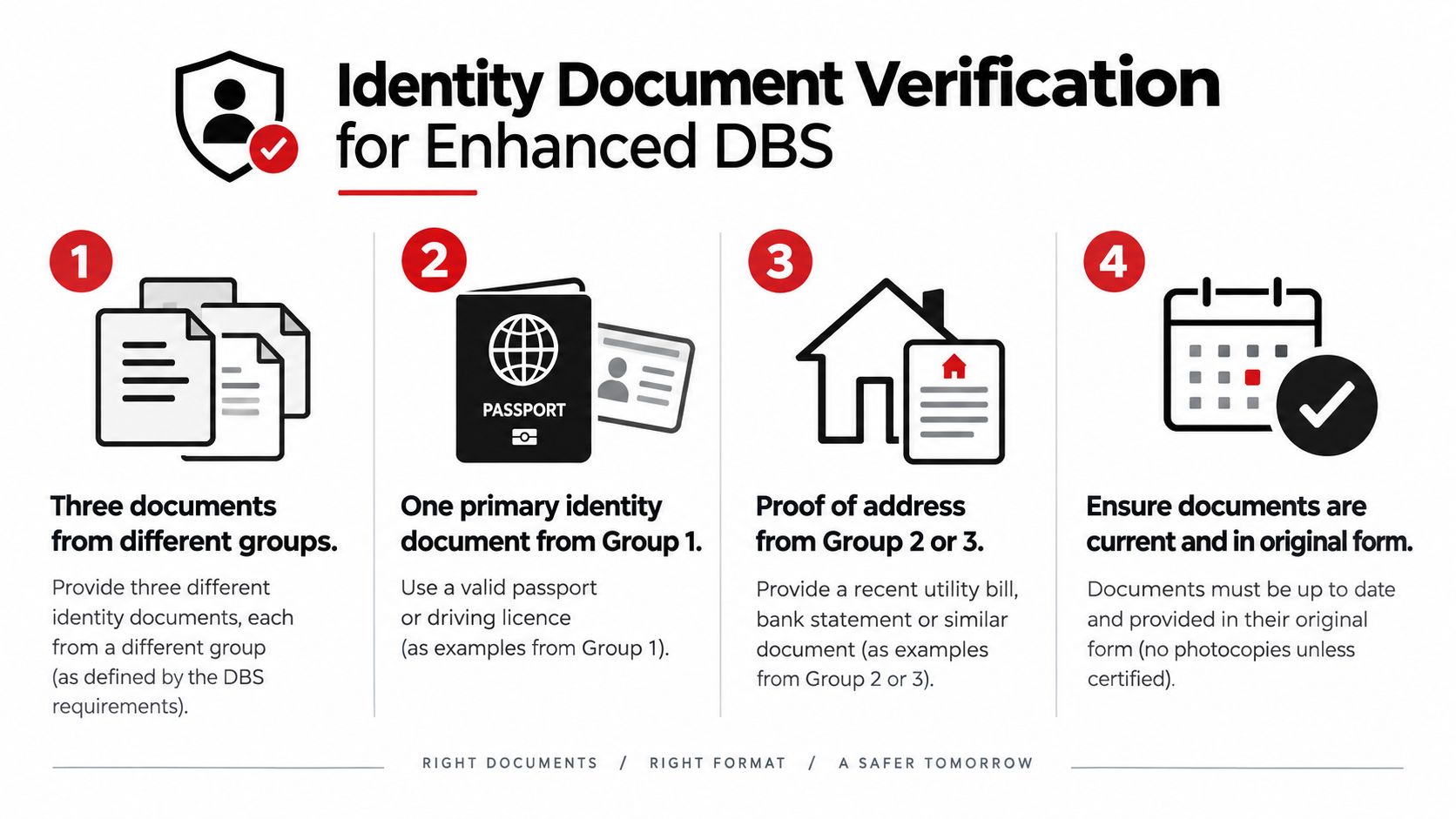
The current DBS identity rules require the checker to use one of the approved identity routes and to prioritise photographic documents where available. Start by preparing original documents, not blurred phone photographs or improvised scans.
Use a sensible document set
A typical set includes a passport or photocard driving licence, supported by documents such as a birth certificate, utility bill, bank statement, council tax bill, HMRC letter or payslip. Your verifier will tell you which combinations are acceptable under the route being used.
Check these points before your appointment:
- Match your legal name: Include every current name and explain a previous name where the form requires it.
- Prove your current address: Use an accepted document showing where you live now.
- Check dates: Address evidence that falls outside the permitted period can be rejected.
- Bring originals: Photocopies or screenshots may not satisfy the verifier's requirements.
- Keep details consistent: Your date of birth and address must agree across the application and documents.
Mobile banking statements may be accepted when presented through an approved verification process, but a casual screenshot often won't be enough. If you're unsure, ask the employer, Post Office verifier or Umbrella Body before submitting anything.
For a clearer explanation of address evidence, use this guide to proof of address in the UK. Don't wait until the appointment to discover that your only available document carries an old address.
Route 1 uses an automated identity check with suitable photographic identity evidence. Route 2 involves a manual check of the required documents. Route 3 is an exceptional process for cases where the first two routes can't be completed and requires an authorised identity verifier.
Choosing Your Application Route as a Care Worker
The right application route depends on who employs you and who has legal authority to submit the check. Most applicants can't apply for a Standard or Enhanced DBS check as private individuals. An employer, Registered Body or eligible Umbrella Body must submit and counter-sign it.
Employer-led applications
If a care agency employs you, it will normally start the application, verify your identity and submit the completed form through its Registered Body or Umbrella Body. This is usually the cleanest route because the organisation already knows the role, the required check level and the onboarding deadline.
The drawback is dependence on the agency's administration. If HR waits to review your documents or enters an incomplete address history, you can't fix the delay by contacting DBS directly.
Umbrella Body applications
Self-employed carers, agency workers and personal assistants often need an Umbrella Body. A January 2026 government update confirms that eligible self-employed people and personal employees can apply for Enhanced or Enhanced with Barred List checks through an Umbrella Body, provided the role qualifies. The guidance for self-employed people and personal employees also warns that administration fees may be added.
This route makes sense when no standard payroll employer can counter-sign the application. Ask the Umbrella Body to confirm the role's eligibility before paying. Don't describe the work vaguely. Explain whether you provide personal care, medication support, domestic assistance, companionship or a mixture.
Direct routes for personal assistants
Some personal assistants paid through Direct Payments may have a route through GOV.UK or through a responsible body that supports Update Service access. The details depend on the employment arrangement and the eligible duties, so the person arranging the care should confirm the route rather than assume it.
| Route | Who Initiates | Typical Cost | Best For | Drawback |
|---|---|---|---|---|
| Employer-led | Care employer or agency | DBS fee plus any employer administration charge | Employees joining a care provider | You depend on the employer's processing |
| Umbrella Body | Applicant or engaging organisation through an Umbrella Body | DBS fee plus the body's administration charge | Eligible self-employed carers and personal assistants | Fees and eligibility checks vary |
| Direct or responsible-body route | Eligible personal employee arrangement | Depends on the route and provider | Certain Direct Payment arrangements | It may not apply to ordinary self-employed work |
The Enhanced DBS fee is £49.50, and a Registered Body may add its own administration fee, as stated in DBS fee guidance. Treat any quoted total as two separate parts: the statutory DBS charge and the provider's administration cost.
Submitting Your Application and What Happens Next
A small error in your address history can hold up an otherwise straightforward application. Complete the form slowly, using the same spelling and dates shown on your identity documents. DBS and the relevant police forces need enough accurate information to distinguish you from someone with a similar name.
You'll normally provide your address history for the required period, including dates and postcodes. List previous names, middle names and relevant changes. If you have recently moved or changed your name, ask the counter-signatory to compare the form with your documents before submission. Do not leave gaps or guess dates.
The application sequence
- Role review: The employer or Umbrella Body confirms that the role legally qualifies for an Enhanced check.
- Form completion: You enter your personal details, previous names and address history.
- Identity verification: An appointed checker verifies your documents through an approved route.
- Counter-signing: The Registered Body or Umbrella Body submits the application.
- Fee payment: The statutory Enhanced DBS charge is paid, alongside any administration fee.
- Police review: Relevant police information may be considered where the legal test for disclosure is met.
- Certificate issue: DBS sends the certificate to you, not directly to the employer.
The certificate may show convictions, cautions and other information covered by the particular check. Read what an Enhanced DBS check shows so you understand the result and do not treat it as a simple pass or fail label.
DBS's published performance aims are 75% of all disclosures within 14 calendar days, 90% within 28 days and 99% within 60 days from receipt. For Enhanced checks, police-force service standards are 85% within 14 days, 90% within 18 days, 95% within 25 days and 100% within 60 days. These standards guide service delivery, but they do not guarantee the shortest timeframe for your application.
Applications that need no referral to a local police force can usually move faster. A police referral may extend the wait because the relevant force must assess information before DBS can issue the certificate. Accurate identity details, complete address history and a prompt response to queries give your application the best chance of avoiding preventable delay.
When the certificate arrives, check every detail immediately, including your name, date of birth and the level of check. If anything is wrong, contact the submitting organisation and DBS through the formal dispute process. If the certificate goes missing, tell the employer or Umbrella Body promptly and follow DBS instructions. Do not submit a second application until you know what happened to the first one.
Joining the DBS Update Service for Faster Onboarding
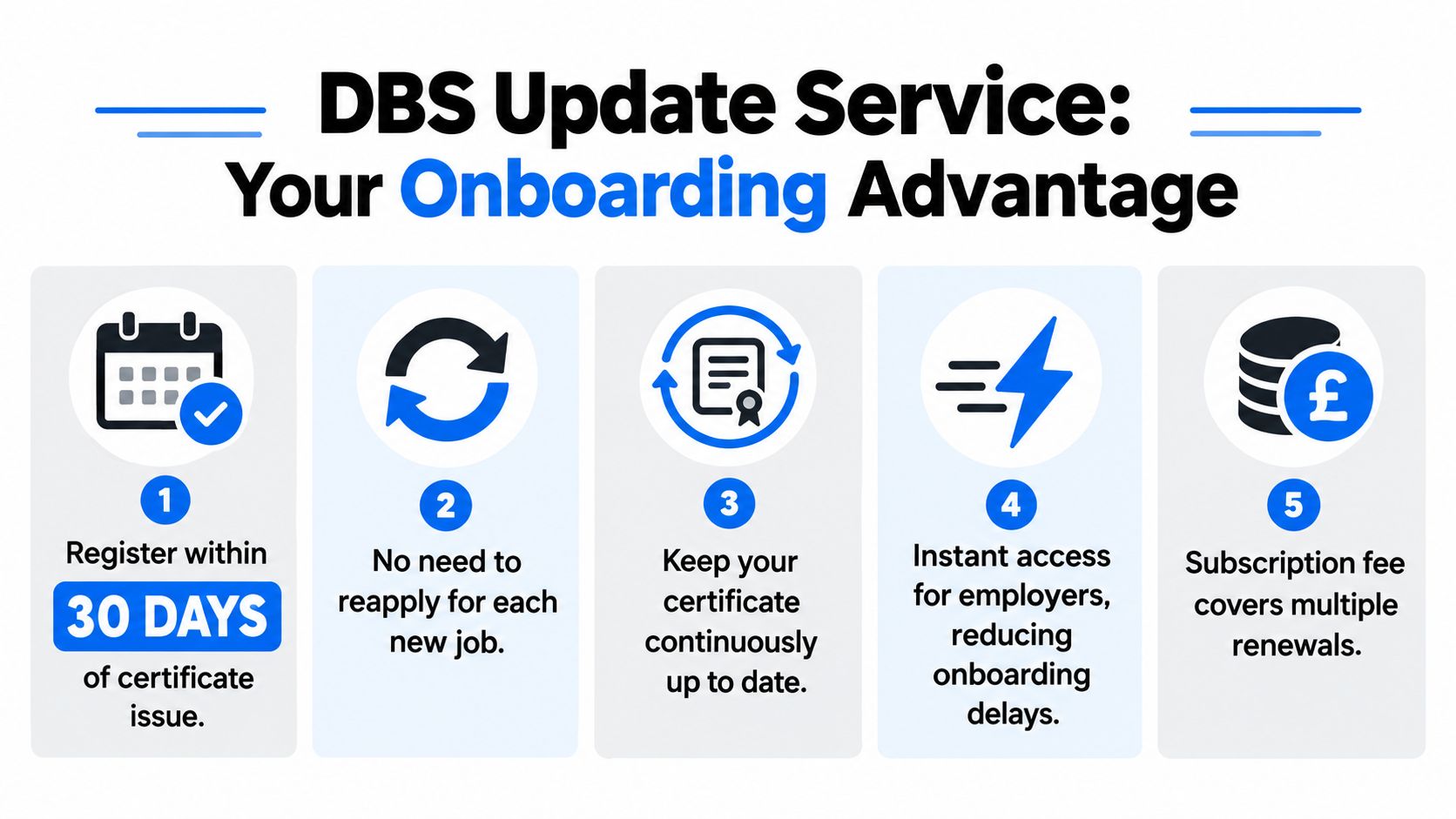
Join the DBS Update Service within 30 days of the certificate issue date if your certificate and role make the service suitable. The CQC DBS guidance explains that applicants can join once they have the reference number and that employers can check certificate status online with the applicant's consent.
This is a shift-readiness tool, not a decorative extra. Without it, an agency changing roles may ask you to start a new DBS application. With it, the employer may be able to carry out an online status check instead, provided the certificate is the same level and workforce type, the role is comparable, and you give consent.
The service isn't available for Basic checks, and applicants can't hand control of their account to a third party. An employer also can't inspect your status without your permission.
Understand the trade-off
The Update Service helps with portability, but it doesn't turn one certificate into universal clearance. A domiciliary care employer must still decide whether the existing certificate is suitable for the new role, inspect the original certificate and obtain your consent for the status check.
The level also matters. An Enhanced certificate without the required Barred List information may not satisfy a role that legally requires an Adults' Barred List check. The service can show whether the existing certificate has changed, but it can't add a missing check type.
There's a wider operational reason to take portability seriously. The DBS annual report recorded 3,828,880 active Update Service subscribers as of April 2026, showing that many workers and employers use ongoing status checking as part of recruitment workflows. The same guidance states that only 53.60% of DBS checks processed were Enhanced with Barred List checks, so employers shouldn't assume every care applicant needs the highest combination of checks.
Watch the subscription terms, including any fee and renewal arrangements applicable to your certificate. Set a calendar reminder for the registration deadline and keep your certificate reference secure. For the practical registration steps, follow this guide on how to join the DBS Update Service.
Common Pitfalls That Delay Your Enhanced DBS
A clean record does not guarantee a quick Enhanced DBS check. Delays usually start with incomplete applications, identity details that do not match, or police information requiring assessment. A care worker can lose days before the application even reaches the right stage.
Check these points before submission:
- Name mismatches: Your passport, driving licence and application show different names, or one omits a middle name.
- Address gaps: You miss a previous address or enter overlapping dates incorrectly.
- Weak identity evidence: You provide an expired document, an unaccepted screenshot, or proof showing an old address.
- Wrong check level: You request Standard when the duties require Enhanced, or select Enhanced when the role supports only a lower-level check.
- Incorrect Barred List selection: You choose both lists without confirming that the role involves regulated activity with both groups.
- Misrouted self-employed applications: You apply as though a normal employer will counter-sign, although an Umbrella Body route is required.
- Missed Update Service deadline: You fail to register within the permitted window and cannot use that certificate for status checking.
- Unreported changes: You treat one certificate as an answer to every future safeguarding question, despite a material change in role or circumstances.
For an Enhanced check, police involvement often separates a routine application from one needing further review. As noted earlier, straightforward applications without police referral are typically the fastest. Accurate information improves the application, but it cannot guarantee an immediate police decision.
Compliance advice: Request the check the care role legally requires. Verify every identity document and address date before submission. Use the Update Service only when the certificate and the new role genuinely match.
Self-employed carers and personal assistants should confirm the application route before accepting shifts. An Umbrella Body may need to submit and counter-sign the application because an individual cannot normally apply directly for an Enhanced certificate. Ask the organisation who will submit it, which Barred List applies, and whether it accepts an existing Update Service certificate.
Agency workers should also ask whether the agency requires a new check despite an existing certificate. The Update Service can support status checking, but it does not change the check level or add missing Barred List information. Those questions prevent more onboarding trouble than paying for an advertised fast-track service.
Cura Academy helps care workers prepare for compliant onboarding through care training, Care Certificate standards, and guidance related to Enhanced DBS and Update Service readiness. Visit Cura Academy to organise the training and compliance steps required before approaching an employer or Umbrella Body.