
The UK Government announced £53.9 million in 2024 to support a new Level 2 Adult Social Care Certificate qualification, with funding intended to enable up to 37,000 people in direct adult social care roles to enrol between June 2024 and March 2025, according to the UK Government announcement on developing the domestic care workforce. That scale of investment tells you something practical about healthcare assistant training. Employers don't just want willingness to care, they want dated evidence that you can work safely.
A certificate in a downloads folder isn't enough on its own. You need the right course, completed at the right point, with an observation or sign-off an employer or inspector can check. Get that evidence organised early and you won't lose shifts while someone chases an expired date or a missing assessor name.
Table of Contents
- Required Training for UK Healthcare Assistants
- The 15 Care Certificate Standards and What Proves Them
- Core Course Topics and How Long Each Takes
- How to Become Job-Ready Step by Step
- How Training Lines Up with DBS and Onboarding Checks
- Costs of Subscriptions and One-Off Bundles Compared
- Confirm Your Training Route Before You Enrol
Required Training for UK Healthcare Assistants
A new healthcare assistant must complete the Care Certificate within 12 weeks of starting, must have an enhanced DBS check cleared before unsupervised work, and must then keep mandatory refreshers current under employer policy. That's the headline sequence, and everything else fits around it.
Don't confuse induction training with a formal qualification. The Skills for Care state of the adult social care sector and workforce in England 2025 executive summary recorded that approximately 54% of direct-care workers lacked a relevant social-care qualification, yet 69% of direct-care workers without a relevant qualification had engaged with Care Certificate standards. Training is the entry point into competent practice, while a Level 2 or Level 3 qualification is normally the longer progression route.
Mandatory and Expected Training for a UK Healthcare Assistant
| Requirement | Who needs it | When it is due | Renewal |
|---|---|---|---|
| Care Certificate (15 standards) | New healthcare assistants and support workers | Within 12 weeks of starting | Once, recorded by the employer |
| Basic life support (BLS) | Most healthcare assistants in care and clinical settings | During induction | Usually annual, per employer policy |
| Moving and handling | Staff who support people with mobility or transfers | During induction | Usually annual, per employer policy |
| Safeguarding adults and children | All frontline care staff | During induction | Often every 1 to 3 years, per employer policy |
| Infection prevention and control | All frontline care staff | During induction | Usually annual, per employer policy |
| Dementia awareness | Staff in care homes and domiciliary care | At role start or per employer policy | Per employer policy |
| Enhanced DBS check | Anyone in a regulated care role | Before unsupervised work | Checked via the DBS Update Service where registered |
| Level 2 or Level 3 adult social care qualification | Workers progressing their career | Within the role, often over months | Once; no renewal |
Read the table in three tiers. Before the first shift, the DBS position controls whether you can work unsupervised. In the first 12 weeks, the Care Certificate sits alongside basic life support, safeguarding, infection prevention and control, and moving and handling. After that, annual refreshers, dementia awareness where your setting needs it, and optional Level 2 or Level 3 study keep you current and promotable.
Practical rule: Mandatory means mandatory under your employer's policy and the CQC's expectations, so treat renewal timings as typical patterns, not fixed national dates.
If you're planning beyond assistant work into nursing, it's worth understanding the academic entry route early so you don't choose the wrong qualification level. You can explore online access to nursing courses to see how that pathway differs from frontline care training.
Compare this table line by line with the induction list your employer gives you. Flag any gap before your first shift, not after a coordinator removes you from the rota.
The 15 Care Certificate Standards and What Proves Them
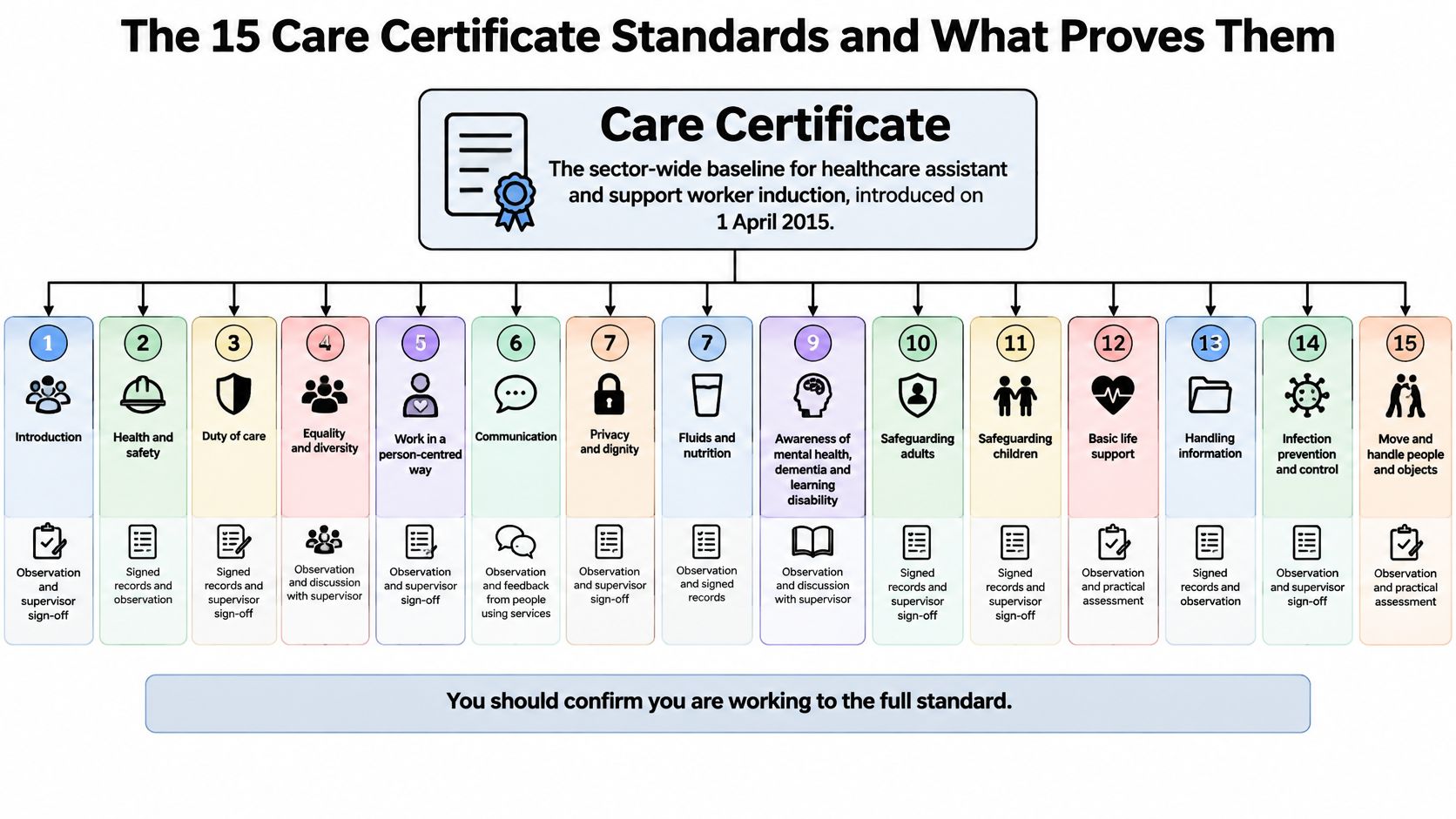
The Care Certificate is the sector-wide baseline for healthcare assistant and support worker induction. The UK Government Care Certificate launch announcement states that the UK Care Certificate became a national baseline for healthcare assistants and social care support workers on 1 April 2015, with 15 standards and an expectation that new staff complete it within 12 weeks of starting employment. Confirm you're working from the version your employer uses, because your assessor signs against that employer's evidence format.
The diagram below maps the full set before you break it into manageable clusters.
Five Clusters That Make the Standards Manageable
- Role and development: 1. Understand your role, and 2. Your personal development. Expect a job description discussion, agreed learning goals, and a review date.
- Values and practice: 3. Duty of care, 4. Equality and diversity, and 5. Work in a person-centred way. Evidence usually links your choices to a person's plan, preferences, and rights.
- Communication and care: 6. Communication, 7. Privacy and dignity, 8. Fluids and nutrition, and 9. Awareness of mental health, dementia and learning disability. Assessors look for respectful interaction, not just correct quiz answers.
- Safeguarding and safety: 10. Safeguarding adults, 11. Safeguarding children, 12. Basic life support, and 13. Health and safety. You must know reporting routes and act within your role boundary.
- Information and infection: 14. Handling information, and 15. Infection prevention and control. Records must be accurate, stored correctly, and shared only with people entitled to see them.
Each standard has two evidence layers. First, you build underpinning knowledge through e-learning, workbooks, or taught sessions. Second, an assessor checks observed workplace practice on shift, because safe care is physical, relational, and time-pressured in ways a multiple-choice test can't reproduce.
One Worked Example of Acceptable Evidence
Take infection prevention and control. You complete the learning on hand hygiene, waste, cleaning, and personal protective equipment (PPE) first. Then your assessor watches you put on and remove PPE correctly during real care, without contaminating your hands, uniform, or the person's surroundings. The record names the standard, the task observed, the assessor, the date, the evidence seen, and any remedial action you must repeat.
That same record helps your employer decide when close supervision can end. If you dispose of gloves correctly but touch a clean surface before hand hygiene, you're not signed off yet. You practise, get observed again, and only then does the standard count as met.
A finished e-learning module proves exposure to knowledge. It doesn't prove you can deliver safe practice with a real person in front of you.
The common 15-standard structure helps when you move between providers because the next employer can read what was observed and when. It still decides what it accepts, so keep the underlying sign-offs, not only the final certificate. A portable record with dates and assessor details saves you repeating work you've already demonstrated.
Core Course Topics and How Long Each Takes
Basic life support, moving and handling, and dementia awareness appear again and again in job adverts and induction plans, but they're not equally urgent on day one. Prioritise the skills that allow supervised practice to start safely. Then add setting-specific depth before you're left to manage a predictable risk alone.
Typical Length and Content for Core Healthcare Assistant Courses
| Course | Typical length | What it covers |
|---|---|---|
| Basic life support | About half a day, face to face or blended | Recognising cardiac arrest, CPR, AED use, choking |
| Moving and handling | About 1 to 2 hours online plus a practical session | Risk assessment, hoist and transfer techniques, safe body positioning |
| Dementia awareness | About 2 to 3 hours online | Communication, distress triggers, person-centred care, escalation |
| Infection prevention and control | About 1 to 2 hours | Hand hygiene, PPE, cleaning, outbreak procedures |
| Safeguarding adults | About 1 to 3 hours | Recognising abuse, reporting routes, record keeping |
| Care Certificate (full set) | Within 12 weeks of starting, self-paced and workplace-based | All 15 standards with observed practice |
Basic life support covers recognising cardiac arrest, calling for help, starting CPR, using an automated external defibrillator, and responding to choking. It's usually renewed annually under employer policy because compression quality and confidence fade. If your course is blended, don't treat the online theory as the finish line.
Moving and handling combines theory with a practical session on hoists, slide sheets, stand aids, transfers, and risk assessment. Employers check the practical element because poor technique injures staff and residents quickly. Read the person's moving and handling plan before you touch equipment, check sling size and loops, and stop if the equipment or staffing level doesn't match the plan.
Safeguarding deserves the same operational focus. Our guide to safeguarding adults training requirements and reporting routes sets out how recognition, recording, and escalation fit together in frontline practice.
When Basic Dementia Awareness Is Not Enough
Dementia awareness should cover communication, distress and its triggers, person-centred responses, family involvement, and escalation. The Care Quality Commission State of Care workforce report reported that only 38% of direct-care staff in England had completed dementia-care training in the latest cited data, even though dementia is a routine feature of adult social care. That gap matters because awareness language doesn't automatically become a calm response at 2 a.m.
Basic awareness is enough for a first supervised shift in a setting where few people live with dementia and senior staff are immediately available. It becomes insufficient when a resident shows sudden distress, tries to leave unsafely, refuses essential care, or when a capacity, medication, or safeguarding decision arises.
In those moments, slow down and use the person's plan. Reduce noise and crowding, use short familiar phrases, check for pain, thirst, toileting needs, and environmental triggers, then record exactly what you saw and escalate to senior staff. Don't argue with a fixed belief, physically block without authority, or document a vague label such as aggressive when the record needs observable behaviour.
I would book basic life support and moving and handling first for early shifts, then add dementia awareness immediately if you're entering a care home where residents live with dementia. Test yourself. Could you explain your first minute in a cardiac arrest, and your first minute with a distressed resident, without guessing?
How to Become Job-Ready Step by Step
Job readiness isn't a pile of downloaded certificates. It's a sequence where checks, learning, supervised practice, and sign-off happen in an order that protects the people you support. The timeline below shows the route before you work through each deadline.
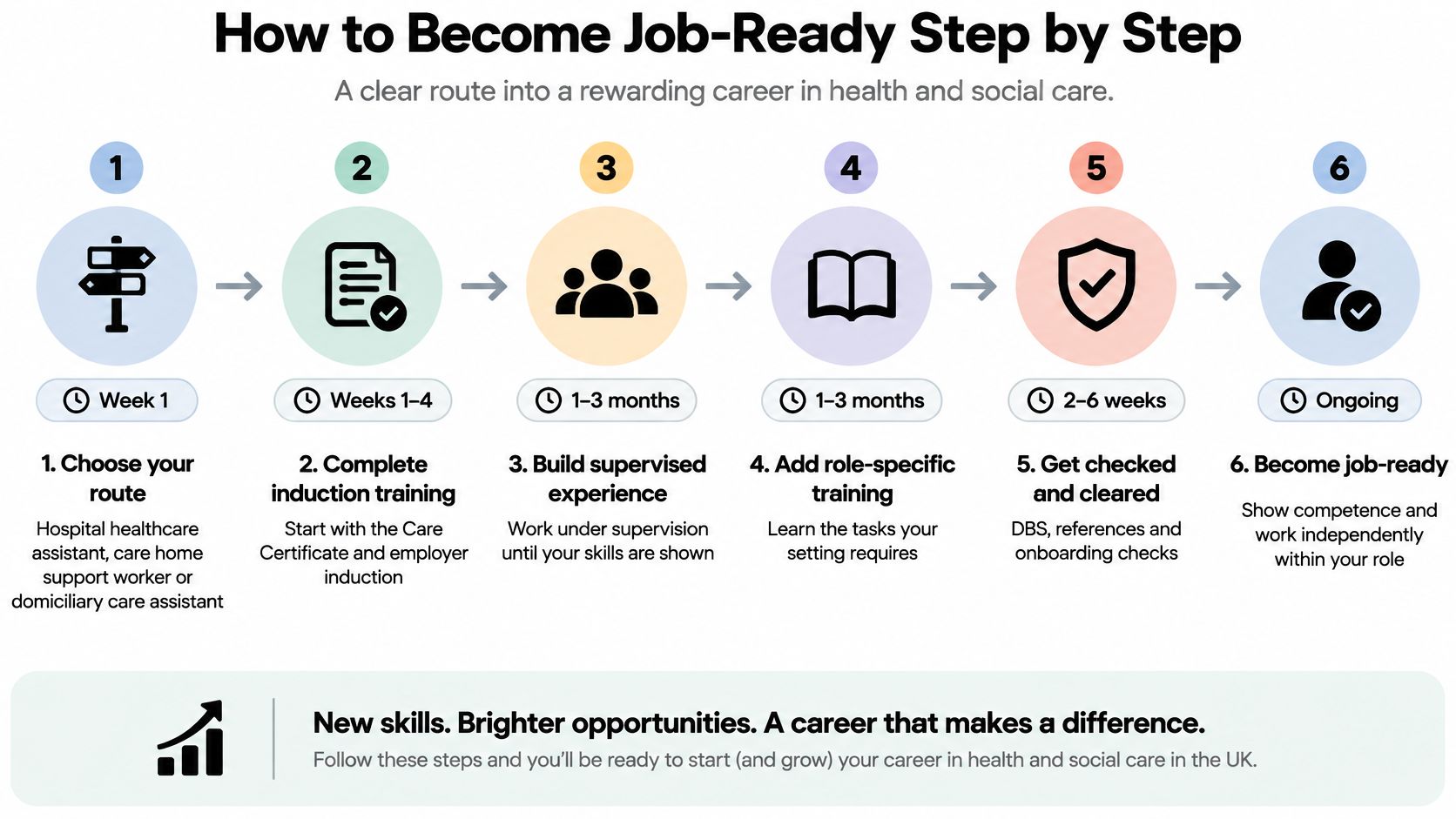
Seven Steps With Timeframes
- Choose your route before you buy training. Decide whether you're aiming for a hospital healthcare assistant, care home support worker, or domiciliary care assistant role, because each setting emphasises different courses and practice evidence.
- Start the enhanced DBS application early. Ask your employer to begin it as soon as recruitment allows, since the check can take several weeks and unsupervised work waits for clearance.
- Begin the Care Certificate in week one. Pace the knowledge and observations across the first 12 weeks instead of leaving assessors a backlog near the deadline.
- Complete the safety core in weeks two to four. Finish basic life support, moving and handling, infection prevention and control, and safeguarding early because supervised practice depends on them.
- Build a portable evidence folder as you go. Save certificates with dates, observation sign-offs, references, employment history, and assessor details in one clearly named digital folder.
- Practise under supervision until competence is signed off. Ask for feedback after observed tasks, repeat anything marked as remedial action, and don't present theory completion as workplace competence.
- Move to unsupervised work only after employer confirmation. Then diarise annual refreshers and consider a Level 2 or Level 3 qualification for progression.
When you apply for roles, your evidence folder should support a clear, searchable application rather than a long narrative. It helps to prepare your resume for automated screening so course names, dates, and care settings are easy for both software and coordinators to find.
The video below gives a visual walkthrough of the readiness sequence, which is useful if you're comparing self-funded learning with employer induction.
Prove Competence Rather Than Completion
The Skills for Care state of the adult social care sector and workforce in England 2026 executive summary recorded that in England's 2025/26 adult social care workforce, only 45% of workers held a relevant social-care qualification, while 78% of direct-care staff without a recorded qualification had engaged with Care Certificate standards. That distinction is why employers ask what was observed, not only what was clicked through.
If you've worked in care before, including overseas, document settings, tasks, equipment, supervision, and training dates. Ask the employer what it can recognise and what must be observed again in the UK setting. Don't repeat entry-level courses blindly, but don't expect undocumented experience to transfer without evidence.
Bank and agency workers lose time when coordinators can't see current training quickly. Keep your folder updated after every refresher and name files with the course and expiry date. When a shift is offered at short notice, visible evidence is often the difference between confirmation and another candidate being called.
How Training Lines Up with DBS and Onboarding Checks
Employers carry the duty to prove you're competent, and training is one part of that wider onboarding file. The CQC guidance on Regulation 19 for fit and proper persons employed requires providers to assess and record whether employees have the competence, skills and experience needed for their roles, and to provide supervision until competence is demonstrated. For healthcare assistants and support workers, the Care Certificate standards provide the assessment structure for that judgement.
The checklist below shows how recruitment checks and competence evidence sit side by side.
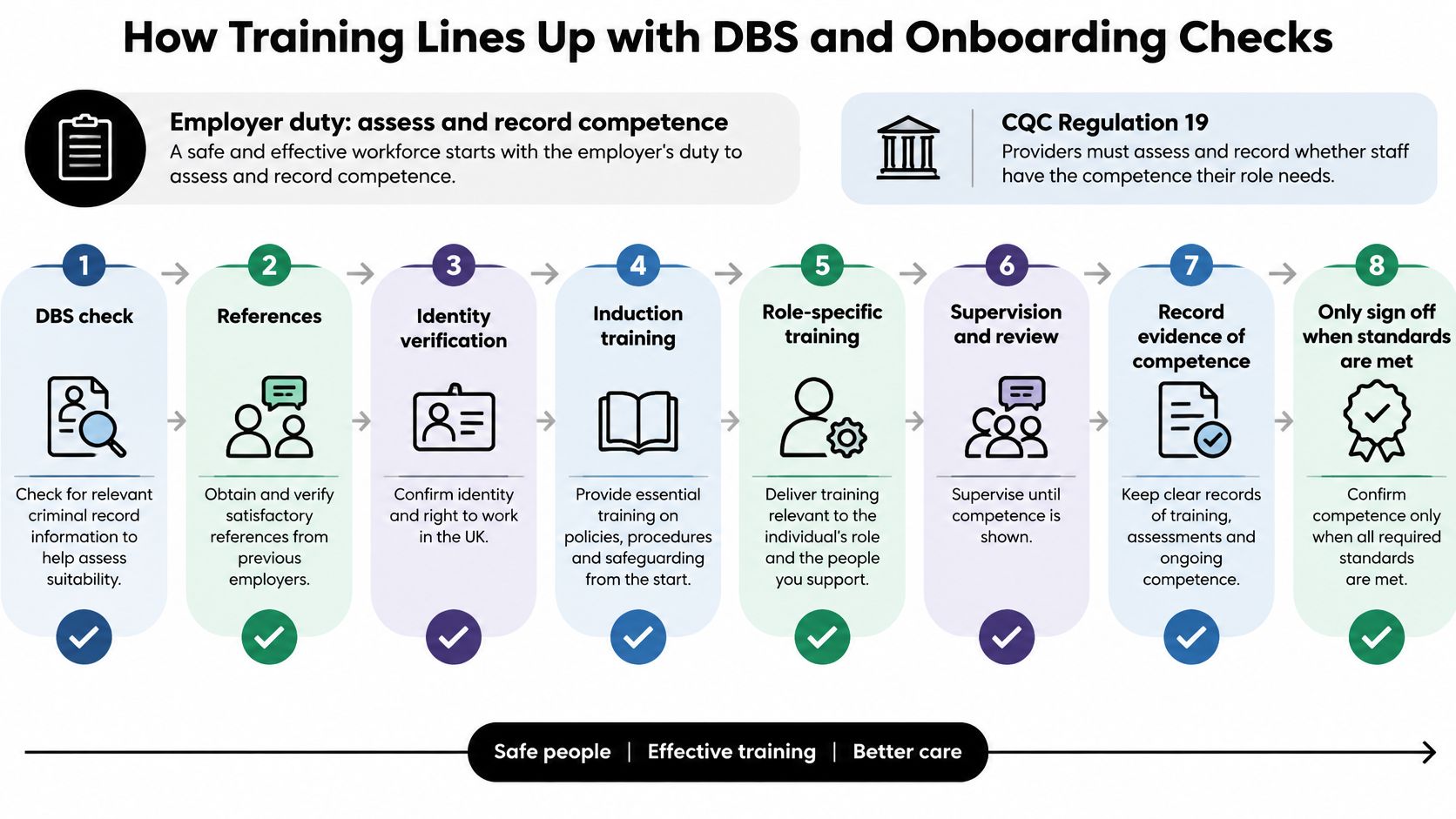
Onboarding Evidence to Have Ready
- Enhanced DBS check: Include the adult barred list where the role is a regulated activity with adults.
- DBS Update Service registration: Keep your subscription and consent current so an employer can check status online where appropriate.
- Right to work evidence: Provide the documents or share code your employer requests, within its deadline.
- Two references: Warn referees early and make sure employment dates match your application.
- Mandatory course certificates: File each certificate with its completion date and renewal date visible.
- Care Certificate sign-off: Record the standard, task observed, assessor, date, evidence, and any remedial action.
- Written supervision schedule: Keep the plan that shows who supervises you and what must happen before unsupervised practice.
Our step-by-step guide on how to get a DBS check for care work explains the application evidence in more detail. Read it before you submit identity documents, because a small mismatch can slow an otherwise straightforward start.
Agencies filter candidates on training that's current and visible. An expired basic life support certificate can drop you down the list even if your practical skills are sound, because the coordinator must defend the booking to the provider.
File discipline: Keep one digital folder, one course per file, with the renewal date in the filename. You'll spot a gap before an employer does.
What transfers between employers? Care Certificate standards with dated, observed sign-offs are usually the most portable evidence because another assessor can see the task and judgement behind them. A mandatory course transfers only if it's current and fits the new employer's training matrix, which each provider sets itself. A certificate accepted by one provider may therefore need repeating for another, particularly where equipment, client group, or local procedures differ. Ask before you resign yourself to paying twice, and send the full evidence rather than a cropped certificate image.
Costs of Subscriptions and One-Off Bundles Compared
Pay for coverage you'll use in the next 12 months, not for the longest course catalogue. The cheapest headline price becomes expensive if it excludes a mandatory refresher you'll need before an agency will book you.
Training Options Compared on Cost and Coverage
| Option | Typical cost | What it includes | Best for |
|---|---|---|---|
| Cura Academy subscription | £10 per month, about £120 over a year | Unlimited access to Care Certificate standards, mandatory refreshers and role-specific courses such as basic life support and dementia awareness | Workers who need several courses or regular refreshers within 12 months |
| One-off bundle | Check current bundle price before buying | Curated courses for a defined role, bought once | Candidates who need one induction set and will not renew soon |
| Individual courses paid one at a time | Price charged per course, check before buying | Single courses chosen to fill specific gaps | People who only need one or two courses |
| Employer-funded induction | Free to the worker | Care Certificate and mandatory training delivered in employment | Staff who have an offer of employment |
| Level 2 Adult Social Care Certificate (England) | Funded under the 2024 programme for learners enrolling June 2024 to March 2025; current availability unknown | Accredited qualification | Workers in England seeking formal progression |
The subscription arithmetic is straightforward. At £10 per month, you pay about £120 over a year for access to Care Certificate standards, mandatory refreshers, and role-specific courses. That suits you if several certificates fall due within 12 months or you expect agency work to demand rolling updates.
A one-off bundle has a fixed curated set for one defined role. It suits a single induction where you can name every course now and won't need another round soon. Individual courses work for a narrow gap, such as safeguarding only, but buying several separately can surpass the subscription total.
Use this decision rule. List every course you need in the next 12 months, price each option that includes the full list, include renewal dates, and choose the cheaper complete option. Don't compare a bundle that includes six courses with a subscription if your employer requires nine.
Employer-funded induction is free to the worker, so ask your employer before paying for anything. Some providers will accept recent external certificates, while others put every starter through their own matrix. A two-minute email can save you buying training twice.
For funded progression in England, check current availability rather than assuming the 2024 Level 2 enrolment window remains open. Our breakdown of Care Certificate training costs and funding questions helps you separate induction costs from accredited qualification costs.
Employers making the opposite calculation, buying training and recruitment support for a whole team, should compare total onboarding cost per starter rather than licence price alone. Reviewing current platform costs for talent acquisition alongside trainer time and delayed start dates gives a fuller picture of what slow compliance really costs.
Confirm Your Training Route Before You Enrol
Start with your situation, not a course sale page. If you're new to care, a subscription can cover the Care Certificate standards and core courses, then employer induction and observation confirm your competence. If you're already employed with lapsed refreshers, targeted individual courses or a refresher bundle usually close the gap at the lowest cost.
Agency and bank workers need the full mandatory set kept current, with dates visible in one folder so coordinators don't have to ask. If you trained overseas, check how your documents will be recognised before paying for duplicates, and ask which tasks still need UK workplace observation.
Cura Academy's £10 per month membership covers Care Certificate standards, mandatory refreshers, and role-specific courses, with structured pathways from route choice toward DBS readiness, while curated bundles suit a fixed induction set. Treat that as one option to price against employer-funded and one-off routes using your own course list.
Do three things next. Compare your employer's induction list with the requirements table in Required Training for UK Healthcare Assistants, apply the cost rule in Costs of Subscriptions and One-Off Bundles Compared, and book basic life support and moving and handling first because supervised shifts depend on them.
Start building evidence employers can verify, not just certificates you can download. With structured pathways for Care Certificate standards, mandatory refreshers, and role-specific healthcare assistant training, Cura Academy helps you organise your route from first course to job-ready sign-off. Visit today, list the courses your target role requires, and choose the subscription or bundle that covers them for the next 12 months.