

You're ready for your first care shift. Your uniform is prepared, your journey is planned, and then the agency asks for your training certificates, DBS status and evidence of competency. One course has expired, your DBS check is still being processed, and the digital record of another certificate is sitting in an old inbox. The shift goes to someone else.
That situation is common because health and social care compliance is no longer just a provider's inspection concern. It affects whether a new carer can start work, whether an agency can place a worker quickly, and whether a provider can show that its staff are safe, supported and suitable for their roles. Compliance is the practical evidence behind trust.
For care workers, the process becomes manageable when you treat it like preparing a work bag. You need the right items, each in usable condition, and you need to know where everything is when an employer asks for it. This guide explains the main legal duties, role-based training, DBS portability, record keeping and a simple route to staying shift-ready.
Table of Contents
- Introduction Why Compliance Decides Who Gets to Care
- What Health and Social Care Compliance Really Means
- The Legal and Regulatory Frameworks You Must Know
- Mandatory Training and Certifications That Keep You Compliant
- DBS Checks Onboarding and Becoming Job Ready Fast
- Record Keeping Audit Preparation and Fixing Common Gaps
- Your Step by Step Compliance Checklist with Cura Academy
Introduction Why Compliance Decides Who Gets to Care
A care coordinator rarely has time to chase missing evidence while filling an urgent rota. If two workers are available, the one with current certificates, a verified DBS position and a complete onboarding profile is easier to book. That doesn't mean the other worker is less caring or less capable. It means the first worker has made their readiness easier to prove.
For a new entrant, compliance can feel like a locked door. You may understand how to treat people with dignity, but an employer still needs evidence that you understand safeguarding, infection prevention, moving and handling, confidentiality and emergency procedures. For an agency carer, the challenge is different. You may already have experience, yet an expired refresher or incomplete competency sign-off can prevent you from returning to a familiar setting.
The purpose isn't to create paperwork for its own sake. The Care Quality Commission's historical inspection evidence showed that 82% of adult social care services originally rated inadequate and then re-inspected improved their rating, while 80% of GP practices did the same in that review (CQC State of Care report). Those results show why providers take training, governance and inspection evidence seriously. When organisations address safety and quality weaknesses, inspection outcomes can change.
Your practical advantage: the easier you make your competence and current status to verify, the fewer reasons an employer has to delay your booking.
This guide is for people entering care, support workers updating their certificates, bank and agency staff seeking more shifts, and providers building a defensible compliance system. By the end, you'll have a clear route from identifying your role requirements to maintaining evidence month after month.
What Health and Social Care Compliance Really Means
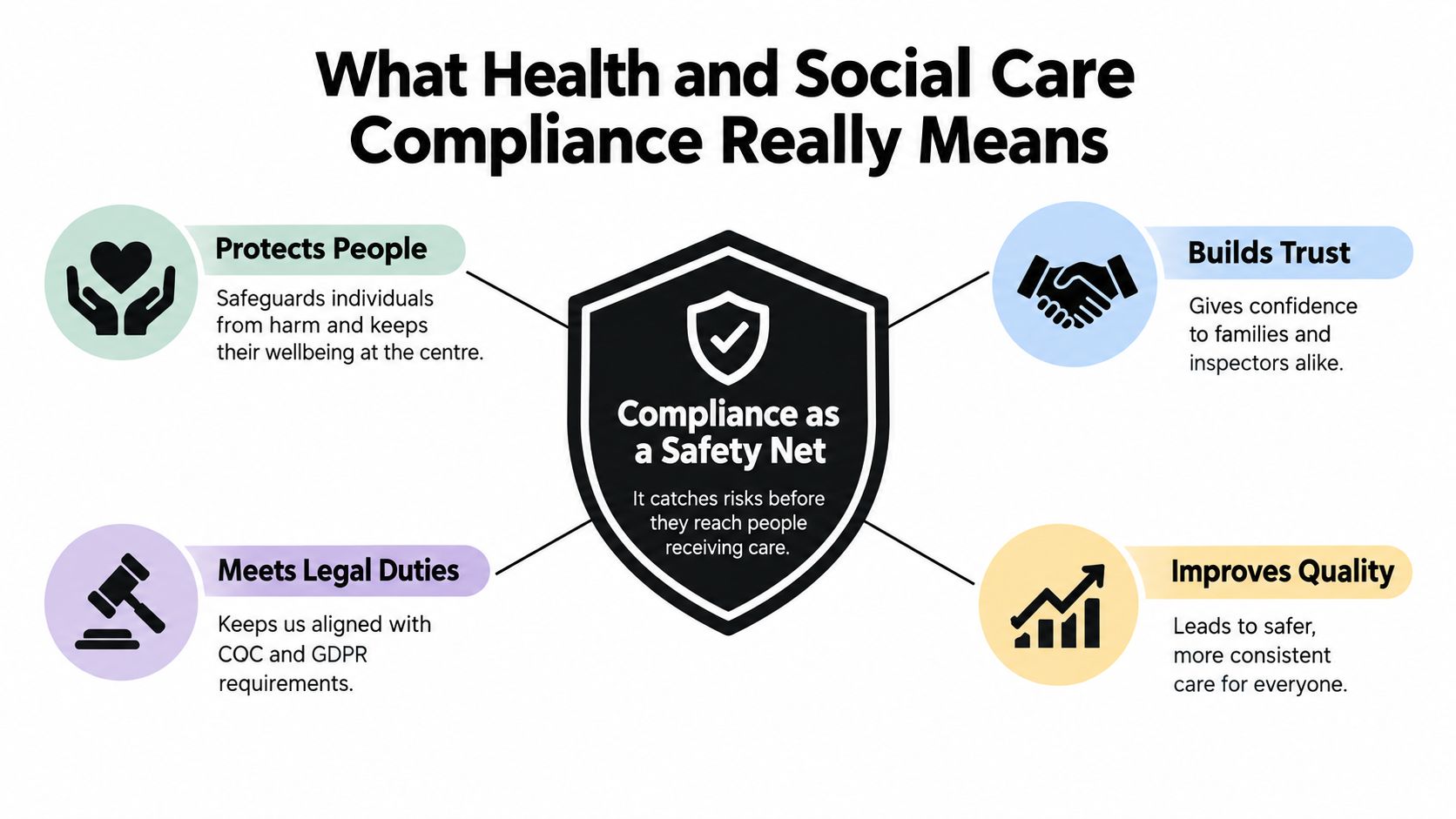
A shift can fall apart over one missing record. A worker may know how to give respectful care, but an employer still needs proof that the person can report abuse, use equipment safely, protect confidential information and log incidents correctly. For new starters and agency carers, that proof often decides whether a booking goes ahead.
Compliance has three parts:
- Safe practice, following the right method during care.
- Suitable preparation, with training matched to the job.
- Reliable evidence, with certificates, competencies and records that show what you can do.
Training on its own is only the first layer. A certificate can show that learning was completed, but it does not always show that someone can safely support a person with a hoist, handle medication within their role, respond in an emergency, or follow a local procedure. Those tasks often need observation, supervision and sign-off, like a driver who needs both the lesson and the road test before they are trusted on the road.
Why evidence matters to workers
Employers need to see that staff are trained and supported, not just that they attended a course. Guidance on role-based CQC training links learning to supervision, appraisal, competency checks and governance records (role-based CQC training guidance).
That is why evidence affects employability. A worker with clear training records can move through onboarding faster and answer shift-booking checks with confidence. A worker with scattered certificates may be asked to repeat learning, even if the course was taken before. Good evidence turns experience into something a provider can verify quickly.
What continuous readiness looks like
Continuous readiness means checking expiry dates before they cause problems, reporting changes in your role, completing refreshers on time and keeping records secure. It also means recognising that risks change by setting. A domiciliary carer working alone in people's homes will face different checks from a care-home worker or a clinical assistant.
Good compliance asks three simple questions:
- Is this training relevant to my role?
- Is my competence current and evidenced?
- Can the provider retrieve proof quickly?
If the answer to all three is yes, compliance becomes a practical part of shift-readiness. It helps protect people, and it helps employers book the right person without delay.
The Legal and Regulatory Frameworks You Must Know
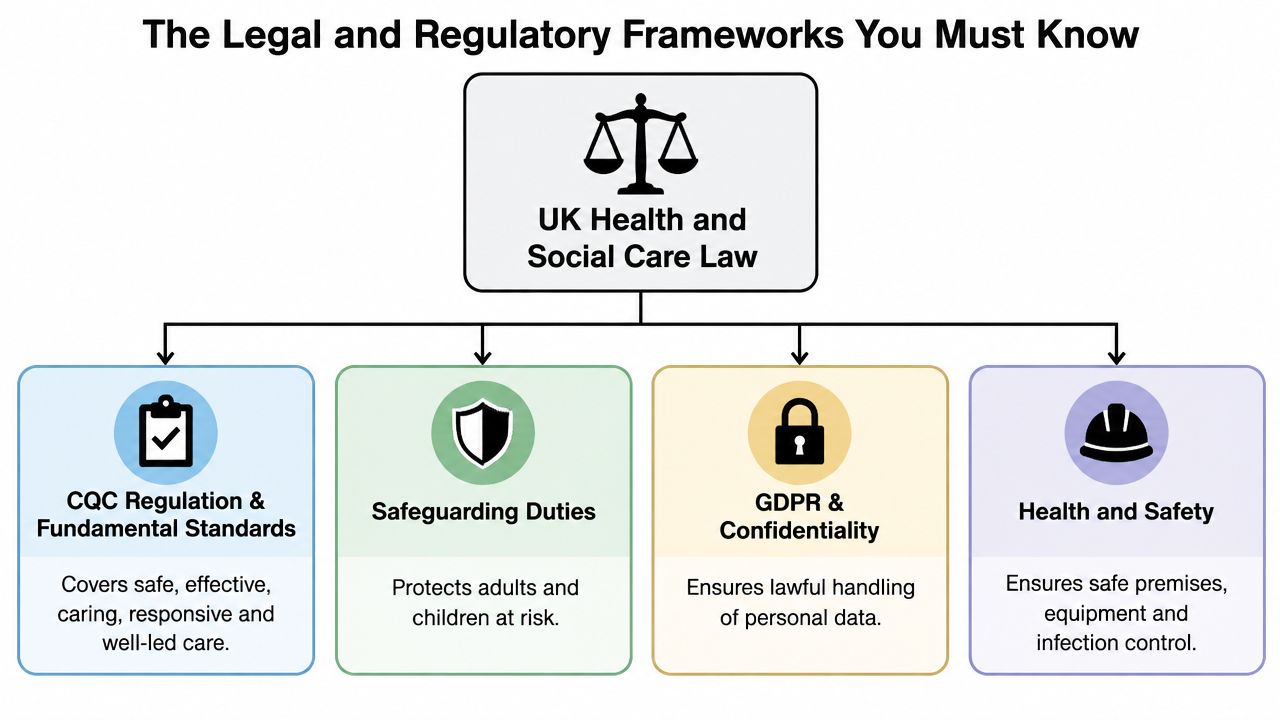
UK health and social care compliance rests on connected duties rather than one universal checklist. The CQC examines whether regulated services provide safe, effective, caring, responsive and well-led care. Safeguarding duties focus on protecting people from abuse and neglect. Health and safety controls reduce risks from premises, equipment, infection and working methods.
Information governance adds another layer. The Health Research Authority explains that information about identified or identifiable people in health and care is governed by UK GDPR within the Data Protection Act 2018 and the common law duty of confidentiality. It also identifies health and care information as a special category of personal data under Article 9 of UK GDPR (HRA legal frameworks for health and care information).
The four pillars in daily work
CQC regulation and fundamental standards ask providers to organise care around people's safety, needs, rights and outcomes. For a worker, that may mean following a care plan, escalating a concern, recording an incident or refusing a task outside their competence. For a manager, it means retaining evidence that staffing, training and governance systems work in practice.
Safeguarding duties require staff to recognise signs of harm, listen to concerns and follow the organisation's reporting route. You don't investigate an allegation yourself unless your role specifically requires it. You record what you observed or were told, preserve confidentiality and escalate promptly.
GDPR and confidentiality apply whenever you handle care plans, medication information, photographs, messages or digital notes. Use approved systems, check the recipient before sharing information and disclose only what is necessary for a lawful care purpose.
Health and safety covers more than avoiding slips. It includes infection control, safe moving and handling, fire procedures, lone working, equipment use and reporting hazards. A safe worker follows the risk assessment and speaks up when the situation has changed.
The connection is important. A missed training record can hide a competence gap. A poor care note can weaken safeguarding evidence. An unsecured message can become a data breach. NHS England reported 246 personal data breaches in 2024/25, with 10 reported to the Information Commissioner's Office because they met the UK GDPR threshold or were reported voluntarily (NHS England data security reporting). Good care and good records support each other.
Digital compliance is now part of service assurance. The government's Data saves lives plan announced powers for the Secretary of State to require information from regulated adult social care providers about the services they deliver, whether publicly or privately funded (Data saves lives policy paper). Providers must therefore think about lawful processing, secure access, accurate records and information-sharing readiness alongside traditional inspection preparation.
Mandatory Training and Certifications That Keep You Compliant
A new agency carer may have completed several courses and still be unable to accept a shift. The missing piece could be role-specific learning, a practical sign-off or evidence that an employer can verify quickly. In 2026, training records affect employability as well as inspection readiness.
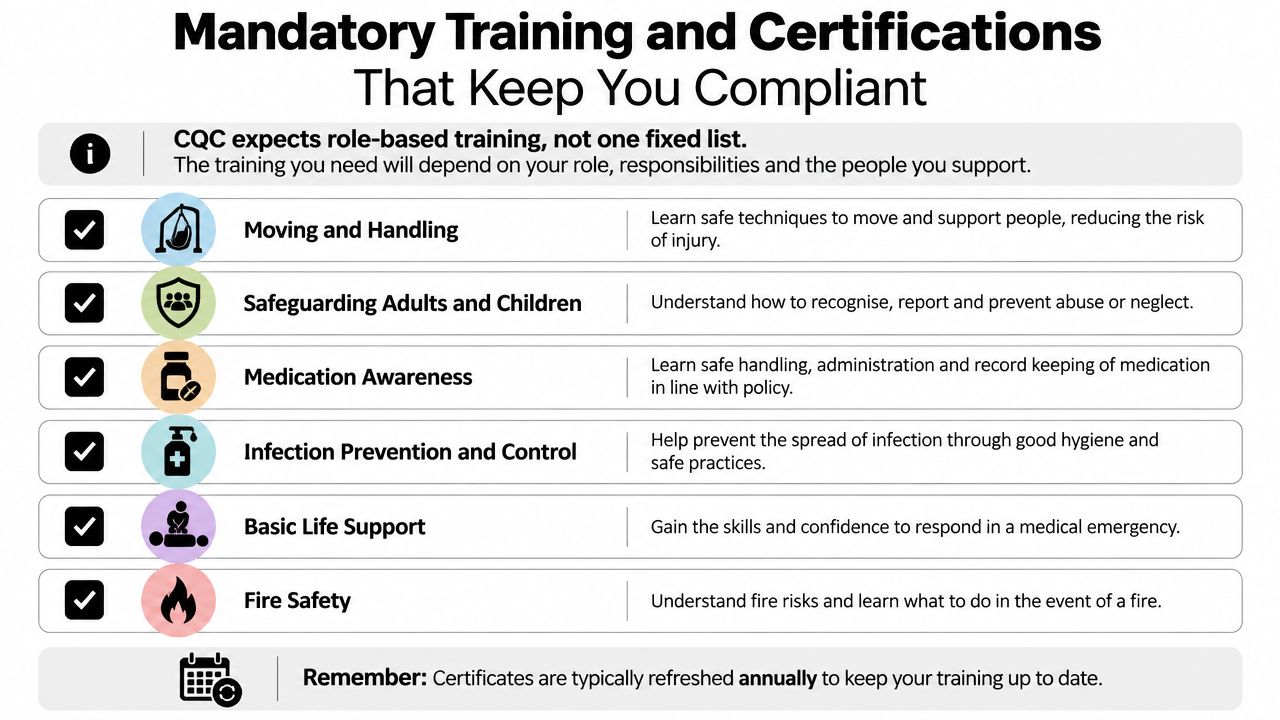
There is no single mandatory course list for every care worker. A care home, domiciliary agency, supported living service and GP practice may share core subjects, yet their people, duties, staffing arrangements and risks differ. Compliance works like a key cut for one door: the training must fit the setting and the work.
CQC guidance connects training with the service, staff roles, people supported, incidents and policies. Regulation 18 concerns suitably trained and supported staff, while Regulation 17 requires governance evidence that can show competence. Keep those requirements in view when building a learning record.
Start with your role, not a random course list
Work through this sequence:
- Identify the setting. Homecare, residential care, supported living and healthcare environments have different controls.
- List your actual duties. Include personal care, medication support, transfers, clinical tasks, lone working and record handling.
- Match learning to risk. Safeguarding, infection prevention, moving and handling, fire safety and Basic Life Support may be core areas, but the required depth depends on the work.
- Check practical competence. An online module can cover knowledge. Equipment use or delegated clinical tasks may need observation and sign-off.
- Set review dates. Follow employer policy and task risk rather than assuming every subject renews on the same cycle.
A sensible starting point may include the Care Certificate standards for induction, followed by role-relevant courses such as Moving and Handling, Safeguarding, Infection Prevention and Control, Basic Life Support, Fire Safety and Medication Awareness. Supporting people with dementia, learning disabilities or autism may require further learning suited to their needs and your duties.
The new Code of Practice for learning disability and autism training commenced on 6 September 2025. Its guidance says training must suit the role (UK impact assessment and Code of Practice information). Relevant learning is easier to defend than a folder filled with unrelated certificates.
For practical course guidance, use this mandatory training guide for health and social care. Store certificates in one accessible location, then add local induction, supervision and competency evidence where required. A tidy digital record can help an agency confirm that you are ready to book.
DBS Checks Onboarding and Becoming Job Ready Fast
Two workers can have similar experience and different booking prospects. Worker A has current training, a clear onboarding profile and a DBS status that the agency can verify with consent. Worker B has the same enthusiasm but is still searching through emails for a certificate and has no convenient way to show whether an existing check remains current.
The difference is operational. Agencies need to reduce uncertainty before placing someone with people who may be vulnerable. Your aim is to make each decision easier by presenting current, organised evidence.
What the Update Service changes
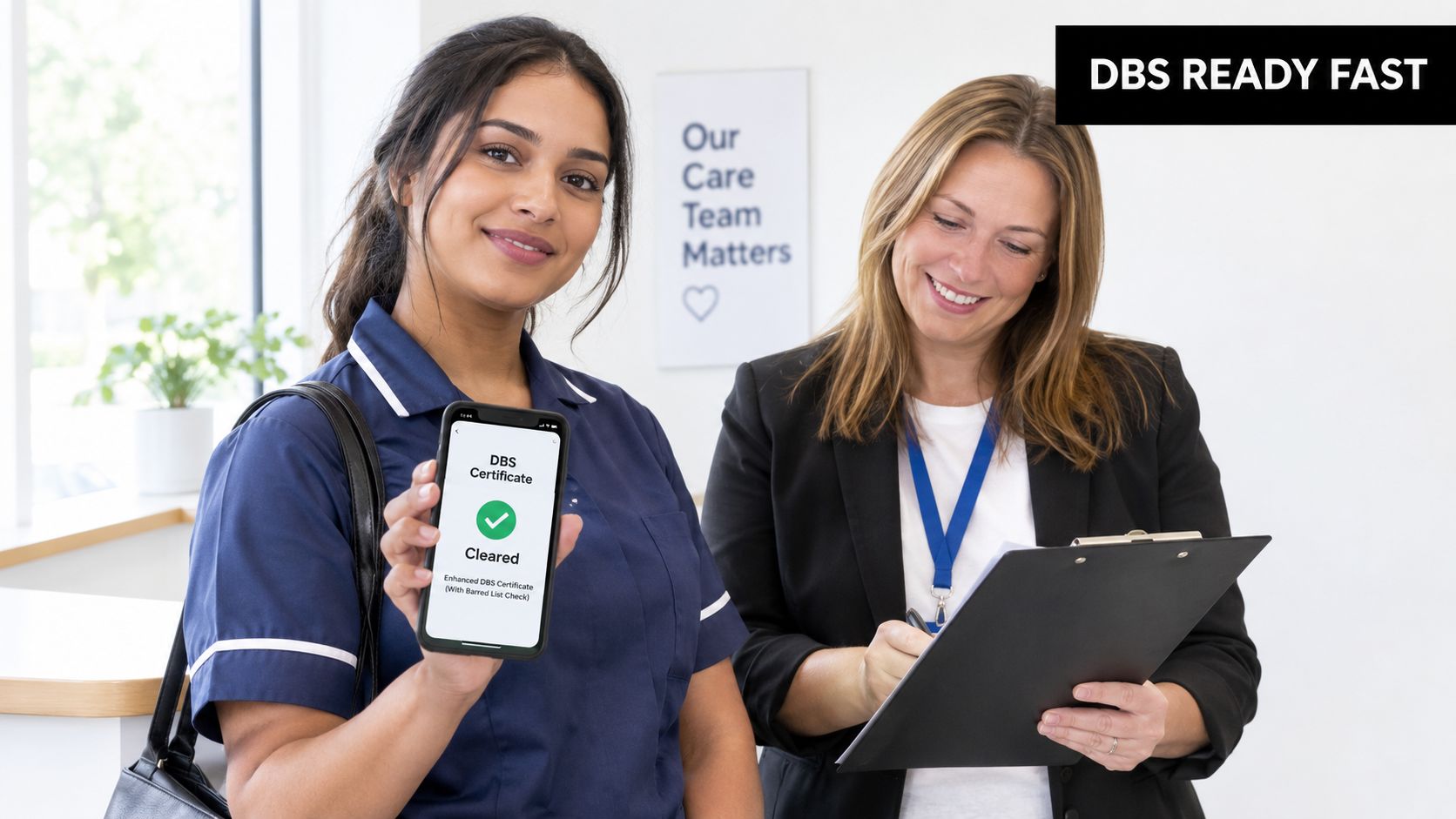
The DBS Update Service is a subscription model for standard and enhanced checks only. It costs £16 per year, and you can join when the application reference number is issued or within 30 calendar days of the certificate issue date (DBS Update Service guidance). With the individual's consent, an employer can check online whether the certificate remains current.
That can help agency and bank workers who move between providers. It improves the speed of verification and reduces the friction of repeating checks, but it doesn't remove the need for risk-based recruitment, identity checks, references or the employer's assessment of the role.
Compare the common gaps with the fix
| Onboarding gap | What the agency sees | Practical fix |
|---|---|---|
| Training dates are unclear | The recruiter can't confirm readiness | Keep certificates and expiry dates in one tracker |
| DBS application is unfinished | A start date may be delayed | Complete the application promptly and retain the reference |
| Update Service timing is missed | Portability may not be available | Join within the permitted window |
| Practical competency is absent | Course completion doesn't answer the safety question | Arrange supervised observation and sign-off |
| Documents are scattered | Each booking creates another chase | Build one consistent onboarding profile |
The DBS process should sit beside, not replace, the rest of your compliance preparation. This guide to getting a DBS check can help you understand the application route and the information employers typically request.
Record Keeping Audit Preparation and Fixing Common Gaps
A worker arrives for an agency shift, ready to care, but the recruiter cannot find the competency sign-off or confirm when training was reviewed. The shift may go to someone whose evidence is easier to check. In 2026, record keeping affects employability as well as inspection outcomes. A clear digital file helps providers decide who is ready to book.
A compliance file should tell a complete story. It should show what the worker was expected to learn, what they completed, how competence was checked, when evidence needs review and what the provider did when a gap appeared. A course certificate is one piece of the puzzle. The file also needs to connect learning with the worker's role, supervision, appraisal, incidents, care plans and governance.
Good records protect people in two ways. They support safe decisions about care, and they protect privacy when approved systems restrict access to authorised users.
The daily record habit
Write notes as close to the event as possible. Record what happened, what you observed, what action you took and who you informed. Use factual language. Avoid unsupported opinions, unclear abbreviations and casual messages that contain identifiable information.
Managers should check the training matrix for expired certificates, missing competencies, changed duties and agency cover. Workers should check that their own evidence matches the shifts they accept. General care training does not automatically authorise a clinical task or equipment use. Practical approval must be recorded separately.
| Compliance Gap | Why It Fails Checks | Quick Fix |
|---|---|---|
| Expired training | The provider cannot show current knowledge | Set review alerts and book refreshers before expiry |
| Missing competency sign-off | Attendance does not prove practical ability | Arrange observation, supervision and documented approval |
| Inconsistent care notes | Auditors cannot follow the care delivered | Make timely, factual entries linked to the care plan |
| Unsecured personal data | Confidentiality and lawful handling may be compromised | Use approved systems and check access permissions |
| Generic training matrix | Evidence does not match the worker's duties | Map each role to service risks and responsibilities |
| Paper-only processes | Records may be difficult to retrieve and compare | Maintain a controlled digital evidence trail where appropriate |
Information standards create another pressure point. Government impact assessments report that 42% of sampled health and social care providers complied with core information standards, while 58% were not currently compliant (UK information standards impact assessment). The figures show why a paper folder alone is not enough. Providers need accurate, retrievable and controlled information, and workers benefit when their readiness evidence can be found quickly.
Funding can make that system harder to maintain. The Homecare Association estimates a £3.25 billion annual funding shortfall, reports that 29% of councils and Health and Social Care Trusts pay rates that do not cover direct employment costs at minimum wage, and says 61% buy too few hours per provider to sustain employment rights and viable operations (Homecare Association funding gap analysis). Providers may understand the standard yet struggle to fund paid training, stable schedules and administrative controls. Sustainable compliance therefore depends on realistic staffing and purchasing models, not reminders alone.
For inspection preparation, use this CQC inspection preparation guide to organise evidence around practice, governance and improvement.
Your Step by Step Compliance Checklist with Cura Academy
Treat compliance as a repeating work-readiness routine rather than a one-off event. Start with the role you want, then build only the evidence that supports that route.
- Choose the care setting. Decide whether you're preparing for domiciliary care, residential care, supported living, agency work or a healthcare support role.
- Check the employer's matrix. Ask which induction subjects, practical competencies and refreshers apply to your duties.
- Complete foundation learning. Work through the Care Certificate standards and core subjects relevant to the role.
- Add role-specific training. Include learning for dementia, learning disability and autism support, medication, clinical tasks or other responsibilities where required.
- Arrange practical sign-off. Confirm who will observe moving and handling, equipment use, emergency response or delegated care tasks.
- Manage DBS evidence. Track the application, certificate and Update Service eligibility, while completing the employer's wider safer-recruitment checks.
- Build your onboarding profile. Store certificates, dates, identity evidence, references and competency records where you can retrieve them quickly.
- Maintain readiness. Review expiry dates, complete refreshers, update your role information and keep records secure.
Cura Academy is one option for organising this route. Its membership provides access to Care Certificate-aligned learning, mandatory refreshers and role-specific courses, while its Training Tracker helps members organise certificates and monitor validity dates. Learners can also choose individual bundles rather than a subscription, depending on how much training they need.
Use the checklist today. Identify one missing certificate, one competency that needs sign-off and one document that an agency may request. Fix those items first, then set a regular review habit so your next shift isn't delayed by avoidable evidence gaps.
Cura Academy offers structured health and social care training, Care Certificate-aligned learning, mandatory refreshers and tools for organising compliance evidence. Visit Cura Academy to choose a learning route that supports your next onboarding check and keeps your shift-readiness easier to demonstrate.