
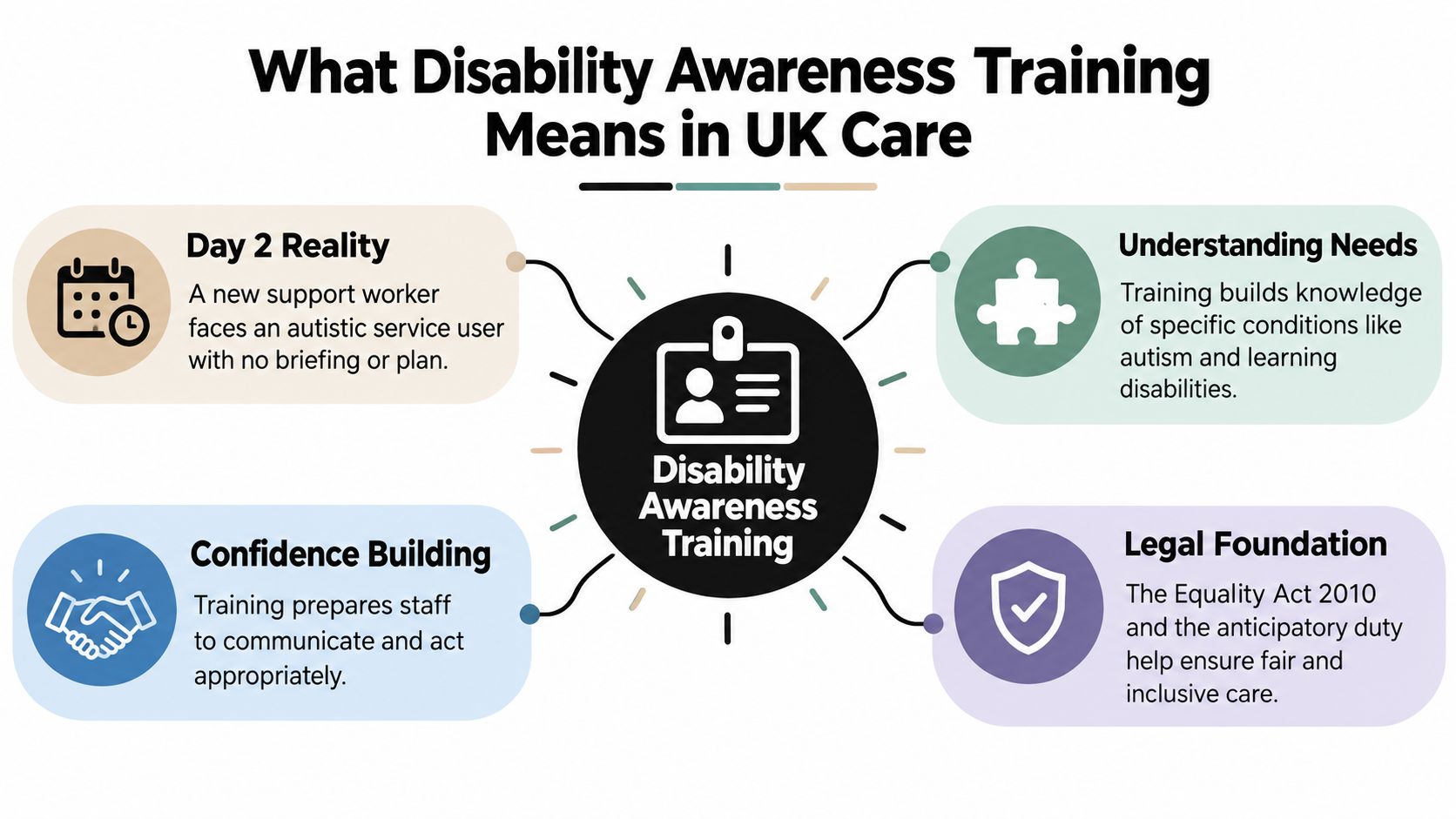
You're on your second day as a support worker. The regular carer is off sick, and you're asked to support an autistic person you've never met. There's no useful handover, no clear communication plan and no explanation of what helps when the day room becomes noisy. You want to be respectful, but you're worried that one rushed question or unexpected change could cause distress.
That gap is exactly where disability awareness training matters. It gives care workers more than definitions. It builds the practical awareness, communication skills and decision-making habits needed to support disabled people safely, respectfully and within UK requirements.
Table of Contents
- What Disability Awareness Training Means in UK Care
- Types of Disability Care Workers Need to Understand
- Reasonable Adjustments Under the Equality Act 2010
- Communication Skills for the Confidence and Care Workers Need
- Delivery Formats and What Good Training Looks Like
- Linking Awareness Training to the Care Certificate and Mandatory Cycles
- Employer Responsibilities and an Adjustment Workflow You Can Use
- Becoming Compliant and Job-Ready with Cura Academy
What Disability Awareness Training Means in UK Care
Disability awareness training is structured learning for people who work with disabled colleagues, patients and service users. It usually covers disability, communication, inclusion, reasonable adjustments, consent, person-centred support and the responsibilities created by UK equality law.
It isn't the same as a general equality course. Equality training may introduce discrimination and protected characteristics, while disability awareness training focuses more closely on barriers, communication needs and practical support. It also isn't a substitute for safeguarding training or specialist clinical education. A care worker may need all three.
On shift, good awareness training helps you pause before making assumptions. Instead of deciding that an autistic person is “being difficult” because they avoid eye contact, you ask how they prefer to communicate. Instead of treating a wheelchair user's equipment as an inconvenience, you understand that the equipment may be essential to independence, safety and dignity.
Practical rule: If a course only teaches terminology and legal definitions, it hasn't prepared you for the day-to-day decisions care workers make.
The training applies across care settings. New starters need a safe foundation, experienced workers need refreshers and managers need enough understanding to organise adjustments, respond to concerns and supervise fairly. The Office of Rail and Road's disability-awareness programme offers a useful UK example of this structured approach. In March 2021, train and station operators committed to refresher training for more than 29,000 passenger-facing staff, with relevant learning included in induction for new staff and senior managers. The ORR progress report shows how awareness moved from optional development towards planned organisational responsibility.
For care employers, the message is straightforward. Training should be part of onboarding, renewed at appropriate intervals and recorded clearly. Skipping it can leave a worker uncertain, a service user unsupported and an employer unable to demonstrate consistent practice.
Types of Disability Care Workers Need to Understand
Start with a working map, not a list of stereotypes. Under the Equality Act 2010, disability is a protected characteristic, and the law is concerned with the effect of a condition on a person's daily life, not merely with whether a condition is visible or has a particular label.
A person may have a physical impairment, sensory impairment, learning disability, autism, ADHD, dyslexia, a mental health condition or a long-term health condition. Some people have more than one disability. Others may not use the same identity or diagnostic language that professionals use.
| Category | Common examples | Practical implications for care staff |
|---|---|---|
| Physical disabilities | Mobility impairment, cerebral palsy, chronic pain | Check access, positioning, transfers and fatigue. Ask before offering physical help. |
| Sensory impairments | Deafness, hearing loss, blindness, sight loss | Adapt communication, lighting, written information and the environment. |
| Learning disabilities | Mild, moderate or profound learning disability | Use clear language, allow processing time and check understanding without testing or patronising. |
| Autism | Autism spectrum presentations | Ask about sensory needs, predictability, communication preferences and changes to routine. |
| Neurodivergence | ADHD, dyslexia and related conditions | Consider attention, reading, organisation, sensory processing and information format. |
| Mental health conditions | Anxiety, depression and other enduring conditions | Avoid assumptions, protect privacy and agree communication or workplace support. |
| Long-term conditions | Epilepsy, diabetes and chronic fatigue | Follow the person's care plan, recognise fluctuating needs and escalate changes appropriately. |
This map helps you notice possible barriers, but it mustn't become a shortcut for predicting behaviour. Two people with the same diagnosis may need completely different support. The useful question is not, “What do autistic people need?” It's, “What does this person need in this situation?”
The social model of disability is useful on shift because it directs attention towards barriers. A person may be disabled by inaccessible information, a noisy environment, inflexible routines or staff who speak to a carer instead of speaking directly to them. Disability awareness training should therefore include non-visible disabilities, cognitive conditions, mental health and neurodivergence, rather than presenting disability only through mobility equipment.
For a more focused introduction to autism and practical support, see these autism awareness classes. Use the learning to ask better questions, not to label a person before you know them.
Reasonable Adjustments Under the Equality Act 2010
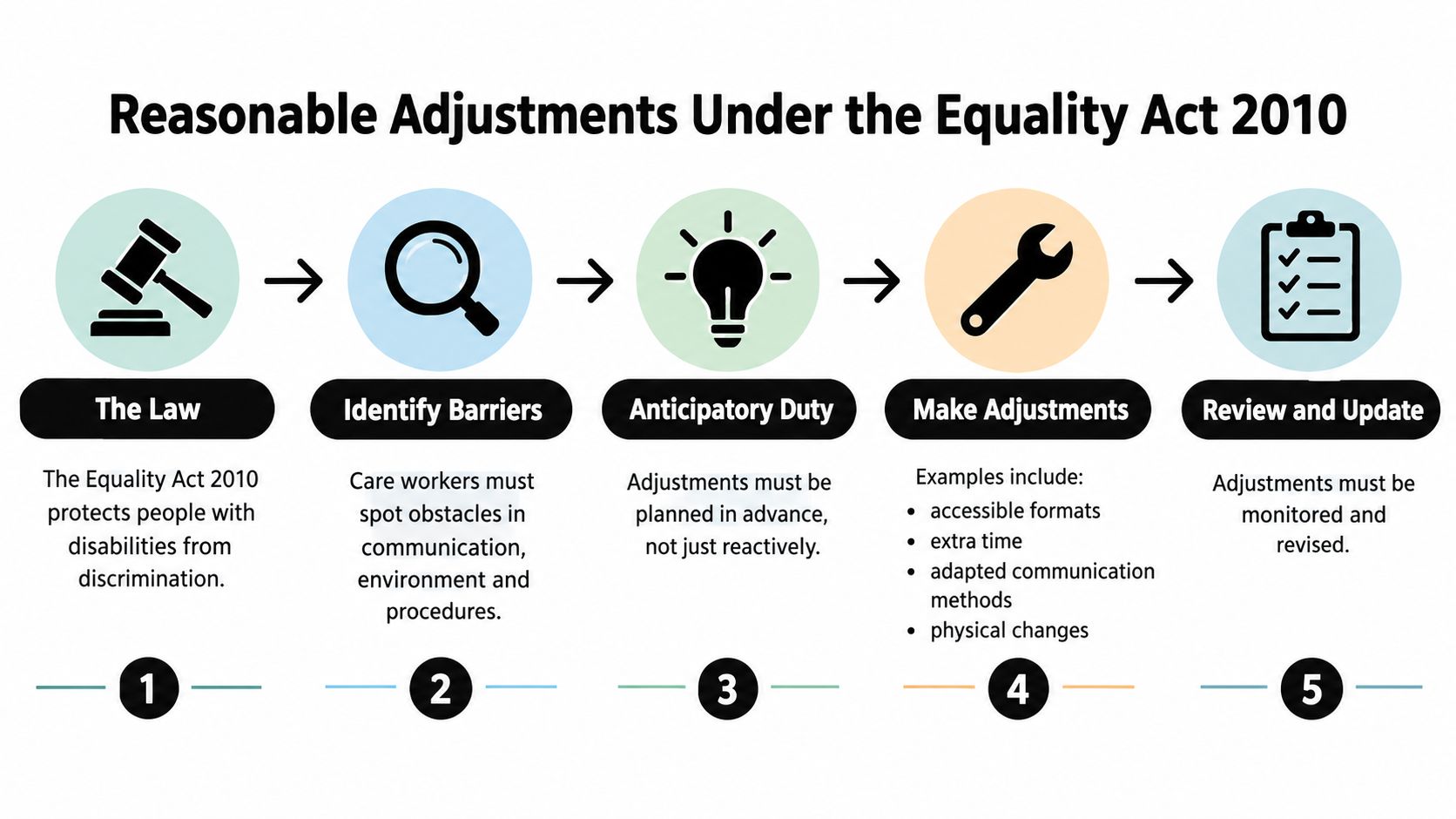
The Equality Act 2010 protects disabled people from discrimination and requires organisations to make reasonable adjustments where a disabled person would otherwise face a substantial disadvantage. In care, this affects how services are delivered, how information is shared and how staff organise environments and procedures.
The anticipatory duty means service providers should think ahead about barriers. You shouldn't wait until a person is distressed, excluded or unable to access a service before considering what could have been changed.
A worked example on shift
An autistic service user finds fluorescent lighting and the noise in the day room distressing. They become anxious, stop communicating and leave activities early. A useful workflow is:
- Ask. Speak directly to the person, or use their agreed communication support, and ask what makes the environment difficult and what helps.
- Assess. Identify the actual barrier. It might be harsh lighting, overlapping conversations, sudden changes or the absence of a quiet space.
- Agree. Work with the person, their support plan and the relevant manager to choose a realistic adjustment.
- Implement. This could involve a quieter activity area, a warning before changes, different lighting, written prompts or a preferred communication method.
- Review. Check whether the adjustment works. If the person still cannot participate comfortably, change the plan.
An adjustment doesn't have to be expensive. It might be extra processing time, an accessible format, a quieter appointment, a clear rota or a consistent explanation before personal care. You also shouldn't assume that a formal diagnostic letter is required before you respond to an obvious barrier. Follow your employer's policy, protect confidentiality and escalate where a formal assessment is needed, but don't use paperwork as an excuse to ignore distress or exclusion.
The same condition doesn't create the same adjustment. Ask rather than guess, and record the agreed approach in the appropriate care or workplace documentation. For a practical perspective on the built environment, review these venue accessibility compliance steps, then apply the same barrier-focused thinking to entrances, corridors, activity rooms and information points.
A course on equality and diversity training can provide the legal foundation, but your conduct on shift turns that foundation into accessible care.
Communication Skills for the Confidence and Care Workers Need
Communication is not only speech. It includes pace, tone, facial expression, written information, gestures, signs, technology and the time you give someone to respond.
Begin with the person, not the diagnosis. Speak directly to the service user rather than automatically addressing a family member or support worker. Ask whether they prefer speech, writing, pictures, signs or a communication aid. Keep your language clear, but don't confuse clear language with childish language.
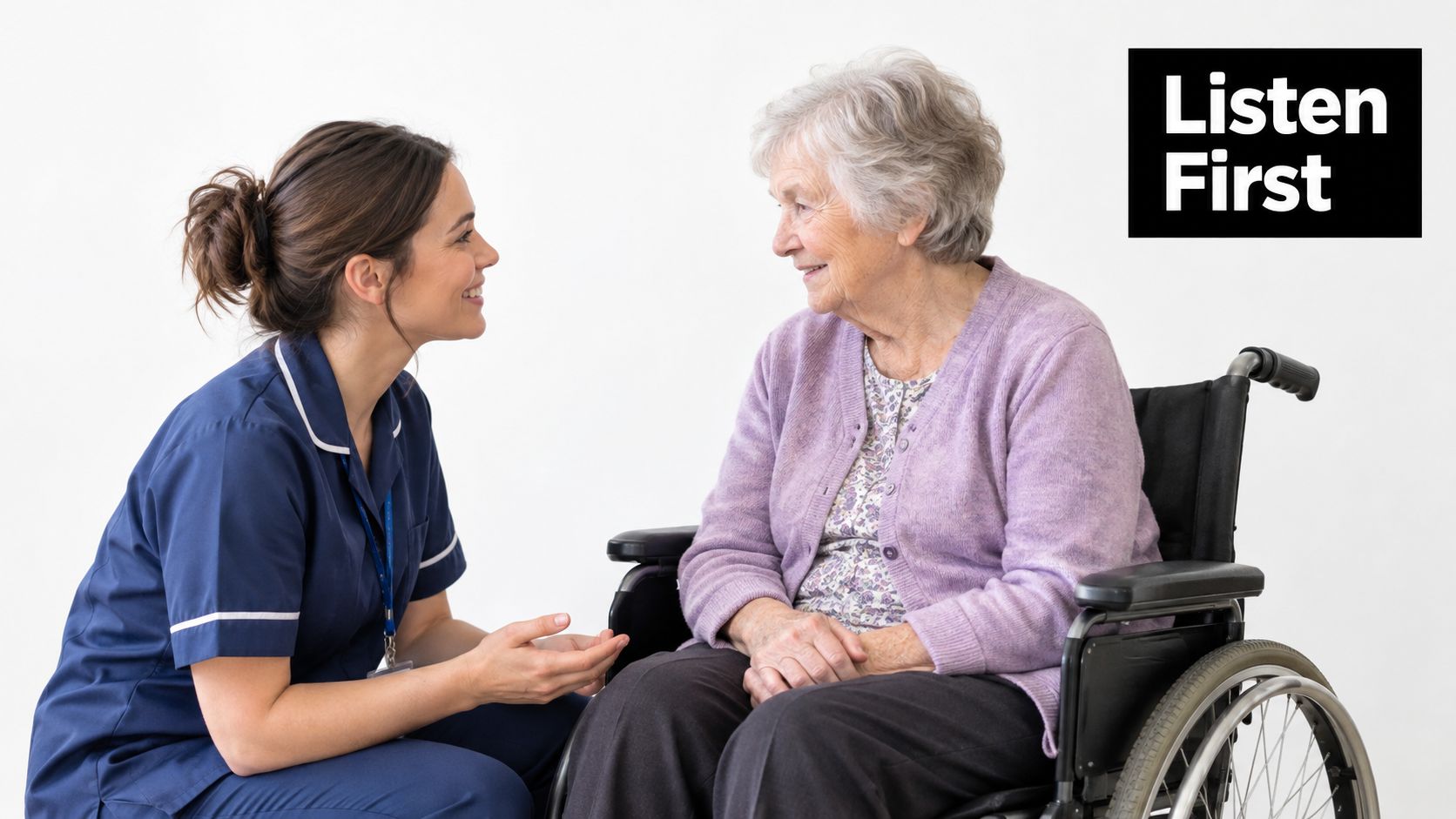
Useful behaviours include:
- Slow the pace: Ask one question at a time and allow silence for processing.
- Offer choices: Say, “Would you like the blue top or the green top?” rather than asking a broad question when a person may find open choices difficult.
- Explain changes: Give advance notice before a new worker, altered routine or unfamiliar activity.
- Check understanding: Ask the person to show or explain the plan in their own way, rather than asking a quick “Do you understand?”
- Use accessible information: Consider easy-read text, photographs, symbols, large print, captions or audio.
- Respect communication tools: Makaton, basic BSL signs, communication books and electronic aids are part of a person's communication, not optional extras.
Acas research found that disabled employees whose condition substantially affects daily activities reported workplace conflict at a rate of 68%, compared with 44% across Great Britain. The same research found particularly high reports of bullying, discrimination and harassment, conflict involving sickness absence and conflict with line managers. Acas's report on disabled employees' workplace conflict also records concerns that generic training focuses too heavily on physical disabilities and doesn't cover mental health, cognitive difficulties and neurodivergence well enough.
That matters in care because staff communication affects both service users and colleagues. Your e-learning platform, rota, medication administration record and moving-and-handling instructions should also be usable by the people expected to read them. If a worker has dyslexia, a mental health condition or a sensory impairment, consider format, contrast, timing, screen compatibility and the need for instructions to be repeated or demonstrated.
For further practical guidance, see communication in health and social care.
This video can support discussion about respectful communication and how staff respond to individual needs:
Delivery Formats and What Good Training Looks Like
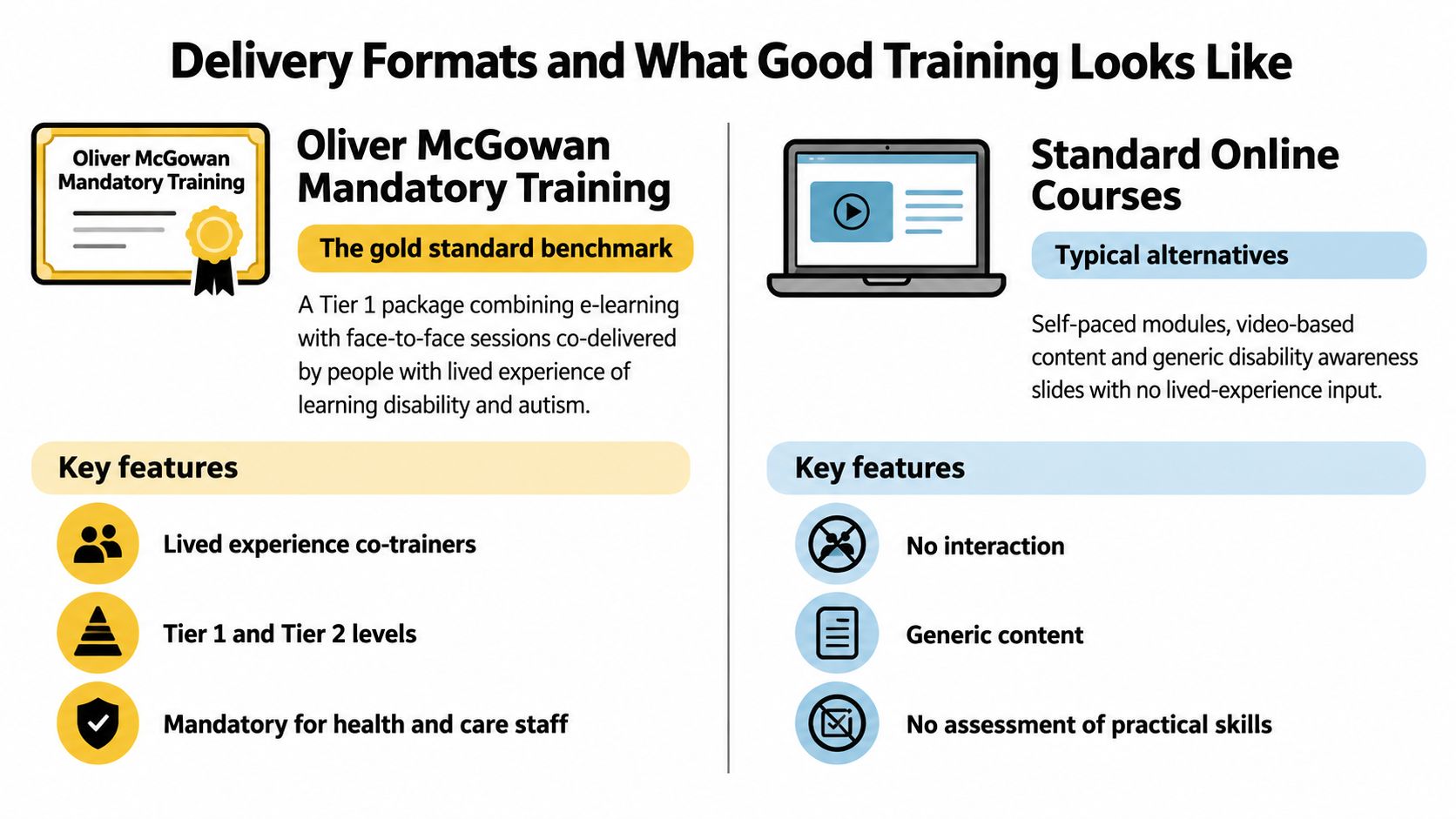
A completion certificate doesn't prove that a worker can adapt communication or make a safe decision under pressure. Good disability awareness training combines knowledge with practice, feedback and a way to check whether learning changes confidence or behaviour.
The Oliver McGowan Mandatory Training provides a useful UK benchmark. Its Tier 1 format combines a 90-minute e-learning module with a 60-minute interactive webinar involving experts by experience. In an evaluation with UK healthcare students, post-training results showed statistically significant improvements in confidence communicating with autistic people and people with learning disabilities, as well as understanding different levels of learning disability, with both outcomes reported at p < 0.0001. The Aston University evaluation also identified individualised care, reasonable adjustments and multidisciplinary working as important parts of equitable support.
Compare the main delivery options
| Format | Useful for | Main limitation |
|---|---|---|
| E-learning | Consistent induction, flexible access and knowledge foundations | May not test communication or practical judgement |
| Classroom workshop | Discussion, questions and facilitated scenarios | Harder to schedule across dispersed teams |
| Live webinar | Interaction without travel and access to specialist speakers | Participants may remain passive without structured activities |
| Blended learning | Theory before a facilitated application session | Needs coordination and protected learning time |
| Role-play | Practising disclosures, adjustments and difficult conversations | Requires skilled facilitation and psychological safety |
| Microlearning | Short refreshers linked to specific risks | Small units may fragment the wider picture |
An employer should look beyond the format and inspect the course design. Does it include people with lived experience? Does it cover learning disability, autism, physical and sensory disability, mental health and neurodivergence? Does it teach staff how to respond when a colleague discloses a condition or a service user refuses support?
Assessment should also match the outcome. A quiz can check terminology, while scenario questions can test judgement. Pre- and post-learning confidence surveys can identify perceived change, and observation or supervision can explore whether the worker applies the learning on shift. The Oliver McGowan draft code of practice says training should be evidence based, reflect current research and best practice, and draw on the expertise of people with learning disabilities and autistic people.
For providers building a digital learning service, a platform such as the Mentor LMS package can be considered for organising modules, learner progress and assessments. The platform itself doesn't make content effective. The quality still depends on the learning objectives, accessibility, lived-experience input and evidence trail.
Linking Awareness Training to the Care Certificate and Mandatory Cycles
Disability awareness training works best as part of a wider compliance system. A new care worker may complete Care Certificate learning, safeguarding, infection prevention, moving and handling, basic life support and role-specific training. Disability awareness should connect with these subjects rather than sit in an isolated folder.
The link to privacy and dignity is direct. A worker who understands disability is better placed to offer choice, protect personal information, explain intimate care and avoid speaking over a person. Communication also connects with person-centred care, duty of care, equality and diversity, and handling information.
Employers and agencies need a renewal system that answers four questions:
- What was completed? Keep the course title, version, date and learner record.
- What was assessed? Retain quiz results, scenario outcomes or other assessment evidence.
- Who contributed? Record involvement of disabled people in course development or delivery where relevant.
- When is renewal due? Set a clear review date and identify any role-specific reason for earlier refreshment.
The Oliver McGowan draft code of practice states that health and social care staff should undertake learning-disability and autism training at least every three years, or more frequently where required. It also proposes four training standards and expects registered providers to use evidence from research, best practice, testing and expertise by experience. The draft code of practice should be checked for current policy status because draft guidance can change.
A weak evidence trail says, “Staff completed disability training.” A stronger record identifies the course version, learning level, completion date, renewal date, assessment and any follow-up action. An agency coordinator can then check whether a worker's training is current before offering a shift, while an employer can show how learning fits into induction, supervision and refresher planning.
Employer Responsibilities and an Adjustment Workflow You Can Use
Employers are responsible for designing accessible systems, providing appropriate training, considering reasonable adjustments and responding to concerns. Individual workers are responsible for following care plans, treating people with dignity, raising barriers and recording relevant information accurately. You shouldn't be expected to solve every adjustment alone, but you are expected to notice and escalate.
Use this workflow when a service user, colleague or candidate raises a disability-related barrier.
Ask what would help
Don't demand a diagnosis before listening. Ask open, respectful questions such as, “What would make this task easier?” or “How would you like us to explain this?” Keep the conversation private and share information only with people who need it to arrange safe support.
Assess the barrier
Look at the task, environment and process. A colleague may struggle with a rota that changes without notice, an e-learning module that cannot be used with assistive technology or a medication record that relies on dense text. A service user may face a barrier in a noisy room, an inaccessible entrance or a rushed appointment.
Agree and implement
Record the adjustment in the right place and involve the manager, HR or occupational health team when needed. Possible actions include a predictable shift pattern, accessible training materials, a quieter handover, extra time, adapted instructions or a suitable communication aid.
Government material on assistive-technology policy reports that 41% of people receiving an Access to Work grant in 2023–24 received Special Aids and Equipment. The government review of disabled people's employment also identifies the need for clearer guidance and competency-based training for staff who assess, provide and review assistive technology. Access to Work may be relevant to eligible workers, but many care adjustments are simple and low cost.
Digital records can support consistency. For example, an affordable eSignature platform for care teams may help an organisation manage signed care documents, provided the process and documents are accessible to the people using them.
Review and escalate
Ask whether the adjustment worked. If a manager dismisses a disclosure, delays an agreed change or allows discriminatory comments to continue, record the concern and use the employer's grievance, safeguarding or whistleblowing route as appropriate. A service user's discriminatory comment may need a calm boundary, not retaliation: “I'm here to support you, but we speak respectfully to everyone.”
Becoming Compliant and Job-Ready with Cura Academy
A job-ready learning pathway should give you more than isolated certificates. Use a checklist that connects training to the work you'll do:
- Complete the core foundation: Work through relevant Care Certificate standards and understand how privacy, dignity, communication, equality and safeguarding affect disability support.
- Build role-specific skills: Add disability awareness, learning disability and autism learning, Dementia Awareness, Basic Life Support and any training required by the setting.
- Practise application: Use scenarios involving communication changes, sensory barriers, consent, reasonable adjustments and escalation.
- Track renewal dates: Keep course versions, assessment evidence, completion records and refresher dates together.
- Prepare for onboarding: Maintain the documentation employers and agencies need, including Enhanced DBS and Update Service readiness where applicable.
- Check the employer's expectations: A course certificate doesn't replace local induction, care plans, supervision or competency checks.
The Oliver McGowan framework is useful because it connects online learning with interactive, lived-experience-led discussion. Your employer may also require additional training or a different renewal schedule, particularly where your role involves complex support.
Cura Academy offers a £10-per-month membership with unlimited access to care training, including Care Certificate standards, mandatory refreshers and role-specific courses. It also provides structured pathways, curated bundles for one-off purchases and support for Enhanced DBS and Update Service readiness. That model can help bring fragmented learning, renewal dates and onboarding preparation into one place, while employers still need to confirm that the content meets their own policies and regulatory requirements.
Cura Academy gives aspiring and existing care workers access to disability awareness training alongside Care Certificate learning, mandatory refreshers and role-specific courses. Visit Cura Academy to build a structured, evidence-ready learning pathway before your next shift.