

You're halfway through a morning call when the routine changes. A familiar support worker is off sick, breakfast is served later than usual, and the person you're supporting begins covering their ears, pacing, and refusing to enter the kitchen. If you're new to care, it's easy to interpret the response as non-compliance. With good autism awareness training, you're more likely to pause, reduce the sensory pressure, explain the change clearly, and ask what would help.
That difference is the purpose of autism awareness classes. They should give care workers more than a definition of autism. They should help you recognise communication differences, understand distress, make reasonable adjustments, and support autistic people with dignity across health, social care, and supported living environments.
Table of Contents
- Why Autism Awareness Classes Matter in UK Care
- The Legal and Regulatory Framework Behind Autism Training
- What Autism Awareness Classes Cover
- Comparing Delivery Formats and Accreditation Options
- Moving Beyond Awareness to Practical Workplace Adjustments
- How to Choose the Right Training Provider
- Common Questions About Autism Awareness Classes
Why Autism Awareness Classes Matter in UK Care
The situation above is common in principle, even though every autistic person's needs are individual. A sudden change may be manageable for one person and severely distressing for another. Bright lighting, overlapping conversations, unfamiliar staff, strong smells, or unclear instructions can all affect how someone experiences a care setting.
The care worker's first response matters. If distress is treated as deliberate refusal, staff may increase demands or move too quickly towards restrictive responses. If it's treated as communication, the worker can look for the unmet need, check the person's support plan, and adjust the environment or approach.
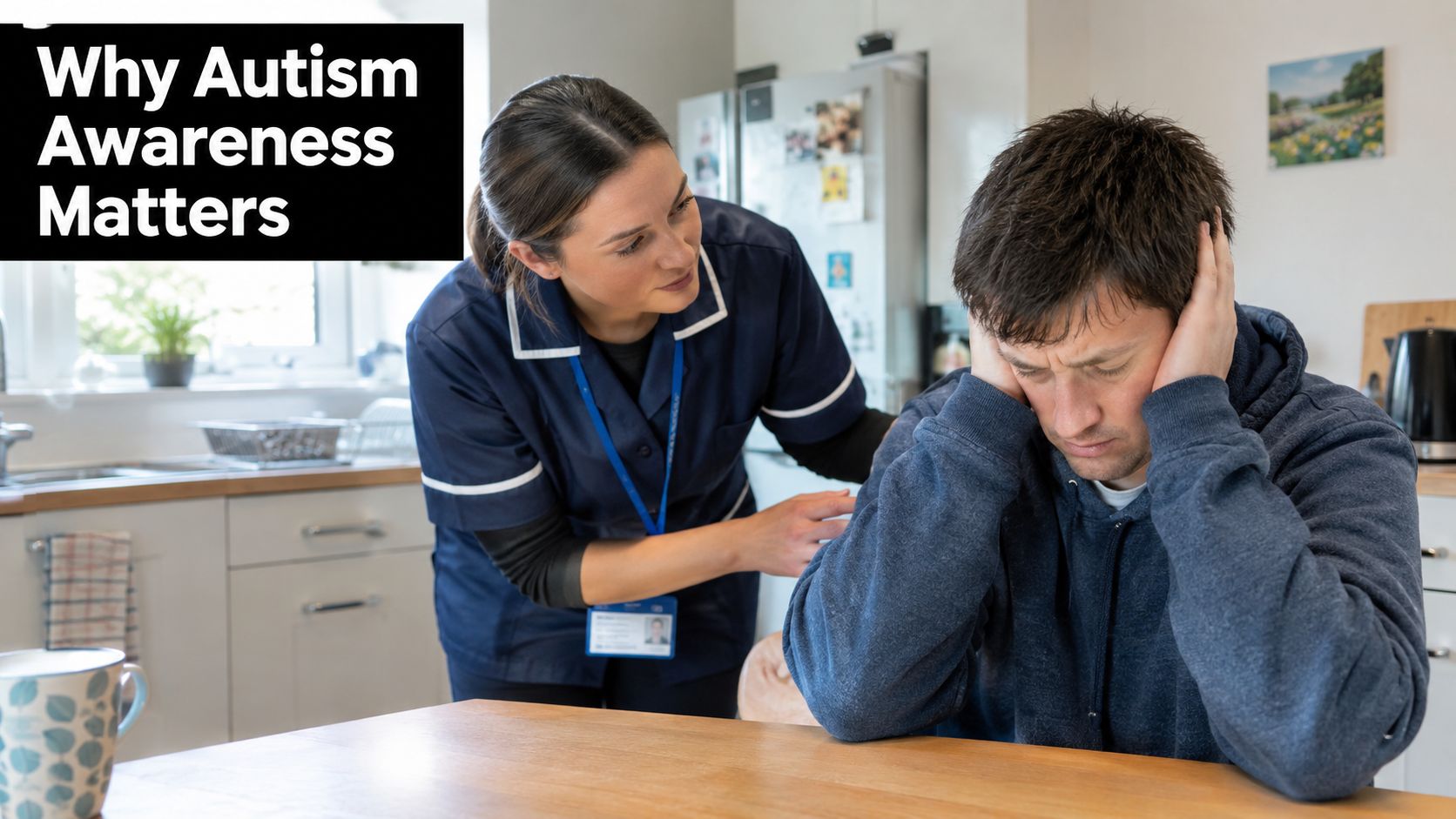
The scale of need helps explain why this knowledge belongs in core care training. UK government guidance states that more than 700,000 people in the UK are autistic, and that more than 1 in every 100 people has an autism diagnosis. Those figures appear in the government's Oliver McGowan draft code of practice, which also describes the move towards role-appropriate learning for regulated providers.
Awareness protects against assumptions
Autism isn't a single presentation or a fixed list of behaviours. One person may use spoken language fluently but struggle with indirect requests. Another may communicate through objects, gestures, writing, or an augmentative and alternative communication system. Someone else may appear calm while working hard to cope with overwhelming sensory input.
A useful class helps staff replace assumptions with questions:
- What might the person be communicating? Look at the context, not just the visible behaviour.
- What has changed? Check routines, staff, lighting, noise, pain, medication, and expectations.
- What does the person's plan say? Follow known preferences and agreed responses.
- What adjustment can reduce the demand? Offer processing time, clearer language, choice, or a quieter space.
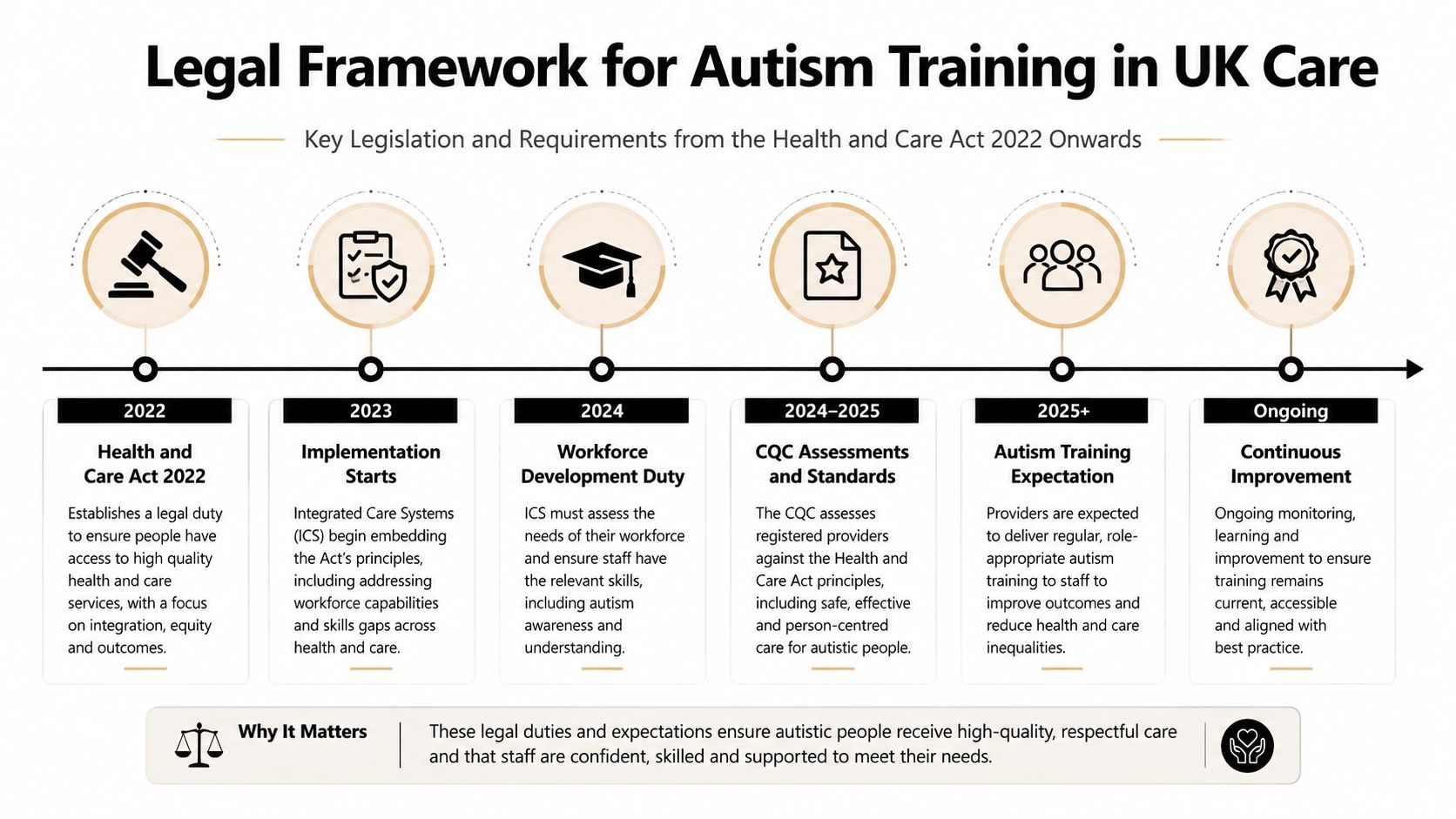
The UK's statutory shift towards autism and learning disability training accelerated through the Health and Care Act 2022. From 1 July 2022, CQC-registered providers have been required to ensure staff receive training appropriate to their role, as set out in the Oliver McGowan draft code of practice. Training is therefore connected to safe, person-centred care and provider accountability, not merely personal interest.
Practical rule: Never judge the quality of autism training by whether staff can repeat a definition. Judge it by whether they can make a safer, clearer decision when a person is distressed.
The Legal and Regulatory Framework Behind Autism Training
A night-shift worker may spend hours supporting one resident with medication routines, personal care, or an unexpected change in plans. That role requires more than a general definition of autism. The worker needs training matched to the decisions made during the shift, while a receptionist or domestic worker may need a different level of preparation. The legal framework follows this principle: responsibility should shape training depth.
The starting point is the Health and Care Act 2022. It requires CQC-registered providers to ensure staff receive learning disability and autism training appropriate to their roles. This makes autism training part of provider accountability and safe, person-centred care, rather than an optional interest for individual employees.
In England, the Oliver McGowan Mandatory Training provides the national implementation model, developed through NHS England and Health Education England. It uses two tiers, so providers can assign learning according to contact, duties, and decision-making.
How the two tiers work
Tier 1 gives general awareness to staff who may encounter autistic people without providing continuing direct care. Tier 2 is for workers whose duties include direct care and support, such as personal care, assessments, transitions, communication, and responding to distress.
The Oliver McGowan Mandatory Training information from Health Education England outlines the delivery model:
- Tier 1: E-learning followed by a 1-hour interactive session.
- Tier 2: E-learning followed by a 1-day face-to-face session.
- Both tiers: Co-delivery with an autistic person and a person with a learning disability, so lived experience informs the learning.
Tier allocation should follow the actual job, not a convenient headcount. For example, a night worker who checks medication, supports continence care, and decides whether to alter a routine needs training that covers communication, sensory demands, consent, and distress prevention. A staff member who has occasional contact may need general awareness and clear routes for requesting specialist support. Providers can compare these requirements with wider mandatory training guidance for care workers, while the employer remains responsible for confirming its own policy and inspection expectations.
What providers need to evidence
A provider should be able to show which worker completed which course, when completion occurred, and which tier or level was covered. Records should also connect the learning to the worker's role. Useful evidence may include the course description, certificate, learning outcomes, induction notes, supervision records, and examples of agreed workplace adjustments.
Training completion is only one part of compliance. Managers should check whether staff can apply the learning, for example by documenting a quieter medication routine, allowing extra processing time, or recording a person's preferred communication method.
The government reported that the Oliver McGowan training was trialled in 2021 with over 8,000 participants, and that Part 1 of the e-learning package had been completed by over 3 million people by 2025. These figures appear in the government's code of practice information. They indicate the scale of the move from voluntary awareness activity towards a recognised national training standard.
What Autism Awareness Classes Cover
A reliable course starts with a practical principle: autism awareness isn't a script for predicting behaviour. It provides a foundation for understanding how communication, sensory processing, routines, relationships, and environments may affect an individual. The class should then show workers how to use that understanding without reducing someone to a label.
Tier 1 generally introduces autism as a neurodevelopmental difference and explores the varied ways autistic people may communicate and experience the world. It should challenge stereotypes, explain that autistic people have different strengths and support needs, and connect inclusion to everyday contact, such as reception, housekeeping, estates, or administration.
Tier 2 moves closer to decisions made by frontline workers. It should cover assessment, communication, reasonable adjustments, distress, restrictive practice, and co-occurring needs such as anxiety or ADHD. The content needs to relate to real care tasks, because recognising a concept in a lesson is different from applying it during personal care, medication, or a handover.
A practical tier comparison
| Training Tier | Core Topics Covered | Target Roles | Key Learning Outcomes |
|---|---|---|---|
| Tier 1 | Autism fundamentals, communication differences, sensory experiences, myths, inclusion, and respectful language | Administrative, ancillary, reception, estates, and indirect-contact staff | Recognise potential barriers, communicate respectfully, and signpost appropriate support |
| Tier 2 | Person-centred assessment, reasonable adjustments, distress prevention, communication strategies, care planning, and restrictive practice awareness | Frontline care workers, support workers, nurses, team leaders, and staff providing direct support | Adapt care safely, identify triggers, respond to distress, and apply agreed adjustments |
A good programme uses workplace examples rather than asking learners to memorise traits. “Refusing personal care” might reflect pain, fear, an unfamiliar sequence, cold water, a rushed explanation, or a previous negative experience. The worker's task is to investigate respectfully, check the person's communication profile and care plan, and record what helps. It is similar to checking the cause of an alarm before deciding how to respond. A label alone does not explain the event.
Lived experience should be part of the lesson
The Oliver McGowan model includes co-delivery with an autistic person and a person with a learning disability. That matters because professionals can describe policy, while lived-experience contributors can show how a rushed question, fluorescent lighting, unexpected touch, or unclear choices may feel in practice.
Classes should turn these lessons into observable behaviours. Staff should learn that eye contact is not a reliable measure of attention and that repetitive movement may support regulation. Saying “Good job” is less useful than specifying what the person did well, for example, “You put your cup on the tray.” Clear feedback gives the person information they can use.
The strongest courses connect learning to care plans, handovers, consent, and everyday interactions. That connection helps workers move beyond a compliance tick-box and make adjustments they can explain, record, and review.
Comparing Delivery Formats and Accreditation Options
A night-shift care worker completes an online autism awareness module before supporting a person who becomes distressed during personal care. The module may explain relevant concepts, but the worker still needs opportunities to practise clear communication, consider alternatives, and receive feedback. The right format depends on the worker's role, employer policy, and the practical skills the course expects learners to demonstrate.
Online-only learning suits varied shifts and can provide foundational knowledge through reading, video, and knowledge checks. Its limitation is practice. A worker may understand a principle but have little chance to rehearse a sensitive conversation or respond to distress before facing that situation at work.
Face-to-face teaching creates room for discussion, role-play, questions, and feedback. This is particularly useful for staff who provide direct care, provided the scenarios reflect real workplace situations rather than generic group activities. Scheduling can be difficult across night shifts, agency rotas, and teams working in different locations.
Blended learning joins independent study with a planned interactive session. Learners first build knowledge, then test their understanding with facilitators and lived-experience contributors. The Oliver McGowan model uses e-learning followed by an interactive session for Tier 1, or a face-to-face day for Tier 2. This structure can show whether learning has moved beyond a compliance tick-box, although the quality of the live session still matters.
Compare the format before you enrol
| Criteria | Online Only | Face-to-Face | Blended Learning |
|---|---|---|---|
| Scheduling | Flexible for varied shifts | Requires protected attendance time | Flexible preparation plus scheduled practice |
| Learning style | Good for reading, video, and knowledge checks | Stronger for discussion and role-play | Combines independent study with applied learning |
| Compliance recognition | Depends on employer acceptance and course scope | Depends on provider and course scope | Often gives clearer evidence of knowledge and participation |
| Practical skill development | Limited unless scenarios are interactive | Strong opportunity for coached practice | Strong when the live element is well designed |
| Best fit | General awareness and preliminary learning | Direct-care practice and team discussion | Role-appropriate learning with theory and application |
A certificate does not by itself show that a worker can apply learning. Check how the course assesses understanding and whether learners practise skills relevant to their duties.
Accreditation needs careful checking
A CPD certificate records completion of structured professional development, but it does not automatically meet an employer's mandatory training standard. A qualification on the Regulated Qualifications Framework may have a different status and assessment requirement. Check the exact course title, learning outcomes, awarding arrangements, and employer recognition rather than relying on the label.
Ask your manager before paying. Some employers accept a named internal programme or Oliver McGowan tier. Others accept an external CPD course only when it covers specified outcomes. The training guidance for ADHD also shows why role-specific learning matters across neurodevelopmental support, although autism training requirements must be checked separately.
Be cautious if a provider will not explain who accredits the course, what assessment is used, whether the certificate names the subject clearly, or whether the content includes practical application. A polished certificate is not enough if it cannot satisfy the employer's compliance process.
Moving Beyond Awareness to Practical Workplace Adjustments
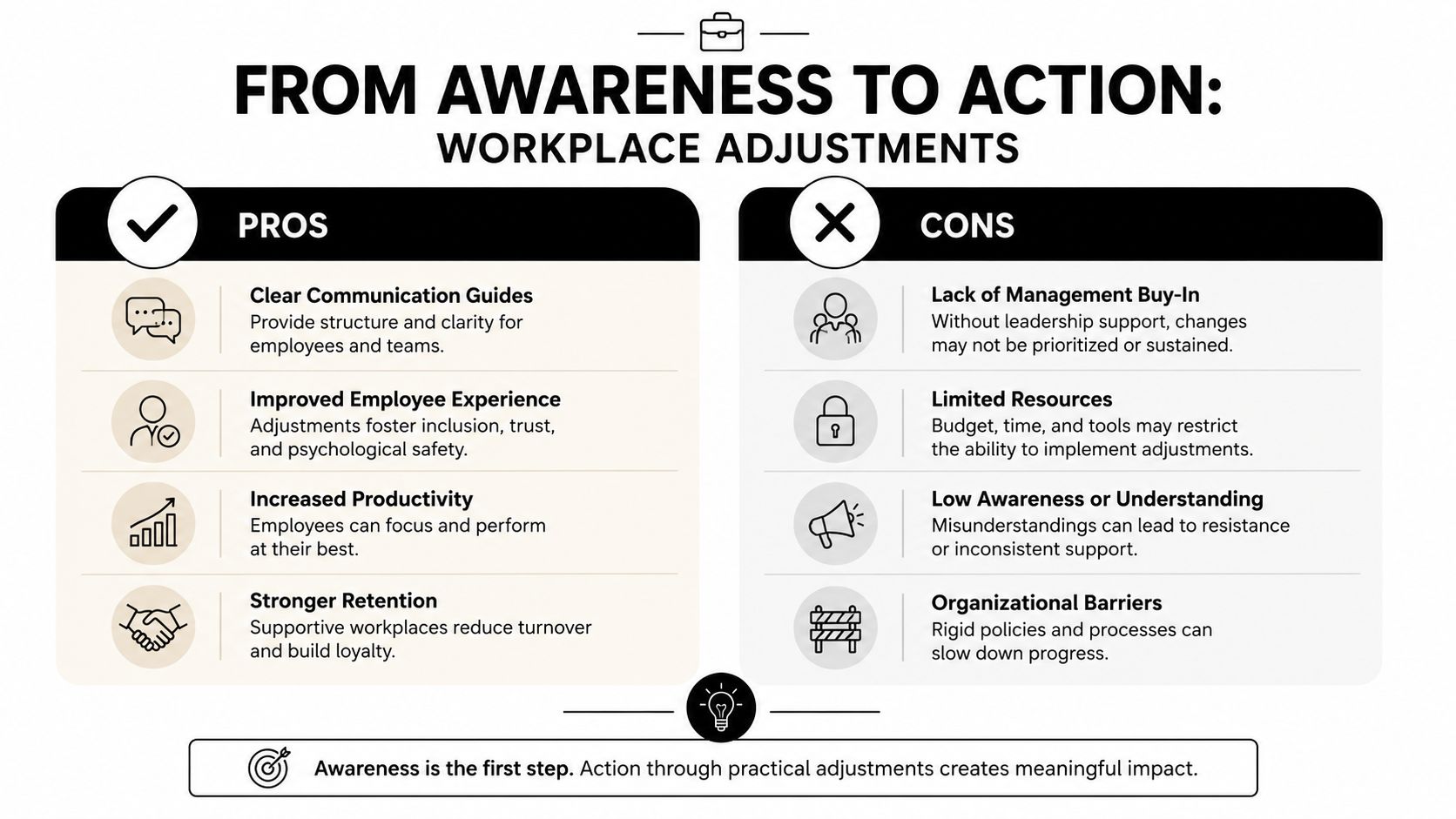
Awareness becomes useful only when it changes what a worker does. A course may explain sensory differences, communication preferences, and the importance of routine, but the person receiving care experiences the training through concrete decisions. Do you explain the sequence before starting? Do you offer processing time? Do you reduce unnecessary noise? Do you record what worked?
UK evidence supports this distinction. Research on workplace autism training found that training was associated with better understanding of adjustments, while contact with autistic family members, friends, or colleagues was associated with even higher confidence in supporting autistic employees. The published UK research also highlights the limits of relying on training alone and the risk of poor, one-size-fits-all employer training reinforcing stereotypes.
Adjustments care workers can apply
- Use concrete communication: Replace “We'll do that shortly” with a clear explanation of what will happen, who will do it, and what comes next.
- Build predictable sequences: Use a written or visual schedule for medication, meals, personal care, appointments, and changes of staff.
- Reduce sensory load: Offer a quieter area, lower unnecessary noise, adjust lighting where possible, and avoid introducing several instructions at once.
- Prepare for change: Explain unavoidable changes early, provide choices where possible, and identify a familiar person or object that can support the transition.
- Record individual preferences: Add successful adjustments to the care plan and handover so the person doesn't need to explain the same need repeatedly.
An adjustment isn't a reward for cooperation. It's a way of removing a barrier so the person can participate in care as safely and comfortably as possible. The adjustment may be small, but it needs to be agreed, recorded, reviewed, and changed when it no longer helps.
Test whether learning transfers
A manager can observe whether a worker applies the course by reviewing care records, supervision discussions, incident debriefs, and feedback from the person and their support network. A useful post-course action plan might ask each learner to identify one communication adjustment, one environmental adjustment, and one change to handover practice.
Training that includes case studies and scenario-based assessment is more likely to expose misunderstandings than a final multiple-choice quiz alone. Resources on behaviour support strategies can complement awareness learning, but staff must still follow the individual's care plan, local policy, clinical guidance, and least-restrictive practice requirements.
How to Choose the Right Training Provider
Begin with your employer's requirements. Ask which autism training the organisation accepts, whether your role requires Tier 1 or Tier 2 learning, and what evidence must be available for audits or CQC inspection. This avoids paying for a certificate that does not match your responsibilities.
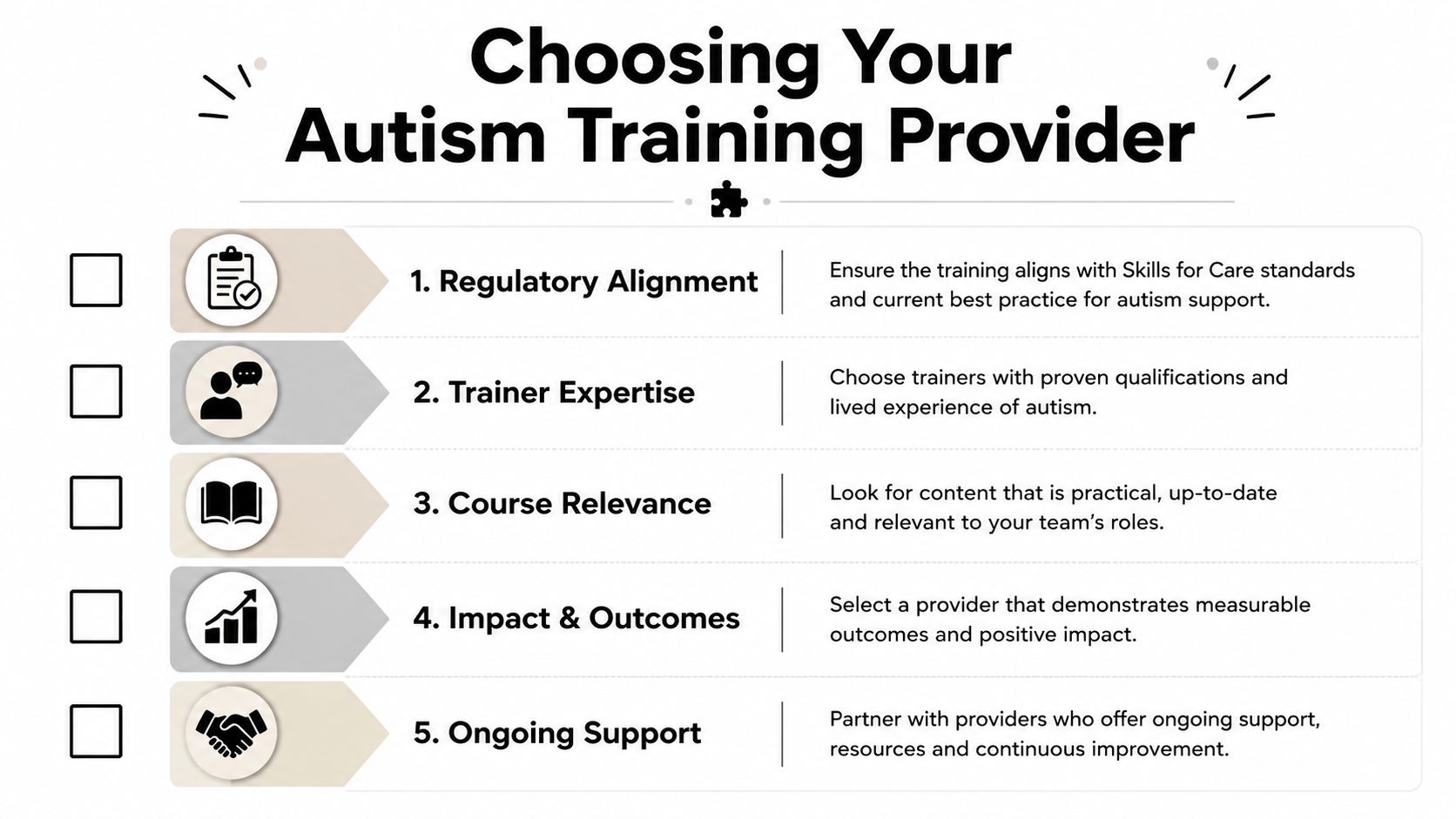
Use five checks before booking
- Regulatory alignment: The provider should explain how the course supports role-appropriate learning, CQC expectations, and relevant UK care standards. Be cautious of broad promises such as “fully compliant everywhere”. Ask what the certificate demonstrates.
- Trainer expertise: Look for trainers with relevant care experience and meaningful involvement from autistic people or others with lived experience. Trainers with autistic contributors should show how those perspectives shape the course content throughout, including examples, activities, and assessments.
- Curriculum depth: Read the syllabus closely. Direct-care workers need more than diagnostic terminology. The outline should cover communication, sensory environments, reasonable adjustments, distress prevention, person-centred planning, and awareness of restrictive practice. These topics connect classroom knowledge with decisions staff make during personal care, appointments, and daily routines.
- Suitable delivery: Choose online, face-to-face, or blended learning according to the skills you need to practise. If you provide direct support, ask how the course checks application rather than attendance alone. A completion record cannot show whether a worker can adapt communication or respond safely when a person becomes distressed.
- Support after completion: Check for downloadable resources, refresher guidance, supervision prompts, progression routes, and clear certificate details. Good follow-up materials give managers something to discuss in supervision and help learners apply the course after the completion screen closes.
The government's care training guidance states that adult social care providers arranging this training between April 2025 and March 2026 can be reimbursed through the Learning and Development Support Scheme. This may reduce the cost barrier for providers standardising training across domiciliary, residential, and agency settings. Employers should confirm current eligibility and administrative requirements before relying on reimbursement.
Cura Academy is one example of a provider offering structured care training pathways, but learners should still check whether a particular course meets their employer's requirements. Before enrolling, request the full syllabus, assessment method, certificate sample, trainer information, and refund terms. A provider that avoids clear questions about accreditation or role suitability is giving you a reason to look elsewhere.
Common Questions About Autism Awareness Classes
Do online-only classes meet CQC expectations?
They can, if the course fits the worker's role and the employer's requirements. CQC expectations concern training appropriate to the role, rather than the format alone. A care worker supporting autistic people should check whether the provider includes interaction, assessment, and workplace application. Some employers may also expect face-to-face learning where their local approach follows the Oliver McGowan model.
How long does a certificate remain valid?
There is no universal expiry period. Check the certificate, your organisation's training matrix, local policy, and refresher schedule. A certificate records completion at one point in time. It does not replace supervision, updated guidance, or discussion when a person's communication, sensory needs, or support plan changes.
Is Oliver McGowan training mandatory for every worker?
CQC-registered providers must ensure staff receive learning disability and autism training appropriate to their roles. The two-tier structure reflects different responsibilities, so workers do not all need identical learning. Managers should consider each person's duties, level of contact, and decisions made during care before assigning Tier 1 or Tier 2.
Is awareness training the same as a specialist qualification?
No. Awareness training establishes respectful communication, autism-informed practice, and basic adjustments. A specialist qualification may be needed for workers who assess complex needs, lead behaviour support, manage services, provide clinical care, or advise colleagues. The right course depends on what the worker must safely do, not their job title.
How can I evidence completion?
Retain the certificate, course outline, assessment record, completion date, and employer confirmation. Managers should keep a training matrix linking each worker's learning to their role and recording refresher activity. Applied understanding also matters. A short discussion about adapting communication or reducing sensory overload can show whether learning has transferred into practice.
Use these checks to identify training gaps and match roles to the appropriate tier. Ask providers how learners demonstrate practical understanding, not only whether a certificate is issued. The strongest course supports safer decisions at the point of care and turns an awareness requirement into workable adjustments.
Cura Academy offers structured UK care training pathways for mandatory learning, refreshers, and role-specific development. Visit Cura Academy to explore options supporting compliance records and practical readiness for frontline care work.