

A new carer arrives for the breakfast round and finds Mrs Patel sitting with untouched toast, her hands clenched and her face tense. When offered help, she turns away and says, “I'm not going,” even though breakfast is usually part of her familiar routine. A rushed response might label her as difficult. A dementia-aware response pauses and asks what the refusal could be communicating.
Perhaps the room is too noisy. Perhaps she has pain, feels embarrassed, doesn't recognise the carer, or believes the meal belongs to someone else. The difference isn't a special trick. It comes from understanding dementia well enough to see behaviour as information, protect the person's dignity, and change the approach before distress escalates.
Table of Contents
- Why Dementia Awareness Matters on Every Shift
- What Dementia Really Is in the UK Today
- How Dementia Changes Behaviour and Communication
- Person-Centred Care Strategies That Work
- Linking Awareness to Care Certificate Standards
- Real Care Moments That Show Awareness in Action
- The Recommended Training Pathway for UK Care Workers
- Bringing It All Together as a Confident Carer
Why Dementia Awareness Matters on Every Shift
Dementia awareness affects ordinary care moments, not just formal assessments. It shapes how you introduce yourself, explain a shower, support someone to eat, respond to repeated questions, and speak with relatives. Without that foundation, a well-meaning worker can mistake fear for refusal, pain for aggression, or confusion for wilful non-compliance.
The scale of dementia makes this a core workforce skill. UK-facing government information describes around 850,000 people living with dementia, with more recent reporting placing the figure close to one million and projecting that it will exceed 1.5 million by 2040. A nationwide poll found that only 5% of people could correctly estimate the true prevalence, while 34% said they didn't know how common dementia is. The same evidence found that just 60% of UK adults realised dementia is a cause of death, although it is described as the UK's leading cause of death and accounts for more than one in ten deaths. These figures are set out in the UK government dementia awareness guidance.
The pause that changes the outcome
When Mrs Patel refuses breakfast, try a short sequence:
- Pause and regulate yourself. A low voice and unhurried movement can reduce pressure.
- Check the immediate environment. Look for noise, glare, crowding, an unfamiliar apron, or an uncomfortable chair.
- Use one simple sentence. “Would you like tea first?” is easier to process than several questions.
- Observe rather than argue. Notice facial expression, posture, breathing, and whether she protects a part of her body.
- Report a change. New or unusual distress may need a pain, infection, medication, or health check by the appropriate person.
Practical rule: Don't ask, “Why are you being difficult?” Ask, “What might this person be trying to tell me?”
Awareness also protects dignity in practical details. Clear name labels can help people identify clothing and belongings, particularly where several residents have similar items. Guidance on why care homes need name labels can support a wider conversation about orientation, ownership, and respectful organisation.
This is why dementia awareness isn't optional background knowledge. It is the lens through which every shift is filtered. It helps you make safer decisions, preserve choice, and feel more confident when a familiar routine suddenly stops working.
What Dementia Really Is in the UK Today
Dementia is an umbrella term for conditions that affect the brain and can progressively change memory, thinking, communication, judgement, and the ability to manage everyday tasks. It isn't one single illness, and two people with the same diagnosis may have very different strengths, needs, and patterns of change.
On shift, you may notice that a person can remember a childhood song but not what happened at breakfast. They may understand warmth and kindness even when they can't find the right words. They may still make choices, show humour, recognise familiar routines, or complete part of a task independently. A diagnosis never removes the need to look for ability.
The distinction from ordinary forgetfulness is usually found in impact on daily life, not in an isolated memory slip. Forgetting where keys are and finding them later is different from repeatedly losing the ability to prepare food, follow a familiar route, use the telephone, or manage personal care. Any sudden change should be reported, because delirium, pain, infection, medication effects, or another health problem can also affect cognition.
The UK picture and the care workforce
Government statistics for England recorded 483,000 people aged 65 and over with a formal dementia diagnosis by December 2024, a record high. The diagnosed prevalence rate was 4.2% of the primary care registered population, compared with 4.3% in 2017 and 3.9% in 2021. The figures and their interpretation appear in the March 2025 dementia profile commentary.
These figures matter to new care workers because dementia will appear across residential care, domiciliary care, day services, hospital discharge support, and unpaid family networks. Training priorities shouldn't depend on whether your job title contains the word dementia. Your first response may influence whether someone feels safe enough to accept help.
Common types of dementia UK carers will meet
The table uses practical distinctions rather than rigid rules. A person can have a mixed presentation, and only qualified professionals can diagnose a condition.
| Type of Dementia | What Carers May Notice | Approximate UK Share |
|---|---|---|
| Alzheimer's disease | Gradual changes in short-term memory, orientation, word finding, and everyday sequencing | No single share is stated here |
| Vascular dementia | Changes that may affect planning, attention, movement, or thinking speed, sometimes alongside memory difficulties | No single share is stated here |
| Lewy body dementia | Fluctuating alertness, visual experiences, movement changes, and sensitivity to routine or medication changes | No single share is stated here |
| Mixed dementia | Features associated with more than one type, requiring flexible observation and support | No single share is stated here |
Use the person's care plan and professional guidance rather than trying to identify a subtype yourself. Your role is to notice patterns, communicate clearly, record changes, and support the person as an individual.
How Dementia Changes Behaviour and Communication
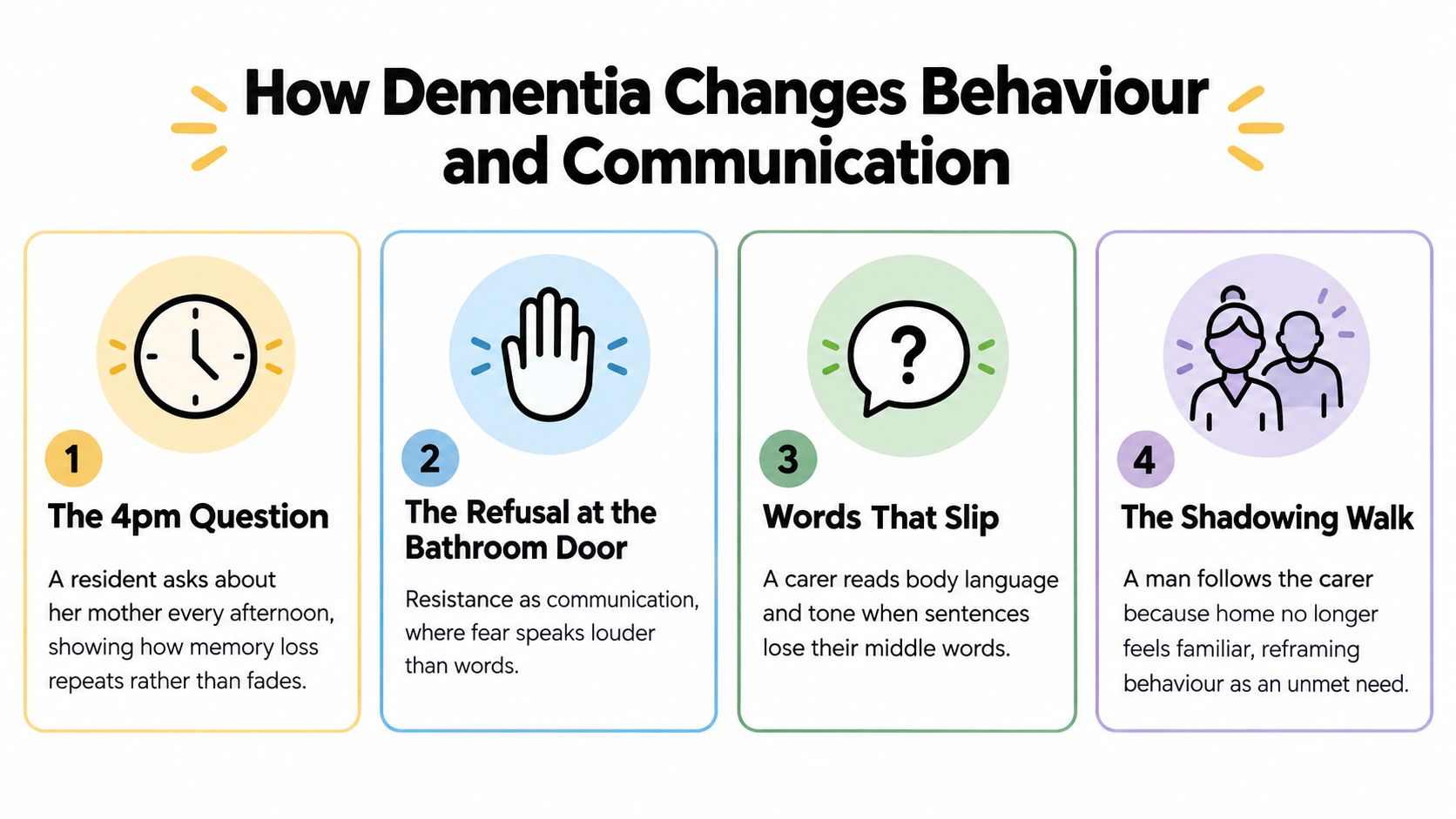
A person asks, “When is my mother coming?” You answer, and a few minutes later they ask again. Repeating the answer more firmly rarely solves the problem because the person may not retain the information, or the question may express fear rather than a request for a fact. Offer reassurance first: “You're thinking about your mother. You're safe here, and I'm staying with you for a moment.”
Language may change in less obvious ways. Someone can lose the thread of a conversation, struggle to retrieve a familiar word, use a related word instead, or return to a first language. Broken sentences don't necessarily mean that comprehension has disappeared. Slow down, use short phrases, allow time, and read tone, gesture, and facial expression alongside the words.
Read the message behind the action
Recognition can also fluctuate or change. A person may fail to recognise a partner, relative, or regular carer, then respond warmly to a familiar song or routine. That isn't proof of indifference. The brain may no longer connect a face with the right meaning, even though the person still experiences comfort, threat, familiarity, and emotion.
Wandering, following a worker, resisting personal care, or becoming more unsettled later in the day should be approached as behavioural expressions, not character flaws. Consider what happened immediately before the action and what the person may need:
- Pain or physical discomfort: Look for guarding, grimacing, changes in movement, or unusual restlessness, and report concerns.
- Fear or loss of control: Explain each step, offer a choice, and ask permission before touching.
- Overstimulation: Reduce television volume, move away from a busy doorway, or offer a quieter space.
- Boredom or an unmet role: Provide a meaningful task, familiar object, music, or a short supported walk.
- Confusion about place: Use calm orientation without testing or correcting harshly.
A bathroom refusal might mean the room feels cold, the person doesn't understand what is being asked, or a previous transfer was frightening. Try a different time, offer privacy, and ask a colleague who knows the person's routine what usually helps. For more examples of practical communication for dementia, focus on approaches that preserve connection rather than forcing compliance. You can also review dementia communication techniques as a prompt for adapting your words and pace.
Behaviour is a message. Your first task is to understand what the message may be, not to silence it.
Person-Centred Care Strategies That Work
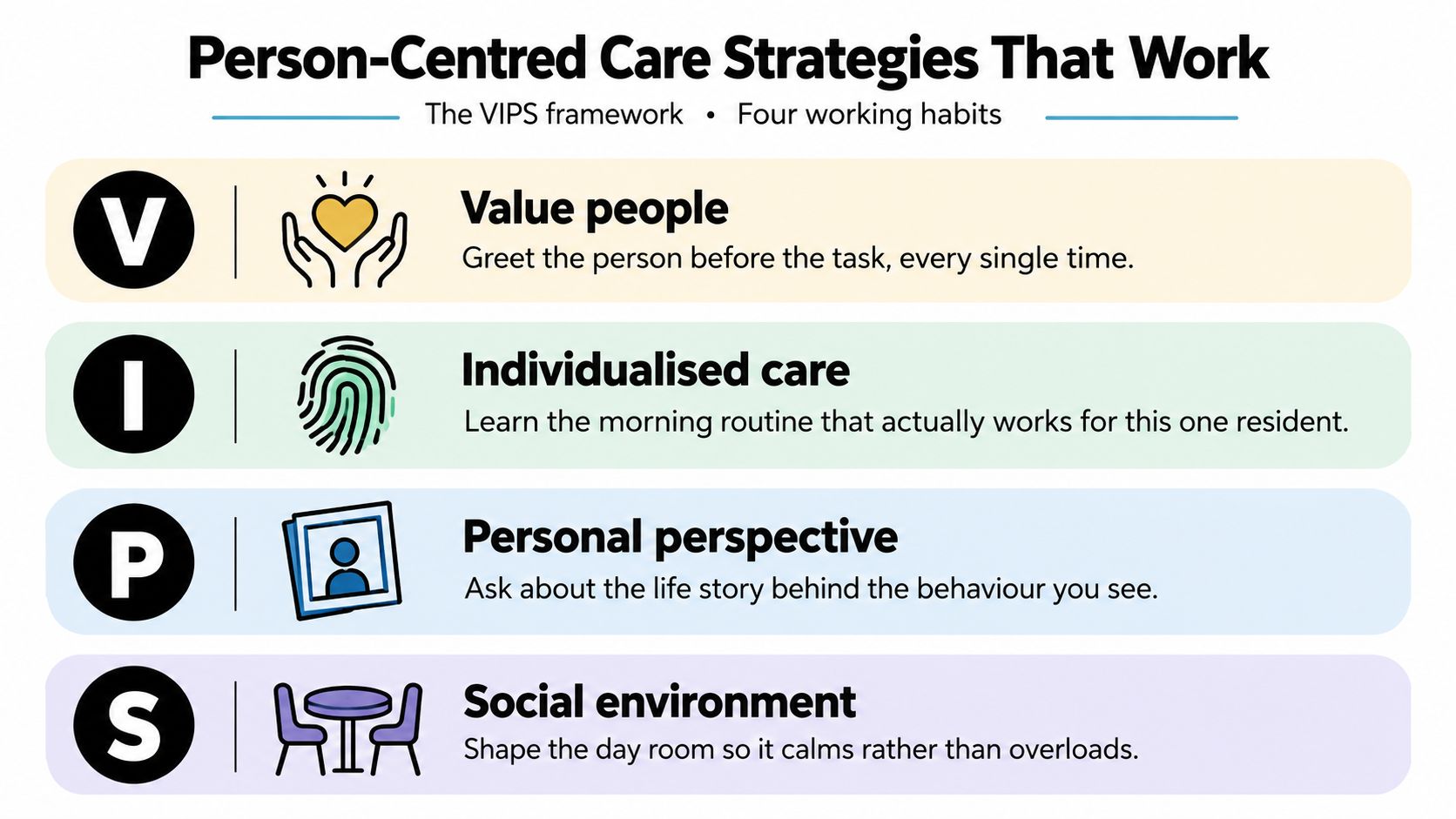
Person-centred care means treating the person as more than a diagnosis, task list, or room number. The VIPS framework offers a useful working lens: valuing people, individualised care, personal perspective, and social environment. You don't need to recite the framework during a busy shift. You need to let it influence what you do.
Start with the person's identity. Find out how they prefer to be addressed, what time they usually wake, which foods they dislike, and whether they prefer conversation before personal care. A life-history detail can change the meaning of an action. Someone who refuses a uniform may have spent a lifetime valuing independence or privacy, not just be "unco-operative".
Four habits to practise today
- Value the person before the task. Knock, greet them by their preferred name, make eye contact, and explain what you're there to do. Don't begin by pulling back curtains or moving equipment.
- Individualise the routine. Offer two realistic choices, such as “Would you like the blue top or the green one?” Open questions can be overwhelming when processing is difficult.
- Use the personal perspective. Ask what the behaviour might feel like from the person's side. A shower can feel exposing, a rushed handover can feel threatening, and a busy dining room can feel impossible to manage.
- Shape the social environment. Reduce clutter, make important objects visible, and consider lighting, noise, temperature, and seating. The room can either support orientation or add another demand.
A person-centred response also protects consent. Explain, wait for a response, and notice whether the person is comfortable. If they refuse, don't turn the interaction into a contest. Consider whether you can offer a later opportunity, involve a familiar colleague, or seek advice from the senior worker while maintaining privacy.
Make remaining ability visible
If someone can wash their face, choose clothing, butter toast, or fold towels, support that ability rather than taking over. Give enough time for the person to attempt the step, then provide only the assistance needed. This can make care slower in the moment, but it can preserve confidence and reduce the frustration that comes from being treated as incapable.
Record what works in concrete language. “Mrs Patel ate after the television was switched off and she was offered tea first” is more useful than “Mrs Patel was settled”. Consistent notes help colleagues provide continuity, which is one of the most practical forms of respect. Further guidance on dementia person-centred care can help turn the VIPS principles into daily habits.
Linking Awareness to Care Certificate Standards
The Care Certificate gives new workers a shared language for safe and respectful practice. Dementia awareness shouldn't sit apart from the rest of the framework. Communication, equality, dignity, consent, and person-centred care all meet in the same interaction at the bedside, bathroom door, or dining table.
Skills for Care's Dementia Training Standards Framework positions dementia awareness as a baseline capability across the health and social care workforce, including non-clinical and community-facing roles. It recommends embedding awareness in induction and refresher training, because workers need to recognise signs, escalate concerns, and communicate in a person-centred way.
Compare the standard with the shift
| Care Certificate Standard | What It Requires | Real Dementia Care Behaviour |
|---|---|---|
| Standard 9, Awareness of Mental Health, Dementia and Learning Disabilities | Understand how dementia can affect a person's experience, communication, and support needs | Treat repetition, distress, and refusal as information, then check for unmet needs and report changes |
| Standard 4, Equality and Diversity | Respect identity, rights, beliefs, preferences, and individual differences | Use the person's preferred name, respect cultural communication, and avoid assumptions based on diagnosis |
| Standard 5, Work in a Person-Centred Way | Support choice, dignity, independence, privacy, and wellbeing | Offer manageable choices, explain care, and support the person to complete tasks they can still do |
| Standard 6, Communication | Adapt communication to the person's needs and confirm understanding | Use short sentences, allow processing time, observe non-verbal cues, and avoid arguing over errors |
Your evidence might include an assessment, reflective account, observation by a supervisor, or a record of how you adapted an interaction. The evidence should show what you noticed, what you did, why you chose that response, and what happened next. A general statement such as “I provided good care” doesn't demonstrate the skill as clearly as a specific example.
For workers updating a CV, a practical StoryCV resume for caregivers resource can help describe responsibilities in terms of observable actions. Keep the focus on what you can demonstrate, such as adapting communication, recording changes, supporting consent, and working with colleagues.
The Care Certificate should be treated as a foundation for practice, not the end of dementia learning. A signed-off standard shows that you have met an expected level at a particular point. Supervision and continued learning show how you apply it when the situation is unfamiliar.
Real Care Moments That Show Awareness in Action
At lunchtime, Daniel pushes his plate away and says, “Not that.” The new carer, Aisha, notices that he keeps looking towards the corridor and rubbing his left shoulder. Instead of insisting that he eat, she lowers the noise around the table, sits at his eye level, and says, “You look uncomfortable. Would you like to sit somewhere quieter?”
Daniel doesn't answer, so Aisha waits. She offers the choice of the quiet lounge or his usual chair, then checks the care notes and tells the senior worker about the shoulder rubbing and change in appetite. She doesn't diagnose pain, but she does report an observation that could need attention. Later, when Daniel is more settled, she offers a smaller portion and gives him time to decide.
The effective part of the interaction wasn't a perfect phrase. Aisha knew his usual routine, noticed a change, read his body language, and protected his choice. She avoided treating the untouched meal as a task failure.
Good dementia care is flexible without being vague. The carer observes, responds, records, and asks for support when the change could indicate a health need.
These moments build professional confidence because they replace automatic reactions with a repeatable process. Prepare by reading the care plan, ask colleagues about preferences, and record useful detail after the interaction. Over time, your reflections become evidence that you can apply awareness in real conditions, not just remember definitions in a course.
The Recommended Training Pathway for UK Care Workers
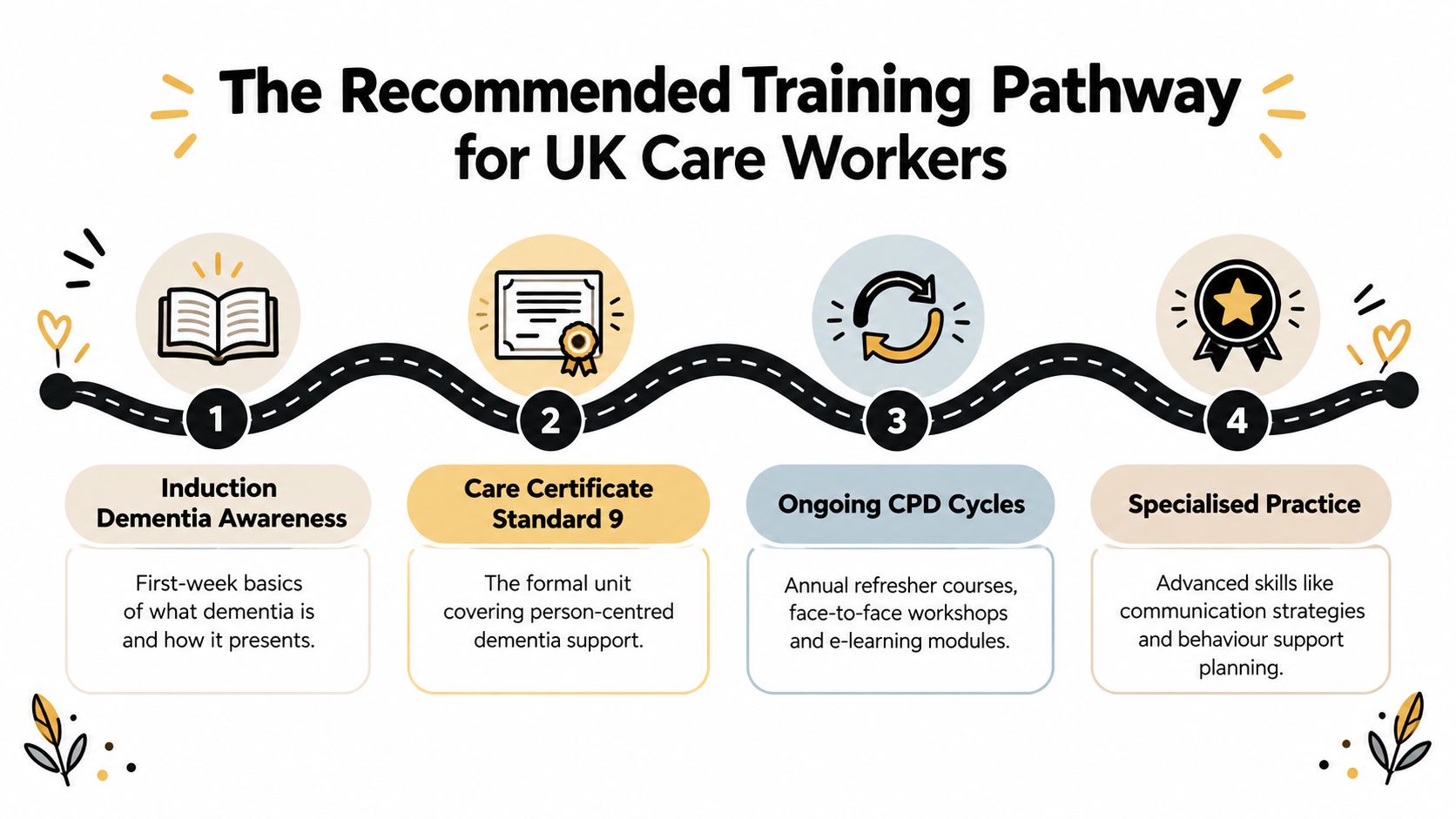
A practical pathway starts with basic awareness and then deepens through supervised application. New workers should know what dementia can look like, how to communicate respectfully, when to report a change, and how their role fits within the wider team. Training shouldn't be separated from observation on shift.
Begin with induction
Induction-level learning introduces the condition, common communication changes, dignity, safeguarding, and person-centred support. Combine an online course with discussion, shadowing, and workplace examples. A face-to-face workshop can be valuable when a team needs to practise tone, pacing, consent, and responses to distress together.
Progress to Care Certificate Standard 9 and connect the learning to the other standards. Ask your assessor or supervisor to observe a real interaction, such as supporting a meal or explaining personal care. Keep a reflective account that states what happened, what you noticed, how you adapted, and what you would do next time.
Keep learning active
Use refresher learning to revisit communication, behaviour support, equality, safeguarding, and escalation. Dementia Friends sessions, virtual dementia experiences, supervised practice, and specialist workshops can add perspective, but each activity should lead back to safer care. Ask how the learning will change your next shift.
Maintain a simple portfolio:
- Certificates: Save completed course records and refresher evidence.
- Reflective accounts: Describe a specific interaction and your reasoning.
- Observation notes: Ask a senior colleague to record what they saw.
- Supervision actions: Write down one communication or environment change to practise.
- Feedback: Include comments from colleagues, people receiving care, or families where appropriate.
Employers may set their own induction and refresher timetable, so follow local policy rather than assuming one schedule fits every service. Review the required learning when you change roles, take on dementia lead responsibilities, or begin supporting people with more complex needs. The aim is a visible link between training, observed competence, and the care people receive.
The public also needs clearer education beyond symptoms and diagnosis. UK polling found that 39% of adults thought dementia risk could be reduced, 30% had seen information about how to reduce risk, and only 2% of people who attended a Health Check recalled dementia risk being discussed, according to Alzheimer's Research UK reporting on dementia risk reduction. Care workers can signpost people to appropriate health professionals and trusted information, while avoiding personal medical advice.
Bringing It All Together as a Confident Carer
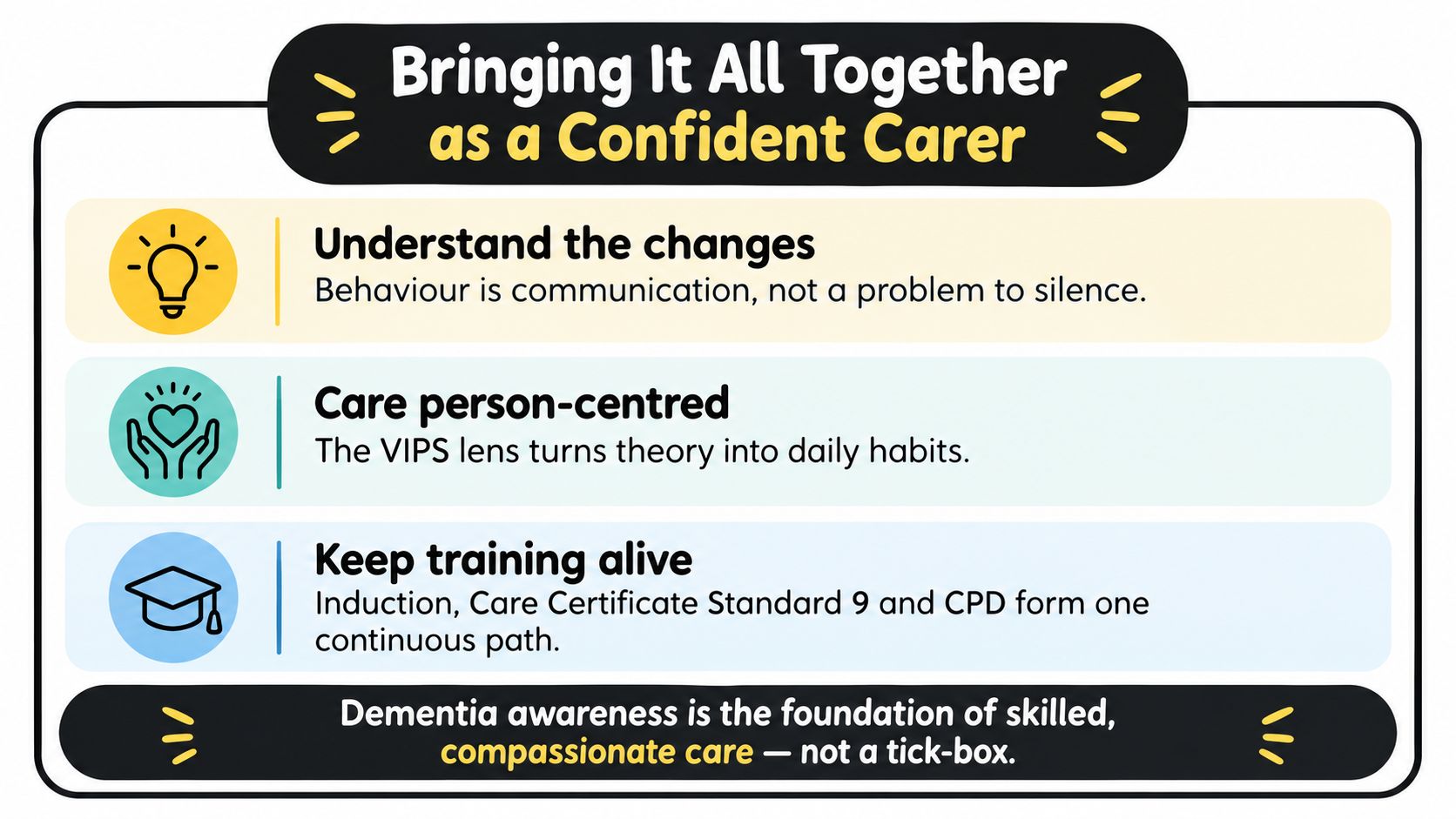
Dementia awareness is the foundation of skilled care, not a training tick-box. It helps you respond to distress with curiosity, communicate when words become difficult, protect a person's choices, and recognise when a change needs reporting. It also gives your Care Certificate evidence substance because you can show how knowledge shaped an actual interaction.
The most useful habits are simple but require consistency:
- Notice before you correct. Behaviour may communicate pain, fear, confusion, boredom, or overstimulation.
- Adapt before you insist. Change the pace, words, setting, or person providing support.
- Record before you forget. Specific observations help colleagues provide continuity.
- Reflect before the next shift. Ask what worked, what didn't, and what the person may have experienced.
Wider support can become confusing after diagnosis. UK evidence found that 46% of respondents didn't know who to contact for social care support, rising to 56% among unpaid carers and 62% among ethnically diverse respondents. It also found limited public understanding of dementia as a terminal illness, who pays for care, and when palliative support may be relevant, as reported in this UK evidence on dementia, palliative care, and public understanding. Stay within your role, but know how to signpost questions to senior staff and relevant services.
Cura Academy offers UK care training that includes Dementia Awareness, Care Certificate standards, and mandatory refresher learning in an online pathway for people preparing for or developing frontline care roles. Visit Cura Academy to explore the training options and start building practical, evidence-based confidence for your next shift.