

A daughter arrives for her mother's morning visit and finds the same routine already under way. A carer is encouraging her to wash, dress and eat, but every instruction is met with frustration. The task matters, yet the approach has missed the person. Her mother used to choose her clothes carefully, disliked rushing, and always started the day with tea before getting dressed. Once the carer slows down, offers two outfits and brings the tea first, the morning feels less like a battle.
That small change captures the purpose of dementia person centred care. It doesn't remove the need for safe washing, nutrition, medication or documentation. It changes how those tasks are planned, communicated and delivered, so the person's history, preferences, abilities and relationships remain part of everyday care.
Table of Contents
- Introduction to Person Centred Dementia Care in the UK
- What Person Centred Dementia Care Really Means
- Core Principles That Shape Everyday Care
- Communication Techniques That Preserve Identity and Choice
- Adapting Environments and Routines Around the Person
- Real World Examples of Person Centred Care in Action
- How Training Prepares You to Deliver Person Centred Care Confidently
Introduction to Person Centred Dementia Care in the UK
Person-centred dementia care matters because a diagnosis never describes a whole life. A person may need help remembering, communicating or completing personal care, while still having strong preferences about food, clothing, music, privacy and the people they trust. Good care starts with those details rather than treating the diagnosis as a complete set of instructions.
The need is substantial and growing. In England, NHS data recorded 458,562 people with a coded dementia diagnosis in August 2018, with a diagnosis rate of 67.8% among people aged 65 and over. By December 2024, 483,000 people aged 65 and over had a formal diagnosis, a record high, as reported in the March 2025 dementia profile. Each person in that population needs care that reflects their own circumstances, not a standard routine applied without question.
From completing tasks to supporting a life
Task-led care asks, “Have we completed the wash, meal, medication and record?” Person-centred care asks an additional question: “How can we complete this safely while protecting the person's dignity, choice and sense of control?”
That difference affects wellbeing. The UK WHELD programme found that a structured person-centred intervention in care homes improved quality of life and reduced agitation and neuropsychiatric symptoms. One analysis reported a 19.7% increase in positive care interactions across 62 care homes, and NIHR reported that the programme may cost less than usual care in its summary of the evidence.
This guide is for new carers, experienced support workers, family members and managers who want practical dementia care that remains consistent across settings. It moves from the meaning of person-centred practice to communication, environments, real-life decisions and the training needed to carry those skills from diagnosis through homecare and residential transitions.
What Person Centred Dementia Care Really Means
Person-centred dementia care means adapting support around the individual, rather than expecting the individual to fit the service. The person remains the focus of decisions, conversations and routines. Their diagnosis helps staff understand possible needs, but it doesn't replace learning who they are.
A useful analogy is a map. The diagnosis marks one important location, but it isn't the whole journey. A proper care map also includes the person's life story, relationships, cultural background, routines, abilities, communication style, comforts and sources of distress. Without those details, staff may know what condition someone has while still not knowing how to help them feel safe.
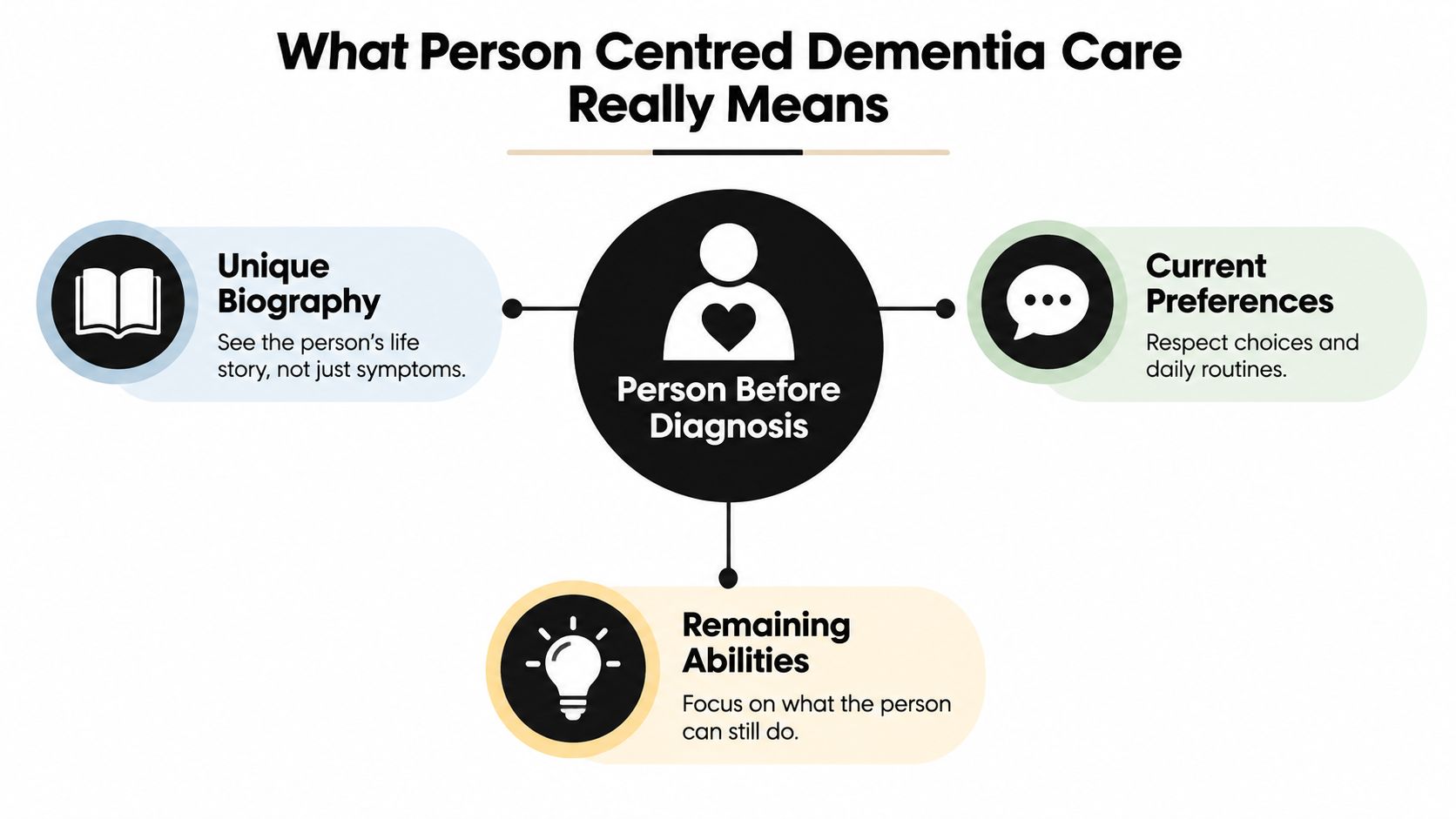
What carers do differently
A medical model may concentrate on symptoms, risks and treatment. A task-focused model may concentrate on finishing the shift's required activities. Person-centred practice includes those responsibilities, but adds the person's perspective to each decision.
For example, a care plan might say that someone needs support with dressing. A person-centred plan would also record whether they prefer to dress before breakfast, which fabrics irritate them, whether they can choose between two outfits, and how staff should offer help without taking over. The task stays visible, but the method becomes individual.
NICE's dementia guideline NG97, published in 2018, sets out person-centred care as best practice. Its guidance expects care plans to be individualised, reviewed and based on what matters to the person, rather than built only around the diagnosis. The NICE guidance on person-centred care also provides the UK policy foundation for involving people with dementia and their families in care decisions.
Practical rule: If a care plan could describe almost anyone with dementia, it probably needs more personal detail.
Person-centred care isn't an occasional activity, such as playing a favourite song or arranging a reminiscence session. It's a daily mindset. It shapes how a carer knocks before entering, explains a procedure, handles refusal, records a preference and shares information with the next worker.
Capacity and choice also need careful handling. A person's difficulty making one decision doesn't mean staff should remove every choice. Carers should follow the relevant care plan and local procedures, support understanding, allow time, and seek appropriate guidance when assessing mental capacity.
Core Principles That Shape Everyday Care
The strongest practice combines several principles at once. Dignity without choice can become polite control. Choice without support can become unsafe or overwhelming. Individualised care without communication between staff can disappear at the next handover. Person-centred care works when these parts reinforce each other.
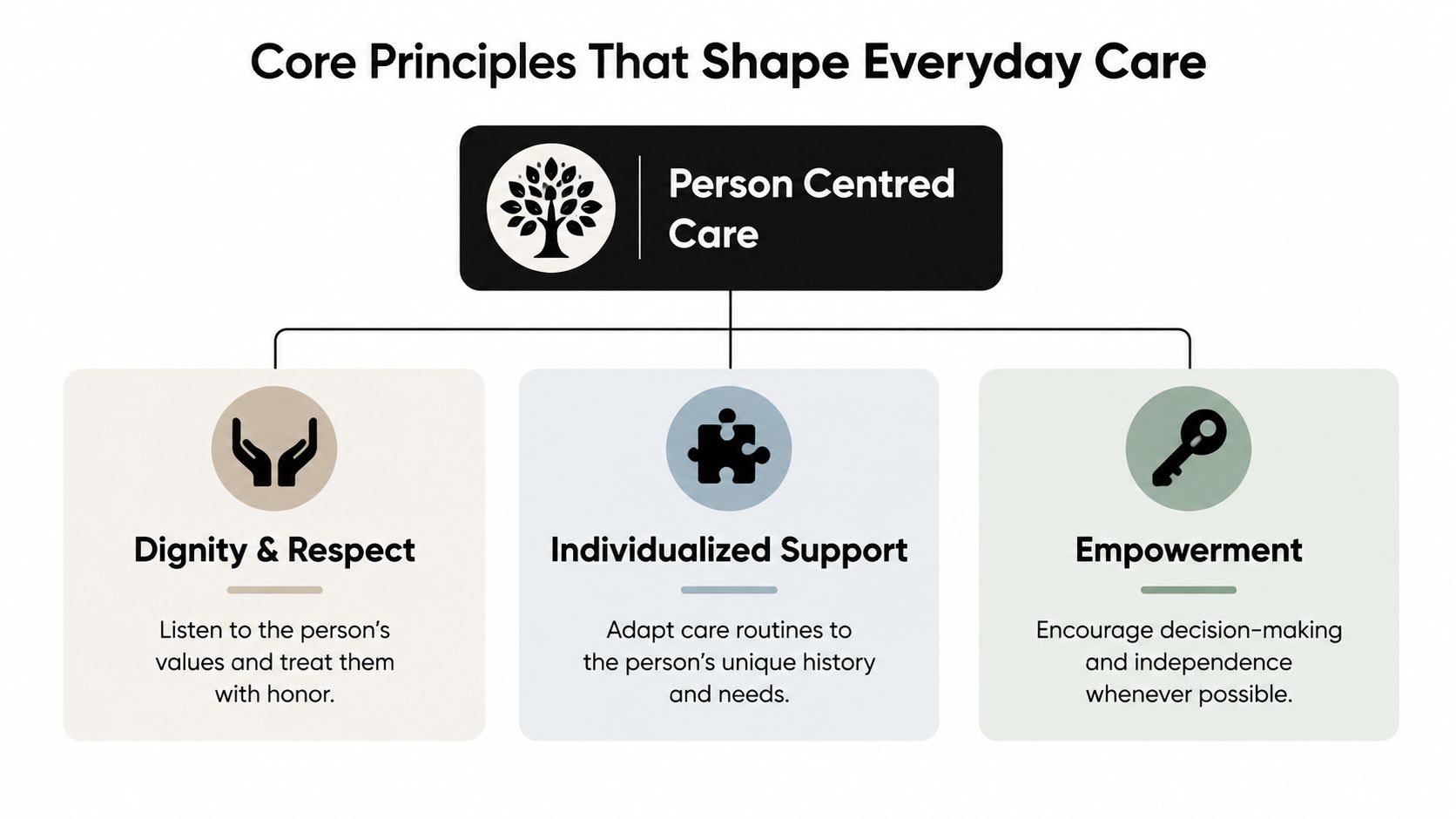
Dignity and respect
Dignity appears in ordinary moments. Close the door during personal care. Explain before touching. Use the person's preferred name. Avoid discussing them as if they aren't present. Offer continence support discreetly and never use childish language.
Respect also means taking refusals seriously. A refusal may express pain, fear, embarrassment, confusion or a wish to retain control. It shouldn't automatically be treated as non-compliance.
Dignity is protected by the way a task is offered, not only by whether the task is completed.
Individuality and life story
A life story gives staff useful clues. Someone who worked in a busy kitchen may enjoy helping prepare vegetables, while a former office worker may respond well to sorting papers or organising a desk. These aren't entertainment tricks. They're ways of connecting support with familiar roles and abilities.
Ask families what helps the person settle, what tends to cause distress, which routines matter and how they prefer to communicate. Record useful information where the team can find it, then update it when the person's needs or preferences change.
Choice and inclusion
Choices should be real, limited and manageable. “What would you like to wear?” may feel too broad, while “Would you like the blue jumper or the green one?” gives the person a clear opportunity to decide. Staff can offer choices about timing, food, clothing, activities and where support takes place.
Inclusion also means noticing barriers linked to hearing, sight, language, culture, religion, gender, sexuality or disability. A person may appear unwilling to engage when they can't hear the question or understand unfamiliar wording.
Partnership with families
Families often hold knowledge that can't be gathered during a short assessment. They may know the meaning of a repeated phrase, the reason someone dislikes a particular room, or the signs that indicate tiredness rather than distress.
Care providers should treat relatives and other trusted people as partners, while respecting the person's rights, confidentiality and preferences. The CQC's expectations for person-centred care include involvement in decisions, coordination, transitions and carer support. These responsibilities need active communication, not a single family meeting followed by silence.
A useful test is simple. Ask whether the person and family can recognise their knowledge in the care plan, whether staff use it during difficult moments, and whether it follows the person when services change.
Communication Techniques That Preserve Identity and Choice
Dementia can affect memory, word-finding, concentration, hearing and the ability to process several instructions at once. Communication may break down even when the carer's intention is kind. The answer isn't to speak louder, argue over facts or complete every sentence for the person. It's to adjust the pace, language and setting.
Start by approaching from the front, using the person's preferred name and making sure they can see your face. Reduce competing noise where possible. Give one idea at a time, then pause long enough for a response.
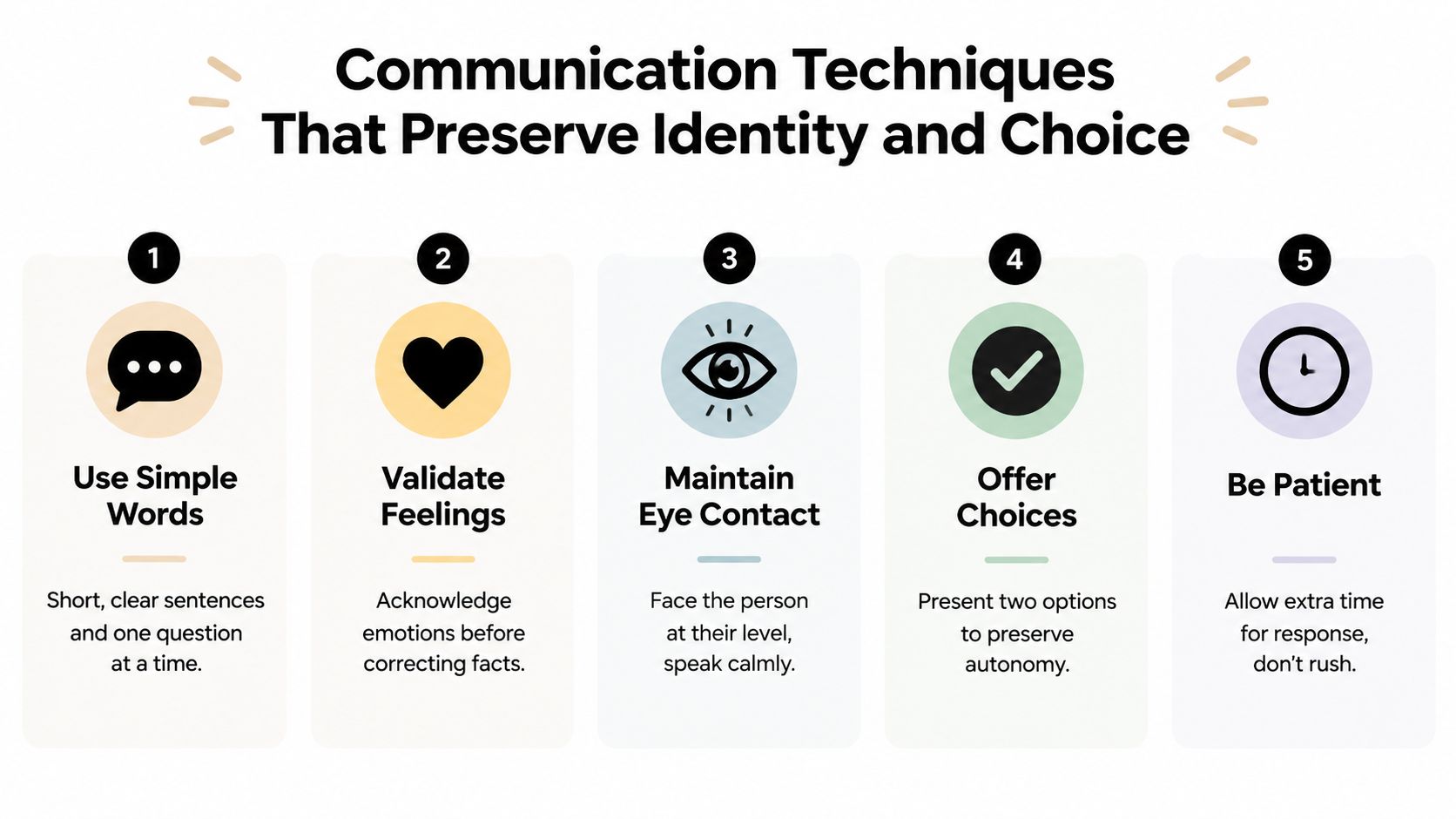
Words that help
Use short, clear sentences. Instead of saying, “We need to get ready now because the transport will be here soon and you haven't had breakfast,” try, “Good morning, Joan. Would you like tea first or a wash first?”
Offer two options when a decision is needed. Too many choices can create pressure, while no choice can make the person feel powerless.
| Situation | Task-led response | Person-centred response |
|---|---|---|
| The person refuses a shower | “You need to shower now.” | “You don't want a shower at the moment. Are you worried about the water, or would you prefer to try later?” |
| The person says they need to go home | “You are already at home.” | “You're thinking about home. What do you miss most about it?” |
| The person struggles to answer | Repeat the question quickly. | Use fewer words, show the item and allow extra time. |
Validate before correcting
Feelings often matter more than factual accuracy. If someone says, “I'm waiting for my father,” arguing that their father died years ago may increase distress. Acknowledge the emotion first: “You're missing your father and want to feel close to him.” Then offer comfort, a familiar activity or a gentle change of focus.
Life story information can guide these responses. A photograph, favourite radio programme, familiar object or well-known song may help a person connect when direct questioning becomes difficult. Use these cues respectfully, not as a test of memory.
Listen for the need beneath the words. Fear, loneliness, pain, tiredness and the wish for reassurance may all appear as repeated questions or resistance.
Watch body language too. Stand at the person's level, keep your expression calm, avoid crowding them and don't continue talking while walking away. For more practical examples, see these dementia communication techniques.
Short demonstrations can help a team practise these skills. The video below can be used as a discussion prompt during supervision or refresher learning.
After a difficult interaction, record what happened in neutral language. Note the trigger, the person's words or actions, what you tried, and what seemed to help. That record allows the next carer to respond with knowledge rather than starting again from guesswork.
Adapting Environments and Routines Around the Person
A person-centred environment makes helpful actions easier and confusing situations less likely. The change may be modest, such as improving lighting, placing a clock where it can be seen, labelling a bathroom door, or keeping a favourite chair in a familiar position. The aim isn't to make a home or care home look clinical. It's to help the person understand where they are and what they can do.
Small environmental decisions
Look at the room from the person's position. Can they identify the toilet? Is glare making it hard to see a plate? Does a patterned floor look like a change in level? Are important objects within reach? Familiar photographs, meaningful ornaments and clearly displayed personal items can support orientation and identity, provided they're safe and relevant to the individual.
In homecare, ask permission before moving furniture or adding signs. In residential care, involve the person and family when personalising a bedroom or communal space. CQC expectations emphasise involvement and coordination, so environmental decisions should form part of care planning rather than happen without consultation.
Flexible routines
A fixed timetable may suit staffing arrangements, but it may not suit the person. Someone who has always risen late may become distressed when woken early. Another person may eat better in a quiet room, while someone else prefers company. Record preferences clearly and explain any unavoidable limits.
Consider a before-and-after example:
- Before: Staff wake a resident at the same time each morning, rush personal care and serve breakfast in a noisy dining room.
- After: Staff offer a quieter start, present clothing choices, allow time for tea and support the person to eat where they're most comfortable.
The second approach still requires organisation. It may involve handover notes, clear responsibilities and agreement about how to manage safety. Person-centred care doesn't mean every preference can always be met. It means staff identify what matters, discuss constraints and avoid treating the service routine as more important than the person by default.
Meaningful activity should also connect with identity. Folding towels, watering plants, setting a table, listening to football or looking through family photographs may provide purpose when matched to the person's abilities. Staff should offer, observe and adapt rather than assume that a group activity suits everyone.
Real World Examples of Person Centred Care in Action
A person-centred approach becomes clearer when staff have to make a decision under pressure. The following scenarios are fictional training examples, but they reflect common moments in homecare and residential support.
Supporting someone at home
Mr Patel has early-stage dementia and receives morning homecare. His care notes say that he needs support with washing, dressing and breakfast. A rushed approach would move through each task in the order most convenient for the visit, correcting him whenever he forgets what comes next.
A better approach starts with conversation and observation. The carer asks whether he'd like tea before personal care, places two shirts on the bed, and uses a simple reminder about the next step. Mr Patel chooses his shirt and helps prepare toast. The carer notices that he becomes anxious when several instructions are given together, so this information is recorded for the next worker.
The outcome isn't measured only by speed. Mr Patel has taken part in decisions, completed parts of his usual routine and begun the day with less pressure. His daughter also receives a clear update, so she can share useful information with the care team rather than repeatedly explaining the same preferences.
Responding to distress in a care home
Mrs Evans lives in a care home and often becomes distressed during the evening. She walks towards the front door, calls for her sister and pushes away staff who try to guide her back to a chair. A task-led response might describe her as difficult or focus immediately on stopping the walking.
The team instead looks for meaning. Her life story shows that she cared for younger siblings and often became restless when she believed someone was waiting for her. Staff reduce noise, approach one at a time and say, “You're worried someone needs you.” They offer a familiar sorting activity and invite her to help fold napkins near the dining room.
The care plan records the likely trigger, helpful language and approaches that increase distress. Staff continue to check for pain, toileting needs, hunger, tiredness and other causes rather than assuming every episode has the same explanation. The person hasn't been “managed” into silence. The team has tried to understand what she's communicating and offered a safe, meaningful response.
These examples show why continuity matters. The same principles need to appear in assessment, handover, homecare visits, residential routines and conversations with relatives. Otherwise, good support depends on which worker happens to be present.
How Training Prepares You to Deliver Person Centred Care Confidently
Completing dementia awareness training is useful, but awareness alone doesn't guarantee person-centred practice. Leeds Beckett University's 2026 England report found that over half of dementia training accessed by the social care workforce covered awareness only, while 39% of available training was designed for the practical knowledge and skills social care staff need. The report also found that fewer than half of training packages covered equality, diversity and inclusion, families and carers as partners in care, and end-of-life care, as detailed in the Leeds Beckett University report.
That distinction matters on shift. A worker may recognise common dementia symptoms but still struggle to respond when a person refuses care, a relative disagrees with a plan, communication changes, or a resident becomes distressed during a transition. Behaviour-changing training should let staff practise language, analyse situations, reflect on assumptions and apply learning to documentation and handovers.
What capable training should include
Look for learning that covers:
- Communication in practice: short phrases, validation, non-verbal communication, sensory considerations and time for responses.
- Family partnership: gathering life story information, sharing observations appropriately and involving carers in continuity.
- Equality and inclusion: adapting support around culture, identity, disability, language, relationships and personal values.
- Choice and capacity: supporting decisions while following the Mental Capacity Act and local procedures.
- Transitions: carrying personal preferences and effective approaches from diagnosis to homecare, hospital, respite and residential care.
- End-of-life support: recognising the importance of dignity, known wishes, comfort and family communication.
Alzheimer's Society reported that 48% of respondents lacked person-centred support, 65% weren't receiving consistent and ongoing support, and 68% weren't receiving carer support in its report on being left to cope alone after diagnosis. Those findings underline a continuity problem. People need support that remains coordinated after the diagnosis, not just information at the point of assessment.
Carers can build confidence by reviewing one interaction after each shift, asking what triggered distress, what preserved choice and what the next worker needs to know. Providers should combine structured courses with supervision, observation and feedback. Cura Academy provides online care learning that includes a dementia awareness training area and courses aligned with person-centred care learning needs.
Start with one change today. Ask the person what would make the next care task easier, listen to the answer, record what you learn and share it through the agreed handover route. For practical UK care training that supports person-centred skills alongside wider compliance learning, visit Cura Academy and explore the available pathways for carers and care organisations.