

You've completed a health and social care qualification, updated your CV and started applying for care work. Then the replies stop. An agency asks for your mandatory training certificates, DBS position and right-to-work evidence, and your profile goes quiet because it shows what you've studied, not what you're cleared to do.
That's the reality for many new carers. Compliance training courses UK employers recognise are an onboarding requirement, not an optional learning project. Your certificates have to enable a shift, sit correctly in a recruitment portal and give a manager enough evidence to approve you without chasing missing documents.
Table of Contents
- Why Compliance Training Courses UK Matter Before Your First Shift
- The Core Compliance Training Courses UK Employers Expect
- Building Your Evidence Portfolio So Compliance Is Visible
- Subscription Versus One-Off Compliance Training Courses UK
- Getting DBS and Update Service Ready
- Speeding Up Shifts After You Finish Training
- Your 12-Week Compliance Plan and Quick Answers
Why Compliance Training Courses UK Matter Before Your First Shift
Priya had the right attitude and a Diploma in Health and Social Care. She applied to ten agencies over three weeks and received no bookings. Her profile listed her qualification, but it didn't show the mandatory training evidence agencies needed before placing her with a client.
That distinction matters across domiciliary care, residential care and supported living. Recruitment teams normally work through a pre-shift checklist before adding a candidate to the rota. If a required item is missing, the whole onboarding process can pause, even when the applicant appears capable.
Your qualification proves what you've studied. Your compliance portfolio proves that an employer can put you in front of a client.
A care provider needs to know that you understand safeguarding, infection prevention, moving and handling, medication responsibilities and person-centred practice. Providers carrying out regulated activities also need organised records that demonstrate staff competence and training. The official guidance on statutory and mandatory training describes this training as a structured set of knowledge and skills based on legislation and guidance.
The Care Certificate is the obvious starting point. It launched in April 2015 in England, replacing the Common Induction Standards, and established 15 standards for social care workers providing safe and compassionate care. A parliamentary briefing reports that 54% of adult social care workforce roles in 2023/24 had achieved or were working towards the Care Certificate (House of Commons Library briefing). That makes it a major baseline, but it doesn't mean every employer will accept a course certificate as proof that every practical element has been assessed.
Treat training as a hiring gate
A recruiter usually wants three things before releasing shifts:
- Recognised training evidence: Certificates must identify the learner, course and completion date.
- Operational clearance: DBS, identity and right-to-work checks must be progressing or complete.
- Role suitability: Your evidence must match the work, especially if the shift involves medication, mobility support or complex needs.
The House of Commons Health and Social Care Committee says the Care Certificate should be completed within 12 weeks of starting the process, while also identifying time and funding pressures as practical barriers for care workers (committee report on the Care Certificate). Don't wait until an employer offers you a shift before making study time available. Complete the training that blocks access first, then add specialist modules as the role demands.
Read what compliance training means for care workers before you start collecting certificates. The useful question isn't “Have I taken a course?” It's “Can a recruiter verify my readiness quickly?”
The Core Compliance Training Courses UK Employers Expect
Start with the training that appears most often in agency and provider onboarding systems. The exact list varies by role and employer, so ask for the organisation's matrix before paying for a course. Never assume an online certificate replaces an employer's practical observation.
Start with the baseline
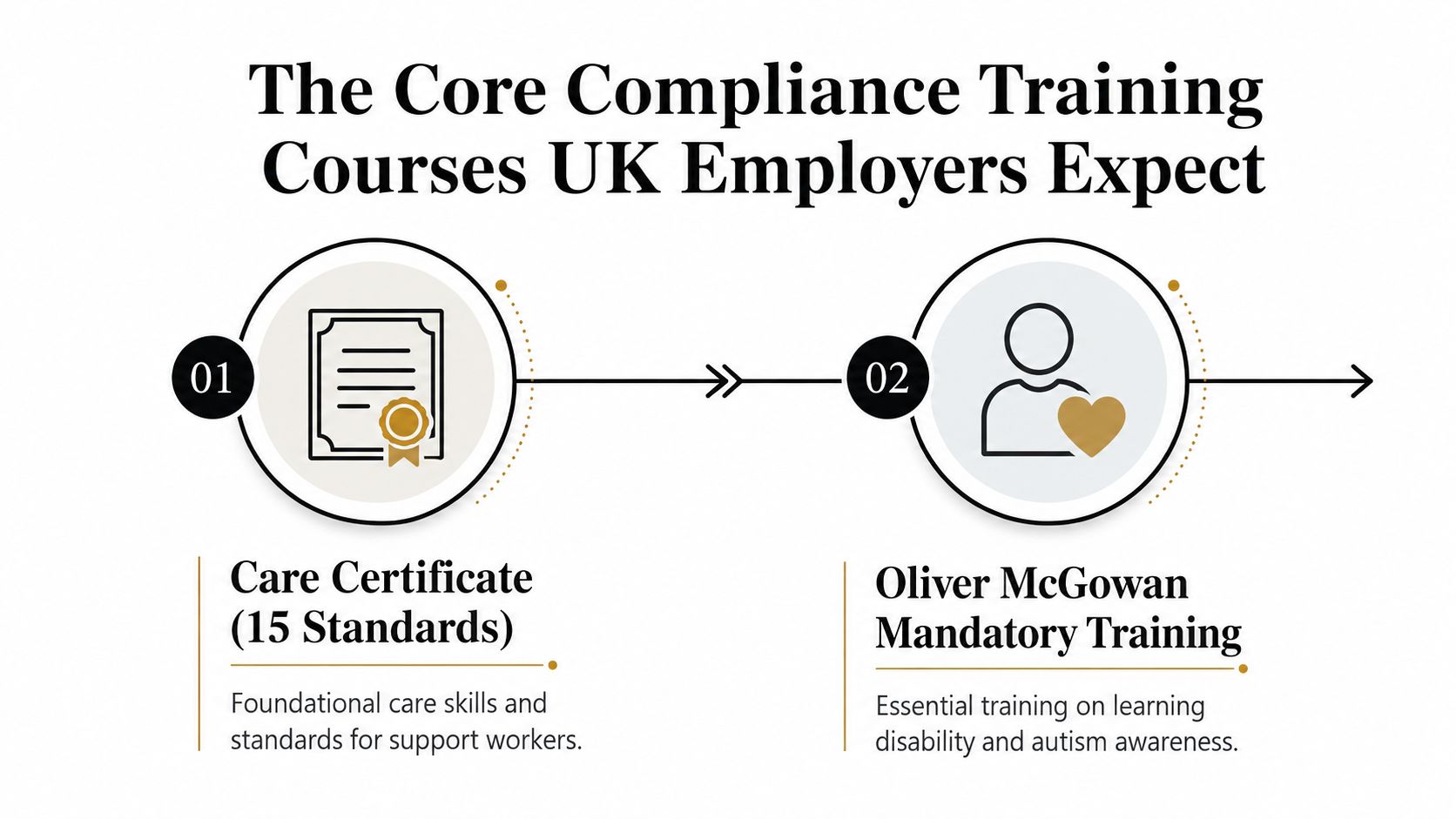
Care Certificate standards should anchor your induction. Work through the 15 standards, collect evidence against each one and arrange manager sign-off for workplace competence. Online learning can prepare you, but an employer may still need observations, discussions and local induction evidence.
Oliver McGowan Mandatory Training on Learning Disability and Autism is now a statutory requirement for staff working in settings that perform CQC-regulated activities, under the Health and Care Act 2022 from 1 July 2022. Government impact-assessment material estimates that 63% of adult social care staff require tier 1 and 37% require tier 2 (Oliver McGowan impact assessment). Confirm which tier fits your role and employer.
Basic Life Support and First Aid at Work can be a booking blocker for hands-on care roles. Employers may require practical assessment, particularly where the role includes emergency response responsibilities. Treat the employer's validity and refresher policy as decisive rather than relying on a generic course description.
Complete the practical-risk subjects early
Moving and Handling usually combines theory with practical demonstration. Medication Administration should cover safe processes, accountability and MAR chart awareness, but you must also learn the employer's local medication policy before administering medicines.
Safeguarding Adults and Children, Infection Prevention and Control, Health and Safety and Fire Safety belong in the early onboarding batch. Providers commonly treat safeguarding and infection control as core induction subjects, while some role-specific modules can be completed during probation.
Mental Capacity Act and Deprivation of Liberty Safeguards training becomes especially important in supported living, residential care and services involving people who may lack capacity for particular decisions. Equality, Diversity and Inclusion should be part of the same foundation because person-centred care depends on respecting protected characteristics, communication needs and individual choice.
Cura Academy presents these subjects through online care training pathways, bundles and refresher access. Review its mandatory training options for care workers, then compare the course list with the employer's onboarding checklist.
Sequence for shift access
Put Care Certificate evidence, safeguarding, infection control, moving and handling, medication awareness, Basic Life Support and Oliver McGowan training at the front of your plan. Ask which items are marked as mandatory before your first booking and which can be added during probation. Refresher timing varies by course and employer, so record the required renewal date on the certificate and in your calendar.
Building Your Evidence Portfolio So Compliance Is Visible
A folder full of certificates can still produce a rejected application. Recruiters don't just look for course names. They check whether the evidence is identifiable, current, relevant to the role and supported by other onboarding documents.
Build your portfolio around three layers:
- Training evidence: Certificates should show your name, course title, provider, issue date and any expiry or renewal information.
- Observed competence: Moving and Handling and Medication Administration often require practical assessment, workplace observation or confirmation that you've completed the employer's local competency process.
- Identity and employability checks: Include photo ID, right-to-work evidence, DBS information and references in a format the agency can review.
Use one audit-ready folder
Create a digital folder and a matching printed file if you attend face-to-face interviews. Name documents consistently, for example Surname_Firstname_Care_Certificate_Date.pdf, and avoid sending phone screenshots that cut off the provider name or certificate number.
Put documents in this order:
- Care Certificate standards and sign-off evidence
- Mandatory training certificates
- Practical observation records
- DBS certificate and Update Service confirmation, where applicable
- References
- Immunisation history, if requested for the role
- Photo ID and right-to-work evidence
- CV, arranged in the same sequence as the evidence
The CV should reinforce the folder, not contradict it. If your CV says you're medication trained but the portfolio only contains a general awareness module, a recruiter may pause the application until you clarify the difference.
| Document | Typical format | Acceptance window |
|---|---|---|
| Care Certificate evidence | Combined PDF or verified portfolio record | Current employer or framework requirement |
| Mandatory training certificates | Individual PDFs or one clearly indexed PDF | Provider and employer renewal policy |
| Practical competency records | Signed observation or employer assessment | Current role and local policy |
| DBS evidence | Certificate details plus Update Service confirmation | Current check status |
| References | Contact details or formal reference document | Recent and verifiable |
| Right-to-work evidence | Approved digital or scanned documents | Valid for the employment arrangement |
Check every scan before sending it. Unreadable certificates, missing dates, expired refreshers and unfamiliar providers create avoidable delays. A combined PDF with clear filenames is easier for an agency to upload and easier for a manager to audit.
Skills for Care data cited by the Digital Care Hub shows that, in 2024/25, 54% of direct care staff did not hold a relevant social care qualification, 69% had engaged with Care Certificate standards and 81% had completed non-statutory training (Digital Care Hub summary of Skills for Care data). The lesson is straightforward: attendance isn't the same as job-ready evidence. Keep proof of completion, prior experience and practical competence together.
Subscription Versus One-Off Compliance Training Courses UK
The right buying model depends on how much training your profile needs and how often you expect to renew it. A learner starting from scratch may need a broad pathway, while an experienced carer might only need a missing safeguarding module or an updated moving and handling certificate.
Cura Academy's advertised membership costs £10 per month and provides access to care training, mandatory refreshers and role-specific courses. It's a sensible structure for someone building a full profile or maintaining several certificates, provided the available course list matches the employer's requirements.
One-off bundles suit a worker who already has most of the evidence. They can reduce unnecessary study, but only if you first compare the bundle against your target employer's checklist. Buying individual courses elsewhere can work when an agency specifies a particular provider, assessment method or classroom requirement.
Compare the real cost
Don't compare headline prices alone. Check whether the provider includes retakes, downloadable certificates, progress tracking, mobile access and a usable record of completed training. A cheap course becomes poor value if you pay extra for manual marking, certificate reprints or access to a refresher.
| Model | Typical cost | Best for | Watch out for |
|---|---|---|---|
| Cura Academy membership | £10 per month | Learners building or maintaining a broad care profile | Confirm each required course and practical assessment requirement |
| One-off bundle | Varies by provider | Workers missing a small group of standards | Check expiry dates, retakes and certificate downloads |
| Individual course | Varies by provider | A single employer-requested module | Separate fees, limited tracking and fragmented records |
A practical budget rule is to stay under £30 per month if you plan to maintain compliance long term, but that figure should guide comparison rather than replace a written quote. Calculate the cost of the certificates you need now, then add the cost of keeping records current.
Choose the model that keeps your evidence visible. A lower upfront price doesn't help if you can't retrieve the certificate when an agency asks for it.
Before enrolling, email the provider or recruiter with your course list. Ask whether online completion is accepted, whether practical assessment is separate and how the certificate displays renewal information. That short check prevents you from paying for training that doesn't help you start the shift you want.
Getting DBS and Update Service Ready
DBS preparation is an onboarding task, not something to leave until after training. An agency or provider normally needs to establish your identity, submit the correct level of check and confirm that the result can be used for the role.
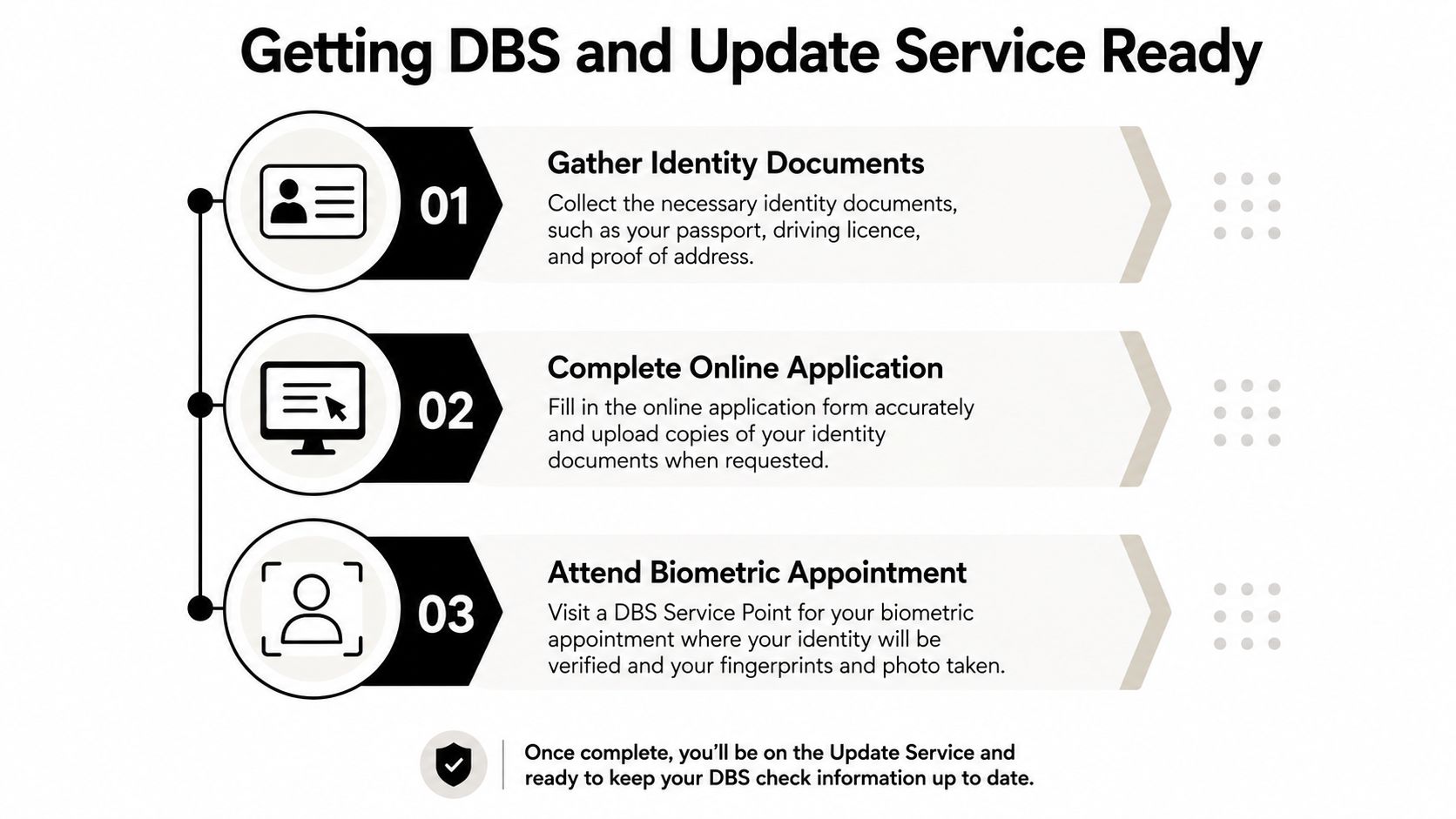
Start by gathering the identity documents the registered umbrella body requests. Complete the application through the organisation handling the check, follow its identity-verification process and keep every confirmation email. Don't send an employer a cropped screenshot when the agency needs the certificate details or the original certificate available for inspection.
Make the Update Service decision promptly
The DBS Update Service applies to standard and enhanced checks. GOV.UK states that most applicants pay £16 per year and must join within 30 days of the certificate issue date. The DBS Update Service guidance also says the subscription is intended for the individual and that a third party must not control the account.
Save a digital copy of the DBS certificate, the Update Service confirmation and the certificate issue date. Add the renewal date to your calendar, then check that the name and certificate details match your recruitment profile.
In January 2026, the government announced that self-employed workers and personal employees could apply for enhanced DBS checks, changing the position for some carers working without a conventional employer sponsor. Check the current application route before assuming you can apply alone, because the eligibility and process depend on the work arrangement.
An Update Service subscription doesn't remove the employer's responsibility to assess whether the check is suitable for the role. It can, however, support a more portable onboarding record where the employer accepts the check and the required conditions are met.
For a practical explanation of the process, use Cura Academy's guide to Enhanced DBS and the Update Service. Treat the certificate issue date as the trigger for your next action, not the day you first submitted the application.
Speeding Up Shifts After You Finish Training
The first two weeks after course completion determine whether your certificates become paid work or remain unused files on your laptop. A complete profile needs to reach recruiters in a form they can approve quickly.
On the first day, upload PDFs rather than screenshots. Write a short bio that names your care interests, relevant experience, preferred shift pattern and geographical availability. List every completed framework accurately, separating awareness training from practical competency.
A practical 14-day sequence
Days one and two: Check certificate names, dates and filenames. Add DBS status, right-to-work evidence and two reliable references. Make sure your CV uses the same course names as your certificates.
Days three to five: Register with at least three agencies operating in your area. Compare their requirements instead of assuming one portal's checklist applies everywhere. Agencies using platforms such as Florence, Patchwork or LocumTap may still require their own onboarding steps and local policy acknowledgements.
Days six to ten: Complete employer-specific modules. These may include safeguarding refreshers, medication systems, electronic care records or local incident-reporting procedures. Ask whether the provider requires a practical observation before allowing you to accept a shift.
Days eleven to fourteen: Contact recruiters with a concise evidence pack, respond to document requests quickly and confirm your available dates. Chase references from previous employers rather than waiting for the agency to tell you that the application is stalled.
Recruiters usually check certificate dates, DBS status and right-to-work evidence first because those items determine whether onboarding can proceed. Send them proactively in one organised message, with a short explanation of any item still pending.
Your follow-up message should answer the recruiter's next three questions before they have to ask them.
Don't promise availability you can't keep. If you're waiting for a practical assessment or DBS result, state the exact status and the action already booked. A transparent profile is easier to place than one that appears complete until the agency discovers a gap.
Your 12-Week Compliance Plan and Quick Answers
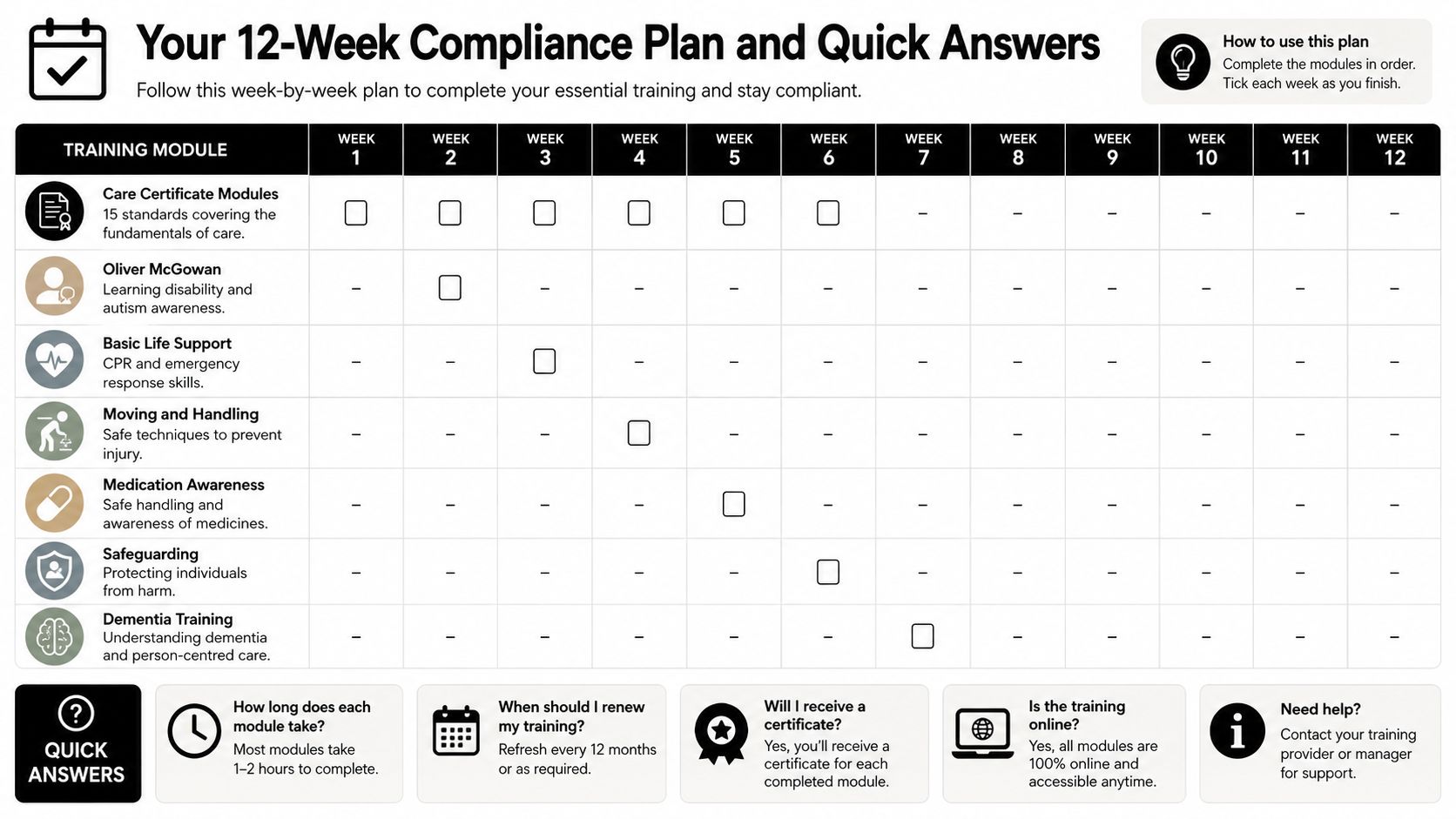
Use this plan as a working schedule, then adjust it to your employer's checklist. The Care Certificate framework should be mapped to evidence collection and manager sign-off, with the 12-week completion checkpoint kept visible. Don't postpone study time, because time and funding pressures are recognised barriers to completion.
| Timing | Priority | Evidence to save |
|---|---|---|
| Weeks one to three | DBS application, identity documents and right-to-work checks | Application confirmation and document checklist |
| Weeks one to four | Care Certificate foundation standards | Course records and initial assessment evidence |
| Weeks three to five | Safeguarding and Equality, Diversity and Inclusion | Certificates and employer-specific acknowledgements |
| Weeks four to six | Infection Prevention and Control, Health and Safety and Fire Safety | Certificates and completion dates |
| Weeks five to seven | Moving and Handling theory and practical assessment | Theory certificate and observation record |
| Weeks six to eight | Medication awareness and MAR chart practice | Certificate and competency evidence |
| Weeks seven to nine | Basic Life Support and First Aid requirements | Certificate and practical assessment record |
| Weeks eight to ten | Oliver McGowan training and role-relevant specialist learning | Tier confirmation and completion evidence |
| Weeks ten to twelve | Remaining Care Certificate standards and manager sign-off | Completed portfolio and checkpoint record |
Quick answers for new carers
Does one bundle cover every employer? No. Employers set their own acceptance rules, and practical assessments may still be required.
How long do certificates last? Follow the course provider's stated renewal date and the employer's policy. Annual and three-year refreshers are common planning points, but don't assume they apply to every subject.
Does an Enhanced DBS still count without the Update Service? It may, subject to the employer's checks and suitability assessment. The Update Service is separate from the DBS certificate and has its own subscription conditions.
What if an employer rejects my certificate? Ask for the exact reason in writing. It may be the provider, assessment method, course level, missing practical evidence or an expired record. Replace only the rejected item after you know the requirement.
How quickly will shifts start? There's no guaranteed timeframe. A complete profile can be reviewed faster, but local demand, references, DBS processing and practical assessment still control the decision.
Use the next hour to compare your portfolio with one agency checklist, then enrol only for the gaps that can help meet your target shifts.
Cura Academy offers a £10-per-month route to online care training, Care Certificate standards, mandatory refreshers and role-specific modules, alongside one-off bundles for narrower gaps. Visit Cura Academy, match the available courses to your employer's checklist and start building the evidence portfolio that gets your profile shift-ready.