
Compliance training in UK health and social care is the structured set of statutory and mandatory learning workers complete to meet legal, regulatory, and employer safety requirements. For new starters, the Care Certificate now contains 16 standards, all of which must be completed before the certificate is awarded.
You may meet compliance training for the first time through an agency portal, a care home onboarding checklist, or an employer's learning platform. Before you're offered regular shifts, you might need to complete courses on safeguarding, infection prevention, health and safety, information handling, and basic life support.
That checklist can feel like administration, especially when you're eager to start work. In practice, it's your first opportunity to show that you understand the responsibilities attached to caring for another person. It can also become a practical career asset, because employers need evidence that workers are prepared, safe, and suitable for the setting.
Table of Contents
- Understanding Compliance Training in Health and Social Care
- Legal and Regulatory Expectations for UK Care Workers
- Typical Mandatory Modules Every Care Worker Needs
- How the Care Certificate Sets the Compliance Baseline
- Why Compliance Training Boosts Retention and Career Growth
- Becoming Job-Ready with Cura Academy
- Next Steps and Common Compliance Questions
Understanding Compliance Training in Health and Social Care
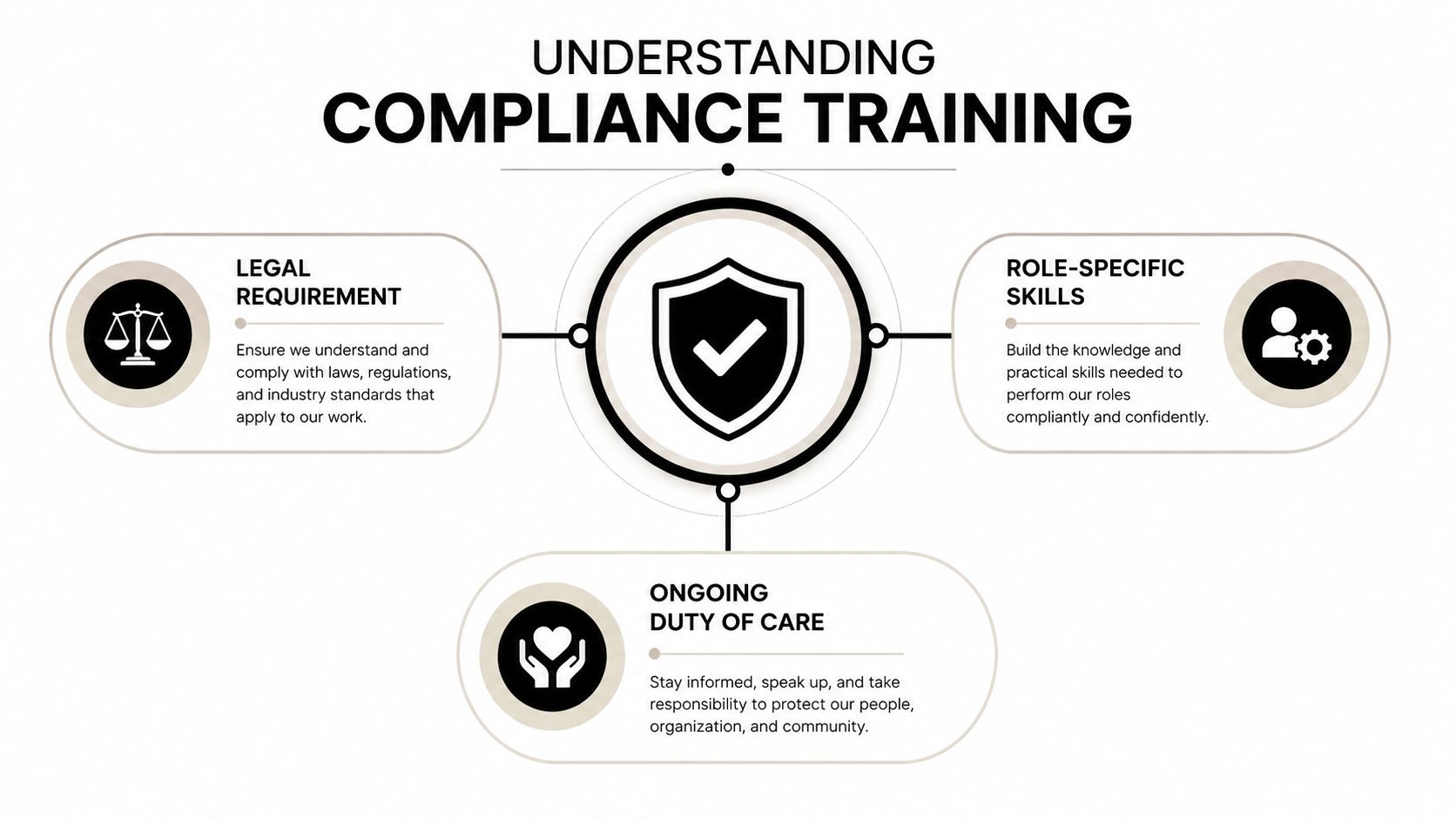
Compliance training is a structured set of statutory and mandatory courses designed to help health and social care workers meet the duties attached to their roles. Skills for Care describes statutory and mandatory training as topic areas selected through a review of legislation, statutory guidance, standards, and regulator expectations. That means the right programme depends on your role, your employer, and the people you support, rather than on one universal course.
A domiciliary care worker, a residential care assistant, and a support worker in a learning disability service may share core learning, but their additional training can differ. Safeguarding, infection prevention and control, moving and handling, information governance, equality, diversity and human rights, and basic life support commonly form part of the foundation. Specialist duties may require further training before you carry them out.
Statutory and mandatory are not identical
Statutory training is connected to duties created by law. Mandatory training may be required by an employer, commissioning body, professional framework, or regulator. The two categories can overlap, but they aren't interchangeable.
For example, an employer may require all staff to complete a particular information governance module because workers handle confidential care records. A regulator may expect the provider to demonstrate that staff are competent, even where a specific course title isn't written into statute.
The purpose goes beyond passing an online assessment. Training helps you recognise risks, respond consistently, protect people from harm, and understand when to escalate a concern. It also gives managers evidence that they've taken reasonable steps to prepare staff for their duties.
Practical rule: If your employer asks for training before your first shift, treat completion and evidence as part of becoming job-ready, not as paperwork to finish later.
In the UK care sector, compliance records are often checked before shifts are allocated. A complete record can reduce onboarding delays and help an employer decide which duties you can safely undertake.
Legal and Regulatory Expectations for UK Care Workers
Care providers operate within several layers of law, guidance, and inspection. The Health and Safety at Work Act 1974 establishes broad workplace safety duties, while the Care Act 2014 provides a framework for protecting adults and promoting wellbeing. The Health and Care Act 2022 added a specific statutory training requirement for CQC-registered providers, requiring appropriate learning disability and autism training for staff from 1 July 2022. The government's final Oliver McGowan code of practice on statutory learning disability and autism training was issued on 6 September 2025.
These changes show how UK compliance is moving towards role-based legal duties. A generic induction may introduce workplace expectations, but it won't necessarily demonstrate that a worker has the knowledge required for a particular service or responsibility.
What employers and inspectors need to see
The Care Quality Commission assesses registered providers through its expectations around whether services are safe, effective, caring, responsive, and well-led. Training evidence forms part of the wider assurance picture. Managers may need to show who completed learning, whether assessments were carried out, how competence was checked, and what happens when training expires.
Employers also have responsibilities under the Management of Health and Safety at Work Regulations 1999 to consider risk and staff competence. In practical terms, that means a care provider must match training and supervision to the work people perform.
| Legislation or body | Role in compliance training |
|---|---|
| Health and Safety at Work Act 1974 | Provides the wider legal foundation for workplace health and safety. |
| Care Act 2014 | Supports safeguarding, wellbeing, and responsibilities towards adults receiving care. |
| Health and Care Act 2022 | Introduced the statutory learning disability and autism training requirement for CQC-registered providers. |
| Care Quality Commission | Regulates registered services and expects providers to evidence safe, effective care and competent staff. |
| Skills for Care | Helps define statutory and mandatory topic areas through legislation, guidance, standards, and regulator expectations. |
You can explore the practical relationship between workforce learning and inspection preparation in this guide to CQC compliance training.
When a worker's training record is incomplete, the risk affects more than that person's access to work. The provider may face questions about supervision, competence, safe staffing, and whether its systems support lawful care delivery.
Typical Mandatory Modules Every Care Worker Needs
Your employer's course list will depend on the service, but most care workers encounter a recognisable group of core subjects. The mandatory training guide for care workers can help explain how these requirements differ from broader workplace learning.
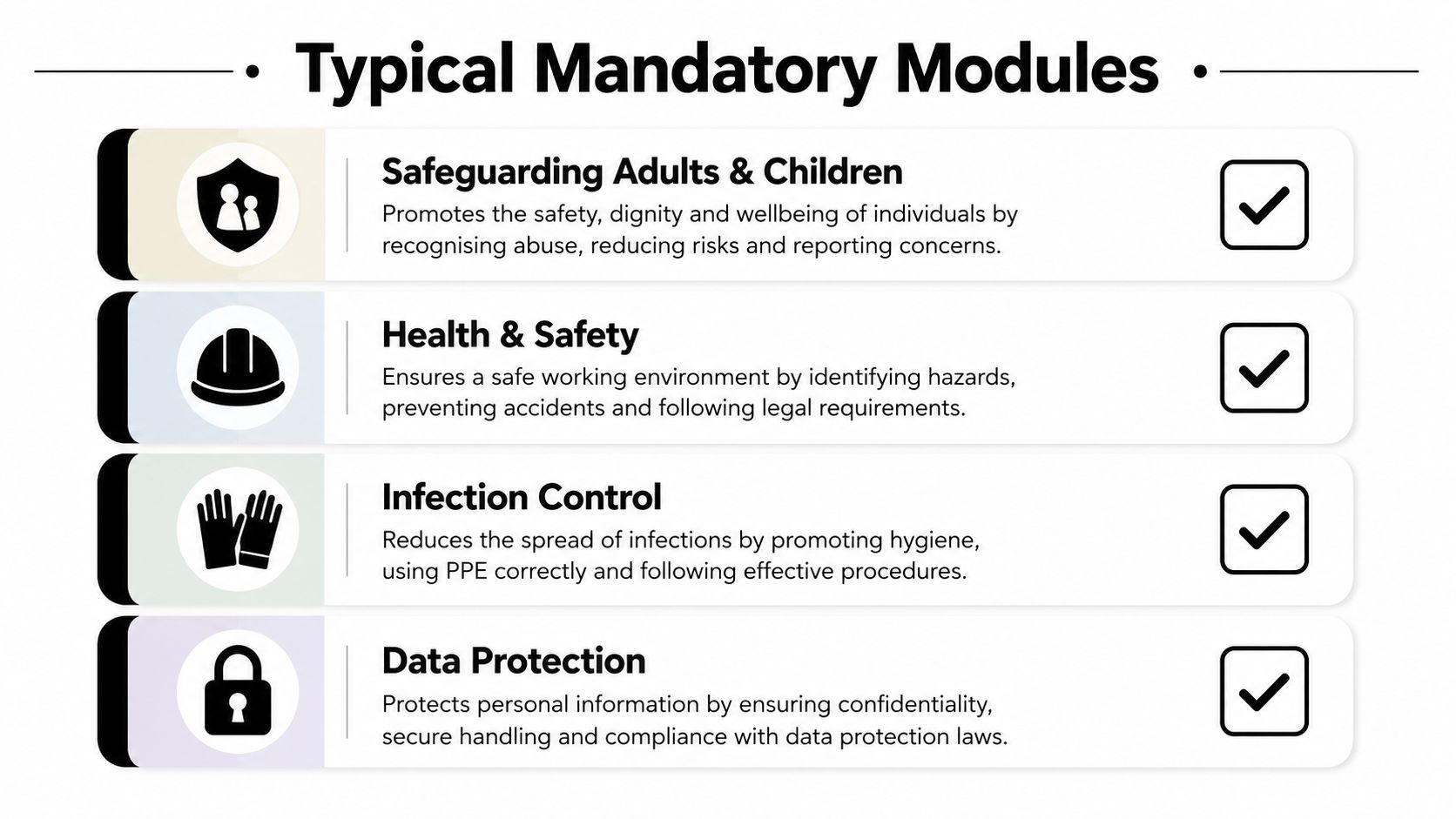
Safeguarding adults and children teaches you to notice signs of abuse, neglect, exploitation, or poor practice. On shift, that might mean listening carefully to a disclosure, recording what you observed, and reporting through the correct safeguarding route instead of investigating the concern yourself.
Infection prevention and control turns general cleanliness into specific action. You'll learn how hand hygiene, personal protective equipment, cleaning procedures, and waste disposal reduce avoidable transmission. The correct response can change depending on the task and the setting, so follow local policies as well as course guidance.
Training becomes useful when it changes behaviour
Moving and handling training focuses on risk assessment, safe positioning, communication, and appropriate equipment. It isn't solely about lifting technique. You need to understand the person's care plan, work within your competence, and seek assistance when the planned transfer can't be completed safely.
Basic life support prepares you to respond to an emergency while following local procedures and contacting the appropriate help. Fire safety covers prevention, alarm response, evacuation arrangements, and the needs of people who may require support during an emergency.
Other common topics include:
- Information governance: Handle care records, passwords, conversations, and personal information securely.
- Equality, diversity and human rights: Provide respectful, person-centred support without discriminatory assumptions.
- Health and safety: Identify workplace hazards, report incidents, and follow control measures.
- Food hygiene: Apply safe food handling practices where your role includes preparing or serving meals.
Specific modules may be added for medication, dementia care, mental health, learning disability support, or other specialist responsibilities. Completion of an online course doesn't automatically authorise you to perform every task. Your employer may still require workplace observation, local competency checks, or supervised practice.
The following video offers another way to understand how mandatory learning fits into workplace expectations:
How the Care Certificate Sets the Compliance Baseline
A new care worker may complete an online module in the morning, then face a workplace assessment before taking on certain duties. The Care Certificate helps connect those two stages. For people entering non-regulated care roles in England, it sets a clear baseline for introductory knowledge and workplace behaviour.
The framework was updated in March 2025 after a joint review by Skills for Care, Skills for Health, NHS England, and the Department of Health and Social Care. It now contains 16 standards, rather than 15, with Standard 16 covering awareness of learning disability and autism. The Care Certificate framework confirms that all 16 standards must be completed before the certificate is awarded.
Its subjects include understanding your role, duty of care, personal development, communication, privacy and dignity, equality and diversity, safeguarding, health and safety, infection prevention and control, fluids and nutrition, mental health and wellbeing, and basic life support.
Learning alone isn't the whole certificate
The Care Certificate joins theoretical learning with workplace assessment. Statutory and mandatory courses may cover parts of the content, but employers still need to provide induction, supervision, and assessment. The Care Certificate guidance for new care workers describes the standards as a way for employers to gain confidence that staff have introductory skills, knowledge, and behaviours for safe, high-quality care.
An online certificate records that you completed a learning activity. It does not necessarily show that you can apply the skill during a real interaction. Understanding moving and handling theory, for example, differs from demonstrating safe practice with the equipment used in your workplace.
The Care Certificate is not a legal qualification, and the framework does not replace role-specific competence checks. It gives employers and new starters a shared language for induction. A completed portfolio can show what you have studied, what has been assessed, and which duties still require supervision.
That record can affect how quickly an employer confirms your readiness for shifts. It also gives you evidence to carry into specialist learning and roles with greater responsibility. Compliance becomes a foundation for trust and progression, rather than paperwork completed once and forgotten.
Why Compliance Training Boosts Retention and Career Growth
Compliance training can influence your career because employers allocate work according to risk, competence, and available evidence. A worker with missing certificates may need additional checks before being placed on a shift. Someone with a current, well-organised record is easier to assess for suitable work.
The workforce data presents a mixed picture. The Care Certificate isn't a statutory legal requirement, yet in 2024/25, 56% of filled adult social care posts had staff who had achieved, were working towards, or had partially completed the standards, according to the data summarised by LearnDirect's Care Certificate resource. The same source reports that 54% of direct care staff did not hold a relevant social care qualification. These figures suggest that training access and completion remain practical workforce issues, not minor administrative details.
Training needs a career purpose
The same source reports that the Workforce Strategy for Adult Social Care in England recommends aiming for 80% of new direct care staff to hold the Care Certificate within five years. It also reports that turnover is around 10 percentage points lower among staff with a relevant qualification. Those figures support a useful conclusion: learning can contribute to stability when it connects with competence, progression, and job mobility. A course completed in isolation won't fix poor supervision or limited development opportunities.
Your training record can support progression in several ways:
| Training milestone | Career opportunity unlocked |
|---|---|
| Core mandatory modules completed | More straightforward onboarding for suitable care shifts. |
| Care Certificate standards completed and assessed | Stronger evidence of baseline competence for non-regulated care work. |
| Current refreshers maintained | Fewer delays caused by expired or missing records. |
| Specialist learning added | A clearer basis for discussions about dementia, learning disability, or mental health support. |
| Workplace competence demonstrated | Greater readiness for additional responsibilities, subject to employer assessment. |
Training becomes a career accelerator when it proves what you can do, not merely what you've clicked through.
Ask your manager which learning links to progression. Find out whether the next step is supervised practice, a competency assessment, a qualification, or experience in a different service. That conversation turns compliance from a one-off task into a visible development plan.
Becoming Job-Ready with Cura Academy
A practical route to compliance starts with matching learning to the role you want. An adult social care worker may need a different bundle from someone preparing for mental health or learning disability support. Begin by comparing the employer's checklist with the relevant Care Certificate standards and any setting-specific requirements.
Build your evidence in a deliberate order
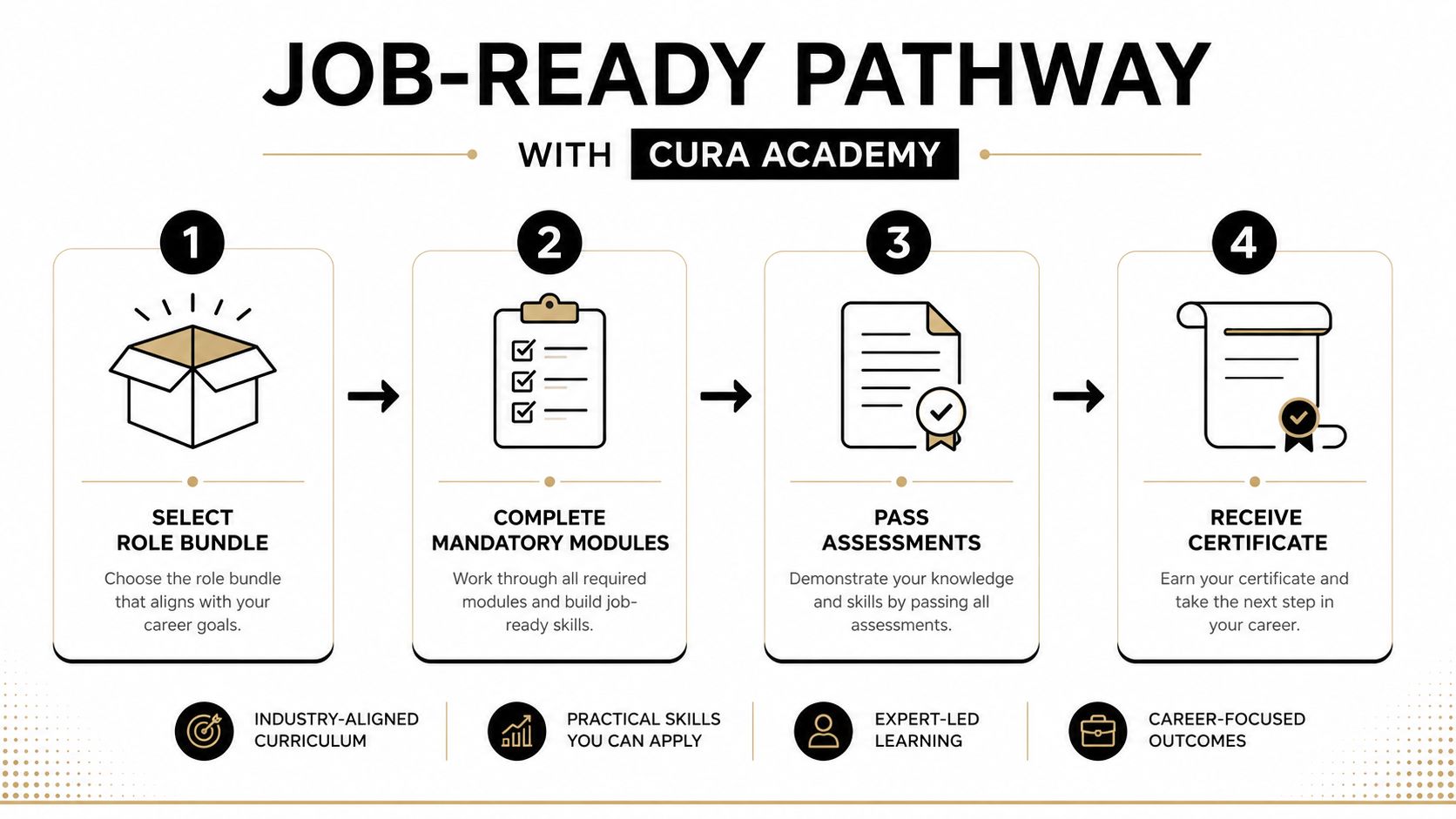
- Choose a role-specific bundle. Start with core subjects such as safeguarding, health and safety, infection prevention and control, information handling, and basic life support. Add specialist modules only where they relate to your intended duties.
- Complete the learning and assessments. Work through the course material, take the knowledge checks, and save certificates or other completion evidence. Remember that your employer may still need to assess practical skills in the workplace.
- Organise your compliance profile. Keep certificates together with issue dates, expiry dates where applicable, assessment records, and evidence of supervised practice. A clear file helps an agency or care provider see what you've completed without searching through separate emails.
- Schedule refreshers. Use reminders to review training before an employer marks it overdue. Requirements vary by topic and organisation, so follow the refresher schedule provided by your employer.
Cura Academy offers online health and social care training, including Care Certificate standards, mandatory modules, specialist courses, and refreshers. Its training tracker is designed to help learners organise certificates and monitor validity dates, while its platform supports a structured profile for sharing training evidence with employers or agencies.
Before you rely on any online certificate, check what the employer accepts and whether the course includes the practical assessment they require. Cura Academy also offers Ofqual-regulated qualifications and CPD-accredited modules, but those labels don't remove the employer's responsibility to confirm role-specific competence.
A job-ready profile won't guarantee a shift, because providers still consider references, background checks, availability, experience, and service needs. It can reduce avoidable onboarding friction by presenting your learning record in one place and showing that you take professional readiness seriously.
Next Steps and Common Compliance Questions
Start by asking your employer or agency for its current training matrix. Compare it with your certificates, mark anything missing or expired, and identify which subjects require workplace assessment rather than online learning alone. Then complete the highest-priority gaps before applying for shifts that involve those duties.
How often does mandatory training need refreshing?
There isn't one universal refresher timetable for every care topic or employer. High-risk subjects may be reviewed more frequently, while other organisations may set a different cycle. Check the certificate date, your employer's policy, and any role-specific instruction before assuming that previous learning remains current.
Will an online certificate be accepted by a CQC-registered employer?
Acceptance depends on the provider, the course, the subject, and the employer's policy. CQC registration doesn't mean every online certificate is automatically accepted. Ask whether the employer requires a recognised framework, an assessment, practical observation, or a particular training provider.
What evidence should you keep?
Retain certificates, assessment results, completion dates, refresher records, and workplace competency sign-offs. Keep copies in a secure location and make sure the name on each document matches the identity information used by the employer or agency.
What happens if you change employers?
Your previous learning may remain useful, but the new employer should review it against their own requirements. Local procedures, equipment, service users, and risk assessments can differ, so you may need an updated induction or additional competency check.
What if you take a career break?
Review your records before returning to work. Training may need refreshing, and practical skills may need reassessment after time away. Be honest about gaps, because accurate disclosure helps the employer plan safe supervision.
Compliance training is easiest to manage when you treat it as a living professional record. Keep it organised, update it when your role changes, and use each completed module as evidence for the next conversation about work or progression.
Cura Academy brings Care Certificate learning, mandatory training, specialist courses, refreshers, and compliance tracking into one job-readiness pathway. Visit Cura Academy to review the course catalogue, identify your training gaps, and start building an onboarding-ready profile for UK care work.