
You've found a care training course that promises a certificate, completed the quizzes, and still aren't sure whether an employer would trust you with a shift. That uncertainty is justified. In UK care, course completion is only half the job. The other half is showing that you can apply what you've learnt safely, consistently, and recently enough for a manager to sign it off.
A useful care training course should give you more than downloadable paperwork. It should connect learning modules to Care Certificate standards, practical assessment, employer induction, DBS readiness, and refresher tracking. This guide shows how to choose that kind of pathway, what each course area is for, and how to build evidence that travels with you between employers.
Table of Contents
- Why Care Training Feels Overwhelming And What This Guide Is For
- What a Care Training Course Actually Is
- Core Modules You Will Meet in Any Care Training Course
- Why Coverage Is Uneven And What That Means For You
- Subscription Vs One-Off Bundles
- A Realistic Learning Pathway To Become Job-Ready In 12 Weeks
- What About UK Sponsorship And Overseas Applicants
- Practical Next Steps And FAQs
Why Care Training Feels Overwhelming And What This Guide Is For
You finish a few online modules, download the certificates, and still cannot answer the question a recruiter or registered manager will ask next. Can you prove what you're safe to do, who observed it, when it was signed off, and whether it is still current? That is where many new carers and experienced support workers get stuck.
The overload is real. One provider sells a Care Certificate package. Another pushes separate courses in safeguarding, dementia, moving and handling, infection control, first aid, medication, and autism. Employers then add their own induction rules, practical assessments, and document checks. A certificate file can look busy while still leaving gaps that block interviews, onboarding, or shifts.
That matters even more if you want agency work or you are changing employers. The challenges carers face when trying to secure shifts in 2026 show why scattered records slow people down. Managers do not want a stack of random completions. They want a clear record they can read quickly.
A certificate proves that you completed learning. Job readiness proves that you can perform safely under supervision and explain how you would respond in real situations.
Start with the decision that affects employability.
- Coverage: Does the training match the Care Certificate standards and the tasks in the role you want?
- Assessment: Does it stop at quizzes, or does it connect to observed practice in a real setting?
- Evidence: Can you show dates, outcomes, practical sign-offs, DBS readiness, and what needs refreshing?
- Portability: Will a new employer or agency understand your record without chasing three old managers and four course portals?
The Care Certificate gives this process a backbone. It was introduced in England on 1 April 2015 as a standardised induction framework for new healthcare assistants and adult social care support workers. It set out 15 standards and expected new workers to complete them within 12 weeks of employment. The UK Government's launch information is still the clearest starting point if you want the original purpose in plain terms.
Use this guide to cut through the noise. The aim is not to help you collect more certificates. The aim is to help you build a job-ready evidence portfolio that joins theory, observed practice, background checks, and refresh dates into one record an employer can trust.
What a Care Training Course Actually Is
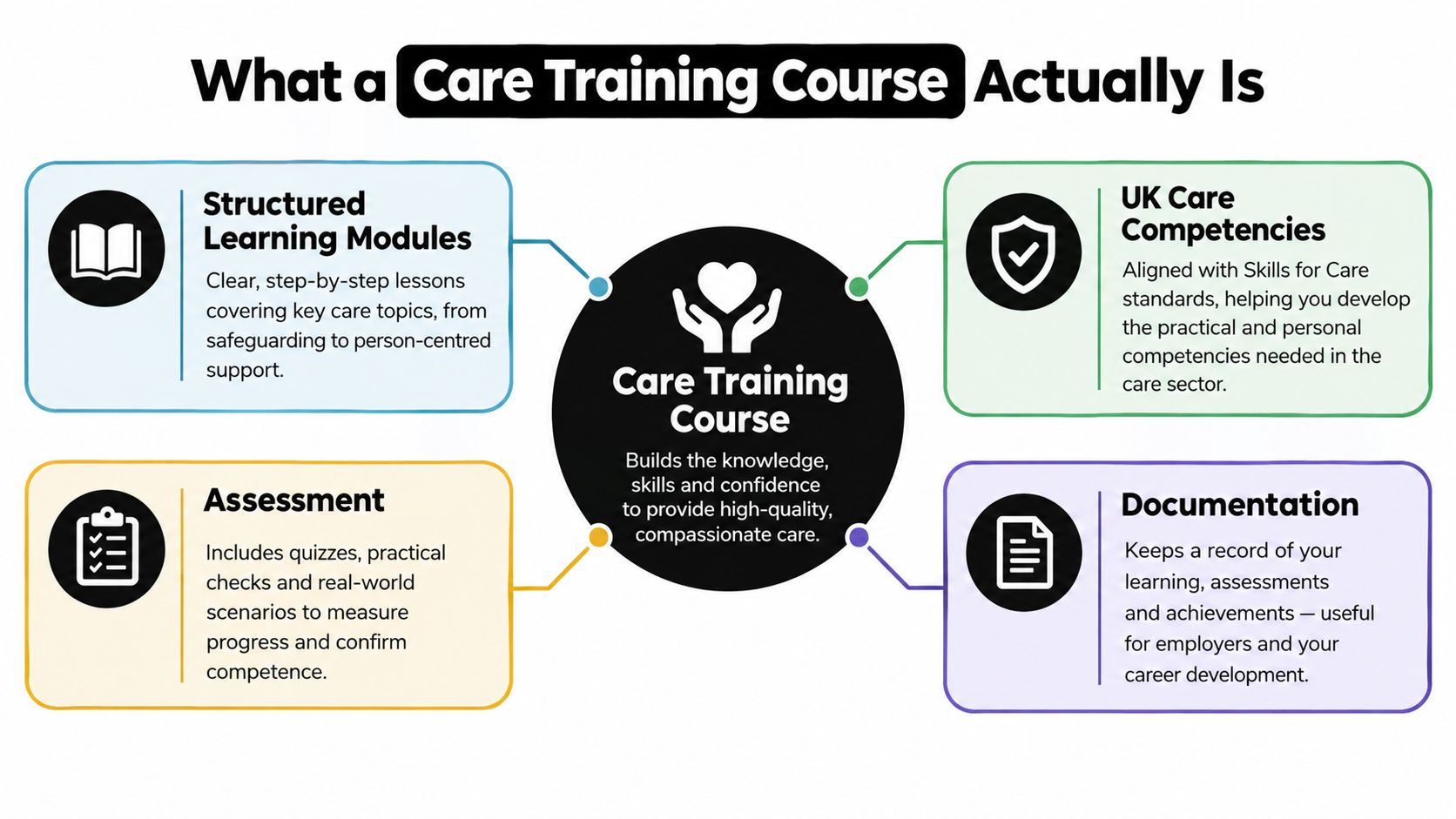
A care training course is a structured set of learning modules designed around care knowledge, workplace behaviours, assessment, and documentation. The weak version stops at videos and a multiple-choice quiz. The useful version links every topic to an observable task, a workplace assessor, and a record that an employer can audit.
The Care Certificate standards provide the working backbone for many entry-level pathways. They cover capabilities including privacy and dignity, duty of care, communication, safeguarding, basic life support, health and safety, infection prevention and control, mental health and dementia awareness, learning disabilities, and handling information. Skills for Care, Skills for Health, and Health Education England developed the framework jointly, which gives it relevance across health and adult social care settings.
The Care Certificate is not itself a statutory legal qualification. The Care Quality Commission recognises it as a benchmark that can help regulated providers demonstrate that staffing expectations are being addressed. The standards combine knowledge with practical competence, so an online completion record shouldn't be presented as the complete proof of safe performance. The distinction between the induction framework and the newer Level 2 Adult Social Care Certificate, launched in 2024, is set out in the Care Certificate standards guidance.
Use the driving-test analogy carefully
Online learning is like the theory part of learning to drive. It can teach you the rules, hazards, terminology, and correct sequence of actions. It can't demonstrate that you can position a person safely, communicate during personal care, recognise a safeguarding concern, or remain calm when a situation changes.
A proper evidence chain looks like this:
- Module completion: You study the relevant material.
- Knowledge assessment: You demonstrate understanding through questions or scenarios.
- Observed practice: A competent person watches you perform the task.
- Workplace sign-off: The assessor records whether you meet the required standard.
- Review record: The employer logs when the competence must be refreshed or reassessed.
That structure matters because a course certificate usually shows what you completed with the training provider. It doesn't automatically show what your employer has authorised you to do. Medication administration is a clear example. A learner may understand medication principles online, yet still must not manage or administer medicines before the employer has assessed competence in the relevant workplace process.
A strong course therefore gives you a traceable map, not just a certificate. It should show the standard covered, assessment completed, evidence still required, assessor or employer responsibility, and renewal point. The guide to mandatory training in care is useful when you're sorting general induction learning from duties that need local approval.
Core Modules You Will Meet in Any Care Training Course
Course catalogues look complicated because providers use different names for similar training. Group the options by purpose, then choose according to the setting and duties you're targeting.

The foundation cluster
Care Certificate standards cover the core behaviours expected from people entering direct care. They help you understand person-centred practice, dignity, duty of care, communication, safeguarding, health and safety, infection control, information handling, and awareness of dementia, mental health, learning disabilities, and autism. They're the right starting point for a new healthcare assistant, support worker, or adult social care worker, but they still need employer-specific induction and workplace evidence.
Basic Life Support focuses on recognising deterioration and responding appropriately within your role. Treat it as a practical safety skill, not merely a completion badge. Check whether the course explains escalation, emergency communication, and the limits of online learning. Employers may require additional face-to-face assessment for practical life-support competence.
Dementia Awareness matters across residential, domiciliary, and supported-living work. The value isn't memorising labels. It's learning how communication, environment, routines, distress, consent, and person-centred support affect someone living with dementia.
The compliance and role clusters
Mandatory refreshers commonly include moving and handling, safeguarding, infection prevention and control, fire safety, health and safety, and adult safeguarding. Skills for Care distinguishes statutory training from employer-defined mandatory training. The exact package depends on the organisation, job role, service users, and local risk controls.
Role-specific add-ons should follow the work you'll perform. Medication, autism awareness, learning-disability support, mental-health training, physical interventions, and specialised clinical topics may be essential in one setting and unnecessary in another. Don't buy every course on a catalogue. Ask an employer or agency for its current compliance matrix first.
A useful course framework should also explain the difference between learning content and authorisation. A medication module can prepare you for supervised assessment, but it can't grant permission to administer medicines independently. Similarly, an online moving-and-handling module can't replace local training on hoists, slings, care plans, or equipment used at a particular service.
For a useful example of how certification resources can be organised outside social care, see this HomeProBadge pool certification guide. The subject is different, but the underlying lesson applies: a credential is easier to trust when its scope, assessment, and evidence are clearly defined.
The core skills training framework can help you separate the common foundation from specialist additions before you spend money.
Why Coverage Is Uneven And What That Means For You
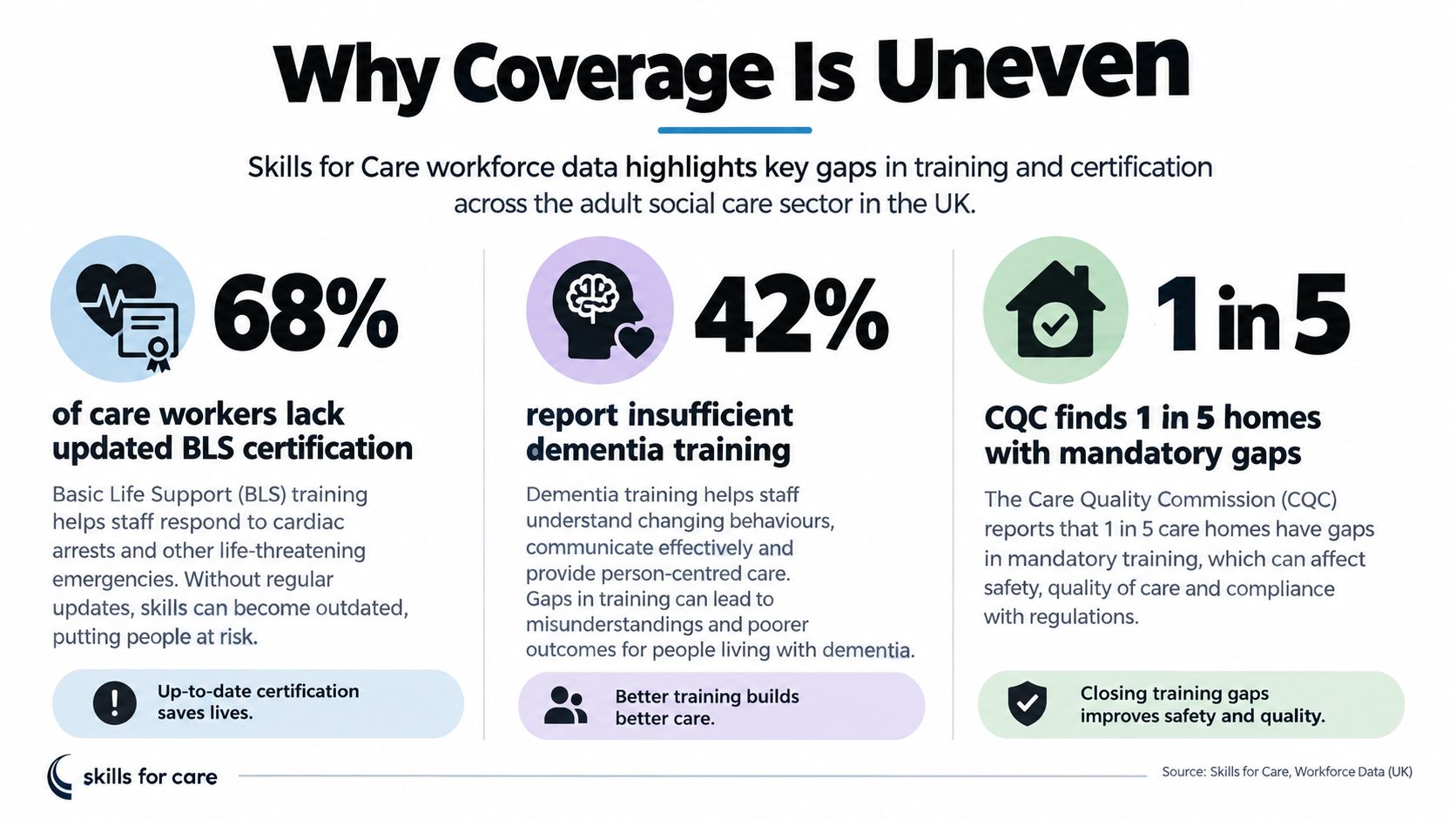
Experience doesn't automatically produce a complete training record. CQC reporting based on Skills for Care workforce data found recorded training coverage of 46% for equality, diversity and human rights and 56% for the Mental Capacity Act and deprivation of liberty. Recorded coverage was much lower for specialist topics, with 8% for mental-health training, 10% for autism training, and 9% for learning-disability training. Physical-interventions training had recorded completion for 10% of the workforce. The CQC workforce summary warns that employers weren't required to submit completion records, so the figures don't prove that everyone without a record lacked training. They do reveal serious gaps in documented coverage.
Why specialist evidence changes your position
A generic induction certificate tells an agency that you've started. A recent, role-relevant record tells them what work you may be ready to discuss. If you want supported-living shifts involving autism, or mental-health support where communication and escalation are central, documented specialist learning gives a manager a clearer basis for the next assessment.
The same CQC material reports that the Department of Health and Social Care invested £1.4 million in 2021 to develop, test, and trial Oliver McGowan mandatory training, involving more than 8,000 people. It also reports that the share of reviewed care-home providers saying staff always or mostly always received specific oral-health training rose from 30% in 2019 to 60% in 2022, while 47% had not provided that training in 2019. These figures don't tell you that one online module makes you competent. They show why employers keep adding subject-specific expectations after induction.
Treat every gap as an evidence problem
For each target role, build a simple matrix:
- Core requirement: What must every direct-care worker understand?
- Local requirement: What does this employer add for its service?
- Practical requirement: Which tasks need observation and sign-off?
- Renewal requirement: When must the learning or competence be reviewed?
- Evidence location: Can you produce the record immediately?
This approach is more useful than collecting certificates indiscriminately. A short list with clear dates, scope, assessment status, and outstanding workplace sign-offs is stronger than a large folder no recruiter can interpret.
Subscription Vs One-Off Bundles
The commercial choice is straightforward if you match it to your likely learning pattern. A subscription suits someone building a career pathway, refreshing regularly, and adding role-specific modules as their work changes. A one-off bundle suits someone who already knows the required package and needs a fixed set of records for a particular employer or application.
The hidden cost appears when learners buy individual modules from several providers. Course versions may differ, renewal dates can disappear into separate inboxes, and nobody owns the master checklist. You may save money on the first purchase while creating more administration and still missing a required subject.
| Factor | Subscription | One-off bundle |
|---|---|---|
| Best fit | Ongoing development and changing role needs | A defined employer or job requirement |
| Access | Broad course library while membership remains active | Fixed package selected at purchase |
| Refreshing | Easier to revisit modules and track updates | Requires separate planning after completion |
| Evidence | Can centralise records if the platform supports it | Simple to present when the bundle matches the role |
| Main trade-off | Ongoing cost and the need to manage membership | Less flexibility if your target role changes |
| Buying risk | Paying for access you don't use | Buying missing or unnecessary modules |
Choose based on your next decision
Pick a subscription when you're new to care, applying across several settings, or expect to move between agency, domiciliary, residential, and support roles. The breadth helps you build a pathway rather than repeatedly restart.
Pick a bundle when an employer has given you a written list and you can confirm that the modules map to it. Don't assume a “complete” package includes practical assessment, local induction, or medication authorisation. Ask what remains for the employer to assess.
Learning platforms also have a business reason to keep content organised and current. The discussion of how providers turn course content into revenue is relevant because sustainable course delivery depends on clear packaging, updates, and a sensible relationship between access and value. For learners, that translates into a practical question: can you see what you're buying, what it covers, and how you'll maintain the evidence?
Cura Academy is one option that combines a membership route with curated one-off bundles, including Care Certificate standards, mandatory refreshers, and role-specific training. Compare it with employer-provided learning and other established providers, then choose the model that leaves you with one coherent record rather than scattered certificates.
A Realistic Learning Pathway To Become Job-Ready In 12 Weeks
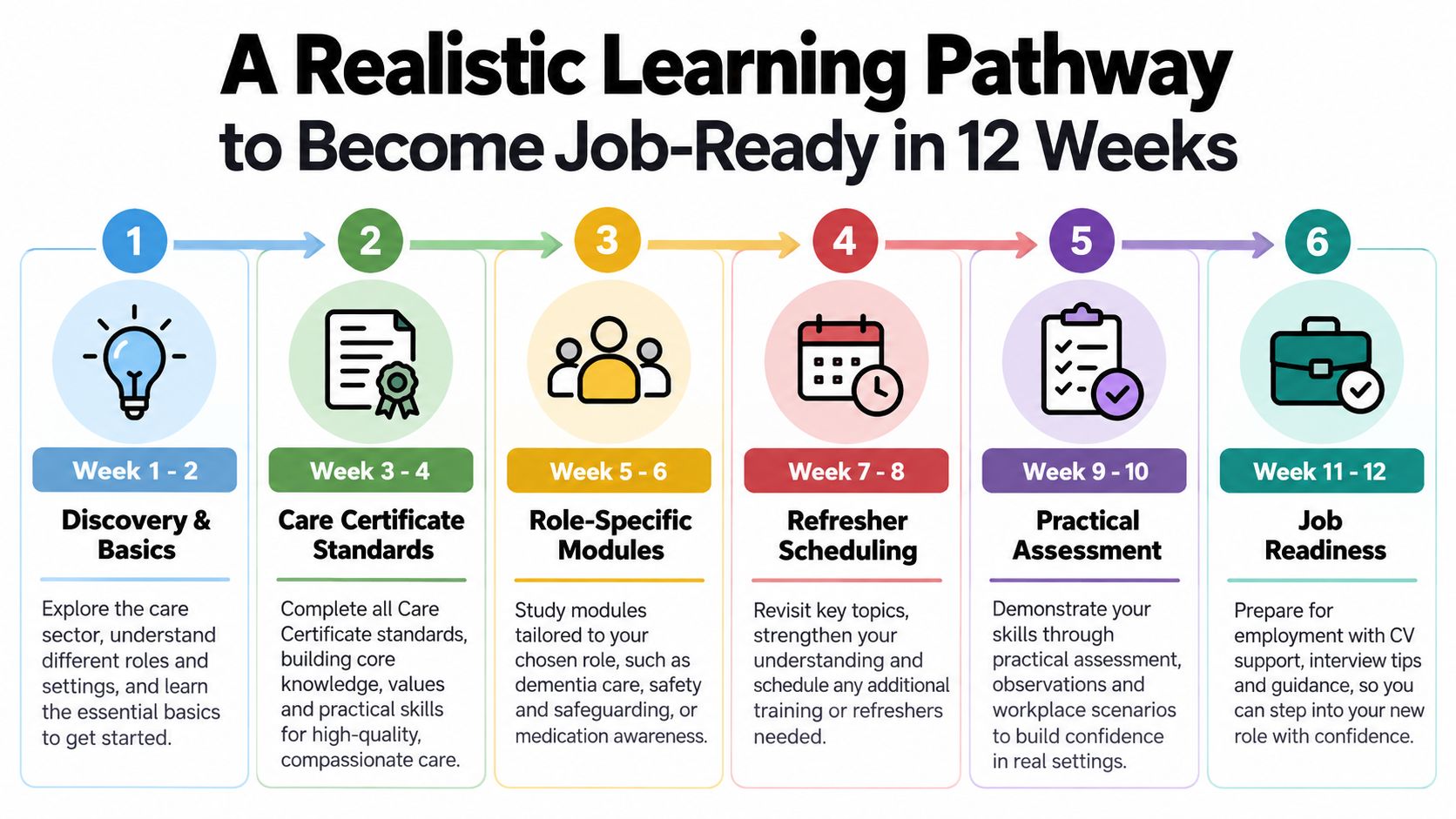
A twelve-week pathway works because it follows the same broad timetable expected for new workers completing the Care Certificate standards. It doesn't mean every learner will be fully competent in every task by the end. It means each stage produces evidence and identifies what still requires supervision.
Weeks 1 to 2, discovery and basics
Choose the target setting, request the employer's training matrix, prepare your identification and DBS information, and start foundational modules. Produce a personal checklist showing each subject, provider, completion date, assessment status, and evidence still needed.
Weeks 3 to 4, Care Certificate standards
Work through the relevant Care Certificate standards rather than rushing through unrelated specialist content. Save certificates and assessment results, then mark which standards require workplace observation. Ask your supervisor how the organisation records competence.
Weeks 5 to 6, role-specific learning
Add the subjects that match the people you'll support. That may include dementia, autism, learning disabilities, mental health, moving and handling, or medication awareness. Keep the role profile narrow enough that every module has a clear job connection.
Weeks 7 to 8, refresh and evidence controls
Create renewal reminders and place them beside your training records. Include supervised-practice prompts, equipment familiarisation, escalation routes, and local policies. A completion date without a review plan is an incomplete compliance record.
Weeks 9 to 10, practical assessment
Book observed practice for relevant tasks. The assessor should record what you did, the standard applied, any restrictions, and the action required before independent work. Online learning becomes workplace competence at this stage.
Weeks 11 to 12, onboarding readiness
Compile a one-page profile with your training summary, outstanding sign-offs, DBS readiness, availability, and contact details. CQC Regulation 18 requires providers to provide training, professional development, supervision, and appraisal necessary for staff responsibilities, with learning needs assessed at employment and reviewed periodically. The CQC Regulation 18 guidance explains why employers need more than attendance records.
Your portfolio should let a manager answer three questions quickly: what have you learnt, what have you demonstrated, and what still needs supervision?
Use the following video as a practical supplement, not as a substitute for employer assessment.
What About UK Sponsorship And Overseas Applicants
A care training course can improve employability. It doesn't create immigration eligibility. Those are separate decisions, and anyone selling a course as a guaranteed route to a sponsored job is giving dangerous advice.
The UK changed the position for care workers and senior care workers from 22 July 2025. Sponsors generally must recruit people already in the UK, and the worker will normally need to have been legally working for that sponsor as a care worker for at least three months before a Certificate of Sponsorship is assigned. The government also announced that employers would first need to try recruiting eligible workers already in England before recruiting from overseas. The current Skilled Worker sponsor guidance should be checked before you spend money or make plans.
Use a visa-first decision path
If you're already in the UK, establish your lawful right to work, the restrictions attached to your visa, and whether an employer can sponsor the relevant role. Then build employability evidence through Care Certificate learning, safeguarding, moving and handling, Basic Life Support, English communication, DBS readiness, and observed competence.
If you're overseas and relying on a care course to secure sponsorship, stop and verify the current rules first. Training may prepare you for future employment, but it isn't a standalone migration strategy. Don't pay for a package because an advert implies that a certificate guarantees a visa, a job, or a Certificate of Sponsorship.
The sensible order is immigration position, lawful work eligibility, realistic employer pathway, then targeted training. That order protects your money and gives you a clearer route to work.
Practical Next Steps And FAQs
A finished course certificate is only half the job. What gets people hired is a clean evidence trail that shows what you learned, what you can do in practice, and what still needs signing off.
Build one folder for everything and keep it current. Start with your target setting, then match that role against the employer's compliance matrix, the Care Certificate standards, and any role-specific training. Save certificates, assessment results, course dates, observed practice records, and any workplace competencies still awaiting sign-off. Add DBS paperwork, Update Service details where relevant, references, right to work documents, and your actual availability. Then set refresher reminders. Memory is unreliable. A dated record is what protects you.
Common questions
What does a care training course cover?
The better question is whether it matches the job you want. Compare the provider's course list with the employer's mandatory training matrix, then check what must be evidenced by workplace observation rather than an online completion record.
How long does it take?
The learning can be completed quickly, but job-readiness takes longer because practical competence still has to be observed and signed off. For new starters, Care Certificate standards are commonly worked through within 12 weeks of employment, with assessment continuing alongside day-to-day work.
Do online certificates count?
They count as knowledge evidence. They do not prove you can deliver care safely on shift. Employers may still require local induction, supervised practice, and manager sign-off.
Does training lead to sponsorship?
No. Training supports employability. Sponsorship depends on immigration rules, lawful work status, the employer, the role, and current eligibility.
Cura Academy offers structured care training, including Care Certificate standards, mandatory refreshers, role-specific courses, and pathways built to organise onboarding evidence into a job-ready record.