

You're on shift, a new starter walks in, and everyone's asking the same thing in different words. Has the person done the Care Certificate, or do they still need the employer's mandatory courses before they touch a rota on their own? That confusion is common, and it's exactly where compliance slips start.
The blunt answer is this, care certificate mandatory training is not one thing. The Care Certificate gives you the induction baseline, but it does not replace the role-specific training that keeps people safe, signed off, and regulator-ready. If you treat it like a full compliance package, you'll miss the gaps that matter most.
Table of Contents
- Understanding the Care Certificate and Its Core Purpose
- Breaking Down the 16 Mandatory Standards
- Mandatory Training Versus the Care Certificate
- Completing Your Training Pathway and Refreshers
- What CQC Inspectors Expect From Your Compliance
- How Cura Academy Supports Your Training Compliance
- Accelerating Your Career and Securing More Shifts
Understanding the Care Certificate and Its Core Purpose
A provider deciding whether a new worker is ready for unsupervised care needs evidence, not a familiar job history or a completed online module. The Care Certificate supplies that evidence through a consistent induction framework. In England, it launched in April 2015, replaced the Common Induction Standards, and established a national baseline for health and adult social care workers. The framework is not mandatory in law (UK Parliament briefing on the Care Certificate).
What it means in practice
For a worker joining a care home, hospital, or community service, the certificate gives the employer a defined route from induction to assessed competence. It replaces improvised local checklists with shared expectations and requires completion of all 16 standards before the certificate can be awarded (Skills for Care FAQ on the Care Certificate).
Employers should set up the pathway early, assign supervision, collect workplace evidence, and record the assessment outcome. A worker who has “done care before” still needs evidence that they meet the required standards in the current role.
Practical rule: Do not place a worker into unsupervised care until the Care Certificate or an equivalent induction pathway has been completed and competence has been assessed.
The certificate also sits alongside statutory and mandatory training. It gives new staff a foundation, while the employer must identify and deliver training linked to the service, role, and risks. That includes basic life support, safeguarding, infection control, moving and handling, and other courses required for the duties involved. Completing the Care Certificate alone does not satisfy every compliance requirement (Skills for Care FAQ on the Care Certificate).
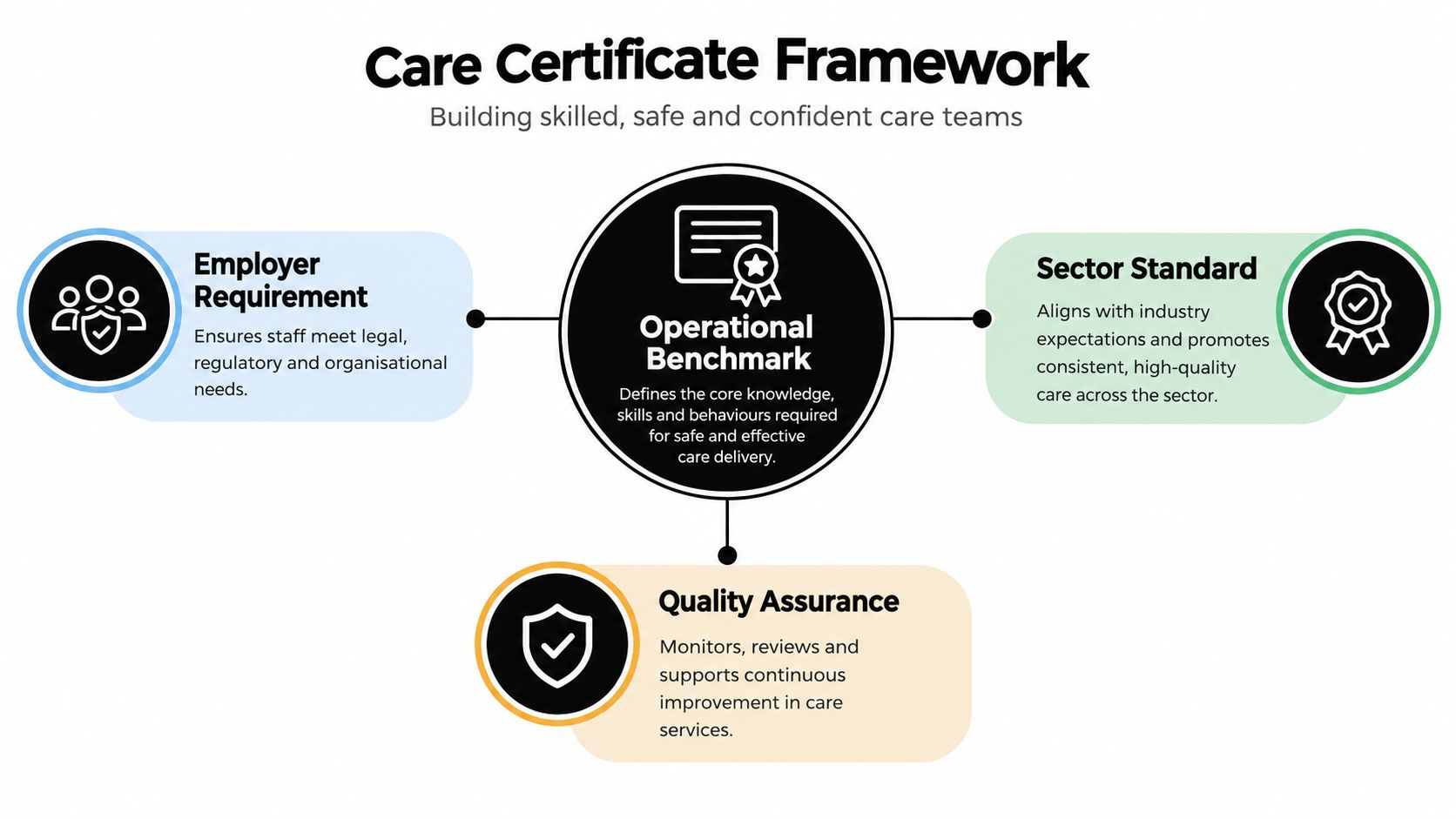
Read the framework as the operational benchmark for new care staff. The employer owns the final competence decision, keeps the supporting records, and confirms that the worker can perform safely before working alone. That is how the Care Certificate becomes part of compliance rather than a box-ticking exercise.
Breaking Down the 16 Mandatory Standards
The Care Certificate was once described as having 15 standards. That description is outdated. The current Skills for Care publication sets out 16 standards, with the added standard covering awareness of learning disability and autism (Skills for Care Care Certificate standards, March 2025).
Safety, dignity, and day-to-day practice
These standards set expectations for the work a care worker performs every day. They cover basic life support, infection prevention and control, safeguarding adults and children, handling information, and person-centred care, alongside the knowledge and behaviours needed to protect people's safety, dignity, rights, and wellbeing. Treating these topics as optional extras leaves a serious gap in the induction plan.
What the standards group together
Use the framework by function, rather than treating it as a disconnected list of course titles.
- Role and accountability: understanding your role, personal development, and duty of care.
- Respect and communication: equality and diversity, person-centred working, communication, privacy, and dignity.
- Daily care tasks: fluids and nutrition, health and safety, and handling information.
- Protection and emergency response: safeguarding adults, safeguarding children, basic life support, and infection prevention and control.
- Modern inclusion: awareness of mental health, dementia, learning disability, and autism.
This structure makes the framework easier to apply. A worker must be able to put the standards into practice, not merely recall definitions or complete online modules. For example, knowledge of safeguarding must support appropriate action, while infection control training must translate into safe routines during a shift.
The standards are not boxes to tick. They define the minimum shape of safe practice.
Managers should map every standard to evidence of competence. That evidence may include discussion, written work, observed practice, or assessment, depending on the standard and the role. A course certificate can show that learning took place, but it does not prove that the worker can perform safely. Supervisors must check the work in practice and record the outcome clearly.
Mandatory Training Versus the Care Certificate
The easiest way to get this wrong is to assume the Care Certificate and mandatory training are the same thing with different labels. They're not. The Care Certificate is the induction foundation, while mandatory training is the wider employer-led set of learning that covers legal duties, service risk, and role-specific requirements (Care Certificate FAQs March 2025).
Where one ends and the other begins
The certificate may introduce basic life support, but that doesn't mean the employer has met its duty with a single introductory module. A provider may still require a fully assessed, practical Basic Life Support course, because the service risk is higher and the local policy demands it. The same applies to safeguarding, moving and handling, medicines support, and information governance, which belong in the employer's mandatory training plan as well as the induction pathway.
If you want a broader comparison of how the employer-side training layer works, this mandatory training in health and social care guide is a useful reference point.
The clean distinction is this, and providers should say it out loud to every new starter:
- Care Certificate: proves structured induction and observed competence across the national framework.
- Mandatory training: proves the person can meet the employer's own safety, legal, and role-specific requirements.
- Statutory elements: apply where law or regulator expectations create specific duties.
That means “I've done the Care Certificate” is not a free pass. It's a starting point, not a completion badge for everything else your service needs.
For managers, the safest approach is to build a matrix that separates induction from refreshers and role-specific training. If you don't do that, staff end up repeating the wrong courses while missing the ones that protect service users.
Completing Your Training Pathway and Refreshers
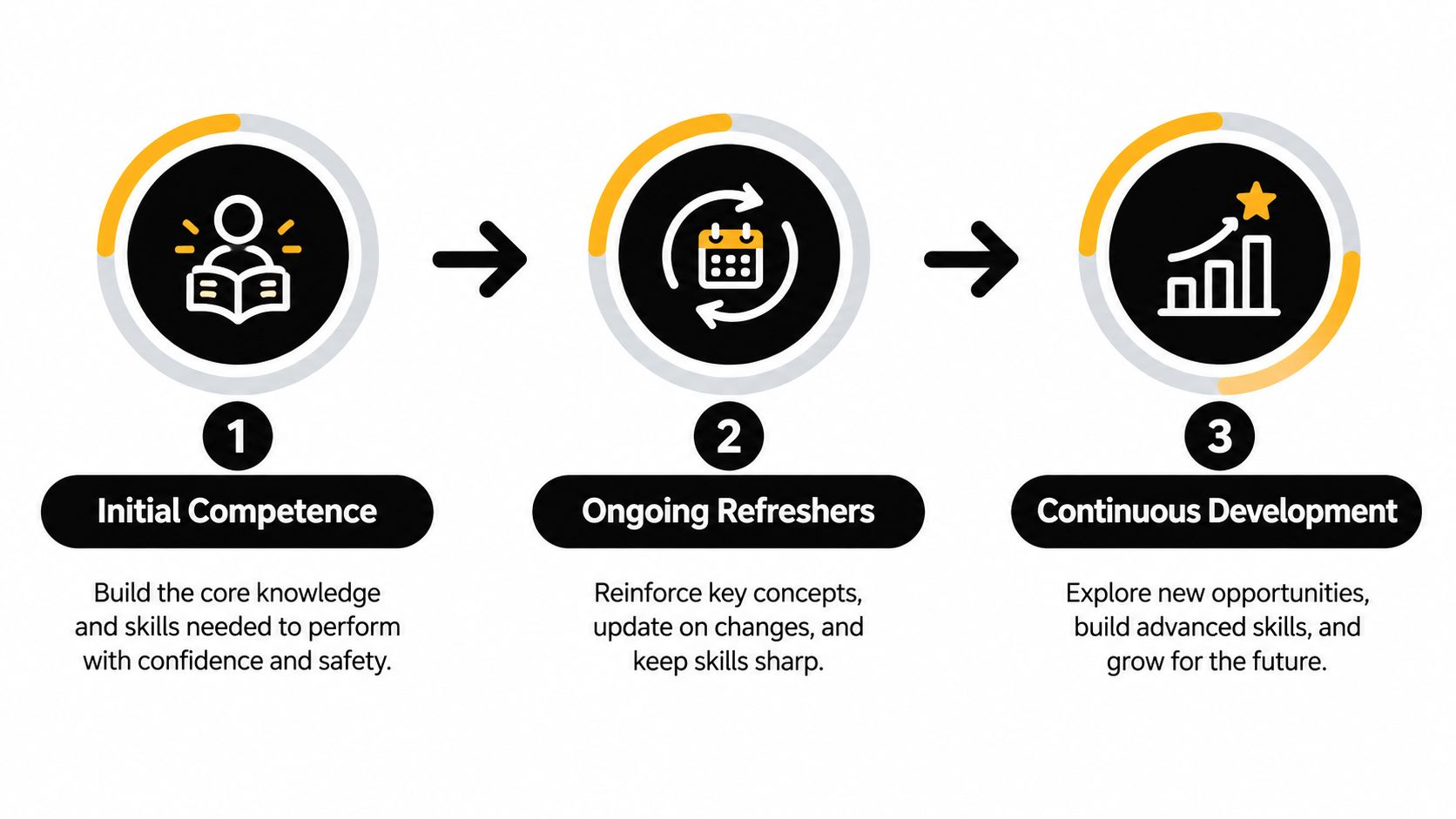
The people who stay compliant don't treat training as a one-off event. They treat it as a pathway. A worker needs learning, supervision, workplace observation, and sign-off before they're trusted to work unsupervised, then they need refreshers to keep the core skills current.
What good completion actually looks like
The Care Certificate should be evidenced through real workplace performance, not just attendance. That means the assessor checks whether the person can apply what they've learned on shift, and the employer keeps that record in a form that can be retrieved quickly. If the evidence sits in random folders, emails, and spreadsheets, it's already weak.
A training matrix keeps the whole process organised. This training matrix template is useful because it forces you to separate initial induction, ongoing refreshers, and role-specific learning instead of mixing everything together.
Operational rule: Training only counts if you can prove it, find it, and relate it to the person's actual role.
That matters even more for teams that move quickly, like agency or bank staff. If someone is new to your setting, you need to know what's completed, what's current, and what still needs observing before they work independently. Good systems remove guesswork from that process.
For teams that need a clean way to keep certification records straight, credential tracking for teams is a relevant approach to compare with your own process. The principle is the same, track the evidence before it becomes a problem.
What to keep current
You don't need to overcomplicate refreshers. Focus on the areas that affect safety fastest.
- Emergency response: keep basic life support practice current.
- Infection control: keep PPE, hand hygiene, and cleaning routines up to date.
- Safeguarding: keep referral routes and escalation steps fresh in people's minds.
- Information handling: keep confidentiality and record-keeping aligned with local policy.
- Role-specific duties: refresh medicines, moving and handling, or any service-specific competence as required.
This is also where a good tracker saves time. One person can't remember every expiry date for every shift worker, and nobody should be relying on memory anyway. If you're still chasing paper certificates manually, you're wasting time you could spend on real supervision.
What CQC Inspectors Expect From Your Compliance
A new worker may have completed online learning and still be unready to work alone. CQC inspectors test that difference. They want evidence that staff were inducted, assessed, supervised, and prepared to work safely within your service.
Proof beats promises
Inspectors expect records covering training, assessment, supervision, and follow-up. A certificate shows course completion, not workplace competence. Pair it with an observed assessment and a clear sign-off before the worker works independently.
The Care Certificate provides a foundation for induction, but it does not replace role-specific compliance. Keep evidence for training such as basic life support, safeguarding, medicines, moving and handling, infection control, and other duties linked to the role and service.
A worker's personal portfolio should match the provider's records. Keep induction evidence, supervision notes, workplace assessments, and refresher learning together. That record helps managers decide whether someone is ready for a shift and gives inspectors a clear audit trail.
If you are building the process internally, the LearnStream compliance training guide explains how internal training can be delivered and documented.
What the regulator wants to see
Keep your records aligned to the questions an inspector will ask, using the CQC key lines of enquiry as a practical checklist.
- Was the person inducted properly? Show the Care Certificate pathway or equivalent induction evidence.
- Was competence checked in the workplace? Show observation records, assessment results, and sign-off.
- Were gaps followed up? Show action plans, supervision notes, and completion dates.
- Are refreshers current? Show ongoing mandatory training, including role-specific updates, rather than only first-day learning.
Inspectors will look for evidence that staff can apply their knowledge in your service, follow local procedures, and manage the risks attached to their work. Attendance alone does not prove that.
Organised records are part of safe service management. If certificates, assessments, and follow-up actions are scattered or out of date, your compliance position is difficult to defend. Set one record standard, assign responsibility for updates, and review it before an inspection exposes gaps.
How Cura Academy Supports Your Training Compliance
A new care worker may be ready for induction but still lack training required for specific duties. The Care Certificate provides the foundation for safe practice. It does not replace mandatory training such as basic life support, safeguarding, or other role-specific requirements. Providers need a training route that keeps both parts visible.
Cura Academy brings the Care Certificate standards, mandatory refreshers, and role-specific care training into structured learning pathways. That gives workers a clear sequence to follow and gives providers a more practical way to see which learning has been completed and what remains outstanding.
What that looks like for real teams
A new starter can follow the induction route, complete the relevant modules, and keep their learning organised instead of contacting separate course providers for every requirement. Managers can spend less time checking whether the correct training has started and more time confirming that the worker is ready to apply it in the role.
Why consolidation matters
Agency and bank staff often move between employers with different training expectations and record-keeping systems. A central platform makes it easier to identify completed learning, find outstanding modules, and keep the Care Certificate pathway alongside mandatory training rather than treating them as interchangeable.
Choose a platform that offers clear course pathways, records you can retrieve quickly, and training mapped to onboarding and compliance checks. If it cannot show what a worker has completed and what still needs attention, it will not solve the underlying compliance problem.
That's also where Cura Academy fits into this topic. It gives workers and providers a structured route through the training that matters most, without forcing them to piece together compliance from multiple unrelated systems. Visit Cura Academy to review the available pathways.
Accelerating Your Career and Securing More Shifts
A care worker with clean training records gets to yes faster. Employers don't have to guess whether the basics are covered, and agencies don't have to spend extra time chasing missing evidence. That's the difference between being available and being ready.
Compliance opens doors
If your Care Certificate is complete and your mandatory courses are current, you look low-risk. That matters because managers want staff who can start safely, follow the local process, and fit the shift without extra delays. A worker who still needs their core compliance sorted is a slower hire, even if they're experienced.
Some teams also look at career support alongside training. For example, Digital Souls Studios LTD careers is one of many places people check when they're exploring next steps, but in care, the first filter is still the same, can you prove you're job-ready?
Confidence follows evidence
Workers feel that difference too. When you know your induction is complete, your refreshers are current, and your records are in order, you're not second-guessing yourself on shift. You step in with more confidence because the paperwork and the practice both line up.
That's the career value of care certificate mandatory training done properly. It doesn't just keep you compliant, it helps you get placed, trusted, and rebooked.
If you want a simpler way to keep Care Certificate standards, mandatory refreshers, and role-specific compliance together, Cura Academy gives you a structured route through the training that care workers need. Visit Cura Academy to review the available pathways and keep your compliance evidence in one place.