
A sharp drop in emergency admissions is a better test of the benefits of person centred care than a values poster. In a 2025 NHS England case study from Lincolnshire, a personalised-care and linked-data approach was associated with a 58% reduction in emergency-department admissions over six months. That was a local retrospective evaluation, not a national trial, so it isn't proof that every team will match it. It does show what the gains are. Crises get spotted earlier, support follows one person's goals, and money isn't spent on avoidable hospital care. Short visits, rushed handovers and tick-box plans wipe those gains out before a quality statement ever gets read.
Table of Contents
- Person Centred Care Benefits at a Glance
- Clinical Outcomes and Fewer Avoidable Incidents
- Wellbeing, Choice and Engagement
- Organisational Gains in Cost, Staff and Retention
- Barriers That Limit the Benefits and How to Respond
- How to Measure Benefits in Your Service
- Start Putting Person Centred Care into Practice
Person Centred Care Benefits at a Glance
Person centred care means building support around what matters to the individual. Routines, preferences, relationships and goals come first, instead of giving every person the same visit, the same meal pattern and the same activities. A custom suit and an off-the-peg one can cover the same body. Only one fits well enough to wear comfortably every day. Care is the same. Tasks can be completed on time and still leave someone worse off, because nobody checked the fit.
The idea isn't new to people who counsel. These key insights into client centred therapy from Therapy with Ben show how staying with the person's own frame of reference changes the work. In social care the test is blunter. Did today's visit follow what this person said a good day looks like, or did it follow the run sheet?
| Benefit area | What changes for the person | How to see it |
|---|---|---|
| Quality of life | More control over daily routines and goals | Self-rated quality-of-life score at each review |
| Unplanned hospital use | Early signs noticed and acted on sooner | Emergency attendances and admissions per six months |
| Nutrition and appetite | Food and drink matched to personal preferences | Weight and meal-intake records |
| Falls and infections | Routines fitted to individual needs | Incident logs per month |
| Antipsychotic use in dementia | Distress managed without default medication | Prescription review records |
| Staff engagement | Workers see the results of their practice | Staff survey scores and turnover rate |
| Cost per person | Support targeted rather than identical | Cost per person per year |
Read the middle column as the change you are trying to cause. Read the right-hand column as the smallest record that can show it. A completed care plan isn't on the list. The file can be perfect while appetite, falls and distress stay exactly where they were.
Where the evidence is strongest
The rows a UK service can already defend are quality of life, unplanned hospital use and cost per person. National budget evaluations and linked local data sit behind those three. Nutrition, falls, infections and antipsychotic use show up as linked changes in dementia practice, but they need your own incident logs and prescription reviews before anyone should claim them in a board paper. Staff engagement is the row people assert most often and count least often. Survey scores and turnover, set against a baseline, are what turn "the team feels better" into something a manager can stand behind. The rest of this piece takes the rows in turn, names the working conditions each one needs, and shows the record that proves it happened.
Clinical Outcomes and Fewer Avoidable Incidents
Say Mrs Ahmed likes a short walk after lunch. On Tuesday she is unsteady on the first few steps. A support worker who knows that routine reports it the same afternoon. A medication review and a walking aid follow. The fall that would have filled an incident form on Wednesday doesn't happen. That is what a clinical benefit looks like in this work. It is small, early and easy to miss if the worker is new to the person.
The mechanism is pattern recognition, not a new clinical skill. When you know someone's breakfast, their pace after lunch and how they usually sleep, a break in the pattern stands out. Someone stops eating a favourite meal. Their steps shorten. They are more irritable at dusk. Those are the signals that sit upstream of a fall, an infection, a dehydrated admission or a distressed evening. If the rota swaps staff every day, nobody holds the pattern, so nobody reports the change.
In dementia care, person-centred approaches have been linked with reduced antipsychotic use, improved appetite, increased activity and fewer infections and falls. Treat that as an association, not a guarantee. A calmer unit can still have a bad month. What the link does tell you is where to look. Distress managed through routine and occupation, rather than a default prescription. Food matched to what someone will eat. Movement built into the day they already want.
A baseline you can compare
In the first week, record three baselines for each person. Food and drink intake, mobility (how they transfer and walk), and sleep. Compare the same three once a month. Don't wait for a serious incident to start the log. The month with no falls is the month the baseline earns its keep. When something does change, write three lines and nothing more:
- What was noticed: the specific change, in ordinary words, with the time.
- What was done: who was told, what was altered, and when.
- What happened next: the outcome at the next check, including "no change".
That three-part note is also what a sound incident reporting procedure expects when the change does become a fall or a hospital trip. If the first two lines are missing, the investigation starts from a blank.
Practical rule: If you can't describe the person's usual Tuesday, you can't claim you prevented an unusual one.
Wellbeing, Choice and Engagement
Wellbeing here isn't a score on a poster. It is control, purpose, dignity and some enjoyment in an ordinary day. The bath at the time they asked for. The radio station they chose. A visit from the person they want to see. When those pieces are missing, people withdraw from the support that was commissioned for them.
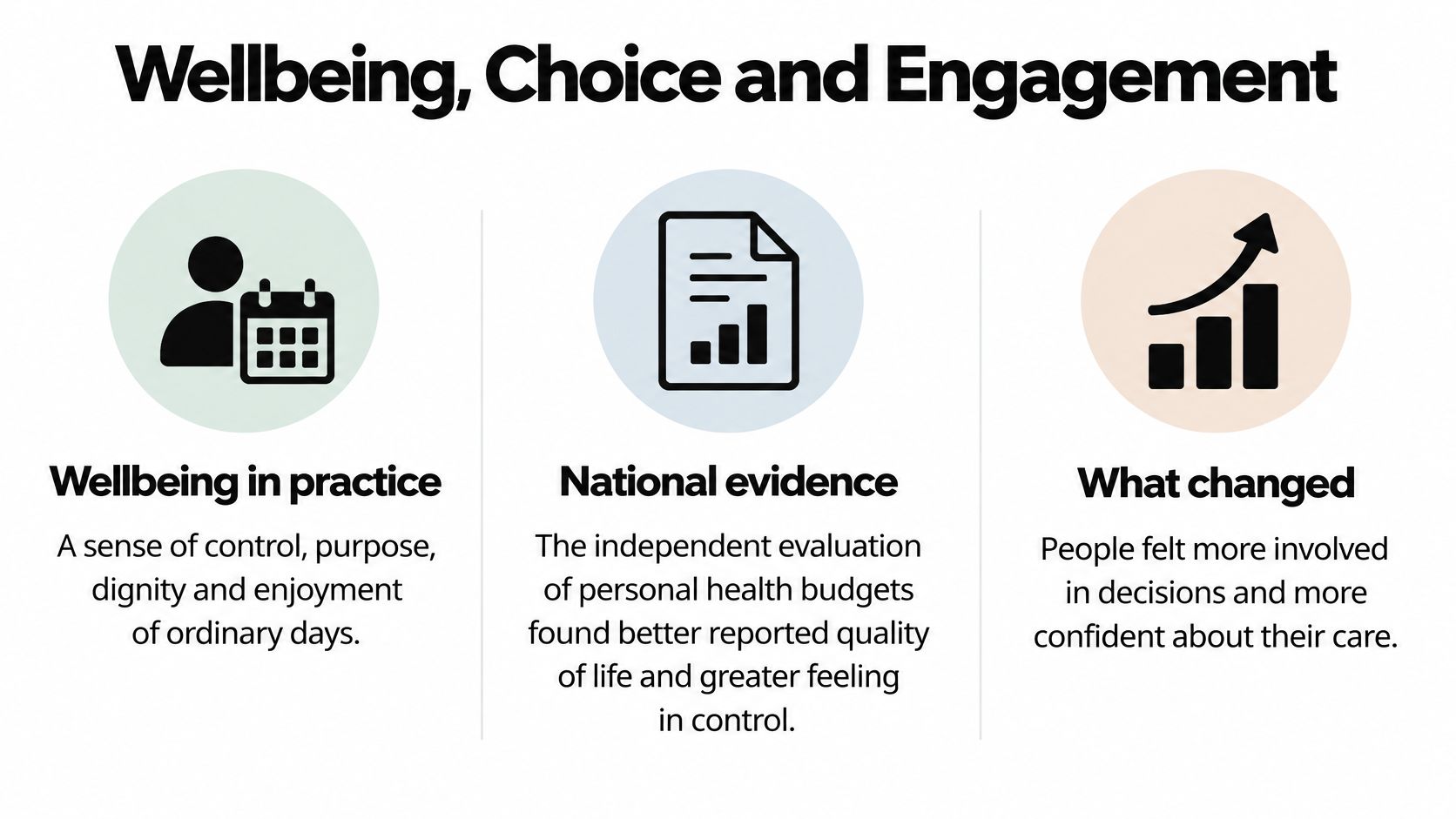
The national evidence is stronger than a case story. The independent evaluation of personal health budgets, led in 2012 by the Personal Social Services Research Unit at the University of Kent, found that people who arranged support around their own goals had improved quality of life and less reliance on unplanned care, including accident-and-emergency admissions. For people receiving NHS Continuing Healthcare-funded personal health budgets, that evaluation reported overall savings of approximately £3,100 per person per year. Later NHS evidence found that 86% of personal health-budget holders said they had achieved what they wanted through their budget, while 77% said they would recommend personal health budgets to others. NHS England's personalised care evidence also reports an average 17% saving on the direct cost of home-care packages for those Continuing Healthcare budgets.
Why choice produces engagement
People take part in support they helped to design. They skip, resist or endure support that arrives as a fixed script. That is why the 86% figure matters more than a satisfaction slogan. Holders weren't reporting that staff were nice. They were reporting that the budget did what they had asked it to do. Recommendation followed from that, not from a leaflet.
The worker's question is simple. Ask what a good day looks like for this person. Write the answer in their words, not a rewritten goal. Check it at every review, and change the plan when the answer has changed. Teams that want a fuller method can use this guide on how to promote choice without turning the conversation into a form.
Choice only works when the person can reach the support they picked. Readers comparing funded care in Australia can explore NDIS in-home care eligibility with Core Nursing Solutions Pty Ltd to see how an individual budget gets from a plan into a visit. The UK lesson is the same shape. A preference that nobody can staff is not choice. It is a sentence in a file.
Write the good day in the person's words. If the review can't quote them, the plan has drifted back to the service's default.
Organisational Gains in Cost, Staff and Retention
Put the Lincolnshire costs side by side before anyone briefs a board. The evaluation estimated £230,000 in avoided emergency-department costs against an £80,000 annual investment. That is a potential return of almost 3:1. It is the sort of ratio that makes personalised care look like an obvious saving. It isn't a blank cheque.

Read the ratio with the design in view. This was one place, looking back, not a randomised trial across England. Shared goals, coordinated records, proactive outreach and co-produced plans travelled together, so you can't point at a single practice and say it produced the saving. Association isn't causation. A service that copies the language and skips the linked data should not expect the same avoided costs.
| Measure | Reported change or value | Context |
|---|---|---|
| Emergency-department admissions | 58% reduction | Six months, local retrospective evaluation |
| Emergency-department attendances | 41% reduction | Six months, local retrospective evaluation |
| GP encounters | 4% reduction | Six months, local retrospective evaluation |
| Mental-health-service activity | 37% reduction | Six months, local retrospective evaluation |
| Avoided emergency-department costs | £230,000 | Estimated by the evaluation |
| Annual investment | £80,000 | Potential return of almost 3:1 |
The spread matters. Admissions and mental-health activity moved a long way. GP encounters barely moved, at 4%. A story that says "demand fell everywhere" is already overclaiming. Frontline evidence should be just as specific. Independence, distress, hospital use, nutrition, falls and engagement will show a change long before a finished care plan does.
What you can say about staff
Teams that share goals duplicate less. The nurse, the support worker and the coordinator stop reassessing the same risk in three systems. Purpose gets clearer because the worker can see a fall that didn't happen, not only a form that was signed. Retention is the claim to hold back. No national figure here tells you that person-centred teams keep staff longer. Count your own turnover and your own survey scores against the six months before you changed the way plans are written.
Before anyone writes "we saved" into a report, ask four questions.
- What was the baseline? The six months before, not a bad winter you half remember.
- What was the comparison? The same service earlier, or a similar team that didn't change.
- Over what period? Six months is what Lincolnshire reported. A fortnight proves nothing.
- Which costs were included? Avoided emergency-department costs are not the same as total spend.
A short briefing on film won't replace those four answers. Use it to give the team a shared picture of coordinated care, then go back to the baseline you hold.
Barriers That Limit the Benefits and How to Respond
Person centred care isn't uncomplicated best practice. UK evidence says the benefits depend on the shift in front of the worker. If the visit is too short, the colleague in health never calls back, and the plan was written for an inspection, the preference loses.
A 2025 NIHR-supported study of older people using community-based social care found that homecare workers faced short visits, limited collaboration with health professionals and insufficient opportunities to develop nutritional knowledge. Those barriers reduced their ability to give person-centred support for food and drink. The study is awkward for any guide that lists benefits and stops there. Recent CQC reporting points the same way. Poor information sharing, weak coordination and disconnected services damage people's experience and the handoff between services.
Research on UK care homes describes a second trap. Staff called care plans "tick-box" documents shaped by inspection requirements. They understood person-centred principles, and their practice still didn't match. Knowing the right sentence isn't the same as having ten minutes to act on it.
Five moves inside a rushed visit
You will not meet every preference in a short call. You can stop the call from deleting the ones that matter.
- Prioritise two or three things that matter most to this person today. Hydration and a time-critical medicine beat a tidy kitchen.
- Escalate the unmet need to the coordinator on the same shift. Tomorrow's email is too late for today's drink or today's pain.
- Record what was not done, and why. An honest gap is useful. A blank line looks like the task was never owed.
- Hand the preference to the next shift in words they can act on. "Likes tea milky, left hand, before the news" beats "promote choice".
- Say what can change. Don't promise an evening visit you can't roster. False choice is worse than a clear limit.
Say the visit is fifteen minutes. The carer gets a drink taken, gives the lunchtime medicine, writes that the person wants soup rather than a sandwich this evening, and tells the coordinator that a promised welfare call never came. Hydration and medication were protected. The meal preference survived the handover. The missed call became someone else's job before the shift ended. That is person-centred work under a bad rota, not a failure to be ideal.
New and agency workers need this boundary more than a speech about values. You're not required to invent time. You are required to choose, record and pass on. A preference you couldn't meet today is still a preference the next person can meet, if you wrote it down and refused to pretend the visit was long enough.
How to Measure Benefits in Your Service
Pick a small set and protect it. A service that tracks fifteen outcomes tracks none of them past week three.
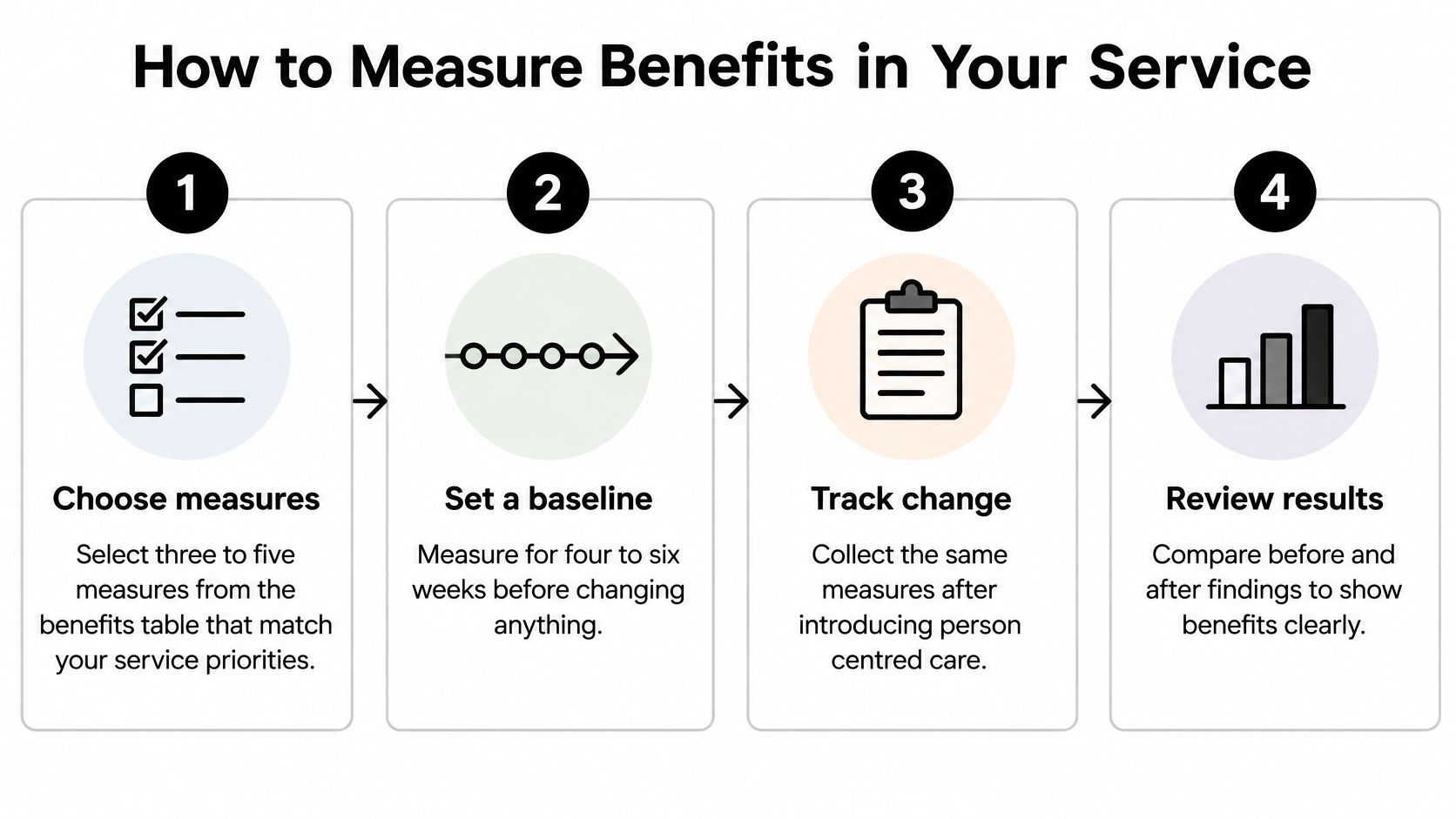
- Choose three to five measures from the benefits table, matched to this service. A dementia unit might take falls, antipsychotic reviews and a wellbeing score. A homecare branch might take meal intake, emergency attendances and a quality-of-life score. The usual slip is choosing a measure nobody is in the room to see.
- Set a baseline for four to six weeks before you change the plan, the rota or the training. You need the "before" or the "after" is a story. The usual slip is starting the new paperwork and the new count on the same Monday.
- Agree who records each measure, how often, and in which system. One owner per measure. The usual slip is "everyone updates the notes", which means the night shift thinks the day shift did it.
- Review each person's goals against those measures every month. Bring the good-day sentence to the same meeting as the incident log. The usual slip is two meetings that never share a name.
- Compare. Use a similar unit, or the same unit before the change. Without a comparison, a quiet month gets the credit for your project. The usual slip is comparing a trained unit with a short-staffed one and calling the gap culture.
- Share the results with staff and with the people using the service. Workers who see the fall rate move will keep the baseline. People using the service should see what changed in their own words. The usual slip is a dashboard that only the manager can open.
- Adjust at three months if a measure hasn't moved. Drop it, or change the practice, don't add four more metrics. The usual slip is defending a dead measure because it was in the original plan.
What a useful report contains
Five lines, in this order. The baseline. The change. The comparison. The actions taken. The limits of the data, including small numbers and missing weeks. If a line is missing, the report is a brochure.
That report is also what a well-led conversation with the regulator can use. A service that can show who records falls, who checks goals and who acts when a measure stalls is already doing the work described in CQC well-led guidance. The rating follows the habit. It doesn't create it.
Start Putting Person Centred Care into Practice
Choose one row from the table this month. Falls and infections, or wellbeing. Don't launch all seven.
Name the person who will record it, the system that will hold it, and the date the baseline starts. Run that baseline for four to six weeks. Use the simplest record in the table. Incident logs per month for falls. A self-rated quality-of-life score for wellbeing. Share the first results at the next team meeting, and invite the people using the service if they want to be there.
Make the first move a conversation, not a form. Ask each person what a good day looks like, write their words, and check them at the next review. For someone whose priority is bladder or bowel care, it helps to see what understanding your continence assessment appointment looks like when the assessment itself starts from the person, as Nursing Assessment Australia sets out. The same habit applies to every other preference.
Staff understanding decides whether this survives a rushed visit. Use the first session on the principles and on what to protect when time runs out, not on a new template. Our Person Centred Care course, at £20.00, is one way to do that session. The Privacy & Dignity course covers confidentiality, personal space, choice and respectful practice, and all Cura Academy courses are aligned with CQC and Skills for Care standards.
At the next review, use three questions. Can the worker say what matters to this person? Can they say what has changed? Can they say what they did about it? If all three answers are clear, the benefits in this guide have a real chance of showing up in your incidents, your hospital use and your costs.
Cura Academy trains UK care workers to turn person centred care into records, handovers and reviews that stand up on shift. The Person Centred Care course sits alongside mandatory training for new staff, agency workers and established teams. Visit Cura Academy to start the course or the wider training library.