
A long-expiry certificate isn't a substitute for an annual hands-on BLS refresher when your employer follows NHS-aligned expectations. UK ambulance services and resuscitation organisations estimate that around 60,000 out-of-hospital cardiac arrests occur each year, with ambulance crews starting or continuing resuscitation in roughly 30,000 cases.
You might be updating your training profile before an agency books you for a shift, or a care-home coordinator may be checking your documents during onboarding. A certificate can show that you completed a course, but it doesn't automatically prove you can demonstrate the skills now. For UK care workers, the distinction between holding a certificate and showing current competence can determine whether an employer considers their training evidence acceptable.
Table of Contents
- Why BLS Certification Matters for UK Care Workers Today
- What Basic Life Support Certification Actually Covers
- Prerequisites and Who Can Get Certified
- Choosing Your Course Format in the UK
- Booking, Assessment and What Employers Want to See
- Costs, Bundles and Subscription Models Worth Considering
- Passing the Practical and Staying Certified Year After Year
Why BLS Certification Matters for UK Care Workers Today
A coordinator checking your profile needs to know more than whether a course appears on your record. They need to see what you learned, when you completed the training, and whether you can demonstrate the practical skills the role requires. A certificate with a distant expiry date may answer only part of that question.
Basic life support matters in care settings because emergencies don't happen only in hospitals. A domiciliary carer may be with a service user at home; residential staff may be supporting a resident; an agency worker may be the person closest to a colleague or visitor who collapses. UK ambulance services and resuscitation organisations estimate that around 60,000 out-of-hospital cardiac arrests occur in the UK each year, and crews start or continue resuscitation in roughly 30,000 of them, according to East Midlands Ambulance Service's CPR learning guidance.
That's why employers look for evidence of a practical response, not just course attendance. Basic life support certification should prepare you to recognise a possible cardiac arrest, call 999, perform CPR, and use an automated external defibrillator (AED). These are frontline safety skills, whether your workplace is a care home, a client's home, or a supported-living service.
What your certificate proves, and what it doesn't
Think of the certificate as a record of course completion, not a permanent guarantee of ability. A reliable training record should identify the provider, course content, completion date, and practical assessment. Your employer may also expect more recent evidence of hands-on practice than the printed expiry date suggests.
Practical rule: If an employer asks when you last demonstrated CPR and AED skills, don't answer only with the expiry date on your certificate.
Care workers already checking their wider training profile can use this guide to understand mandatory training for care workers. Keep BLS evidence alongside the rest of your compliance documents, and confirm the employer's requirements before relying on a course that may not match the role.
What Basic Life Support Certification Actually Covers
A solid course teaches a sequence you can carry out without losing time to unnecessary steps. You check the area for danger, assess whether the person responds, call 999 for an unresponsive person, and assess breathing while the call is being answered. If breathing is absent or abnormal, you start CPR and get an AED as soon as one is available.
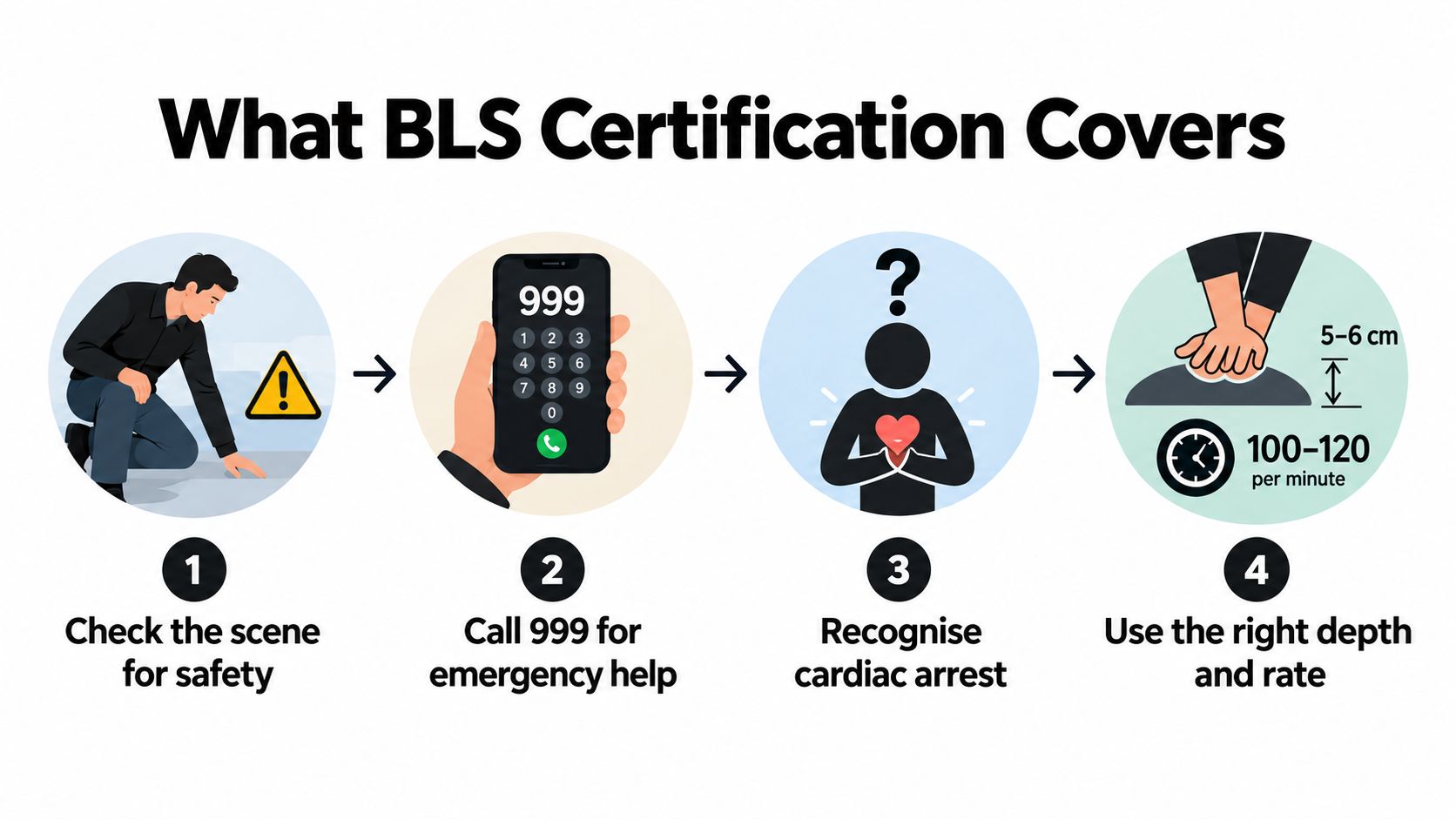
The breathing check deserves particular attention. Resuscitation Council UK's 2025 guidance treats agonal gasping, panting, and slow, laboured breathing as possible signs of cardiac arrest, and recommends compressions at 100–120 per minute, to a depth of 5–6 cm, with complete recoil. The full guidance is available in its adult basic life support recommendations.
Skills to look for in the practical assessment
For trained rescuers, the CPR cycle is 30 compressions followed by 2 rescue breaths. Compression-only CPR is appropriate for someone who isn't trained or can't deliver breaths. In either case, avoid leaning on the chest between compressions and keep pauses as short as possible.
An AED is designed to guide the rescuer with prompts. Training should still let you practise switching it on, attaching the pads, following its instructions, and returning to compressions promptly when directed. A written quiz can test your memory, but it can't establish that you can perform these actions under pressure.
A credible practical assessment should give you feedback on compression rate, depth, recoil, and interruptions. It should also check whether you recognise abnormal breathing, activate 999 promptly, and apply the AED without unnecessary delay. If a provider offers only an online module and a downloadable certificate, ask how your hands-on CPR and AED competence will be assessed before you enrol.
Prerequisites and Who Can Get Certified
BLS training is open to people entering care work as well as experienced staff. You don't need to be a clinician to learn the basic response, and a previous first-aid qualification isn't a universal prerequisite. The employer's own policy still matters, especially if the role involves clinical responsibilities or regular contact with children.
The practical training is physical. You'll need to practise compressions on a manikin, usually kneeling or positioned close to the floor, and may be asked to demonstrate rescue breaths. If a health condition or mobility limitation affects how you can take part, contact the provider before booking. They can explain the assessment format and discuss what adjustments are possible without assuming that a knowledge test alone will satisfy the employer.
A sensible training pathway
Start by checking the role and the people you'll support. Adult-focused training may suit a role serving adults, while work involving children may require paediatric content as well. NHS clinical roles can have more specific requirements than social-care posts, so ask your manager, recruiter, or compliance team what evidence they accept before choosing a course.
The training should move from explanation to practice. You learn how to assess the situation and recognise possible cardiac arrest, then practise calling for help, CPR, and AED use. The provider should assess what you do, not only what you can recall on a screen.
Care settings may also expect other role-specific learning alongside BLS. That doesn't make every additional module a prerequisite for BLS itself; it means your onboarding requirements depend on the job. Get the employer's course list in writing, especially if you're joining an agency or moving between adult and paediatric settings.
Choosing Your Course Format in the UK
Online-only convenience is appealing, but it isn't proof that your employer will accept the training. NHS guidance says online-only evidence of CPR isn't acceptable for relevant clinical trainees; updates must be hands-on and face-to-face, with CPR and AED competence demonstrated every calendar year, as set out in the Bristol GP training guidance on CPR and AED requirements. That requirement applies to the relevant clinical trainees described in the guidance, so don't assume it sets the rule for every social-care role. Do ask your employer whether it follows a similar standard.
Compare the formats against your employer's rules
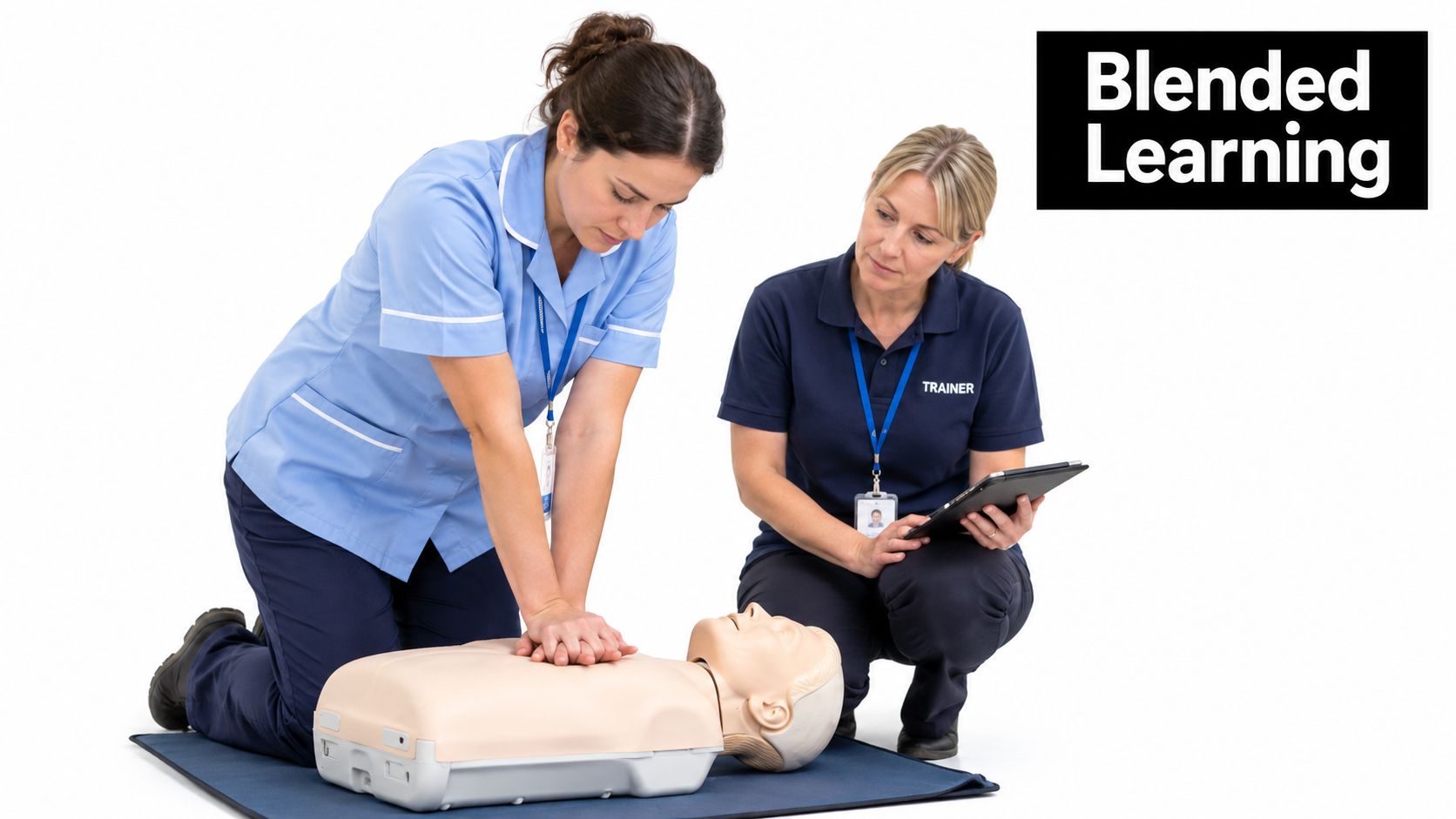
A blended course lets you complete theory online and practise skills face to face. It can suit workers who need scheduling flexibility, provided the practical assessment is included and accepted by their employer. A classroom course puts the explanation and practical work together with an instructor present. An annual refresher focuses on refreshing and demonstrating skills, rather than relying on an old course record.
Don't mistake a PDF for proof of practical competence. Save your certificate, but also keep any dated practical assessment record or competency statement your provider issues. If an agency's compliance system asks for evidence, a clear record of hands-on assessment makes it easier for the reviewer to see what you demonstrated.
The distinction between emergency training for care work and other first-aid interests matters, too. Someone preparing for outdoor activities might explore wilderness first aid courses, but that training isn't automatically a substitute for the care employer's required BLS evidence. If you're comparing workplace first-aid options, first check how a first aid at work course differs from the BLS requirement in your role.
Some courses use video to explain the practical sequence. Treat a video as preparation, not a replacement for assessed practice.
Booking, Assessment and What Employers Want to See
Before booking, ask the provider and employer the same practical question: Will this course's assessment and evidence meet the requirements for my role? That matters more than whether the course title sounds thorough. Once you have an answer, check that the course includes hands-on CPR and AED practice and that you'll receive documentation identifying what you completed.
Your evidence pack should make a coordinator's check straightforward. Keep the dated certificate, training provider's name, course learning outcomes, and any statement showing that you passed the practical assessment. If the employer requires a current competency check, keep that evidence too. Store the documents together in a place you can access when applying for shifts, rather than searching through old emails each time.
Settings compared for BLS evidence
| Setting | Accepted BLS Evidence | Typical Refresh Cycle |
|---|---|---|
| Adult social care | Employer-approved adult BLS course, certificate, and any required practical assessment record | Follow the employer's policy; ask whether a hands-on refresher is required |
| Paediatric-facing care | Evidence that the employer accepts for the setting, including any required paediatric content | Confirm the organisation's specific schedule |
| Agency or bank work | Documents that the agency can verify, including course details and practical evidence where requested | Check the agency's rules and each placement's requirements |
| Relevant NHS clinical training | Face-to-face CPR and AED competence evidence, with annual demonstration as stated in the applicable guidance | Every calendar year under the cited NHS guidance |
The table is a starting point, not a promise that one certificate will be accepted everywhere. Requirements can differ between employers and roles, even when the training covers similar skills. For a clearer picture of wider onboarding standards, review the Care Certificate overview alongside the BLS requirements your employer gives you.
A certificate is useful evidence. A dated record of what you demonstrated is stronger evidence when an employer is checking current competence.
Costs, Bundles and Subscription Models Worth Considering
Compare the full cost and usefulness of each option, not just the price on the booking page. A one-off course may suit someone who needs a particular qualification and has confirmed that the employer accepts it. A bundle can make sense if it combines several relevant modules, but only if you need them and the training meets the required format.
A subscription offers a different kind of value: ongoing access to training and refreshers, rather than a single booking. Cura Academy offers a membership for £10 per month, with access to care training that includes the Care Certificate standards, mandatory refreshers, and role-specific learning such as Basic Life Support and Dementia Awareness. Learners can also choose curated one-off bundles. Check the course details and your employer's acceptance criteria before treating membership access as a substitute for a hands-on assessment.
Choose around your work pattern
If you're new to care, a joined-up training route can help you build an onboarding profile without booking each course in isolation. If you already hold most mandatory training, a one-off BLS refresher may be more appropriate. Either way, don't pay for a package until you know whether it covers the course format, assessment, and documentation your employer expects.
Regular hands-on practice is more than a paperwork preference. Resuscitation Council UK reports bystander CPR rates of 72.6% in England, 64.3% in Wales, 62.6% in Scotland, and 41.5% in Northern Ireland, as reported in its cardiac arrest epidemiology guidance. Those differences reinforce why employers should take practical readiness seriously, rather than treating a training record as the whole story.
A subscription can make training access and record-keeping easier if you use it to keep relevant learning current. It can't override an employer's rules or replace a required face-to-face assessment. Confirm those details first, then compare the subscription, bundle, and one-off route against the training you need.
Passing the Practical and Staying Certified Year After Year
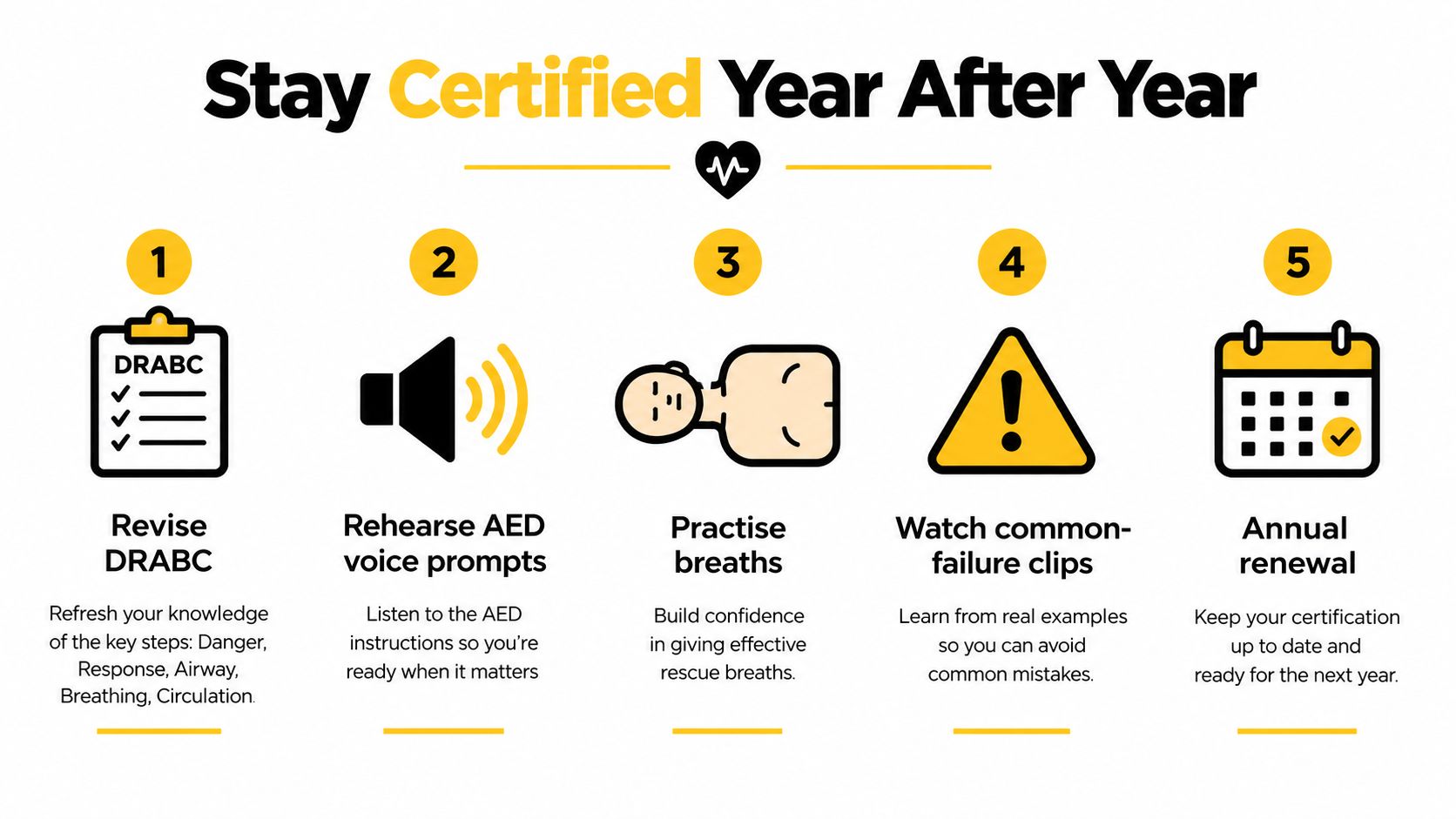
Prepare for the assessment by practising the sequence, not by trying to memorise isolated facts. Start with DRABC: danger, response, airway, breathing, and circulation. Follow your course's current instructions for assessment and CPR, and rehearse how you'll call 999, begin compressions, and bring an AED into the response.
Use a practical readiness checklist
- Revise the sequence: Practise the assessment steps in the order taught by your provider.
- Rehearse AED prompts: Familiarise yourself with the device instructions and practise acting on them without delaying CPR.
- Practise on a manikin: Ask for feedback on compression depth, rate, recoil, and any pauses.
- Correct common errors: Watch for leaning on the chest, shallow compressions, long interruptions, and delayed AED use.
- Put refreshers in your calendar: Book the next practical update according to your employer's requirements, not just the expiry date on the certificate.
A short self-drill between courses can help you remember the sequence, but it doesn't replace assessed, hands-on training where your employer requires it. Keep your evidence together and check it before applying for a shift. If your record doesn't show a recent practical assessment, ask your provider or manager what update is needed.
Care workers who want to understand how BLS fits into a wider workplace response can also review these emergency response procedures for senior care. Use them as context for discussing emergency roles and escalation with your employer, not as a substitute for local procedures or approved skills training.
Cura Academy offers care training that includes Basic Life Support, mandatory refreshers, and role-specific courses, with membership access and one-off bundles available. Check your employer's practical assessment requirements, then visit Cura Academy to explore training options and organise your learning records.