
A Saturday lunch service is already under pressure. A cook lifts a chicken portion from hot holding, notices that the unit has drifted below the required temperature, and finds that nobody recorded a probe check. The meal may still look and smell normal, but appearance can't tell the team whether the food is safe for a resident.
Care-home residents may be older or have reduced immune resilience, so a control failure can carry more serious consequences than it would for a healthy adult. The practical question isn't just whether staff know the word HACCP. It's whether everyone understands which step is a critical control point, what limit applies, who must check it, and what happens when the reading is outside that limit.
The UK Food Standards Agency recorded pathogenic micro-organisms, allergens, and poor or insufficient controls among the leading incident hazard types in 2024/25. Poor or insufficient controls rose from 136 incidents to 198, a 45% year-on-year increase, according to the FSA annual report on incidents, resilience and prevention. That makes reliable day-to-day control more important than a tidy HACCP folder.
This guide gives care-sector readers the decision logic to identify a CCP, separate it from an ordinary control step, monitor it properly, and record evidence without guessing.
Table of Contents
- Why Care Kitchens Cannot Afford to Guess on Food Safety
- Defining a Critical Control Point in HACCP Terms
- How to Tell If a Step Is Really a CCP
- CCP vs General Control Point at a Glance
- Monitoring, Limits and Corrective Actions in Practice
- Why CCP Discipline Matters More Than Ever in 2026
- Applying CCPs in Care-Sector Kitchens
- Common Misconceptions and Your CCP Next Steps
Why Care Kitchens Cannot Afford to Guess on Food Safety
A care kitchen doesn't have the luxury of treating food safety as a paperwork exercise. The cook, kitchen assistant, care worker, and manager all influence whether a hazard is controlled before food reaches a resident. If one person assumes someone else took the temperature, the process may appear organised while the critical evidence is missing.
The first response to an out-of-limit reading should be practical, not defensive. Stop the affected food from being served, tell the responsible senior person, establish what happened, and follow the corrective action written into the local food safety management system. A recorded problem that is acted on is safer than an unrecorded problem hidden by routine.
Practical rule: If a control matters enough to protect a resident, it matters enough to be assigned to a named person and recorded at the time.
The Food Standards Agency's UK guidance explains that HACCP systems require businesses to identify CCPs, set critical limits, monitor them, take corrective action when controls fail, and keep records showing that the system works. The official HACCP guidance places CCP identification at the centre of a measurable and auditable food safety system.
For a care-sector learner, the useful sequence is straightforward:
- Identify the hazard: Decide what could make the food unsafe at each process step.
- Find the decisive step: Establish where control must be applied because the hazard won't reliably be removed later.
- Set the boundary: Use a measurable critical limit, such as a temperature or time.
- Check and act: Monitor the point, respond to a failure, verify the system, and retain the record.
The rest of the article applies that sequence to cooking, cooling, chilled storage, hot holding, allergens, and service. The aim is not to label every task a CCP. The aim is to identify the few steps where losing control could leave a serious hazard in the food.
Defining a Critical Control Point in HACCP Terms
A care kitchen may check deliveries, clean benches, wash hands, and record fridge temperatures every day. Those tasks all support safe food, but they do not all carry the same decision. A critical control point, or CCP, is the particular step where control must prevent, eliminate, or reduce a food safety hazard to an acceptable level. If that step fails, a later stage will not reliably make the food safe.
HACCP organises this decision through seven principles:
- Conduct a hazard analysis.
- Determine the critical control points.
- Establish critical limits.
- Establish monitoring procedures.
- Establish corrective actions.
- Establish verification procedures.
- Establish documentation and record-keeping procedures.
The UK's official MyHACCP guidance places CCP determination in principle 2. The sequence works like a chain. Hazard analysis identifies what could go wrong, CCP determination identifies where control must hold, and the remaining principles show whether that control is working.
CCPs are not the same as good hygiene practice
Cleaning schedules, pest control, supplier approval, equipment maintenance, hand hygiene, and staff training are prerequisite programmes. They create the basic conditions for safe food handling and reduce contamination risks throughout the kitchen. Their importance does not automatically make each one a CCP.
A poultry cooking step can be a CCP when the process is designed to reduce a biological hazard and the care-kitchen example uses a measurable core temperature of 75°C. Chilled storage can also be a CCP when the food safety plan depends on a defined range of 0°C to 8°C to control chilled-food risk. The UK food safety management systems guidance describes the controls that must sit around a CCP, including critical limits, monitoring, corrective action, verification, and records.
A surface-cleaning task remains important, yet it usually manages the kitchen environment rather than providing the final measurable barrier for one significant hazard in a specific food. Records then provide evidence that the control was checked and that a failure received an appropriate response. Cura Academy's guide to HACCP Principle 7 and food safety documentation explains this documentation role.
The practical test is simple: is this the point where control must be achieved, and can the team measure whether it has been achieved? That question connects the formal HACCP definition with the judgement staff make during real food preparation.
How to Tell If a Step Is Really a CCP
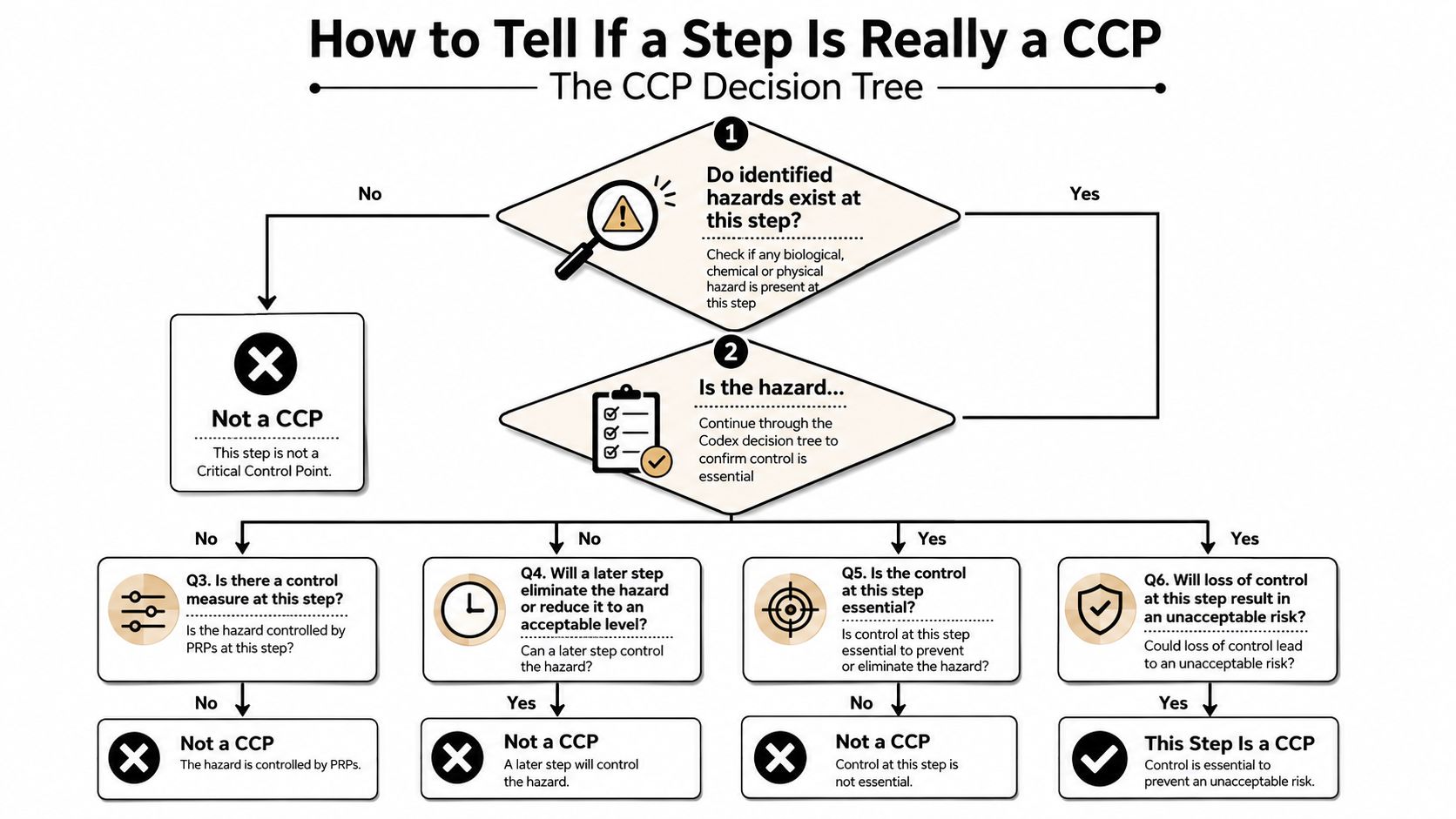
Use a decision tree rather than instinct. Apply the questions to each significant hazard at each stage of the food flow, from delivery through service.
Start with three practical questions
Question 1: Is there an identified hazard at this step?
If no biological, chemical, or physical hazard is present at that point, the step isn't a CCP. Do not promote a routine task into a CCP just because staff perform it regularly.
Question 2: Is the hazard significant enough to cause illness or injury?
Consider the food, the process, and the people eating it. A hazard that might be manageable for the general population may require more careful control where food is served to residents with greater vulnerability.
Question 3: Is this the step that controls the hazard, with a measurable limit?
The step qualifies only when it prevents, eliminates, or reduces the hazard to an acceptable level, and the team can measure the boundary between acceptable and unacceptable control. If a later process reliably removes the hazard, that later process may be the CCP instead.
The FSA MyHACCP guidance on determining CCPs uses decision-tree logic to test whether a step is specifically designed to control a hazard and whether a later step will remove it.
Three care-kitchen examples
Cooking poultry. Raw poultry may carry pathogens such as Salmonella or Campylobacter. Cooking is a CCP when the kitchen relies on the cook to reduce that hazard, and the plan sets a measurable core temperature of 75°C. If the reading isn't achieved, the food must not move forward as though the control worked.
Cooling a cooked dish. A cooked dish cooled from 70°C to below 8°C within 90 minutes can be treated as a CCP where the process depends on rapid cooling to control microbial growth and possible toxin formation. Both time and temperature matter. A dish that reaches the target temperature too slowly hasn't met the full control requirement.
Washing salad leaves. Washing can reduce contamination, but it doesn't necessarily eliminate the risk of Listeria. Where washing is part of general hygiene and the hazard isn't fully controlled at that step, it may remain a prerequisite control rather than a CCP.
A process can have more than one CCP for the same hazard, and one step can control several hazards. The decision must follow the actual menu, equipment, ingredients, process, and resident risk profile. A generic template won't make that decision for you.
CCP vs General Control Point at a Glance
A general control point supports safe operations but doesn't carry the same role as a CCP. It may reduce the chance of contamination, maintain hygiene, or protect food quality. A CCP is the specific point at which a significant food safety hazard must be controlled to an acceptable level.
| Feature | Critical Control Point, CCP | General Control Point |
|---|---|---|
| Purpose | Controls a significant hazard at the decisive stage, such as cooking poultry | Supports general hygiene, such as cleaning a preparation surface |
| Hazard addressed | A defined biological, chemical, or physical hazard | Wider contamination or operational risks |
| Critical limit | Requires a measurable limit, such as a 75°C core temperature or a chilled range of 0°C to 8°C | May use a cleaning standard, checklist, or work instruction rather than a CCP limit |
| Monitoring | Scheduled checks tied to the limit, method, time, and responsible person | Routine supervision or completion checks |
| Corrective action | A defined response is required when the limit is breached, including assessment of affected food | Staff correct the task or condition under the relevant procedure |
| Verification | The system and records need review to confirm that the CCP works | Supervisors check that the supporting programme is followed |
| Failure outcome | Food may need to be held, assessed, reprocessed, or discarded because the hazard may remain | The kitchen may need to clean, retrain, repair, or repeat the task |
Wiping a prep surface every 30 minutes can be an important operational control, but it isn't automatically a CCP. If the cleaning activity manages the general kitchen environment rather than providing the decisive control for a significant hazard in a particular food, it belongs in the prerequisite programme.
The practical consequence is that a CCP record must show more than a tick. It should show the actual result, when it was checked, who checked it, and what happened if the result fell outside the limit. UK guidance links CCPs to monitoring, corrective action, verification, and documentation, making the distinction important for inspections and internal accountability.
Monitoring, Limits and Corrective Actions in Practice
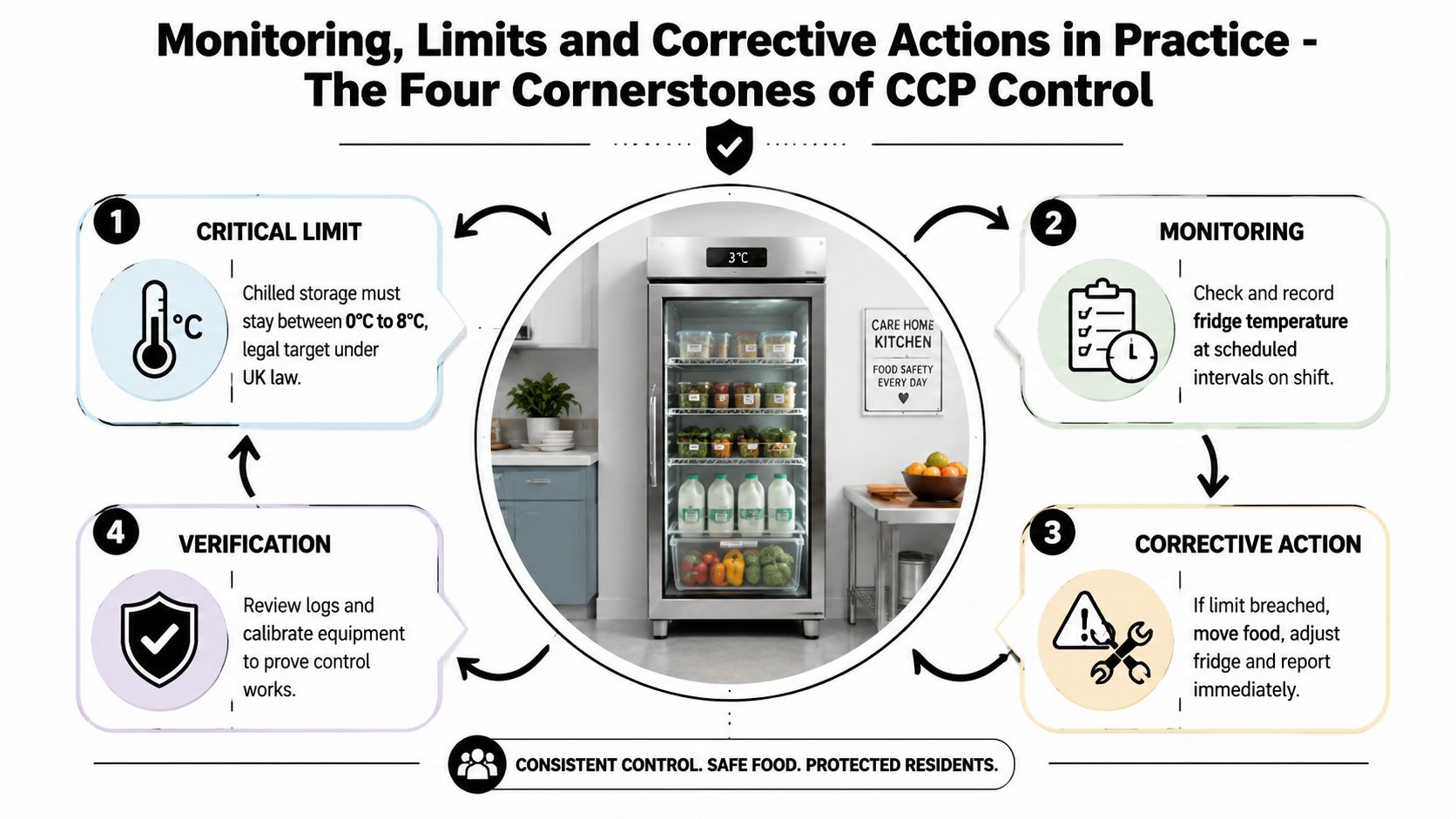
Take a care-home refrigerator. The unit protects chilled food between delivery and preparation, so the HACCP plan may define its critical limit as 0°C to 8°C. UK local-authority guidance gives this range as a practical benchmark and also emphasises routine checks, corrective actions, and calibrated probe thermometers in its HACCP guidance for food businesses.
The four parts of control
Critical limit. Write the boundary clearly. “Keep the fridge cold” isn't a critical limit. “Maintain chilled storage between 0°C and 8°C” gives staff a result they can compare with a reading.
Monitoring. Check the unit at scheduled times, such as at the start and end of the relevant shifts, according to the local HACCP plan. Record the actual temperature, the time, and the initials of the person who took the reading. If an in-built display is used, the plan should explain how staff confirm that it remains reliable, including comparison with a calibrated probe where appropriate.
Corrective action. An out-of-range result requires action, not just a note in the margin. Staff may need to move stock to a working fridge, identify the affected food, report the fault, and assess whether food has been held above 8°C for more than four hours before deciding whether it can be used. Unsafe items must be discarded, and the unit must be restored to below 8°C before it returns to service.
Verification. Monitoring asks, “Is the fridge within its limit now?” Verification asks, “Does the whole control system work?” This can include weekly probe calibration and monthly management review of temperature records where that schedule forms part of the approved local plan.
A strong record doesn't hide a deviation. It shows the original reading, the decision taken, the food affected, the person notified, and the action that restored control. That evidence helps a manager identify repeated equipment faults or missed checks before they become a resident-safety incident.
The same logic applies to cooking, cooling, hot holding, allergen controls, and other CCPs. The limit must be measurable, the monitoring method must be realistic during service, and the corrective action must be specific enough for a trained worker to follow without improvising.
For care workers who also need broader infection-prevention knowledge, infection control training for care settings can complement the food safety procedures used in the kitchen.
Why CCP Discipline Matters More Than Ever in 2026
A care kitchen can have a written HACCP plan and trained staff, yet still lose control during a busy service. A missing probe, unclear allergen label, or fridge fault left out of the handover can turn a planned control into an unsafe gap.
The current UK incident picture reinforces that identifying a CCP is only the starting point. The Food Standards Agency's 2024/25 annual incident report listed 436 incidents involving pathogenic micro-organisms, 264 involving allergens, 133 involving residues of veterinary medicinal products, and 198 involving poor or insufficient controls. These figures are reported in the FSA annual report for 2024/25.
The figures do not show that every incident came from a care home or from a missed CCP. They do show why care providers need controls that staff can follow under pressure. A CCP is like a checkpoint on a journey. If nobody checks the result, records it, or knows what to do when it falls outside the limit, the checkpoint provides little protection.
Turning incident categories into priorities
Pathogenic micro-organisms make dependable cooking, cooling, chilled storage, and hot holding important control areas. The responsible person must know the relevant critical limit and understand that a visual check cannot replace measurement when the HACCP plan requires one.
Allergens require accurate ingredient information, separation, labelling, and clear communication between kitchen and care staff. Control may depend on several connected tasks, so the HACCP study must identify the point where control is necessary and explain how staff will confirm it.
Poor or insufficient controls highlight the difference between having a procedure and carrying it out. The FSA reported that this category rose from 136 to 198 incidents, a 45% increase year on year. For care kitchens, that finding supports a practical priority: test whether the process still works during deliveries, staff changes, rushed service, and handovers.
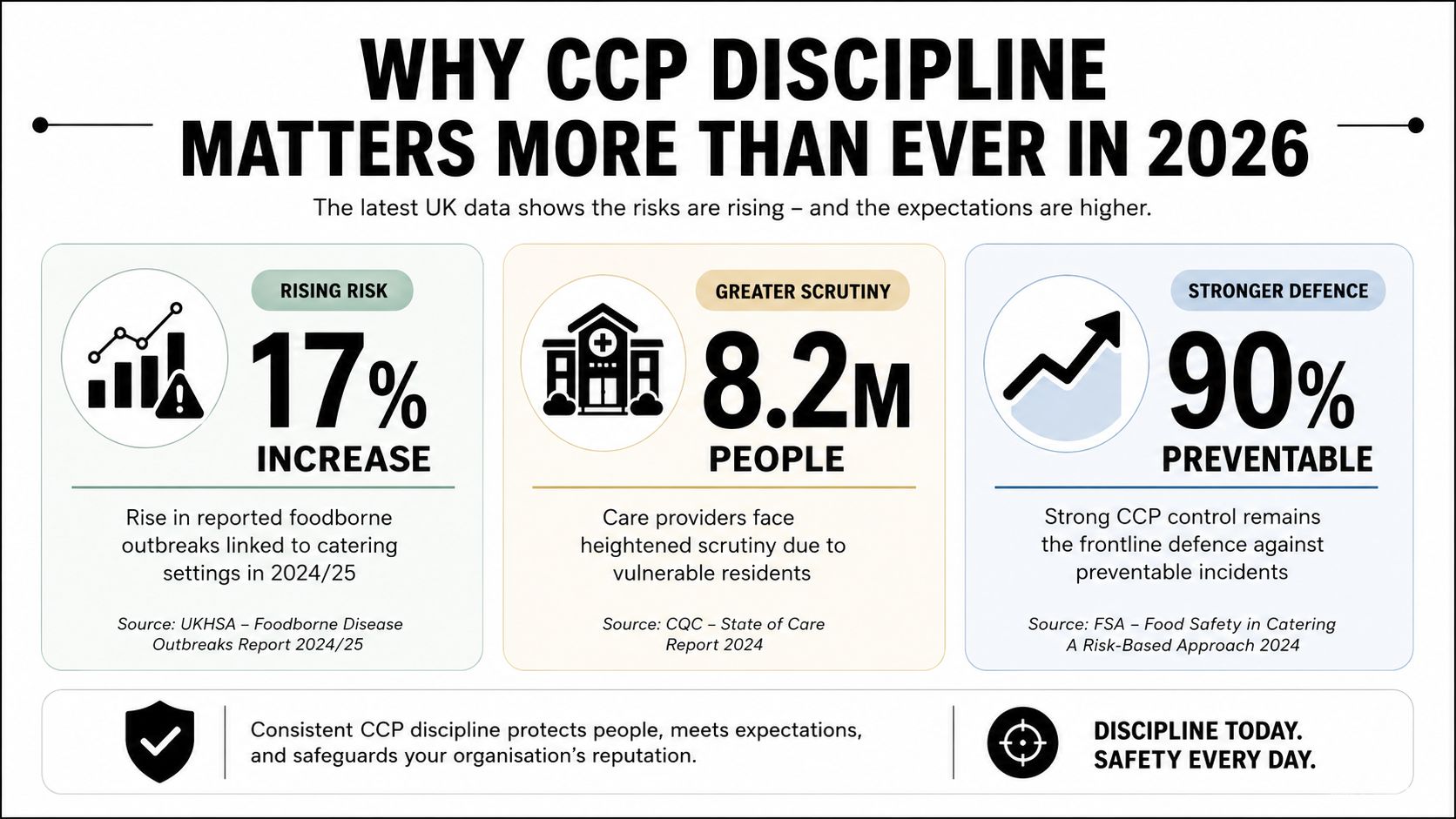
Residents in care settings may face more severe consequences from foodborne illness. Consistent CCP discipline therefore protects people as well as supporting legal compliance. It gives staff a defined decision before an uncertain meal reaches someone least able to cope with the harm.
Applying CCPs in Care-Sector Kitchens
A HACCP plan becomes useful when each worker can connect a task to a hazard, a limit, and an action. Responsibility can be shared, but accountability must stay clear.
At receiving, the nominated worker checks delivery condition, labelling, packaging, and chilled products against the site procedure. Damaged, warm, unlabelled, or otherwise questionable items should be isolated and reported rather than accepted because the delivery is busy.
At preparation, cooks and kitchen assistants follow separation rules for raw and ready-to-eat food, use clean equipment, and prevent allergen cross-contact. Not every preparation task is a CCP, but every task still needs to follow the prerequisite programmes that make the CCPs reliable.
At cooking and cooling, the cook takes the required measurements and records the actual results. At service, care staff confirm the correct meal and any required allergen information, protect food from contamination, and report anything that doesn't match the resident's dietary instructions.
A shift-ready responsibility check
- Receiving staff: Check delivery condition, temperatures where required by the local plan, dates, packaging, and labels. Escalate concerns before stock enters general storage.
- Cooks: Follow the approved recipe and process, measure CCP limits, and stop food moving forward when a required result hasn't been achieved.
- Care staff: Match meals to residents, follow allergy and texture instructions, and report service problems immediately.
- Managers: Review records, investigate deviations, maintain equipment, examine complaints and incidents, and keep the HACCP documentation current.
A shift handover should mention unresolved faults, food placed on hold, corrective action still in progress, and any change to the menu or resident risk. A temperature reading is not a safety control if nobody acts on it. The person responsible must know where the affected food is, whether it can be used, and who must approve the decision.
Training should use the local flow diagram, actual equipment, and real records. Ask a worker to explain the critical limit and demonstrate the response to a breach. Attendance proves that someone attended training. Observation helps confirm that they can apply the control during service.
Managers should also check that probes are calibrated, labels are legible, high-risk foods are protected from unauthorised handling, and records are completed at the time rather than retrospectively. Guidance on identifying food-related risks in the working environment is available in this hazard-focused kitchen resource.
Common Misconceptions and Your CCP Next Steps
A care kitchen may have many safety checks, but only some are critical control points. A cleaning schedule, hygiene rule, or inspection can support safe food without being a CCP. The deciding question is whether control at that step is needed to prevent, eliminate, or reduce a recognised hazard to an acceptable level.
Labelling every task as critical creates paperwork and can hide the controls that protect residents. Labelling too few steps creates a different risk: a serious hazard may remain in a general procedure with no measurable limit or agreed response. The label should follow the decision logic, not the importance of the task in general.
A temperature reading is only one part of the system. The HACCP plan must state the critical limit, how staff monitor it, who is responsible, what happens after a breach, how the control is verified, and which record provides evidence. Without that information, a worker may record a result but still be unable to decide whether food can proceed.
A practical review checklist
Use the HACCP study and process flow diagram to examine each step:
- Hazard: Which biological, chemical, or physical hazard has been identified?
- Significance: Could it cause illness or injury, especially for the residents served?
- Control: Does this step prevent, eliminate, or reduce that hazard?
- Later protection: Will a later step reliably deal with it?
- Measurement: Can staff check a clear critical limit?
- Response: Is the corrective action specific and achievable?
- Evidence: Are monitoring and verification records retained?
Review the plan after a menu or supplier change, equipment replacement, staffing change, or alteration in residents' needs. Ask workers to explain the limit and response without searching through a folder. The free HACCP guidance mentioned earlier can help teams apply HACCP principles and identify CCPs. Complex hazards should be reviewed with a competent food-safety professional.
Cura Academy offers care-sector training that helps workers build practical compliance knowledge alongside local food safety procedures. Visit Cura Academy to explore training options for care workers, mandatory learning, and role-specific skills that support safer daily practice.