

You've just started a shift in a care home. After lunch, a resident collapses in the lounge. You check whether she responds, ask a colleague to call 999, and begin chest compressions while another colleague brings the defibrillator. You don't need to be a doctor to help, but you do need to know what to do, in what order, and how to perform each action safely.
That's the practical answer to what is basic life support training. It's hands-on instruction that prepares you to recognise a life-threatening emergency, maintain circulation and breathing, use an automated external defibrillator, and protect the airway until emergency services take over. For UK care workers, BLS is also connected to workplace competence, mandatory training records, and the expectations of employers and regulators.
Table of Contents
- What Basic Life Support Training Actually Means for UK Care Workers
- The Four Core Skills You Will Learn on a BLS Course
- Course Format, Duration, Assessment and Certification in the UK
- Why BLS Training Matters for Care Compliance and CQC Standards
- 2025 UK Guideline Updates and Common Misconceptions
- Refresher Frequency and How Cura Academy Fits In
- FAQs for Care Workers Starting Basic Life Support Training
What Basic Life Support Training Actually Means for UK Care Workers
Basic life support training teaches the immediate actions that can keep someone alive during cardiac arrest or another sudden collapse. In a care setting, you'll practise checking safety, assessing responsiveness, calling 999, starting CPR, using an AED, and managing an unresponsive person who's breathing normally.
The sequence matters because a collapsed resident may deteriorate quickly. You might need to use speakerphone so the emergency call handler can guide you, direct a colleague to bring the defibrillator, and keep working while someone else gathers the person's relevant information. Training turns those actions into a coordinated response rather than a moment of uncertainty.
What the course prepares you to recognise
A BLS course normally covers adult emergencies and, where relevant to your role, children and infants. You'll learn to distinguish normal breathing from abnormal breathing, recognise when someone is unresponsive, and understand when CPR must begin.
For an adult, UK guidance focuses on high-quality compressions and rescue breaths. You'll practise the physical technique on a manikin, including hand placement, compression depth, rhythm, recoil, and how to minimise pauses.
You'll also learn how to position an unresponsive person who's breathing normally. The recovery position helps keep the airway open while you monitor the person and wait for paramedics.
Practical rule: Don't wait for perfect confidence. Make the safety check, get help, call 999, and follow the operator's instructions while starting the appropriate response.
Why this is part of care work
The NHS Core Skills Training Framework treats resuscitation training as part of statutory and mandatory training requirements. One NHS resource describes Basic Life Support as meeting the learning outcomes for Resuscitation Level 1, while NHS organisations may set more demanding requirements for clinical staff.
That framework reflects the nature of care work. A support worker may be the person closest to a resident when an emergency begins, long before ambulance crews arrive. BLS training gives you a repeatable method for those first critical minutes and supports the wider duty to provide safe, competent care.
The Resuscitation Council UK guidance also makes clear that an AED should be used as soon as it's available, and that anyone can use one because no training is required to operate it. Formal practice still matters, because a trained care worker is more likely to recognise the device, attach the pads correctly, follow its prompts, and communicate clearly with colleagues.
The Four Core Skills You Will Learn on a BLS Course
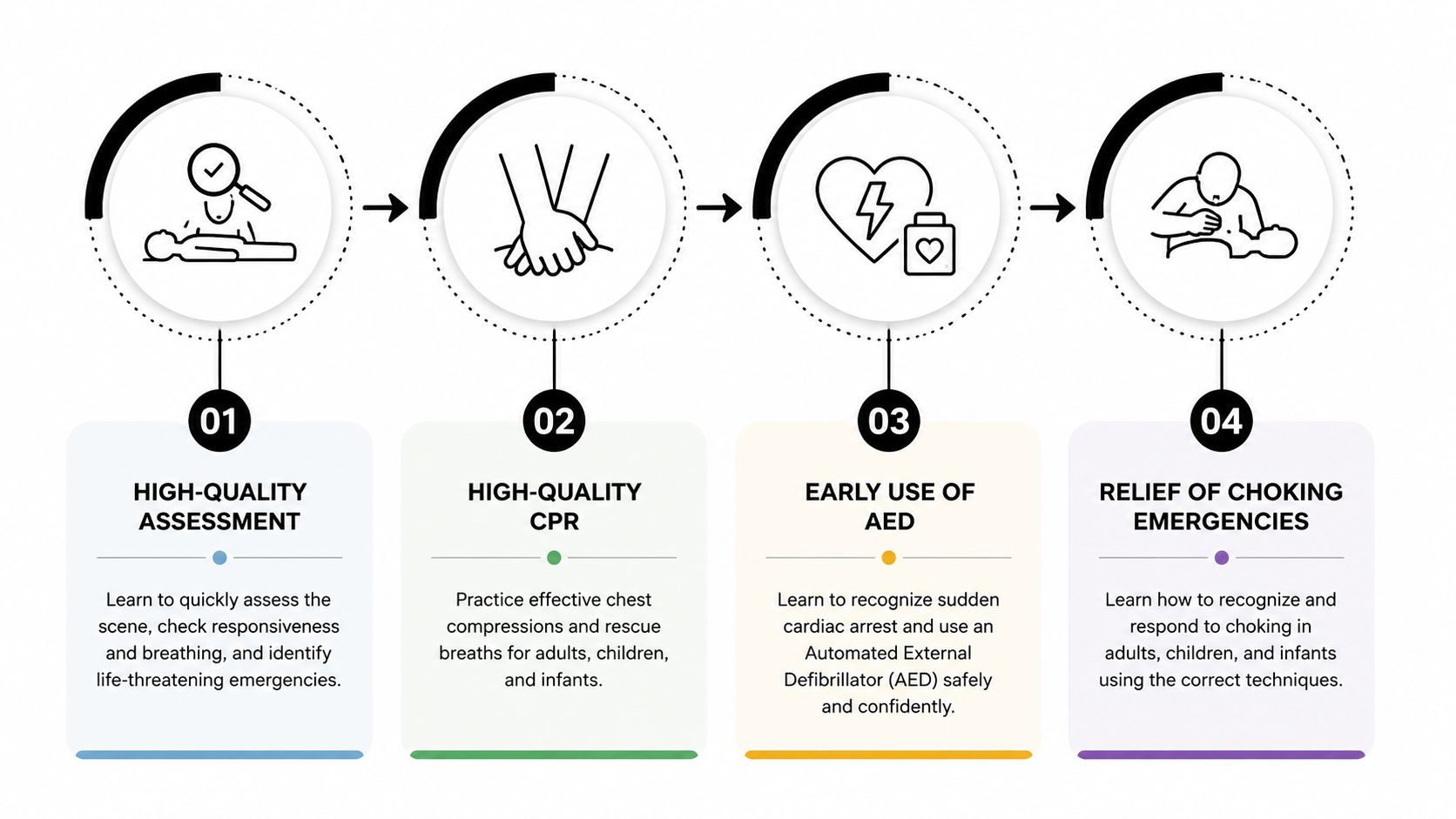
A UK BLS course is built around practical decisions, not memorising medical theory. You'll learn four connected skills: CPR, AED use, the recovery position, and choking management. Each one addresses a different emergency that could occur in a lounge, bedroom, dining area, day centre, or supported-living service.
CPR for an unresponsive adult
Start by checking that the area is safe, then check whether the person responds. Under the Resuscitation Council UK adult Basic Life Support guidance, a lay rescuer should call 999 immediately for an unresponsive person, using speakerphone where possible, and follow the call handler's instructions.
If breathing is abnormal, begin CPR. The adult sequence is 30 chest compressions followed by 2 rescue breaths. Press in the centre of the chest at 100 to 120 compressions per minute, to a depth of 5 cm to no more than 6 cm, allowing the chest to recoil fully after each compression. Keep interruptions as short as possible.
In a care home, this might mean one worker performs compressions beside a resident's chair while another calls 999 and a third clears space for the ambulance team.
AED use during cardiac arrest
Ask someone to bring the AED as soon as possible. Switch it on, expose the chest, attach the pads according to the diagrams, and follow the spoken instructions. Everyone must stand clear while the device analyses the rhythm and, if advised, delivers a shock.
You don't need to diagnose the heart rhythm yourself. The AED provides prompts, but your role is to listen, act promptly, and resume compressions when instructed.
The recovery position
If an unresponsive person is breathing normally, place them in the recovery position and keep monitoring them while waiting for help. The position supports the airway and allows fluids to drain from the mouth rather than obstructing breathing.
For example, a resident may be found on the floor after a faint but continue breathing normally. You still need to call 999, observe changes in breathing, and be ready to begin CPR if their condition changes.
Responding to choking
For mild airway obstruction, encourage the person to cough. If the obstruction becomes severe, give up to five back blows, checking after each one, followed by up to five abdominal thrusts if the back blows haven't worked. Continue alternating the responses and call 999 if the obstruction doesn't clear.
If the person becomes unresponsive, lower them safely to the floor and start CPR. A choking incident in a dining room can become a cardiac arrest emergency, so staff must know when to move from first aid actions to resuscitation.
Course Format, Duration, Assessment and Certification in the UK
A BLS course should match the care worker's responsibilities. NHS examples include a 30-minute non-clinical Basic Life Support Level 1 module and a three-hour course for first responders. The difference reflects the practical skills and decisions expected from each role, rather than a single course being suitable for everyone.
For a care worker, the useful test is what the course lets you do under pressure. A face-to-face session may combine demonstrations, manikin practice, scenarios, AED handling, and coaching on technique. Blended learning can place the theory online before a practical assessment, but check that your employer accepts this format and that it meets the requirements of your role.
Comparing the main formats
| Format | Duration | Assessment |
|---|---|---|
| Online theory module | Short and self-paced, depending on the provider | Knowledge checks or quiz, with no substitute for hands-on competence where required |
| Face-to-face practical session | Can range from a short staff module to a three-hour first-responder course | Trainer observes CPR, AED use, recovery position, and other required skills |
| Blended learning | Online theory followed by a practical appointment | Online knowledge assessment plus supervised demonstration |
The NHS Basic Life Support course information shows why the course level matters before booking. A module designed for a non-clinical worker may not provide the supervised practice expected in a patient-facing or regulated role. Public CPR awareness can help someone recognise an emergency, while workplace competence also requires controlled practice, communication, and evidence of assessment.
What assessment looks like
A trainer normally watches you perform the skills required for your course and corrects errors as they occur. Feedback may cover hand position, compression depth and rate, full chest recoil, rescue breaths, AED pad placement, and safe communication with colleagues. This turns guidance into a repeatable response, rather than relying on memory from a video.
Your certificate should identify you, the training provider, completion date, course content or level, and renewal information. Store it with your wider training record so your employer can confirm that the learning is current and appropriate to your duties.
Before enrolling, check the practical arrangements, employer acceptance, alignment with current Resuscitation Council UK guidance, and how competence is confirmed. Cura Academy's guide to choosing a Basic Life Support course online discusses these points for UK learners.
Why BLS Training Matters for Care Compliance and CQC Standards
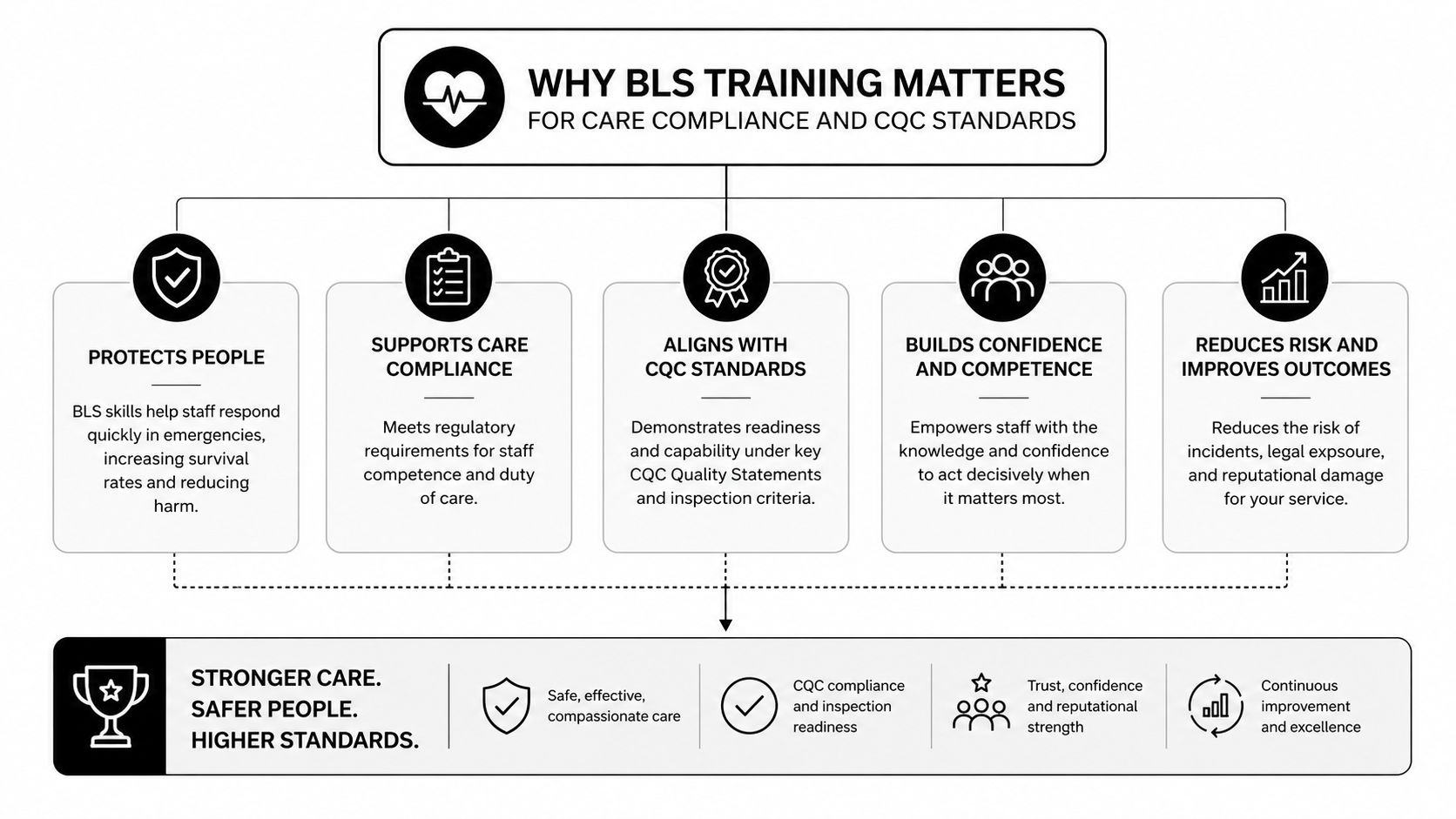
BLS training matters because care providers must show that staff can respond safely when a service user becomes seriously unwell. The requirement isn't satisfied because a worker once watched a CPR video. Managers need a clear training pathway, appropriate assessment, and records that demonstrate competence for the person's role.
The NHS Core Skills Training Framework places resuscitation within mandatory training expectations, with learning outcomes that organisations can use to structure induction and refresher programmes. NHS organisations may set annual requirements for clinical staff, and care providers often align their own systems with the needs of patient-facing and regulated roles.
How compliance becomes practical
A provider's training records should help answer straightforward inspection questions:
- Role fit: Does the course match the worker's responsibilities and the people they support?
- Practical competence: Has the worker physically demonstrated CPR and AED skills where the role requires it?
- Renewal control: Can the manager identify upcoming refresher dates?
- Evidence storage: Can the service retrieve certificates and attendance records during supervision or inspection?
The Care Quality Commission training and compliance guidance provides wider context for how training evidence fits into a care service's compliance arrangements.
The worker's responsibility
Managers carry responsibility for systems and staffing, but individual workers also have a duty to act within their training and competence. If you discover a collapse, you should follow your employer's emergency procedure, contact 999 promptly, use available equipment, and communicate what you've done to the arriving professionals.
That doesn't mean you're expected to perform advanced treatment. BLS is about immediate, structured actions until help arrives. A documented course helps demonstrate that your employer provided relevant preparation and that you've engaged with the competence expected of your role.
2025 UK Guideline Updates and Common Misconceptions
The 2025 Resuscitation Council UK update changes the first action for lay rescuers dealing with an unresponsive person. Instead of waiting to confirm abnormal breathing before calling 999, the updated approach says to call 999 immediately for any unresponsive person. The Resuscitation Council UK states that the changes are being rolled out across training courses from January 2026, with organisations preparing during the following 12 months. See the Resuscitation Council UK announcement about the 2025 guidelines for the implementation context.
That change matters in care settings because staff may feel tempted to spend too long checking breathing or moving the person first. The safer training habit is to summon emergency help immediately, then follow the call handler's instructions while assessing breathing and starting the appropriate care.
Public CPR awareness isn't workplace competence
Anyone can learn CPR, and the Resuscitation Council UK confirms that anyone can use an AED. That public message removes fear around helping, but it doesn't automatically meet an employer's requirements for a regulated care role.
A care worker may need documented, hands-on demonstration of compressions and AED use. GP-facing compliance guidance describes annual face-to-face, hands-on BLS and AED training as an expectation for appraisal and CQC purposes. The UK guidance on how often to complete BLS training helps explain why an online awareness module and workplace competency assessment shouldn't be treated as interchangeable.
Other assumptions to question
- “I watched the video, so I'm competent.” Watching supports knowledge, but it doesn't prove that you can maintain correct depth, rate, recoil, or pad placement under pressure.
- “The recovery position is optional.” It's a core response for an unresponsive person who's breathing normally, not an extra topic.
- “Choking is separate from BLS.” Severe choking can progress to unresponsiveness, requiring a move to CPR.
- “An annual course makes practice unnecessary.” You still need to follow workplace procedures and use every supervised opportunity to correct technique.
Refresher Frequency and How Cura Academy Fits In
For many UK care roles, an annual practical BLS refresher is a sensible working standard. NHS organisations may also require clinical staff to complete training each year, but your employer's policy determines what applies to your post. Treat BLS renewal like servicing safety equipment. A planned check helps identify gaps before an emergency exposes them.
Some organisations require annual reassessment, while others set different intervals for practical refreshers and certification. Ask your manager which rule covers your role, service, commissioning arrangement, and local policy. Record the renewal date in your supervision or appraisal plan, and book training before the current evidence expires.
Why practice needs planning
BLS involves physical skills that can deteriorate without practice. You need to maintain the correct compression rate and depth, allow full recoil, give effective rescue breaths where required, and position AED pads accurately. A trainer can spot small technique problems and correct them before they become habits.
Keep a personal copy of your training evidence and tell your manager if you change employers. Your new workplace may need to verify the certificate or arrange an assessment under its own policy.
| Component | Cura Academy Online | Face-to-Face Practical |
|---|---|---|
| Guideline knowledge | Supports theory refreshers and knowledge checks | Explains relevant guidance during the session |
| CPR technique | Revisits the sequence and key thresholds | Manikin practice allows observation and correction |
| AED knowledge | Reviews device recognition and prompts | AED trainer supports supervised pad placement and operation |
| Evidence | Keeps course records or certificates under the provider's process | Records attendance and practical competency where assessed |
| Planning | Useful between practical sessions and when reviewing updates | Scheduled according to employer and role requirements |
Cura Academy includes BLS-related learning within its online care training. Use it to revisit knowledge between workplace training dates, then follow your employer's renewal process and keep the next practical assessment in your calendar. This approach helps prevent an expired certificate or missed refresher from becoming a compliance problem.
FAQs for Care Workers Starting Basic Life Support Training
Do I need clinical experience before taking BLS training?
No. BLS training is designed to teach the immediate response in plain, practical steps. You'll need to follow instructions, take part in manikin practice, and tell the trainer if you have a physical limitation that could affect kneeling, compressions, or rescue breaths.
How do I check whether a provider is suitable?
Ask whether the course follows current Resuscitation Council UK guidance and whether local employers accept the certificate. Check that the course level matches your role, particularly if you work directly with residents, patients, children, or adults with complex needs.
Also ask whether the assessment is hands-on. An online quiz may test recall, but your employer may require observed CPR and AED competence. Confirm what the certificate shows, how renewal is recorded, and whether the provider sends refresher reminders.
What happens on the day?
Wear comfortable clothing that allows you to kneel and move around a manikin. The trainer will usually demonstrate the skill, explain the reason for each action, and give you time to practise. You may work through scenarios involving a collapse, abnormal breathing, an AED, recovery position, or choking.
Assessment should be competency-based. The trainer isn't looking for trick answers. They're checking whether you can perform the required steps safely, respond to feedback, and repeat the technique to the expected standard.
Before you attend: Read your employer's emergency procedure, check whether you're expected to cover adults, children, or infants, and bring any previous certificate so the trainer can understand your learning history.
What if I'm nervous about performing CPR?
Nerves are normal, especially if you've never pressed down on a manikin before. Focus on the sequence rather than trying to predict every possible emergency. Tell the trainer that you're new, practise your hand position slowly, and ask for correction before increasing your pace.
How can I keep the skill fresh?
Review the course material, talk through the emergency sequence during supervision, and use workplace drills if they're available. Check where the AED is stored and learn how your service summons help, because knowing the local process reduces hesitation.
Record each course, refresher, and practical assessment in your personal training file. A clear record supports appraisal, helps you plan renewal, and makes it easier to show employers that your BLS competence is current.
Cura Academy provides online care training and BLS learning support for people preparing for or working in UK health and social care. Visit Cura Academy to review the available training options, then confirm with your employer whether you also need a face-to-face practical assessment.