
You've found a senior care assistant vacancy, but the application asks for training records, a DBS check and evidence of competence. You may understand the caring part of the job, yet still wonder whether you're ready to support medication, guide colleagues or take responsibility for a difficult shift. Employers make the same distinction: enthusiasm matters, but hire-ready evidence determines whether you can be safely placed on the rota.
A senior care assistant sits between frontline care delivery and formal management. The role rewards compassion, but it also demands accurate records, sound judgement, reliable communication and the confidence to escalate concerns. This guide focuses on what employers screen for, what training proves, and how to build a practical compliance profile that supports safe work from your first day.
Table of Contents
- What Does a Senior Care Assistant Actually Do
- Qualifications and Training Requirements
- How to Become a Senior Care Assistant
- Career Progression and Pay Expectations
- Tips for Applicants and Employers
- Common Myths About Care Assistant Roles
What Does a Senior Care Assistant Actually Do
A new applicant often imagines a shift as a series of friendly conversations and personal care tasks. In practice, the day starts with a handover, checking changes in residents' needs, reviewing appointments or risks and confirming that the team understands its priorities. You may help someone wash and dress, support breakfast, assist with mobility, observe changes in mood or health, and record what happened clearly enough for the next worker to act on it.
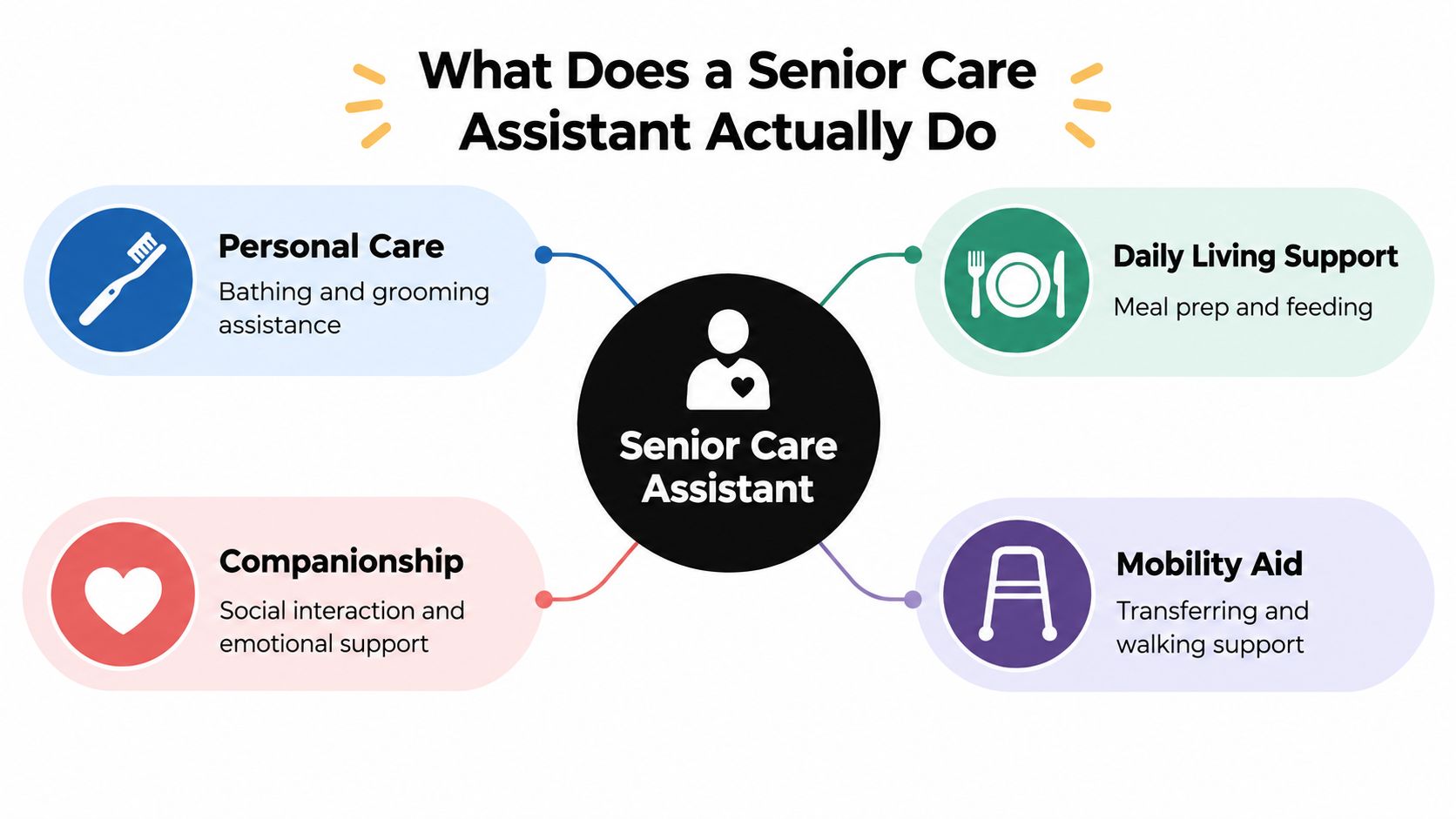
The senior element changes the level of accountability. You might allocate tasks, check that personal care has been completed respectfully, support a colleague with moving and handling, report an incident, or contact a manager when a person's condition changes. Medication support must follow the employer's policy and your assessed competence. You shouldn't improvise because a colleague is busy.
| Setting | Typical senior responsibilities |
|---|---|
| Residential home | Coordinate a shift, support care planning, check records and escalate risks |
| Domiciliary care | Follow individual care plans across visits, communicate changes and maintain accurate notes |
| Community support | Encourage independence, support routines and manage boundaries around safety |
Frontline care and support work forms the dominant employment pathway in England's adult social care sector. In 2023/24, care worker and support worker posts represented about 75% of filled roles, with 1.705 million filled posts and approximately 131,000 vacancies. The vacancy rate was 8.3%, roughly three times the wider UK economy's rate, showing sustained demand for people who can deliver personal care, practical support and supervision under procedures. These figures cover England, not the whole UK. Skills for Care workforce data
For families comparing support options, a resource such as finding assisted care for seniors can help explain the broader care environment. Applicants should also understand how the frontline role differs from related duties in this care worker job role guide.
Qualifications and Training Requirements
A qualification can open the door, but a certificate on its own doesn't prove that you can perform a task safely. Employers usually want a record that connects learning, observation and current competence. That means checking what the course covered, when it was completed, whether a refresher is due and whether a supervisor has observed practice in the workplace.
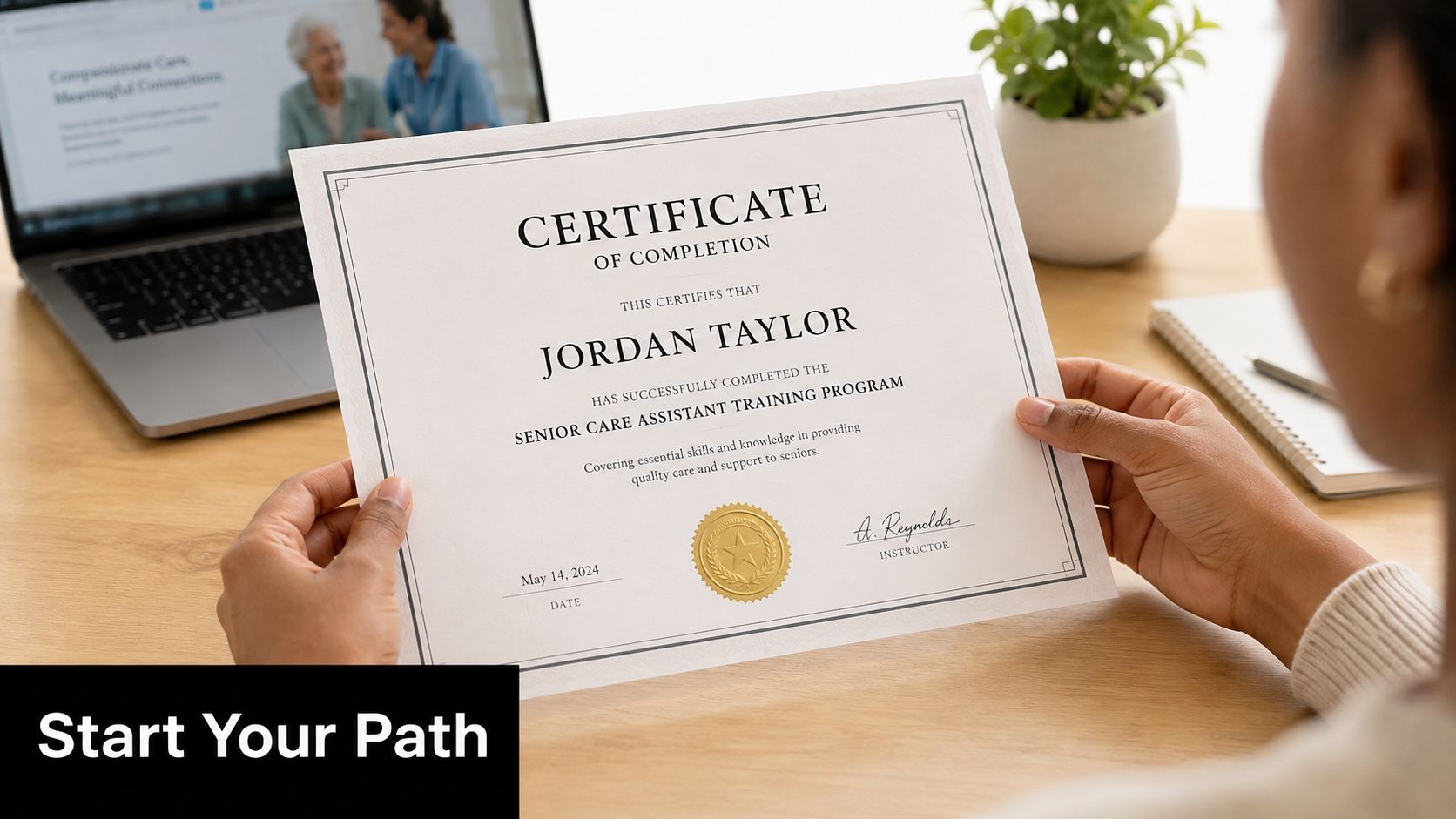
The Care Certificate provides a practical starting framework for people entering adult social care. Build your learning around person-centred care, communication, safeguarding adults, privacy and dignity, health and safety, infection prevention and control, basic life support, mental capacity and duty of care. Add role-specific learning for dementia, medication support and moving and handling where the employer requires it.
An Enhanced DBS check is part of safer recruitment for roles involving regular contact with vulnerable adults. It isn't a qualification and it doesn't replace references, identity checks or employer assessments. Treat it as one part of your onboarding evidence, not as proof that you're ready to supervise others.
The workforce data makes the distinction between qualification and competence particularly important. In England's 2024/25 adult social care workforce, only 45% of staff, excluding regulated professionals, held a relevant social-care qualification, while 55% had no relevant qualification recorded. Skills for Care's 2025 workforce report This doesn't mean unqualified staff can't provide good care. It does mean employers need auditable evidence rather than assumptions based on job title or length of service.
Practical rule: Keep certificates, induction records, observed competencies, refresher dates and restrictions in one organised profile.
Use the video below as supplementary learning, then confirm the employer's own requirements before undertaking delegated duties.
A structured health and social care Level 3 pathway may suit applicants who want a broader progression route, while focused mandatory courses can be more useful when an employer needs you ready for specific shifts.
How to Become a Senior Care Assistant
Start by choosing the setting you want to enter. Residential care may give you consistent contact with a team and repeated exposure to shift coordination. Domiciliary care builds independence and communication because you work across visits and must follow each person's plan accurately. Agency work can offer flexibility, but agencies often need compliance documents before they can book you.
Use this sequence:
- Prepare your identity and employment documents. Gather proof of identity, address history, references and any previous care experience. Missing paperwork can delay an otherwise suitable application.
- Complete foundational learning. Begin with Care Certificate-aligned subjects, safeguarding, infection control, health and safety, moving and handling, basic life support and dementia awareness. Don't claim competence in a practical task merely because you completed an online module.
- Apply for the appropriate DBS check. The employer or approved organisation normally manages the application. Keep the outcome and any Update Service information available, but expect the new employer to confirm whether it can rely on an existing check.
- Create a training matrix. List each course, completion date, renewal expectation, certificate location and practical assessment status. Add clear boundaries for medication, hoisting, clinical support and supervision.
- Prepare for assessment. Employers may ask you to explain how you'd respond to a fall, a safeguarding concern, a medication error or a change in presentation. Give answers that follow policy, preserve dignity and escalate appropriately.
The labour market remains active, although staffing pressure has eased. England's overall adult social care vacancy rate fell from 10.5% in 2021/22 to 7.0% in 2024/25, while turnover fell from 25.8% to 24.7%. Skills for Care's executive summary Training improves readiness, but it won't compensate for weak references, poor attendance or an inability to explain safe escalation. This career guide for people entering health and social care without experience is useful for building the first part of that pathway.
Career Progression and Pay Expectations
The senior care assistant role can lead in several directions, and the best route depends on what you enjoy. A shift leader or team leader focuses on coordination, records, handovers and staff support. A specialist route may involve dementia care, learning disabilities, mental health or delegated healthcare tasks. A management route adds supervision, audits, recruitment, complaints and regulatory accountability.
The settings also create different trade-offs:
| Route | What suits it | What to check before accepting |
|---|---|---|
| Residential care | People who prefer a stable team and ongoing relationships | Shift pattern, staffing model and senior responsibilities |
| Domiciliary care | Workers who value independence and varied visits | Travel expectations, paid travel time and lone-worker support |
| Agency or bank work | People seeking flexibility across services | Compliance requirements, induction quality and employer-specific checks |
| Team leadership | Experienced workers who enjoy coaching and coordination | Decision-making authority, supervision and pay band |
Pay progression isn't automatic. Experienced staff can carry responsibility for handovers, mentoring, safeguarding concerns and delegated tasks without receiving a clear increase in recognition. Independent analysis of the workforce evidence found that care workers with five or more years' experience earned only 7 pence per hour more than new starters. The figure appears in the Skills for Care executive summary linked above.
Ask an employer how it separates basic care delivery from senior duties. A credible role band should identify required training, observed competencies, supervision frequency and the pay or progression criteria attached to each level. Without that structure, you may accept a senior title that adds pressure without providing authority or development.
A senior title should describe verified responsibility, not simply the person who has been on the team longest.
Before accepting an offer, ask who signs off competencies, which duties you can delegate, how incidents are reviewed and what progression looks like in practice. Those answers tell you more than a broad promise of “career development”.
Tips for Applicants and Employers
Applicants should make the employer's decision easier. Send a concise training summary with course names, completion dates, certificates and any practical observations. Bring examples of respectful communication, accurate recording and escalation to the interview, rather than relying on statements such as “I'm a people person”.
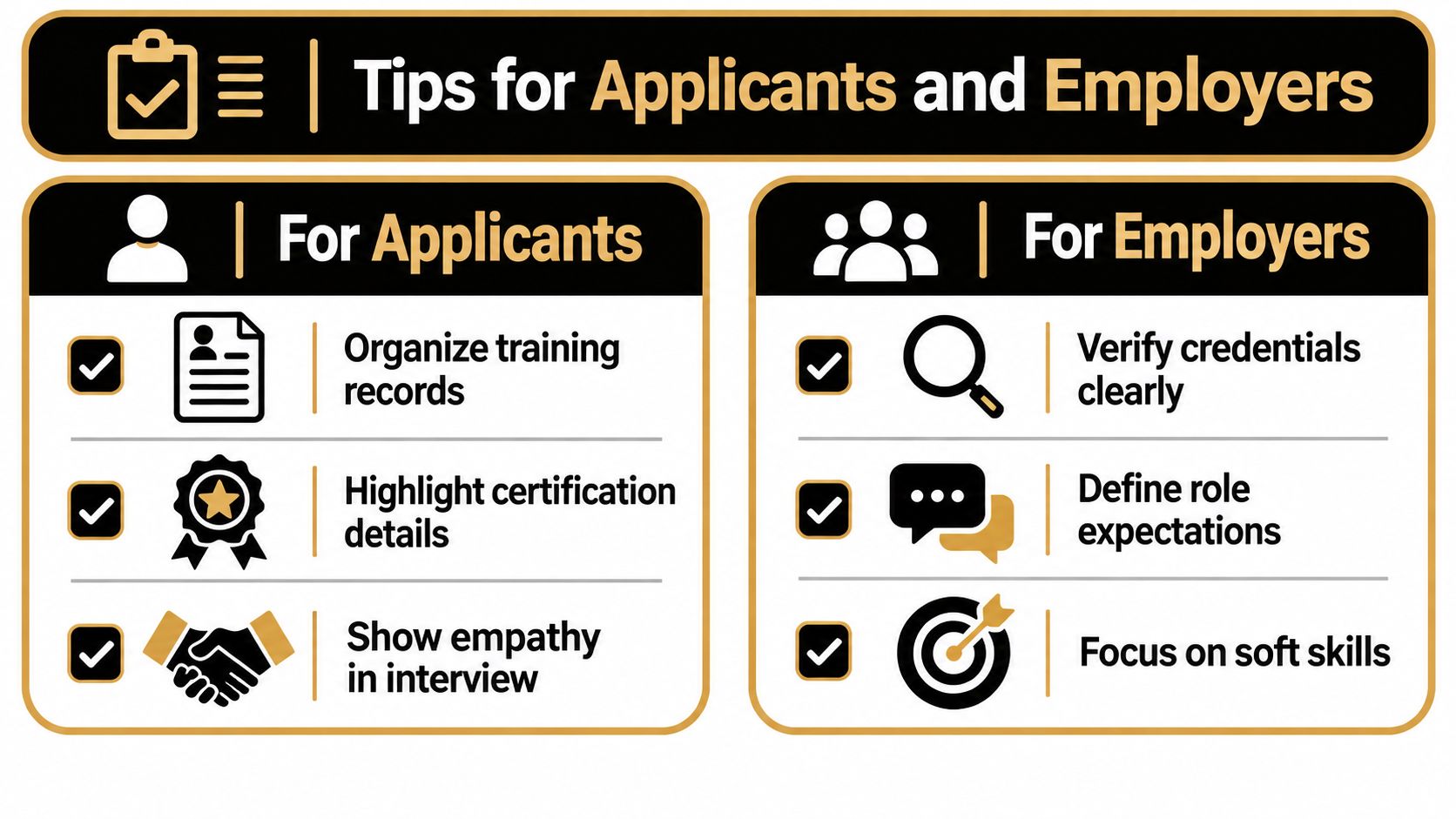
Employers should test the duties they expect a senior care assistant to perform. A certificate may confirm attendance or completion, but an observed assessment confirms whether the worker can apply learning with a real person, under the service's procedures.
For applicants
- Organise records: Keep certificates, DBS information, references and competency sign-offs together.
- Explain boundaries: Say what you can do independently, what needs authorisation and when you'd escalate.
- Prepare examples: Use situations involving dignity, safeguarding, teamwork, documentation or changing needs.
- Ask direct questions: Clarify induction, supervision, delegated duties, pay bands and refresher expectations.
For employers
- Verify evidence: Check dates, course content and practical assessment status before allocating duties.
- Define the role: Separate care delivery, shift coordination, mentoring and clinical support.
- Observe practice: Use workplace competency checks instead of treating e-learning as full authorisation.
- Support retention: Link extra responsibility to recognition, supervision and transparent progression.
A portable training record can reduce repeated administration when someone moves between residential, domiciliary and agency work. It can't replace employer-specific checks, because each service has its own equipment, care plans, medication procedures and escalation routes. Applicants who want interview preparation can also review this practical guide to ace your care home interview.
Common Myths About Care Assistant Roles
Myth one, you need healthcare experience before anyone will consider you. Many people enter through transferable experience, a clear understanding of boundaries and structured training. Retail, hospitality, community volunteering and family caring may demonstrate patience, reliability and communication, but you still need to learn professional safeguarding, recording and escalation.
Myth two, care work is only physical. Personal care and mobility support matter, yet senior staff also interpret information, notice changes, coordinate colleagues, protect confidentiality and make timely reports. A worker who completes a task quickly but misses a change in someone's presentation can create more risk than one who takes time to observe and communicate properly.
Myth three, finishing a course makes you competent for every task. It doesn't. Employers must match delegated duties to training, observed practice and current authorisation. Medication support, moving and handling and other higher-risk activities require service-specific instruction and assessment.
Myth four, experience automatically produces meaningful progression. Experience helps, but it needs to be visible in competency records and linked to a role with defined authority. The workforce evidence discussed earlier shows why providers should connect development to pay and progression instead of relying on goodwill.
Myth five, an overseas applicant can secure sponsorship by obtaining a care certificate. That route is not straightforward. International recruitment into England's adult social care sector fell from 105,000 recruits in 2023/24 to approximately 50,000 in 2024/25, according to the UK government sponsorship guidance. Since 22 July 2025, new sponsorship for care workers and senior care workers under occupation codes 6135 and 6136 generally requires the applicant to already be in the UK, normally with at least three months of lawful work for the sponsoring employer in one of those occupations. A training certificate alone doesn't create visa eligibility.
Cura Academy brings Care Certificate standards, mandatory refreshers and role-specific learning such as Basic Life Support and Dementia Awareness into one training and membership platform for people preparing for senior care assistant work. Visit Cura Academy to organise your compliance evidence and build a clearer, safer route into care employment.