

You've been offered your first care role, your start date is close, and your new manager asks for safeguarding evidence. You search your inbox and find a certificate from an online session, but you're still unsure whether it covers Safeguarding Level 1, adult safeguarding, children's safeguarding, or only a general introduction.
That uncertainty is common because “Level 1” can describe slightly different training routes across UK workplaces. The practical question isn't merely whether you've completed a course. It's whether the course matches your role, your employer's framework, and the level of responsibility you'll have on shift.
Table of Contents
- Starting Your First Shift Without the Right Safeguarding Training
- What Safeguarding Level 1 Training Actually Covers
- Core Topics Every Learner Needs to Understand
- Duration, Assessment, and How Often You Refresh
- How Level 1 Maps to the Care Certificate and Employer Compliance
- Progressing From Level 1 to Level 2 and Level 3
- Practical Tips for Completing Level 1 and Speeding Up Onboarding
- Common Questions New Care Workers Ask About Level 1
Starting Your First Shift Without the Right Safeguarding Training
Priya had been waiting for this opportunity. After applying to several residential homes, she'd finally been offered a role as a care assistant, with a Monday morning start. She'd already completed a free safeguarding webinar the previous month, so she assumed that part of her onboarding was finished.
At reception, the administrator asked for her safeguarding certificate.
Priya opened her phone and found the attendance email. It showed that she'd watched a webinar, but it didn't identify the learning outcomes, the UK Core Skills Training Framework, or whether the content covered adults at risk. She began wondering whether it was awareness training, a children-only course, or an informal introduction.
She called her manager. The manager was helpful, but needed to check with HR before allowing Priya to work independently. Priya spent the afternoon shadowing another carer while the home confirmed what evidence it could accept. She was present, willing, and ready to learn, but she wasn't yet able to demonstrate the required baseline training.
Practical rule: A certificate is useful only when it clearly shows what you studied, who provided it, and how it relates to your employer's requirements.
This is the gap safeguarding level 1 training is designed to close. It gives people who work in or around care settings a shared starting point, so a new receptionist, domestic worker, volunteer, or care assistant understands the first response to a concern.
Level 1 won't turn Priya into a safeguarding investigator. It should, however, help her recognise possible abuse, respond safely if someone discloses a concern, make an accurate record, and report the matter through the correct route. It also gives her employer a clearer basis for onboarding and supervision.
Before booking a course, check four things:
- The audience: Does it cover adults at risk, children, or both?
- The framework: Is it mapped to the standard your employer uses?
- The evidence: Will you receive a named certificate showing completion?
- The progression: Does your role require Level 2 or additional training as well?
Those checks can prevent the awkward delay Priya experienced and help you move from accepted applicant to shift-ready worker with fewer surprises.
What Safeguarding Level 1 Training Actually Covers
Safeguarding Level 1 is baseline awareness training. In plain English, it teaches people how to notice a possible concern, respond without making the situation worse, record what happened, and tell the right person.
In England, it sits within the wider expectations of the UK Core Skills Training Framework. NHS Learning Hub materials describe Level 1 as meeting the Level 1 learning outcomes for adult safeguarding, while the NHS framework treats adult safeguarding at this level as statutory and mandatory training. You can review the relevant NHS Learning Hub adult safeguarding training information before enrolling.
The course is best understood as a fire drill. Nobody expects the alarm to sound during every shift, but everyone needs to know the route out before an emergency occurs. Safeguarding works in a similar way. You need a calm, familiar response before a resident tells you something worrying, a relative behaves inappropriately, or you notice an unexplained change in someone's presentation.
Awareness rather than investigation
Level 1 normally gives you the foundation to:
- recognise common forms of abuse and neglect
- notice signs that may indicate harm
- listen appropriately when someone raises a concern
- avoid promising secrecy or attempting your own investigation
- follow your workplace reporting procedure
- write a factual record
- understand when to seek immediate help
It doesn't usually prepare you to manage a complex safeguarding enquiry, make professional judgements about capacity, or lead multi-agency work. Those responsibilities require a higher level and role-specific guidance.
Who needs the baseline
The audience is wider than frontline carers. Staff in a care home may include cleaners, kitchen workers, maintenance staff, receptionists, activities workers, volunteers, and administrators. Any of them may notice a concern or receive a disclosure.
The same principle applies in domiciliary care, supported living, general practice, and NHS-linked roles. The Royal College of General Practitioners safeguarding standards state that new practice staff should receive a safeguarding induction and complete relevant Level 1 learning during induction, followed by Level 1 updates annually.
The essential habit is simple: notice, respond, record, report. The next step is understanding what sits inside that framework.
Core Topics Every Learner Needs to Understand
A useful Level 1 course should feel like a practical checklist, not a legal textbook. You're learning enough to act safely on shift, then pass the concern to the person with the authority and expertise to take it further.
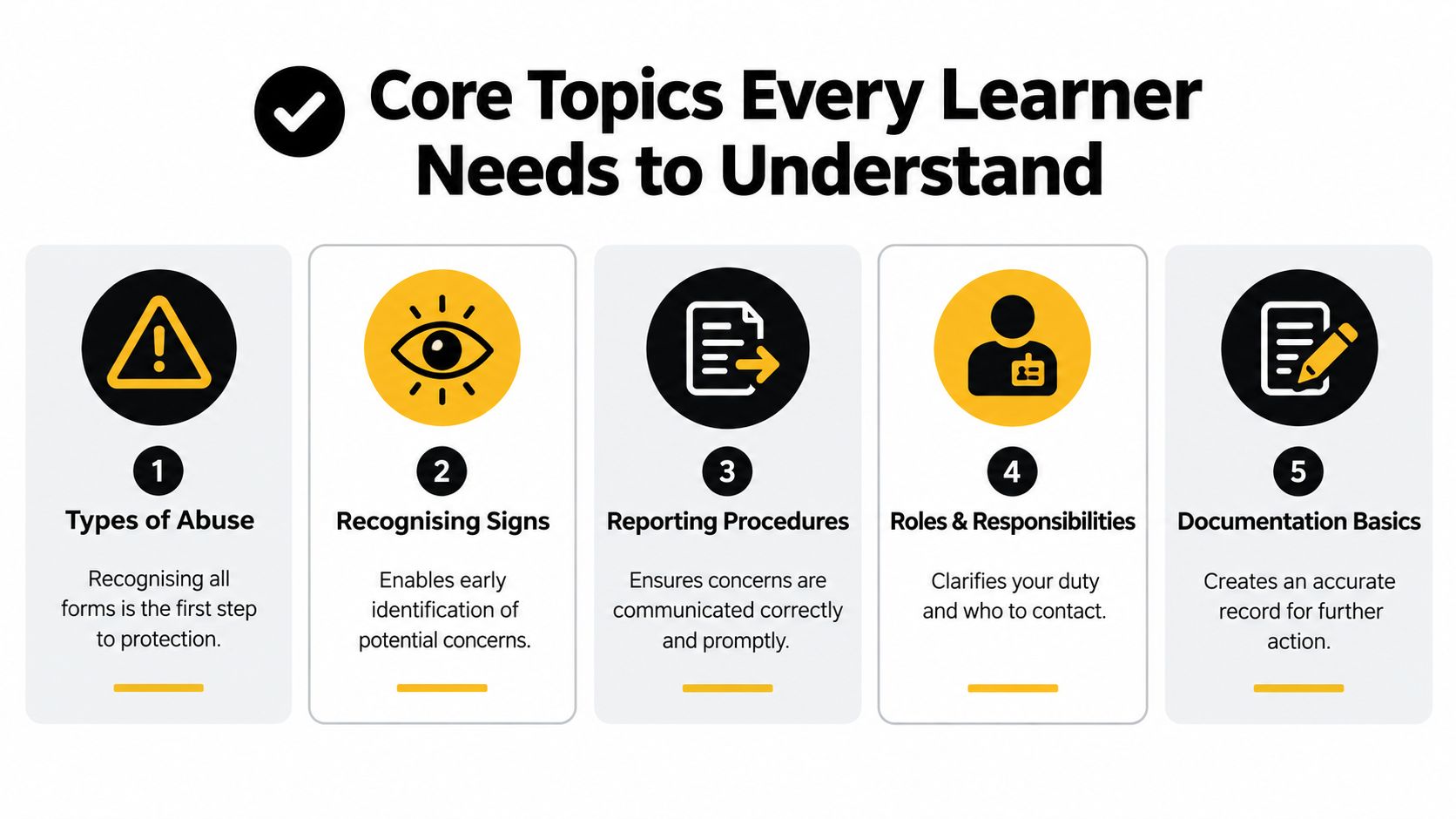
1. Types of abuse
You can't report a concern clearly if you don't have language for what you're seeing. Courses commonly introduce physical, emotional, sexual, financial, institutional, discriminatory abuse, and neglect.
A resident being left without appropriate support may raise a neglect concern. A person repeatedly being mocked because of a protected characteristic may indicate discriminatory abuse. Unusual withdrawals from someone's bank account may point towards financial abuse. The course won't ask you to prove the category, but it should help you describe the concern accurately.
For adult safeguarding, the Care Act 2014 provides the modern framework in England. The adult safeguarding training overview from Florence Academy explains how Level 1 functions as an entry point for awareness across health and social care.
2. Recognising signs
Abuse doesn't always arrive as an obvious incident. You might notice a sudden change in behaviour, repeated unexplained bruising, withdrawal from usual activities, fear around a particular person, or unexplained weight loss.
One sign doesn't prove abuse. Level 1 encourages professional curiosity, which means taking a change seriously, checking the facts you're allowed to check, and reporting rather than dismissing it.
3. Reporting procedures
You need to know your immediate internal route. That may be your line manager, senior on duty, safeguarding lead, or whistleblowing channel. Depending on the circumstances, concerns may also involve the local authority safeguarding team or a regulator such as the CQC.
Your employer's policy should tell you who to contact outside normal hours and what to do if the person you'd usually report to is involved in the concern. Don't rely on memory alone. Keep the local procedure accessible.
4. Prevent and radicalisation
Many UK health and care packages include Prevent awareness, covering the safeguarding response to concerns about radicalisation. The important Level 1 lesson is not to investigate someone's beliefs yourself. It's to recognise a potential vulnerability, follow the organisational route, and seek advice.
5. Roles and documentation
Your role has boundaries. You're expected to pass on concerns, not conduct interviews or decide whether abuse has occurred.
Records should be dated, factual, signed, and clear. Write what you saw, heard, or were told, using the person's own words where relevant. Avoid speculation, labels, and conclusions. Good documentation gives the next professional a reliable starting point.
For a plain-language explanation of safeguarding principles in care, see Cura Academy's guide to the principles of safeguarding.
Duration, Assessment, and How Often You Refresh
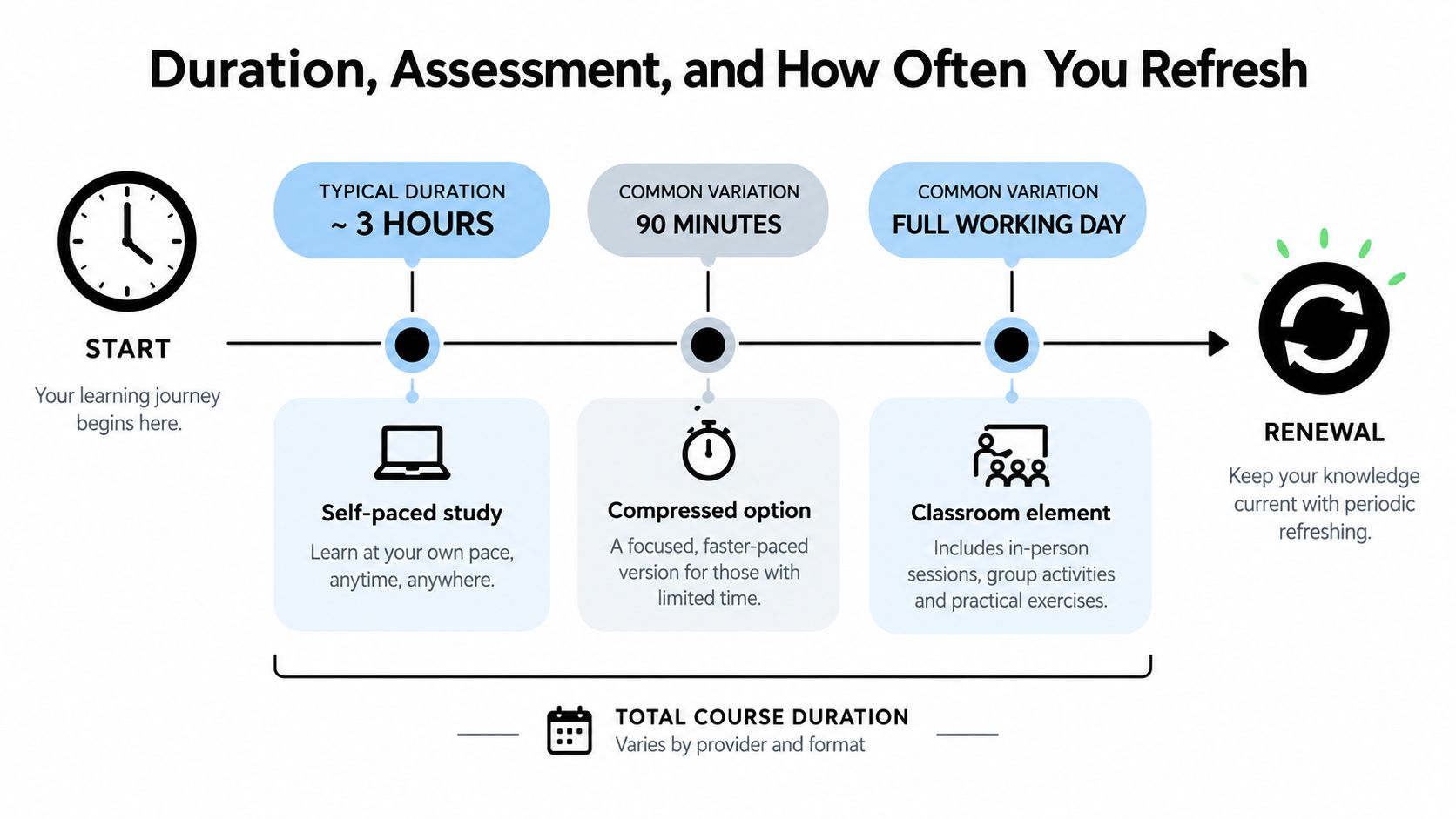
A Level 1 course is designed for induction, so it should be manageable alongside the practical demands of starting work. The East Riding Safeguarding Adults Board describes a Level 1 online module as requiring around 3 hours and no prior learning, which illustrates the awareness-tier structure of this training. Its Level 1 safeguarding adults module information also shows that learners can begin without specialist knowledge.
What the study usually involves
You'll normally work through short theory modules, examples, and knowledge checks. Online learning lets you pause and return to a topic, while classroom courses may allow more discussion about local procedures and difficult scenarios.
Most providers finish with a multiple-choice assessment. The exact question count and pass arrangements vary, so check the provider's course description rather than assuming every certificate follows the same format.
The assessment should test practical judgement, such as what to do after a disclosure or which information belongs in a record. It shouldn't encourage you to investigate or confront the person you suspect.
Refreshing your knowledge
A certificate records that you completed training. It doesn't mean your safeguarding knowledge stays current forever.
The East Riding pathway states that Level 1 modules should have been completed within the previous 3 years, giving a concrete example of a recurring refresh cycle. The RCGP takes a more frequent approach for general practice, with annual Level 1 safeguarding updates expected for new and existing practice staff.
That difference matters. There isn't one universal timetable for every UK setting. Follow your employer's policy, local safeguarding arrangements, and the framework attached to your role.
Save the certificate somewhere you can retrieve it quickly. You may need it for HR checks, supervision, appraisal records, or a compliance audit.
How Level 1 Maps to the Care Certificate and Employer Compliance
For many new care workers, Level 1 is the compliance floor. It doesn't complete every part of your induction, but it gives your employer evidence that you've covered the starting knowledge needed before you work with people who may be at risk.
The Care Certificate provides a structured induction framework for health and social care workers. Its safeguarding content sits mainly within Standard 10 for safeguarding adults, with related responsibilities depending on the setting and role. The Care Certificate guide from Cura Academy explains how safeguarding training fits into a broader onboarding route.
The relationship between frameworks
A standalone Level 1 certificate may contribute evidence towards an employer's induction record, but it doesn't automatically replace workplace assessment. Your manager may still need to observe how you follow the reporting procedure, protect confidentiality, and record information.
CQC-regulated providers also need to show that staff are trained and competent to protect people from abuse. That expectation affects residential homes, domiciliary care agencies, and supported living services, even when staff don't have clinical roles.
| Framework or setting | Relevant expectation | How Level 1 contributes |
|---|---|---|
| UK Core Skills Training Framework | Adult safeguarding at Level 1 is treated as statutory and mandatory training in England | Provides baseline awareness for relevant health and care workers |
| Care homes | Staff need safeguarding knowledge as part of safe induction | Supports evidence for initial learning and workplace sign-off |
| Domiciliary care | Workers may encounter adults at risk alone in people's homes | Establishes the first response, reporting, and recording basics |
| Supported living | Staff need to recognise concerns while respecting people's rights and independence | Helps standardise awareness across different support roles |
| General practice | New staff complete safeguarding induction and relevant Level 1 learning | Contributes to induction evidence and ongoing update planning |
| NHS-linked services | Training aligns with the UK Core Skills Training Framework | Creates a common baseline across clinical and non-clinical roles |
The key distinction is between completion and competence. A certificate can show that you completed learning, but your employer still needs to confirm that you understand the local policy and can use it responsibly.
For a new starter, the practical message is reassuring. Level 1 is usually the gateway into the workforce, not the whole professional journey. Once your employer confirms the course is suitable, it can remove one of the main barriers between accepting a role and completing your first supervised shift.
Progressing From Level 1 to Level 2 and Level 3
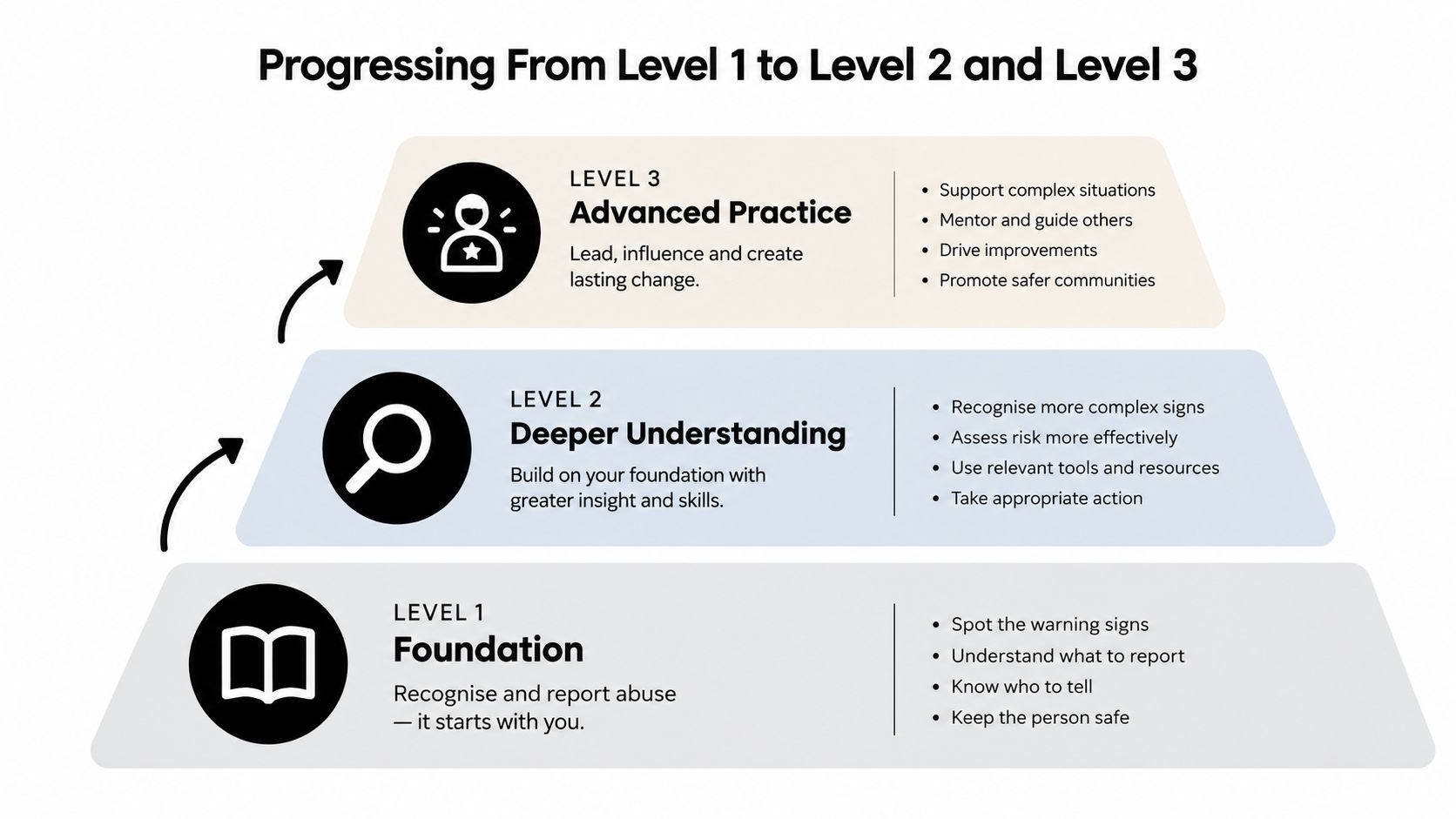
Level 1 is the foundation, not the destination. As your contact with people at risk becomes more direct or your responsibilities increase, your training needs to deepen.
Level 2 adds role and legal depth
Level 2 builds on recognising and reporting abuse, then adds more detail about the responsibilities attached to particular roles. Learners may study the Care Act 2014, the Mental Capacity Act, information sharing, escalation, and referral expectations.
This level is more relevant when you have regular direct contact, work with greater independence, or become a senior carer, team leader, or safeguarding champion. The exact threshold depends on your employer and setting. Ask before enrolling if your role has changed.
Level 3 supports leadership
Level 3 is aimed at people who manage safeguarding practice rather than merely report concerns. Managers, trainers, safeguarding leads, and people responsible for coordinating responses may need knowledge of investigations, inter-agency working, escalation, and referrals under the Care Act framework.
You shouldn't choose Level 3 just because a higher number sounds more impressive. The right course is the one that matches the decisions you're expected to make.
A sensible progression looks like this:
- Level 1: Learn to recognise, respond, record, and report.
- Level 2: Apply safeguarding knowledge within a role involving greater contact or responsibility.
- Level 3: Coordinate practice, support colleagues, and manage more complex safeguarding duties.
Cura Academy's safeguarding Level 2 course information can help learners compare the next step with their current duties. Its subscription model presents role-related training pathways after enrolment, so learners can move from foundation learning towards higher-level content without repeatedly rebuilding their learner profile.
Plan progression around a new role, supervision discussion, or appraisal objective. Learning is more useful when you're ready to apply it.
Practical Tips for Completing Level 1 and Speeding Up Onboarding
Efficient training isn't the same as rushed training. The aim is to protect your attention, understand the reporting process, and leave with evidence your employer can verify.
Prepare before you start
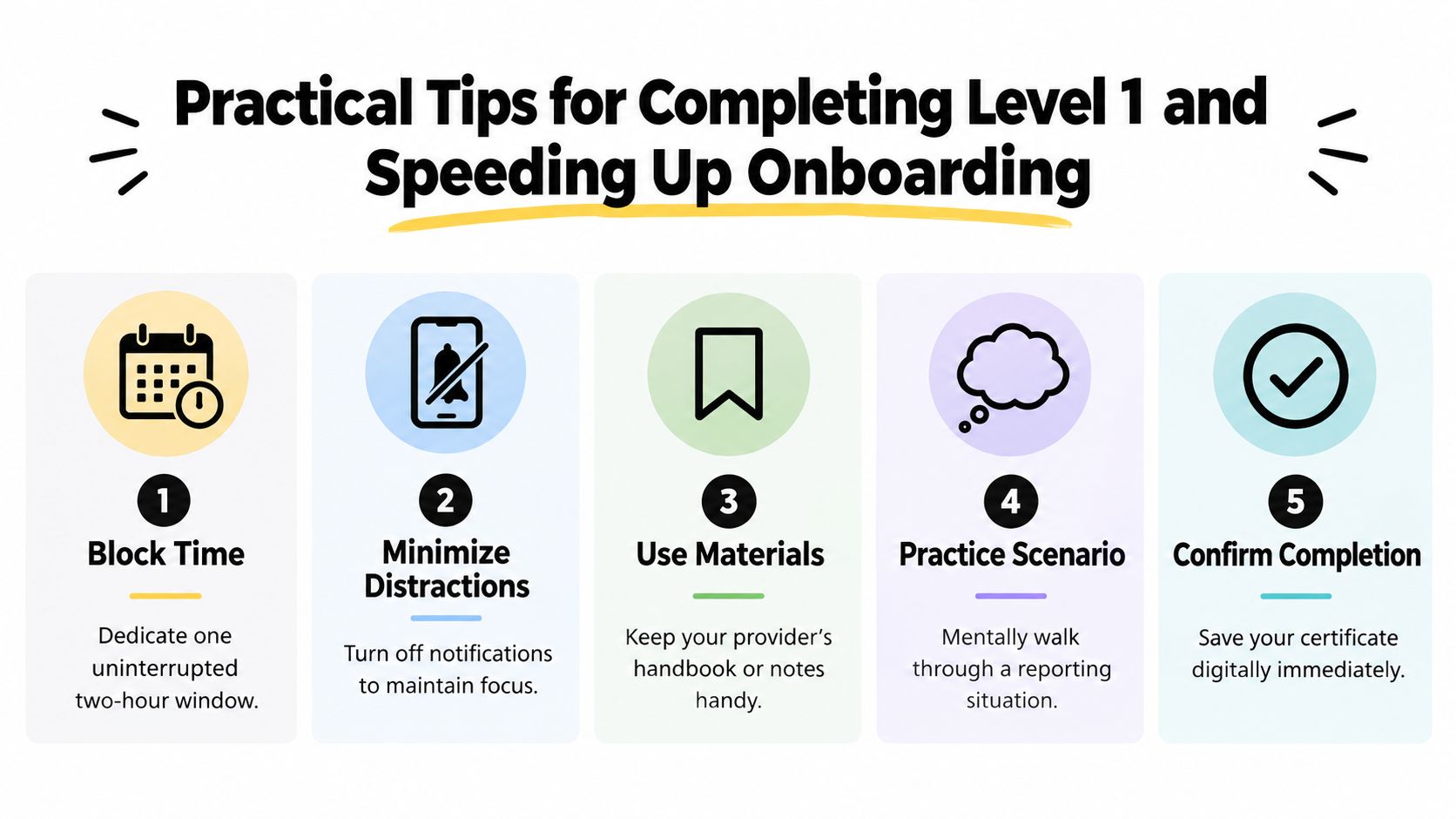
Block out an uninterrupted study period if you can. Put your phone on silent, close unrelated tabs, and keep a notebook beside you. Safeguarding scenarios depend on detail, and constant interruptions make it harder to remember reporting routes and recording standards.
Write down three things as you study:
- Abuse indicators: The changes or patterns that should make you pause.
- Reporting contacts: Your manager, safeguarding lead, out-of-hours route, and whistleblowing option.
- Recording rules: The difference between an observation, a direct quote, and an assumption.
That short reference list becomes useful on your first shifts.
Use the course as a rehearsal
Don't treat quizzes as obstacles between you and the certificate. Use them to test whether you'd know what to do if a resident disclosed abuse, a colleague behaved inappropriately, or you noticed a worrying change.
Ask yourself:
- What would I do first?
- Who would I tell?
- What would I write down?
- What must I avoid doing?
Pairing safeguarding with other induction subjects, such as health and safety, infection prevention, or mental capacity, can also reduce the stop-start feeling of onboarding. You'll still need to understand each subject separately, but planning related learning together can make the overall process easier to manage.
Secure the evidence immediately
Download your certificate as a PDF and keep a screenshot on your phone or in your secure files. Send it to HR only through the method your employer approves, and check that your name and completion details are correct.
Cura Academy offers a £10-per-month subscription with access to essential care training, Care Certificate standards, mandatory refreshers, and role-specific courses. For learners who want one place to organise onboarding evidence and continue into further care learning, that model can connect Level 1 with the wider journey from enrolment to employer checks.
Common Questions New Care Workers Ask About Level 1
Does the certificate expire?
The certificate records your completion date, but employers usually treat safeguarding knowledge as current only within the refresh cycle that applies to your setting. The UK framework includes a 3-year example for recurring Level 1 learning, while general practice expects annual updates. Your employer's policy decides what evidence it will accept.
Is online learning accepted?
Online Level 1 learning is widely used, including in NHS-linked and social care settings, when it matches the required outcomes. Some employers may require a particular platform, local module, or classroom discussion, so check before booking. A course title alone doesn't prove that it meets your workplace's requirements.
Is Level 1 enough to start work?
It may be the minimum starting point for non-clinical roles and new care workers, but it isn't automatically enough for every position. Senior carers, team leaders, safeguarding champions, and designated safeguarding leads may need Level 2 or Level 3 content. Your contact with people at risk, supervision level, and decision-making responsibility matter more than your job title alone.
Should I complete it before my interview?
If an employer accepts the course you choose, having the certificate ready can show that you understand the basic expectations of care work. It won't replace employer induction or workplace assessment, but it may remove a training task from the early onboarding process.
If you're unsure, ask the employer one direct question: “Which safeguarding course and level do you require for this role, and which framework should it follow?” That answer is more reliable than guessing from a generic course listing.
If you're preparing for a care role, visit Cura Academy to explore safeguarding, Care Certificate, mandatory refresher, and role-specific training in one subscription. Start with the Level 1 foundation your employer needs, save your evidence, and continue along a structured pathway towards being ready for your first shift.